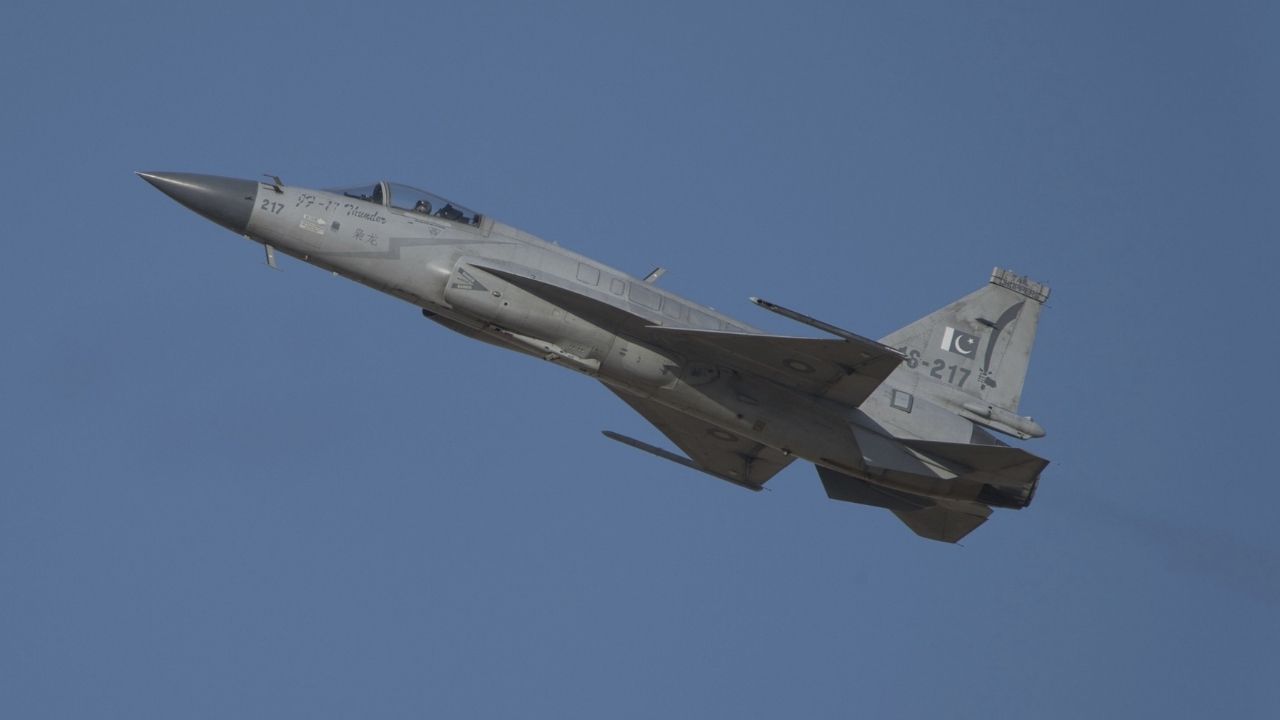
Confirming a flood of reports regarding defence orders that the country has been receiving in recent days, Defence Production Minister Raza Hayat Harraj has said that Pakistan is holding discussions with “multiple countries” for the sale of JF-17 Thunder jets.
Speaking to BBC Urdu, the minister confirmed that negotiations were underway but declined to share specific details.
“These negotiations are taking place and they take some time. Many countries have shown interest in these aircraft,” he said, adding that he could not yet name any country or reveal the level at which the negotiations were taking place.
“When these jets are exported, the world will know which countries have bought them,” he added.
The defence production minister also said that Pakistan would only sell the aircraft to friendly countries. “Firstly, we must ensure that we only sell [JF-17s] to those who are our friendly countries. So, they are not used against us.”
He added that China was involved whenever Pakistan signed such agreements.
According to Harraj, the JF-17 jets were battle-tested during last year’s four-day conflict with India. “The entire world’s air forces saw these jets’ performance during that time and praised it,” he said.
Harraj termed pricing an important factor, saying that while fighter jets globally were valued between $250 million and $350 million, the JF-17 was much cheaper.
When asked about the exact price, he told BBC Urdu, “Its value is around $40–50m… this depends on the jet’s features and the price can also be higher than this”.
When questioned about whether China received a share from the sale, the minister said, “A lot of matters are discussed on the table. China is definitely included in them; it should be and it is their right”.
Responding to a question about Pakistan’s production capacity amid growing interest, Harraj told BBC Urdu that it was a question related to national defence. “These are our secrets, let them remain secrets.”
He said the production of such “state-of-the-art” jets was time-consuming, adding that some components were manufactured in Pakistan while others were produced from China.
Einar Tangen, a senior fellow at China’s Centre for International Governance Innovation (CIGI), told BBC Urdu that the technology used in the JF-17 was likely controlled by China, which means any export deal would be a joint agreement with Beijing as a “senior partner”.
“China might even increase Pakistan’s defence production, but all this will be in Beijing’s control,” he said.