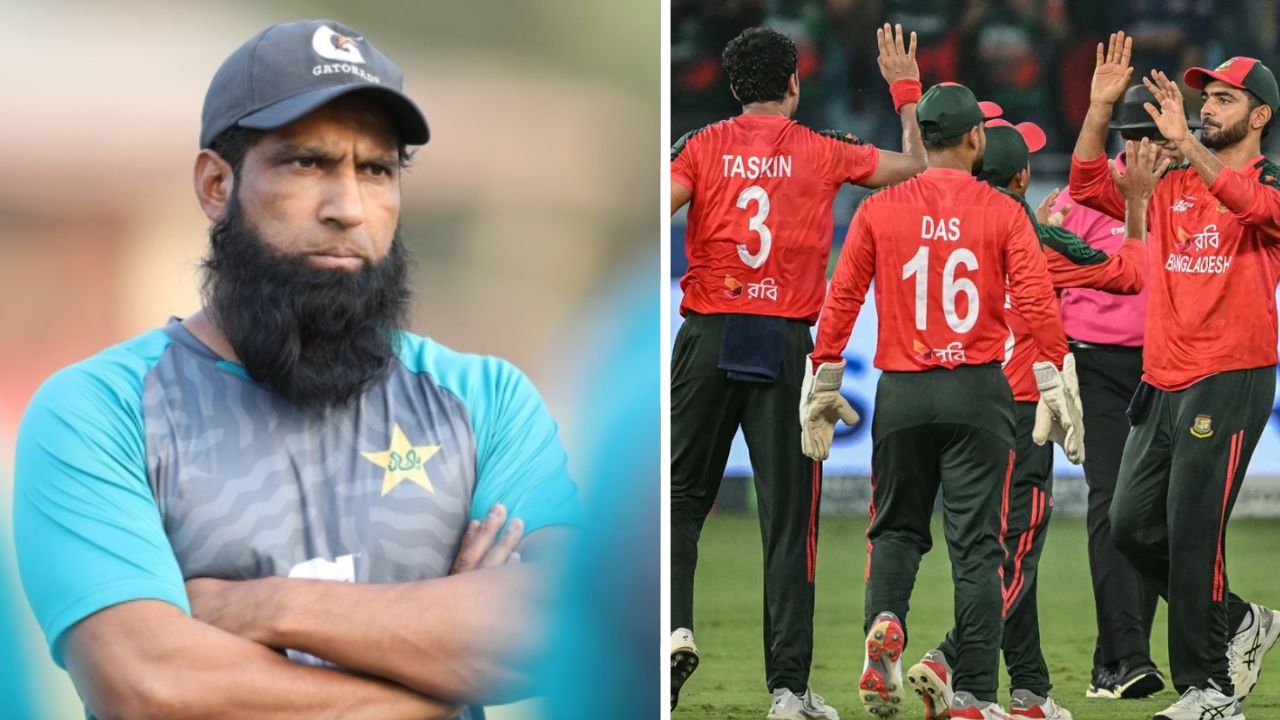
Former Pakistan batting great Mohammad Yousuf has raised serious concerns over global cricket governance, questioning the International Cricket Council’s (ICC) decision-making after Bangladesh was removed from T20 World Cup 2026.
In a strongly worded post on X, Yousuf highlighted Bangladesh’s massive contribution to cricket viewership and warned that sidelining the country over security concerns reflects poor governance and selective decision-making.
“The combined cricket viewership of New Zealand, Australia, Scotland, Nepal, Netherlands, Ireland, Namibia, Zimbabwe, Sri Lanka and Afghanistan is broadly equivalent to the viewership Bangladesh generates on its own,” Yousuf wrote. “Ten nations combined generate around 178 million viewers, while Bangladesh alone accounts for nearly 176 million.”
The combined cricket viewership of
— Mohammad Yousaf (@yousaf1788) January 26, 2026
New Zealand, Australia, Scotland, Nepal, Netherlands, Ireland, Namibia, Zimbabwe, Sri Lanka and Afghanistan
is broadly equivalent to the viewership Bangladesh generates on its own.
10 nations combined:178 million
Bangladesh alone: 176 million
In…
Yousuf argued that a sport driven by global audiences cannot afford to ignore the concerns of a country that holds such a large fan base. “In a sport driven by global audiences, sidelining Bangladesh’s legitimate security concerns raises serious questions about consistency and governance,” he said. “When accommodation becomes selective, fairness disappears. Cricket cannot be administered by influence, only by principle.”
The remarks came after the ICC officially removed Bangladesh from the T20 World Cup 2026 and replaced them with Scotland. The decision followed the Bangladesh Cricket Board’s (BCB) refusal to send its team to India, citing security concerns.
The controversy escalated after a recent Indian Premier League (IPL) incident involving Bangladeshi fast bowler Mustafizur Rahman, who was reportedly dropped from the tournament after receiving threats from Hindu extremist groups.
Bangladesh cited the incident as evidence that if a single player could not be protected, the safety of an entire national team could not be guaranteed during a World Cup.
The ICC rejected the argument, stating that the IPL incident was a domestic matter and had no connection with the security arrangements planned for the World Cup. Despite this clarification, the decision triggered criticism from several quarters, including Pakistan.
Pakistan openly supported Bangladesh’s stance. According to media reports, the Pakistan Cricket Board (PCB) is considering multiple protest options, including a possible boycott of its February 15 match against India in Colombo.
PCB Chairman Mohsin Naqvi briefed the team about the board’s position in Lahore on Sunday.
“Bangladesh Cricket Board’s decision not to play in India during the World Cup is based on principles. PCB rejects ICC’s double standards,” Naqvi said. “We supported Bangladesh keeping in mind cricket’s golden principles. We will follow whatever decision the Pakistani government makes.”
Naqvi later met Prime Minister Shehbaz Sharif on Monday to discuss Pakistan’s future in the tournament. While the meeting ended without a final announcement, reports suggest that Pakistan’s participation remains uncertain.
PCB has criticised ICC’s decision and indicated that a final call will be made by Friday or early next week.
Prime Minister Shehbaz has reportedly entrusted the PCB chairman with making the decision, as Pakistan keeps all options open, including a formal protest or a boycott of matches against India.