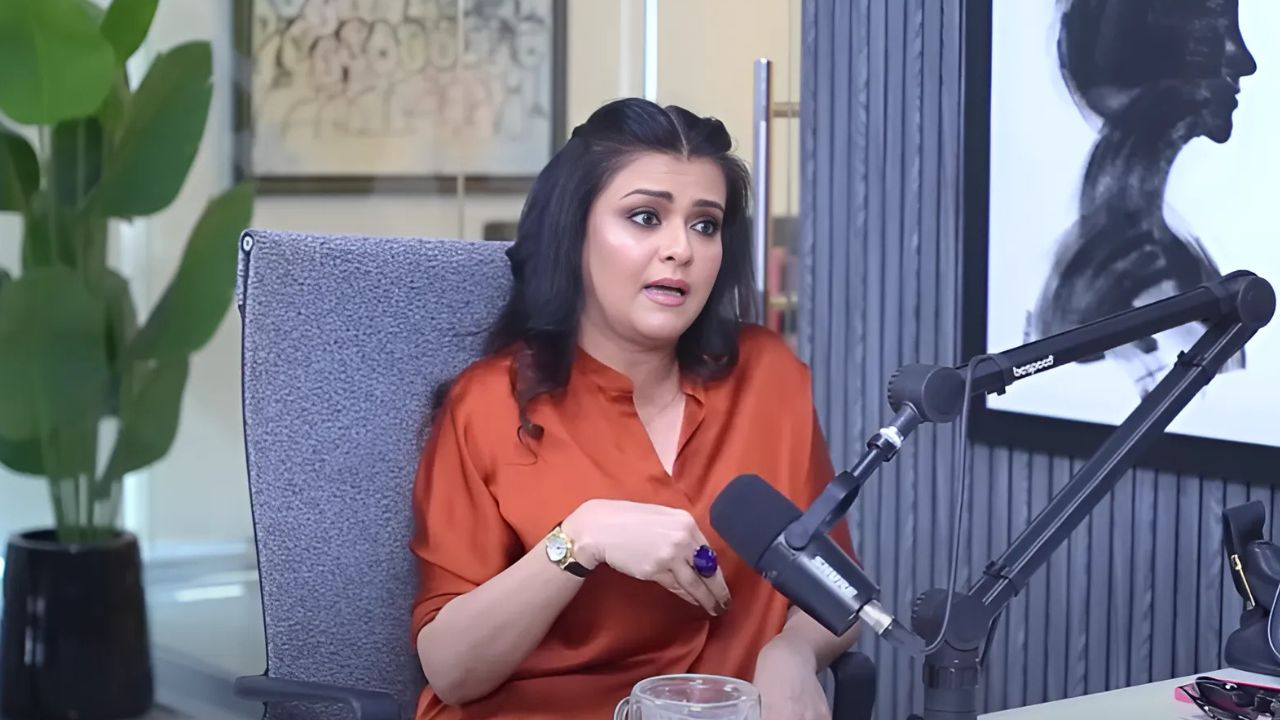
Veteran actress Maria Wasti has never been one to shy away from speaking from speaking her mind.
Appearing as a guest on FHM Podcast with Adnan Faisal, she emphasized that the true meaning of the slogan Mera Jism Meri Marzi is often misunderstood and deliberately made controversial.
Maria Wasti explained that the slogan is often misinterpreted. She pointed out that while women use it to assert their autonomy, the term is intentionally sensationalized to make it controversial.
“The meaning is not what people think it is, it’s about freedom of thoughts and freedom of expression.”
The Mayi Ri actress also touched upon the significant issues of women’s rights in Pakistan, noting that despite making up 55 percent of the population, women are still considered a minority when it comes to receiving their due rights. “Women are not receiving their rights, and that’s why they are raising their voices,” she pointed out.
She highlighted the criticism of the word ‘body’ in the slogan, saying “During the struggle for women’s rights, the focus has shifted entirely to the slogan ‘My Body, My Choice’. Everyone is disturbed by the word ‘body,’ but if the same word were said in English, it would sound better.”
Maira Wasti further explained that there is nothing wrong with the slogan, comparing it to other personal belongings. “Just as everyone owns their home, everyone owns their thoughts and their body.”
She clarified that modernity isn’t about imitating the West but embracing freedom of thought and rights.
“Modernity does not mean Westernization, and enlightenment does not mean wanting to become part of Western society. It’s all about freedom of thought and rights,” Maria said.
The Aik Sitam Aur actress pointed out an important contradiction in society’s perception. “If someone says ‘my kidney is mine,’ or ‘my eyes are mine,’ no one objects, but when it comes to ‘My Body, My Choice,’ people object without any valid reason,” she added.
The Dharkan actress expressed her concerns about the long-standing lobbying and groupism in award shows.
“In our entertainment and fashion industry, everything revolves around award shows, determining who gets work, which production house is involved, and which channel is associated with it.” She acknowledged that the industry is the same everywhere. “When you have to justify a standard, your work is being seen globally. The screen doesn’t forgive; it reveals when someone is brought in based on recommendations,” Maria Wasti concluded.