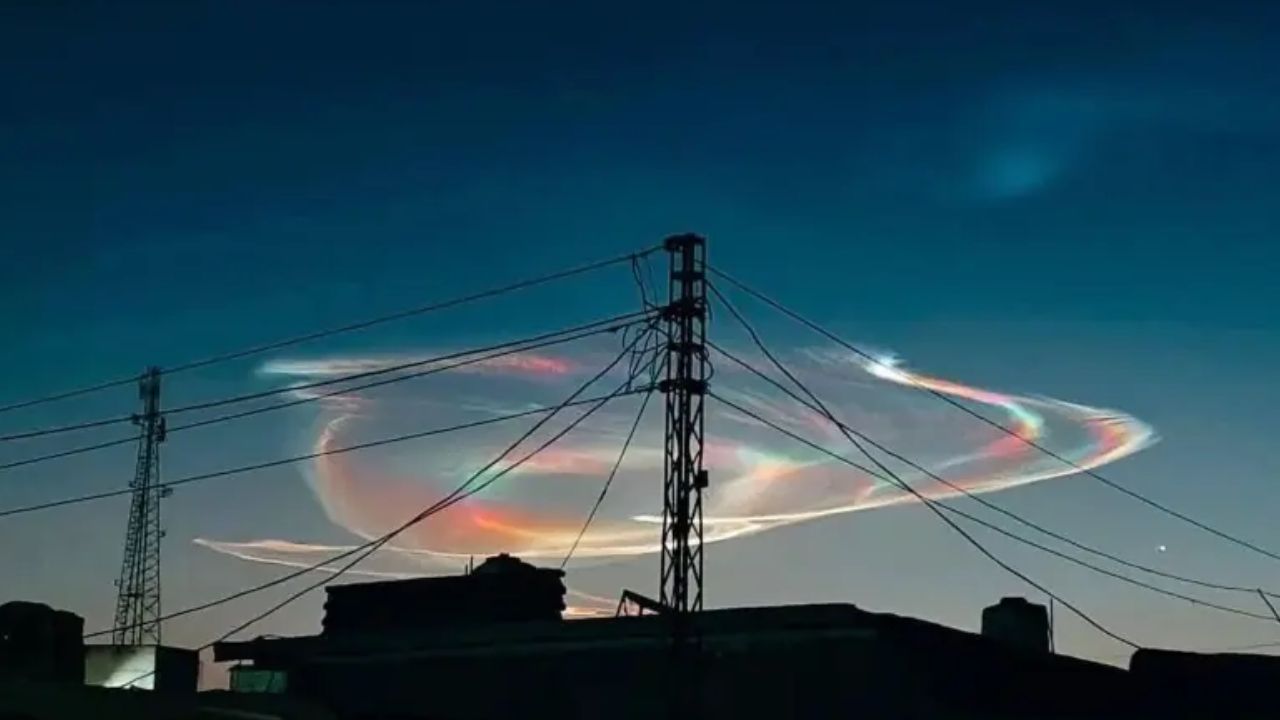
Early on Tuesday, October 28, 2025, Quetta and several other parts of Balochistan witnessed the rare phenomenon of glowing lights above the Koh-e-Murdar mountain range.
The “lenticular cloud formation,” observed around 6:20 a.m., appeared briefly before sunrise and lasted for nearly 20–25 minutes, leaving people across the province puzzled about its origins.
Widespread curiosity was sparked by the spectacle. Social media was swamped with images and videos, and citizens shared their theories as to why the sky glowed.
Some claimed the phenomenon was a UFO sighting, comparing its saucer-like shape to flying spacecraft. Others suggested it might be a secret hypersonic missile test or even an ICBM (intercontinental ballistic missile) experiment.
Later that day, the Pakistan Meteorological Department (PMD) took to social media platform X (formerly Twitter) to clear the confusion. Their official statement identified the sight as a “rare lenticular cloud formation” observed early morning over the Koh-e-Murdar region of Quetta.
PMD spokesperson Anjum Nazir further explained that the spectacle occurred when moist, stable air flowed over the eastern mountain range, forming a stationary, lens-shaped cloud.
He added, “These cloud formations are stationary, lens-shaped structures that typically form on the downwind side of mountains. Their flying-saucer-like shape sometimes leads people to mistake them for UFOs.”
What are Lenticular clouds?
Lenticular clouds, also known as altocumulus lenticularis, are lens-shaped orographic wave clouds created as air travels across hills or mountains at different altitudes in a stable environment, according to the UK Met Office.
When moist air flows over a mountain range, it creates standing waves in the atmosphere. At the crests of these waves, air cools to its dew point, causing moisture to condense into cloud droplets. As the air descends again, it warms and evaporates, giving the cloud its distinct, smooth, layered appearance.
“These strange, unnatural-looking clouds sometimes form downwind of hills or mountains,” the Met Office notes.
“They look a lot like the traditional shape of flying saucers in science fiction, and real lenticular clouds are believed to be one of the most common explanations for UFO sightings across the world.”