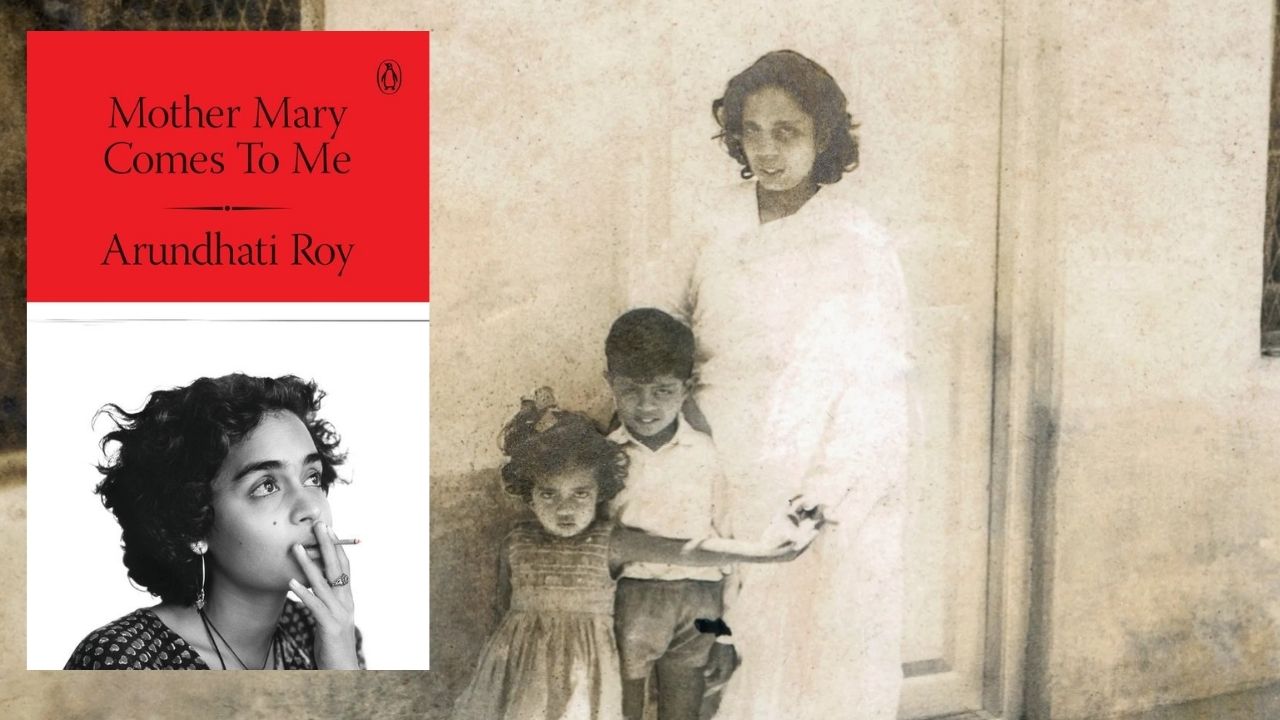
I read Arundhati Roy’s Mother Mary Comes to Me a week ago but I’ve thought about it every single day since. I couldn’t put it down out of love for Roy’s writing and sheer terror because I had to find out how it ends. I know it ends well right? She’s alive, a best-selling author, someone who calls out what’s wrong and goes to prison for what’s right.
Terror because the one question I can’t stop thinking about is if Arundhati would have been the great author she is if her mother had not been cruel Mother Mary.
Roy’s first memoir has been released after her mother passed away. Her mother is larger than life, a giver to the ones not related to her, a taker from everyone who is, a person who made history and a woman who failed at nurturing her children. What Roy goes through before she gets away from her mother is dark. What was good in Mary Roy went to the children of the school she ran, and what was bad was beaten into Arundhati and her brother.
It reads like slow death for children that young and then when you think it can’t get worse, Arundhati sends a spark up into the sky. Her mother taught her to be fearless, to stand up for her beliefs, to read, to write. In the depths of her darkness, Mrs. Roy would send Arundhati a lifeboat when her child most needed it and then drowned her all over again.
‘The book is so Arundhati’, is what I’ve heard people say around me and it’s true. It’s purely and most beautifully the woven skill of the master Indian weaver that is the Booker prize winning author. It is so raw, it hurts and it is so heartwarming, it hugs. She seamlessly takes us through her childhood, growing up Syrian Christian, without a father and troubled relatives, only a brother to hold onto, the rock that remains. As for her mother, you won’t be able to get over the majesty that is Mrs. Mary Roy.
A trailblazer who set up a massive school in a small town in Kerala, went to the Supreme Court to win a case that helped her get her inheritance and did not allow anyone to weigh her down. Arundhati says that her mother loved herself and when you read the book, you feel that it likely happened when Mrs. Roy had to learn to rely on her own.
Arundhati glorifies her mother by showing the worst side of her. For every mother who wants to berate their children and hold back, Mrs. Roy lets it burst through like a tsunami. Mrs. Roy says things you should never let a child know exist, leaving them black and blue, so much so that Arundhati the teenager, realises that the only way to live with her mother is to leave her.
Near the end, Arundhati tells us about how she enters the sphere of awakening the world to issues that are condemned in public – she herself goes through contempt of court to stand up for stories she has written. It, at first, seems like a sharp break from the story she had been telling. We lose Mrs. Roy there for a few chapters, and one wonders why until we come back to her, closer to her mother’s passing. It seems as if Arundhati’s real ownership of her self is when she is fighting for the cause of another – her books weave her mother in and out – but her voice for the other, that voice is purely her own.
You likely won’t read a better book this year and you will stare at Arundhati’s picture long after you’ve finished, finding it difficult to remove it from your bedside table. And the worst part is, if you are a mother, you know that what Mrs. Mary Roy did to her child should never be done to another and you are certain you won’t do it to your own – but then you realise if she had not, there will not be an Arundhati Roy – and that is a heavy cross to bear.