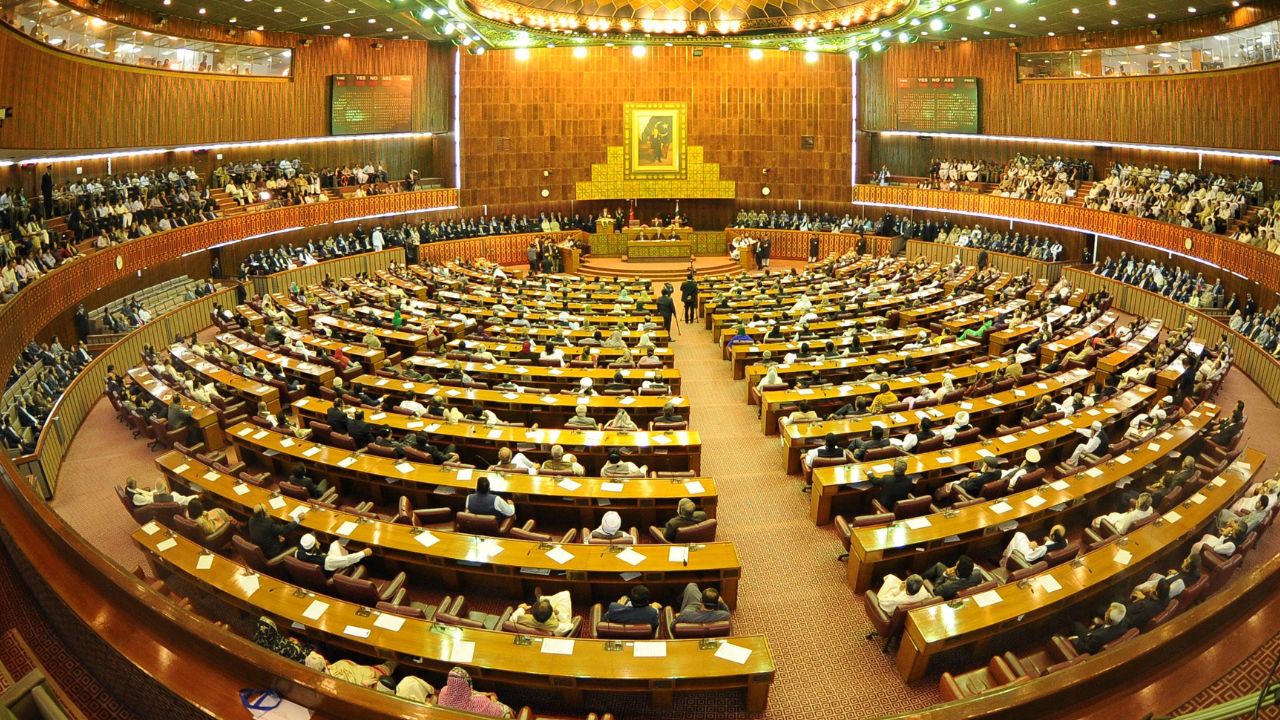
The parliament, in a joint session chaired by National Assembly Speaker Sardar Ayaz Sadiq, on Tuesday passed the National Commission for Minority Rights Bill 2025 with a majority vote.
As per the details, the bill, aimed at establishing a commission to safeguard the rights of minorities, received 160 votes in favor and 79 against.
Law Minister Azam Nazeer Tarar, while presenting the bill, recalled that in 2014 the Supreme Court (SC) had directed the formation of such a commission. He thanked Jamiat Ulema-e-Islam-Fazl (JUI-F) chief Maulana Fazlur Rehman for his party’s proposed amendments, noting that the law clearly defines Ahmadis as non-Muslims.
During the debate, Maulana Fazlur Rehman cautioned against making the Constitution controversial, arguing that the 27th Amendment could prove as divisive as earlier amendments before the landmark 18th Amendment.
He cited historical examples, including that of the late former prime minister (PM) Zulfikar Ali Bhutto’s negotiations in 1973, which led to consensus despite political differences. He criticised the government for not taking opposition parties into confidence on the latest amendment and warned against provisions that, in his view, created class divisions.
The JUI-F leader also expressed concern that none of the recommendations of the Council of Islamic Ideology (CII) had been incorporated into the bill. He objected to clauses redefining underage marriages as sexual assault and provisions related to transgender rights, which the Council had rejected.
“We must ask ourselves whether we are upholding the oath to Pakistan’s Constitution or following the dictates of the United Nations,” he remarked, stressing that his opposition was principled rather than emotional.
Deputy Prime Minister and Foreign Minister Ishaq Dar, addressing the session, emphasised that the bill had already been passed by both houses of parliament before being sent to the president, who raised objections.
He acknowledged amendments proposed by Maulana Fazlur Rehman and Senator Kamran Murtaza, which the government accepted.
“Governments come and go; they are not anyone’s inheritance. Our lives and wealth are devoted to the Holy Prophet. Political disputes should not overshadow matters of national importance,” Dar said, adding that while political prisoners could be debated, sacred issues must remain above politics.