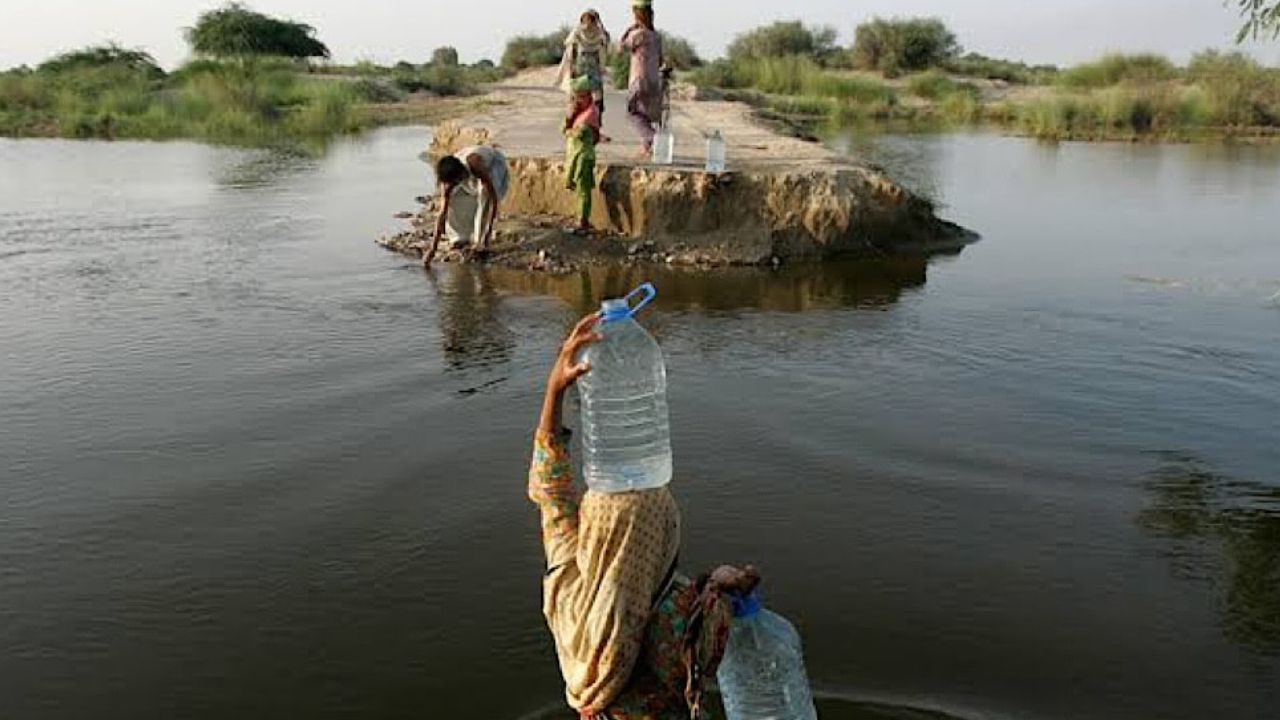
Pakistan’s Indus Basin Water System is under growing pressure as upstream controls, falling groundwater levels, ageing canal networks and widespread contamination continue to strain the country’s already fragile water supply.
More than 80 percent of Pakistan’s population still lacks access to safe drinking water, the Asian Development Bank’s latest Asian Water Development Outlook has reported.
The report classifies Pakistan as a severely water-stressed country, noting that per capita water availability has dropped sharply from 3,500 cubic metres in 1972 to 1,100 cubic metres in 2020, far below the safe benchmark of 1,700 cubic metres.
The ADB attributes the decline to rapid population growth, climate change and long-standing governance issues.
Pakistan remains in the ADB’s “Engaged” category since its total water security score has not changed significantly during the 2016, 2020, and 2025 evaluations.
According to the report, despite the size of Pakistan’s agricultural sector, progress is still slow, primarily because of poor water use, low industrial output, and limited investment in key infrastructure.
The ADB observes that rapid depletion and arsenic contamination have resulted from excessive groundwater extraction for agricultural in many areas.
Waterborne illnesses are still mostly caused by inadequate WASH systems, and open defecation is still prevalent in some rural areas of Pakistan. Service delivery, it adds, is still inconsistent and poorly managed.
There are still significant gaps in the infrastructure. Due to poor planning, scarce funding, changes in land use, and an increasing risk of flash floods, Pakistan’s drainage system continues to have the lowest grade in the region.
The report says water-related disaster security is still a serious concern as unchecked construction along floodplains increases vulnerability, though early warning systems have improved.
There has been very little progress in urban water security. Recurring urban flooding, untreated wastewater, and rising demand all put further strain on already fragile municipal systems.
As untreated wastewater and industrial growth contaminate rivers, lakes, and wetlands, environmental water security has gotten worse.
Despite some recent improvements in hygiene indicators, contamination hazards and inadequate monitoring methods continue to jeopardize rural household water security.
Economic water security continues to struggle as per capita water availability falls, storage capacity remains inadequate and industries rely heavily on unregulated groundwater extraction problem.
The nation’s national water security score climbed by 6.4 points between 2013 and 2025 despite these enduring issues, while indicators connected to governance increased from 50 percent in 2017 to 63 percent in 2023.
Although institutional fragmentation, inadequate coordination, and long-term underinvestment continue to limit implementation, ADB says that this reflects improvements in the policy framework.
There is still not enough money for governance pertaining to water. Despite a 152 percent increase in WASH investments between 2019 and 2023, the Public Sector Development Programme’s total funds came to just Rs1.5 trillion, compared to the Rs10–12 trillion needed over the following ten years.
The ADB has recommended strengthening coordination through the National Water Council, shifting to volumetric pricing to encourage responsible water use, and creating an independent authority to monitor water quality. It also urged increased environmental regulation, protection of ecosystems and the inclusion of women in water-related decision-making.
The report places Pakistan’s challenges in the larger regional context, pointing out that between 2013 and 2023, rising temperatures and unpredictable weather patterns increased in South Asia, resulting in 244 big floods, 104 droughts, and 101 severe storms.
The ADB projects that $4 trillion in water-related investment will be needed throughout the continent between 2025 and 2040, but current spending levels only meet 40 percent of that need, leaving an annual gap of more than $150 billion.