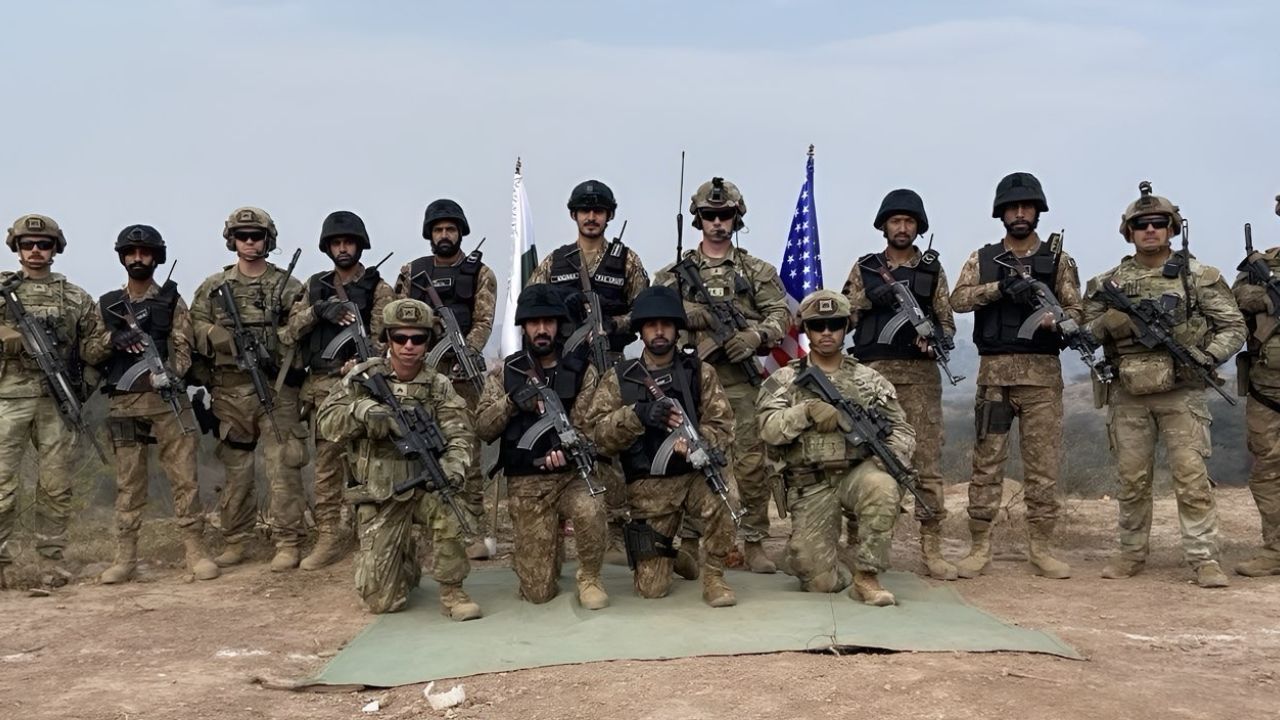
Military-to-military relations between Pakistan and the United States (US) appear to be entering a new phase of cooperation, marked by joint training exercises, major defence sales and unusually warm rhetoric from President Donald Trump towards Islamabad’s military leadership.
According to a statement issued by the US Central Command (Centcom), American and Pakistani troops this week concluded joint training at Pakistan’s National Counter-Terrorism Center in Pabbi. The exercise, dubbed Inspired Gambit, focused on combined infantry skills, tactics and counterterrorism operations. Centcom said such engagements “strengthen our long-standing defense ties.”
This week, U.S. and Pakistan Army Soldiers completed training at Pakistan’s National Counter-Terrorism Center during Exercise Inspired Gambit, which focused on combined infantry skills and tactics, and counterterrorism operations. Training exercises like this between the U.S. and… pic.twitter.com/z8eZNvPKLS
— U.S. Central Command (@CENTCOM) January 16, 2026
The training comes against the backdrop of broader re-engagement between the two defence establishments.
In December, Washington approved a $686 million package to upgrade Pakistan’s fleet of F-16 fighter aircraft. The deal followed heightened regional tensions after Pakistan and India fought a brief but intense five-day conflict in May 2025. Pakistan is believed to operate between 70 and 80 F-16s, ranging from upgraded Block-15 aircraft to newer Block-52+ models. US officials have long described the programme as a cornerstone of bilateral military cooperation.
Political signaling from Washington has also drawn attention. President Trump has repeatedly praised Pakistan’s army chief, Field Marshal Asim Munir, referring to him publicly as his “favourite field marshal”.
In a year-end briefing on December 31, Trump claimed Pakistani leaders credited him with preventing a wider catastrophe during the May conflict, saying he “saved 10 million lives, maybe more”.
Trump’s remarks at the Sharm el-Sheikh Peace Summit in October 2025 again highlighted Field Marshal Munir, alongside Prime Minister (PM) Shehbaz Sharif. Since returning to the White House in January for a second term, Trump has publicly praised Pakistan’s army chief at least ten times. In June 2025, he also hosted Munir at the White House for a lunch meeting – the first time a sitting US president formally received Pakistan’s military leader.
Analysts suggest Washington’s renewed focus on the Middle East, particularly Gaza and Iran, combined with Pakistan’s air force performance during the May conflict, has encouraged closer defence ties. Islamabad has also signaled willingness to join a US-led stabilisation force for Gaza, a controversial proposal advanced by Trump.
Recent military exercises, arms sales, and high-level engagement suggest defence ties between Washington and Islamabad are entering a new, more pragmatic phase, with both sides signaling readiness to deepen cooperation.