Author: Fizza Abbas

  • Manshoor: Pakistan’s oldest communist magazine still going strong

    Manshoor: Pakistan’s oldest communist magazine still going strong

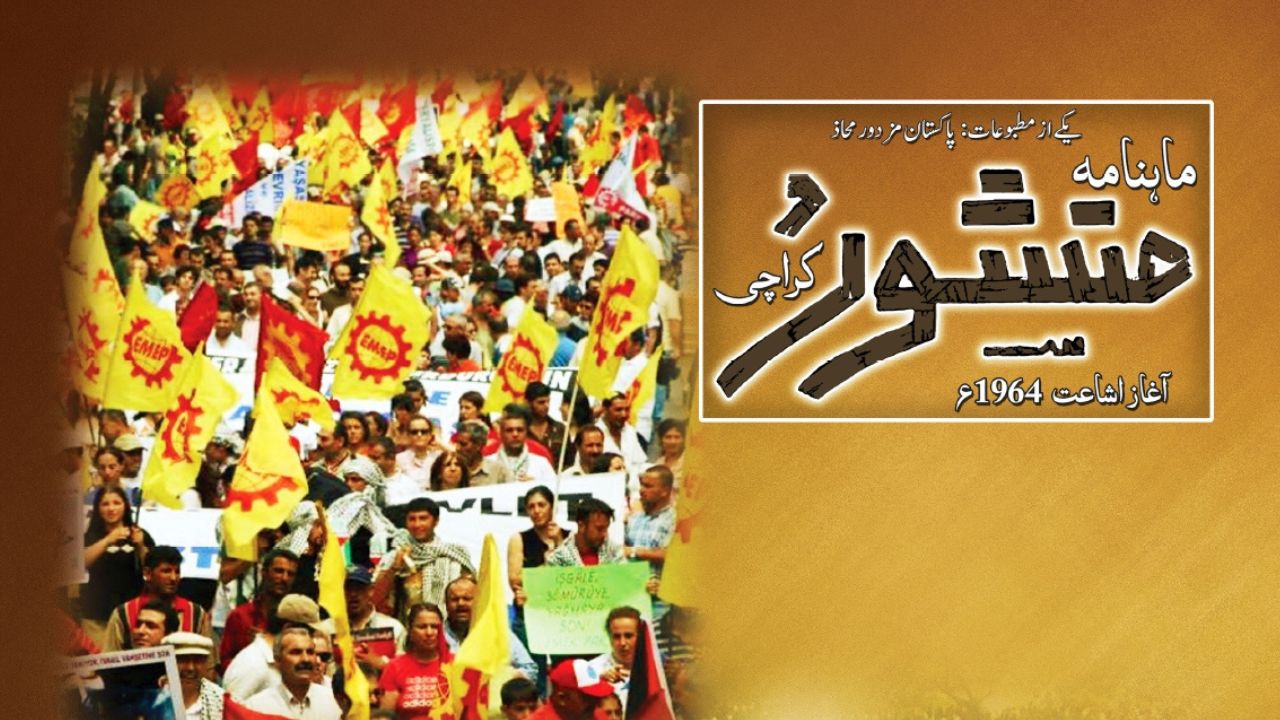
    In the ever-changing landscape of Pakistani media, where publications often come and go with the winds of censorship, corporate funding or political shifts, Monthly Manshoor stands tall — not as a relic of the past, but as a stubborn, breathing witness to history. It is, quite literally, the oldest continuously published left-wing magazine in Pakistan. But Manshoor is more than just a magazine. It’s a living testament to ideological resilience, intellectual defiance and an unwavering commitment to socialist thought in a country where such words are often met with suspicion, if not outright hostility.

    Born in Struggle, Raised in Shadows

    Manshoor didn’t start in some polished newsroom. It was born out of the labour movement — specifically as the publication of the Airways Employees Union, under the leadership of Comrade Tufail Abbas. 

    This was the Cold War era, when being a communist in Pakistan wasn’t just unfashionable — it was dangerous. With the state hunting reds under every bed, Manshoor served as an underground voice for the Communist Party of Pakistan. Its pages carried the hopes and frustrations of an entire generation of revolutionaries who organized in backrooms, held secret meetings, and distributed literature under cover of darkness.

    Among its early torchbearers were legendary figures like Hassan Nasir, who died under torture in the Lahore Fort dungeons during General Ayub Khan’s dictatorship, and comrades like Zaki Abbas, Shafiq and Azhar Abbas, whose lives were intertwined with the communist and labour struggles of the time.

    Ideological Evolution: From Moscow to Tirana

    In its early days, Manshoor followed the global communist playbook with the Soviet Union as its compass. But the Pakistani left, like the international left, was never a monolith. When the ideological earthquake of the Sino-Soviet split hit in the 1960s, the comrades behind Manshoor pivoted toward Mao Zedong’s China. This Maoist phase was marked by revolutionary zeal and radical clarity.

    But revolutions age, and so do ideologies. When China began to soften — opening markets and shaking hands with the West — the Manshoor collective didn’t follow. Instead, their gaze shifted to Albania, then the last stronghold of what they saw as pure Marxist-Leninist thought. Inspired by Enver Hoxha’s hardline anti-revisionist stance, Manshoor embraced Hoxhaism — a rare path, but one they’ve followed with intellectual honesty ever since.

    This ideological evolution wasn’t just theoretical. It defined the magazine’s tone, content and political commitments. From that point on, Manshoor became the official organ of the Pakistan Mazdoor Mahaz, a far-left workers’ front that remains firmly rooted in classical Marxist-Leninist principles. Joseph Stalin, for them, isn’t a controversial figure but a symbol of uncompromising leadership.

    Surviving Where Others Folded

    Through military dictatorships, populist regimes, Islamic radicalisation, and wave after wave of neoliberal reforms, Manshoor never caved. While other leftist publications died quiet deaths — some due to state repression, others due to internal contradictions or lack of readership — Manshoor kept going. Sometimes with just enough resources to scrape by. Often unnoticed by the mainstream. But never silent.

    Its pages became a space for critique — of capitalism, imperialism and the Pakistani state’s entanglements with both. It translated Marxist classics, dissected global political shifts, and offered counter-narratives to those promoted by textbooks, TV channels and government think-tanks.

    In doing so, it helped nurture generations of politically aware readers — students, workers, unionists and thinkers — who saw in Manshoor not just a magazine, but a political home.

    The Present — and the Fight Ahead

    Today, Manshoor continues its quiet but firm journey under the leadership of Chief Editor Kamran Abbas, a lifelong leftist deeply rooted in Pakistan’s progressive traditions. 

    “I believe that without understanding Marxism, one cannot truly understand life, society or the structures that sustain exploitation,” Abbas tells The Current.

    Alongside him are Editor Shaukat Ali Chaudhry and Managing Editor Yameen Jatoi, whose recent efforts have helped revive the magazine after a brief hiccup in its publishing.

    Their collective is small. The resources are thin. But the commitment? Rock solid.

    In a world increasingly shaped by algorithmic distractions, ideological fatigue and a media environment that rarely tolerates nuance, Manshoor’s existence is, in itself, an act of resistance. 

    It doesn’t chase clicks or trends on X. It doesn’t dilute its message to stay palatable. It just continues to do what it has always done: speak truth to power, offer critical thought and keep the flame of leftist politics alive in Pakistan.

    So the next time someone tells you that socialism is dead, or that Pakistan has no space for progressive ideas — point them toward Manshoor. It’s not just surviving. It’s enduring.

    And in that endurance lies its quiet, revolutionary power.
  • The Pakistani Sisters (TPS): Building women up, one free platform at a time

    The Pakistani Sisters (TPS): Building women up, one free platform at a time

    It was the first week of May, and the air was thick with unease. Another Pak-India conflict had taken over the headlines — missile tests, political chest-thumping, and the same old loop of fear and fury. The kind of days when you can’t tell if it’s the anxiety or the heat that’s making it hard to breathe. I was scrolling through Facebook late at night, not looking for anything in particular. Just… scrolling. Half-distracted, half-desperate for something that didn’t feel like doom. I wasn’t searching for inspiration. I wasn’t even sure what I needed. Maybe a soft corner. A quiet sentence. A moment of recognition. Some place where I didn’t have to carry the weight of being strong.

    That’s when I stumbled upon The Pakistani Sisters (TPS).

    At first, I assumed it would be like most women’s groups—maybe some recipes, a few clothing ads, polite small talk. But within minutes, I realized I was wrong. This wasn’t surface-level. Women were openly talking about stress, fear, mental health, even the pressure of holding everything together at home. There were even some wives of armed officers who were worried about the safety of their husbands out in the battlefield and just like me, were looking for some relief, some comfort, a helping hand, perhaps. Nothing was performative — it was raw, real, and strangely comforting.

    I saw posts from women saying exactly what I was feeling but couldn’t put into words. We were reaching out — asking women across Pakistan, from Lahore to Islamabad, Peshawar to Karachi—if they felt safe. Most of us didn’t know each other, yet there was an unspoken bond between us. A shared thread of agitation, of concern—not just for ourselves, but for one another, as fellow Pakistani women. I felt as if I had walked into a room where no one needed me to explain why I was exhausted — they already knew.

    That night, I didn’t just find a Facebook group — I found a sisterhood. And the feeling lingered.

    The next day, still curious, I reached out to the group’s admin, Afrah Sattar Khan. I wanted to know who had created this space, and more importantly — why. That’s when I learned about the quiet revolution Afrah had started seven years ago, not for profit, not for recognition, but because she believed in something radical.

    “I don’t want to build a brand. I want to build a safe space. A space where women could be supported, heard, and helped — without ever having to pay for it”.

    Today, TPS is not only the largest women’s support group in Khyber Pakhtunkhwa and Islamabad, but it’s also a real-world force for social change. With over 50,000 members, a growing cross-platform presence, and national recognition through multiple awards, TPS has proven one thing again and again: real empowerment doesn’t come with a price tag — it comes with intention, consistency, and heart.

    In an increasingly commercialised online ecosystem, TPS stands out for one very simple reason: they don’t charge anything.

    Where other platforms demand fees for business promotions or visibility, TPS flips the script. Every woman — whether she’s a home-based baker, a tailor, a photographer, or a budding tech entrepreneur — gets to promote her work for free. There are no hidden costs, no premium tiers, no payment gates.

    “I always found it odd that people charge struggling entrepreneurs just to get exposure. That’s not support, that’s gatekeeping”, Sattar says

    This no-cost model is not only rare; it’s revolutionary in the local context. It lowers the barrier of entry for hundreds of women who may not have the capital to pay for promotion or advertising.

    TPS isn’t just another social media group — it’s a living, breathing community with structure, purpose, and soul. “A family”, as one member says.

    But here are some other factors that set TPS apart…

    Every weekend, TPS hosts a business promotion activity. Women can drop their links, showcase their products, or simply introduce their services. The TPS team not only boosts these posts within the group but also shares many of them on Instagram, YouTube and their blog, giving members exposure across multiple platforms.

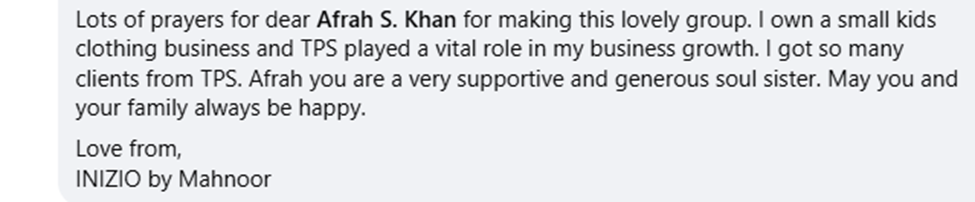
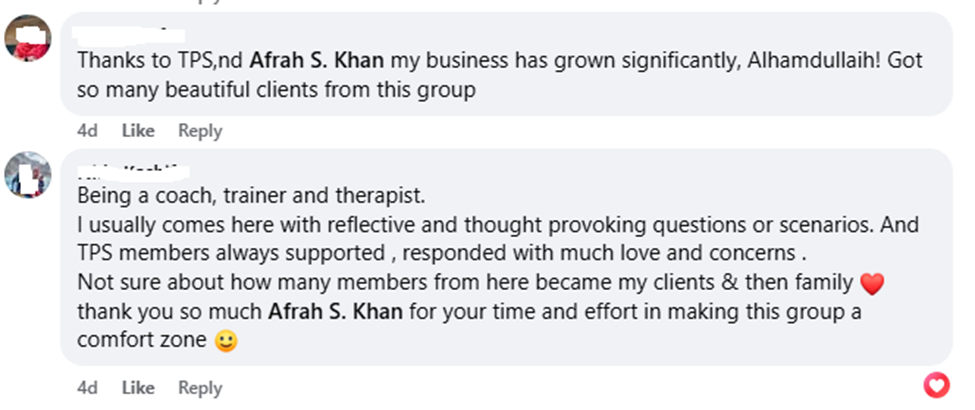
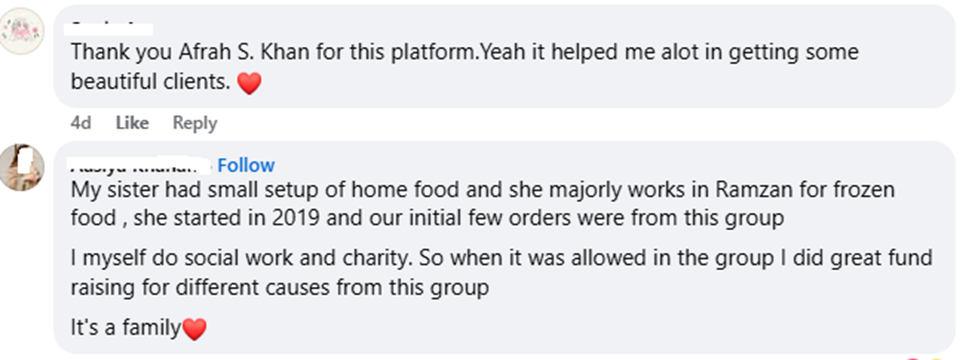
    This weekend ritual has become a beacon for home-based businesses, many of which have grown into profitable ventures solely because they found their first customers through TPS.


    Promotion doesn’t end with a single post. The TPS team ensures that deserving businesses get exposure across platforms — creating Instagram spotlights, video shoutouts and even blog features. This kind of organic, grassroots marketing is both rare and impactful — especially in areas where women often lack digital visibility.

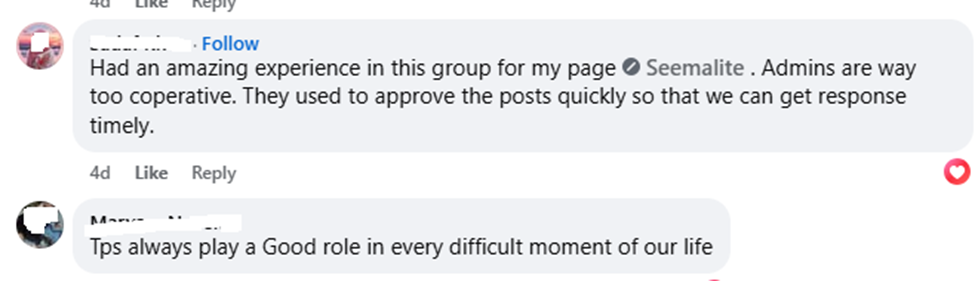
    TPS is more than a megaphone — it’s a forum for questions, advice, and mentorship. Women regularly post about job issues, business challenges, pricing queries, or even mental health struggles. And what they get back is a wave of crowd-sourced wisdom, kindness, and lived experience.

    There’s no spam. No toxicity. Just women showing up for each other.

    The group’s strong and active moderation team ensures TPS remains a safe, respectful and inclusive space. Trolls are shown the door. Unethical behavior is shut down fast. This has earned TPS the trust of thousands of members who feel comfortable being honest and vulnerable.


    TPS doesn’t chase viral posts or social media gimmicks. The focus remains firmly on real-world impact: did someone get a client? Did a woman land a job interview? Did someone find clarity about launching her own business?

    At its core, TPS is a feminist space — but not in a Western-imported, hashtag-driven way. The feminism practiced here is deeply rooted in local culture, built on values of fairness, support, and equality — not superiority.

    Afrah and her team know the ground realities of women in KP: they’re often managing homes, raising kids, studying, or working multiple part-time gigs. TPS gives them a voice and validates their hustle. It doesn’t preach, it guides — through example, through community and truth.

    The group regularly talks about so many things, right from navigating family pressure while working to learning to say no without guilt (a much-needed lesson for empaths like myself!).

    TPS is proof that feminism can be soft-spoken but powerful, culturally aware but transformative.

    Behind every movement is a leader who quietly fuels the fire. For TPS, that 

    woman is Afrah Sattar Khan. She doesn’t post daily selfies or seek the spotlight. Instead, she spends her energy uplifting others, managing the group, moderating discussions and building new pathways for visibility.

    Here are just a few examples of TPS’s real-world impact:

         A group of young women from Peshawar started posting their photography work in TPS. Back then, female photographers were almost unheard of in the region. Today, they’re professional, in-demand artists with fan followings — and TPS helped launch them.

         A woman who made stitched clothes at home found her first 30 clients through a single shoutout. Now, she employs two assistants and manages her orders online.

         Countless members have learned how to price, brand, and market their offerings — just by participating in the weekly business activities.


    With its continued growth, TPS has plans to expand its digital infrastructure. Afrah and her team are working toward building a searchable online directory of women-led businesses, organising in-person networking meetups, and growing their YouTube and Instagram channels to further amplify success stories.

    Still, the core promise remains unchanged: support, not sales.

    “We’ll never charge women for being seen. That’s not what this space is about,” Afrah says. “TPS is a free hand when you’re climbing — not a toll gate at the top.”

    In a country where opportunities for women are still too often gatekept, The Pakistani Sisters (TPS) has kicked open the door. It has done so without sponsors, without flashy influencers, and without charging a single rupee.

    It’s built on community, consistency, and an unshakeable belief that women can rise—especially when they lift each other up.

  • How Pakistani citizens are redefining global philanthropy

    How Pakistani citizens are redefining global philanthropy

    It wouldn’t be wrong if I say that philanthropy and Pakistan are synonymous. A look at Pakistan’s history reveals a tradition deeply rooted in the religious and cultural practices of giving—whether it’s zakat, sadqa, or community-driven initiatives like food drives, wedding fund contributions, or general hospitality. Figures like Abdus Sattar Edhi, who founded the Edhi Foundation and built the ‘world’s largest ambulance service network,’ embody this enduring spirit of generosity. Today, citizens across Pakistan are carrying this legacy forward globally by blending creativity, innovation, and modern technology into the age-old tradition of giving back. 


    The Rise of Technocratic Social Citizenship

    Philanthropy in Pakistan is changing thanks to globalisation, technology, and education. Unlike the older generation, who often kept their charity work low-key and low-tech, today’s youth want to see real and visible results. Take Seed Out, for example— helping fund small businesses for underprivileged entrepreneurs through online micro-donations.


    Fun Fact: According to a study conducted by the Pakistan Centre for Philanthropy, Pakistanis give around PKR 240 billion (more than $2 billion) annually to charity, even with the challenges in our national economy. This speaks volumes about the culture of philanthropy in the country. 

    Impacts of Technologised PhilanthropyModern tools have decentralised efforts and transcended borders, redefining how charity work is done. Fast Micro-Funding, online collaborations, and social media have made it easier for individuals and organisations to assist the disenfranchised among us. Here are some noteworthy examples of their impact. 


    • Charity Events: Pakistanis are finding new ways to blend style with social impact. One such example is Fashion for a Cause, a charity fashion show that showcases local, sustainable designs and also raises funds for education programs in underprivileged areas.

    • Social Enterprises: On the business side, social enterprises are becoming a big deal. Companies are integrating social responsibility into their business models, which is a win-win for both the business and the community. Take The Hunar Foundation, for example, which provides skill development to underprivileged women. The Citizens Foundation (TCF), which runs schools for underprivileged children, helps bridge the education gap in rural and urban communities.

    • Social Entrepreneurship: Individual social entrepreneurship is also on the rise, i.e. entrepreneurs like Pakistani-American physician Dr Anosh, head of Anosh Foundation and YOUR DIL, which has invested over $10 million in healthcare, education, and community development initiatives in more than 25 countries globally.

      Dr. Anosh Ahmed’s work exemplifies how a global perspective and localised action can intersect, demonstrating that impactful philanthropy knows no borders. Through his foundation, he combines healthcare expertise with a commitment to empowering marginalised communities worldwide.


    Rethinking the concept of charity through a modern lens

    Modern philanthropy is completely changing the way we think about giving back in Pakistan. It’s no longer just about quiet, private acts of charity or fulfilling religious duties like zakat and sadqa. Now, it’s becoming something exciting, collaborative, and, most importantly, inclusive—especially for younger generations.

    For years, charity was seen as a solemn, individual responsibility. But today’s youth are flipping the script. They’re turning giving back into something personal and fun. Think charity fashion shows by a 16-year-old Pakistani student, Eeman Syeda or music festivals like 4.0 Concert by Acts of Kindness Pakistan that blend entertainment with social causes. These aren’t your traditional fundraisers—they’re community-driven experiences that bring people together. Suddenly, philanthropy isn’t just about writing a check—it’s about making a real impact while connecting. 

    What’s really special is how this new wave of giving blends the old with the new. The core values—generosity, community, and religious obligation—are still there. But younger Pakistanis are adding their own twist: creativity, innovation, and a focus on transparency. 

    What can you do to be a part of this change?

    I believe that by supporting existing initiatives or becoming a catalyst for new projects leveraging the power of technology, new networks can keep the momentum going and drive real social change.

    Even the smallest act—donating a little, sharing a campaign, or volunteering your time—can add up to something huge.

    Together, we can create a future where our efforts don’t just make headlines but change lives for generations.

  • Women are not rehabilitation centres for men

    Women are not rehabilitation centres for men

    There, I said it! But it took me eight years of marriage and constant reassurances from my husband to truly come to terms with the fact that we, as women, are not responsible for fixing broken men. And yet, I can’t help but wonder: how many women, like me, are still living under the delusion that it’s their duty to shoulder the burden of their spouse’s mental struggles? Who will tell them that it’s not? Recognising the importance of addressing this issue openly, I decided to write about it so that no other woman has to go through the emotional ordeal I endured as a married woman. But it’s not really our fault that we believe this way – this is what we’ve been indoctrinated to believe.

    Historical context: Where did this mindset come from?

    It’s important to understand where this mindset came from. Historically, women have always been seen as nurturers and caregivers. From the time we’re little, we’re taught that our greatest strength lies in our ability to take care of others—whether it’s siblings, parents, or, eventually, a husband and children. This expectation has been so deeply ingrained in our culture that many women internalise it without question, believing their worth is tied to how much they can give, heal, or endure for others.


    In South Asia, this mindset was reinforced during colonial rule, where rigid gender roles were imposed through the introduction of Victorian ideals about family and gender roles, the setting up of schools that largely excluded women from formal education and the Widow Remarriage Act of 1856, which while protecting widows, also reinforced the idea that women were supposed to be submissive and dependent on men. These gendered norms were later internalised by South Asian societies long after colonial rule ended. And it’s not just a problem of the past—this notion still thrives today.


    Project ‘Broken Men’


    Then there’s this infamous idea of men as ‘projects’—something broken that women are supposed to fix. It’s like society hands out a manual at birth, saying, “Here’s your future husband. He’ll be emotionally distant, maybe even reckless, but don’t worry—that’s your job to fix.” 


    Women are subtly (and sometimes not-so-subtly) conditioned to believe that love means sacrifice—that patience and perseverance can transform any man into a prince. This narrative doesn’t just trap women; it excuses men from doing the work they need to grow and thrive on their own.


    There’s also this heavy pressure from elders to accept men with their flaws as if it’s simply a part of the deal. We all have grown up seeing such people around whose maxim is: larkay ki shadi karado, sudhar jaega. [Get the boy married, he’ll improve] And, if you ask them, kon sudharega? [Who will improve him?] The answer is, of course, uski biwi [wife].


    So the message is clear from day one: marriage is not about finding a compatible partner but about taming your husband, fixing his mental hurdles, and sacrificing personal happiness for the sake of tradition and family reputation.


    The ‘Bas guzara karlo’ [Just survive it] syndrome


    We also romanticise this idea of sacrifice and perseverance in marriage. We’ve all heard the stories of women who quietly endure their husbands’ temper, neglect, or emotional baggage with the expectation that somehow, over time, love will fix everything. 


    The concept of sabr [patience] is often elevated to a saintly virtue in this context (read: sabr-kay-agay-jeet-hai illusion) as if a woman’s selflessness in putting her own needs second is a sign of moral strength. 


    And the problem is we see this mindset glorified everywhere, in our TV shows and films. In Pakistan, dramas like Humsafar and Zindagi Gulzar Hai portray women who suffer in silence but are expected to stay patient for things to get better. Take Humsafar, for example, where Khirad endures emotional neglect from her husband, Ashar, yet in the end, the story suggests that her patience is what saved the marriage. And in Zindagi Gulzar Hai, we see Kashaf’s mother forgiving her husband after all the emotional turmoil he put her through—once again perpetuating the same mindset.


    In India, shows like Balika Vadhu and Woh Rehne Wali Mehlon Ki portray women enduring challenges in their marriages and family lives at the hands of selfish husbands, all in the name of adarsh [ideals] and sanskar [tradition]. Their sacrifices are celebrated, with the underlying message being that patience and enduring hardship will ultimately lead to happiness.


    Even popular films like Kabhi Khushi Kabhie Gham and Dilwale Dulhania Le Jayenge feature women who go through tough times for the sake of love, believing that their perseverance will fix everything. 

    Global Perspectives: Parallels Across Cultures

    This idea of women being expected to “fix” their husbands isn’t just a local phenomenon—it spans across cultures and societies. Whether it’s in Hollywood, Bollywood, or media in the Middle East, the narrative often remains the same: women are seen as the emotional saviours or the ones who can help men improve their lives. In Western cultures, movies like The Pursuit of Happyness show a woman’s support as a form of emotional rehabilitation for her struggling partner. 


    But this mindset doesn’t only deal with emotional issues—there are also career and economic factors at play. In many societies, women are expected to “help” their husbands grow economically or professionally, sometimes at the cost of their own dreams. 


    And this pressure varies across socioeconomic classes, with wealthier societies focusing more on emotional rehabilitation and poorer societies often tying women’s role to economic survival. 


    Consequences of the ‘Fixer Fantasy’

    When women are expected to “fix” their husbands, it often leads to emotional burnout and disillusionment. Studies indicate that 40% to 70% of family caregivers experience clinically significant symptoms of depression, with about a quarter to half meeting the criteria for major depression.

    In Pakistan, divorce remains a taboo, and the fear of social stigma prevents many women from seeking help. Approximately 56% of abused women have never told anyone about their situation. This societal pressure can lead to marital dissatisfaction and, in some cases, divorce. 

    As per research, divorced women in Pakistan often face psychological crises, including feelings of insecurity and health issues like insomnia and panic attacks. The unequal emotional labour expected from women in these relationships can erode the foundation of marriage, leaving both partners unhappy and unfulfilled.

    How to break the cycle?

    It all starts with recognising unhealthy patterns in relationships. We, as women, must understand that we don’t need to “fix” anyone and that relationships should be about mutual respect, not one-sided sacrifice. The media also plays a key role by showcasing healthier relationships where both partners support each other. Additionally, we must incorporate relationship education in schools and communities to help everyone understand what a balanced, respectful relationship looks like. 


    This can be done through age-appropriate content in school curriculums, such as emotional intelligence, empathy, and conflict resolution, seminars and workshops for students, parents, and teachers that address healthy relationships, communication, and gender roles, involving psychologists and educators. 


    Moreover, we can organise community discussions or sessions in madrassas, mosques and local event venues like T2F, TDF Ghar, Pak Tea House or The Black Hole Islamabad. Arts Council Pakistan and NAPA can also play a huge role in this regard by organising plays that can teach people the essence of a healthy relationship. While it’s often said that our shows reflect real life, why not depict an alternate reality—one that could inspire positive change and ultimately become the norm? After all, if art imitates life, life also imitates art.


    On top of that, we need to remove the stigma around seeking counselling or therapy. There are still many men, in particular, who hesitate to admit to having mental health issues, let alone seeking therapy due to bad experiences with previous therapists or the fear of opening up to someone new. They must be encouraged to talk openly about their mental health for the sake of themselves and their partners. Because if they don’t, we women—being hopelessly empathetic—will try to help them, constantly finding flaws in ourselves and our methods for not being able to fix them, and how is that fair to us?


    So, let’s break the cycle—one step at a time. We all are in this together—no gender war, no blame games—as two passengers supporting each other to make the journey all the more enjoyable, all the more peaceful!

    Fizza Abbas is a co-founder of Aurat Kahani, a freelance journalist and an award-winning poet with over 100 publications across several literary platforms.
    She can be reached at fizza_abbas@outlook.com