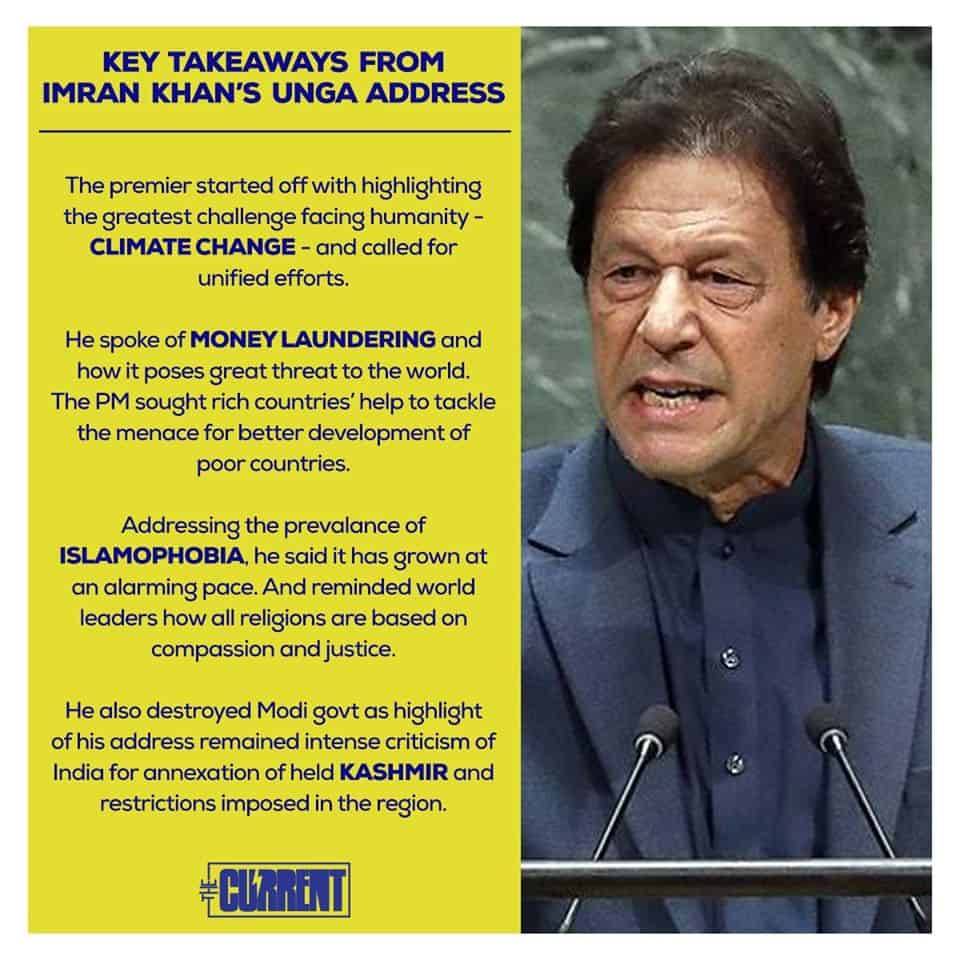

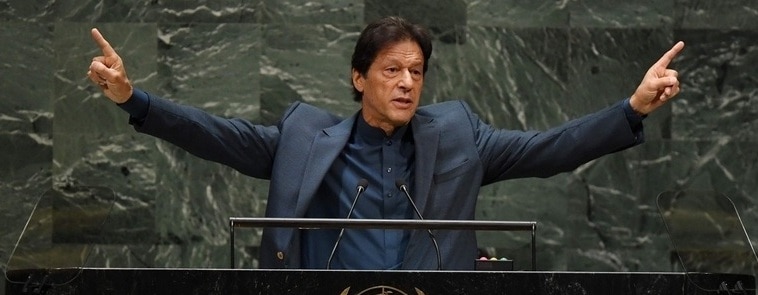
Prime Minister Imran Khan on Friday addressed the 74th session of the United Nations General Assembly (UNGA) in New York. From climate change to destroying the Indian government over the Kashmir crisis, his historic speech had it all. So much so, that even his biggest critics lauded him for being bold and straight-forward.
Apart from politicians and journalists, Pakistani celebs and sportspersons, including Mahira Khan, Wasim Akram, Humayun Saeed, Hamza Ali Abbasi and Sanam Saeed took to social media to appreciate PM Khan’s speech.
I feel like we are being represented with the true voice of Pakistan and now the world can finally see who we are and what we stand for #ThankYouSkipper #ImranKhan #NayaPakistan #PakistanStandsUp
— Wasim Akram (@wasimakramlive) September 27, 2019
Spoken like a true leader with the voice that speaks for our whole country. We are now being heard by the world and proudly represented as a nation of peace and integrity! Pakistan Zindabad #ImranKhanSpeaksForPakistan #PakistanForPeace #Kashmir4Freedom
— Shaniera Akram (@iamShaniera) September 28, 2019
Dear Pm @ImranKhanPTI I cried I clapped & I felt proud . you spoke as the son of the soil a true leader who strives for peace and betterment of his people . You spoke like a lion who will fight for freedom till the last breath . The nation sir stands behind you in every word.🇵🇰
— Shaan Shahid (@mshaanshahid) September 27, 2019
Finally got to watch the speech… @ImranKhanPTI you make us proud!!♥️🇵🇰
— Mahira Khan (@TheMahiraKhan) September 27, 2019
Thankful to Allah for blessing us with PM Imran Khan who today proved that he is not just a leader of Pakistan & Kashmir but a Leader for all Muslims & one of the biggest voices of Humanity & Islam. May Allah protect him. #UNGA2019#IKFinalTalkForKashmir #ImranKhanVoiceOfKashmir
— Hamza Ali Abbasi (@iamhamzaabbasi) September 27, 2019
Our PM’s address to the UNGA was awe inspiring. So glad that we have a leader who so eloquently put our case to the world. The UN has to take heed & end the oppression in Kashmir. Remember the Pakistani nation are like cornered tigers don’t provoke us! 🇵🇰#ImranKhanVoiceOfKashmir
— Mehwish Hayat TI (@MehwishHayat) September 27, 2019
Prime Minister Imran Khan packs a powerful punch with his eloquent speech and tremendous passion. As a truly dynamic leader, he gets the message across loud and clear. So proud of him! #UNGA2019 pic.twitter.com/n9jlZ6LbzK
— Humayun Saeed (@iamhumayunsaeed) September 27, 2019
@ImranKhanPTI proved to be a true spokesman for Islam & Pakistan today. He is definitely an ambassador for peace in the subcontinent. He is becoming a world leader. Hats off to our Prime Minister and how he addressed such a big issue.#ImranKhanForPeace #UNGA2019 #ImranKhan pic.twitter.com/UkVasJc3K6
— Shoaib Akhtar (@shoaib100mph) September 27, 2019
This is the stuff leader's are made of. A heartfelt, sensitive, well backed and impassioned plea for #HumanRights and awareness by our PM @ImranKhanPTI to the United Nations General Assembly.@PTIofficial.
— Sanam Saeed (@sanammodysaeed) September 27, 2019
I feel proud to have voted for you, I feel proud to have you as my leader, I feel proud to have you as Pakistans Prime Minister, I feel proud to have you @ImranKhanPTI , I feel proud to be a Pakistani. What a vision, what a speech !#ImranKhanVoiceOfKashmir
— Farhan Saeed (@farhan_saeed) September 27, 2019
Brilliant speech by our PM @ImranKhanPTI that covered an extensive content emphasising four points.
— Sana Mir ثناء میر (@mir_sana05) September 27, 2019
1. Climate change.
2. Eliminating money laundering & tax heavens.
3. Islamophobia & blasphemy of Prophet (PBUH).
4. Freedom for Kashmir.@AsiaSociety @UN #UNGA2019 pic.twitter.com/qNj7aX5oym
reasons; the most pertinent being the welfare of #kashmiri people and the most terrifying being the danger of open hostility among two nuclear powers.
— Mansha Pasha (@manshapasha) September 27, 2019
I also especially liked the part of Islam being blamed for Radicalisation which in fact made it sound like Islam is in some way
“Will the world community appease a market of 1.2bn or stand for justice and humanity?”
— Wahab Riaz (@WahabViki) September 27, 2019
I’m a proud Pakistani today, whose leader raised such concerns so fearlessly on a global platform. #PakistanZindabad 🇵🇰
I'm in tears. How can we ever repay Imran Khan for the way he's represented us at the #UNGA2019 Salute to you Imran Khan!! 🇵🇰♥️#ImranKhanVoiceOfKashmir
— Haroon Shahid (@Haroon_5hahid) September 27, 2019
No one has ever represented not only Pakistan but 1.3billion Muslims the way PM @ImranKhanPTI did today during his speech at #UNGA2019 A true leader spoke 2day who has the right to represent Muslim world.May Allah protect him and make him achieve what he is willing for Humanity
— Faysal Quraishi (@faysalquraishi) September 27, 2019
PM @ImranKhanPTI just clean bowled the lies of @narendramodi and hit all his doubters/haters for a SIX. His closing sentences were the roar of a lion. His message is clear we want PEACE but if u impose WAR then you will find a worthy opponent that will rattle your foundations.
— Fakhr-e-Alam S.I & S.E (@falamb3) September 27, 2019
In case you missed PM Khan’s speech, here’s a short summary: