A judicial inquiry into the killing of Rawalpindi youth Usama Satti by the five officials of the Anti-Terrorism Squad has found the policemen guilty and asked the authorities to use the Anti-Terrorism Act against the cops.
Constable Muhammad Mustafa, Superintendent Hafiz Ikhtikar Ahmed, Constable Mudassar Mukhtiar, Constable Shakeel Ahmed, and Constable Saeed Ahmed gunned down Satti in an alleged car chase. They fired 17 bullets at the car, most of which hit the upper body of the slain student.
The inquiry report also pointed out the “carelessness” of the police high-ups and ordered an investigation against the SP and DSP of the capital police.
The report prepared by Additional Deputy Commissioner Rana Muhammad Waqas said that officers should be appointed on the basis of their mental health in addition to the physical prowess.
“The system of police monitoring is weak,” it revealed, adding that the inspector general should improve the technology being used by the police. It further said that the ATS officials shouldn’t be allowed to work with the police without prior permission.
Last week, at least five officials of Islamabad Police were arrested after they gunned down 21-year-old Usama Satti in cold blood in G-10 sector in the federal capital.
The policemen who belonged to the Anti-Terrorism Squad fired bullets from the front and hit the youth mostly on the face and upper body. No weapons etc were discovered from the boy’s car.
A source in the capital police had said that the ATS officials and the youth had an argument on New Year’s Eve when the police officials stopped his vehicle for checking. The source had claimed that the police officials stopped the guy even though they were off-duty at the time.
This altercation between the cops and the youth may have resulted in this killing, the source claimed.
Pakistan is in talks with the International Monetary Fund (IMF) to put the fiscal support programme back on track, State Bank of Pakistan Governor Dr Reza Baqir said on Monday.
Baqir said he was optimistic about the economic outlook despite the fallout from the coronavirus pandemic and the central bank was eyeing 1.5pc to 2.5pc GDP growth in the current fiscal year.
With dwindling foreign exchange reserves and a struggling economy, Pakistan entered a three-year $6 billion IMF bailout programme in 2019, but is yet to have its second review approved, which has been pending since early last year.
“We hope to have good news for the market and the world that we are putting the programme back on track,” Baqir said in an interview on Monday at the Reuters Next conference.
Last year, staff from the IMF and Pakistani authorities reached an agreement to pave the way for a disbursement of $450 million in IMF funds pending approval from the global lender’s executive board, which is yet to take place.
Baqir said there was no disagreement on the end goal between the two sides, and that Pakistan needs to increase its low tax-to-GDP ratio.
Pakistan and the IMF have been working to implement IMF-supported economic reforms, in particular tax collection, aimed at stabilising the economy and shoring up a yawning fiscal deficit.
Though the bailout programme is still pending, Pakistan received $1.4 billion in emergency financing from the IMF to allow it to fund targeted and temporary spending increases aimed at containing the pandemic and mitigating its economic impact.
Authorities are counting on the IMF bailout package to bolster Pakistan’s fiscal position and increase global confidence in its economy.
“Pakistani authorities and the IMF team remain closely engaged, discussions are going on, both teams are working very hard and non-stop to bring the programme review to positive conclusion,” IMF’s Resident Representative to Pakistan, Teresa Dabn Sanchez, told Reuters.
Baqir also said he is more optimistic about the outlook even as Pakistan battles a second wave of the coronavirus outbreak.
“We are prepared for the challenges that may come about. We are already in the middle of Covid without any vaccine and once the vaccine comes, it will only makes this better,” he said.
Baqir added that an economic recovery is underway and the bank’s job is to support the rebound until a vaccine is available.
1.5 to 2.5% GDP GROWTH:
Pakistan is aiming to achieve 1.5pc to 2.5pc GDP growth in the current fiscal year, Baqir said. “I think the next two or three years should bring some good news on the economic front.”
Pakistan’s economy contracted 0.4% in the last fiscal year ended June 30, 2020, as the pandemic hit. Baqir added that an economic recovery was under way and the bank’s job was to support the rebound until a vaccine was available.
“I think the next two or three years should bring some good news on the economic front,” he said.
Baqir said Pakistan’s growth in its foreign exchange reserves from $7 billion to $13 billion in recent months was not due to borrowing.
He said Pakistan needed “a rollover of the support” of friendly countries that had parked money in the bank to shore up reserves, but did not need new loans.
Among those countries is Saudi Arabia, which recently asked Pakistan to repay $2 billion of its loan. Islamabad returned $1 billion to Riyadh in December last year and was to pay another $1 billion this month.
The Supreme Court (SC) of Pakistan on Monday approved Meesha Shafi’s harassment case against Ali Zafar for hearing. As per details, Pakistan’s top court granted leave to Shafi in her harassment case against Ali Zafar. This means that the SC has granted permission to hear the appeal based on its legal points and will deliberate whether Shafi’s accusations of sexual harassment come under the workplace harassment law.
Furthermore, notices were issued to respondents Zafar and the Punjab Government by a three-judge bench of the apex court led by Justice Mushir Alam.
Meesha explained that the legal issue has never before been decided by the SC.
Case of first impression, a case that presents a legal issue that has never before been decided by the Honorable Supreme Court. https://t.co/44tp74huyK
Meesha was represented by senior lawyer Khawaja Ahmad Hosain and Noor Ejaz Chaudhry.
Leave granted by the Supreme Court of Pakistan in Meesha Shafi vs The Governor of Punjab to consider whether all women, including students, are covered under Pak's harassment law!
We're very proud today & for Mr. Khwaja Ahmad Hosain for the most brilliant advocacy! pic.twitter.com/EwLlqKzKWr
The singer’s appeal was earlier rejected by the Lahore High Court (LHC) and Punjab ombudsperson, who ruled that her allegations did not come under the workplace harassment law.
On Sunday, Meesha had informed her fans and followers that the Supreme Court was to hear her appeal on whether a ‘self-employed person’ has the “right, as per the law, to be heard after being harassed and therefore expect justice on merit as an equal citizen”. She had thanked her well-wishers for standing by her and for making her feel “less alone”.
Thread*
Tomorrow, the Supreme Court of Pakistan hears my appeal on whether I, a ‘self employed person’ have a right, as per the law, to be heard after being harassed and therefore expect justice on merit as an equal citizen.
Thank you to all of you for making me feel less alone. Thank you to all of you for the solidarity, love and prayers I am receiving. Whatever the outcome tomorrow… I am at peace knowing I tried my best 🙏🏼#SupremeCourtHearing 11-1-21
Congratulations Meesha! You have done it for every girl who faces harassment and can't get a just hearing because of the technicalities. Way to go girl! ♥️ https://t.co/vYLvHOJUiO
More power to you, @ItsMeeshaShafi. The fact that you have fought this far means that you have already won.
You stood up for yourself despite knowing that you will be accused of doing it for ulterior motives, you are very brave. This good news feels like a personal victory. https://t.co/OkQQuovNkE
Congratulations to @itsmeeshashafi for her win in the SC today. If the civil remedy for harassment means anything it should apply to all women whether self employed or not. Unfair & many times impossible for women to prove harassment to criminal std of proof. #MeeshaShafi
In 2018, Meesha first came forward with allegations of sexual harassment against Ali Zafar. She later filed a complaint with the provincial ombudsperson. After her appeal was rejected, she approached Governor Punjab, who upheld the ombudsperson’s decision. Meesha then challenged the Governor’s decision in Lahore High Court which again dismissed Meesha’s case for hearing on grounds that she did not have an employer-employee relationship with the accused.
Inter-Services Public Relations (ISPR) Director General (DG) Major General Babar Iftikhar has said that leaders of the opposition alliance, the Pakistan Democratic Movement (PDM), will be offered tea and snacks and looked after if they decide to stage a long march towards Rawalpindi.
“I don’t see a reason for [them] to come to Pindi. And if at all they want to come, we will offer them chai paani [refreshments] and look after them. What more can I say?” the military spokesperson said while responding to a journalist’s question regarding PDM chief Maulana Fazlur Rehman during a wide-ranging press briefing.
Maulana had indicated that the opposition could turn the direction of its anti-government movement towards the army leadership, saying that the opposition alliance’s movement would no longer be directed only at the Prime Minister (PM) Imran Khan-led government but also “his backers”, hinting that its possible long march to the capital “could also be to Rawalpindi”.
Earlier, Maj Gen Babar spoke on a broad range of issues, including the border situation and to present an analysis of the security challenges of the past decade.
The army’s spokesperson said the last 10 years were a challenging time in every aspect for Pakistan, but in 2020 alone the coronavirus pandemic and locust attack had put the country’s food security and economy in severe danger. He said while banned organisations were also being facilitated on the western border, the state, institutions, the armed forces and intelligence agencies, and most importantly the people of Pakistan were facing all challenges with a united front.
Saying that along with restoring peace in the tribal districts on the western border, socio-economic projects were also launched in this period; he added that concrete steps were taken to strengthen Pakistan’s borders with Afghanistan and Iran. “The security situation improved considerably as a result of successful operations against terrorism.”
Maj Gen Babar further said that whether it was India’s condemnable designs or the application of hybrid warfare against Pakistan, internal threats or external challenges, the country not only identified the threats and presented facts, but also combatted them successfully.
“The world is recognising this [Pakistan’s position] because truth always prevails,” he maintained.
Pakistan Muslim League-Nawaz (PML-N) leader Hina Pervaiz Butt has claimed that she graduated from the Lahore University of Management Sciences (LUMS) with a GPA of 3.98.
She made this statement on an Express News show hosted by Mansoor Ali Khan.
Hina was responding to the remarks made in the show, where it was said that she became a member of Punjab Assembly on a reserved seat the basis of her wealth and contacts. She said it was not right to “say such a thing about women who become lawmakers on reserved seats”.
She said she moved the highest number of resolutions in the assembly during the last tenure, 2013-18. Hina said saying “women are selected on the basis of their wealth or beauty” was akin to the character assassination of the lawmakers, who become MPs on the seats reserved for women.
Last time, Hina, while appearing on the same show, said that she considered BBC Urdumore credible source of information compared to its parent organisation, BBC News.
According to Hina Butt, independent media outlets, such as Al Jazeera and BBC Urdu, did “good reporting” on the jalsa compared to the local news channels.
The vehicle comes with a three-year/100,000km warranty, whichever comes first, and will be available in multiple colours, including Steller White, Lunar Silver, Galaxy Black, Cosmic Red, Nebula Blue and Space Gray.
Former prime minister Nawaz Sharif offered a bribe to Broadsheet for abandoning probe against his foreign assets, claimed Broadsheet Chief Executive Officer (CEO) Kaveh Moussavi in an interview on Sunday.
In an interview published on YouTube, he said the assets recovery firm “had flatly refused the deal offered by a person claiming himself as the nephew of Nawaz Sharif in 2012”.
According to APP, Moussavi said the firm refused the deal because it did not “negotiate with the crooks”.
The Broadsheet CEO also criticised Nawaz for claiming that the firm hired by military dictator Gen Pervez Musharraf to identify assets of Pakistanis, mainly politicians, had exonerated him and his family.
According to Moussavi, the Sharif family has assets not only in the United Kingdom (UK) but across the globe, claiming he still has evidence against the Sharifs.
The Sharif family required plenty of explanation about their resources of amassing these assets, he added. He said his firm was ready to probe the Avenfield Apartments’ purchase by the Sharifs on the request of the Pakistan government.
He said the process of accountability was continuing but after President Musharraf left the office, his successors started hampering the process by not giving them access to information and termination of Broadsheet’s contract.
Broadsheet was asked to go after the Sharif family at start, but it told Gen Musharraf that it would not become a part of a witch-hunt, the CEO said, adding that the probe was subsequently expanded to the previous governments as well.
The payment to Broadsheet under the asset recovery agreement was contracted at 20 per cent of the recovery from each ‘target’, the term used for those being probed. However, the agreement was revoked in 2003.
According to Moussavi, the former president had told him in 2007 about the cancellation of the agreement, saying: “You know Mr Moussavi the Supreme Court told us to have an election and we did so. They came back to power and gutted NAB.”
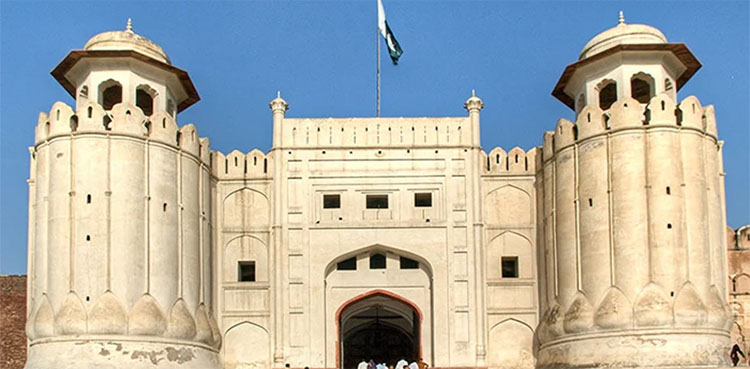
A 50-year-old man died after falling from a 200 feet high wall of the Lahore Fort.
The deceased, identified as Munir was seriously injured after falling from the Lahore Fort wall while trying to take a selfie on Saturday. He was taken to a nearby medical facility where he succumbed to his wounds.
A spokesman for the walled citysaid that the deceased was from Sheikhupura. He fell from wall while trying to take a picture.
“The administration of the fort warned him multiple times to refrain from climbing up the wall but he did not listen to their warnings that lead to this incident,” the spokesperson added.
Imagine the pain of those families who not just lost their loved ones to a gruesome terrorist attack but also kept waiting for the state to show empathy towards them.
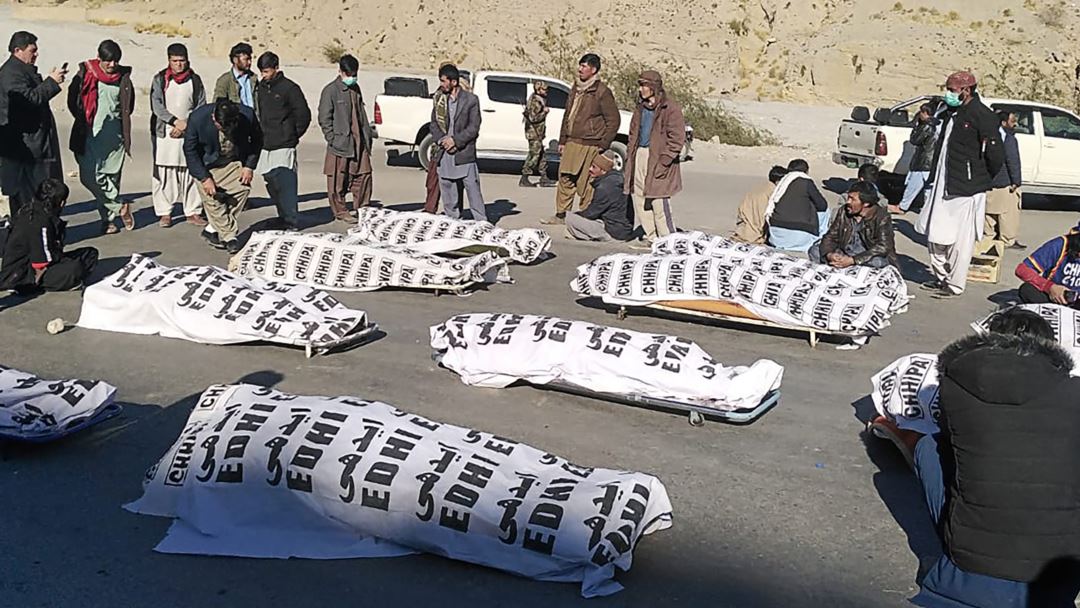
11 Hazara coal miners were target killed in Balochistan last week. Their families staged a protest in the freezing cold of Quetta for a week and said they would not bury their dead till they meet Prime Minister Imran Khan. But the PM asked them to bury their dead first. He said he wouldn’t be ‘blackmailed’.
At last, the Hazara mourners had to bury their dead and only then did PM Imran visit Quetta to meet them. No words can make us imagine the pain of the mourners. And to even think that they could blackmail anyone — those who are a marginalised community, those who have been relegated to a designated area, those who cannot even roam their area freely, those who cannot even get justice for their dead. There are Hazara families that have no male members left as they have all been target-killed.
In a 2014 report by the Human Rights Watch (HRW), the Hazara Shias were described as ‘The Walking Dead’. They have continued to suffer at the hands of sectarian terrorist outfits committing genocide of the Hazara community. Thus the state should not have shown apathy towards their demand of meeting the PM. A powerful state cannot put conditions on its marginalised and beleaguered people. It is callous. Period.
It is also important that the state safeguards the lives of all citizens, especially a marginalised community like the Hazaras. Pakistan made a lot of gains in its fights against terrorism in the last few years. The government should have consolidated those gains and made a proper strategy to counter terrorism and extremism.
It is also important to empower the local police in Balochistan just like it was done in Khyber Pakhtunkhwa. We hope that the Hazaras will get justice as well as protection. They have suffered enough.
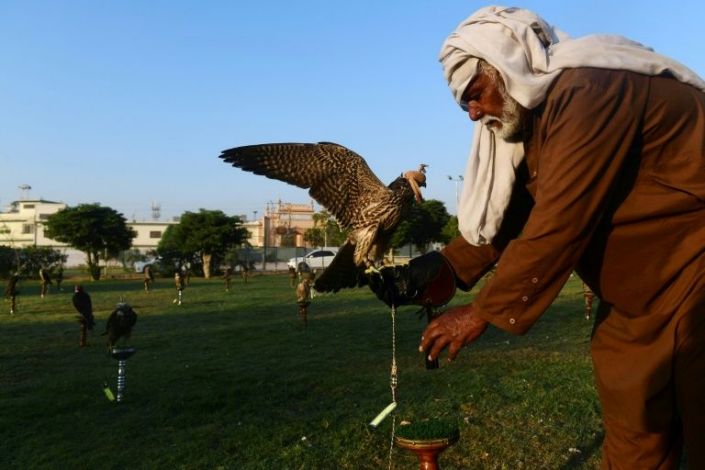
Since learning to capture birds as a teen, Muhammad Rafiq has amassed a small fortune in Pakistan trapping and trafficking falcons — including some endangered species — for wealthy Gulf Arabs.
A single falcon can fetch up to tens of thousands of dollars on the black market, which allowed Rafiq to renovate his family home.
“Every season, dealers come from Karachi and leave their contacts with us, and we call them back if we catch something,” said the 32-year-old, from a nearby coastal village.
He recently trapped a peregrine falcon on a one-week hunting mission.
“I desperately needed money,” he told AFP. “And God has listened to me.”
For years, Pakistan has stood at the nexus of the falcon trade, both as a source of the birds of prey, and then as a destination to hunt with them.
Falcon poaching is officially banned, but demand for the birds is rising, according to the World Wildlife Fund in Pakistan.
It estimates that up to 700 falcons were illegally smuggled out of the country last year alone, often by organised criminal networks.
Their destination is normally Gulf countries, where falconry is a treasured tradition.
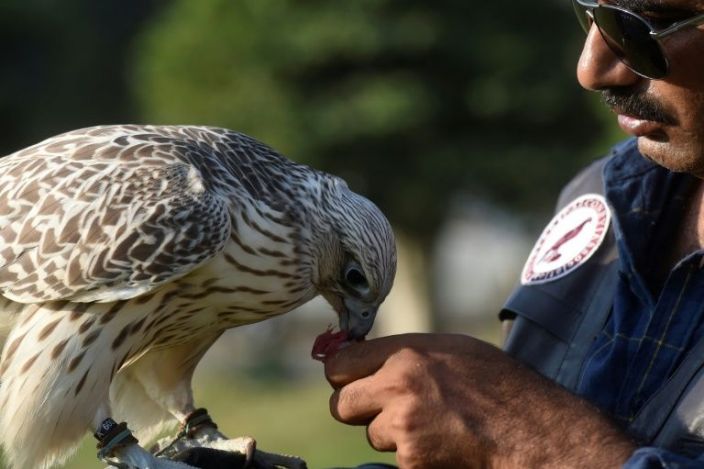
Owners treat the birds “like their own children”, said Margit Muller, the director of Abu Dhabi’s falcon hospital, which treats 11,000 falcons annually, a number that has more than doubled in the past 10 years.
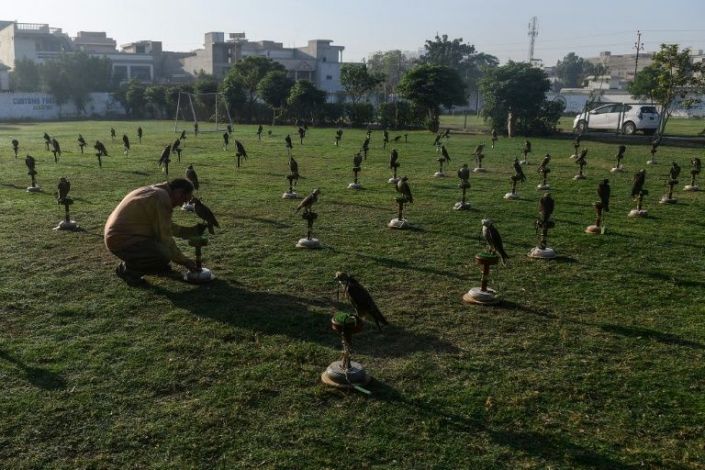
One conservationist told AFP an Arab falconer usually owns around five to six hundred birds, most of which will be captured in the wild in Pakistan or Mongolia.
Wild birds are prized over those bred in captivity because they are believed to be better hunters, though there is no evidence to support those claims.
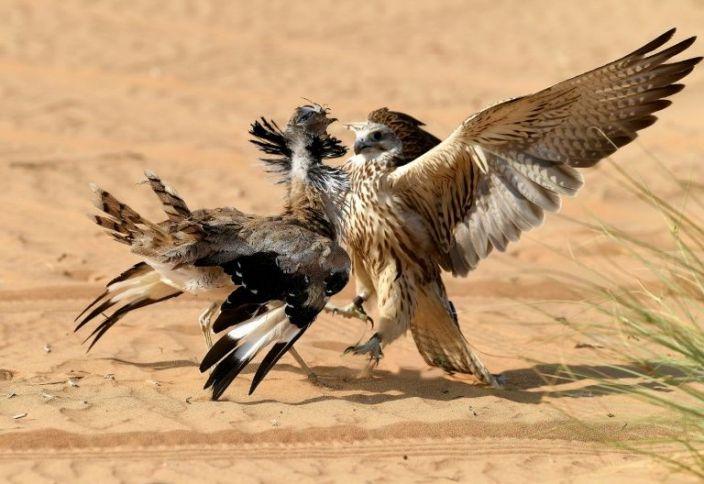
Every winter, lavish hunting parties from the Gulf flock to Pakistan’s sprawling deserts, where they are given permits to use their falcons to hunt the houbara bustards, a migratory bird wrongly prized as an aphrodisiac and classified as vulnerable by conservationists.
These excursions have cast a spotlight on the deep ties between Pakistan and its allies in the Gulf. For decades, the Gulf states have propped up Islamabad’s ramshackle finances with generous loans, with one of the expectations being that they can continue to use Pakistan as a hunting playground.
Saudi Crown Prince Mohammed bin Salman and two other royals were granted permission to catch bustards by Prime Minister Imran Khan’s government in December last year, a soft diplomacy tactic that Khan had openly disagreed with when he was in the opposition.
The government also presents falcons as gifts to world leaders.
“Our officials are working like pimps for the Arabs,” a government official requesting anonymity told AFP.
A brief ban on the bustard hunts was overturned in 2016 by the Supreme Court, but conservationists are now pushing for the export of falcons to be regulated in an ongoing case at the Islamabad High Court.
Every year, falcons escape the harsh Siberian winter and fly thousands of miles to warmer regions, including southern Pakistan.
During the migratory season, wildlife traffickers descend on villages along the Arabian Sea coastline, offering fishermen cash to briefly abandon their boats and try their hand at poaching.
“We pay them in advance, send food to their families and if they catch a bird that is precious, we happily give them motorbikes,” said one trafficker who spoke to AFP on the condition of anonymity.
A range of tactics can be employed — sticky liquids, net traps or, most commonly, using smaller birds as bait.
Poachers especially target the peregrine falcon, whose populations remain stable — but also the saker, which is endangered.
Bob Dalton, a veteran falcon conservationist, helped oversee the rehabilitation of dozens of falcons seized by Pakistani authorities in October, with officials estimating the cache to be worth well over $1 million.
“The illegal trade is growing, there is more money being spent, more pursuit from the Gulf,” he told AFP.
“With the exception of one or two species, most falcon populations are in decline or on the point of being unstable.”
With ongoing efforts to curtail rampant poaching failing, some officials in Pakistan have suggested regulating the falcon trapping market, inspired by a scheme involving another rare native species, the markhor — an elusive mountain goat with striking twisted horns found in Pakistan’s mountainous north.
Every year, foreigners shell out tens of thousands of dollars for a handful of trophy hunting permits, providing a financial incentive for communities to prevent poaching. Naeem Ashraf Raja, the director of the biodiversity at the ministry of climate change, said markhor numbers have rebounded as a result of this controversial conservation method.
With hunting parties set to descend on Pakistan again over the next few months, Kamran Khan Yousafzai, the president of Pakistan’s Falconry Association, said the country desperately needs to implement a sustainable wildlife programme.
“Arab falconers can’t resist coming to Pakistan. They have been coming to these hunting grounds for generations, and unless they face any real problems, they are not going to search for new destinations.”