An officer of the Pakistan Army on Monday embraced martyrdom as security forces foiled a terrorist attack in Dera Ismail Khan, the Inter-Services Public Relations (ISPR) said in a statement.
The martyred officer, identified as Colonel Mujeebur Rehman, was a resident of Bunji in District Astore of Gilgit Baltistan. He is survived by a widow, three sons and a daughter.
According to the military’s media-wing, the operation was launched against terrorists who were hiding out near Tank area of the city. The operation was conducted on confirmed intelligence reports, the ISPR added.
“As soon as troops cordoned the area, terrorists opened fire. During operation, two terrorists were killed. In intense exchange of fire, Col Mujeebur Rehman embraced martyrdom,” the ISPR said, adding that during sanitisation operation, a large cache of arms and ammunition was recovered from the terrorist hideout.
Since the September 11, 2001 attacks on the United States (US) and the world super power’s retaliatory “War Against Terror,” thousands of Pakistani military personnel — ranging from brilliant high-ranking officers to gallant soldiers on the frontline — have lost lives defending their homeland, which has also borne economic losses worth over hundreds of billion till date.
Reserving its verdict on the maintainability of a petition seeking to restrict the Aurat March for being “unlawful, unconstitutional and un-Islamic”, the Islamabad High Court (IHC) has questioned the petitioners’ interpretation of slogans they had objected to.
“The first individuals to embrace Islam were women,” IHC Chief Justice (CJ) Athar Minallah noted as the petitioners’ lawyers told the court that they sought restrictions on the Aurat March — scheduled to take place across the country on March 8 as the world marks Women’s Day — and shared three slogans that women would chant at such an event, Dawn reported.
The eight petitioners had earlier appealed to the court to regulate activities like the Aurat March “subject to law, norms, decency and public morality in the best interest of justice and to order the respondents to perform their obligatory duties towards the Constitution and the law of land in this regard and restrain unlawful, unconstitutional and un-Islamic activities forthwith”.
“In our society, various Islamic laws are being seriously violated. The court hopes that the petitioner also approaches it for the enforcement of all these Islamic laws,” remarked Justice Minallah during the hearing today.
“The women’s slogans are that they be given the rights that Islam grants them. Can we interpret their slogans by ourselves?” the judge questioned.
“It is important that you see the Aurat March in a positive light. On your own, how can you interpret these slogans?”
The judge also questioned the petitioners’ counsel on how many women in the country were given the right to an inheritance, alluding to the difficulties they face despite clear Islamic laws in place.
“Who ended the practice of burying girls alive?” the IHC chief justice inquired, in response to which the petitioners’ lawyer said Prophet Muhammad (PBUH) had done so.
“In our society, the birth of a girl is still not considered good,” he added.
The petitioners’ lawyers told the court that they completely supported women’s rights, adding that they were not opposed to the march or to the rights of women.
They pleaded for the court to pass an order that the march is conducted within the ambit of the law, Constitution and Islam.
Following the statements of the parties in the case today, the IHC reserved its verdict.
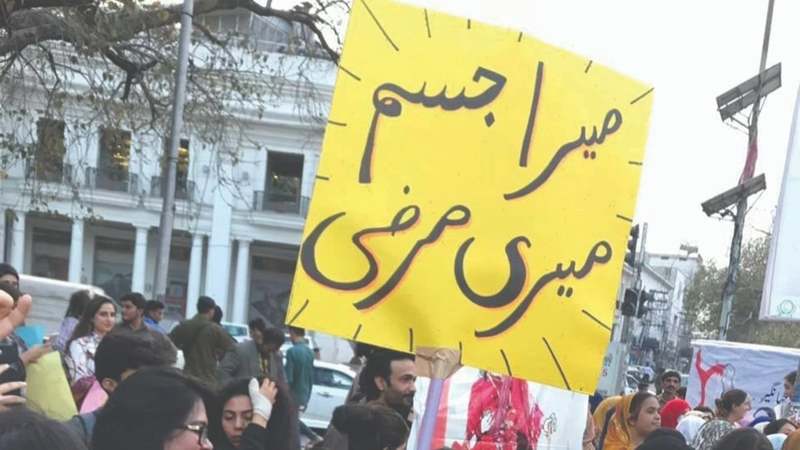
In a supposed attempt to curb ‘moral indecency’ allegedly linked to the Aurat March, the National Assembly’s Standing Committee on Information and Broadcasting urged the Pakistan Electronic Media Regulatory Authority (PEMRA) to direct all media channels to stop telecasting slogans like “Mera Jism, Meri Marzi”.
The NA body held a meeting on Thursday under the chairmanship of Mian Javed Latif of the Pakistan Muslim League-Nawaz (PML-N).
The committee asked the government to check the telecast of indecent and controversial content on television channels with a special reference to the slogans related to the Aurat March annually held on the International Women’s Day. The committee decided to take up the issue with PEMRA and owners of the electronic media houses.
A lawmaker, Aftab Jahangir, expressed ‘concern’ over the language used by “certain people in news channel programmes” saying it was repugnant to the Islamic teachings, which no person could “watch in the presence of family members”.
Special Assistant to the Prime Minister (SAPM) on Information and Broadcasting Dr Firdous Ashiq Awan said Islam was the champion of women’s rights, and anything against the religion and socio-cultural values would not be allowed.
The constitution gives the right of freedom of speech but being the citizens of an Islamic and democratic country “we have some responsibilities and values”.
“Nobody would be allowed to ridicule the ‘Islamic way’ of life in the name of freedom of speech,” the SAPM stressed.
Dr Firdous said it was not an issue of the government but that of the entire society. The government, however, was committed to protecting the constitutional, legal, political, social and economic rights of women.
‘NO ONE CAN STOP AURAT MARCH’:
Meanwhile, Pakistan People’s Party (PPP) chief Bilawal Bhutto-Zardari has said that “no maulana, politician or anchorperson can stop women from holding the march”.
Speaking at a women convention by PPP Punjab in Lahore on Thursday, he said Benazir Bhutto had always fought against terrorism with courage.
“The people who say that women would not march should hear loud and clear that they will march and no one can stop them. This path was shown by Benazir Bhutto. The PPP is standing shoulder to shoulder with women of this country and we demand the government provide protection to each and every march and the people threatening women be arrested and cases registered against them.”
He said women were not begging, rather they were seeking their constitutional rights. “This is Pakistan of Mohtarma Fatima Jinnah, Shaheed Mohtarma Benazir Bhutto and Pakistan of every woman the country. This is not a Pakistan for the conservatives.”
The PPP, Bilawal added, was a party of prosperity for the people of Pakistan. “Women know the best about the economy of the country because they manage homes. Women will take the PPP’s message of prosperity to every nook and corner of this country.”
The PPP chief further said that his party had always raised voice for women empowerment.
The Pakistan Tehreek-e-Insaf (PTI) government has approved certain amendments to Section 10 of the Members of Parliament (Salaries and Allowances) Act, 1974, to ensure privileges for the members of parliament, including 25 business class air tickets for themselves and their families.
According to reports, the federal cabinet during a meeting on February 25 approved the amendments to ensure perks to 446 lawmakers, which would cost taxpayers Rs300 million.
The lawmakers will be able to avail 25 business class air tickets from the respective constituency to Islamabad or vouchers worth over Rs0.8m that could also be used by their family members for travel. These amendments would be presented in parliament for approval later on.
They said that these amendments were proposed by the Parliamentary Affairs Division through a summary to the federal cabinet following the demands of some parliamentarians.
The cabinet considered the summary titled ‘The Members of Parliament (Salaries and Allowances) (Amendment) Bill, 2020′ dated February 7, and approved the proposal given in the summary, the report said.
Meanwhile, Federal Minister Fawad Chaudhry has differed on the claims made by the media report.
Not true only amendment is that flight vouchers can be used from any airport,this was done on request of MNA’s travelling from Quetta and Kar for example if Quetta MNA is in Kar he had to go back to Quetta and take flt for Isld now he can use Kar airport,cost is remains unchanged https://t.co/cQ34Ols2oB
Indian media reports have quoted Defence Research and Development Organisation (DRDO) experts as saying that the industrial autoclave — a pressure chamber used to carry out industrial and scientific processes — seized from Chinese ship Dai Cui Yun, can be used for the manufacture of very long-range ballistic missiles or satellite launch rockets.
According to Hindustan Times, the ship on February 3 was detained by Customs at Kandla Port in Kutch District of the Indian state of Gujarat while en-route to Port Qasim in Karachi “on the basis of an intelligence tip-off” and later allowed to proceed to Pakistan on February 20 after dual-use equipment was seized.
The autoclave was declared as an industrial dryer.
According to top government and intelligence officials, the DRDO’s technical experts and missile scientists informed the Kandla Customs, the Ministry of External Affairs and national security planners on Tuesday morning that the seized 18 metres by 4 metres autoclave could indeed be used in the manufacture of weapons of mass destruction (WMD) platforms.
“The autoclave can be used for the manufacture of the motor of very long-range missiles, with range upwards of 1,500 kilometres or even in the construction of a motor for the launch of satellites. Pakistan has the Shaheen-II missile in the 1,500-2,000 kilometre range and the platform was tested last May,” the report quoted an official as saying on the condition of anonymity.
Islamabad’s nuclear missile programme is not indigenous and is based on Chinese design with Beijing helping Islamabad since the 1980s. India claims it is for no other reason that China is blocking India’s entry into the Nuclear Suppliers Group (NSG) till Pakistan is also allowed to enter the nuclear club”.
The report added that given the seizure of the autoclave, Indian “friends” such as France and the United States (US) “could now pressure Beijing to allow India into the NSG”.
NADRA, PTA spokespersons reject claims against their respective departmentsas data leakmakes headlines
In a massive breach of privacy, personal and sensitive data of millions — if not hundreds of millions of Pakistanis — has been leaked over the internet as blame game continues between the authorities concerned with none of them willing to take the fall for the divulgence.
According to the details, multiple smartphone applications and websites, one of which is Sim Database Online, are hosting millions of Pakistani telecom users’ sensitive data such as their Computerised National Identity Card (CNIC) numbers, names and even residential addresses, all of which can be accessed by simply entering the victim’s mobile number.
Not only does the web-based application further goes on to reveal other mobile numbers registered in the name of the privacy breach victim, but also claims to be providing services such as mobile phone tracking.
A screen grab of ‘Sim Database Online’
“Such applications have been around for quite some time now and most probably are the reason behind the recent spike in number of identity theft incidents in Pakistan,” sources told The Current, adding that leaks of government-held databases remain the biggest contributor to identity theft-related crimes in the country, around 50,000 of which were reported in 2019 alone.
Some groups on Facebook are also offering information regarding driving licences, current location, call details and even criminal records associated with any CNIC numbers if you pay them, sources claimed. “You can even dig out the National Database and Registration Authority (NADRA) family trees associated with a CNIC for a few hundred rupees.”
They went on to claim it wasn’t just Pakistanis’ confidential data that was being hosted by such web applications. “Sensitive personal information of Afghans and Indians can also easily be accessed through these websites, but there appears to be no urgency among authorities of the three countries to protect their citizens,” they claimed.
When asked if NADRA or the Pakistan Telecommunication Authority (PTA) were to be held responsible for the leak, they blamed the latter, saying the watchdog had failed to keep an eye on what the country’s telecommunication companies were doing with sensitive data of their customers.
“How else do you the inboxes of so many people get flooded with text advertisements?” sources questioned, alleging that a data archive of registered telecom users was leaked online in August 2017.
“The archive contains information about registered mobiles users of Pakistan categorised by their telecom companies. It is publicly available and contains personal information recorded to verify SIM cards. Despite the leaked information being brought to light by many, the data remains available.”
Speaking to The Current, an information technology (IT) expert said that e-governance came with a set of standards across the world. “If you give access to someone, you have to follow these standards and maintain a certain security level. But unlike the rest of the world… where they have emergency response teams to investigate such issues, Pakistan has had no such probes I know of.”
“Instead of having teams that react to such incidents, we need certain proactive measures,” the IT expert said, adding that privacy over the internet was a right of the users, and most identity theft-related crimes could be linked to data leaks associated with government bodies over the years.
NADRA & PTA:
When approached, NADRA spokesperson Faik Ali told The Current that there was no truth to the claims being made regarding the role of the authority in the data leak as it very carefully managed the sensitive registration database of all citizens.
“NADRA has nothing to do with it,” he said and also rubbished claims regarding a data breach from two years ago.
“We had in 2018 also denied accusations of leakage of voters’ data ahead of the general election,” he said, adding that it was also clarified by the authority in a letter to the Election Commission of Pakistan (ECP). “There has never been a data breach in the history of NADRA and we have never shared any citizen’s data with anyone.”
Faik also reiterated NADRA’s commitment to protect sensitive data of all citizens come what may.
PTA Public Relations Director Khurram Mehran, on the other hand, rejected all claims regarding the watchdog’s alleged inability to protect the data of telecom networks’ customers, saying that no telecommunication companies were involved in releasing confidential information of their customers.
He, however, said that action would be taken against any company if evidence to support such claims is there.
To a query, the PTA spokesperson further said if there were any such cases, they were to be dealt under the Prevention of Electronic Crimes Act (PECA) provisions by the agency concerned, as they were cybercrime cases.
Repeated attempts were made to contact the chairperson of Senate Standing Committee on IT and Telecommunication, Rubina Khalid, but she was unavailable.
At least 66 per cent Pakistanis have expressed dissatisfaction with the performance of the Pakistan Tehreek-e-Insaf (PTI) government, revealed a Gallup survey on Sunday.
According to the survey, 59 per cent believed that the ruling PTI’s performance was worse than that of the previous governments. Further, 62 per cent Pakistanis have opposed the policies of the current government whereas 35 per cent feel that the country is heading in the right direction.
In the survey, it was said that those who felt the country wasn’t heading in the right direction were only 48 per cent in 2018 — a figure that significantly shot up since the PTI came to power.
Regarding the perception of the federal government’s performance, only 1 in 3 Pakistanis is satisfied (very or somewhat). Only 32 per cent are satisfied with the performance of the PTI government.
According to the breakdown, only 16 per cent from Sindh, 13 per cent from Balochistan, 34 per cent from Punjab and 64 per cent from Khyber Pakhtunkhwa (KP) were satisfied with the ruling party’s performance.
A Christian labourer, who was tortured by local landowners in Kasur three days ago on accusations of “polluting” their tube-well water by bathing in it, succumbed to his injuries on Friday, Pakistan Today reported.
The report quoted the deceased’s family members as saying that 22-year-old Saleem Masih on Thursday was brought to General Hospital in a critical condition from Chunian tehsil.
“On February 25, Saleem had finished unloading chaff in fields in Baguyana village and was rinsing himself off in the tube-well when a group of men, including Sher Dogar, Iqbal, Altaf, Jabbar and Haji Muhammad, rushed over, yanked him out of the water and began beating him,” Saleem’s father Ghafoor Masih said.
“They cursed and abused Saleem for ‘polluting’ the water, calling him a ‘filthy Christian’,” Masih claimed, adding that the assailants then dragged the youth to their cattle farm, where they chained his hands and feet and continued to torture him with sticks and rods. “They also rolled a thick iron rod over Saleem’s entire body, causing multiple fractures and internal injuries.”
Ghafoor said that the family was informed about the incident by police officials four hours after his son was taken hostage and tortured.
“When we reached the cattle farm, we found Saleem lying unconscious on the ground, his face and body bloodied,” he said. He alleged that according to Dogar and the other men, Saleem had “committed a crime by dirtying” their well water and that his punishment was “justified”.
Masih said that after much pleading, the family was allowed to take Saleem to the hospital while the police acted like spectators.
Accusing the Ila Abad Police of favouring the accused, Pakistan Center for Law and Justice (PCLJ) Executive Director Napolean Qayyum said that police had helped the five men obtain bail after briefly holding them in custody.
He said successive governments have failed to reform a deeply corrupt police system that often shows religious prejudice toward minority and marginalized communities.
“The police’s attitude is often biased when they deal with matters relating to blasphemy, forced conversions and marriages of girls belonging to minority faiths, and even in minor disputes,” Qayyum said. “In this instance, for example, the police favoured the accused and helped them in getting bail even though a young man’s life was at serious risk.”
Punjab Minister for Human Rights and Minorities Affairs Ejaz Alam Augustine said that the incident was in his knowledge and stern action would be taken against the perpetrators and the police officials concerned.
Regarding the family’s claim that their son’s killing was religiously motivated, Augustine said the incident was a result of the mindset that prevails in society. “No law can change such a mindset. The government is trying to promote tolerance for the other faiths but it is an uphill task that cannot be achieved overnight.”
It merits a mention that Kasur is the same district where an illiterate young Christian couple was beaten and burned to death by a frenzied mob in 2014 over false allegations of blasphemy. Shahzad and Shama Masih, 26 and 24 respectively, had been accused of desecrating pages of the Holy Quran along with other household waste.
The mob beat the two with sticks and stones before burning them in a brick kiln in front of police officials who stood watching. Postmortem reports revealed that the two were alive when they were thrown into the kiln.
After the attack, it emerged that the couple had been falsely accused. The pages that the family burned were their personal documents.
In what is being termed as a major win against the new coronavirus — COVID-19 — for China, the country has discharged a total of 36,117 patients from hospitals after recovery, official state-run Chinese press agency, Xinhua, reported.
The criteria for deciding if a patient has recovered varies between provinces, but in general, Chinese hospitals require people to test negative twice in a row, and to show no obvious symptoms such as a fever. Patients who are released are supposed to check in with their hospital and can face retesting — which is when some tested positive again.
A total of 36,117 patients infected with the novel coronavirus had been discharged from hospital after recovery by the end of Thursday, reports quoted Chinese health officials as saying on Friday.
Thursday saw 3,622 people walk out of hospital after recovery, the National Health Commission said in its daily report.
By the end of Thursday, a total of 78,824 confirmed cases of novel coronavirus infection had been reported in 31 provincial-level regions of mainland China, and 2,788 people had died of the disease.
Meanwhile, another report quoted a key Chinese respiratory disease expert as saying that some discharged coronavirus patients could still carry the virus and be infectious, potentially posing another complication to Beijing’s efforts to control the epidemic.
Zhao Jianping, the head of the coronavirus containment team in worst-affected Hubei province, said a minority of patients who were discharged from hospital after tests showed they were negative for the virus later tested positive again. China counts patients whose throat or nose swabs show up positive for the virus in a nucleic acid test, and those whose CT scans show lesions in their lungs, as infected cases.
It is pertinent to note that the news of recoveries from China — epicentre of the virus — comes as the world fights a global outbreak of the disease. While cases are being reported in the United States (US), Europe and the Middle East, Pakistan has also confirmed the presence of virus with first two infections.
The presence of coronavirus in Pakistan was confirmed on Wednesday, with Special Assistant to the Prime Minister (SAPM) on Health, Dr Zafar Mirza, tweeting the reaffirmation.
220/ I can confirm first two cases of corona virus in Pakistan. Both cases are being taken care of according to clinical standard protocols & both of them are stable. No need to panic, things are under control. I will hold press conf tomorrow on return from Taftan.
Dr Mirza also addressed a joint press conference with Balochistan Chief Minister Jam Kamal Khan late on Wednesday night confirming the two cases in Karachi in Islamabad.
The SAPM, while urging calm across the country, confirmed that the first patient along with his family had been quarantined. The 22-year-old man in question had returned to Pakistan from Iran on February 20, with all passengers from the flight set to be tracked and tested. At least 100 patients have been tested negative thus far.
The Senate House Committee has ordered the Capital Development Authority (CDA) to open a beauty salon at Parliament Lodges for women lawmakers “as soon as possible”, Associated Press of Pakistan (APP) reported.
The committee, headed by Senate Deputy Chairman Saleem Mandviwalla, gave the directions after Senator Kulsoom Parveen said that despite clear directions from the convener of the committee to consult her and Samina Saeed for the allocation of a place for the salon in Parliament Lodges, the CDA officials had not bothered to contact either of them.
The chairman directed CDA to solve the issue on priority with consultations of the two senators.
Regarding complaints of different senators about their accommodation in Parliament Lodges, the Senate deputy chairman directed CDA officials to contact senators and solve their issues with immediate effect.
He also reminded CDA that directions to make a financial plan about repair and maintenance work of the lodges were given but were not implemented.
Regarding budget, the committee was informed that Rs319 million were allocated for repair and maintenance work of the lodges whereas the agency had spent Rs203 million so far.
Senator Samina Saeed, while referring a media report, pointed out that water supply in the Parliament House and Parliament Lodges was substandard.
She pleaded the Senate deputy chairman to direct CDA to ensure purified water supply and ensure the delivery of electricity bills to parliamentarians at least seven days ahead of the due date.