Category: Politics

  • Turkey detains 34 suspected of spying for Israel

    Turkey detains 34 suspected of spying for Israel

    Istanbul (AFP) – Turkey announced on Tuesday it had detained 34 people suspected of planning abductions and spying on behalf of Israel’s Mossad intelligence service.

    The raids came just weeks after President Recep Tayyip Erdogan warned of “serious consequences” should Israel try to target figures from Hamas living or working in Turkey.

    Unlike Israel, Turkey does not view Hamas as a terrorist organisation and has hosted the Islamic group’s political leaders for much of the past decade.

    A Turkish security source told AFP that most of the 34 people detained were foreign nationals whom Mossad recruited for “operations targeting Palestinians and their family members”.

    “We are determined to ensure that absolutely no foreign intelligence agency can operate on Turkish soil without proper authorisation,” the security source said.

    Turkish government released video footage showing armed security service agents breaking down doors and handcuffing suspects in their homes.

    The Istanbul public prosecutor’s office said 12 additional suspects remained at large.

    “There is an insidious operation and sabotage attempts being made against Turkey and its interests,” Erdogan said after the raids were announced.

    Breakdown in ties

    Relations between Turkey and Israel imploded following the outbreak of the war in Gaza nearly three months ago.

    Erdogan has turned into one of the world’s harshest critics of Israeli Prime Minister Benjamin Netanyahu.

    The Turkish leader last week compared Netanyahu to Adolf Hitler and demanded that Israel’s Western allies drop their support for the “terrorism” being conducted by Israeli troops in Gaza.

    Erdogan has also recalled Ankara’s envoy to Tel Aviv, and pushed for the trial of Israeli commanders and political leaders at the International Criminal Court in The Hague.

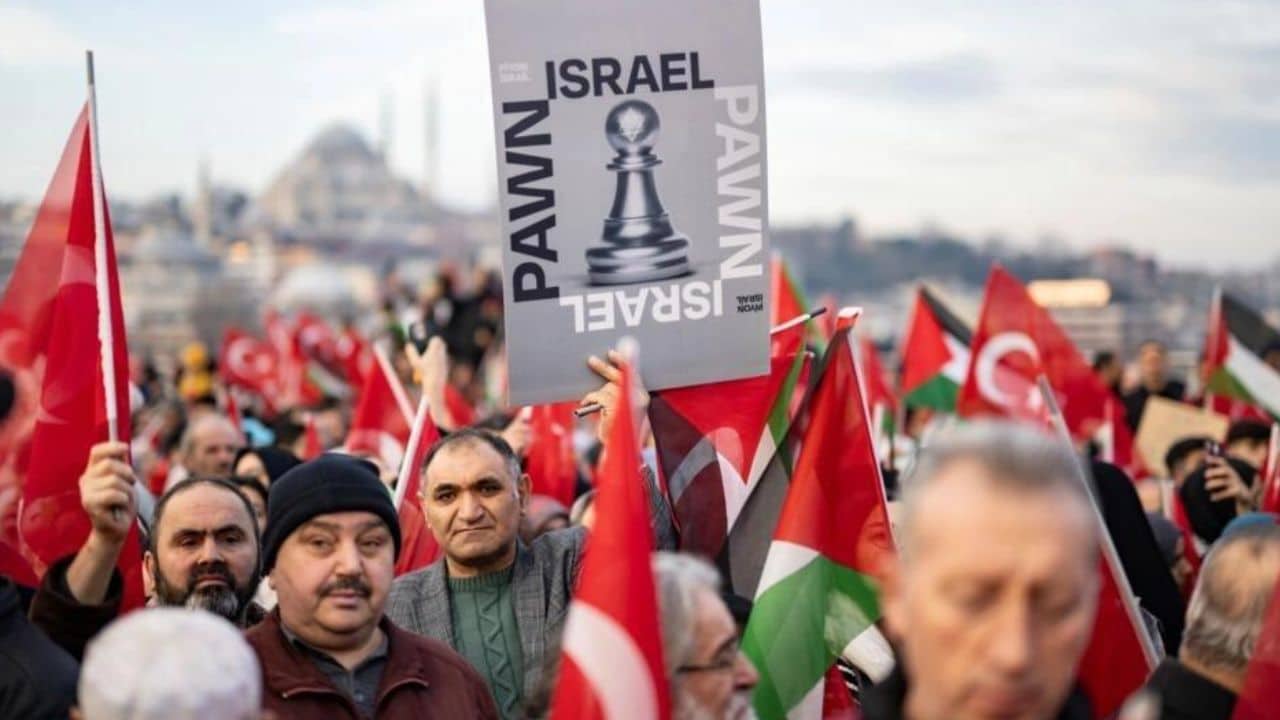
    The president’s ruling Islamic, conservative AKP party also led tens of thousands of protesters out on the streets of Istanbul on Monday for one of Turkey’s biggest rallies against the Israeli government of the entire war.

    The war in Gaza has put an end to a gradual thawing in Turkish-Israeli relations that culminated with the reappointment of ambassadors in 2022.

    Israel and Turkey resumed long-stalled talks about a major Mediterranean Sea natural gas pipeline project that could have reshaped geopolitical alliances across parts of the Middle East.

    Turkey won words of gratitude from Israel in 2022 for detaining a group of Turkish and Iranian nationals were allegedly planning to murder and kidnap Israeli tourists in Istanbul.

    Erdogan and Netanyahu met briefly on the sidelines of a United Nations meeting in New York in September and were discussing holding a formal summit this year.

    Periodic raids

    The Turkish MIT intelligence service conducts periodic raids against suspected Israel operatives working in major cities such as Ankara and Istanbul.

    Most are accused of conducting surveillance work on Palestinians living in Turkey.

    Istanbul served as one of Hamas’s foreign political offices until the outbreak of the Gaza war.

    Turkey informally asked Hamas leaders to leave, days after militants conducted raids into southern Israel on October 7.

    The Gaza health ministry says Israel’s relentless military campaign targeting Hamas has killed around 22,000 people in Gaza since October 7 – mostly women and children.

    UN agencies have voiced alarm over a spiralling humanitarian crisis facing Gaza’s 2.4 million people.

    Most have seen their homes destroyed and now face dire shortages of food, water, fuel and medicine, and are surviving in tents and shelters amid the rubble.
  • Israel ready ‘for any scenario’ after strike kills Hamas deputy in Lebanon

    Israel ready ‘for any scenario’ after strike kills Hamas deputy in Lebanon

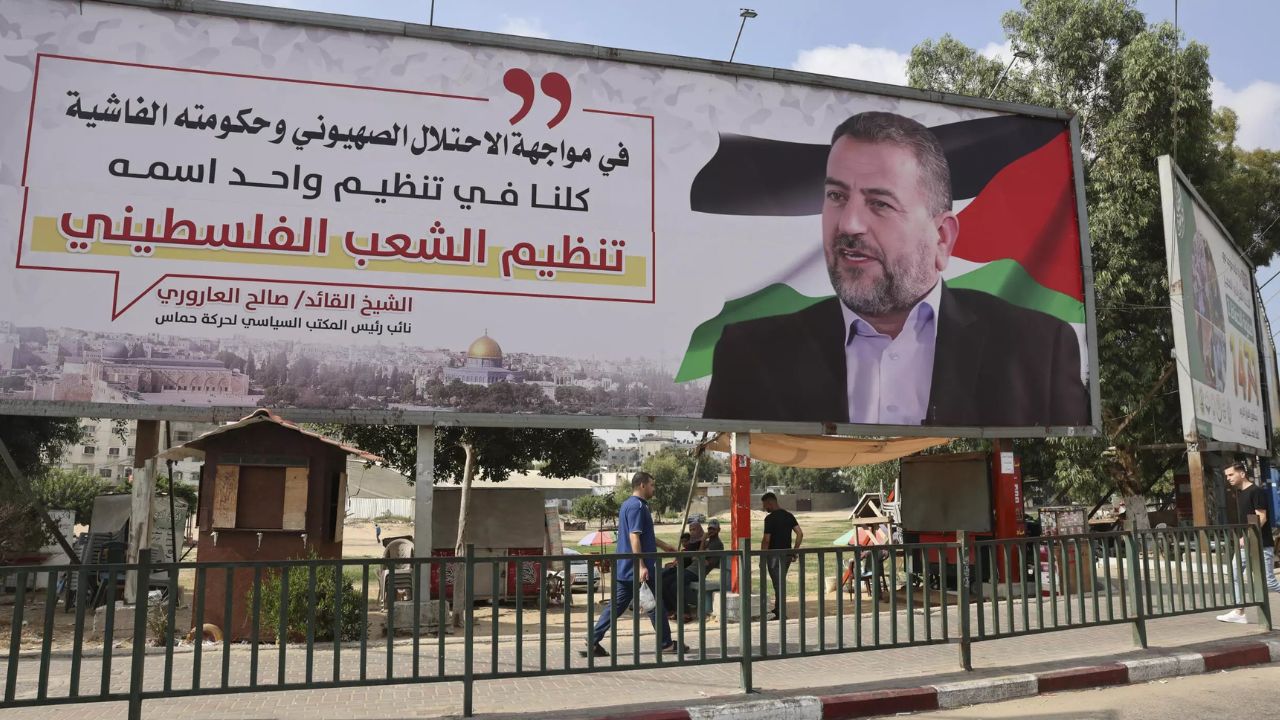
    Jerusalem (AFP) – The Israeli army has said it is “prepared for any scenario” after a strike in Beirut that killed Hamas’s deputy chief, stoking fears that it could boil over into wider regional conflict.

    A high-level security official in Lebanon told AFP that Saleh al-Aruri was killed along with his bodyguards in a strike by Israel.

    A second security official confirmed the information, while Hamas TV also reported Israel had killed Aruri in Lebanon.

    Israeli army spokesman Daniel Hagari did not directly comment on the killing, but said afterwards that the military was in “very high state of readiness in all arenas, in defence and offence. We are highly prepared for any scenario.”

    Israel has previously announced the deaths in Gaza of Hamas commanders and officials during the war, but Aruri is the most high-profile figure to be killed, and his death came in the first strike on the Lebanese capital since hostilities began.

    The strike adds to widespread fears that it could lead to a wider regional conflagration.

    Hamas said Aruri’s death would not lead to its defeat, while its Lebanon-based ally Hezbollah vowed the killing would not go unpunished, calling it “a serious assault on Lebanon… and a dangerous development”.

    Lebanese Prime Minister Najib Mikati condemned the killing and said it “aims to draw Lebanon” further into the war.

    Aruri, who lived in exile, is accused by Israel of masterminding numerous attacks.

    Following his death, Hamas chief Ismail Haniyeh said that a movement “whose leaders fall as martyrs for the dignity of our people and our nation will never be defeated”.

  • State won’t accept ‘elements’ supporting terrorists in Balochistan, says PM Kakar

    State won’t accept ‘elements’ supporting terrorists in Balochistan, says PM Kakar

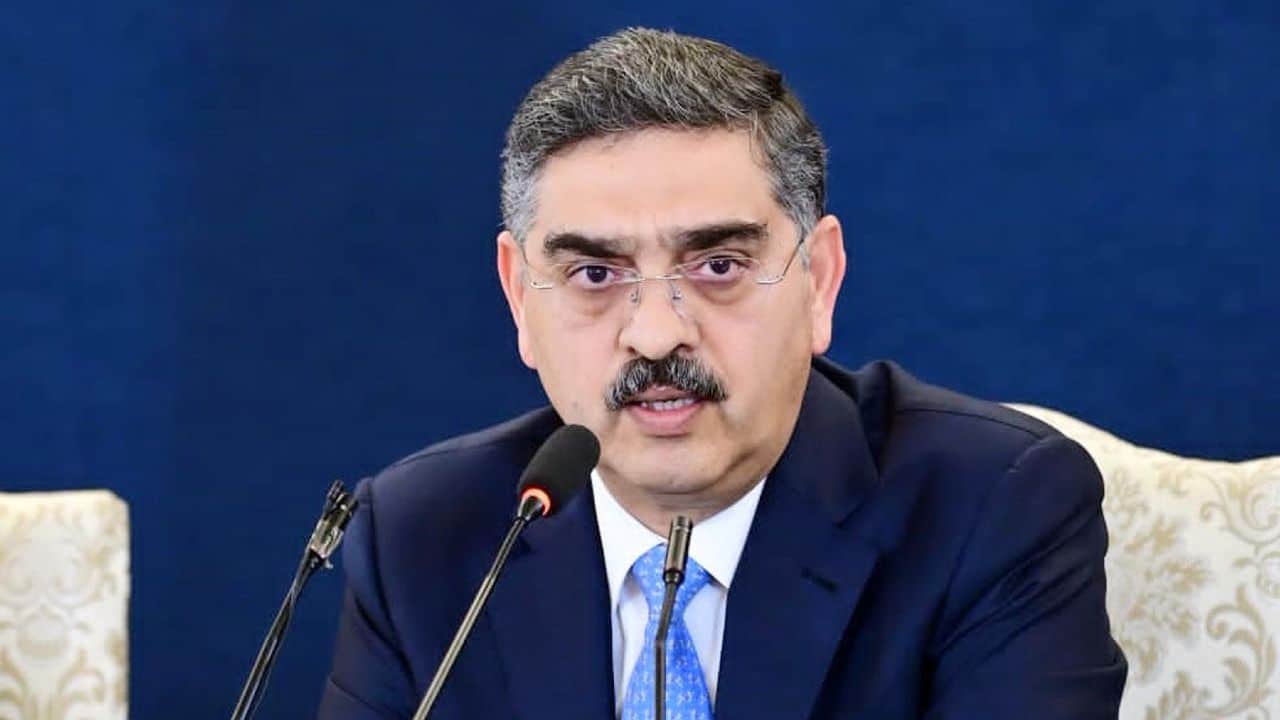
    Caretaker Prime Minister Anwaar-ul-Haq Kakar criticised “elements” who are backing terrorists and militants in the name of supporting Baloch protesters demanding the release of all missing persons.
    The prime minister’s statement came during a press conference in Lahore as the Baloch families of missing persons protested against “enforced disappearance” and “extrajudicial killing” in Islamabad.


    PM Kakar said that the state would not tolerate elements who are supporting militants and terrorists involved in the killing of individuals from Balochistan, including teachers, doctors, and lawyers.


    The Prime Minister also criticised the media for portraying the Baloch families protest in an inaccurate way, but in reality, he said, Baloch stood with Pakistan.


    The premier said that there was no restriction on freedom of expression and that every citizen has the right to protest within constitutional limits. “The families have the right to protest for their beloved ones, but others are just launching baseless criticism.”


    However, he also said that the state won’t allow those elements who want to support militants and terrorists in the country.
    “Those who want to support them [armed militants] should join the camp of the militant outfits who termed terrorism as a movement,” he added.
    Anwaar-ul-Haq Kakar also said that the Indian spy agency, Research and Analysis Wing (Raw), is funding terrorists in Balochistan.


    On the other hand, Baloch activist Mahrang Baloch tweeted on X (previously Twitter) in response to Kakar’s press conference: “From the inception of our movement, our demands have been clear: an end to all forms of human rights violations in Balochistan and the cessation of the Baloch genocide. We’ve presented these demands to the state through the media. Our stance has remained clear from the beginning – we seek negotiations with the state regarding these demands. Sadly, the world witnesses the continuous irresponsibility and stubbornness of the state, where peaceful protestors endure torture and arrests, and media trials are conducted against this peaceful movement. Today, the Prime Minister of Pakistan declared victims of enforced disappearances as terrorists, insulting victim families and addressing peaceful political activists in a threatening tone. However, we assert to this state and government that we will persist in informing the world about your oppression and barbarism.”

  • Peshawar High Court reserves decision on ECP’s petition

    Peshawar High Court reserves decision on ECP’s petition

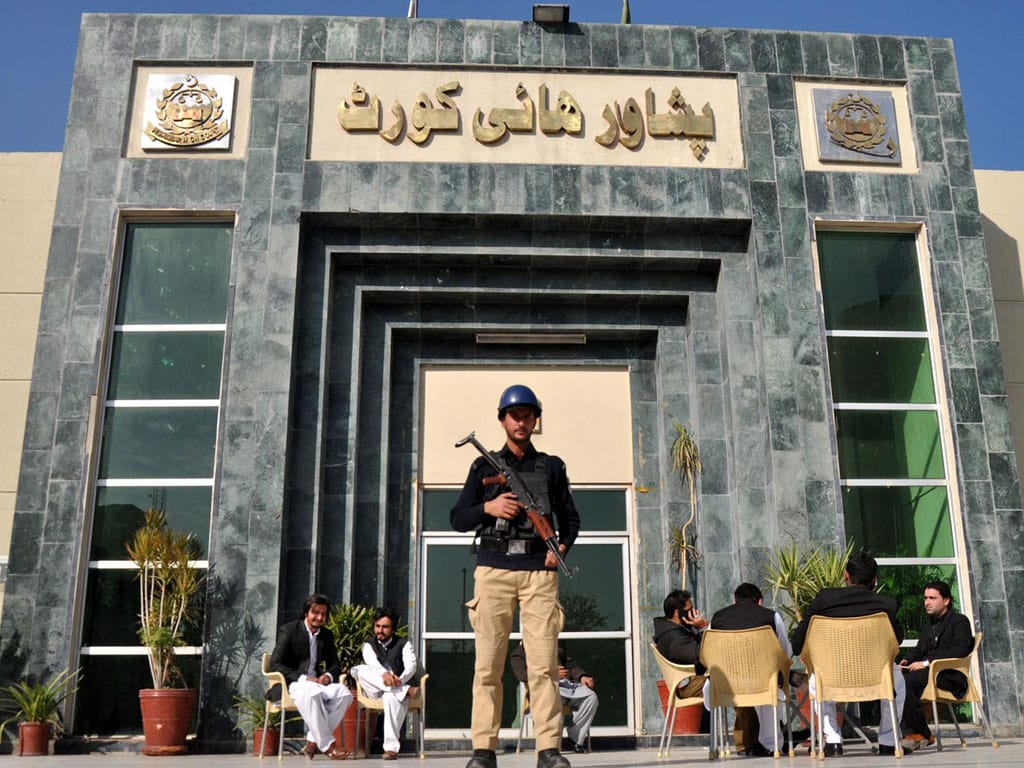
    The Peshawar High Court (PHC) has reserved its decision on the petition of the Election Commission of Pakistan (ECP) that contested the ruling of its single bench regarding the Pakistan Tehreek-e-Insaf’s (PTI) electoral ‘bat’ symbol and intra-party elections.

    The ECP submitted a review petition in PHC against its December 26 verdict, that suspended the ECP’s order and restored the party’s ‘bat’ symbol until a final decision on the matter.

    ECP, through its order, deemed the intra-party polls of the PTI as “illegal” and revoked its authorization to use the ‘bat’ symbol.

    In response to this decision, the erstwhile ruling party appealed to the Peshawar High Court, requesting the reinstatement of its party symbol in anticipation of the upcoming general elections scheduled for February 8.

  • South Korean opposition leader stabbed in neck, expected to undergo surgery

    South Korean opposition leader stabbed in neck, expected to undergo surgery

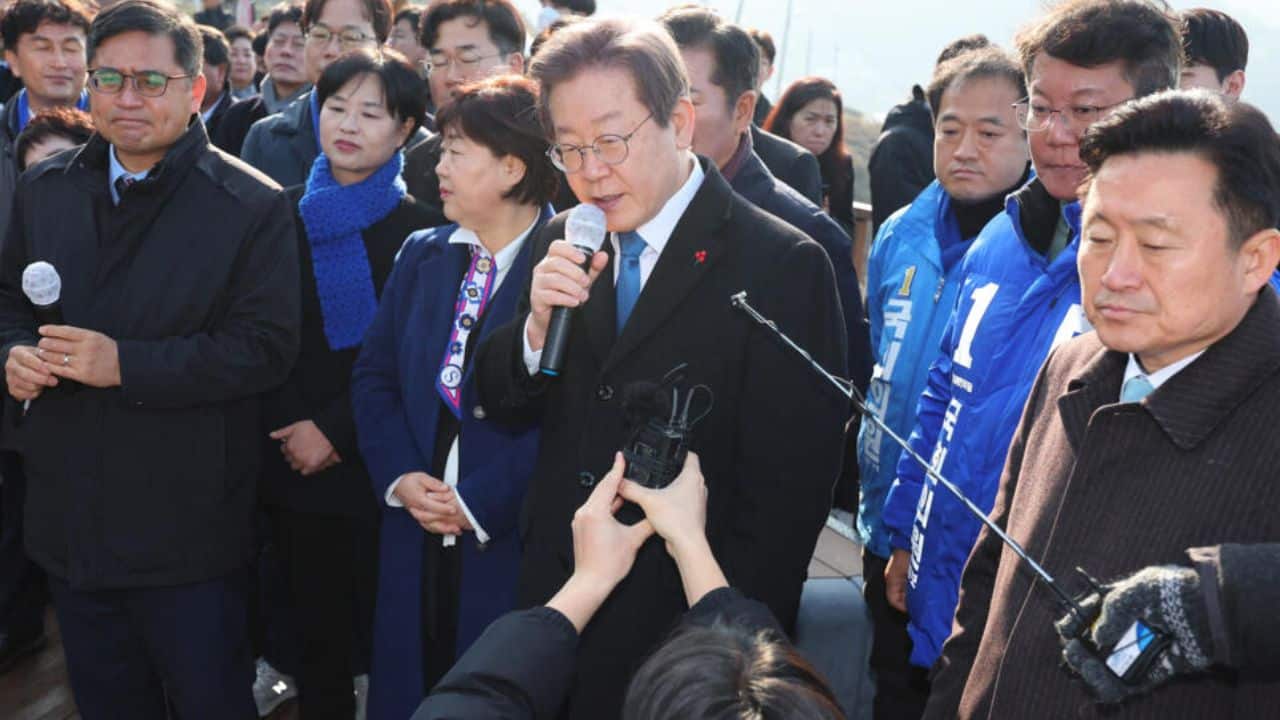
    South Korean opposition party leader Lee Jae-myung was stabbed in the neck on Tuesday by a man who pushed through a crowd pretending to be his supporter.

    Lee was surrounded by journalists and supporters at a construction site in the southern port city of Busan when a man lunged and struck him in the neck, South Korean television channels showed.

    He was bleeding but conscious as he was rushed to a local hospital, the Yonhap news agency reported, before being flown to the capital Seoul for surgery, according to an official from his party.

    An official from Pusan National University Hospital, where Lee received emergency treatment and CT scans before his transfer to Seoul, said the injury was not life-threatening.

    Police were seen wrestling the assailant, who wore a hat with a pro-Lee slogan, to the ground. He was arrested at the scene, Yonhap reported.

    Lee was “walking to his car while talking to reporters when the attacker asked for his autograph”, a witness told local broadcaster YTN, adding that Lee was then struck with what “looked like a knife”.

    The 59-year-old was seen collapsing to the ground as people rushed to aid him, one of whom pressed a handkerchief on Lee’s neck before emergency responders carried him to an ambulance.

    “This is an act of terror against Lee and a serious threat to democracy that should never occur under any circumstances,” Kwon Chil-seung, an MP from Lee’s Democratic Party, told reporters outside the hospital in Busan.

    Lee was later flown to the capital, where Kwon said he would undergo surgery at the Seoul National University Hospital.

    Police in Busan said Lee suffered a “one-centimetre laceration on his neck” and that he “remains conscious and bleeding is minor”, according to South Korean news outlet Chosun Ilbo.

    The attacker has not stated his motive, according to police officials cited by Yonhap.

    Presidential contender

    Lee lost in 2022 to conservative Yoon Suk Yeol in the tightest presidential race in South Korea’s history.

    Yoon expressed “deep concern over the safety of Lee Jae-myung upon hearing of the attack”, his spokeswoman Kim Soo-kyung said.

    “Yoon emphasised our society should never tolerate this kind of act of violence under any circumstances.”

    A former child factory worker who suffered an industrial accident as a teenage school drop-out, Lee rose to political stardom partly by playing up his rags-to-riches tale.

    He is widely expected to run for president again in 2027, and recent polls have indicated that he remains a strong contender.

    But Lee’s bid for the top office has been overshadowed by a string of scandals.

    He avoided arrest in September when a court dismissed a request from the prosecution for him to be taken into custody pending trial on various corruption charges.

    Lee still faces trial on charges of bribery in connection with a firm that is suspected of illicitly transferring $8 million to North Korea.

    He is also accused of breaching his duties, allegedly resulting in a loss of 20 billion won ($15 million) for a company owned by Seongnam city during his term as its mayor.

    Lee has denied all allegations against him.

    In August last year, he launched a hunger strike against what he called the Yoon government’s “incompetent and violent” policies.

    He was hospitalised because of fasting-related ailments after not eating for 19 days.

  • Putin Says Russia Will ‘Intensify’ Attacks on Ukraine

    Putin Says Russia Will ‘Intensify’ Attacks on Ukraine

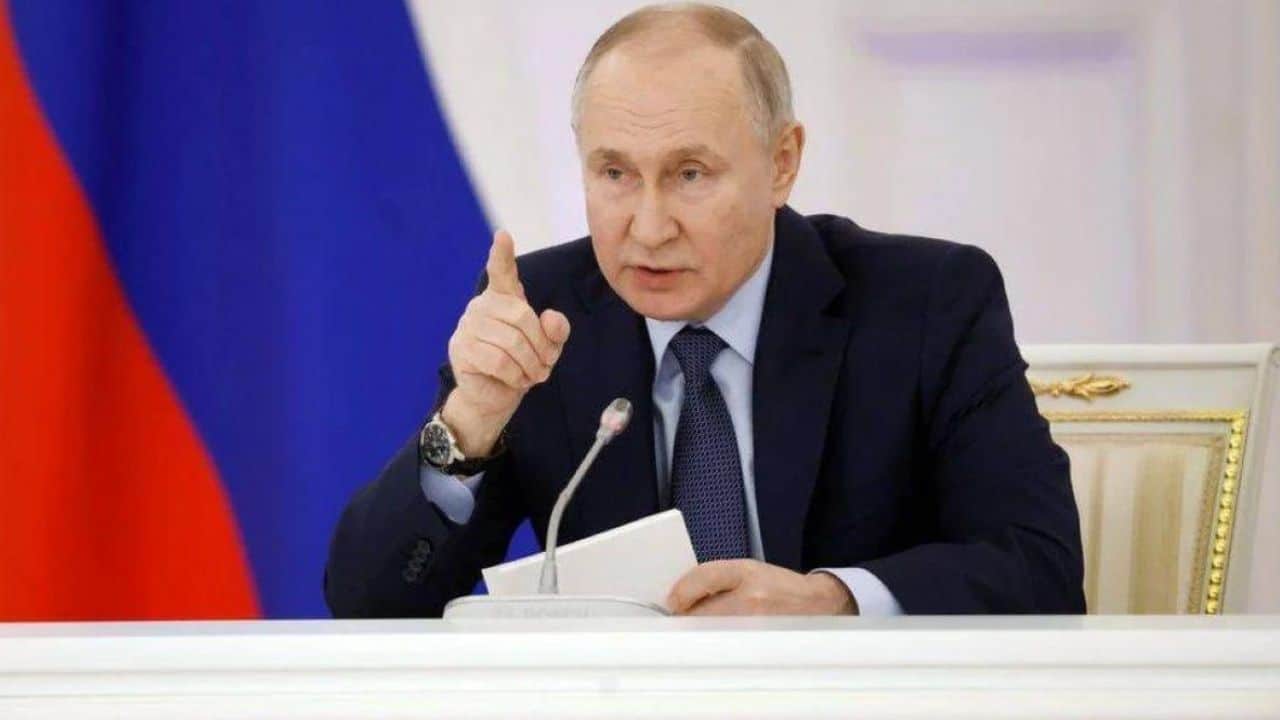
    President Vladimir Putin said Monday that Moscow will intensify strikes on military targets in Ukraine after an unprecedented attack over the weekend on the Russian city of Belgorod.

    The attack killed 24 people and left over 100 wounded in Belgorod on Saturday. It came after Moscow launched a large-scale attack on Ukrainian cities.

    “We’re going to intensify the strikes, no crime against civilians will rest unpunished, that’s for certain,” Putin said Monday during a visit to a military hospital.

    He said Russia will press on with hitting what he called “military installations.”

    “We are doing that today, and tomorrow we will continue doing it,” Putin said, almost two years into Moscow’s offensive.

    He spoke as Ukraine said Russia had hit it with a “record” number of drones on New Year’s Day.

    Putin called the Belgorod hit a “terrorist attack” and accused Ukrainian forces of targeting “right in the city centre, where people were walking, before New Year’s Eve.”

    He repeated a claim that Ukraine is being used by the West to “settle its problems” with Russia.

    The Russian leader said he believed the “strategic initiative” in the dragging conflict was on the Russian side.

    “In any case that is how I am being briefed and I always insist: any offensive operations should be done after a defeat of the enemy,” he said, according to the Interfax news agency.

  • The curious case of PTI’s missing lawyer

    The curious case of PTI’s missing lawyer

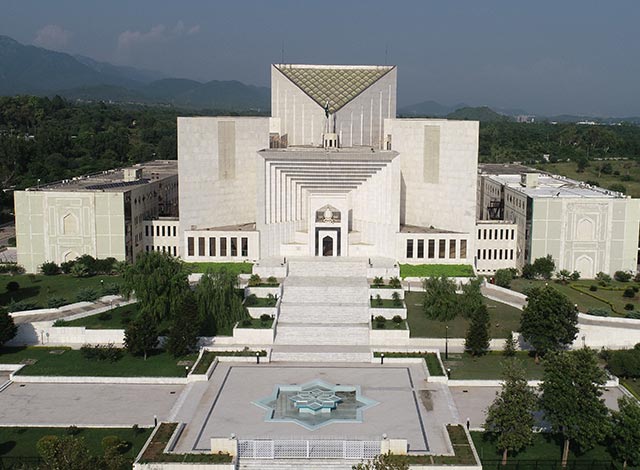
    A lawyer representing Pakistan Tehreek-e-Insaf (PTI) failed to appear before the Supreme Court of Pakistan on Monday in a case related to providing a level playing field in the upcoming elections.

    The PTI lawyer had been scheduled to appear before Chief Justice of Pakistan, Qazi Faez Isa. The Chief Justice had instructed the PTI lawyer to appear at 11 am after a recess.

    After the recess, the PTI lawyer did not appear in court, and proceedings were initiated by the Supreme Court Bench once the cases were complete.

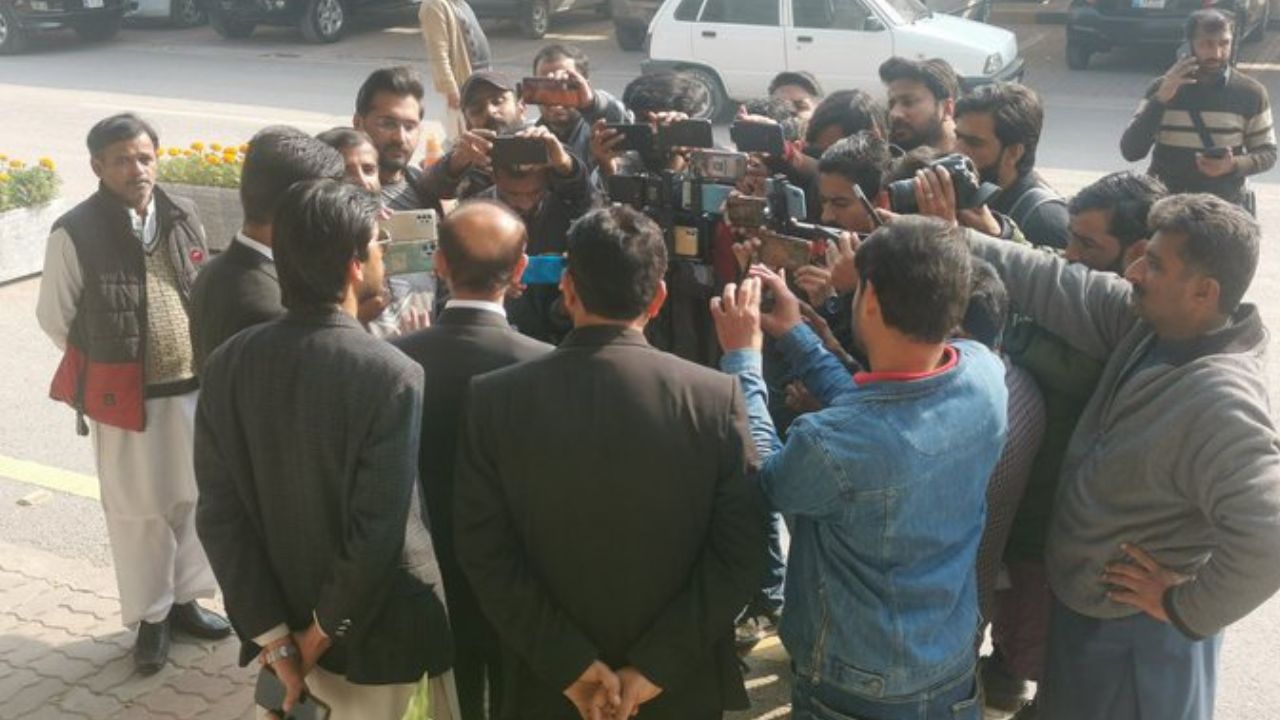
    Journalists criticized the lawyer’s absence, stating that the advocate held a press talk but didn’t focus on the case.

    PTI’s lawyer, Shoaib Shaheen, stated that his team had a meeting with the Registrar of the Supreme Court.

    He further mentioned that the Registrar had assured them that the application would be scheduled for a hearing either today or tomorrow, expressing confidence that their application will be heard. He also said that PTI’s legal team is doing their best.

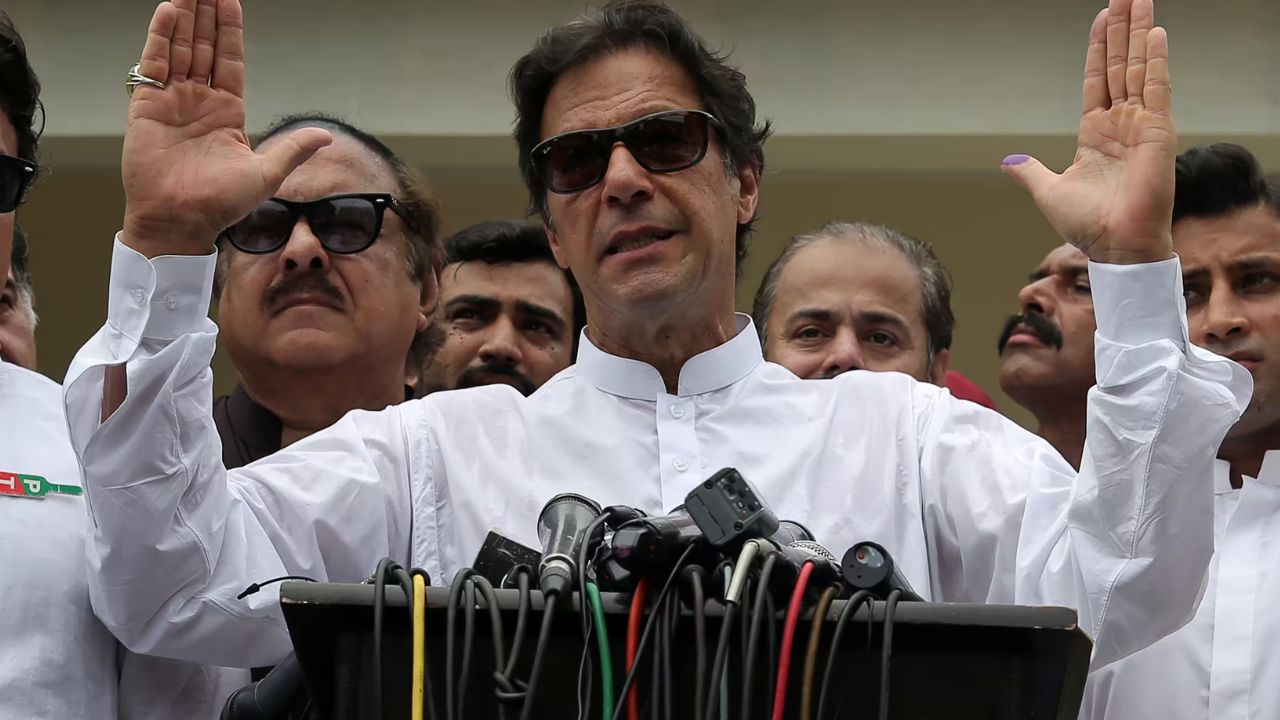
    In another electoral development, a written decision has been issued rejecting the nomination papers of former PTI Chairman Imran Khan for NA-122 and NA-89 constituencies in Lahore.

    Imran Khan’s lawyer, Rai Muhammad Ali, described in detail that he was unable to meet Imran Khan for the signing of nomination papers.

    He further stated that the Election Commission of Pakistan (ECP) changed the constituency of people at the last moment which led to the rejection of nomination papers.

    According to the decision, Imran Khan has been sentenced to five years for ethical misconduct, and he has been declared ineligible under Article 63 of the Constitution.

    The decision clarified that Imran Khan has not been disqualified or declared defunct; rather, he has been declared ineligible under Article 63, and the complainant’s objections are legal.

    It’s noteworthy that Mian Nasir Ahmad, a former PML-N MPA, had raised objections to Imran Khan’s nomination papers. After a three-year legal battle, the Election Commission decided to declare Imran Khan ineligible for five years.

    Imran Khan now has the option to file an appeal in the High Court. Appeals in the High Court Tribunal will be accepted from January 1 to January 3, and the Election Tribunal will begin hearings from January 3. The Election Tribunal will make decisions on all appeals by January 10.

    As the legal proceedings unfold, with 3345 candidates screened during the scrutiny process, the election process for the third phase of general elections 2024 is well underway. The Supreme Court and Election Tribunal will play pivotal roles in ensuring fair and transparent elections in the country.

  • Imran Khan kitnay ameer hain?

    Imran Khan kitnay ameer hain?

    It’s that time of the electoral season when we find out just how rich are the people who rule us.

    Financial details in nomination papers reveal a noteworthy surge in the assets of former Prime Minister and founding Chairman of Pakistan Tehreek-e-Insaf (PTI) Imran Khan, a rise of a whopping Rs277 million over the past five years.

    According to the documents, Imran Khan’s assets, which were valued at Rs38.694 million in 2018, have now exceeded Rs315.95 million as per the nomination papers submitted for the upcoming elections in 2023.

    Imran Khan has made public the possession of a seven kanal eight marla house in Zaman Park, Lahore, with an associated construction expenditure of more than Rs48.6 million.

    At the same time, the PTI founder also owns another piece of land in Islamabad, much smaller in size though – six kanals and 16 marlas- with a stated market value of over Rs 5 million.

    Additionally, he has disclosed ownership of a 300-kanal land in Bani Gala received as a gift.

    Notably, the former PTI chairman does not own any vehicles, as indicated in his documents.

    Other assets in Islamabad include a Rs120m shop and a two-bed apartment which has been priced at Rs34m.

    According to the documents, the items bought from Toshakhana – the infamous pieces that resulted in a case and disqualification – are valued at over Rs11.8m.

    On the other hand, the PTI founding chairman says his wife – Bushra Bibi – is the owner of 698 kanal in Deepalpur and Pakpattan besides another three-kanal house located at Banigala.

    The financial trajectory showcases a substantial increase in Imran Khan’s wealth.

    He mentioned the value of his assets at Rs38.694m in the 2018 general elections’ nomination papers, which has now reached Rs315.95m, representing a massive jump, out which over Rs60m are in cash deposited with different banks of Islamabad.

    In 2021, he declared assets valued at over Rs141 million to the Federal Board of Revenue, which further rose to over Rs320 million in 2022.

    The Federal Board of Revenue (FBR) certificate attached to his nomination papers for the upcoming elections in 2023 verifies that the current value of Imran Khan’s assets is over Rs315.9 million.

    This revelation holds significance as Imran Khan, the jailed former Prime Minister, gears up to contest the upcoming elections. The submitted details to the Election Commission of Pakistan (ECP) depict a considerable financial evolution over the specified five-year period.

  • Supreme Court to finalise lifetime disqualification case on Thursday

    Supreme Court to finalise lifetime disqualification case on Thursday

    Chief Justice of Pakistan, Qazi Faez Isa, has announced that the Supreme Court (SC) aims to finalise the proceedings on the lifetime disqualification case by January 4 (Thursday). This significant decision will determine whether the Election Act 2017 amendment aligns with Article 62(1)(F) and establishes whether lawmakers’ disqualification from contesting polls should be lifelong or limited to five years.

    The Supreme Court of Pakistan (SC) addressed the matter of lifetime disqualification of lawmakers today.

    A seven-member larger bench, headed by Chief Justice of Pakistan (CJP) Qazi Faez Isa, and comprising of Justice Mansoor Ali Shah, Justice Yahya Afridi, Justice Aminuddin Khan, Justice Jamal Mandokhail, Justice Muhammad Ali Mazhar, and Justice Musarrat Hilali.

    During the hearing of a case submitted by former PML-N provincial member Sardar Meer Badshah Khan Qaisrani last month, the top court noted discrepancies over the length of disqualification in the Election Act, 2017 and a Supreme Court ruling.

    The apex court noted that there is a contradiction regarding the duration of disqualification in the Election Act, 2017 and a SC verdict.

    In 2007, Meer Badshah Qaisrani filed a petition against his lifetime disqualification over a fake degree.

  • No surveys; PEMRA to take action against media channels violating ECP’s Code of Conduct

    No surveys; PEMRA to take action against media channels violating ECP’s Code of Conduct

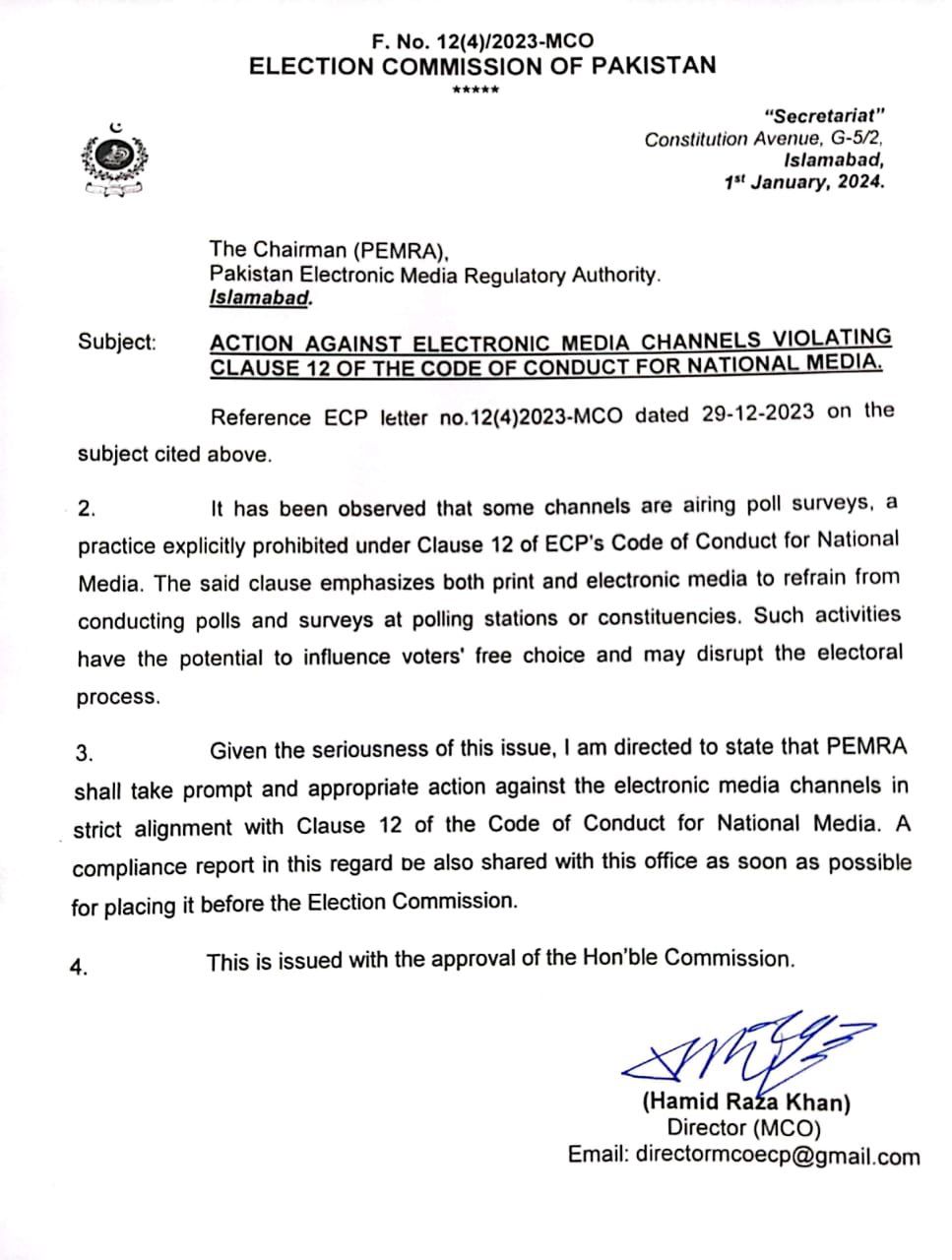
    The Election Commission of Pakistan (ECP) has officially communicated with the Pakistan Electronic Media Regulatory Authority (PEMRA), seeking strict action against media channels found violating the established code of conduct for the upcoming February 8 polls.

    The letter explicitly points out the airing of voting surveys by certain media channels. This practice, as per the ECP’s Code of Conduct for National Media, is prohibited under Clause 12.

    According to Clause 12, individuals working in print, electronic, and social media are prohibited from obstructing the election process and are required to display accreditation cards provided by the Election Commission.

    The ECP emphasized that both print and social media should refrain from conducting polls and surveys at polling stations or constituencies. The electoral watchdog stated that such activities have the potential to influence voters’ free choice and may disrupt the electoral process.

    The letter stated, “Given the seriousness of this issue, I am directed to state that PEMRA shall take prompt and appropriate action against the electronic media channels in strict alignment with Clause 12 of the Code of Conduct for National Media. A compliance report in this regard be also shared with this office as soon as possible for placing it before the Election Commission.”

    The ECP’s comprehensive 18-point code of conduct for media during elections includes provisions preventing the dissemination of content that reflects opinions prejudicial to the sovereignty, uprightness, or security of Pakistan. It also prohibits statements that could harm national solidarity or create a law and order situation.

    The regulatory framework extends to personal attacks on candidates or political parties in media content, mandating that any allegations should include comments from both sides. Monitoring responsibilities are delegated to Pemra, Pakistan Telecommunication Authority, Press Information Department, and the Cyber Wing and Digital Media Wing of the Ministry of Information and Broadcasting.

    The ECP further emphasized that these authorities are accountable for monitoring political parties’ and candidates’ coverage during election campaigns through electronic channels, print, and social media. Details of payments made by political parties and candidates must be submitted within 10 days after the poll day.

    The Election Commission of Pakistan warns that, in case of any violation of this Code of Conduct, it reserves the right to withdraw accreditation from individual journalists or media organizations. The authority to determine violations also rests with the electoral body. The media is also prohibited from airing unofficial results of a polling station until one hour after the close of the poll during the polling process coverage.