Actor Iqra Aziz is returning to the television screens with a magnum opus project after taking a brief post-pregnancy break. The Raqeeb Se heroine will star opposite Imran Ashraf and Feroze Khan in Geo TV’s next project, Sanwal Yaar Piya. Written by Hashim Nadeem, this Wajahat Rauf directorial will be produced by Shazia Wajahat.
https://www.youtube.com/watch?v=IHbpA1MMkp8&t=1s
The director took to Instagram and confirmed all speculations. Feroze Khan, Iqra Aziz, and Imran Ashraf are working in his forthcoming project Sanwal Yaar Piya which is written by renowned playwright Hashim Nadeem.
“It gives me great pleasure to announce this labour of love called Sanwal Yaar Piya in association with Geo TV, featuring this dream cast Feroze Khan, Iqra Aziz, and Imran Ashraf along with some of the most talented actors in the country. It is an honour teaming up once again with the great Hashim Nadeem sb (after Raqse Bismil) who has given us this intense story!” he wrote.
Wajahat also posted a picture of the first look of the drama with the three actors in it.
While Aziz previously worked with Feroze in blockbuster drama Khuda Aur Muhabbat Season 3, while she collaborated with Imran Ashraf in Hum TV’s Ranjha Ranjha Kardi.
The filming will commence on September 12th. It is indeed a great cast which has never appeared together on screen.
The devasting floods have killed at least 1,191 people in the country. Balochistan and Sindh are the most affected provinces of the country. Hundreds of thousands of people who were displaced by the floods since June are currently residing in camps or with host families.
As per an estimate, 8.2 million women in flood-affected areas are of reproductive age. Menstruating women in disaster-hit areas require access to safe and clean menstruation hygine products.
Many organisations are donating sanitary pads for women. However, a debate has been going around for days that whether sanitary pads should be donated or not. Some give the arguments that rural women do not use and do not know how to use sanitary pads, and donating them sanitary pads is a waste of already limited resources. While others give an argument that disposing of sanitary pads pollutes the environment.
“One study has suggested that there may be an increased risk of urogenital infections, such as yeast infection, vaginosis or urinary tract infections, when women and girls are not able to bathe and/or change or clean their menstrual supplies regularly,” a report published by the United Nations Population Fund reads.
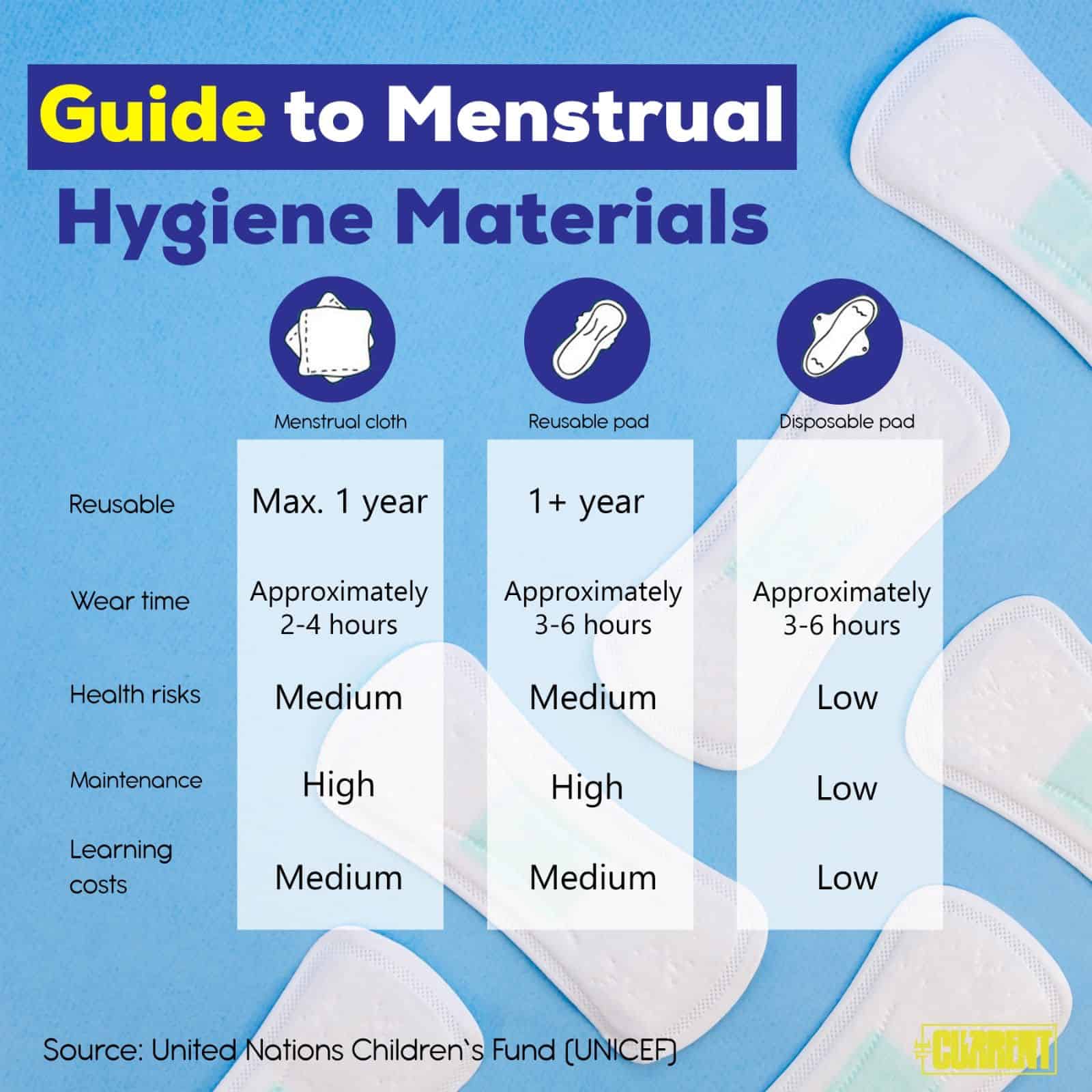
Here is the United Nations Children’s Fund (UNICEF) Guide to Menstrual Hygiene Materials:
Pads are arguably the most widely used period product the sanitary pad/napkin has been commercially available for more than a century. They are worn inside the user’s underwear and absorb menstrual blood through layers of absorbent material, often rayon, cotton, and plastic. Pad design has changed over the decades to become considerably more absorbent and pleasant, with a wide selection available to suit different flows.
Talking about the arguments going around regarding the negative consequences of using disposable pads environment Lawyer Ahmad Rafay Alam while talking to The Current about the issues said, “Women are as entitled to their dignity as men. Screaming plastic pollution at a time like this is disingenuous at best. We can work out plastic pollution issues soon. Let’s first deal with the millions of women who menstruate.”
Dr Alia Haider, who is working for the relief of flood victims in Khyber Pakhtunkhwa (KP), while talking to The Current said that women in flood-affected areas do not have access to sanitary pads or the clothes they would normally use, as all of their belongings were completely destroyed.
Talking about the need of donating sanitary pads in flood-affected areas Haider said, “It would be very unfair to give women medicines but not sanitary pads,” adding that sanitary pads are not a luxury but a basic human need.
However, she said that donating sanitary pads is not enough, a tutorial about how to use them should be sent along or people distributing them should go and teach the flood-affected women.
“When I was working in medical camps in those areas, women came to me and said they don’t need it because they don’t know how to use them, then I used to take a group of 10 to 15 women in a room and used to teach them how to use sanitary pads. I made sure that they know that these are disposable.
She continued by adding, “We can also find and coordinate with women from those communities and backgrounds who know how to use sanitary pads and they can teach their fellow community members” So we need to connect with them on a community level.”
“When I was in Rajanpur, Taunsa, a woman did not know how to use sanitary pads so a guy came to me and said do get it to them. I asked the guy if he knows someone who knows how to use sanitary pads, to which the boy replied that his wife knows how to use them. Then I asked him to bring his wife, she knew how to use it and she offered that she would teach women in that community how to use sanitary pads.”
“We can’t sit idle and say oh my God that this is not the need of the time. Not maintaining menstrual hygiene can lead to many issues including Urinary tract infection (UTI), fungal infection, and prolonged use of clothing cause menorrhagia (excessive bleeding). During my visit to flood-affected areas, almost 60 to 70 per cent of women were suffering from Menorrhagia and other infections.”
She said that she does not think there is any other option than sanitary pads because even if they are provided with clothes, they will not have the resources to wash them or reuse them. Sanitary pads are accessible and disposable so they are the best option available according to Dr Alia’s assessment.
Where can you donate?
Bushra Mahnoor, who is leading a campaign called “Mahwari Justice” along with her friend Anum, while talking to The Current said that they started the campaign when the floods hit Pakistan at the end of June.
Mahwari is an Urdu word for Menstruation and Mahwari Justice means justice for women who menstruate and who are in dire need of menstrual assistance.
Talking about why she felt compelled to start the campaign, Bushra said,” I was a kid when the 2010 foods hit Pakistan. A lot of areas near my hometown Attock were flooded. My parents would collect goods and would take them to relief camps.”
Once when she went along with her parents to a relief camp, she saw a girl who was a year or two older than her. The girl’s shirt and shalwar (trousers) were spotted with large blood stains.
“My mother approached the girl and gave her a shawl to cover herself and a piece of clothing to use [as a pad]. The young girl explained to my mother that her periods started in the relief camp and she had nothing to use as a sanitary cloth. The girl was using her dupatta to manage periods but it was barely doing the job.”
“When floods hit Pakistan this year, the image of that little girl flashed into my mind and I knew I had to do something,” said Mahnoor. She then contacted Anum and they both decided that they had to do something for the women in flood-affected areas.
“Women and their needs get neglected not only by the state but by relief campaigners as well.”
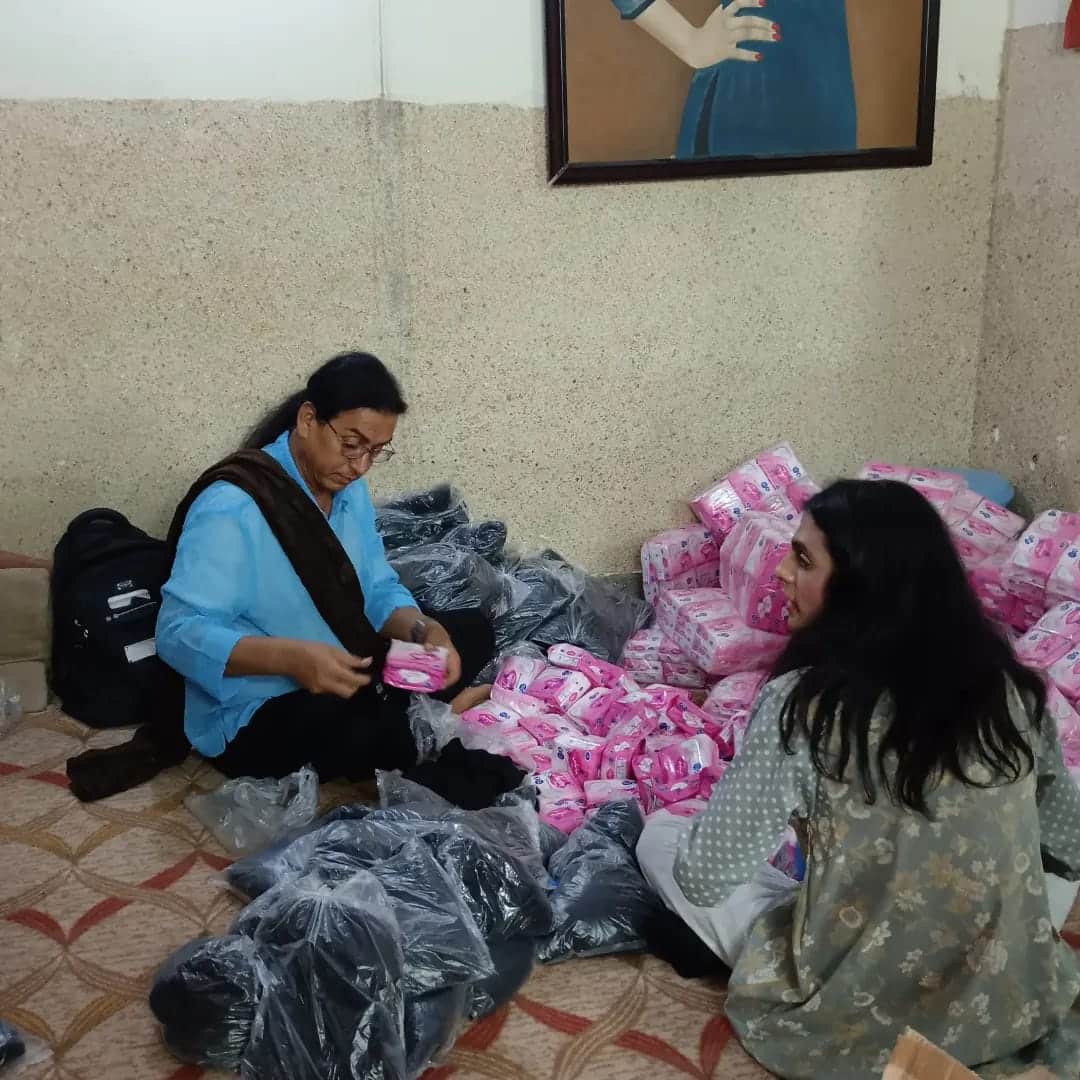
Mahnoor told The Current that Mahwari Justice is collecting sanitary napkins, cloth pads, cotton pads, underwear and sheets which they then donate to women in disaster-hit areas.
“There are many people who are saying that women in rural areas do not use sanitary pads. Why don’t they use sanitary pads? Because they do not have access to them and the critique is mostly coming from those who maybe have never used a cloth pad in their lives,” she stated.
Bushra comes from a lower-income background and for most of her life, she used a cloth pad. “Do you even realise, how uncomfortable and how unhygienic and how itchy the cloth pads are?” she wondered, adding: “I had to use cloth pads because we did not have the resources to buy sanitary napkins. It was difficult to afford sanitary napkins for six people every month.”
Mahoor further said that she agrees that sanitary pads have many problems too, but she does not understand why people think it is okay to preach about climate impact when an urgent crisis has hit the country.
“Pakistan is only contributing one per cent to the global carbon emission and women in rural areas do not make even a fraction of that one per cent.” She said she doesn’t understand why people are so worried about the waste that will be generated.
Anum Khalid, who started this campaign with Mahnoor while talking to The Current said, “If a flood victim is thirsty and you are giving them water in a plastic bottle, does that not harm the environment?”.
She continued by saying, “Bushra and I started this campaign to provide immediate relief to women or other menstruators from the issues they face from continuous bleeding.”
United Nations (UN)’s report on Guide to Menstrual Hygiene products suggests that consultation should be done on what products women are comfortable using because different materials and products are utilised for this purpose.
Anam said that they now send information about how to use sanitary pads along with their sanitary kits. They are also providing cloth pads for women in the areas where women ask for them because of their cultural preferences.
She continued by adding that our volunteers are teaching women in rural areas in their own language how to correctly use sanitary napkins.
She concluded by saying that the debate about whether something is a luxury or a basic need in times of crisis was tragic. “Our justice campaign, I believe, is helping to change the belief that sanitary pads are luxury,” she stressed.
🚨Appeal for donations 🚨
Help us reach more flood-affected women and girls!
Jemima Goldsmith is auctioning a private screening of her upcoming movie What’s Love Got To Do With It to collect donations for flood victims of Pakistan. The movie stars Sajal Aly and Shabana Azmi in key roles.
“In aid of Pakistan’s flood victims, We are auctioning a private screening in London for up to 20 people of our film What’s Love Got To Do With It? See you there,” Jemima wrote in a tweet.
“One lucky winner along with 20 friends will have a private screening of What’s Love Got To Do With It? written by Jemima Khan and directed by Shekar Kapur at Working Title Films, London. This exclusive opportunity, hosted by Jemima Khan and Fatima Bhutto, means that the winner can see What’s Love Got To Do With It? before its theatrical release. The winner can choose their guests and time and date, two weeks before the film’s release in January 2023, subject to the private theatre’s availability. Jemima will introduce the film and Fatima will join her to say hello to the auction winners. This is a once-in-a-lifetime opportunity.”
In aid of Pakistan’s flood victims 🇵🇰🙏🏼🇵🇰🙏🏼 We are auctioning a private screening in London for up to 20 people of our film What's Love Got To Do With It? See you there 💚 https://t.co/BiAmbgvVG2
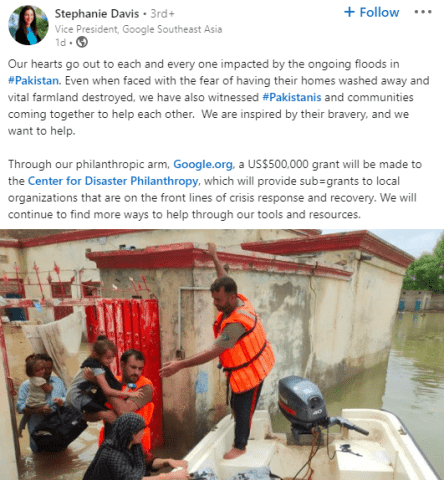
Tech giant Google has announced that it will donate $500,000 (Rs110 million) for flood relief efforts in Pakistan.
Google Southeast Asia Vice President Stephanie Davis posted on LinkedIn that the tech giant would donate the amount to the Centre for Disaster Philanthropy through Google.org.
In a post, she wrote: “Our hearts go out to each and everyone impacted by the ongoing floods in Pakistan. Even when faced with the fear of having their homes washed away and vital farmland destroyed, we have also witnessed Pakistanis and communities coming together to help each other. We are inspired by their bravery, and we want to help.”
She added that the company would find more ways to help Pakistan through its tools and resources.
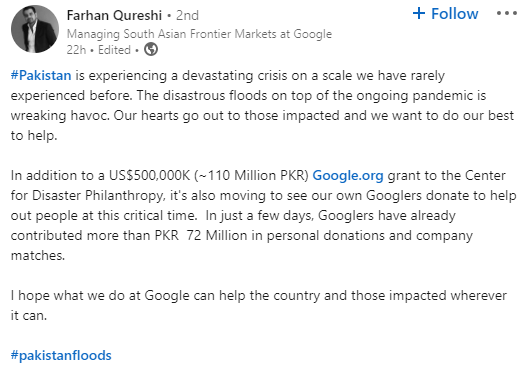
Separately, Google’s Regional Head for South Asian Frontier Markets Farhan Qureshi said Google employees have contributed over Rs72 million so far in personal donations and company matches.
Earlier this week, Apple Chief Executive Officer Tim Cook said his company would donate to relief and recovery efforts on the ground.
“The floods in Pakistan and surrounding areas are devastating humanitarian disasters. Our thoughts are with those that have lost loved ones, the many displaced families, and all those affected,” he tweeted.
The floods in Pakistan and surrounding areas are devastating humanitarian disasters. Our thoughts are with those that have lost loved ones, the many displaced families, and all those affected. Apple will donate to relief and recovery efforts on the ground.
Suzuki has also decided to offer aid to Pakistan in support of the flood victims. According to an official notification, the company will offer a relief fund of 10 million Japanese Yen (Rs15.6 million).
Water levels continued to rise on Friday as the overall death toll from the devastating floods has crossed 1,200.
The Islamabad High Court (IHC) has fixed a contempt case against former Gilgit-Baltistan (GB) Chief Judge (CJ), Dr Rana Muhammad Shamim, on September 5.
Islamabad High Court has fixed contempt case against ex chief judge GB Rana Shamim etc on September 5. Rana Shamim is accused to influence the judicial proceedings in Maryam case through leaking his affidavit to media before hearing. pic.twitter.com/Ho5E6DtDgc
Shamim allegedly signed an affidavit that incriminates former Chief Justice of Pakistan (CJP) Mian Saqib Nisar.
The affidavit contained allegations that Saqib Nisar attempted to influence a case against former Prime Minister (PM) Nawaz Sharif and his daughter, Maryam Nawaz, in an attempt to bring Imran Khan into power.
The authenticity of the affidavit, which surfaced in one of Pakistan’s leading newspapers in November 2021, has been in question.
Journalist Ansar Abbasi who published this investigative report has also been called in for contempt of court.
At the time, IHC Chief Justice Athar Minallah deferred the framing of charges against the media personnel who were also named in the case, including journalist Abbasi and Jang Group owner Mir Shakeel-ur-Rehman.
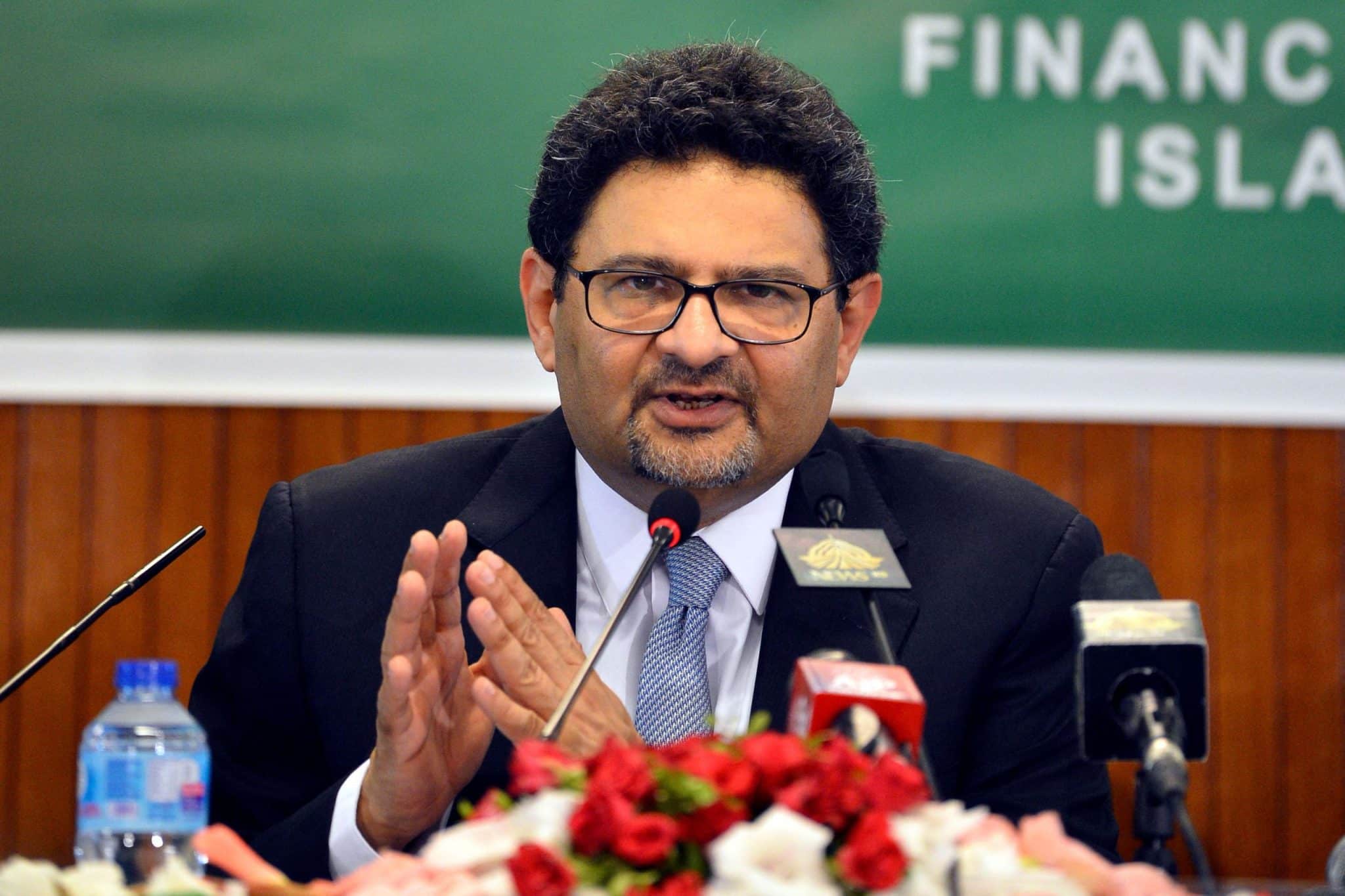
Finance Minister Miftah Ismail on Friday, September 2, said that the government has 13 months more of its tenure but he may not have that much time left.
Addressing a seminar in Karachi, the Finance Minister said, “The government has 13 months but I may not have that much time,” said Ismail, hinting at the increasing criticism and dissatisfaction that his party has expressed over his performance.
In recent times, Pakistan Muslim League-Nawaz (PML-N) supremo Nawaz Sharif has shown dissatisfaction in how Miftah is handling the country’s economy.
‘Misleading and incorrect’: Nawaz Sharif reacts to reports that he is ‘dissatisfied with Shehbaz’
Pakistan Muslim League-Nawaz (PML-N) supremo Nawaz Sharif has distanced himself from statements attributed to him regarding his brother and Prime Minister Shehbaz Sharif. He said that they are “misleading and incorrect”.
“I remain hopeful that the sincere and tireless efforts by SS under the most challenging circumstances will bear fruit and he will steer the country out of the mess created by Imran Khan,” tweeted Nawaz Sharif.
The negative comments attributed to me about PM Shahbaz Sharif are misleading and incorrect. I remain hopeful that the sincere and tireless efforts by SS under the most challenging circumstances will bear fruit and he will steer the country out of the mess created by Imran Khan.
Nawaz Sharif’s tweet came after senior analyst Suhail Warraich revealed that he is not satisfied with the performance of his brother Shehbaz Sharif or Finance Minister Miftah Ismail. Warraich said Nawaz wants Shehbaz to review his policies.
“Nawaz had already said that they should not take over the government and go towards elections. It seems like he [Nawaz Sharif] has made up his mind that he wants the economic policies reviewed, and he would want Ishaq Dar to manage it. He [Nawaz Sharif] does not trust Miftah Sahib,” said Warraich on Geo News programme ‘Aaj Shahzeb Khanzada Kay Sath’.
عمران خان خطرے میں ہیں مگر ابھی بھی معاملات کیسے بہتر کرسکتے ہیں؟ دیکھیے سینئر صحافی سہیل وڑائچ کا تجزیہ
“Mian Sahab repeatedly kept telling me to go and meet Shehbaz Sharif and ask him what are these policies and that he [Shehbaz Shairf] needs to review his policies,” said Warraich.
Warraich said that Nawaz is not happy with PML-N’s present narrative.
Warraich further revealed that Nawaz’s next narrative will be directed against the judiciary, not the army. He said Nawaz will write a letter to the Supreme Court of Pakistan to complain about the delay in hearing of his cases.
The senior analyst said that Nawaz Sharif believes that like Quaid-e-Azam, cases should be faced without being jailed, and added the former premier is of the view that he should return once the jail issue is resolved.
“Nawaz believes Imran is a fascist who needs to be dealt with first, while matters of democracy can be taken care of later,” Warraich added.
Suhail Warraich recently met Nawaz Sharif in London.
This is not the first time Nawaz Sharif has reacted to his brother’s policies and government. Earlier this month, PML-N leader Maryam Nawaz tweeted that Nawaz Sharif was unhappy with the government for increasing petrol prices.
“Mian Sahib strongly opposed this decision and even said that I cannot burden the people with one more penny. And if there is any compulsion of the government, I am not involved in this decision and he left the meeting,” tweeted Maryam.
The International Monetary Fund (IMF) has issued its country report for Pakistan, exposing erroneous policies implemented by the PTI administration that, according to the Fund, undermined the country’s currency reserves and led to the rupee’s devaluation.
The study also discloses what the present administration, led by the PML-N, has promised the international lender, according to Samaa.
The study does not identify any political party, but it does mention rising GDP, which the PTI has said is the outcome of its policies. Pakistan’s GDP increased by 6 per cent in fiscal year 2021-22 (FY22), which ended less than three months after Imran Khan was overthrown by parliament in early April.
According to experts, the increase in GDP was driven by unsustainable expansion, which resulted in economic overheating. The IMF study comes to the same conclusion.
According to the Fund, GDP growth in FY22 was “driven by permissive fiscal policy and a delayed monetary reaction to inflationary pressures.”
These factors, together with worldwide food and fuel price shocks, resulted in a major worsening of the external situation, including an unsustainable current account deficit, a considerable decrease in reserves, and a significant devaluation of the rupee.
The PTI administration failed to respond to the worldwide commodity price increase, and its policies caused the rupee to depreciate and currency reserves to dwindle, according to the international lender.
Pakistan is at a crossroads in its economic development. Internal demand reached unsustainable levels as a result of a challenging external environment paired with procyclical domestic measures. According to the IMF, the resulting economic overheating resulted in high fiscal and external deficits in FY22, contributed to increasing inflation, and destroyed reserve buffers.
The PTI administration broke its pledges quickly after collecting roughly $1 billion from the IMF. Following the completion of the sixth evaluation, programme implementation worsened. In the midst of a volatile political scene, planned fiscal adjustment was reversed, and some significant EFF agreements were honoured, as per the report.
According to the report, the present administration has informed the Fund that it would reimpose the general sales tax (GST) on petroleum products and will not provide any fuel subsidies.
The current administration will not declare a tax amnesty unless Parliament first approves it. It will also simplify the sales tax on services throughout the country. Currently, different provincial territories apply varying rates of sales tax on services.
The Fund takes notice of the actions implemented by the PML-N administration to re-establish the IMF programme, including a budget based on a basic surplus, a rise in interest rates, and the elimination of fuel subsidies.
The IMF has advised the government to maintain a market-based currency rate, enhance tax income, and strengthen foreign reserves. The IMF also said that the lending programmes entail exceptional risks even after policy adjustments.
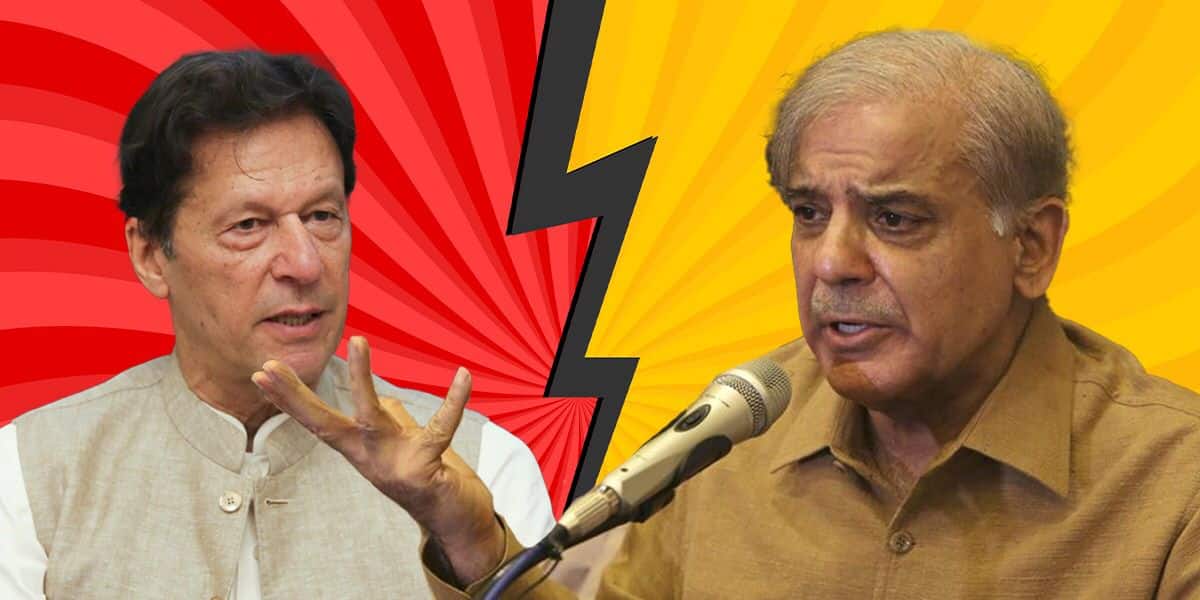
Prime Minister (PM) Shehbaz Sharif did not mince his words when talking about Pakistan Tehreek-e-insaf (PTI) Chairman Imran Khan.
“Thank God Pakistan was saved from default. Imran Khan wanted Pakistan to become Sri Lanka. Look at his real face,” said the PM on Thursday. He stated that after the crucial International Monetary Fund (IMF) programme restarted for Pakistan, the country was able to stand back on its feet.
“I was sitting in a meeting when the minister of finance gave me the news [of the IMF bailout package], so I told him in front of everyone that Pakistan was saved from default,” he said.
اللہ کا شکر ہے کہ پاکستان ڈیفالٹ سے بچ گیا جو عمران خان چاہتا تھا کہ پاکستان سری لنکا بن جائے انہوں نے آئی ایم ایف سے معاہدے کی راہ میں روڑے اٹکانے کیلیے خط لکھے.وزیراعظم محمدشہبازشریف pic.twitter.com/k2pdU2ev8u
“But at least we were saved from a default which is what Imran Khan wanted. A man who gets letters written just so that the IMF programme could fail […] tell me, is there a worse way to show hatred with the country?”
Shehbaz Sharif was referring to Khyber Pakhtunkhwa Finance Minister Taimur Khan Jagra’s letter to the finance division, asserting that it had proven PTI chief’s intention to sabotage the country’s fate.
Shehbaz went on to say that only thinks about himself and said, “Imran Khan kay sur par main sawar hon, aur uski apni main sawar hai tu Pakistan ka kya banay ga? [What will become of Pakistan if he only keeps thinking of himself?]”
جس شخص (عمران خان) پہ "میں" سوار ہو تو پھر پاکستان کا کیا حال ہوگا.مجھے تو اتنی فرصت نہیں اس نے جو جھوٹی فائلیں بنائی تھی میں انکو بھی دیکھ سکوں کیونکہ مجھے تو عوام کی خوشحالی کی فائل دیکھنی ہے.وزیراعظم محمد شہبازشریف pic.twitter.com/9n2aKUiVXU
The prime minister said that when he was in the opposition, Imran Khan conspired to send his members to jail, but they did not create a fuss. “Now everyone should look at Khan’s language.”
PM Shehbaz said that the exemption for fuel adjustment charges (FAC) in August’s billing will apply to consumers who use under 300 units of electricity.
Pakistan Tehreek-e-Insaf (PTI) Chairman Imran Khan’s Chief of Staff Dr Shahbaz Gill approached Islamabad High Court (IHC) on Friday, September 2, after failed efforts to get bail from a trial court in a sedition case filed against him.
Gill requested that he should be released on bail, stating that senior doctors at Pakistan Institute of Medical Sciences (PIMS) performed a medical examination on August 17 and the medical board found “evidence of physical torture”.
The court has fixed a hearing on September 5.
Shahbaz Gill’s bail plea dismissed in sedition case
A district and sessions court in Islamabad dismissed the post-arrest bail petition of Gill on Tuesday (August 30).
Additional District and Sessions Judge Zafar Iqbal pronounced the reserved verdict.
Shahbaz Gill was taken into custody on August 9 from Bani Gala Chowk for inciting the public against state institutions.
There have been claims of torture and sexual abuse by Gill during his detention.
PTI leader Shireen Mazari said that the rejection of Gill’s plea was “shameful”.
She alleged that the “state is hellbent on torturing Gill to try and get to IK”.
Shameful how bail was denied to Shahbaz Gill today. State is hellbent on torturing Gill to try and get to IK. His torture is now evident before the world. How far will Conspirators go in desperation to Get IK! So far they have failed at each turn of their vicious plotting!
Islamabad court rejects plea to send Gill on physical remand
A district and sessions court in Islamabad rejected a request by the Islamabad Police for an extension in the physical remand of Pakistan Tehreek-e-Insaf (PTI) leader Shahbaz Gill on August 24. He is under custody in a sedition case.
Another case has also been registered against Gill over possession of an illegal weapon.
The prosecution sought an extension in Gill’s physical remand, which was strongly opposed by PTI’s lawyers. After hearing the arguments, the court sent Gill on judicial remand.
Islamabad court approves two-day physical remand of Shahbaz Gill
A district and sessions court on Monday (August 22) granted a two-day physical remand of PTI Chairman Imran Khan’s chief of staff, Shahbaz Gill, to the Islamabad Police in a sedition case.
Islamabad court grants two-day physical remand of Shahbaz Gill in sedition case pic.twitter.com/1GTuAUTjfp
Gill was presented in court today after he was discharged from the Pakistan Institute Of Medical Sciences (PIMS) hospital, where he was admitted last week.
During the hearing, the judge asked about his medical report and remarked that the decision to grant an extension in remand will be taken after reviewing the report.
Gill told the court: “I was fed forcefully; 10-12 people shaved me; they lied to me about my bail.”
Earlier, a video of Gill surfaced on the internet where he can he heard saying that he is eating in protest.
United Kingdom (UK) Member of Parliament (MP) Claudia Webbe has called on the international community to cancel Pakistan’s debt as the country’s inflation hits the highest level since 1973.
In a statement on Twitter, Webbe said, “Inflation in Pakistan is at an all-time high at 27 per cent! Pakistan’s international debt should be immediately cancelled – they should instead be given reparations for the climate crisis caused.”
According to the Pakistan Bureau of Statistics (PBS), Pakistan’s Consumer Price Index-based inflation (CPI) climbed by 27.3 per cent on a year-over-year basis in August 2022.
Inflation in Pakistan is at an all time high at 27%!
Pakistan’s international debt should be immediately cancelled – they should instead be given reparations for the climate crisis caused.
Prior to this statement, she repeatedly urged foreign countries to stand shoulder to shoulder in full solidarity with Pakistan and termed the silence from western countries a “moral crime”.
“We need a global climate tax so that the global rich can be made to pay for the climate damage they cause in the world,” she said.
Silence from Western Political leaders while Pakistan floods is a moral crime.
This is the time to stand shoulder to shoulder in full solidarity with Pakistan.
We need a global climate tax so that the global rich can be made pay for the climate damage they cause in the world.
She also blamed rich countries for the climate crisis and said that they should bear the cost, not Pakistan, as the country is responsible for 1 per cent of global emissions.
A tragedy is unfolding.
Pakistan is responsible for 1% of global emissions. It’s completely wrong that it has to bear the brunt of climate change.
The super rich caused the climate crisis. The super rich should bear the cost.
Water levels continued to rise on Friday as the overall death toll from the devastating floods has crossed 1,200.
On Thursday, the UK announced an additional £15 million of lifesaving support for flood victims in Pakistan.
More than 33 million people are affected — one in every seven Pakistanis — and reconstruction work will cost more than $10 billion.
United Nations (UN) chief Antonio Guterres called the floods a “climate catastrophe” and launched an appeal for $160 million in emergency funding. Meanwhile, western countries have also donated millions of dollars to Pakistan.