Blog

  • Yasir Hussain denies calling Turkish actors ‘kachra’, is upset with Anoushey Ashraf for calling him out on social media

    Yasir Hussain denies calling Turkish actors ‘kachra’, is upset with Anoushey Ashraf for calling him out on social media

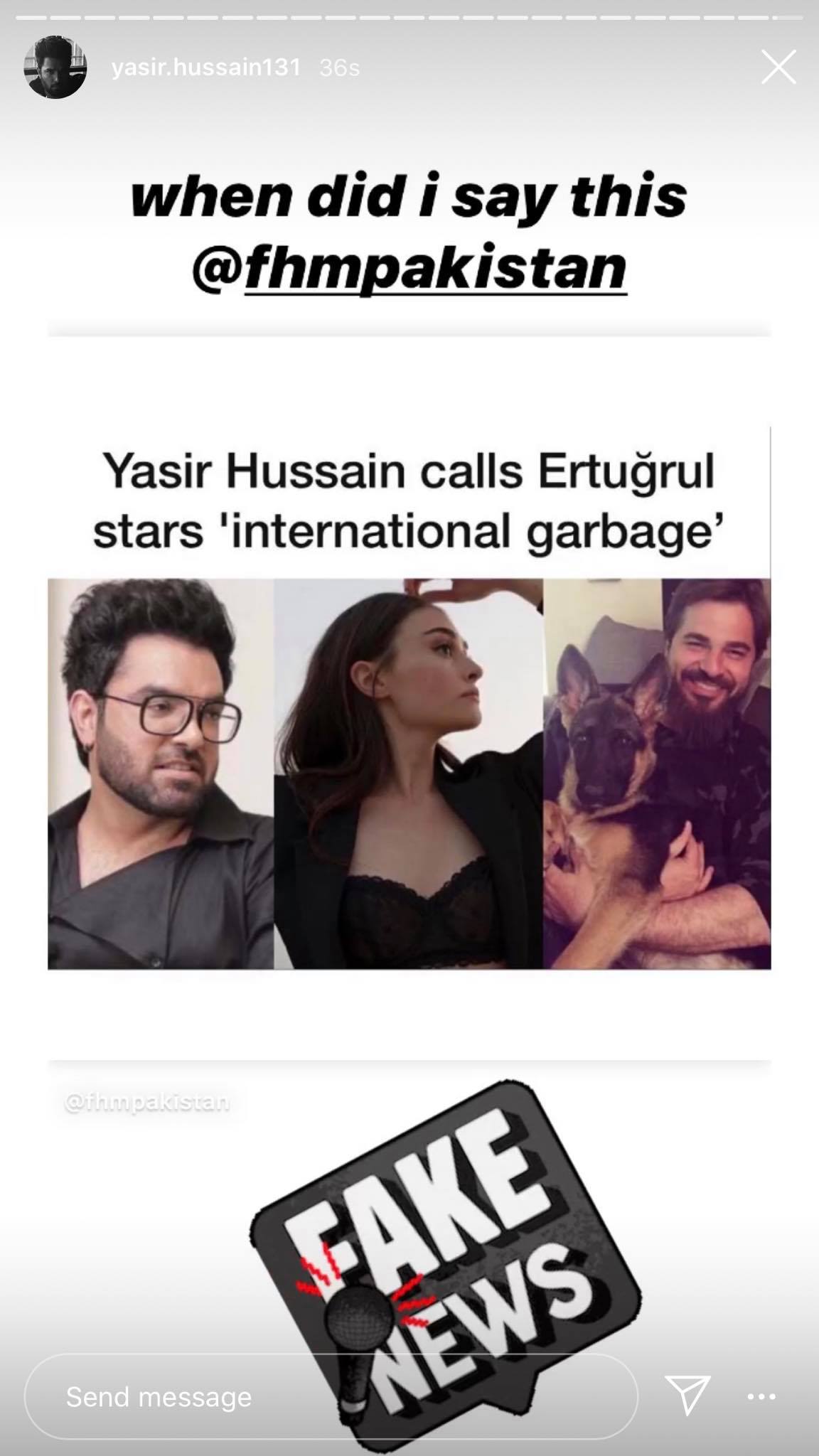
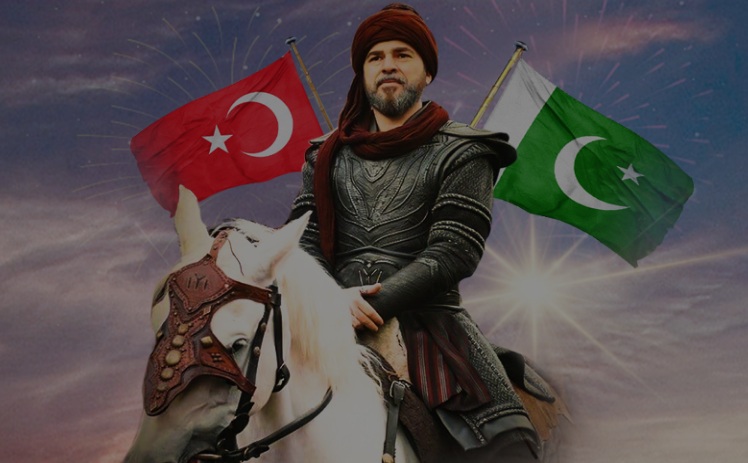
    Yasir Hussain and his comments on Turkish actors have found themselves in hot waters once again. The actor was reported to have likened Turkish actors to ‘kachra‘ (garbage). According to details, Yasir while sharing a picture of ‘Pakistani Turgut and Pakistani Ertuğrul’ had commented: “Inko koi nahi poochega (no one will give them any attention). Kyunke ghar ki murgi daal barabar or bahar ka kachra bhi maal barabar,” insinuating that Pakistanis do not appreciate local talent enough.

    Minutes after Hussain posted this story, people began to call out the actor and strongly criticised him for his remarks.

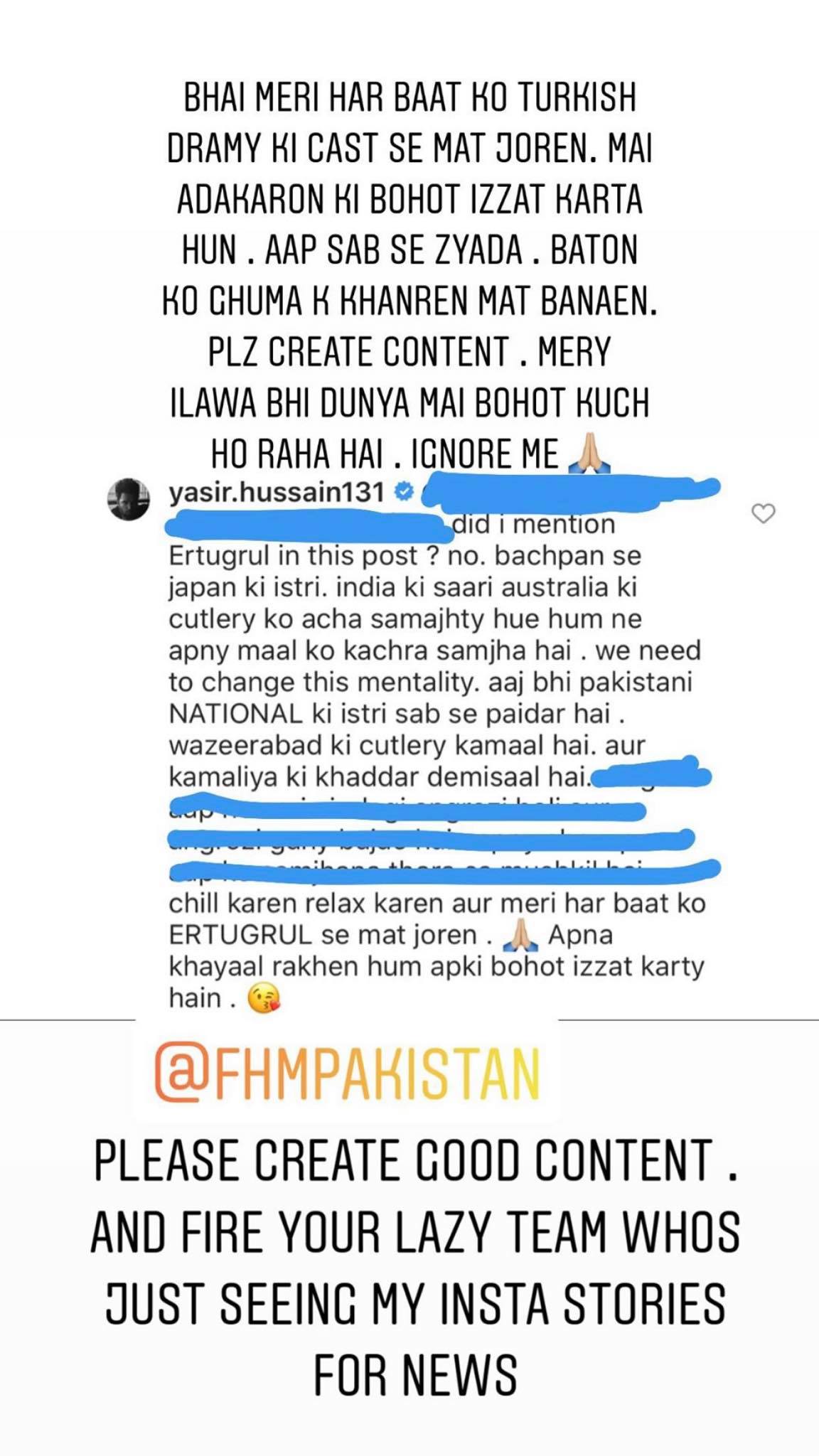
    However, Hussain denied making these comments, saying that the publications twisted his words.

    He said that every comment of his is not connected to the cast of Diriliş: Ertuğrul and that he respects them all before concluding “Ignore me”.

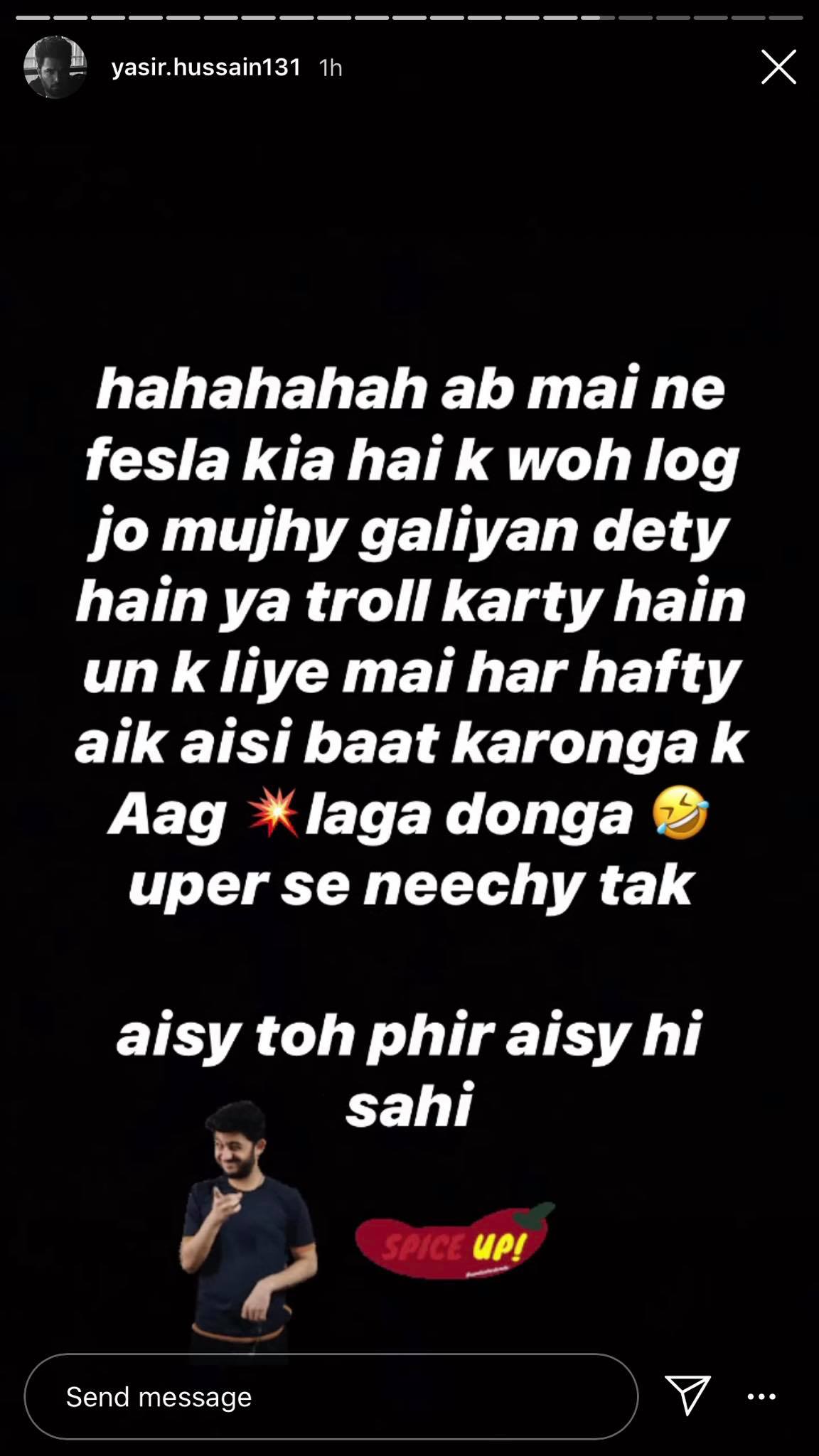
    The actor also joked that he will pass controversial comments every week to irk those who get offended by his comments and abuse him.

    Yasir Hussain vs Anoushey Ashraf

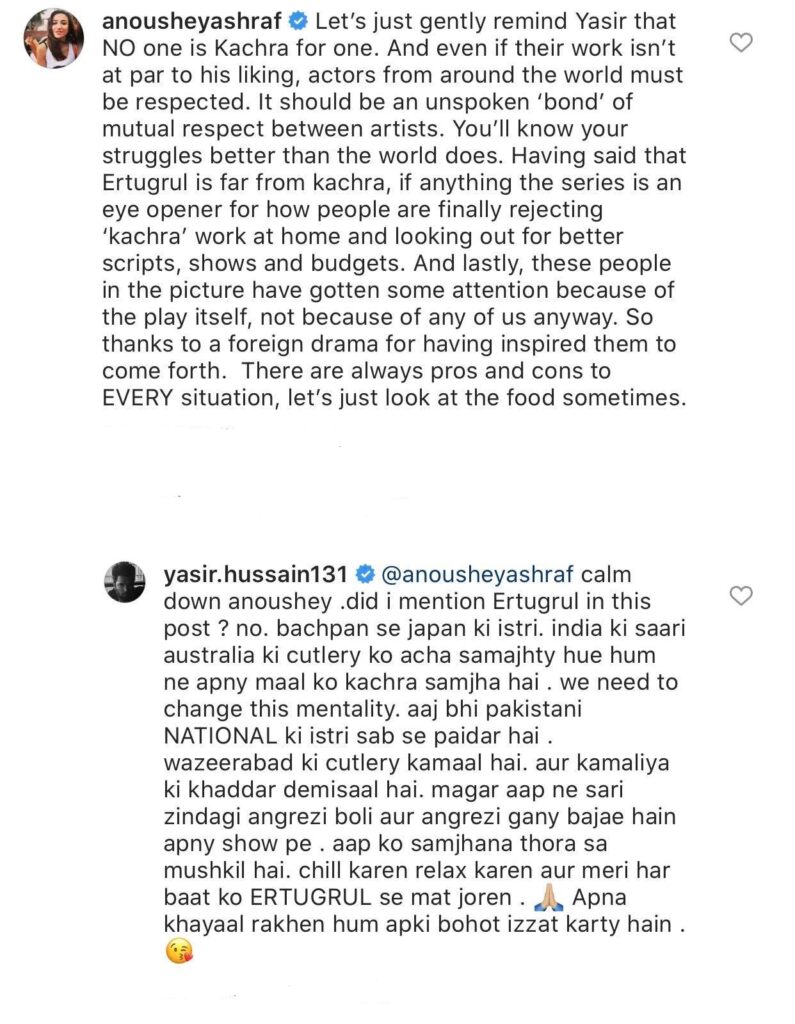
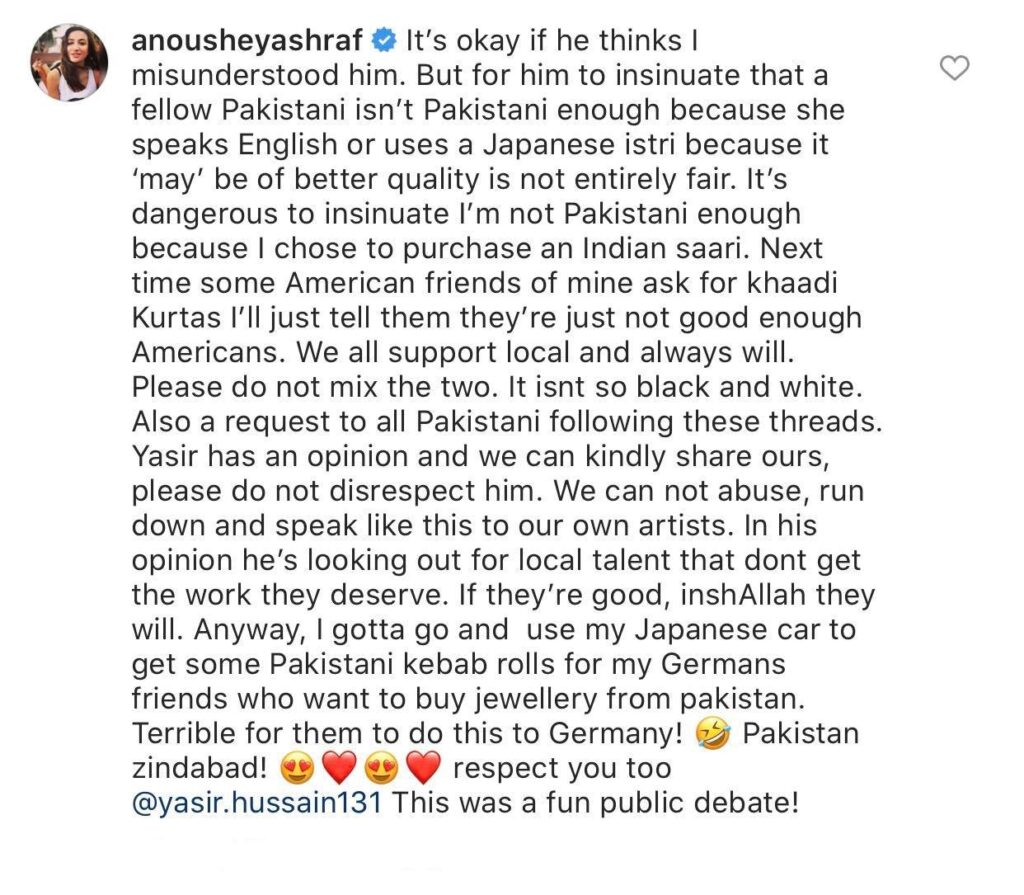
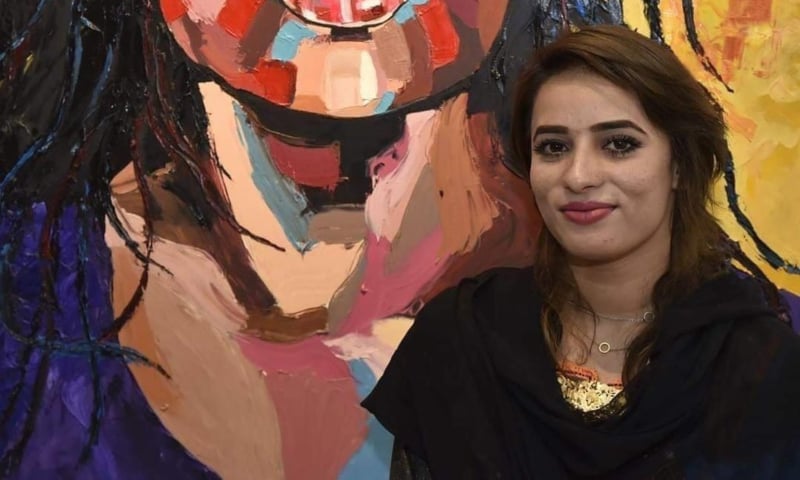
    Among those who called out Yasir for his comments was Anoushey Ashraf who “reminded Yasir that no one is kachra for one.” However, Yasir hit back at Ashraf saying that Pakistanis have always preferred international brands over local ones.
    Anoushey responded by saying that “It’s dangerous to insinuate I’m not Pakistani enough because I chose to purchase an Indian saari.”

    “We all support local and always will,” said Anoushey.

    Anoushey’s comments were widely circulated on social media, which upset Yasir, who then expressed his disappointment with Anoushey for calling him out on social media instead of sending him a message on Whatsapp.

    “Don’t need this kind of fame buddy,” said Anoushey in response to Yasir’s comment. “Just stood up for what I thought was right.”

    It is pertinent to mention here that earlier Anoushey had defended Yasir when he had likened Turkish dramas to landay ke kapray. After Yasir had been strongly criticised and been at the receiving end of personal attacks, Anoushey had urged her followers to respect Yasir’s decision and not abuse him because that’s what Ertuğrul would have done.

    “Yasir shared an opinion,” wrote Anoushey. “Your Ertuğrul wouldn’t have lectured, hated and abused him. He would have seen it as exploring’two sides to a story’.”

  • VIDEO: Three-time champion Novak Djokovic defaults out of US Open after hitting line judge with ball

    VIDEO: Three-time champion Novak Djokovic defaults out of US Open after hitting line judge with ball

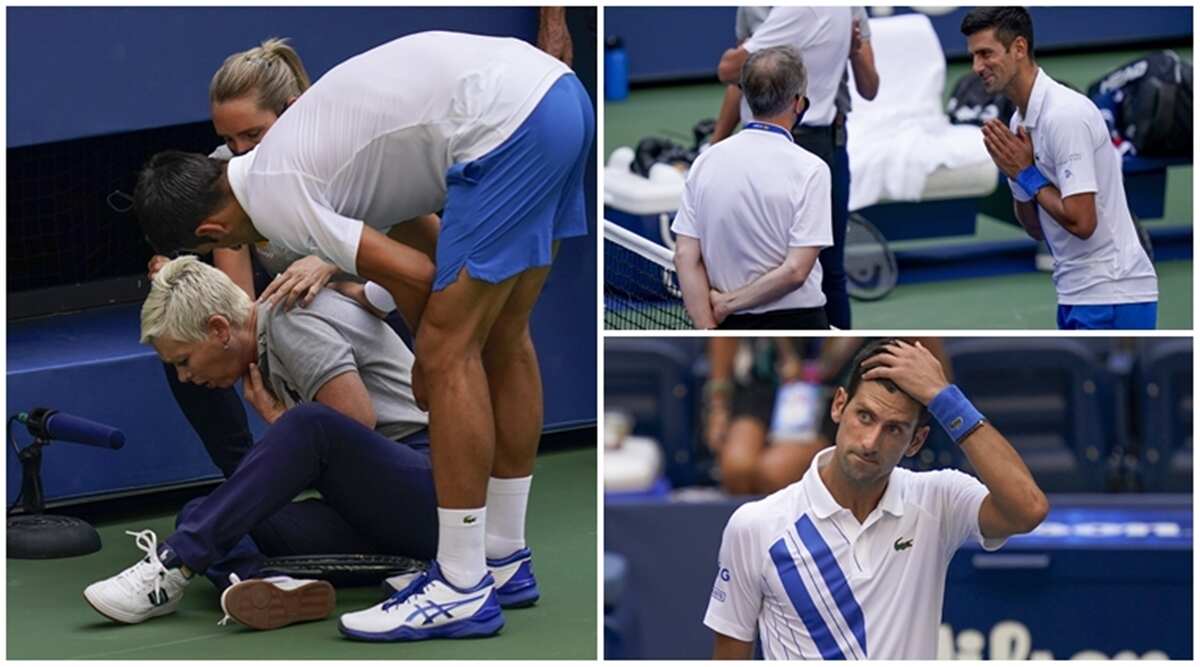
    Novak Djokovic’s charge to his 18th Grand Slam title ended on Sunday after the Serbian defaulted following his petulant swipe at the ball that hit a line judge in the throat that resulted in the world number one’s disqualification from the US Open.

    The dramatic moment came when the overwhelming title favourite reacted angrily to going 5-6 down to Spain’s Pablo Carreno Busta in the first set of their fourth-round encounter at an empty Arthur Ashe Stadium.

    What would have been an innocuous incident had the ball flown a foot either side of the official instead left her lying on the ground, clutching her throat and screaming in pain.

    There was no question that Djokovic hit her inadvertently, and he quickly rushed to apologise, but it was a clear breach of Grand Slam rules forbidding the physical abuse of anyone within the tournament precincts.
    WATCH VIDEO:

    https://www.youtube.com/watch?v=4MF46cTBL8s

    Tournament referee Soeren Friemel came out and spoke to chair umpire Aurelie Tourte and Andreas Egli, the Grand Slam supervisor, before a long chat with the three-times US Open champion.

    Djokovic, who was clearly making the point that he had not intended to hit the official, was overheard saying “she doesn’t have to go to hospital for this” but after 12 minutes of pleading his case his fate was sealed.

    “I don’t think that there was any chance of any opportunity or any other decision than defaulting Novak,” Friemel later told reporters.

    “The facts were so clear and so obvious … (the line judge) was clearly hurt and Novak was angry, he hit the ball recklessly, angrily back.”

    A tournament spokesman told Reuters the line judge appeared to be okay and was “not brought off-site”. Her identity is not known. Djokovic eventually walked over to shake hands with a stunned Carreno Busta and trudged off the court before leaving the grounds without attending a press conference.

    The 33-year-old Serbian later posted an apology on Instagram.

    View this post on Instagram

    This whole situation has left me really sad and empty. I checked on the lines person and the tournament told me that thank God she is feeling ok. I‘m extremely sorry to have caused her such stress. So unintended. So wrong. I’m not disclosing her name to respect her privacy. As for the disqualification, I need to go back within and work on my disappointment and turn this all into a lesson for my growth and evolution as a player and human being. I apologize to the @usopen tournament and everyone associated for my behavior. I’m very grateful to my team and family for being my rock support, and my fans for always being there with me. Thank you and I’m so sorry. Cela ova situacija me čini zaista tužnim i praznim. Proverio sam kako se oseća linijski sudija, i prema informacijama koje sam dobio, oseća se dobro, hvala Bogu. Njeno ime ne mogu da otkrijem zbog očuvanja njene privatnosti. Jako mi je žao što sam joj naneo takav stres. Nije bilo namerno. Bilo je pogrešno. Želim da ovo neprijatno iskustvo, diskvalifikaciju sa turnira, pretvorim u važnu životnu lekciju, kako bih nastavio da rastem i razvijam se kao čovek, ali i teniser. Izvinjavam se organizatorima US Opena. Veoma sam zahvalan svom timu i porodici što mi pružaju snažnu podršku, kao i mojim navijačima jer su uvek uz mene. Hvala vam i žao mi je. Bio je ovo težak dan za sve.

    A post shared by Novak Djokovic (@djokernole) on

    “This whole situation has left me really sad and empty,” he wrote. “I’m extremely sorry to have caused her such stress. So unintended. So wrong.

    “I apologise to the (US Open) and everyone associated for my behaviour.”

  • Loyalty in a partner and attending Oxford is what Pakistanis want

    Loyalty in a partner and attending Oxford is what Pakistanis want

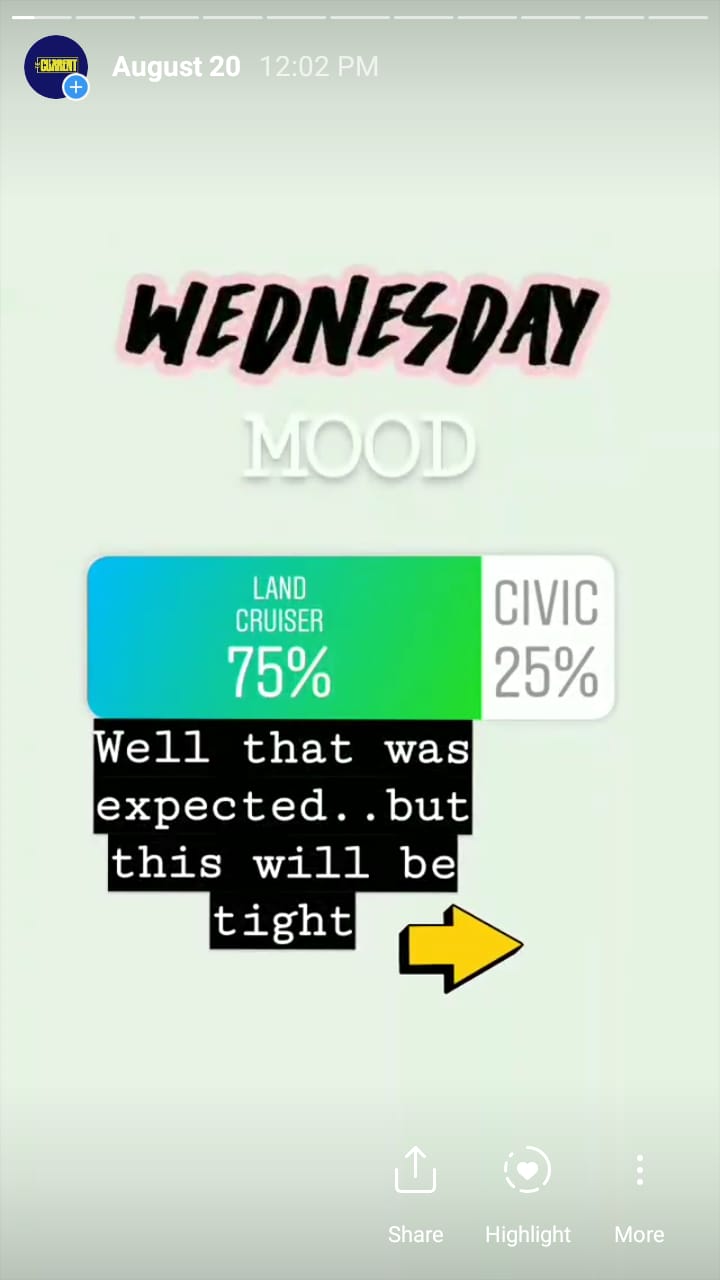
    The Current starts its day with a morning mood to engage followers and find out what they are interested in. This is done via a ‘this or that’ poll and the winner had to compete the same category the next day. It is done over a week’s time and we found out a lot about our followers – and Pakistanis – based on what they vote for.

    Food Wars

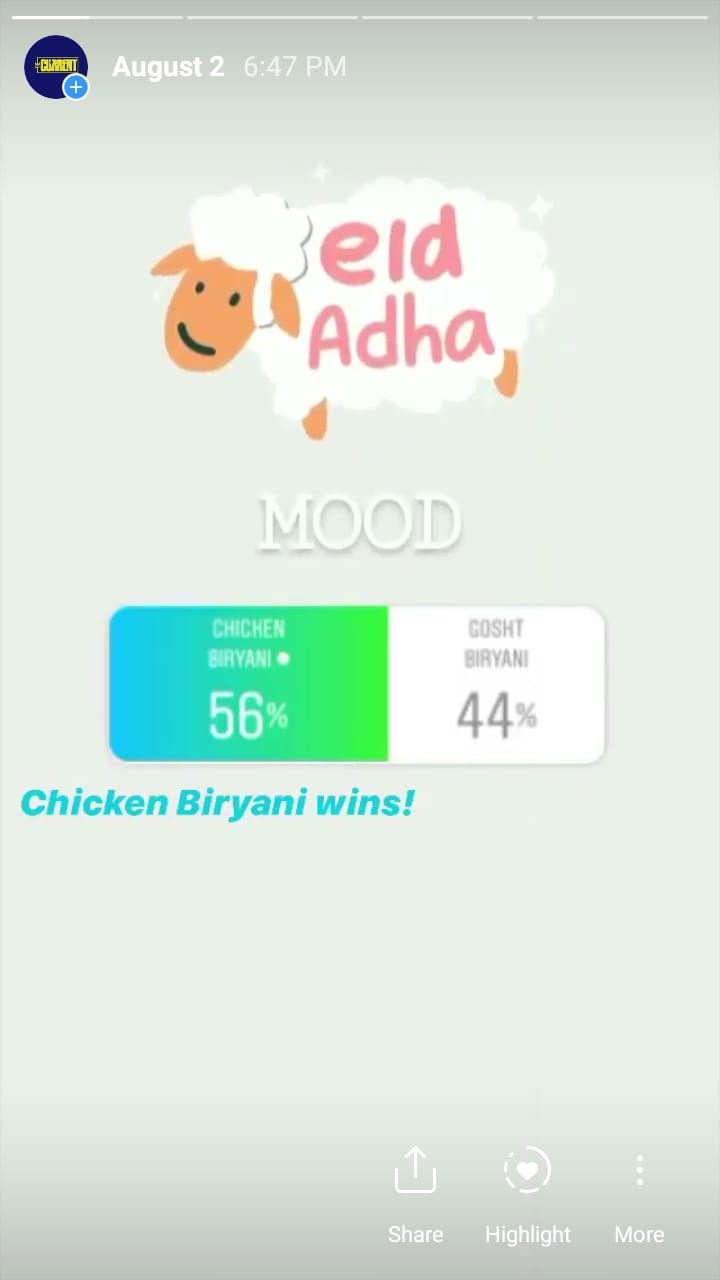
    Honestly, this one is no surprise given how much Pakistanis love their biryani. Hence, biryani was the winner.

    But, we were surprised when chicken biryani won on Eidul Adha.

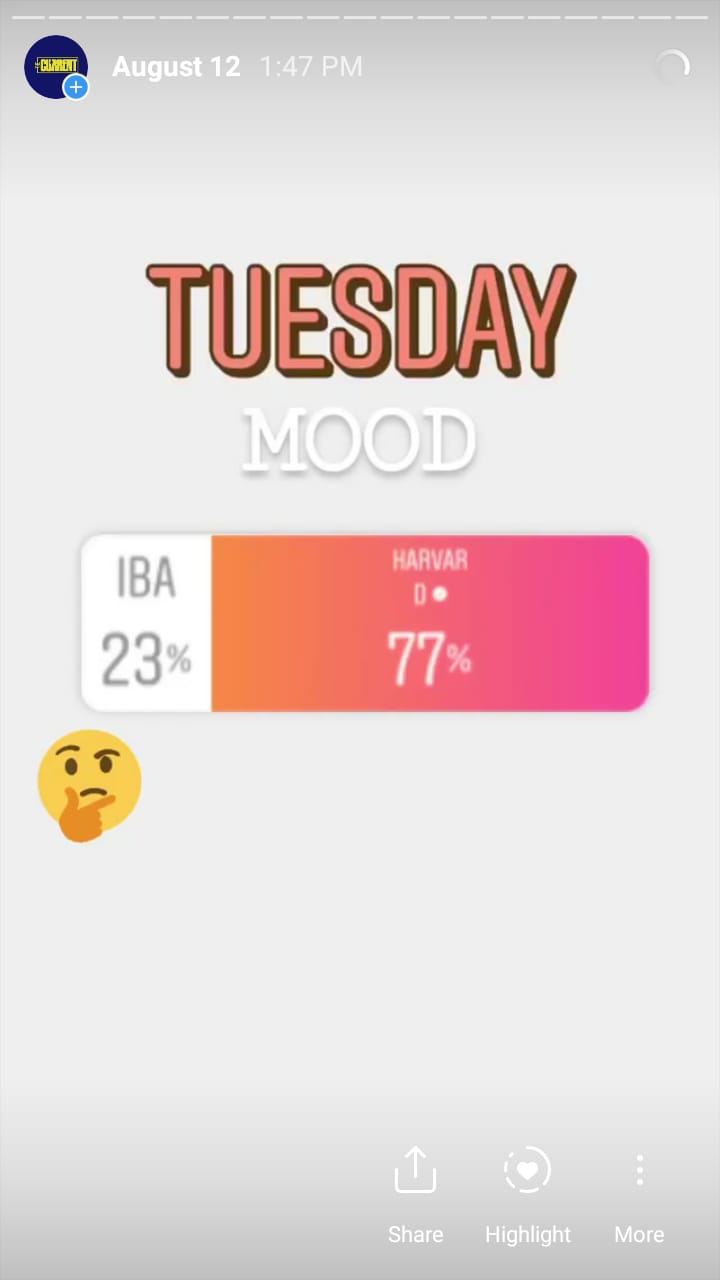
    Which university appeals the most to Pakistanis?

    We did a poll on different Pakistani and foreign universities and asked you what your dream university is. It’s sad that no Pakistani universities made the cut but here is what did win.

    Personality Traits

    This is the most interesting. What do you all want in your life partner?

    Loyal beat everything! Seems like nothing is more important for Pakistanis than a partner who is loyal.

    Your dream car?

    We asked you about your dream car and we got our answer. As per our final poll reults 72% people would go for a Rolls Royce beating Bentley.

    Clothing Brands

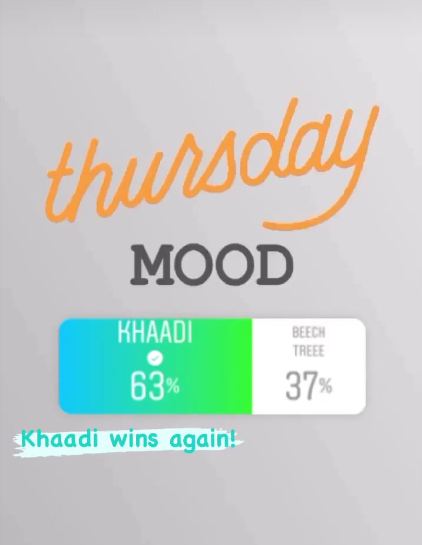
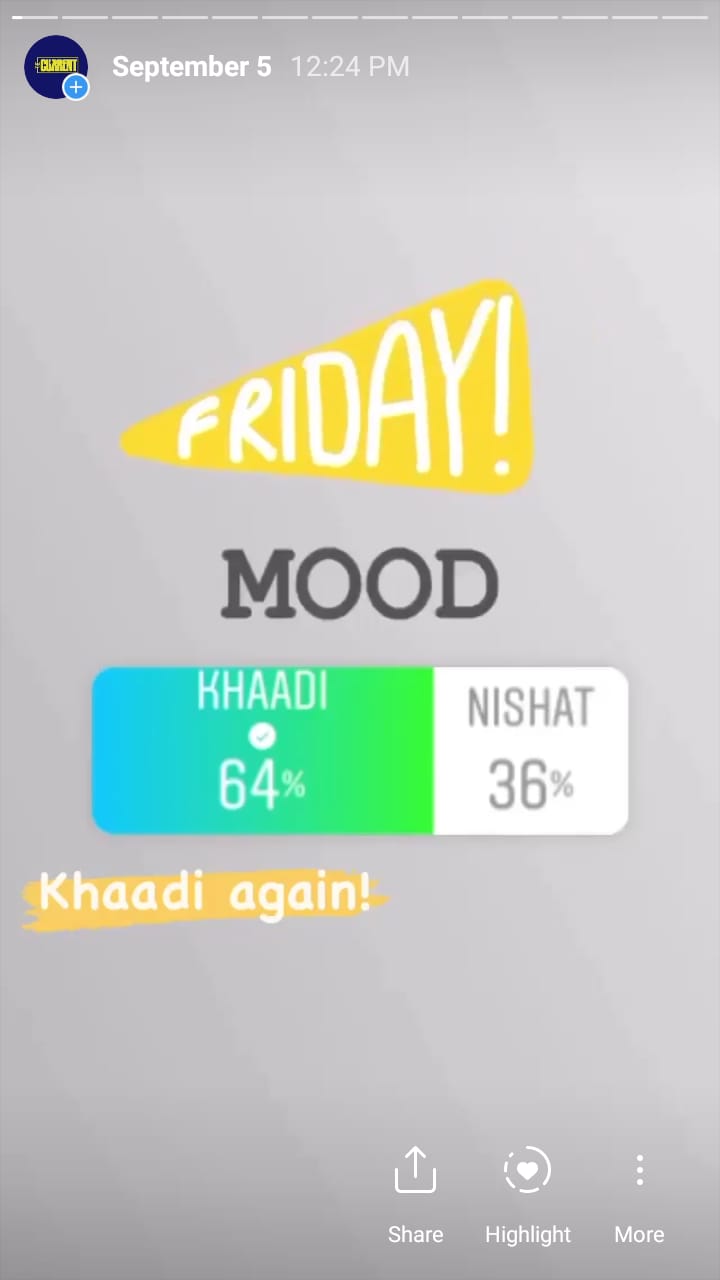
    This one was intense and Khaadi was winning but in the final poll that we posted on Saturday, check out who beat Khaadi.

    Follow us on Instagram at @thecurrentpk to take part in our polls and message us why you vote the way you do. The latest one is on the most popular fast food chains and that’s not one to miss.

  • Educational institutions to re-open on Sept 15?

    Educational institutions to re-open on Sept 15?

    Federal Education Minister Shafqat Mahmood on Monday chaired a meeting of provincial education ministers to make a final decision on whether to reopen educational institutes across the country from September 15, The News reported.

    According to reports, the Higher Education Commission’s (HEC) chairperson and executive director, Special Assistant to the Prime Minister (SAPM) on Health Dr Faisal Sultan, and officials of the health department were also present at the Inter-Provincial Education Ministers Conference (IPEMC), which aimed to compile the final recommendations regarding the opening of educational institutes.

    The recommendations to resume educational activities would be sent to the National Command Operation Centre (NCOC) for further deliberations among all the stakeholders.

    The meeting was set to also focus on finalising the standard operating procedures (SOPs) in this regard. Educational institutes across Pakistan had been shut down back on March 13 in a bid to curb the spread of the deadly coronavirus.

    The Single National Curriculum (SNC), a short curriculum for the current academic year, examinations in 2021, and establishment of anti-harassment bodies in the provinces were also on the meeting’s agenda.

    A discussion on the transition plans related to the Basic Education Community Schools (BECS) and National Commission for Human Development (NCHD) was also planned for the IPEMC.

    In this regard, Sindh Education Minister Saeed Ghani said all educational institutes were to open between September 15 and 30.

    All classes starting Grade 9 and up, as well as all universities, would reopen from Sept 15, while Grade 6-8 classes would resume by Sept 22, Ghani said, adding, however, that pre-primary and primary classes would reopen on Sept 30.

    The provincial minister warned that the schools in any area that may witness a rise in the number of coronavirus cases would be closed.

    Wearing face masks would be mandatory in the schools and strict action was to be taken in case of violation of the coronavirus-related SOPs, he added.

    Moreover, Punjab Education Minister Dr Murad Raas said there would be “no double shift”.

    “Alternative day schedule to be followed by all public & private schools,” Raas said on Twitter.

    Separately, in Khyber Pakhtunkhwa (KP), the provincial education department has decided to conduct coronary tests on school staff and students.

    “Health Department’s teams will be visiting public and private educational institutions to conduct random tests of teachers / staff / students / canteen vendors and all those persons who are working within the premises of educational institutions in an effort to detect COVID-19 positive cases and prevent the spread of disease,” a notification shared on the Twitter account of the ruling PTI’s KP chapter stated.

  • Ertuğrul is coming to Pakistan

    Ertuğrul is coming to Pakistan

    Ertuğrul fans, brace yourself! Because latest reports have suggested that star of the super hit Turkish TV series Diriliş: Ertuğrul Engin Altan Düzyatan is coming to Pakistan in October.

    According to a press release by London-based events management outfit Frontiers World, “Engin Altan Düzyatan has finally confirmed his much-awaited visit to Pakistan. He looks forward to meeting many of his fans in three ticketed-only events in Karachi, Lahore, and Islamabad. The Turkish star will hold an exclusive on-stage question and answer sessions during the events.”

    The three-day tour has been titled ‘Jashn-e-Ertuğrul’ and will take place from October 9-11.

    Frontiers World is organising the trip in collaboration with TRT, the official Turkish broadcaster.

    Set in 13th century Anatolia and based on the struggle of Ertuğrul Gazi, father of Osman I – the founder of the Ottoman dynasty, Diriliş: Ertuğrul has won the hearts of Pakistani audiences ever since its first episode aired on PTV Home in April 2020. In an exclusive interview with The Current, Pakistan Tehreek-e-Insaf (PTI) Senator Faisal Javed Khan revealed that Turkish President Recep Tayyip Erdoğan had gifted the drama series to Pakistan as a goodwill gesture.

  • Defence Day: President warns India, PM praises armed forces, army chief stresses peace

    The 55th Defence Day was observed on Sunday to commemorate the sacrifices of fallen heroes during the 1965 war with India and to renew the pledge to safeguard the country’s geographical and ideological boundaries in every situation and at all costs.

    The day commenced with special prayers in mosques for the peace, prosperity and solidarity of the country and to pay tribute to those who sacrificed their lives for the protection of their motherland.

    The main ceremony was held in the morning at the General Headquarters (GHQ) in Rawalpindi, according to Radio Pakistan, where Chief of the Army Staff (COAS) General Qamar Javed Bajwa laid a floral wreath at the Martyrs Monument.

    A change of guards was also held at the Quaid’s mausoleum with Air Vice Marshal Shakeel Ghazanfar as the chief guest of the ceremony. A contingent of 46 cadets of the Pakistan Air Force Asghar Khan Academy took over guard duties.

    A ceremony was also held at the Naval Headquarters in Islamabad, Radio Pakistan reported.

    In his message to the countrymen on Defence Day, President Arif Alvi said that Pakistan would never compromise on its sovereignty and security, making it clear that any kind of misadventure by the enemy would be dealt with severely.

    “It makes me happy to state that we have achieved self-reliance in the defence field […] We have thwarted external aggression; we have successfully defeated terrorism and extremism, and now we are on the path towards economic prosperity.”

    He said the day was a reminder of the spirit and valour of Pakistan’s armed forces and the nation through which they thwarted the evil designs of the enemy on this day, 55 years ago.

    The president said the nation saluted the martyrs as well as their families for their fortitude as they set a great example of patriotism by sacrificing their loved ones for defence of the country.

    “The spirit of September 1965 still lives in our hearts and I can proudly say that because of this, we have been successful in many testing times. Our armed forces’ professional excellence, combat readiness, and above all their unwavering faith in Allah has made Pakistan invincible,” he added.

    Meanwhile, Prime Minister (PM) Imran Khan said that Pakistan’s desire for peace must not be misconstrued as its weakness, adding that the country’s armed forces were “fully capable” of defending the country.

    “The resilient nation and the battle-hardened armed forces of Pakistan have time and again proved that they are fully capable of defending the country and are fully prepared to meet any kind of eventuality,” the premier said in a series of tweets.

    In his message, the premier honoured the fallen heroes of the war, saying that 55 years ago, the nation and the men in uniform “proved that it is not the size that matters, but it is the courage and devotion that matters the most”.

    “September 6 is a day in Pakistan’s glorious history that is commemorated as a symbol of courage, strong will and unmatched spirit of sacrifice by our gallant armed forces.”

    Later, during an investiture ceremony held at the army’s General Headquarters in Rawalpindi on the occasion of the 55th Defence Day, the army chief conferred military awards to army personnel for acts of gallantry during various operations.

    “Families of shuhada/ghazis, senior serving military officers/soldiers also attended the ceremony,” according to a press release by the Inter-Services Public Relations (ISPR).

    The military’s media wing said 40 officers were awarded Sitara-e-Imtiaz (Military), 24 officers and soldiers were awarded Tamgha-e-Bisalat and a soldier was awarded the United Nations Medal.

    The medals of the martyred were received by their family members.

    Addressing the gathering, the army chief said that Pakistan faced great trials over the last 20 years with war on the eastern and western fronts. He said that the country also faced natural disasters, such as floods and earthquakes, and the war on terror.

    General Bajwa said that thousands of people got displaced and many sacrificed their lives. He also noted that the country successfully fought against coronavirus and the locust attack.

  • Shaheena Shaheen’s murder

    Shaheena Shaheen’s murder

    Yesterday, a female journalist in Balochistan was shot dead. A social activist, an anchorperson at PTV and editor of a Balochi language magazine Dazgohar, Shaheena Shaheen was shot three times in Turbat on Saturday. She succumbed to her bullet injuries at the hospital. According to media reports, Kech Superintendent of Police Najeebullah Pandrani said the killing was the result of domestic violence. Shaheena’s family has nominated her husband in the First Information Report (FIR), whom she married just five months ago.

    Spokesperson of the Government of Balochistan Liaquat Shahwani tweeted that the murder seems to be due to a domestic issue and promised that justice would be served. Federal Minister for Information and Broadcasting Senator Shibli Faraz also condemned Shaheena’s murder. He said the government would fulfil its responsibility and bring the culprits to justice.

    Shaheena achieved a lot during her short but meaningful life. She was a talented artist, a brave social activist, and a talented journalist. Shaheena’s murder brings forth multiple issues plaguing our society, especially domestic abuse.

    Domestic violence is a serious issue in Pakistani context. According to a report released by SSDO in August and titled ‘Tracking Numbers: State of Violence Against Women and Children in Pakistan’, violence against women increased 10 times in just three months in Pakistan. A large number of women are victims of domestic abuse at the hands of their husbands but suffer silently due to multiple reasons, which include family ‘honour’, children’s future, lack of financial independence and the taboo attached to divorce. It is because of their silent suffering and lack of repercussions that these men continue to commit this crime. Some, like Shaheena’s husband, are emboldened enough to even commit murder. Apart from domestic violence, ‘honour killing’ by family members is not an uncommon practice in Pakistan. On Friday, the Supreme Court observed that the killing of women in the name of honour had never been an honourable practice and that such murders should not be categorised as honour killings. “It will help deter such killings if the term ‘Ghairat’ is not used to describe them,” observed Justice Qazi Faez Isa.

    Why is it that ‘honour’ is always attached to a woman’s actions and not that of any man in our society? Why is a woman expected to suffer at the hands of her abuser just to save family’s honour? Our lexicon is filled with phrases like, ‘Log kya kaheinge?’ [what will people say?], which make women think twice before leaving an abusive relationship. We wonder what these ‘people’ will say when a woman is murdered by her husband?

    The Ministry of Human Rights launched an awareness campaign about domestic abuse and violence in March this year, asking the victims to call their helpline. We have laws against domestic violence and honour killing in place but the major issue is under-reporting of these cases by the victims themselves who choose to stay silent due to societal pressures. It is time to raise awareness across the country and let these women know that they are not alone. The state as well as society stands with them. Shaheena, we hope your murderers are brought to justice. Rest in power, Shaheena!

  • You will never guess Kaavan’s favourite song

    You will never guess Kaavan’s favourite song

    Who knew Kaavan would be a music fan? That too of Frank Sinatra.

    Latest reports coming out of Islamabad Zoo have revealed that Kaavan is not only a fan of Sinatra, but his music calms him down.

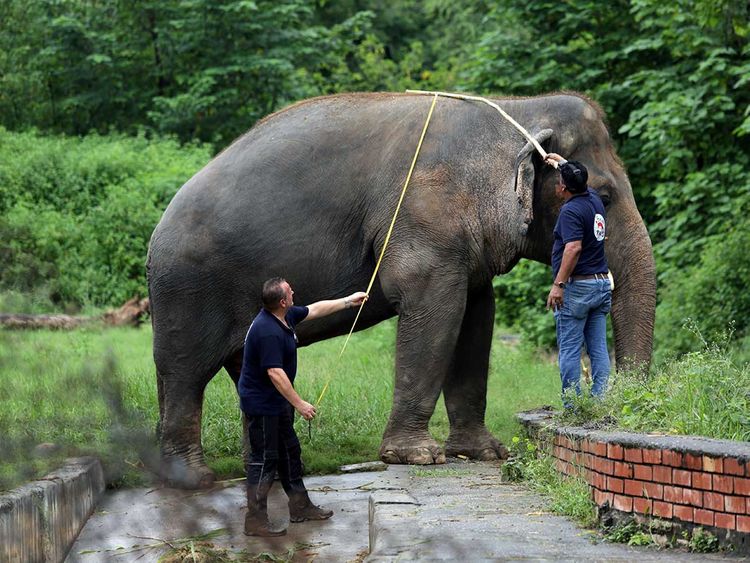
    Vet Amir Khalil, who has been tasked with assessing whether Kaavan can be moved from poor conditions in a zoo in Pakistan’s capital to a sanctuary in Cambodia, has shared that when he arrived in Pakistan, he started to train the elephant by singing to him.

    “When we arrived 10 days ago … I started to train him and to sing to him and he accommodated me so we have a relationship,” he said, adding he chose Sinatra’s hit My Way. Francis Albert Sinatra was an American singer and actor, who was one of the most popular and influential musical artists of the 20th century. He is one of the best-selling music artists of all time, having sold more than 150 million records worldwide.

    36-year-old Kaavan is being relocated to a wildlife sanctuary in Cambodia for retirement after the Islamabad High Court ruled that the Margazhar Zoo in Islamabad is not fit for the animals. Kaavan has spent most of his life in a small enclosure with meager shelter, and the last eight years alone after his companion elephant died. The court decision came after a four-year global campaign, backed by American singer Cher.

    Read more – Cher thanks PM Khan for ‘making her dream come true’

    Earlier, Adviser to Prime Minister Imran Khan on Climate Change Malik Amin Aslam had said authorities would “ensure that he lives a happy life”.

    “We are bidding Kaavan farewell with a heavy heart. It is a sad decision,” he had said, adding that Prime Minister Imran Khan was also concerned about Kaavan’s well-being.

    Plans to relocate the animal are underway though it is no easy feat.

    Four Paws experts, who will be assisting in the relocation, fired darts with a sedative so they could give the sleepy animal a comprehensive checkup.

    As Kaavan woke up to eat some apples, Four Paws elephant specialist Frank Goeritz analysed his blood samples. Though it will be a few days before he files a formal report, Goeritz said despite Kaavan being obese, unhappy and having malformed nails that put him at risk of serious infection, the outlook was hopeful.

    “Let’s wait until we have all the results, but so far I don’t see a big problem with him traveling … he is facing a good life.”

  • Akshay Kumar launches FAU-G after India bans PUBG

    After India banned PlayerUnknown’s BattleGrounds (PUBG) along with 117 other Chinese apps, Akshay Kumar announced the launching of a multiplayer action-game, Fearless and United: Guards (FAU-G). According to the actor, the game is in “line with Prime Minister Narendra Modi’s vision of “AtmaNirbhar Bharat’”. ‘Atmanirbhar Bharat’ is the vision of PM Modi of making India a self-reliant nation.

    Kumar shared that through the game, players “will also learn about the sacrifices of our soldiers.” He added that 20 percent of its net revenue would be donated to ‘Bharat Ke Veer’ trust – which gives homage and support to the country’s brave hearts.

    Talking about the new game, Kumar said: “For youngsters in India, gaming is becoming an important form of entertainment. With FAU-G, I’m hoping that as they play the game they will learn about the sacrifices of our soldiers and also contribute to the families of the martyrs; and with this, each one of us has the ability to support PM Modi’s vision of Atmanirbhar”.

    According to details, FAU-G is based on real scenarios encountered by the Indian Security Forces to deal with both domestic and foreign threats. It is expected to launch at the end of October with its first-level set in the Galwan Valley backdrop followed by third-person shooting gameplay in the subsequent releases. The game will be available on the Google Play Store and the Apple App Store.

    Earlier, Ajay Devgn had announced a film based on the tensions between Indian soldiers and Chinese troops in Ladakh’s Galwan Valley. According to details, the film will narrate the “story of the sacrifice of 20 Indian army men who fought the Chinese army”.

    Meanwhile, recent reports have stated that India and China have agreed to work towards reducing tensions along their contested border, following a meeting of the defence ministers of the two countries. Both sides had deployed additional forces along the frontier running through the western Himalayas after a clash in June, during which 20 Indian soldiers were killed in hand-to-hand fighting. China has not released casualty figures for its troops.

  • Karachi’s rain mess: A case of governance failure, corruption and political turf wars

    Karachi’s rain mess: A case of governance failure, corruption and political turf wars

    “The curious case of this city is that it is administered by a mix of federal and provincial controlled landholding associations, cooperative housing societies, military-run cantonments, the navy, the railways and the industrial area authorities to name a few.”

    A commercial port city with more than 20 million residents, Karachi has continued to suffer decades of civic mismanagement, gaps in urban planning and development given the lack of adequate governance, corrupt civic agencies and political parties vying for power. None of the myriad agencies that control resources and management in this city have honestly bettered the city and the lives of its people.

    Take the tussle between the PPP and the MQM that has not only brutally destroyed the socioeconomic fabric of districts such as Lyari, a sprawling slum settlement turned into a hotbed of violence, guns and drugs when rival gangs were patronised by the city’s two political parties, but also resulted in turf wars affecting the running of civic institutions. The political bifurcation of jurisdictions within this city has, therefore, resulted in a complete breakdown of basic service provision over years – lack of clean drinking water, electricity, housing, security are just a few municipal services that should be under the local government system but this is not the case. Even an elected mayor has no jurisdiction over certain areas of this city. When a city’s history is rooted in ethnic and identity-based politics building urban infrastructure, providing municipal services, or even intervening in areas that are essentially administered by a particular political party is near to impossible.

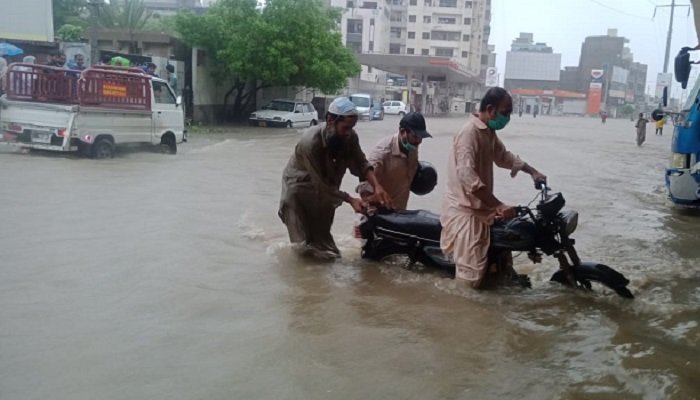
    Last week, Karachi was submerged in 230mm of rainfall in less than 12 hours, the most ever recorded, according to the Pakistan Metrological Department, exposing again glaring gaps in urban development, especially in low-income and vulnerable communities. Wealthy residential areas were not spared where drainage channels were choked. One such densely populated urban settlement with poor access to water and sanitation, Lyari is located about 15 minutes from the city’s business hub at I.I. Chundhrigar Road where you’d find most of the banking sector is headquartered. Streets were inundated with rain and sewerage water for days and later cleared up by residents because no government assistance reached these communities. Similarly, homes, businesses and streets in the city’s old quarter of Kharadar – a symbol of pre-colonial history which becomes the centre for Muharram processions (near Mithadar where the Edhi main office is located and adjacent to Jodia Bazaar) – literally drowned in a mix of rain, putrid sewerage water and floating garbage, increasing the risk of diseases, such as dengue and malaria. Some commercial/residential areas remain flooded with no electricity almost a week after the downpour in this city; sewerage water has collected in empty plots according to residents in different areas of Karachi where gutters are broken.

    First let’s be clear here: vulnerable neighbourhoods with already inadequate urban and social infrastructure have long been neglected by the ruling political powers and whomsoever authority is in charge of a given district. Then, the urban poor in Karachi are like none other. I recently read on Twitter: ‘The Lebanese people are like kids who’ve had to raise themselves because the parents were never around to take care of them.’ Now apply that to Karachi and it makes sense. Migration from rural to urban, and from the north has meant living in overcrowded, unsafe environments with little access to education, health, or sanitation, and with the COVID-19 crisis having reduced livelihood opportunities even further because of mobility restriction and decreased economic activity, natural disasters have the potential to decimate lives and homes. So why no focused body that can fix Karachi? The curious case of this city is that it is administered by a mix of federal and provincial controlled landholding associations, cooperative housing societies, military-run cantonments, the navy, the railways and the industrial area authorities to name a few. Many question the absence of the relevant authorities responsible for civic provisions, such as drain clearing before the annual monsoons, sewerage repairs and garbage collection. In fact, it was army personnel, volunteer rescuers, and even volunteers from the Islamist group Tehreek-e-Labbaik who rescued and evacuated people from many inundated residential neighbourhoods — some using boats for rescuing residents living in the newly constructed Naya Nazimabad area while some families waded through waist-high water. 

    Floating cars and destroyed homes: an apocalyptic sight

    Moreover, substandard construction in the city and informal settlements, built close to water draining channels or nullas, were perilously flooded or sunk during these rains given their poor physical infrastructure. This kind of urban flooding is to be expected as climate patterns change experts warn. And we have witnessed urban flooding in the past in Karachi. Warnings from the late Perveen Rahman, Orangi Pilot Project’s director, of the possibility of urban flooding if the mangrove plantation was removed on either side of Mai Kolachi because it served as a catchment area that could prevent flooding, were never heeded.

    The human toll of the recent rain tragedy has left Karachi’s residents reeling with more anger than ever and rightly so. I use the term tragedy here because rain in Karachi is hardly romantic or calls for a relaxing cup of tea and pakoras – rather it’s become synonymous with loss of lives, homes and livelihoods that could have been avoided had the concerned authorities prioritised rain preparations by declogging stormwater drains beforehand or constructing drainage facilities where none exist. Hundreds of people were forced to take shelter in the homes of relatives while scores of cars and other vehicles caught in the torrential downpours either remained submerged in water, many seen floating away as the water began flowing akin to a river developing rough currents. Scenes captured and shared as photographs and videos on social media were as if this city had been hit by a passing meteor and destroyed with a vengeance. Main thoroughfares and all seven newly constructed underpasses were submerged under several feet of water; children and motorcyclists drowned in waterlogged underpasses; young men slipped into storm drains (nullahs); 21 bodies were pulled out of just one water channel near Korangi; cars were seen stranded or floating everywhere in the city; underpasses resembled swimming pools turned nasty, and electricity was cut in areas for over five days to save people from getting electrocuted because this city has a surplus supply of unnecessary wires dangling on electric poles or lying unattended on roads and pavements. All this while empty shipping containers placed to block streets during the ninth and tenth of Muharram were seen dangerously floating down Zaibunissa street in Saddar jostling calmly for space with cars and buses. In the case of a police van caught in moving water currents on the main Sharah-e-Faisal thoroughfare that leads to Jinnah International airport – images of which went viral on social media – around five policemen were rescued by passersby who threw a rope ladder at them. Where were the authorities, the rescue services other than volunteers such as Edhi and Chippa to help in this disastrous monsoon deluge is a question we need to ask the provincial/federal government.

    And it was not just Karachi that witnessed the monsoon rains this year but images from the interior of Sindh are heartbreaking – entire villages have drowned, mud homes entirely washed away with families having lost their meagre belongings, hungry children huddled together under the open skies – and these are communities that persistently suffer from drought, malnutrition, lack of healthcare, unemployment. Again, why has this government neglected its most vulnerable people needing protection, shelter and food? According to the NDMA, troops using boats evacuated 300 people from the rain-hit district of Dadu in Sindh, while 1,245 people were evacuated from Karachi’s rain-hit areas last week, where residents lost their life’s savings when businesses were destroyed and homes flooded with sewerage water, especially where the city’s outdated drainage and waste systems were overwhelmed by an unprecedented spell of heavy rain. That is not to say urban flooding was unexpected. Although flood warnings were issued, it appears authorities in charge of overseeing the city’s basic services and infrastructure were at their usual lethargic best without formulating any kind of preemptive response.


    When DHA drowned in sewerage water

    This year’s monsoon rains did not distinguish between slum settlements and the wealthy Clifton and Defence Housing Authority (DHA) neighbourhood. Given DHA is a housing authority for the rich and famous, in the aftermath of these rains that didn’t appear so – the sprawling area that comprises DHA was inundated with water as aerial views shared on social media revealed not a dry patch. Originally founded in 1953 as Pakistan Defence Officers Housing Authority, Zia-ul-Haq passed a Presidential Order in 1980 to create DHA, a civic authority run by the powerful military controlling five per cent of urban land in this city. It is a private enterprise given a governing body run by chiefs of defence institutions, essentially administered by serving brigadiers under the direct command of corps commanders. It was decided then that DHA would have its own rules and essentially not adhere to the local government system that oversees the municipal provisions of the city. This Presidential Order divided the Karachi Cantonment – the southern side named Clifton Cantonment that was given DHA Phase 1. In other words, DHA and Cantonment Board Clifton (CBC) do not come under the mayor of the city who cannot control the drainage, water supplies and planning for this area.

    Residents from DHA, one of the largest landholding bodies in this city, were hard hit this year when scores of houses were flooded in the city’s posh district home to politicians, ministers, entrepreneurs and industrialists. No one from this authority emerged to apologise for the putrid mess that was open gutters and collected rainwater measuring over five feet in certain areas and no one attempted to provide assistance for those vulnerable residents trapped in their homes without electricity, food, water and medicine; some even at the risk of drowning. Many took to twitter cussing the electricity supplier, the Sindh government and the DHA authorities, as they witnessed green streets drowning mercilessly with such rainwater intensity that gated homes were left in utter disarray; heavy metal gates flung wide open with currents of the free-flowing water, expensive cars floating aimlessly or submerged and basements of homes flooded with expensive paintings and books destroyed in some homes. The urban middle-class deprived of basic amenities, clean water and electricity for years intermittently, say they watched this side of the Clifton bridge as they term the elite, drowning and waited for a reaction. The point being if you pay your taxes, water taxes included, and get nothing in return, because you’re compelled to buy your water, electricity and security, something has to give – and these rains meant no one was going to sit back and take the callousness suffered over years.

    Residents mobilised over Facebook and protested outside the office of the CBC, DHA’s sister organisation, to register their anger at having paid taxes for years but not having received any services, such as solid waster management disposal – the city actually has no plan for waste disposal – or running water without having to purchase water tankers and pay a whopping Rs 7,000 for one tanker. Furthermore, the stormwater drains clogged with garbage in DHA and elsewhere in the city, have not been removed as a preemptive move before the summer rainfalls. Hundreds of residents protested outside the offices of the CBC demanding the authorities clear the water hours, and present their audit for the past five years. Despite a legitimate right to protest, the organisers are now faced with police charges for rioting — and for shaking the CBC head out of his lethargic stupor. Fed-up with the city administration, other protests happened, in the days to follow, including all Karachi residents irked by years of neglect. A friend who said she’d stopped the water from seeping into her dining room and flooding her house, calling the city a disaster zone, a death trap. I can’t worry unless something hits me in the face, she said. Or else I’d die of anxiety. And I forgot to mention if you have a generator, which most Karachiites at home and for their businesses would do, finding a petrol station at 4 am was a nightmare when you ran out of petrol or diesel. 

    In certain residential and commercial areas of this city, even as I write this, electricity is yet to return; roads are filled with water, and sewerage, despite the Sindh government’s representatives, including the chief minister rolling up their sleeves and supervising water drainage. Draining the water from main roads has largely been left to volunteers and the Sindh government (read Sen Murtaza Wahab’s twitter updates) when the concerned authorities were unable to move in swiftly and do their job. Businesses have been gutted; supplies worth hundreds of thousands lost all over this destitute city, but who is listening to these troubles? Who will work or represent the interests of this city and its people? All of Karachi deserves greater attention because it has suffered years of neglect and economic hardship despite generating maximum revenue. No city can function with multiple agencies and multiple service provision jurisdictions. According to a paper on landownership in Karachi authored by Arif Hasan, Noman Ahmed and others, this city is governed by 13 different land management authorities which resultantly means no consensus is achieved and there is no coordinating mechanism, because of clashing interests. Over the years this has translated into a lack of low-income housing, amenities and utilities.

    Making Karachi liveable

    So while it is critical for megacities like Karachi where urban sprawl has not been able to keep up with the growing population needs to focus resources on immediate management and response to natural disasters or an urban crisis, attention must be paid to how long-term measures can be implemented to build a more sustainable and liveable city. This approach is imperative after an intensely destructive monsoon season countrywide that has revealed how unprepared and clueless we are when it comes to managing disasters of this unprecedented scale – natural disasters intensifying over the years as unusual weather patterns emerge clearly warning of the impact of climate change (Karachi’s extreme heatwave in 2015 is yet another example) If climate change is not addressed adequately by this government, without a disaster management infrastructure and expertise to match, severe weather will cause loss of lives and livelihood. Mitigating the effects of climate change  (on agriculture, for example) is imperative, especially in vulnerable areas, rural districts in Sindh, even KP and Balochistan, where the capacity to sustain climate change shocks is non-existent, and where disaster prevention is unaddressed.

    Karachi’s woes require a serious reorganisation of administrative duties so whomsoever civic agency is responsible gets the job done without political and commercial interference (especially in the use of land to their own advantage) while keeping at the fore the impact of climate change (droughts, floods, rain intensity will adversely affect water and food security in the near future) Governance must no longer be compromised because of conflict between stakeholders at the expense of the people. Strengthening local bodies is critical. As a party, the PPP has never allowed for that because it becomes a political issue whereas the PML-N gets voted on its governance track record in Punjab, so it must keep to a standard when it comes to civic services.