Blog

  • Woke students in ‘secular’ India

    The BJP coming to power has only removed the lid from the internal realities of the unsuccessful story of Indian democracy.

    Unlike Pakistan, where student unions were banned during the military rule of Ziaul Haq, in India, student unions on campuses have successfully sustained till date. In the past few years, Jawaharlal Nehru University (JNU) has been mentioned as a refrain in discussions on student politics — particularly in terms of burgeoning progressive politics — the spillover effect of which has reached not only Pakistan, but major parts of the globe as a good omen for the oppressed.

    The student union of JNU, better known as JNUSU, was recognised as a symbol of resistance, the voice of voiceless and a representative of the marginalised and vulnerable communities within India. JNUSU gained popularity across the world after its former president Kanhaiya Kumar was arrested from campus in 2016 due to his association with a protest gathering held at JNU.

    The protest was organised by some students of the varsity on February 9, 2016, in order to commemorate the judicial killing of Afzal Guru (hanged Feb 9, 2013) and also to question the violation of human rights by the Indian state in Indian occupied Kashmir (IoK).

    Consequently, the fascist Bharatiya Janata Party (BJP) government pressed charges against the students who had organised the protest, as well as Kanhaiya, who had addressed the protest gathering. Kanhaiya, Umar Khalid and Anirban Bhattacharya were the three students who were jailed following the registration of an FIR [First Information Report] against them.

    With already popular Azadi slogans taking a different tone following Kanhaiya’s arrest, students – especially Kashmiri — took a tone that went on to prove their courage at the forefront of the struggle against Indian Prime Minister (PM) Narendra Modi’s fascist regime.

    The recent wave of mass-mobilisation in India started in the aftermath of the controversial Citizenship Amendment Act (CAA) that grants the government the right to declare people, unable to produce citizenship documents, as “illegal immigrants” and allows any declared illegal immigrant, except Muslims, to become a citizen of India on the grounds of persecution in neighbouring Muslim states.

    CAA’s implementation, however, comes after forming a National Register of Citizens (NRC). NRC has been implemented in the Indian state of Assam where people, who have not made it to the register, have either already been detained in camps or are facing the threat of landing in the same since there is no way to prove which countries do these allegedly illegal immigrants belong to.

    The massive mass-scale protests in India against the discriminatory CAA law drew much attention after the December 15 protest led by students of Jamia Millia Islamia University in a Muslim locality of New Delhi. With police cracking down on these protesting students by not only baton-charging but also shooting them, and that too on campus, tables started to turn on the Indian state.

    With students of Aligarh Muslim University protesting on campus against the brutality met out to their peers from Jamia Millia Islamia University, a new wave of resistance took over India. Fierce confrontation meted out to the cops, especially by female students, in what turned out to be the defining moment for the anti-CAA movement, as more people, although largely Muslims, joined the protests, and the same still goes on.

    Outside their campuses, students of Jamia Millia and Aligarh University are much more involved in mobilising and organising the ongoing protests. However, they are subsumed by the grandiosity of JNU and its student leadership that has expressed solidarity to Jamia students by joining one of the protests outside JNU.

    Despite a huge communication gap and both Pakistan and India’s coercive forces employed to keep people away from each other, the engagement of student-political activists gives us hope that a broader united front to fight injustice and oppression will someday be built.

    While mass participation of students, youth and religious minorities in the protests against BJP’s plan of constructing a Hindu Rashtra, which according to their publicised map, is extended to Afghanistan, seems insufficient to deal with, it is important, as well as necessary, to demand that the newly-passed legislation by the parliament be rolled back.

    But would it ensure peace and security for Muslims and other marginalised communities like Dalits, who too are at risk after the promulgation of CAA and NRC? Or in other words, does the struggle for safeguarding Indian constitution in itself, guarantee protection to religious minorities?

    Apart from the popular discourse propagated around the Indian constitution that claims it is ‘secular’, the deployment of state apparatus against lower caste people within Hindus and other marginalised and religious minorities, tell a different story, which has become clearer under the BJP. The destitution of religious minorities in terms of poverty, employment, education and above all, political representation, stands in testimony to the fact that they were reduced to ‘second-class citizens’ in the largest democracy of the world even when BJP was not in power.

    The BJP coming to power has only removed the lid from the internal realities of the unsuccessful story of Indian democracy. Therefore, it becomes much more significant for the protesters from Asam to Uttar Pradesh and from Jamia Millia to Shaheen Bagh to consolidate these anti-BJP forces in one political project which possibly would push the current discourse beyond constitutionalism, instead of leaving the burden of saving constitution and secularism on the shoulders of already underprivileged Muslim community of India.

    Amid all the recent political developments in Pakistan and India, there has been a convergence of progressive ideas across the border which is largely manifested in the unconditional solidarity extended by the Progressive Students’ Collective (PSC) among other progressive student organisations in Pakistan to their counterparts in India.

    Despite a huge communication gap and both the states’ coercive forces employed to keep people away from each other, the engagement of student-political activists gives us hope that a broader united front to fight injustice and oppression will someday be built.
  • ‘Saaf Bath’ initiative to set up portable public toilets with focus on facilitating women

    ‘Saaf Bath’ initiative to set up portable public toilets with focus on facilitating women

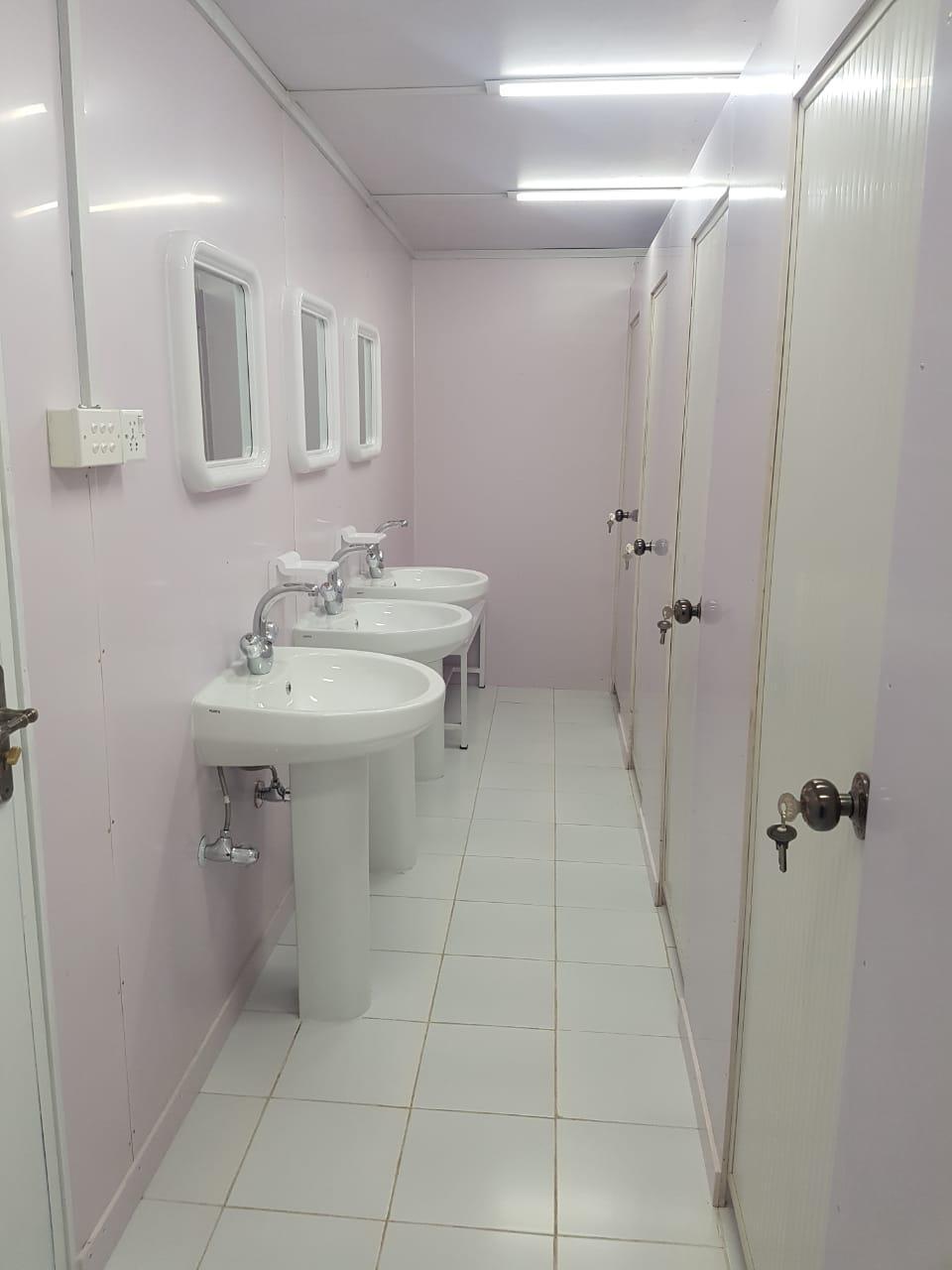
    The Salman Sufi Foundation (SSF) has launched a new project ‘Saaf Bath’ to benefit pedestrians, especially women, who do not have access to clean public toilets in Pakistan.

    According to a press release, the foundation will set up portable public toilets in Lahore and Karachi during the first stage of the project expected to complete by February 2020. The project aims to facilitate women, who are vulnerable to major diseases due to the lack of availability of clean and hygienic bathrooms.

    The SSF is partnering with numerous corporate companies to install portable toilets in all major cities of the country, especially those areas with a large number of female pedestrians. These toilets will set a standard for a public toilet and there will be a proper model that everybody would be asked to follow.

    The restrooms will also be made accessible for the aged and the differently-abled and will be maintained by the foundation’s coordinating officers daily. The foundation will also ensure that sufficient hand sanitizer and water is available for the public. In addition, there will also be a diaper station as well as the availability of sanitary pads.

    “Many women in Pakistan face severe issues in their menstrual cycle because of the lack of sanitized products and clean places,” said Sufi.

    Shedding light on the project, Salman Sufi told The Current: “Initially, we will be launching two to three toilets in Lahore and Karachi. After that, the foundation plans to expand this to the female schools and colleges in Sindh and Punjab. We are working with LDA in Lahore and the commissioner officer in Karachi regarding these.

    “We have requested the Sindh government to give us access to female colleges where we can install portable washrooms”, he added.

    Sharing further details, Sufi said, “We will be setting a standard for a public toilet and there will be a proper model that everybody would be asked to follow. The toilets will be equipped properly, there will be a diaper station as well as sanitary pads available. Many women in Pakistan face severe issues in their menstrual cycle because of the lack of sanitized products and clean places”.

    The project is in line with the foundation’s plan of starting an overall health and sanitation campaign exclusively for women. According to a 2015 report by the World Health Organisation (WHO), Pakistan was the third-largest country where over 43 million people defecate openly.

  • Coronavirus: Eight Chinese nationals deported from Islamabad airport

    As many as eight Chinese nationals have been deported from the Islamabad International Airport as coronavirus fear grips the entire world following the World Health Organization’s (WHO) declaration of a global emergency over the spreading virus and Chinese authorities increasing the toll to 213 dead and nearly 10,000 infections.

    According to reports, a flight from Dubai with eight Chinese passengers on board landed in Islamabad on Friday. The Chinese nationals — five men and three women — were screened and later sent back to Dubai after being disallowed from boarding a Pakistan International Airlines (PIA) flight from the federal capital to Beijing. 

    All eight individuals, reports said, were deported through a private airline carrier.

    The Civil Aviation Authority (CAA) has partially suspended all direct flight operations between Pakistan and China amid fear of the deadly coronavirus. According to a notification issued by CAA, the direct flight operations between two countries will remain suspended till February 2.

    CORONAVIRUS:

    In mid-December, some people in the central Chinese city of Wuhan began complaining of flu and pneumonia-like symptoms. Some had a high fever. Doctors were perplexed. To find out what might be causing their illness, geneticists analysed the DNA of the virus that had infected them.

    At once, the scientists realised the virus was new to science.

    As of January 23, experts at WHO in Switzerland estimated that at least 557 people have contracted the rapidly spreading disease. All countries have since been taking precautionary measures to curb the menace of the deadly disease.

  • Farhan Saeed drops new single ‘Baliyay’

    Farhan Saeed drops new single ‘Baliyay’

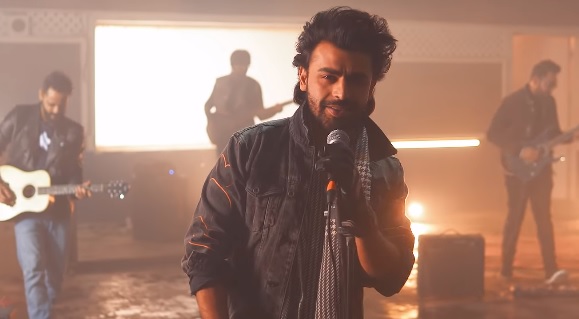
    Time and time again Farhan Saeed has entranced us with his melodious voice. The singer-turned-actor isn’t as active on the music scene as he used to be but he makes sure to keep reminding us that he has still got it.

    Saeed recently dropped a new single titled Baliyay. The song is soft, melodious and almost like a lullaby.

    According to the composer and producer of the song, “Baliyay is about spreading peace and working together to make the world around us a better place.”

    Baliyay has been written, composed and produced by Saad Sultan.

    Listen to it here:

    Earlier, Farhan had shared that he will be releasing a new single soon.

    https://www.instagram.com/p/B73AyTTFP7s/
  • Pakistan, Turkey planning to provide dual nationality to citizens of both countries

    Pakistan, Turkey planning to provide dual nationality to citizens of both countries

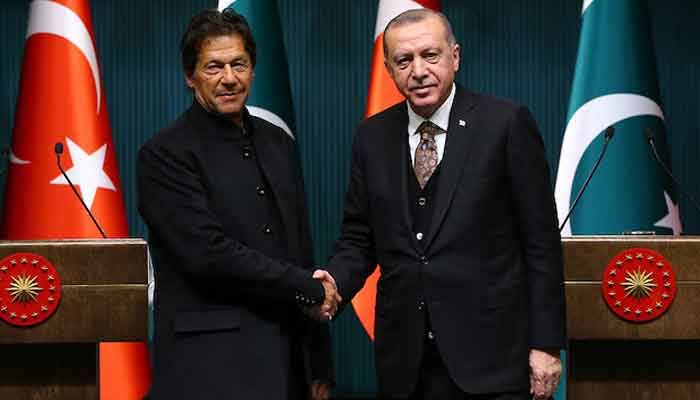
    A plan is under consideration to sign an agreement with Turkey regarding providing dual nationality to the citizens of two countries, a private media outlet has reported.

    Reports quoted a statement issued by the Interior Ministry as saying that this came during a meeting between Interior Minister Brigadier (r) Ijaz Shah and Turkish Ambassador to Islamabad Ihsan Mustafa Yurdakul on Thursday.

    According to the statement, the Turkish ambassador on behalf of his government proposed that both the countries should sign an agreement regarding providing dual nationality to the citizens.

    “In response to this, the minister said that the draft is under consideration and the Ministry of Foreign Affairs is on board with us, we hope to reach a mutual conclusion soon,” it added.

    Shah also welcomed the mutual training programmes and upgrading of equipment of law enforcing agencies with Turkey.

    “The interior minister welcomed the initiative of introducing a patrolling force in collaboration with Islamabad Police on the model of Dolphin Force introduced in Lahore,” the statement said.

    The ambassador and minister also mutually agreed on the continuity of the training programmes being held to improve the capacity of the workforce.

    Yurdakul also informed the minister that the Turkish president was scheduled to visit Pakistan soon.

    Turkish Interior Minister Suleyman Soylu is also expected to visit Pakistan in February and will meet Shah to discuss bilateral matters, the statement said.

    The interior minister was also informed that the Turkish consulate that is under construction in the southern city of Karachi is the largest one in the world by Turkey.

    Interior Minister Shah also extended condolences to the ambassador over the losses due to recent earthquake that killed at least 40 people and left over a thousand others injured.

  • ‘I’m sorry’: Asim Azhar responds to backlash on PSL anthem

    ‘I’m sorry’: Asim Azhar responds to backlash on PSL anthem

    With Pakistan Super League right around the corner, fans are waiting with bated breaths for the fifth edition to start. What’s even more special about this season is the fact that all matches will be played in Pakistan.

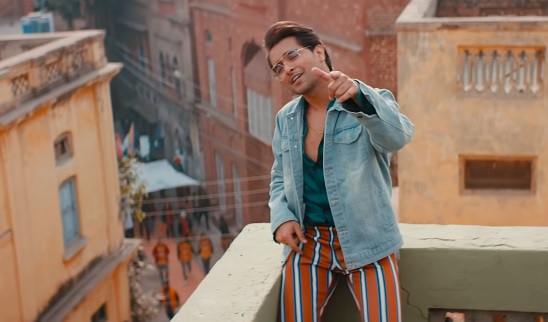
    The team behind the league kick-started this season by releasing the PSL anthem. The song Tayyar Hain featured veterans Arif Lohar, Ali Azmat and Haroon along with Azhar. However, the song failed to impress the audiences who took to social media to voice their criticism.

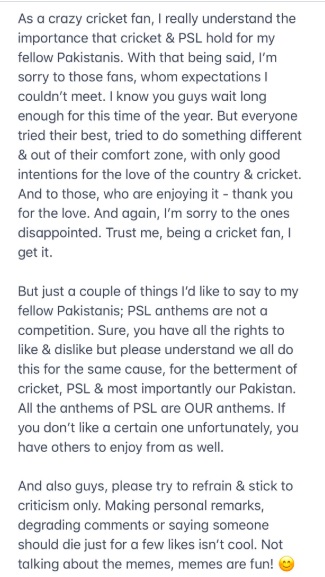
    In a note posted to Twitter, Asim talked about the PSL anthem, the sentiments attached to it and apologised to those who didn’t like it. He also requested people not to resort to personal attacks. However, Azhar added that the memes were great and he enjoyed those.

    Read more – ‘Tayyar Hain’ gets the ball rolling for PSL V

    Haroon endorsed Asim’s statement and said that he personally loved the new PSL song, adding that it will “sound huge in a stadium”.

    https://twitter.com/TheRealHaroon/status/1223277094928560133?s=20

    Tayyar Hain has been composed by Xulfi, while Kamal Khan of Laal Kabootar fame has directed the music video which also features star cricketers including Babar Azam, Hasan Ali, Rumman Raees, Sarfaraz Ahmed, Shaheen Shah Afridi and Shan Masood.

    According to the press release, “A total of 22 instruments have been used in creating Tayyar Hain, including indigenous instruments such as tumba, chimta, rubab and harmonium“.

    In case you missed it, watch the song here:

  • Boy sets himself on fire after father bars him from using TikTok

    Boy sets himself on fire after father bars him from using TikTok

    A teenage boy set himself on fire after his father advised and stopped him making TikTok videos. 

    As per reports, the boy from Arifwala near Pakpattan tried to commit suicide by setting himself on fire after his father constantly stopped him from recording Tiktok videos. The boy was shifted to a nearby hospital in critical condition.

    TikTok is a video-sharing social networking application that is used to create short lip-sync, comedy, and talent videos.

    Last year in December, the teenager was accidentally shot dead while recording a video with his friends in Sialkot’s Kharota Syedan area.

    The 16-year-old boy, identified as Ammar Haider was using a pistol to record a TikTok video with his two other friends. Allegedly, the trigger of the pistol was accidentally pressed and the bullet hit Ammar’s stomach, which caused his death.

    TikTok has over 500 million active users worldwide. The app had already crossed 1 billion downloads last year.

  • Pakistani man becomes first Muslim to head NYPD’s volunteer force

    Pakistani man becomes first Muslim to head NYPD’s volunteer force

    A Pakistani-American police officer has become the first Muslim to head the New York Police Department’s volunteer force.

    According to reports, Nasir Saleem, a 30-year veteran of the New York police, became the first Pakistani and Muslim to be appointed as the auxiliary deputy chief of the nearly 5,000-strong force.

    The volunteer force serves in the city’s neighborhoods as the “eyes and ears” of the regular police through foot, vehicle, and bicycle patrols.

    “It’s a great honour […] I am speechless. I dedicate my new title to Pakistan,” said Saleem speaking to reporters after taking the oath of office.

    Saleem was inducted into his new assignment at a ceremony where senior police officials and members of the Pakistani community were present. Captain Adeel Rana and Lt Zaigham Abbas, fellow Pakistani-American police officers, pinned badges on Saleem’s uniform.

    Taking to Twitter, the New York Police Department Chief of Patrol Fausto Pichardo stated that Saleem’s “28 years and 14,000 hours does not go unnoticed”.

    Auxiliary police officers are trained to observe and report on conditions requiring the services of the regular police, assisting in non-enforcement and non-hazardous duties.

  • Did the 2011 film ‘Contagion’ predict the coronavirus outbreak?

    Did the 2011 film ‘Contagion’ predict the coronavirus outbreak?

    Kate Winslet, Gwyneth Paltrow and Matt Damon’s 2011 film Contagion is re-appearing in movie rental charts in the UK and the US, in wake of the outbreak of coronavirus in Wuhan, China.

    According to reports, Steven Soderbergh’s terrifying thriller, which was inspired by the 2003 SARS epidemic and the 2009 flu pandemic bears striking similarities to the coronavirus outbreak that has the whole world scared.

    Contagion which starres Jude Law and Laurence Fishburne along with Winslet, Paltrow and Damon follows the story of a woman (Paltrow) who unknowingly catches what she thinks is a common cold during a “business trip” (read: secret rendezvous with her lover) to Hong Kong. Upon her return to the United States, the woman spreads her germs, and everyone who has come in contact with her — including her young son — is killed by what scientists call Meningoencephalitis Virus One (MEV-1).

    The film tracked the spread of a deadly virus from discovery through its global spread to, finally, a vaccine being created. However, in the process 26 million people died worldwide in only 26 days after the virus’s discovery, followed by instances of social disorder and widespread societal breakdown.

    The coronavirus is said to have originated in a live animal market in China’s seventh biggest city Wuhan. In the film, it is discovered in the final scenes that the virus was initially spread from a bat, disturbed by jungle clearance, which drops infected food into a pigpen. Additionally, the fictional MEV-1 and the coronavirus share similar symptoms which include fever, cough, and shortness of breath.

    Following the deadly outbreak, China, particularly the mainland areas have been sealed and most flights to and from the country have been suspended. The World Health Organisation has also declared it a global health emergency as scientists rush to discover a cure for it.

  • Regulating Freedom

    Regulating Freedom

    Earlier this month, Pakistan Electronic Media Regulatory Authority (PEMRA) uploaded a draft proposal on its website on regulating web and over the top television (OTT) content services.

    After going through the 25-page draft proposalThe Current is of the view that this is yet another effort by the government to silence independent voices. First of all, PEMRA has no authority and/or mandate to regulate social media. Secondly, Pakistan’s mainstream media is going through its worst period of censorship –- that too under a “democratic” dispensation. Pakistan is ranked 142 out of 180 countries in RSF’s 2019 World Press Freedom Index, i.e. three places lower than it was in 2018.

    Many Pakistani journalists have taken to social media to share their uncensored views online due to media censorship. Now, the government wants to regulate the internet by charging a hefty amount in fees for web TVs (both news and non-news) and OTTs and also issue licenses. They are also proposing a code of conduct without giving out any details. Reporters Without Borders rightly said that this draft proposal by PEMRA “betrays an intent to censor online video content relentlessly”. If this draft is not to discourage online content creators then what is? We, at The Current, firmly believe in freedom of expression and thus any moves to curtail our freedoms, our fundamental rights and our right to dissent, are unacceptable. Period.

    It is quite disappointing to see that a government that fully utilised social media and mainstream media before coming to power is now trying to shut down critics’ voices. Prime Minister (PM) Imran Khan recently said that he has stopped reading newspapers and watching evening news/current affairs shows because the media hammers him all the time is surprising, given that PM Imran has been media’s darling from the first day. His government is being criticised for its lack of performance and delivery. We believe the premier should not demonise media that helped him during his struggling days in politics and made him relevant.

    It is also quite alarming to see that peaceful protesters in Islamabad were arrested and charges of sedition were levelled against them. Their only crime was to be a part of a protest seeking the release of Pashtun Tahafuz Movement (PTM) Manzoor Pashteen. Some were released, but 23 political activists and human rights defenders, including Ammar Rashid and Nawfal Saleemi, are still under arrest — not to mention citizens like Khurram Qureshi who was there for solidarity. Their families are not being allowed to meet them despite the fact that it is their legal right. We would like to ask the government how it is sedition to protest peacefully when it is our fundamental right to do so. Releasing these protestors would be the right thing to do.

    From censorship in media to curbing online dissent to booking peaceful protesters under sedition charges, the state of Pakistan is acting more like a police state and less as a democracy. Let’s not go down this path.