Blog

  • Arshad Nadeem leaves for Asian Athletics Championship in South Korea

    Arshad Nadeem leaves for Asian Athletics Championship in South Korea

    Pakistan’s javelin star and Olympic gold medalist Arshad Nadeem has left for South Korea to compete in the upcoming Asian Athletics Championships.

    This event marks Arshad’s first international appearance since his historic gold medal win at the Paris Olympics. His return to the global stage is being closely followed not only by fans in Pakistan but also by athletics enthusiasts worldwide.

    It is worth noting that in 2024, Arshad Nadeem made history by securing Pakistan’s first-ever Olympic gold medal in track and field at the Paris Games. Since then, he has emerged as one of the world’s leading athletes in his discipline.

    Arshad Nadeem on Neeraj Chopra’s comments

    Pakistan’s star javelin thrower Arshad Nadeem has chosen not to respond to Indian athlete Neeraj Chopra’s recent comments about their relationship, saying that the current tense situation between Pakistan and India is not the right time to talk.

    When asked about Chopra’s statement while speaking to the media on Wednesday, Nadeem said, “I don’t want to talk about it because of the situation between Pakistan and India. I always stand with the Pakistan Army.”

    Chopra, in a recent interview, had said that while the two have always shown mutual respect, they were never close friends, adding that their equation is not the same anymore. “We were never really close friends or anything,” Chopra stated. “But because of this [recent issue], it will not be like before.”

    Despite not commenting further, Nadeem praised Chopra’s performance, congratulating him for crossing the 90-metre mark for the first time in his career at the Diamond League in Doha, where Chopra won a silver medal.

    The Pakistani javelin ace is now focused on the upcoming Asian Athletics Championship, which will be held in Korea from May 27 to 31. 

    “I will try my best to perform well at the event,” he said. “My goal is to throw 100 meters. I’m working hard, and by the will of Allah, I’ll achieve it one day.”

    After the Asian Championship, Nadeem shared that he plans to travel to England after Eid-ul-Adha to begin preparations for the World Athletics Championship. He will be training there alongside his coach Salman Butt.

    At age 28, Nadeem continues to carry Pakistan’s hopes on the international stage and is working tirelessly to reach new milestones in his career.

  • US govt revokes Harvard’s right to enroll foreign students

    US govt revokes Harvard’s right to enroll foreign students

    Donald Trump’s administration on Thursday revoked Harvard’s ability to enroll foreign nationals — more than a quarter of the student body — in a dramatic escalation of the US president’s fight against the prestigious university.

    The school in Cambridge, Massachusetts quickly slammed the move as “unlawful” and said it would hurt both the campus and the country, while one student said the community was “panicking.”

    Trump is furious at Harvard — which has produced 162 Nobel prize winners — for rejecting his demand that it submit to oversight on admissions and hiring over his claims that it is a hotbed of anti-Semitism and “woke” liberal ideology.

    The loss of such a large proportion of the student body could prove to be a huge financial blow to Harvard, which charges tens of thousands of dollars a year in tuition.

    “Effective immediately, Harvard University’s Student and Exchange Visitor (SEVIS) Program certification is revoked,” Homeland Security Secretary Kristi Noem wrote in a letter to the Ivy League institution, referring to the main system by which foreign students are permitted to study in the United States.

    Harvard, which has sued the government over a separate raft of punitive measures, quickly fired back, calling the move “unlawful.”

    “We are fully committed to maintaining Harvard’s ability to host our international students and scholars,” it said in a statement, adding that it was working to offer students guidance and support.

    “This retaliatory action threatens serious harm to the Harvard community and our country, and undermines Harvard’s academic and research mission.”

    Karl Molden, an international student from Austria, said he had applied to study at Oxford in Britain because he feared such measures.

    “It’s scary and it’s saddening,” the 21-year-old government and classics student told AFP.

    “I love Harvard, and getting into the school has been the greatest privilege of my life.

    “It’s definitely going to change the perception of… students who (might) consider studying there — the US is getting less of an attractive spot for higher education.”

    Leaders of the Harvard chapter of the American Association of University Professors called the move “the latest in a string of nakedly authoritarian and retaliatory moves against America’s oldest institution of higher education.”

    “The Trump administration is unlawfully seeking to destroy higher education in the United States. It now demands that we sacrifice our international students in the process. Universities cannot acquiesce to such extortion,” it said.

    ‘Everyone’s panicking’

    Last month, Trump threatened to stop Harvard from enrolling foreign students if it did not agree to government demands that would put the private institution under outside political supervision.

    “As I explained to you in my April letter, it is a privilege to enroll foreign students,” Noem wrote.

    “All universities must comply with Department of Homeland Security requirements, including reporting requirements under the Student and Exchange Visitor Program regulations, to maintain this privilege,” she said.

    “As a result of your refusal to comply with multiple requests to provide the Department of Homeland Security pertinent information while perpetuating an unsafe campus environment that is hostile to Jewish students, promotes pro-Hamas sympathies, and employs racist ‘diversity, equity, and inclusion’ policies, you have lost this privilege.”

    More than 27 percent of Harvard’s enrollment was made up of foreign students in the 2024-25 academic year, according to university data.

    Fourth-year US student Alice Goyer told AFP “no one knows” what the development would mean for international students already enrolled.

    “We just got the news, so I’ve been getting texts from a lot of international friends, and I think everyone’s just — no one knows,” she said.

    “Everyone’s panicking a bit.”

    On whether students would willingly transfer to other institutions, as suggested by Noem in the letter, Goyer said, “I doubt people would do that.”

    “I would hope maybe there’s going to be a legal battle that’ll take place.”

  • Joe Root becomes first English batter to score 13,000 runs in Tests

    Joe Root becomes first English batter to score 13,000 runs in Tests

    England’s Joe Root has achieved a major milestone in Test cricket, becoming the first English player to score 13,000 runs in the longest format of the game.

    The historic moment came on Thursday during the opening day of the Test match against Zimbabwe when Root reached the landmark by scoring his 28th run of the innings.

    With this achievement, Root became only the fifth player in the world to cross 13,000 runs in Test cricket. More impressively, he now holds the record for being the fastest to reach this milestone, doing so in just his 153rd Test match.

    Previously, the record for the quickest to 13,000 Test runs belonged to South Africa’s legendary all-rounder Jacques Kallis, who reached the mark in 159 matches. Other greats such as Rahul Dravid (160 matches), Ricky Ponting (162) and Sachin Tendulkar (163) took longer to achieve the same.

    Tendulkar still holds the record for the most runs in Test history, with 15,921 runs in 200 matches.

    Meanwhile, England dominated the first day of the Test against Zimbabwe, finishing at 498 for 3. Ben Duckett led the charge with a brilliant 140 while Zak Crawley contributed 124 runs. Root added 34 runs before being dismissed.

    At the stumps, Ollie Pope remained not out on 169 and Harry Brook was not out on 9, setting the stage for a massive first-innings total.

  • Tested Home Remedies for Maintaining Good Oral Health

    Tested Home Remedies for Maintaining Good Oral Health

    Simple oral diseases like a toothache and bleeding gums destroy your peace of mind. But the good news is that good oral health starts at home, especially if it’s not an emergency situation. Home remedies for teeth and gums include natural ingredients like green tea, tea tree oils, green vegetables, etc. Get your hands on these tried and tested home solutions for your oral health and reduce the risk of serious medical emergencies. 


    Natural Remedies to Improve Oral Health At Home 

    dental clinic visit every 6 months is always the preferred choice to treat and prevent all mouth and gum diseases. As an add-on, some home remedies passed through generations as they proved to be effective against simple inflammations and toothaches. 


    Salt Water Rinse For Teeth

    Salt water reduces inflammation and fights bacteria with natural antiseptic properties. This remedy dates back to ancient Egyptian practices. Salt water heals mouth sores, treats gingivitis, and provides relief after dental procedures by drawing out bacteria through osmosis.

    How to use:

    • Mix half teaspoon of sea salt or table salt in 8 ounces of warm water until dissolved.

    • Swish solution around mouth for 30 seconds, focusing on problem areas.

    • Spit out completely and rinse with plain water.

    • Use morning and evening after brushing teeth.

    • Never swallow the solution.

    Tip: Adding a drop of peppermint oil can enhance freshness while maintaining effectiveness.


    Oil Pulling Method For Bacterial Removal

    The oil pulling method originated in Ayurvedic medicine 3,000+ years ago. It was known to draw toxins from the body, including the mouth. This technique reduces plaque-causing bacteria, improves breath freshness, and gradually whitens teeth. Studies show that oil pulling significantly reduces Streptococcus mutans bacteria, the primary cause of tooth decay.

    How to use:

    • Place one tablespoon of coconut oil (or sesame oil) in the mouth.

    • Swish between teeth for 15-20 minutes each morning before brushing.

    • Oil becomes milky and thinner as it mixes with saliva.

    • Rinse thoroughly with warm water, then brush normally.

    • Practice daily for best results (improvements often appear within two weeks).

    Tip: Starting with just 5 minutes and working up to 20 minutes makes this practice more manageable for beginners.


    Clove Oil for Toothache Relief

    Clove oil contains eugenol, a natural anesthetic and antibacterial compound providing rapid pain relief for toothaches. Dentists historically relied on cloves before modern anesthetics. The numbing effect works by blocking nerve transmission, while antimicrobial properties fight infection in dental caries or around damaged teeth.

    How to use:

    • Purchase food-grade clove essential oil from a reputable market.

    • Apply one drop to a clean cotton ball and place on the painful tooth/gum. You can also dilute it with 2-3 drops of olive or coconut oil.

    • Apply up to three times daily as needed.

    • Discontinue if irritation occurs and avoid swallowing.

    Tip: For more visible results, combine with a tiny pinch of ground ginger and increase circulation to the affected area.


    Baking Soda For a Pearly Smile

    Baking soda (sodium bicarbonate) works best if you want that pearly white smile. It is a gentle abrasive that neutralizes mouth acids and polishes the stains. It is alkaline in nature, so it adjusts the oral PH accordingly, while the majority of the bacteria are acidic in nature so they are unable to survive. 

    A study in the Journal of Clinical Dentistry found that toothpastes containing baking soda remove plaque more effectively than those without it.

    How to use:

    • Wet toothbrush, dip in a small amount of baking soda, brush gently in circular motions for two minutes.

    • Rinse thoroughly (use no more than twice weekly).

    • You can also make a mouthwash by dissolving 1/2 teaspoon of baking soda in 4 ounces of warm water. Swish for 30 seconds after brushing.

    Tip: Adding a drop of peppermint extract to baking soda creates a more pleasant taste.


    Tea Tree Oil Helps Bad Gums

    Tea tree oil possesses strong antimicrobial properties combating oral bacteria responsible for bad breath, plaque, and gum disease. Australian Aboriginal communities used this remedy for centuries before scientific recognition. Studies show tea tree oil effectively fights Candida albicans (oral thrush) and reduces gingivitis inflammation.

    How to use:

    • For mouthwash: Add 3 drops pure tea tree oil to 1 cup warm water, mix thoroughly, swish 30 seconds before spitting (never swallow).

    • For toothpaste addition: Add 1 drop of tea tree oil to a pea-sized amount of toothpaste before brushing.

    • For gum application: Dilute one drop of tea tree oil with 1 teaspoon of coconut oil, apply to inflamed gums using a cotton swab, leave 5 minutes, rinse thoroughly.

    • Use once daily, preferably before bed.

    Note: The strong medicinal taste indicates potent active compounds working effectively.


    Green Tea Reduces Dental Inflammation

    Green tea contains polyphenols and catechins reducing inflammation and inhibiting bacteria that cause tooth decay and gum disease. Research in the Journal of Periodontology found regular green tea drinkers had healthier gums than non-tea drinkers. The antioxidants may also reduce oral cancer risk.

    How to use:

    • Brewing method: Use one tea bag or 1 teaspoon loose-leaf green tea per 8 ounces of water heated to 175°F (not boiling), steep 3-5 minutes.

    • For oral benefits: Drink 2-3 cups of unsweetened green tea daily, swish each sip briefly before swallowing.

    • Used tea bags: Cool used bags in the refrigerator for 20 minutes. Place directly on canker sores or inflamed gums for 5 minutes.

    Tip: Matcha green tea provides even more concentrated benefits than regular green tea.


    Aloe Vera Gel for Gum Health

    Aloe vera contains anti-inflammatory compounds and 75+ potentially active ingredients. The key players include vitamins, enzymes, and amino acids, promoting oral healing. 

    Clinical studies show that aloe vera gel reduces plaque formation as effectively as chlorhexidine mouthwash. It also provides a soothing effect to the inflamed gum tissues. Aloe’s natural antibacterial properties fight gingivitis without harsh chemicals.

    How to use:

    • Cut open the leaf, scoop clear gel with a clean spoon (avoid yellow latex beneath the skin).

    • Apply a small amount directly to gums using a clean finger or cotton swab, massage gently 1-2 minutes, leave for an additional 10 minutes, and rinse with warm water.

    • For mouth ulcers: Apply directly 3-4 times daily for pain relief and faster healing.

    • For general gum health: Use once daily after evening brushing.

    • For store-bought options, choose 100% pure, food-grade products without preservatives. Refrigerate between uses.

    Tip: Growing aloe vera at home ensures a constant supply of fresh gel for oral treatments.


    Apple Cider Vinegar as Oral Health Remedy

    Apple cider vinegar contains acetic acid, creating an environment where odor-causing bacteria cannot thrive. Natural acidic properties help break down plaque and whiten teeth. Colonial American medical journals from the 1700s document this remedy for oral care.

    How to use:

    • For mouthwash: Mix 1 tablespoon raw, unfiltered apple cider vinegar with 1 cup water, swish no more than 30 seconds, rinse thoroughly.

    • For teeth whitening: Dip toothbrush in diluted solution before adding regular toothpaste, or brush with diluted solution once weekly.

    • For gargling: Use the same dilution to gargle for 10-15 seconds to reach the throat bacteria causing bad breath.

    Important safety note: Always dilute properly. High acidity of undiluted vinegar damages tooth enamel permanently. Limit to once daily, preferably after evening meal.


    Raw Vegetables for Natural Cleaning

    Raw, crunchy and green vegetables act as natural tooth cleaners by mechanically removing plaque and food particles. Carrots, celery, cucumbers, bell peppers, broccoli, cauliflower, etc act as a natural cleansers and work by stimulating healthy saliva production. 

    Some ancient evidence suggests that Europeans from the Middle Ages who consumed more raw vegetables maintained healthier teeth. High fiber in these vegetables, which provide gentle abrasion without damaging tooth enamel. The nutrients provide calcium, folate, vitamin D, and other important components that maintain good oral health.

    How to use:

    • Wash vegetables thoroughly, cut into convenient sticks (3-4 inches long, 1/2 inch thick).

    • Chew thoroughly and deliberately, “scrubbing” all tooth surfaces, focus on molars and areas where food gets trapped.

    • Eat for 5-10 minutes after meals when brushing isn’t possible, or as mid-afternoon snack.

    Tip: Red bell peppers offer additional vitamin C, crucial for gum tissue integrity.


    Honey and Cinnamon Paste for Gum Disease

    Honey contains hydrogen peroxide with a naturally acidic pH inhibiting bacterial growth. Combined with cinnamon (containing antimicrobial cinnamaldehyde), it creates a potent remedy for gum inflammation and early-stage gingivitis. Persian physicians documented this treatment in 10th-century medical texts for oral infections and gum bleeding.

    How to use:

    • Take 1 teaspoon raw organic honey (preferably Manuka) and one teaspoon Ceylon cinnamon powder.

    • Mix thoroughly until a smooth paste forms, add 1-2 drops of clove oil for additional pain relief if needed.

    • Apply directly to gums using a clean finger or cotton swab, leave 10 minutes, rinse with lukewarm water.

    • Apply once every 3-4 days rather than daily (allows gum tissue recovery between applications).

    • One week of consistent treatment typically shows significant improvement.

    Tip: Ceylon cinnamon contains more active compounds than common Cassia cinnamon for better results.


    Summarizing the Oral Health Remedies

    Consult a dentist in Lahore for professional advice based on specific oral health needs. Medical conditions like pregnancy require direct medical consultation but generally some common kitchen ingredients are capable of maintaining your good oral health. Practice these for treating bleeding gums, tooth pain, and other oral diseases but visit your nearest dental clinic if the situation worsens. 

  • Digital asset authority formed to meet FATF requirements

    Digital asset authority formed to meet FATF requirements

    In a bid to ensure that Pakistan’s Virtual Asset Economy complies with safeguards set by the Fina­ncial Action Task Force (FATF), the federal government has decided to set up the Pakistan Digital Assets Authority (PDAA). According to details from reports, PDAA will be responsible for regulating digital assets and ensure that processes do not violate FATF’s regulations.


    As per a statement issued by the Ministry of Finance (MoF), officials from the ministry will initiate a strategy to accelerate the growth of Pakistan’s virtual asset economy while simultaneously regulating the digital asset space. The Pak­istan Cryptocurrency Cou­ncil (PCC) has recommended a general outline of tasks for the PDAA.


    Reports indicate that the tasks include ensuring economic inclusion, responsible adoption of virtual assets and to regulate financial infrastructure that is based on the blockchain. The purpose of regulation lies in ensuring that innovations are in accordance with FATF’s rules.  


    Finance Minister Muhammad Aurangzeb, also PCC’s chairman, outlined how Pakistan’s goal is “not just to catch up but to lead”. He highlighted that this was possible via regulation and with the PDAA, Pakistan will get catapulted to a leading role in global financial innovation.


    The PCC’s chairman further elaborated on the PDAA’s importance as its regulations could protect consumers and attract international investments – as regulation reduces risk.


    As per reports, he emphasized how the newly created PDAA is responsible for matters pertaining to digital asset compliance, licensing and innovation. The body is expected to regulate tokenized platforms, digital stablecoins, DeFi applications, wallets and exchanges. 


    Analysts have pointed out how Pakistan’s decision to lean into crypto and the digital asset space places it in the rank and file of leading economies such as those of Singapore, Japan, Hong Kong and the UAE. Reports confirm that the aforementioned countries have set up regulatory bodies of their own to oversee activities occurring in the digital asset space.


    The establishment of such bodies reportedly allows for the host country to remain compliant with international financial laws while also promoting innovation. Details from reports suggest that the PDAA will be able to yield positive returns from the domestic electricity surplus via regulated crypto mining.


    Aside from attracting investments, reports suggest that PDAA may regulate over $25 billion of the informal crypto market and tokenize government debt and national assets.


    Reports indicate that the PDAA may also assist startups to design and launch block-chain based solutions. If managed effectively, the PDAA could allow Pakistan to become a major competitor to existing players in the international virtual asset economy.

  • Google integrates Gemini AI model into Chrome browser

    Google integrates Gemini AI model into Chrome browser

    Google has officially integrated its powerful Gemini artificial intelligence (AI) model into the Chrome web browser, ushering in a new era of smart browsing for users.

    The announcement was made during the company’s annual developer conference, where Google revealed that the latest update will provide users with access to a new AI-powered browsing assistant. This assistant is designed to help users better understand web pages and complete tasks more efficiently.

    A dedicated Gemini icon will now appear in the upper-right corner of the Chrome browser. By clicking this icon, users can instantly start chatting with the AI assistant.

    Initially, the Gemini assistant will allow users to request explanations for complex information found on web pages. It can also generate concise summaries of online content.

    For example, if a webpage featuring a cooking recipe is opened, the user can ask Gemini how to prepare the same dish using a different method. Similarly, it can be used for a wide range of other purposes, enhancing both productivity and convenience.

    This new AI feature is being rolled out first to subscribers of Google AI Pro and Google AI Ultra in the United States.

    Google’s decision to integrate Gemini directly into Chrome appears to be a strategic move to keep users within its own ecosystem, discouraging them from switching to alternatives such as ChatGPT. With the Gemini icon built directly into the browser, users can access AI assistance instantly without leaving their browsing session.

    According to the company, future versions of the Gemini assistant in Chrome will be even more advanced. It will eventually be able to operate across multiple tabs simultaneously and assist users with navigation across various websites.

    With this integration, Google aims to redefine how users interact with the web, making browsing smarter, faster, and more intuitive.

  • ‘Live and let live’; Iffat Omar slams Fahad Mustafa’s take on family vloggers

    ‘Live and let live’; Iffat Omar slams Fahad Mustafa’s take on family vloggers

    Senior actress Iffat Omar addressed Fahad Mustafa’s remarks about YouTubers in a recent interview, offering the actor-producer some advice.

    In March, while referring to family vloggers in an interview, Fahad stated that he “can never be part of a process like selling their family.” The comment sparked backlash from content creators, including YouTuber Rajab Butt, who said he couldn’t respect a senior who doesn’t value others’ work.

    Addressing his statement, Iffat Omar said, “Everyone has the right to achieve fame, no matter the method. We move with the times; we don’t live in the past. Everyone should have the freedom to do what they want.”

    Directly addressing Fahad Mustafa, she added, “You are the highest-paid actor in this country. You don’t need to compete with anyone. Don’t measure fame by your wealth. Stay in your place, don’t criticise others, live and let live.”

    Discussing the evolution of the entertainment industry, Iffat said, “People’s thinking has changed. Today’s actors live better lives than those in the past. Back then, when a woman said she was an actress, people would ask, ‘What else do you do?’ and many men weren’t willing to marry actresses. That mindset has changed now.”

    On the issue of gender pay disparity, she commented, “There isn’t much difference in remuneration anymore. Women are paid well, and even if there’s a gap, it balances out because women get more advertisement work.”

    She added, “If Fahad Mustafa charges more per ad, Mahira Khan makes up the difference by doing more campaigns, so it evens out.”

  • The Pakistani Sisters (TPS): Building women up, one free platform at a time

    The Pakistani Sisters (TPS): Building women up, one free platform at a time

    It was the first week of May, and the air was thick with unease. Another Pak-India conflict had taken over the headlines — missile tests, political chest-thumping, and the same old loop of fear and fury. The kind of days when you can’t tell if it’s the anxiety or the heat that’s making it hard to breathe. I was scrolling through Facebook late at night, not looking for anything in particular. Just… scrolling. Half-distracted, half-desperate for something that didn’t feel like doom. I wasn’t searching for inspiration. I wasn’t even sure what I needed. Maybe a soft corner. A quiet sentence. A moment of recognition. Some place where I didn’t have to carry the weight of being strong.

    That’s when I stumbled upon The Pakistani Sisters (TPS).

    At first, I assumed it would be like most women’s groups—maybe some recipes, a few clothing ads, polite small talk. But within minutes, I realized I was wrong. This wasn’t surface-level. Women were openly talking about stress, fear, mental health, even the pressure of holding everything together at home. There were even some wives of armed officers who were worried about the safety of their husbands out in the battlefield and just like me, were looking for some relief, some comfort, a helping hand, perhaps. Nothing was performative — it was raw, real, and strangely comforting.

    I saw posts from women saying exactly what I was feeling but couldn’t put into words. We were reaching out — asking women across Pakistan, from Lahore to Islamabad, Peshawar to Karachi—if they felt safe. Most of us didn’t know each other, yet there was an unspoken bond between us. A shared thread of agitation, of concern—not just for ourselves, but for one another, as fellow Pakistani women. I felt as if I had walked into a room where no one needed me to explain why I was exhausted — they already knew.

    That night, I didn’t just find a Facebook group — I found a sisterhood. And the feeling lingered.

    The next day, still curious, I reached out to the group’s admin, Afrah Sattar Khan. I wanted to know who had created this space, and more importantly — why. That’s when I learned about the quiet revolution Afrah had started seven years ago, not for profit, not for recognition, but because she believed in something radical.

    “I don’t want to build a brand. I want to build a safe space. A space where women could be supported, heard, and helped — without ever having to pay for it”.

    Today, TPS is not only the largest women’s support group in Khyber Pakhtunkhwa and Islamabad, but it’s also a real-world force for social change. With over 50,000 members, a growing cross-platform presence, and national recognition through multiple awards, TPS has proven one thing again and again: real empowerment doesn’t come with a price tag — it comes with intention, consistency, and heart.

    In an increasingly commercialised online ecosystem, TPS stands out for one very simple reason: they don’t charge anything.

    Where other platforms demand fees for business promotions or visibility, TPS flips the script. Every woman — whether she’s a home-based baker, a tailor, a photographer, or a budding tech entrepreneur — gets to promote her work for free. There are no hidden costs, no premium tiers, no payment gates.

    “I always found it odd that people charge struggling entrepreneurs just to get exposure. That’s not support, that’s gatekeeping”, Sattar says

    This no-cost model is not only rare; it’s revolutionary in the local context. It lowers the barrier of entry for hundreds of women who may not have the capital to pay for promotion or advertising.

    TPS isn’t just another social media group — it’s a living, breathing community with structure, purpose, and soul. “A family”, as one member says.

    But here are some other factors that set TPS apart…

    Every weekend, TPS hosts a business promotion activity. Women can drop their links, showcase their products, or simply introduce their services. The TPS team not only boosts these posts within the group but also shares many of them on Instagram, YouTube and their blog, giving members exposure across multiple platforms.

    This weekend ritual has become a beacon for home-based businesses, many of which have grown into profitable ventures solely because they found their first customers through TPS.
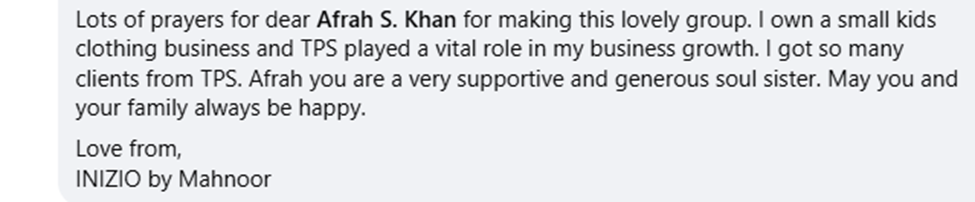
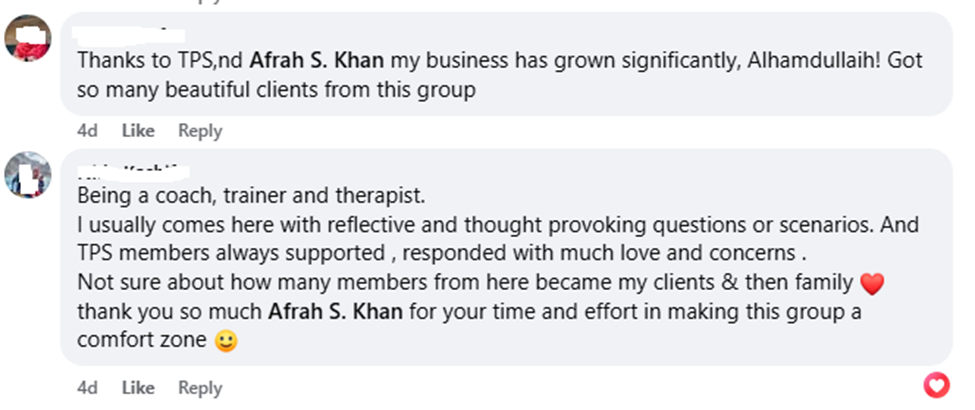

    Promotion doesn’t end with a single post. The TPS team ensures that deserving businesses get exposure across platforms — creating Instagram spotlights, video shoutouts and even blog features. This kind of organic, grassroots marketing is both rare and impactful — especially in areas where women often lack digital visibility.

    TPS is more than a megaphone — it’s a forum for questions, advice, and mentorship. Women regularly post about job issues, business challenges, pricing queries, or even mental health struggles. And what they get back is a wave of crowd-sourced wisdom, kindness, and lived experience.

    There’s no spam. No toxicity. Just women showing up for each other.

    The group’s strong and active moderation team ensures TPS remains a safe, respectful and inclusive space. Trolls are shown the door. Unethical behavior is shut down fast. This has earned TPS the trust of thousands of members who feel comfortable being honest and vulnerable.
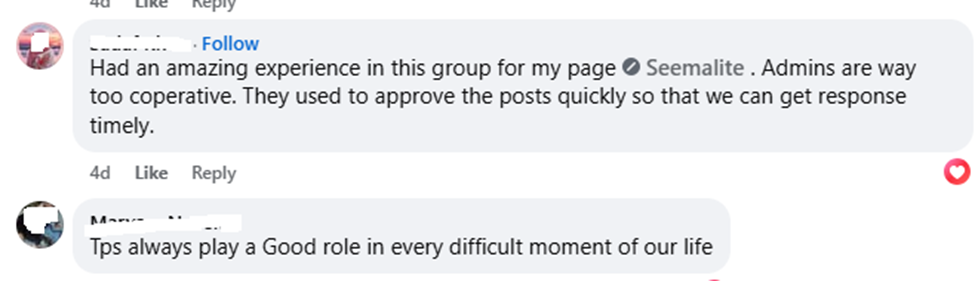

    TPS doesn’t chase viral posts or social media gimmicks. The focus remains firmly on real-world impact: did someone get a client? Did a woman land a job interview? Did someone find clarity about launching her own business?

    At its core, TPS is a feminist space — but not in a Western-imported, hashtag-driven way. The feminism practiced here is deeply rooted in local culture, built on values of fairness, support, and equality — not superiority.

    Afrah and her team know the ground realities of women in KP: they’re often managing homes, raising kids, studying, or working multiple part-time gigs. TPS gives them a voice and validates their hustle. It doesn’t preach, it guides — through example, through community and truth.

    The group regularly talks about so many things, right from navigating family pressure while working to learning to say no without guilt (a much-needed lesson for empaths like myself!).

    TPS is proof that feminism can be soft-spoken but powerful, culturally aware but transformative.

    Behind every movement is a leader who quietly fuels the fire. For TPS, that 

    woman is Afrah Sattar Khan. She doesn’t post daily selfies or seek the spotlight. Instead, she spends her energy uplifting others, managing the group, moderating discussions and building new pathways for visibility.

    Here are just a few examples of TPS’s real-world impact:

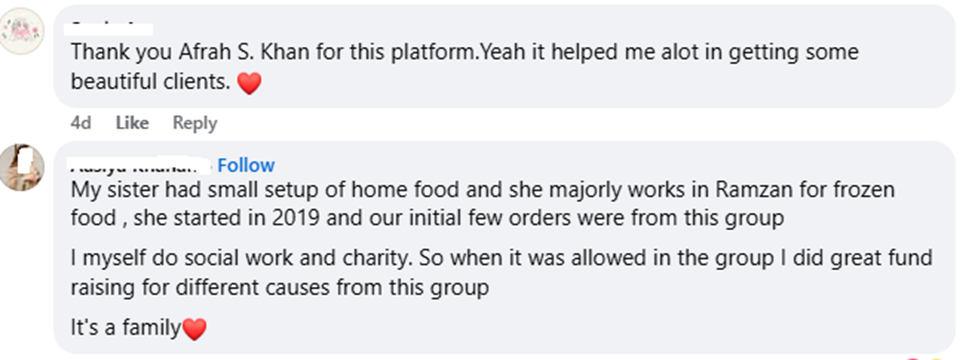
         A group of young women from Peshawar started posting their photography work in TPS. Back then, female photographers were almost unheard of in the region. Today, they’re professional, in-demand artists with fan followings — and TPS helped launch them.

         A woman who made stitched clothes at home found her first 30 clients through a single shoutout. Now, she employs two assistants and manages her orders online.

         Countless members have learned how to price, brand, and market their offerings — just by participating in the weekly business activities.

    With its continued growth, TPS has plans to expand its digital infrastructure. Afrah and her team are working toward building a searchable online directory of women-led businesses, organising in-person networking meetups, and growing their YouTube and Instagram channels to further amplify success stories.

    Still, the core promise remains unchanged: support, not sales.

    “We’ll never charge women for being seen. That’s not what this space is about,” Afrah says. “TPS is a free hand when you’re climbing — not a toll gate at the top.”

    In a country where opportunities for women are still too often gatekept, The Pakistani Sisters (TPS) has kicked open the door. It has done so without sponsors, without flashy influencers, and without charging a single rupee.

    It’s built on community, consistency, and an unshakeable belief that women can rise—especially when they lift each other up.


  • Investment ratio records major boost, just short of target

    Investment ratio records major boost, just short of target

    Pakistan has missed its targeted investment ratio despite the federal government’s best efforts. However, details from reports reveal that the investment ratio has improved, rising to 13.8 per cent of the economy’s size in the current fiscal year (FY).

    Islamabad has been working to raise investment inflows, particularly those that do not contribute to the national debt stock. Figures approved by the National Accounts Committee, however, indicate that the government was unable to meet the official investment ratio target.

    A possible contributing factor is the inelastic nature of private investments. Moreover, the Pakistan Sovereign Wealth Fund (PSWF) remains largely idle despite being set up about two years ago.

    The PSWF’s dormancy is linked to disagreements with the International Monetary Fund (IMF), with reports suggesting that the IMF is concerned about its legal framework.

    Lawmakers and authorities intended to boost the investment-to-GDP ratio up to a respectable 14.2 percent. While this conclusion has been based on provisional figures, reports have revealed that the result will become official next Sunday when authorities launch the Economic Survey of Pakistan. 

    Analysts note that despite missing the investment-to-GDP ratio target, the figure has logged a remarkable improvement from the previous fiscal year, as it sat at an abysmal 13.1 percent – the lowest investment ratio in 50 years.

    Pakistan is now relying on the Special Investment Facilitation Council (SIFC) to boost domestic investment levels while simultaneously assisting the federal government with the implementation of policies. Private sector investment levels increased marginally to settle at 9.1 percent of the Gross Domestic Product (GDP) – well below the target of 9.7 percent. 

    According to reports, the fixed investment-to-GDP ratio climbed up to 12 percent, a stark improvement from the 11.4 percent recorded during the previous FY. However, the targeted level was 12.5 percent, implying that the economy missed yet another investment goal. 

    Reports reveal that if the federal government exhausts its development budget of Rs1.1 trillion, the public sector investment-to-GDP ratio will be able to climb up to 2.9 percent. 

    The lack of investments suggests that the government will have to finance projects by taking out loans. However, the cash-strapped country is already beset by external financing issues; taking up additional loans will only serve to exacerbate financing problems.

    As per a recent staff report released by the IMF, Pakistan needs to ease its trade policies, which the IMF considers to be restrictive. The IMF believes that the removal of trade-hindering policies, with a focus on abolishing the existing inefficient tariff system, could result in increasing private investment levels.

  • ‘You’re that Shabana’; Hania Aamir meets officer behind viral trend

    ‘You’re that Shabana’; Hania Aamir meets officer behind viral trend

    Star actress Hania Amir’s meeting with Sindh police officer Shabana has gone viral on social media.

    In the video, Hania is seen warmly hugging Officer Shabana and saying, “You’re that Shabana! You’re really amazing!” In response, Officer Shabana smiles and says, “It was nice meeting all of you. It’s my pleasure to be with you all, and thank you for all the love.”

    Officer Shabana previously gained fame for her role in protecting American visitor Onijah Robinson during her stay in Pakistan. Onijah arrived in late 2024, reportedly to meet a Pakistani man she had fallen in love with online, and returned to the US in February after spending several months in the country.

    After returning home, Onijah praised Officer Shabana in an interview, describing her as a “kind and dedicated officer” who took care of her like family. Onijah’s heartfelt words, especially the line “I love Shabana,” went viral, inspiring countless TikTok videos and memes.