Tag: CJP

  • Here’s how Justice Mansoor Ali Shah reacted to Yahya Afridi’s appointment as CJP

    Here’s how Justice Mansoor Ali Shah reacted to Yahya Afridi’s appointment as CJP

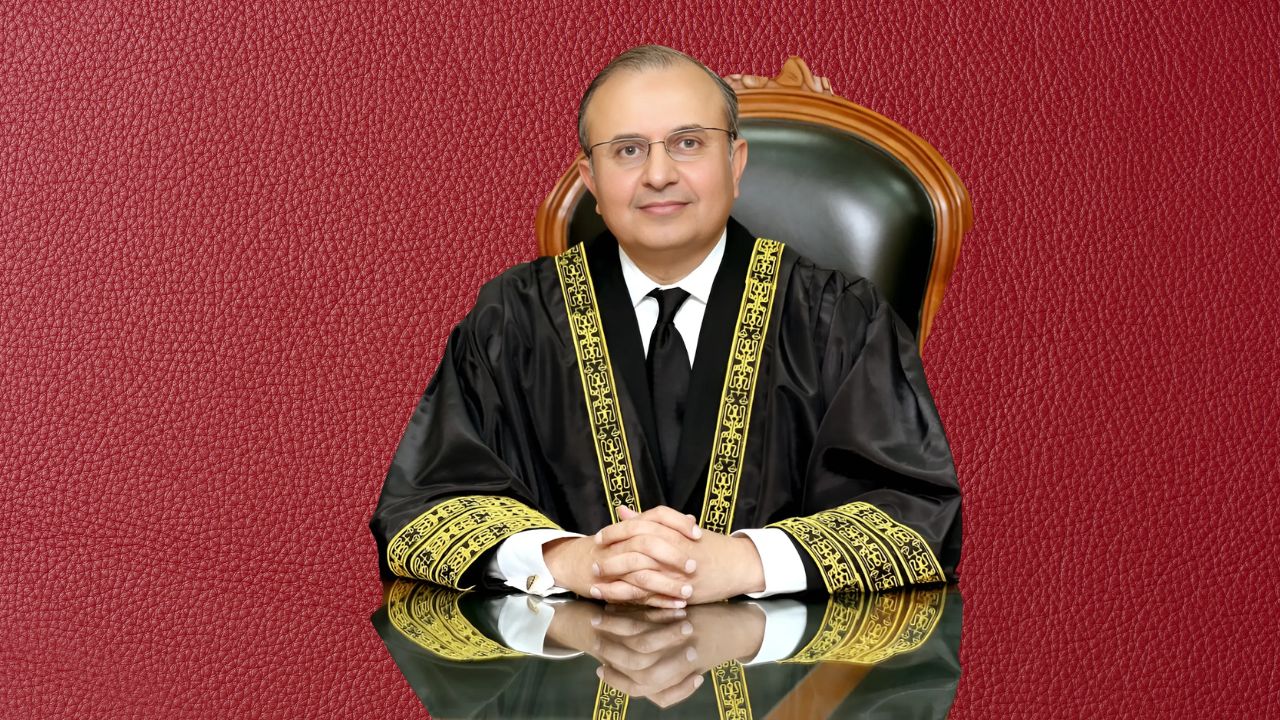
    A claim regarding Justice Mansoor Ali Shah’s reaction to Justice Yahya Afridi’s appointment as the next chief justice of Pakistan (CJP), has taken the internet by storm.

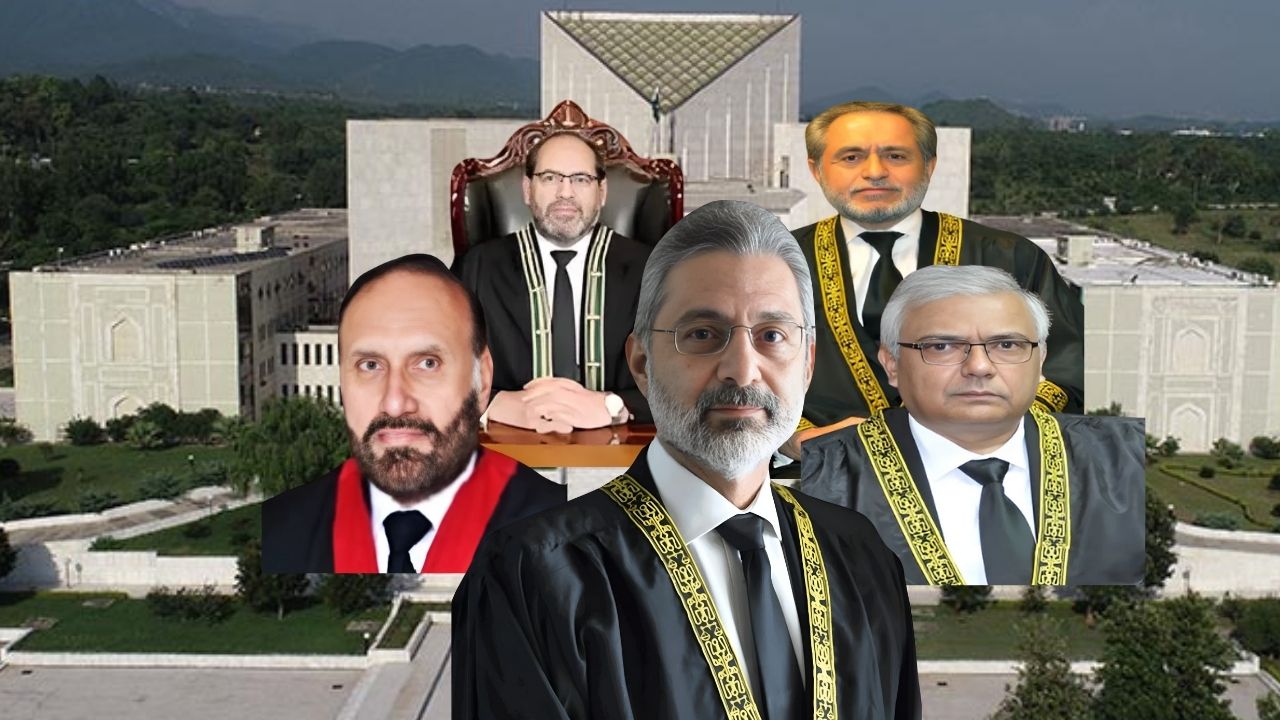
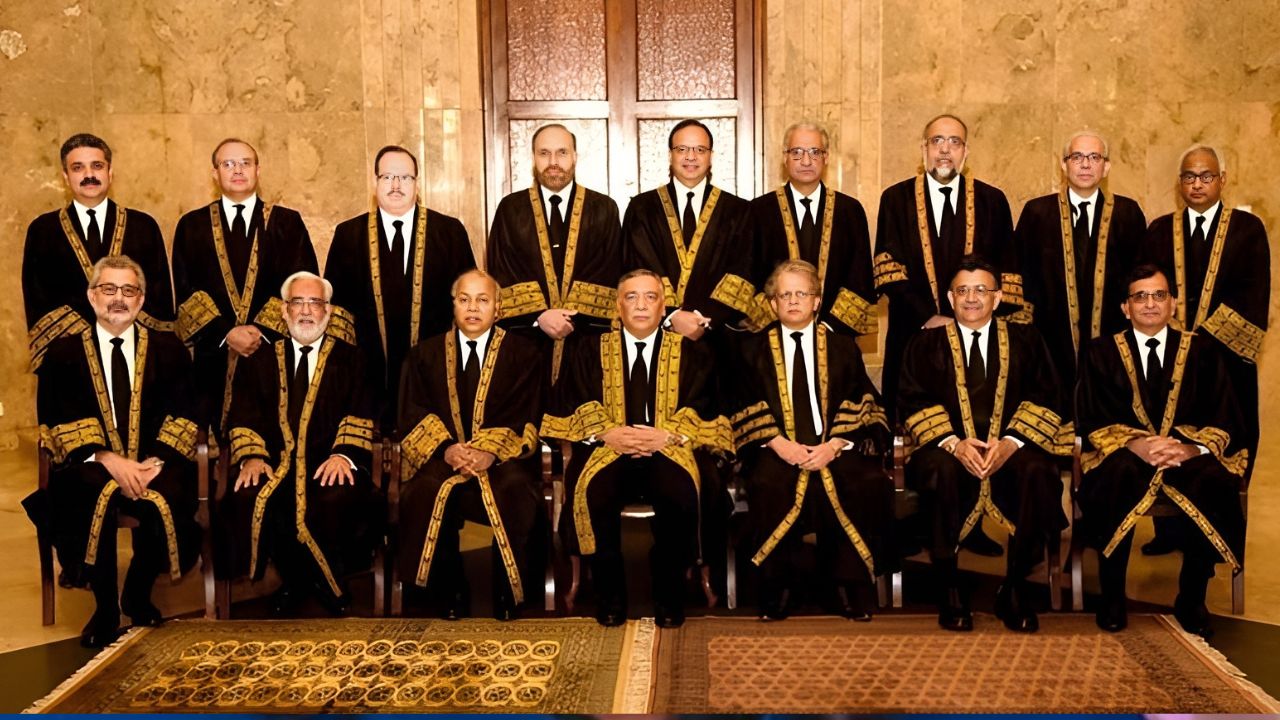
    Justice Shah, who was next in line to be the CJP on the basis of seniority, was on Tuesday sidelined for the appointment of Justice Yahya Afridi, as a Special Parliamentary Committee, formed under the 26th Amendment, nominated the latter instead.

    The committee, with a two-thirds majority, referred Justice Afridi’s name to Prime Minister Shehbaz Sharif, who later forwarded it to President Asif Ali Zardari for a final nod.

    With the Law Minister Azam Nazeer Tarar announcing the decision of the parliamentary committee last night, senior journalist Meher Bokhari shared on X (formerly Twitter) a claim regarding Justice Shah’s reaction to the news.

    “Just spoke to a close family member of Justice Mansoor Ali Shah. He said, ‘I am fine and going off to sleep and need to go early to SC [sic],” she claimed

    It wasn’t later when social media was flooded with commentary on Justice Shah’s reaction.

    One user trolled Meher Bokhari and said, “It was quite a revelation indeed. I also talked to a family member of Justice Mansoor Ali Shah, and he said, ‘I’ll wake up and brush my teeth.”

    “Sanu ki paway lambi taan kay sawy ya choti,” another user posted.

    Optimistically, one X user wrote, “Justice Mansoor Ali Shah’s commitment to his duty speaks volumes. Let’s hope his integrity remains intact amidst all the political pressure.”

    Justice Yahya Afridi’s Early Life

    Justice Yahya Afridi was born in Dera Ismail Khan on Jan 23, 1965. Justice Afridi belongs to the Adam Khel clan of the Afridi tribe and is a resident of Kohat’s Babari Banda village. He comes from a family steeped in the tradition of public service, as per Dawn News.

    Justice Afridi attended Aitchison College and Government College, Lahore, for his schooling and undergraduate degree. He later secured an MA degree in Economics from Punjab University.

    After being awarded a Commonwealth Scholarship, Justice Afridi completed his LLM from Jesus College at the University of Cambridge. He was subsequently selected for a scholarship programme for Young Commonwealth Lawyers at the Institute of Legal Studies in London.

    He was enrolled as a high court advocate in 1990 and a Supreme Court lawyer in 2004. He served as an assistant advocate general for Khyber Pakhtunkhwa and as federal counsel for the federal government while in practice.

    Justice Afridi was elevated to the Peshawar High Court (PHC) as an additional judge in 2010, and confirmed as a PHC judge on March 15th, 2012.

    He was elevated to the Supreme Court on June 29, 2018.

    Justice Yahya Afridi will take oath as CJP on October 26.

  • 26th Constitutional Amendment passed: Here’s what you need to know

    26th Constitutional Amendment passed: Here’s what you need to know

    The coalition government’s much-awaited 26th Constitutional Amendment Bill has been passed by both the Senate and the National Assembly in the wee hours of Monday morning.

    The Constitutional Amendment bill has been sent to President Asif Ali Zardari, following the approval from Prime Minister Shehbaz Sharif.

    The bill, containing 22 clauses, was presented by Federal Law Minister Azam Nazeer Tarar in the Senate where it secured 65 votes, a two-thirds majority in the Upper House.

    Following the voting, Chairman Senate Yousaf Raza Gilani stated, “Sixty-five members are in favour of the motion regarding the passage of the bill, and four members are against it. So, the motion is carried out by the votes of not less than two-thirds of the total membership of the Senate, and consequently, the bill stands passed.”

    The 26th Constitutional Amendment bill was tabled at the National Assembly following approval from the Upper House and passed with a two-thirds majority as 225 lawmakers voted in favour of the bill in NA, while the magic number in the Lower House was 224 votes.

    Pakistan Tehreek-e-Insaf (PTI) and Sunni Ittehad Council’s 12 Member National Assembly (MNA) opposed the Constitutional Amendments In the National Assembly.

    “225 members cast their votes for ayes, 12 for nos. Consequently, the bill is passed by the assembly by not less than two-thirds of the total membership of the assembly,” the Speaker of the National Assembly Ayaz Sadiq said.

    Following the passage of the bill from the NA, Prime Minister Shehbaz Sharif remarked, “Today’s amendment, the 26th, is not just an amendment, but an example of national solidarity and consensus. A new sun will rise, emanating across the nation.”

    The key points of the 26th Constitutional Amendment

    The much-debated Federal Constitutional Court (FCC) has been dropped from the Constitutional Amendments bill. However, it has been suggested that constitutional benches be formed in the Supreme Court (SC) of Pakistan to deal with constitutional matters.

    The Supreme Judicial Commission (SJC), headed by the Chief Justice of Pakistan and including the three most senior judges of the Supreme Court, two senators and two MNAs, a Law Minister and the Attorney General of Pakistan will form the constitutional bench and ensure that all provinces get representation on it.

    The minimum number of judges in the constitutional bench would be five.

    A 12-member special parliamentary committee, including eight members from the National Assembly and four Senators, would be responsible for sending the names of the three most senior judges of the top court to PM Pakistan for the appointment of Chief Justice of Pakistan.

    The Chief Justice’s retirement age is fixed at 65 years of age.

  • Names of opposition Senators revealed who may vote in favour of the Constitutional Amendments

    Names of opposition Senators revealed who may vote in favour of the Constitutional Amendments

    Veteran journalist Azaz Syed has revealed the names of opposition senators who might vote in favour of the government’s proposed Constitutional Amendments.

    Speaking on the YouTube channel Talk SHOCK, Azaz Syed disclosed that there is a possibility that Senator Faisal Saleem, Senator Ahmad Khan, Senator Abdul Shakoor Qasim, Senator Naseema Ehsan, Senator Dr Zarka Suharwardy Taimur and Senator Saifullah Abro might vote in favour of the 26th Constitutional Amendments in the Upper House.

    “Although, these Senators did not confirm their support for the government,” he added.

    Commenting on the suggestion of military court inclusion in the 26th Constitutional Amendment draft, Syed cleared that it is not part of the coalition government’s proposed Constitutional Amendment draft.

    Meanwhile, talking to media outside the parliament, Defence Minister Khawaja Asif today claimed that the coalition government has achieved the magic number to pass the Constitutional Amendments from parliament.

  • Here’s how the chief justice will be appointed after 26th Constitutional Amendment

    Here’s how the chief justice will be appointed after 26th Constitutional Amendment

    A draft of the government’s proposed 26th Constitutional Amendment has unveiled the process of the appointment of the Chief Justice of Pakistan (CJP).

    Ruling out the scenario of the most senior judge being appointed the Chief Justice of Pakistan, it has been suggested in Constitutional Amendments that the appointment shall be made from among the three most senior judges of the Supreme Court on the recommendation of a special parliamentary committee.

    Justice Mansoor Ali Shah, Justice Munib Akhtar and Justice Yahya Afridi are in the running on the basis of seniority.

    Eight members of the National Assembly and four members of the Senate will be part of the 12 members of the special parliamentary committee.

    The majority of the special parliamentary committee will be from the ruling government.

    The proposed Constitutional Amendments further suggested that if the National Assembly is dissolved, then all committee members will be from the Senate.

    However, the special parliamentary committee will send the name of the judge to the Prime Minister of Pakistan, and then the President will give consent to the appointment of the top court judge.

    The next senior judge’s name would be considered for the CJP if the Prime Minister rejects the special committee’s proposed judge name, and the process will continue until the CJP is appointed.

    The majority of the special parliamentary committee would be responsible for sending the name of the nominated judge to the Prime Minister prior to 14 days of retirement of the CJP.

    No decision or action of the commission or committee shall be questioned or deemed illegal following the vacancy in membership or the absence of any member in the special parliamentary committee, the 26th constitutional amendment concluded.

  • Supreme Court overturns 2022 verdict on Article 63A

    Supreme Court overturns 2022 verdict on Article 63A

    A larger five-member bench, headed by Chief Justice Pakistan (CJP) Qazi Faez Isa, has accepted the review petition of Article 63A filed by the Supreme Court Bar Association (SCBA).

    The ruling given in May 2022 by a five-member larger bench headed by former CJ Umar Ata Bandial on Article 63A has been struck down by the apex court’s larger bench with a 5-0 majority.

    Chief Justice of Pakistan Qazi Faez Isa stated that Article 63A is redundant as the constitution already addresses the issue clearly, and added that judges can’t write the constitution.

    The five-member bench included Justice Aminuddin Khan, Justice Jamal Khan Mandokhail, Justice Naeem Akhtar Afghan, and Justice Mazhar Alam Miankhail, along with CJP Qazi Faez Isa.

    A recent top court five member bench verdict by 3-2 stated that parliament members who vote against their parliamentary leader will be considered deviant, and their vote will also be not counted.

    It should be mentioned here that the verdict of May 17, 2022 was authored by Justice Munib Akhtar.

    However, the detailed review case verdict of Article 63A will be issued soon.

    Article 63A noted that parliamentary members will lose their seats if they vote against the command of the party chief.

    However, it is not stated that parliamentary vote can’t be counted.

    During the hearing, Qazi Faez Isa stated that political parties are not subject to the authority of a judge or Chief Justice.

    Counsel of founder Imran Khan of Pakistan Tehreek-e-Insaf (PTI), Barrister Ali Zafar, objected to the composition of the bench on behalf of his client. As a result, the Supreme Court appointed him as judicial assistant.

    Barrister Ali Zafar told the members of the larger bench that the parliamentary party directed the parliament members to vote in parliament and added that the Chief Parliamentary party could send ineligible references to parliamentary members if his order defied.

    In response, the Chief Justice declared the vote against the party “a suicide attack.”

  • Bilawal warns of ‘face-off’ in country if amendments not passed before Oct 25

    Bilawal warns of ‘face-off’ in country if amendments not passed before Oct 25

    Pakistan Peoples Party (PPP) chairman Bilawal Bhutto while talking to journalists during a meeting with Supreme Court Press Association’s delegation on October 2, warned of a “face-off like situation” in the country if the constitutional amendments were not passed before October 25.

    It should be highlighted that Chief Justice of Pakistan Qazi Faez Isa is set to retire on October 25 this year.

    Bilawal has been at the forefront of campaigning for the coalition government’s decision to pass the constitutional amendments ever since it failed to do so last month.

    Last month, the government remained unsuccessful in convincing JUI-F Chief Maulana Fazl ur Rehman as opposition and government leaders raced to woo him.

    “The matter will be resolved peacefully if the amendment is passed before October 25. Otherwise, the situation could lead to confrontation,” warned Bilawal.

    He reiterated the PPP’s goal to establish a constitutional court – a goal set in the Charter of Democracy signed by the slain former Prime Minister Benazir Bhutto and Nawaz Sharif in 2006.

    Bilawal blamed the judiciary for being biased and political, questioning the top court’s reserved seats verdict.

    Interestingly, he also stated that when Law Minister Azam Nazeer Tarar apprised the SC judges of judicial reforms, then “they [SC Judges] instantly announced the verdict in the reserved seats case which is direct interference.”

    Meanwhile, Jamiat Ulema-e-Islam (JUI) leader Senator Kamran Murtaza told Geo News that he won’t cooperate with anyone under threat of bloodshed and pressure, in reference to Bilawal’s statement.

  • ‘Govt and establishment would be comfortable with Qazi Faez Isa’s extension,’ says Ansar Abbasi

    ‘Govt and establishment would be comfortable with Qazi Faez Isa’s extension,’ says Ansar Abbasi

    Chairman Pakistan Peoples Party (PPP) Bilawal Bhutto Zardari has cleared that Justice Mansoor Ali Shah would replace Chief Justice Pakistan (CJP) Qazi Faez Isa as the country’s apex judge.

    Speaking to ARY News, the former Foreign Minister said, “On October 26, Justice Mansoor will become the next chief justice — no doubt.”

    Responding to the formation of the Federal Constitutional Court (FCC), Chairman PPP said that the Supreme Court’s workload is so much that it affects the judiciary’s performance.

    He added, “We waited almost 50 years for justice in Shaheed [Zulfiqar Ali] Bhutto’s murder case.”

    Expecting a constructive role from Pakistan Tehreek-e-Insaf (PTI) over the twenty-sixth amendments, Bhutto said, “It is difficult for [the government] to discuss constitutional amendments with PTI along with its input.”

    On the same day, appearing in the Geo News programme Capital Talk, Bhutto clarified that Jamiat Ulema-e-Islam Fazl (JUI-F) was crafting its amendments draft.

    “PPP will prepare its draft regarding the formation of the constitutional court and will share it with Maulana Fazlur Rehman,” he concluded.

  • Senior lawyers urge Justice Qazi Faez Isa to resign on Oct 25

    Senior lawyers urge Justice Qazi Faez Isa to resign on Oct 25

    Senior lawyers, including the president of the Supreme Court Bar Association (SCBA), have strongly opposed the secretive constitutional package proposed by the government and called upon Chief Justice of Pakistan Qazi Faez Isa to hang his robes with honour on October 25, 2024.

    In a letter signed by senior advocates Muneer A. Malik and Faisal Siddiqi, lawyers stressed that Justice Syed Mansoor Ali Shah will deservedly be the next CJP on the dawn of October 26.

    In the letter, they also urged Justice Isa to “preserve his legacy and not be a nominee for any appointment for any proposed constitutional bench.”

    Both senior advocates recalled that they had acted as legal counsels or supported Justice Isa through their writings against the “unconstitutional and mala fide presidential reference filed against the then Justice Qazi Faez Isa” in 2019.

    SCBA president Shehzad Shaukat cautioned against the secrecy with which the coalition government was trying to pass the supposed amendments and not bringing it to designated forums for open discussion.

    Shaukat pointed out that the SCBA is unlikely to oppose the proposed amendment if it relates to the creation of a constitutional court, which, according to him, is necessary for dispensing justice to common people because the Supreme Court is mostly busy hearing cases of a political nature.

  • Justice Munib Akhtar walks out of Judicial Commission meeting

    Justice Munib Akhtar walks out of Judicial Commission meeting

    Supreme Court Justice Munib Akhtar walked out of the Judicial Commission of Pakistan (JCP) meeting, which was held to review the JCP Rules 2024 concerning the elevation of judges to the superior judiciary.

    The News reported that Justice Akhtar asked Attorney General of Pakistan (AGP) Mansoor Usman Awan about the progress of the government’s intended legislation on superior court judges. AGP Awan responded that he should direct his question to Federal Law Minister Azam Nazeer Tarar and stated that the meeting was not the appropriate forum for such questions.

    Following these remarks, Justice Akhtar suggested postponing the meeting but faced disagreement from fellow judges, prompting him to walk out alone. The JCP meeting continued without him.

    The commission, led by the Chief Justice of Pakistan (CJP) Qazi Faez Isa, discussed various clauses of the rules. The meeting was attended by four provincial law ministers and top court judges, including Justice Mansoor Ali Shah, Justice Yahya Afridi, retired Justice Manzoor Malik, and AGP Mansoor Usman Awan.

    There has been no official confirmation regarding Justice Munib Akhtar’s departure from the meeting.

    Earlier, the commission wrote to the chief justices of the five high courts, requesting nominations for candidates to be elevated as additional judges under the 2024 Rules.

  • Govt just three votes away from extending judges’ tenure

    Govt just three votes away from extending judges’ tenure

    The incumbent government led by Prime Minister (PM) Shehbaz Sharif intends to extend the judge’s tenure as soon as it secures enough votes in the Upper House.

    The incumbent government is only three votes short in the Senate to amend the tenure of Supreme Court and High Court judges, a government source told Geo News.

    Government sources further revealed that the incumbent government has achieved a two-thirds majority in the National Assembly (NA). Once the Senate’s majority is secured, Parliament will pass constitutional amendments.

    After constitutional amendments, the tenure of Supreme Court judges will be extended to sixty-eight years of age, and that of High Court judges will be extended to sixty-five years of age.

    Earlier, Federal Minister for Law Azam Nazeer Tarar had remarked that suggestions for extending the judge’s tenure could be considered. Meanwhile, Chief Justice Pakistan (CJP) Qazi Faez Isa had vehemently rejected the extension offer.