Tag: National Assembly

  • Name your candidate: President asks Khan, Shehbaz to give names for caretaker Prime Minister

    Name your candidate: President asks Khan, Shehbaz to give names for caretaker Prime Minister

    President Dr Arif Alvi has sent letters to Prime Minister (PM) Imran Khan and Leader of the Opposition in the outgoing National Assembly and Pakistan Muslim League-Nawaz (PML-N) President Shehbaz Sharif to seek suggestions for the appointment of a caretaker PM.

    The letter states that the caretaker PM will be appointed after the mutual consultation of the President, current PM, and Leader of the Opposition.

    The letter also mentions that if consultations fail, both government and the Opposition will nominate one person for the seat to a committee comprising both Govt and the Opposition.

    However, responding to the letter, Pakistan People’s Party (PPP) chairperson Bilawal Bhutto-Zardari questioned the President, saying that if there is no Assembly, then how can the Prime Minister and Leader of the Opposition exist name any caretaker prime minister? What would be the status of consultation between them?

    Bilawal also asked the Supreme Court (SC) to stop this ‘coup’.

    A day earlier, Deputy Speaker National Assembly (NA) Qasim Suri dismissed the no-confidence motion against Khan, terming it “unconstitutional”, saying that it was backed by “foreign powers” under Article 5.

    Following this development, Executives [Khan and Alvi] announced the dismissal of the National Assembly under Article 58. However, Imran Khan will remain seated as PM till the appointment of a caretaker PM.

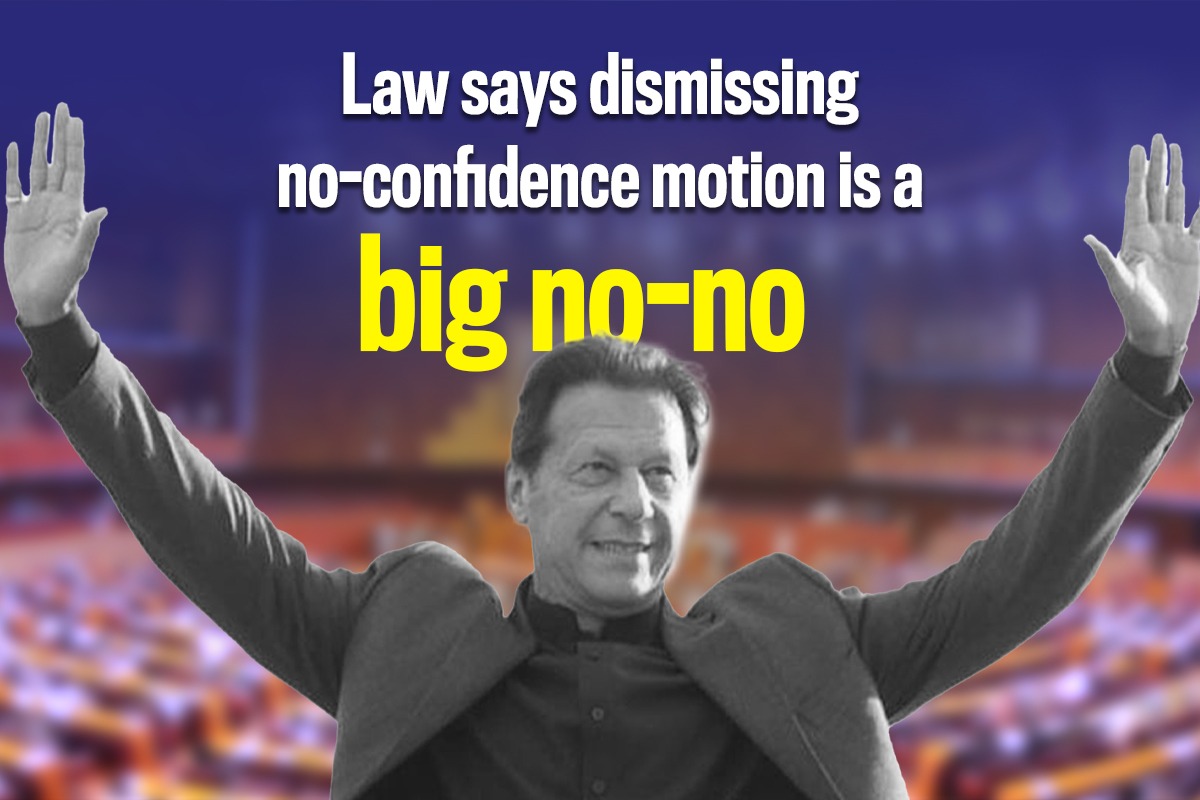
  • Explainer: Law says dismissing no-confidence motion is a big no-no

    Explainer: Law says dismissing no-confidence motion is a big no-no

    Pakistan is in a state of political chaos as the no-confidence motion against Prime Minister (PM) Imran Khan was dismissed abruptly on Sunday. The move came after National Assembly (NA) Deputy Speaker Qasim Suri termed it “unconstitutional”, saying that it was backed by “foreign powers”.

    Suri then quickly disallowed voting on the no-confidence motion and adjourned the session. Later, on PM Khan’s advice, President Arif Alvi dissolved the National Assembly, with the premier asking the nation to get ready for fresh polls.

    After the nation was left in shock, there was much talk about the “unconstitutional trump card” used by PM Khan.What everyone wants to know is: did Khan subvert the constitution of Pakistan?

    Lawyer Salaar Khan tweeted a brief comprehension of the constitutional premise of what happened on Sunday, April 3, which went viral on Twitter.

    “Instead of allowing the vote to proceed against the Prime Minister, the Deputy Speaker dismissed the resolution. After this, the President was able to dissolve the National Assembly on the PM’s advice,” tweeted Salaar.

    “Under Article 58 of the Constitution, the President may dissolve the National Assembly on the PM’s advice. However, a PM against whom a vote of no confidence ‘has not been voted upon’ cannot ask the President to dissolve the house,” wrote Salaar.

    “To get around this, the Deputy Speaker first ‘dismissed’ the no-confidence resolution submitted against the PM. He did this on the basis of a personal interpretation of Article 5, which provides for loyalty to the state.”

    “The rather feeble argument here was that because the letter that Pakistan had received from the US suggested a regime change would improve relations, the vote of the no-confidence motion, itself, was against anti-state,” said the lawyer.

    “The irony, of course, is that Article 5 also provides for obedience to the Constitution – which was arguably violated in the process of the dismissal of the no-confidence motion.”

    “Procedurally, a ‘motion’ for no-confidence is first moved and, if leave is granted, it becomes a ‘resolution’. Under the Rules of Business in the National Assembly, there is no provision that actually allows a Speaker or Deputy Speaker to dismiss a resolution.”

    “In fact, the role of the Speaker is very clearly defined in Schedule 2 of the Rules of Business in the NA, and is essentially limited, in a VoNC, to announcing the result.”

    “And so, because the Speaker can’t dismiss a resolution for a VoNC, there is still a VoNC that has not been ‘voted upon’ by the Prime Minister. Consequently, the PM could not have advised that the assembly be dissolved under Article 58.”

    “In fact, in doing so, it may even be argued that he not only violated Article 5, by not obeying the Constitution but also subverted the Constitution under Article 6. It is, however, important to note that Article 6 is often used rather flippantly in common parlance.”

    “Finally, is the question of what the SC may do in all of this. One provision of the Constitution that has been mentioned a lot is Article 69, which bars courts from interfering in certain Parliamentary proceedings.”

    “However, the SC has laid out exceptions to this bar. Courts can interfere where there is not an ‘irregularity’ but a ‘patent illegality’, where there is clear mala fide, or where the matter in question affects the composition of the house, itself (such as in Farzand Ali).”

    “But while the SC may well find that it can interfere, how far it will go is another question. In theory, the SC could find the dissolution to be without legal effect and even order voting to resume on the VoNC. But given recent precedent, that may be a long shot.”

    The Supreme Court of Pakistan took suo moto notice of the Assembly proceedings on Sunday, April 3, and restrained the state institutions as well as the political parties from taking any unconstitutional acts and exploiting the situation.
  • MNA Ali Wazir granted bail ahead of no-confidence motion vote against PM Khan

    MNA Ali Wazir granted bail ahead of no-confidence motion vote against PM Khan

    Member of National Assembly (MNA) Ali Wazir from South Waziristan has been released from Karachi’s central prison on parole to participate in the no-trust vote against Prime Minister (PM) Imran Khan.

    Members of the Opposition had submitted a written request on March 25, asking the NA Speaker to issue the production order for every detained lawmaker — irrespective of their party affiliation — allowing them to exercise their right to vote.

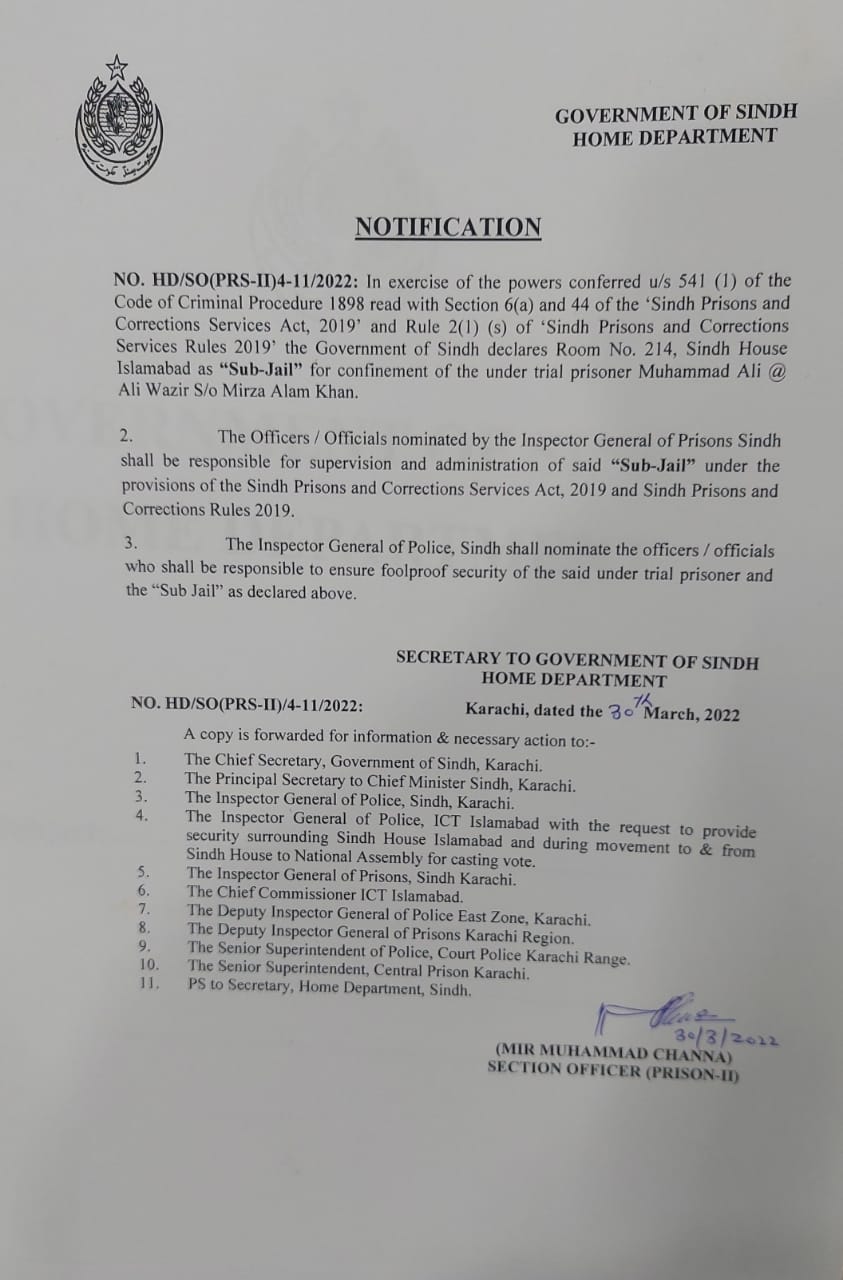
    Ali Wazir will be in Sindh House in Islamabad. A room in Sindh House has been declared as a sub-jail for Wazir.

    Pakistan People’s Party (PPP) MNA Jam Abdul Karim from Karachi has been granted protective bail against a surety bond of Rs100,000 by the Sindh High Court.

     The no-confidence motion against PM Khan will be discussed in the National Assembly during the Lower House session today (Thursday), scheduled to start at 4pm.

    The NA Secretariat issued the order of the day for today on Wednesday night, with a discussion on the no-trust move against the premier on the session’s agenda.

  • Bye Bye Buzdar?: No-trust motion submitted against Punjab CM Usman Buzdar

    Bye Bye Buzdar?: No-trust motion submitted against Punjab CM Usman Buzdar

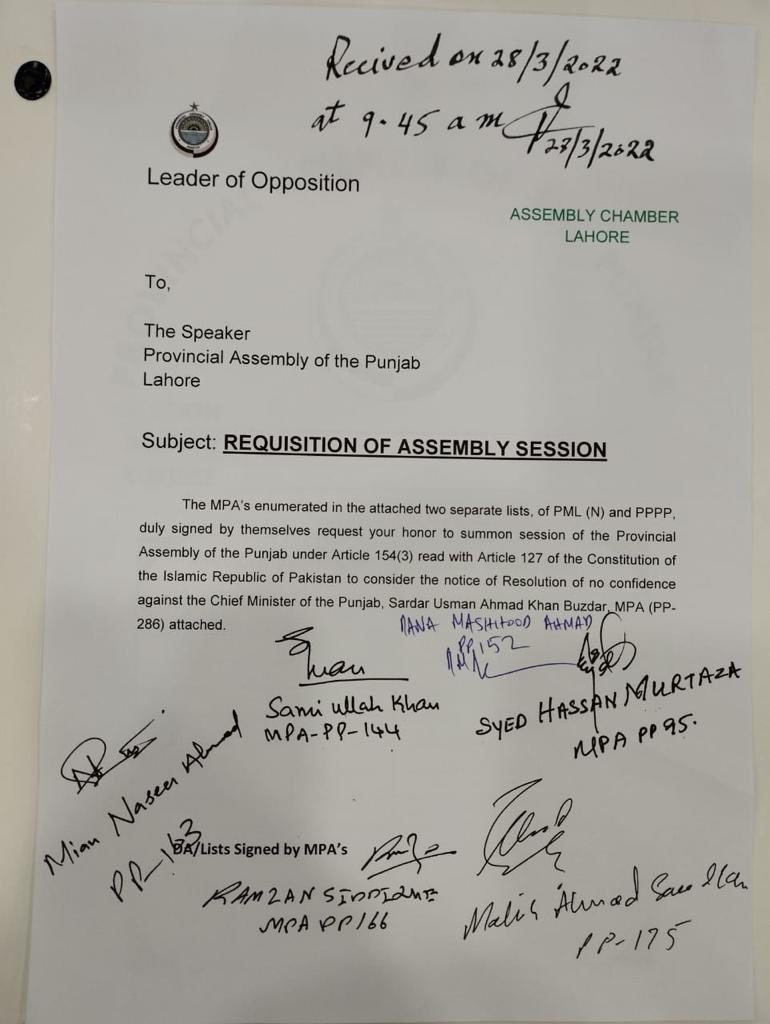
    The Opposition submitted a no-confidence motion against Chief Minister (CM) Punjab Usman Buzdar in the Punjab Assembly today (March 28).

    A total of 126 lawmakers from the Opposition parties have signed the no-confidence motion against Buzdar, said Pakistan Muslim League-Nawaz’s (PML-N) Rana Mashood, adding that 119 members signed the requisition for a session.

    Copy of the no-confidence motion against CM Buzdar

    The speaker is bound to summon a session within 14 days of the submission of the no-trust motion. CM Punjab can no longer dissolve the Assembly after the submission of a no-confidence motion against him.

    It is pertinent to mention here that on March 8, the Opposition submitted a no-trust motion against Prime Minister (PM) Imran Khan in National Assembly, which is likely to be tabled today in a crucial NA session.

  • Speaker Asad Qaiser is ‘Imran Khan’s stooge’, says Opposition after Qaiser adjourns NA session till Monday

    Speaker Asad Qaiser is ‘Imran Khan’s stooge’, says Opposition after Qaiser adjourns NA session till Monday

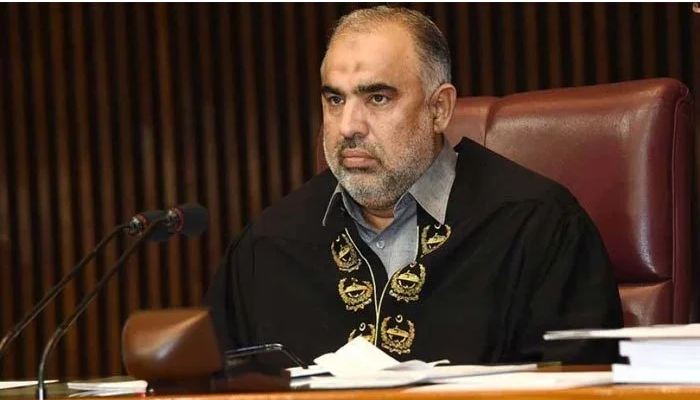
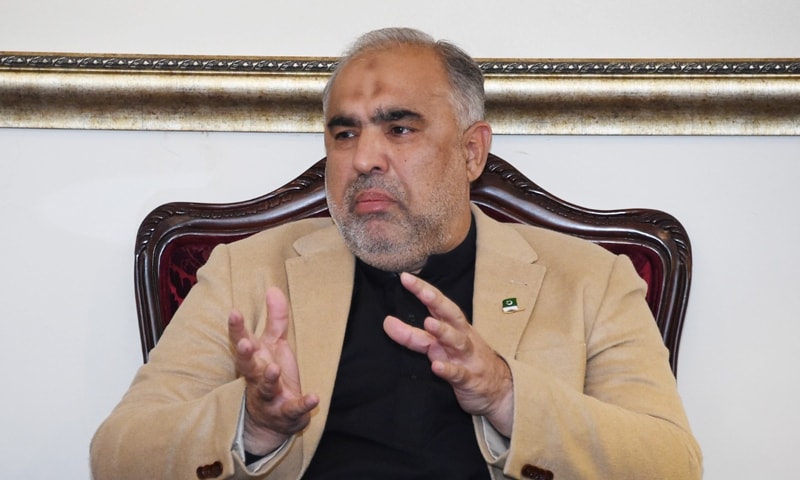
    The much-awaited and critical National Assembly (NA) session on the vote of the no-confidence motion against Prime Minister (PM) Imran Khan was adjourned till Monday (March 28) by National Assembly Speaker Asad Qaiser.

    “Since this is the tradition of this house, that whenever a respectable member [of the assembly] passes away, the [NA] session is adjourned till the next [working] day in their honour,” said Qaiser. “This has happened for years and this had happened a total of 24 times in the past.”

    Addressing a press conference outside Parliament House right after the session was adjourned, Leader of the Opposition in NA Shehbaz Sharif said that the Speaker has become a “stooge” of PM Khan.

     “This was a constitutional obligation and he violated the Constitution by not doing this,” said Shehbaz adding, “The Constitution and the law is above tradition and voting should have been allowed … tradition aside, the Speaker should have taken up the motion [but] he did not listen and left.”

    Shehbaz tweeted, “This partisan behaviour does not suit the custodian of the House. U cannot stop the inevitable through such underhand tactics!”

    Pakistan People’s Party Chairperson Bilawal Bhutto-Zardari said that PM Khan was “fleeing the pitch”.

    Taking to Twitter, Bilawal wrote, “Speaker provided another weak excuse to avoid tabling the no-trust move.”

    “Imran can’t run forever. PM has no sportsman spirit and cannot face defeat with grace. The once great Kaptaan will go down like a rat on a sinking ship,” he said.

    Prior to the session, Information Minister Fawad Chaudhry tweeted, “Nothing will happen in the assembly session today.”

  • CJP Bandial says not counting a vote during no-trust proceedings against Khan would be ‘contemptuous’

    Chief Justice of Pakistan (CJP) Umar Ata Bandial on Thursday observed that not counting a vote that has been cast during the no-confidence vote against Prime Minister (PM) Imran Khan would be “contemptuous”.

    CJP Bandial further questioned that for how long a dissident Member of the National Assembly (MNA) could be disqualified.

    He made the remarks during the hearing of a presidential reference seeking the Supreme Court’s opinion on Article 63-A of the Constitution.

    Earlier, during the hearing, Justice Mandokhail questioned whether the MNA’s vote could be counted in the proceedings conducted before he was de-seated, observing there was no mention of not counting a vote in the 18th Amendment.

    Justice Akhtar observed that the purpose of Article 63-A was to stop defection from party policies. “The party’s collective opinion is above an individual opinion. The collective opinion is important for the stability of democracy.” He said one interpretation of Article 63-A was that the vote of dissidents should not be counted.

    Attorney General of Pakistan (AGP) Khalid Javed Khan argued that the real issue was about clarifying Article 63-A(4). “Someone who violates the Constitution by defection cannot be praised. We cannot read what’s not written in the Constitution. Article 62(1)(f) states that an MNA should be honest and righteous.

    “Should defecting from the party be rewarded? Can those who are dishonest be considered righteous?” he asked.

    Justice Mandokhail replied that every MNA had the right to vote in accordance with Article 95, which deals with the procedure to bring in a no-confidence motion against the prime minister.

    “If vote can be cast, it can also be counted,” he observed, asking the AGP why the government was seeking the court’s opinion if it already had the answer. “If you agree with this point, then withdraw this reference,” he added.

    Earlier, SCBA submitted its response in the apex court, stating that voting is an individual right of an MNA instead of a political party’s collective right under Article 95.

    It declared the MNAs’ right to vote for the no-confidence motion against the prime minister to be an individual capacity in its response to the presidential reference for the interpretation on Article 63A of the Constitution Pakistan.

  • Asad Qaiser summons NA session on March 25, Opposition calls for trial of Speaker under Article 6

    Asad Qaiser summons NA session on March 25, Opposition calls for trial of Speaker under Article 6

    National Assembly (NA) Speaker Asad Qaiser has summoned a session of the lower house of parliament on March 25. The NA session will be held at the Parliament House on Friday at 11am. The 14-day constitutional deadline to convene the NA session on the Opposition’s requisition will expire on March 21 (today).

    Sources told the media that the session will offer fateha for PTI MNA Haji Khayal Zaman who recently passed away, after which the Speaker has the “discretionary power” to continue or adjourn the session.

    Opposition parties on Sunday slammed Qaiser for not convening the assembly session within 14 days of its requisition, demanding that he should be tried under Article 6 of the Constitution.

    Pakistan People’s Party (PPP) Chairperson Bilawal Bhutto-Zardari expressed hope that the Supreme Court would take notice of the violation of the Constitution by the Speaker.

    “This coward captain [the PM] is running away from the vote of no confidence. He is escaping to the extent that he has made the speaker abrogate the Constitution,” said Bilawal.

    Article 6 of the Constitution of the Islamic Republic of Pakistan states, “Any person who abrogates or subverts or suspends or holds in abeyance, or attempts or conspires to abrogate or subvert or suspend or hold in abeyance, the Constitution by use of force or show of force or by any other unconstitutional means shall be guilty of high treason.”

    The second clause adds that any person aiding, abetting, or collaborating in the acts will also be considered guilty of high treason.

    Clause 2A says that an act of high treason cannot be validated by any court, including the Supreme Court (SC) and a High Court.”

  • Govt decides to call National Assembly session soon for no-confidence motion

    Govt decides to call National Assembly session soon for no-confidence motion

    The government has decided to convene the National Assembly (NA) session very soon after the Opposition submitted the no-confidence motion against Prime Minister (PM) Imran Khan, reports Jang.

    According to media reports, only one member of the government will be allowed to sit in NA on the day, when NA members will cast votes on the no-confidence motion.

    The government will issue a notification in which government members will not be permitted to attend the meeting and cast a vote for the no-confidence motion on the basis of Article 63-A of the Constitution.

    As per media reports, if any member of the government attends the meeting or casts a vote, PM Imran Khan — who is also chairman of Pakistan Tehreek-e-Insaf (PTI) — will write a letter regarding a reference against that member. The letter will be addressed to the NA Speaker.

    In a press conference yesterday, Information Minister Fawad Chaudhry said that the Speaker of the National Assembly should call the session for the no-confidence motion against PM Imran Khan.

    He said that the no-confidence motion should not be delayed as the country cannot afford such situations for a longer period of time.

  • National Assembly ‘not available’ for no-trust move against PM Khan

    The National Assembly (NA) Hall and its lobbies are currently being renovated for the March 23 meeting of the Organisation of Islamic Cooperation (OIC).

    The Opposition may not be able to move the no-trust motion against Prime Minister (PM) Imran Khan due to the ongoing renovation.

    It is being said that the renovation will take another month to complete.

    Senior journalist Nasim Zehra tweeted about the renovation and added, “So no NA session. Some plan.”

    NA Speaker Asad Qaiser said that the National Assembly Hall is being prepared for the upcoming meeting of the OIC, which is going to be held on March 23, reports The News

    When asked what would happen if the Opposition parties move the no-trust motion in the next coming days, he said that he would ask his secretariat to consider where the session could be held in case of the non-availability of the National Assembly hall and its lobbies, reported the news outlet.

  • Court reserves decision on PTI’s Faisal Vawda’s appeal against lifetime disqualification

    Court reserves decision on PTI’s Faisal Vawda’s appeal against lifetime disqualification

    The Islamabad High Court (IHC) reserved its decision on the maintainability of an application filed by Pakistan Tehreek-e-Insaf’s (PTI) Faisal Vawda against his lifetime disqualification from parliament, reports Dawn.

    Last week, the Election Commission of Pakistan (ECP) disqualified Vawda as a Member of the National Assembly (MNA) and ordered him to withdraw the notification appointing him as senator for concealing his dual nationality.

    Later, the PTI leader approached the IHC. In his appeal, he stated that Section 8C of the Elections Act, 2017 allowed the ECP to conduct an election but did not empower it to disqualify a candidate. According to him, the commission was directed by the court to “probe the issue of falsity or otherwise of the affidavit expeditiously as per a judgment of the Supreme Court (SC)”.

    The commission said Vawda had submitted a “false affidavit” when submitting nomination papers. However, Vawda’s lawyer, Wasim Sajjad argued in the court that his client [Vawda] did not submit a false affidavit.

    Sajjad maintained that Vawda cancelled his United States (US) passport and acquired a certificate from the National Database and Registration Authority (NADRA) and said that he [Vawda] is only a Pakistani citizen.

    Vawda secured the National Assembly seat (NA-249) in July 2018 and got elected as a Senator last year.

    As per the commission, Vawda can approach the Supreme Court (SC) against its verdict.