Tag: PTA

  • PTA warns public against fake courier messages seeking verification codes

    PTA warns public against fake courier messages seeking verification codes

    The Pakistan Telecommunication Authority (PTA) has issued a warning to the public about fraudulent messages impersonating delivery services and requesting verification codes from recipients. 

    The Authority indicated that numerous individuals have reported receiving text messages or alerts via messaging apps that appear to be from courier companies. These messages urge users to input or share codes, which could be exploited for unauthorized access to personal accounts. 

    PTA emphasized that legitimate courier companies do not require customers to provide any verification codes for parcel deliveries. “Do not disclose any codes received through SMS or messaging apps, as they may be exploited for illegal access,” the Authority remarked.

    The regulator recommended that the public confirm such messages by directly contacting the courier service before responding. It also encouraged citizens to report any suspicious behaviors to the appropriate authorities.

    Additionally, the PTA reminded users to routinely check their digital privacy settings and to refrain from clicking on links included in such messages, as they could direct to phishing sites or lead to unauthorized gathering of personal information.

    In its announcement, the Authority stated that it is actively working to safeguard consumers from online fraud and has been releasing public awareness notices about cybercrime threats.

    Similar alerts have also been issued by banks, advising customers against sharing one-time passwords or verification codes with anyone claiming to represent financial institutions.

    The PTA urged the public to remain vigilant and verify all communications regarding parcel deliveries through official company channels prior to taking any action.

  • ‘Starlink will have to suspend services if PTA shuts down internet’

    ‘Starlink will have to suspend services if PTA shuts down internet’

    Journalist Azaz Syed claimed on Monday that the Pakistan Telecommunication Authority (PTA) has set conditions for Elon Musk’s satellite broadband company, Starlink, to operate in Pakistan.

    Speaking on the YouTube channel Talk SHOCK, Syed stated that the company has submitted an application to the PTA for approval to launch its internet services in the country.

    According to the journalist, one of the key conditions set by the PTA is that Starlink must comply with government-imposed internet shutdowns. This means that if the government shuts down the internet in the country, Starlink must also suspend its services in Pakistan.

    Musk, while responding to Pakistani social media activists on X (formerly Twitter) last month, confirmed that he was awaiting Islamabad’s approval to launch Starlink in Pakistan.

    Days after the response from the Starlink owner, Minister of State for Information Technology (IT) and Telecommunication, Shaza Fatima Khawaja, stated in an interview with a private news outlet that Musk’s company had registered with the Securities and Exchange Commission of Pakistan (SECP).

    “[Following the approval] the space board authority is looking into various technical aspects, and we have communicated [about this] to Starlink,” she said.

    The journalist claimed that some had already brought the Starlink internet device into the country and had used it.

    “Starlink internet is not very expensive, as its routers are available for around $500 to $600,” he said.

    Starlink is a satellite internet constellation built by SpaceX to provide satellite internet access. The system aims to deliver high-speed broadband to areas where access has been unreliable, expensive, or unavailable. The network consists of thousands of small, mass-produced satellites in low Earth orbit (LEO), working in tandem with ground transceivers.

    Reports cited a senior executive from an IT company who stated that they had been using Starlink’s services to maintain a reliable and uninterrupted connection for their overseas customers.

    According to the IT official, the company ordered all necessary equipment from the United Kingdom (UK), and although the service was more expensive, it eased their concerns about losing business.

    “Starlink’s standard residential package is GBP 79 [around PKR 27,000] while business packages start at GBP 110 [around PKR 37,000] per month. Our company has acquired their upgraded package, the monthly fee for which is about GBP 750 [over PKR 2.5 lacs]. Their rates are very high, but we are no longer worried about internet outages and disruption of business activities,” an IT official said.

  • LHC summons PTA, federal govt and Information Ministry over internet disruption

    LHC summons PTA, federal govt and Information Ministry over internet disruption

    The Lahore High Court (LHC) has asked the Pakistan Telecommunication Authority (PTA), the Information Ministry, and federal government representatives to appear before the court on a petition pertaining to internet disturbance on the next hearing on August 21.

    Advocate Nadeem filed the petition stating that the internet shutdown should be declared unconstitutional and the government should ensure smooth internet.
    The petition stated that ‘’Internet shutdown is a violation of Constitution Article 9 (personal security), 18 (freedom of business), article 19 (freedom of speech).”

    “Apart from the general public, hundreds, if not thousands, of companies have also been affected. Ride-hailing companies like Bykea, Careem and InDrive have taken the brunt, as their users —drivers and passengers — need mobile data on the go,” the petition read.

  • Hina Bayat is done with internet shutdowns

    Hina Bayat is done with internet shutdowns

    Since the past few days internet outages have become a serious problem in Pakistan, negatively affecting daily life and business.

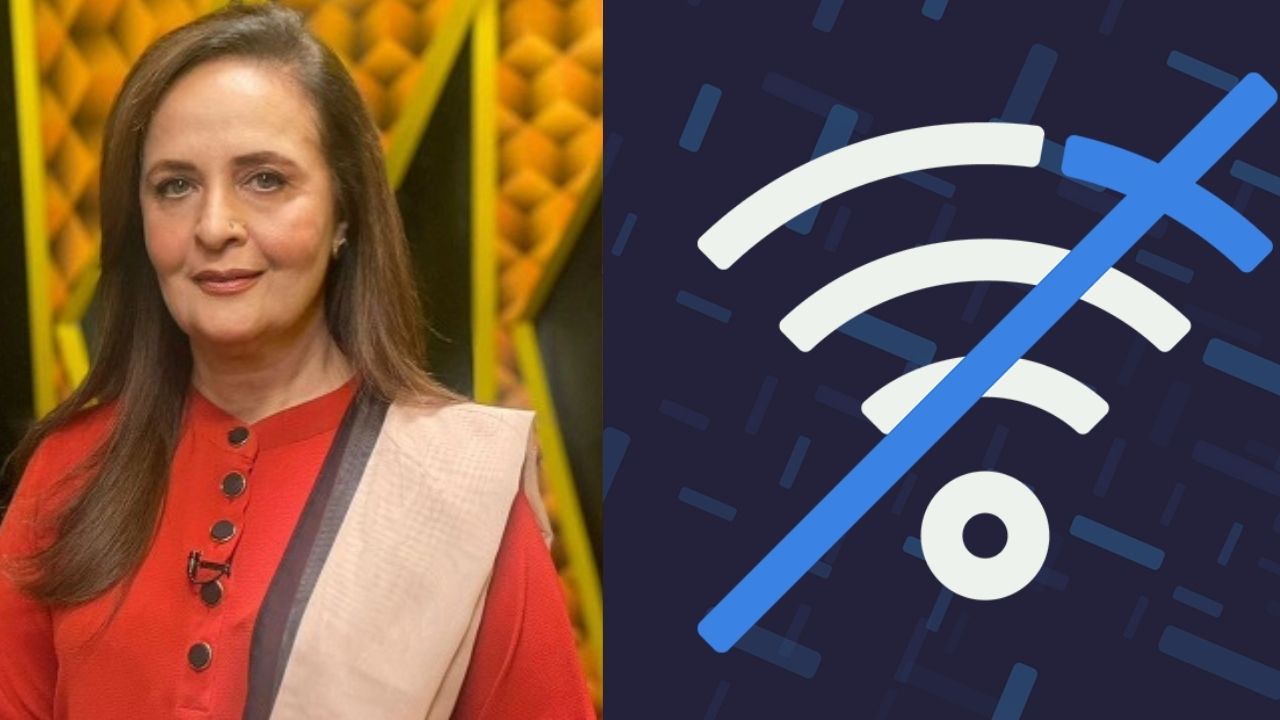
    Actress Hina Bayat posted a video on instagram with the caption “Aapko Khuda ka waasta humari qaum per reham karain ”.

    The star went on to say, “On one hand, we cry about our deteriorating economy, and then the government claims it is working to improve it. Yet, on the other hand, they shut down the internet, which directly affects people’s businesses. I’m worried that shutting down the internet will take away people’s jobs and livelihoods. What’s the point of doing this? Are you trying to protect yourself out of fear? But it’s actually harming our country’s economy and businesses. It feels like you’re trying to destroy Pakistan, which is what our enemies want. I’m asking the government, army, and judiciary to please be fair and do what’s right.”

  • ‘It’s not possible’; Reporting in internet-challenged Pakistan

    ‘It’s not possible’; Reporting in internet-challenged Pakistan

    With the primary shift from newspapers to television channels and now to digital media applications, the dissemination of information has become increasingly competitive for newsrooms, with the latest updates just a click away.

    “Delays can be managed with newspapers, but today everything is in your hands—specifically, mobile phones,” says Raees Ansari, Bureau Chief of Geo News in Lahore.

    “Every single second is crucial in reporting now; some footage needs to be sent and put on air instantly. But due to poor network conditions and slow WhatsApp, content is not being sent on time, which is affecting our professional activities,” he reveals.

    Over the past week, internet users across Pakistan have reported network disruptions, with WhatsApp, Facebook, and Instagram experiencing slowdowns, hindering online activities. The Pakistan Telecommunication Authority (PTA) has denied any connection between these issues and the alleged firewall installation.

    Since the ban on X (formerly Twitter) on February 17, 2024, many have turned to Virtual Private Networks (VPNs). The ongoing disturbances, however, have complicated internet usage, which is crucial for a number of professions.

    Sumaira Raja, an investigative reporter, who is mostly found out on the field, complains of encountering issues with not only the internet but also phone signals which often prevents her from conveying news on time.

    “I also experience delays with receiving beepers, as head office frequently reports that the number is not available due to poor signals. This situation makes it very difficult to do my job. I’ve tried using a VPN, but it hasn’t worked,” Raja says.

    Sports journalist Faizan Lakhani recalls when javelin champion Arshad Nadeem returned to Pakistan on August 17 after winning the gold medal at the Paris Olympics, all the visuals sent through WhatsApp by reporters were delayed, and they struggled to download them unless they used a VPN.

    “This situation is very challenging and affects our workflow. When reporters are working on a story or covering an event, they need to stay connected with the desk. We usually rely on voice notes to pass instructions, but since we started encountering this issue, we are struggling with that method too,” he says.

    “We have been told that the network disruption is because of the firewall installation. While things are becoming easier around the world, it has been getting harder for us. Everything is happening with the help of technology and the current situation is a major challenge.” says Ansari.

    What’s happening?

    A highly placed source in the IT industry identifies that filtering of content delivery networks (CDNs) through Firewall is causing content to be routed via internet backbone rather than CDNs.

    “This means that around 4 TBs of internet traffic previously served through CDNs, hosted in Pakistan, is becoming ineffective. When all traffic goes on backbone bypassing CDNs, it’s causing massive slowdown at many western destinations that’s happening now,” he explains.

    Recently, Fiverr, an online marketplace for freelance services, warned clients that Pakistani freelancers may experience delays due to internet issues and the use of VPNs to change their locations.

    “Brace for impact. God save the internet in Pakistan”, says the IT expert.

    Background

    It all started on February 17, 2024, about a week into the new government, when X (formerly Twitter) was banned.

    Initially, amid the uproar, the government remained silent on the matter while the Pakistan Telecommunication Authority (PTA) seemed aloof until the High Courts of Sindh and Islamabad intervened. The PTA eventually admitted that the ban on X was imposed on the orders of the Ministry of Interior based on reports from intelligence agencies.

    The government eventually justified the ban by attributing it to national security concerns, citing ‘digital terrorism‘ and online propaganda as among the threats.

    Earlier in August, Provincial Information Minister Azma Bokhari stated that the government is not against social media but wants to focus on rules and regulations, which, if enforced, could lead to the removal of the ban on X.

    The disruption has now extended beyond X, affecting other widely used apps along with the internet.

    Ironically, since the February 2024 election, the new government has emphasised the need to grow the tech industry in Pakistan.

    In March, Lahore Knowledge Park (a science park) was handed over to the Punjab Central Business District Development Authority with the approval of Chief Minister Punjab Maryam Nawaz, with the goal of establishing Pakistan’s largest IT city.

    In June, Prime Minister Shehbaz Sharif visited Shenzhen— the tech hub in China— in hopes of future collaboration. Ironically, he posted on X (Twitter), expressing how “impressed” he was by the “city’s skyline and development that symbolizes modern-day China.”

    Given the lack of proper infrastructure in the country amid burgeoning surveillance, how will Pakistan evolve in the rapidly transforming digital world? It remains to be seen – but likely we won’t be able to download it.


  • Audit report reveals illegal hiring in PTA causing over Rs45 million loss

    Audit report reveals illegal hiring in PTA causing over Rs45 million loss

    The Auditor General of Pakistan’s annual audit report for 2023-2024 has revealed significant irregularities in the Pakistan Telecommunication Authority (PTA), leading to a loss of over Rs 45million, Samaa reported.

    The report stated that illegal recruitment in the PTA during financial year 2022-23, including two assistant directors and one IT officer, took place without the presence of any relevant job posts.

    Generally, government job vacancies appear as advertisements in the newspapers but most recruitments in the PTA did not adhere to established criteria.

    The audit report highlighted that the PTA has paid Rs 45.9 million in salaries and perks to these alleged illegal recruitments.

  • Court issues notice to PTA in TikTok ban case

    Court issues notice to PTA in TikTok ban case

    The Peshawar High Court has sought a response from the federal government within 15 days on the request to impose a complete ban on TikTok. The petition stated that relevant authorities have failed to remove ‘profane and obscene’ content on the app.

    According to media reports, the bench, comprising of Chief Justice Ishtiaq Ibrahim and Justice Sahibzada Asadullah, fixed June 20 for the hearing.

    The petition was filed by a lawyer, Imran Khan, who requested the court to order the Pakistan Telecommunication Authority (PTA), the Federal Investigation Agency (FIA) and the Ministry of Information to arrest the defendants on TikTok in Pakistan and to ban the platform permanently.

    According to the petition, the guidelines of Tik Tok violate the Constitution of Pakistan.

    It has also been requested to the court to direct the defendants to not allow social applications in future which would affect the moral values of the people of Pakistan.

    Barrister Babar Shehzad Imran appeared on behalf of the petitioner and argued that while there are benefits of social media, some social media platforms have opened the way for blasphemy against decency, morality and the glory of Islam in countries like Pakistan.

  • Pakistan’s mobile phone imports skyrocket, surpassing $987 million in first half of FY 23-24

    Pakistan’s mobile phone imports skyrocket, surpassing $987 million in first half of FY 23-24

    Pakistan has witnessed a remarkable surge in mobile phone imports, reaching $987.539 million during the first half (July–January) of the fiscal year 2023–24. 

    This marks a substantial growth of 138.08 per cent compared to the same period in the previous fiscal year, where imports totaled $414.800 million.

    The data, released by the Pakistan Bureau of Statistics (PBS), underscores the country’s increasing reliance on imported mobile devices.

    In January 2024 alone, Pakistan’s mobile phone imports rose by 10.70 per cent on a month-on-month basis, totaling $194.928 million, compared to $176.093 million in December 2023. 

    Year-on-year comparisons reveal an even more staggering growth of 275.15 per cent in January 2024, compared to $51.960 million in January 2023.

    The overall telecom imports into Pakistan during July–January 2023–24 amounted to $1.243 billion, showcasing a robust 93.06 per cent growth compared to the same period in the previous fiscal year. 

    Year-on-year, the growth in overall telecom imports stood at an impressive 197.07 per cent, reaching $232.709 million in January 2024, compared to $78.336 million in January 2023.

    Despite challenges faced by the local manufacturing sector, including a decline of around four per cent in local manufacturing and assembling of mobile handsets during the calendar year 2023, commercial imports of mobile handsets increased. 

    Official data revealed that local manufacturing plants produced 21.28 million mobile handsets in 2023, compared to 21.94 million in 2022 and 24.66 million in 2021. However, commercial imports rose from 1.53 million in 2022 to 1.58 million in 2023.

    Moreover, of the locally manufactured and assembled mobile handsets in 2023, 13 million were 2G devices, and 8.28 million were smartphones. 

    According to the Pakistan Telecommunication Authority (PTA), 59 per cent of mobile devices in Pakistan are smartphones, while 41 per cent are 2G devices.

    Despite the challenges faced by the local manufacturing sector, the significant growth in mobile phone imports underscores Pakistan’s increasing reliance on imported devices, contributing to the country’s evolving telecom landscape.

  • Local administration can suspend the internet if need be: Murtaza Solangi

    Local administration can suspend the internet if need be: Murtaza Solangi

    Murtaza Solangi, the Caretaker Information Minister, has stated that the government has not given any instructions yet to suspend mobile or internet services on February 8.

    Solangi also stated that the local administration can take any decision as a result of any adverse law and order situation in the area. Pakistan Telecommunication Authority (PTA) can give directions to internet provider to suspend the internet in a specific area.

    He encouraged the public to use their democratic right to vote, as “it shows their patriotism and their love for democratic continuity in the country.”

  • ‘Ensure uninterrupted Internet access’; Sindh High Court orders on Jibran Nasir’s petition

    ‘Ensure uninterrupted Internet access’; Sindh High Court orders on Jibran Nasir’s petition

    The Sindh High Court (SHC) has issued a directive on Wednesday, instructing the government and the Pakistan Telecommunications Authority (PTA) to ensure uninterrupted internet access until February 8, the scheduled date for the general elections in the country.

    The order came from a two-member bench led by SHC Chief Justice Aqeel Ahmed Abbasi, following a petition filed by lawyer and independent candidate Jibran Nasir. The petition addressed the recent “unconstitutional” internet outages experienced across the country in the past month.

    Jibran took to X (former Twitter) and said, “SHC has directed PTA and Govt to ensure smooth uninterrupted access to Internet till Election Day 8th Feb to ensure no further pre poll rigging happens and any rigging attempts on Election Day can also be reported through social media.”

    “This is not just stopping the PTI from contesting free and fair elections — which is pre-poll rigging — but is also hindering the way of independent candidates like me,” he stated, highlighting that the internet and social media were efficient and cost-effective platforms to reach out to voters.

    Notably, three nationwide disruptions occurred on December 17, January 7, and January 20, coinciding with virtual events organized by the Pakistan Tehreek-e-Insaf (PTI) on social media platforms. The PTI had recently approached the Supreme Court, urging it to take notice of the suspension of internet services and the blocking of social media websites.

    During a press conference earlier in the week, caretaker Information Minister Murtaza Solangi attributed the outages to “technical” issues and system installations. He also stated that there was “no guarantee” such incidents wouldn’t occur in the future.

    In Nasir’s petition, the PTA, the federal government, and the Ministry of Information Technology and Telecommunications were named as respondents. Nasir argued that the act of shutting down mobile internet and broadband services should be declared as “unconstitutional, illegal, disproportionate, unreasonable, and without lawful authority.”

    The plea further sought the immediate restoration of access to social media platforms and the suspension of any directives restricting access to social media until the conclusion of the general elections.

    In response to the petition, the SHC issued notices to the respondents and directed authorities to ensure uninterrupted internet access until the general elections on February 8. The hearing has been adjourned until January 29.

    Read more: PTA warns of possible internet disruption in next 90 days