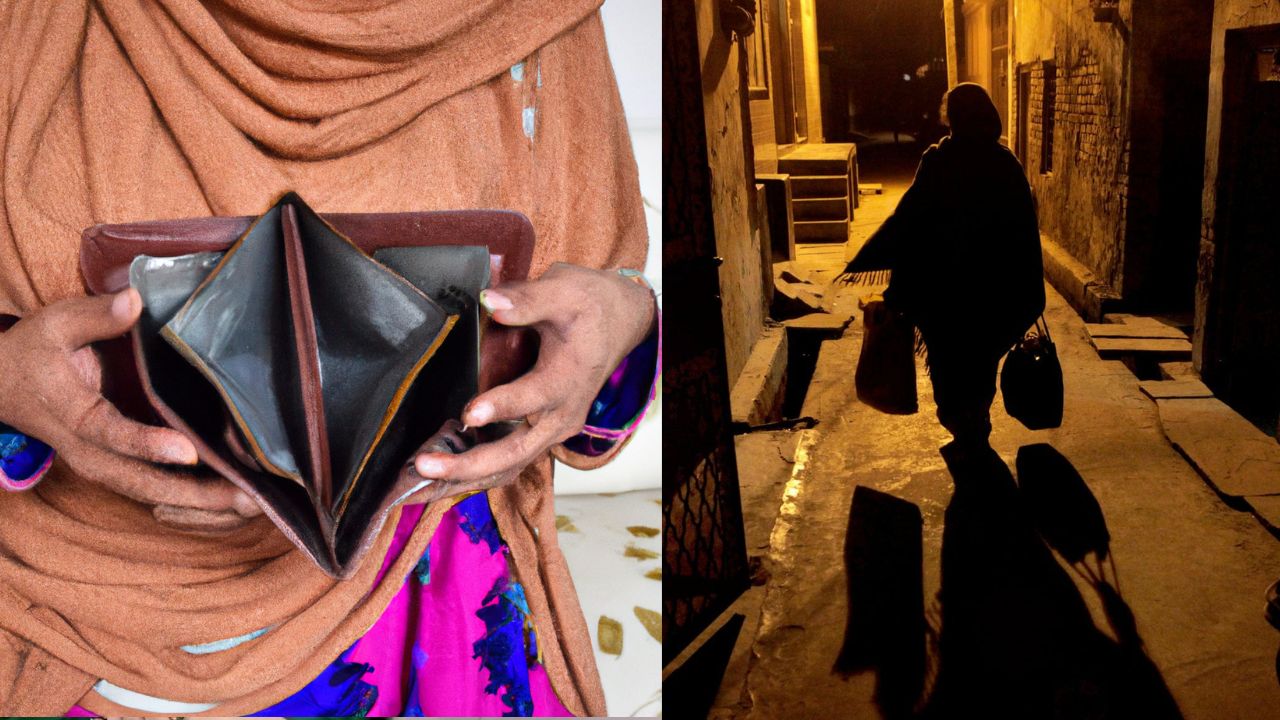
Sonia, a 27-year-old woman, and mother of a 5-year-old daughter works as a house help. In eight years of married life, her husband has never had a stable job, nor does he bother to find work on a daily wage basis.
Sonia has been paying off loans taken by her husband, Afzal, and her in-laws. In the initial months of her marriage, she sold whatever she had to buy a motor rickshaw for her husband so that they could have a source of daily income. Within no time Afzal sold the vehicle, taking additional loans to marry off Sonia’s sister-in-law.
The debt piled up to 150,000 rupees. Sonia was working in two homes at that point, earning Rs20,000 from one for cooking food twice a day and Rs5,000 from the other for cleaning and washing the dishes. This was their sole family income in which they had to do grocery, pay the bills, feed their daughter and themselves, and look after the in-laws in addition to buying medicine for her mother-in-law.
When she reminded her husband that he was supposed to work too if they wanted to get rid of the loans, she was beaten not only by Afzal but by his family too. From here started a never-ending cycle of financial exploitation and physical abuse. She endured two miscarriages due to the beatings and excessive work. She sometimes thinks that things would’ve been different if her father was alive.
“I don’t blame my parents. This is what happens to people in our class. I just think that maybe if my father was alive, I would’ve had the option to tell him everything and he might have allowed me to take divorce and go back to my home. I don’t have that option anymore. I must live and survive here. I have a kid now. I can’t leave her,” she said while sobbing.
Sonia is not the only one who goes through this cycle. I called up as many people as I could in different parts of Pakistan, family, friends, colleagues, acquaintances, and strangers to ask about their house help. Every woman had a similar story. A drug-addicted husband, an abusive husband, a husband who doesn’t work and keeps taking loans which the wife must pay. A never-ending circle of exploitation, harassment, and abuse.
“There are very few people who respect us. It is not easy to clean someone’s dirt or wash their dishes with days-old rotten food. It is embarrassing to ask them for additional money to pay off loans. Sometimes I even have to take a loan from one person to pay off the previous one and the cycle goes on,” Sonia elaborated while talking about how draining her routine is as she does all the house chores and then works in the homes of other people too.
She doesn’t want her daughter to end up like her. Instead she desires an education for her child, better career options. But whenever she brings the topic up, Afzal doesn’t take it seriously. He even spent the money they were given by different people to help finance their daughter’s education. Sometimes it was Eid gifts for sisters, other times it was a loan given to a friend. Sonia never got her money back.
Doctor Ramish Fatima, who works in the periphery of Multan, details how such cases are quite normal and how these women suffer especially during their pregnancies. “These women keep working till the last month of their pregnancy and they must go back to work a few days after giving birth because they must pay off loans. If they fail to do so, they are beaten by their in-laws. In some cases, husbands work on minimum wages, but mostly don’t as they are drug addicts, and they physically abuse their wives after being intoxicated,” she explained.
Ramish has been working in the periphery for over seven years now and most of the time she has dealt with such emergency cases. As a feminist and human rights activist, she believes that the solution to these problems is education and financial independence. She further emphasizes the importance of systemic upgrades and overall behavioral change in society towards women.
Punjab Domestic Workers Act was enacted in 2019 throughout the province to regulate their terms of employment and working conditions of service, to provide them social protection and ensure their welfare, and to provide for the matters ancillary.
The act states that “No child under the age of 15 years shall be allowed to work in a household in any capacity” while every other day we see cases of severe physical abuse and sexual exploitation against underage domestic workers.
In the same manner, this act requires every employer to issue a letter of employment showing the terms and conditions of employment including nature of work and amount of wages.
Regarding registration of Domestic Workers and Employers, this act states, “Every domestic worker, to benefit from the fund, shall make an application for registration in a manner as prescribed by the Governing Body, and every such domestic worker shall be provided by the Governing Body with a security number and identity card, which shall be renewable after completion of every three years. Provided that none of the domestic workers shall be eligible to get more than one security number and identity card. Every employer shall make an application for registration in a manner as prescribed by the Governing Body, and every such employer shall be provided with a registration number, which shall be renewable after completion of every three years.”
Hiba Akbar, a lawyer who teaches at LMUS, believes that such laws are made to just get done with the binding of international treaties without any intention of implementing it.
“Every time we see a shocking case of abuse of domestic workers we talk about laws but a law already exists. How many domestic workers are paid minimum wage? How many workers and employers are registered? Does anyone even know where they can register,” she questions. If the government was serious about implementation, she stresses, they would’ve made all the information public and ensured the safety and security of domestic workers.
She further argues that financial abuse comes from employers too who believe that giving their house help food and clothes once in a while, that too of substandard quality, won’t help them in breaking the cycle of financial abuse and recurring loans.
In 2023, Kashf Foundation, a registered Non-Banking Microfinance Company regulated by the Securities and Exchange Commission of Pakistan which started in 1996, gave 140,572 Easy Loans ranging from 10,000 to 35,000 rupees for short periods, as per their annual report.
Their research in 2023 on low-income households highlighted that income spent on meeting food expenses has increased from 30% of their income in 2018 to 45% of their income in 2023 while earnings didn’t keep pace with the increase in food prices in real terms.
Gender and Financial Inclusion expert Zainab Saeed explains that Pakistan has one of the lowest rates of financial inclusion in the world and only 7 percent of Pakistani women are financially included.
She further says that most of the loans by microfinance institutions aren’t interest-free but have a service charge. Most microfinance institutions borrow money to lend money in addition to the cost of funds and running operations. Akhuwat, an interest-free loan program usually for small businesses, doesn’t solely focus on women but caters to women clients as well.
“Turnaround times vary across institutions- for example Kashf is two days, you get the loan in two days. Other institutions have different turnarounds, like for Akhuwat, it is 10 to 30 days depending on what the set date for disbursement is in the month. Instant credit or nano loans like Jazz Cash have higher interest rates,” she says while emphasizing that a lot of women don’t even know how to use apps like Jazz Cash.
As far as requirements are concerned, most of these institutions lend money to those who have their computerized national identity cards (CNIC), some require guarantors while others might demand post-dated cheques.
When asked about how surety regarding on-time paybacks is made, Zainab said, “It is a trust-based environment so most people tend to pay back their loans on time. People don’t want to be blacklisted from Credit Information Bureau. Some institutions also go for appraisals like Kashf did a very detailed credit appraisal with household cash flows and that helped them to turn in the credibility of the loan.”
For defaulters, there is legal recourse available but tending to civil courts given the judicial system of Pakistan is not the best solution. Generally, there are very few non-performing loans in the world of microfinance banks, as per Zainab. People end up paying back, some institutes take action to make an example out of it but they usually don’t end up taking that route.
As these are not interest-free loans, ‘interest rate may vary from flat 25 to 30 percent’ which might seem high but, “the way the repayment is structured allows people to repay,” explains Zainab. “They Usually do monthly repayments. For instance, for a 10 thousand rupees loan, they are paying back 12 thousand 500 rupees. It is then 1000 to 1100 rupees a month. With microfinance institutions, there is a lot of transparency regarding installment dates and amounts which is lacking in other places,” she added.
As a country with a low literacy rate and even lower financial inclusion of women in Pakistan, the path of loans, financial independence, and empowerment still seems like a far-fetched dream.