Tag: USD

  • Gold loses shine, price drops by Rs2,000 to Rs132,300 per tola

    Gold loses shine, price drops by Rs2,000 to Rs132,300 per tola

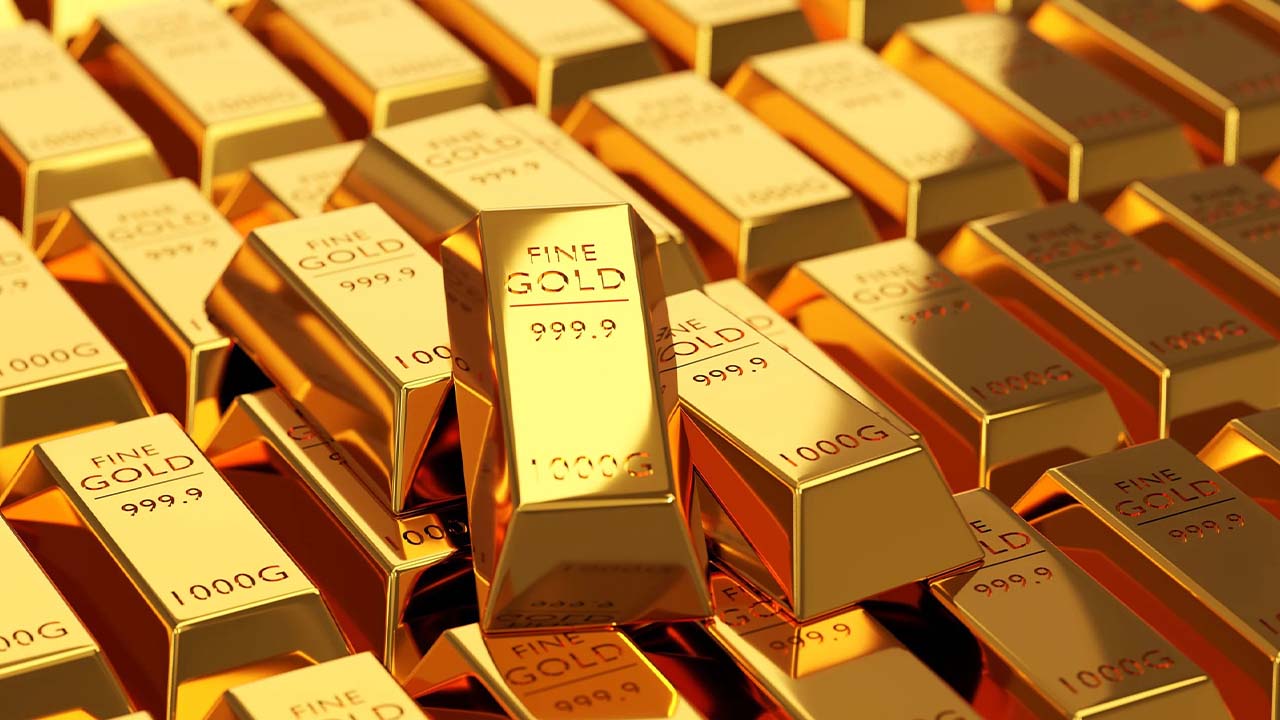
    Gold prices fell sharply in the local market on April 8, following the US dollar’s loss of value versus the rupee.

    The price of precious yellow metal dropped by Rs2,000 to Rs132,300 a tola (11.66 grams). Similarly, the cost of 10 grammes of gold decreased by Rs1,715 to Rs113,426. On the flip side, it jumped from $6 to $1,933 per ounce (28.3 gram) on the global market.

    The yellow metal in Karachi is reportedly selling for as low as Rs129,400, while 10 grams is being sold at Rs110,940. This rate for 24K gold announced by the Sarafa Bazar Association is also followed by the majority of gold markets in cities including Lahore, Islamabad, Peshawar, Quetta, and Karachi.

    The Pakistani rupee (PKR) gained Rs3.50 yesterday against the US dollar, making it the greatest single-day gain since April 2020. The local currency is currently trading at Rs184.68.

    During inter-day trading on April 7, the domestic unit crossed the Rs189 threshold, notwithstanding the political uncertainty. However, following a Rs2.5 depreciation, it concluded at Rs188.18.

    The gold correction had been overdue for a long time, since the political turmoil had created widespread panic, and individuals were transferring their capital to gold, as various rules had made it difficult for everyone to buy dollars.

  • State Bank of Pakistan hikes interest rate to 12.25% in an emergency meeting

    State Bank of Pakistan hikes interest rate to 12.25% in an emergency meeting

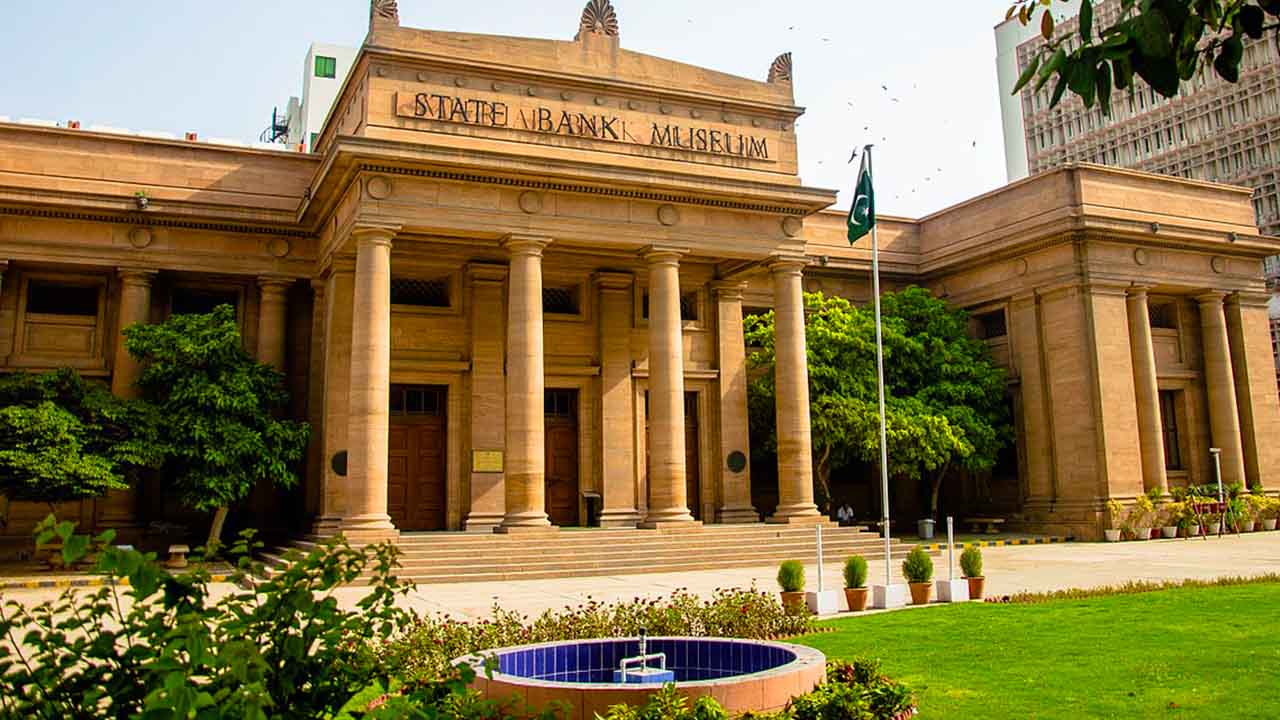
    Following an emergency meeting, the State Bank of Pakistan (SBP) raised interest rates by 250 basis points, as mounting political uncertainty and rising worldwide oil prices threaten to drive the country into a full-fledged economic catastrophe.

    The key rate is now 12.25 per cent, as per the latest statement released by the central bank on Thursday. According to the report, this makes the real rate “mildly positive” and will assist maintain external and price stability.

    The judgment came a few hours before the Supreme Court was due to rule on the constitutionality of Prime Minister Imran Khan’s disputed move to dissolve parliament and hold new elections. Pakistan may find it difficult to persuade the International Monetary Fund (IMF) to grant a much-needed loan tranche due to the political limbo.

    At the recent briefing, SBP governor, Reza Baqir, said, “We thought it’s important to take decisive action”.  He added that the body does not intend to do anything else.

    The central bank claimed that intensified domestic political turmoil contributed to the rupee’s 5 per cent loss and caused a jump in local bond rates, as well as Pakistan’s Eurobond yields and Credit Default Swap (CDS) spreads. Oil prices are likely to remain elevated, and the Federal Reserve of the United States is expected to compress sooner than expected, according to the report.

    The PKR broke all records on Thursday, selling at more than Rs189 per dollar in intraday trading in the interbank market, continuing a slump that has witnessed its decline of more than 10 per cent since March 4.

    Read more: Pakistan to import 32.7 million barrels of oil to cover petroleum needs

    Pakistan’s political instability, in addition to money from the IMF, is causing delays in a planned $1 billion green bond offering. A refinancing from China is also expected; the repayment in recent weeks caused Pakistan’s foreign-exchange reserves to plummet to their lowest level since records began in 2010.

    In a meeting last month, SBP cautioned that it might convene earlier than planned to avoid a crisis. It revised its average inflation prediction for the fiscal year ending in June from 9 per cent to little more than 11 per cent.

  • PKR closed at 184.09 against USD, the lowest level in history

    PKR closed at 184.09 against USD, the lowest level in history

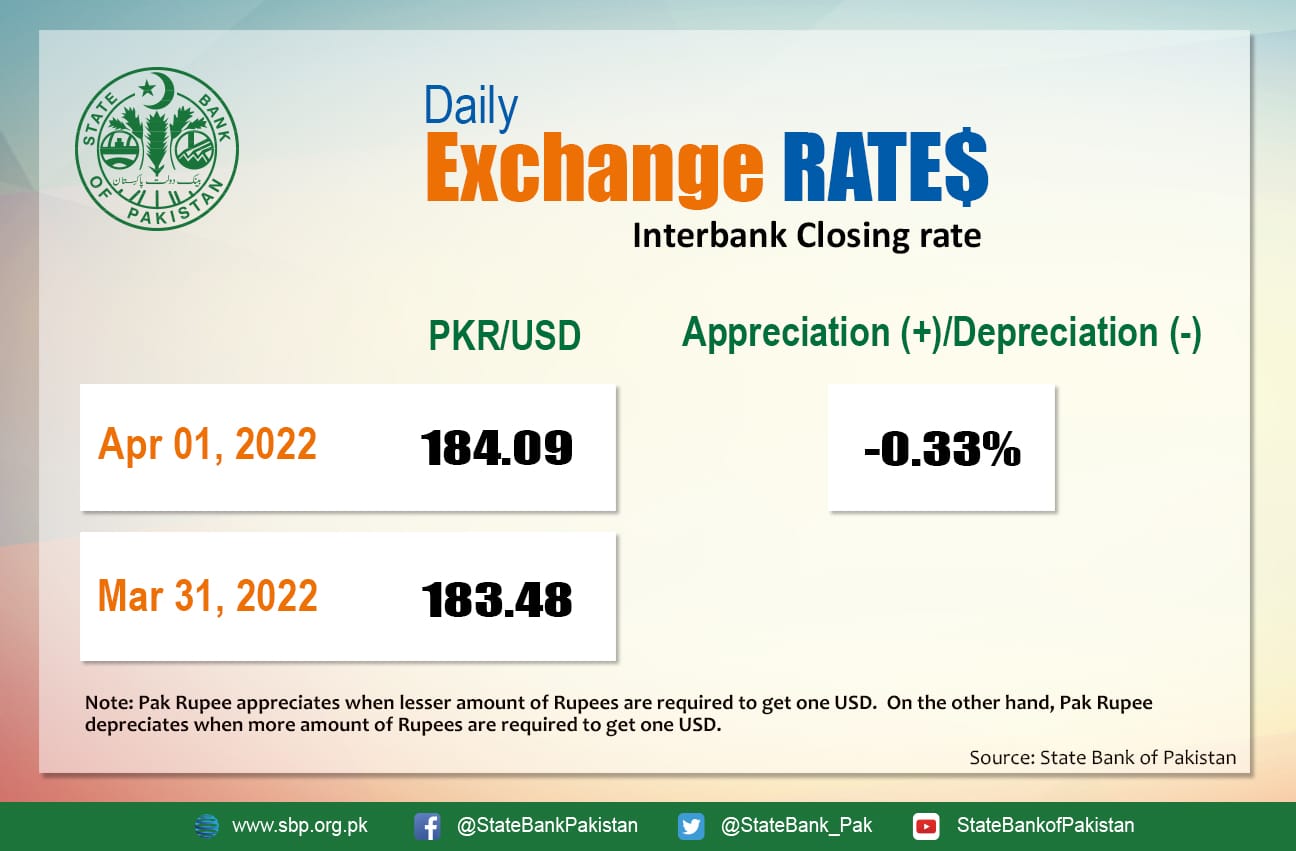
    A substantial decline in foreign exchange reserves, persistent political instability, and hefty petroleum costs dragged Pakistan’s currency (PKR) to new lows on Friday, with the rupee closing over the 184 level for the first time against the US dollar following a 0.33 per cent drop in the interbank market. 

    After a day-on-day devaluation of 61 paisas, the PKR closed at 184.09, its lowest level recorded, according to the State Bank of Pakistan (SBP).

    Since its most recent peak in May of last year, the PKR has lost over 17 per cent, while the local currency has devalued by over 14 per cent in the fiscal year to date (FYTD).

    The last time the PKR rose versus the US dollar (during its most recent weakening run) was on March 11. It has dropped in 13 sessions since that while staying stable in the remaining.

    Moreover, the State Bank of Pakistan’s (SBP) reserves also fell by $2.915 billion, to $12.05 billion, according to figures issued by the central bank on Thursday.

  • Devaluation: What, why and how?

    Devaluation: What, why and how?

    The rupee has been sliding down for the past many weeks and dollar is touching Rs170. This wave of devaluation has sparked speculation of further depreciation in the coming days. Should we be panicking and start hoarding dollars?

    Probably not.

    If anything, this is perfectly in line with market fundamentals. The reasons behind the current spell of depreciation are primarily the rising trade deficit and to some extent, the Afghanistan situation. Our imports have risen sharply in the last few months — predominantly due to rising international commodity prices such as for oil, gas, coal, steel, etc.

    Some increase in imports can also be attributed to recovering economy fuelled by fiscal and monetary stimulus. In simpler terms, as the government injected more money into the market through the Covid stimulus package and other means and maintained interest rates at a low level, the demand increased leading to rebounding growth.

    But with growth recovery, the demand for imports also increased, widening the trade deficit. Moreover, some of the recent increase in imports can also be attributed to the vaccine imports, the phenomenal increase in demand for automotive, capital imports under Temporary Economic Refinance Facility (TERF), etc.

    What impact should the trade deficit and current account deficit have on the exchange rate?

    As soon as the current IMF programme started, the government switched to a market-determined exchange rate. Notwithstanding the reports of some intervention by the State Bank in the market, the market-determined regime does not give the flexibility to the central bank to maintain the exchange rate at an artificial level. This in fact is the right strategy for a country like Pakistan, so that its hard-earned forex reserves are not burnt to preserve the exchange rate, indirectly subsidising imports at the cost of scoring political brownie points. The exchange rate, therefore, took the hit, and the rupee devalued.

    But for now, the threat of any further significant devaluation is not in sight. The devaluation itself has made the imports expensive. In addition, the government is also considering increasing regulatory duty on luxury imports to further dampen the demand for these items. These measures are complemented by a change in monetary stance — an increase of 25 basis points, which is likely to be followed by further increases in the future — and passing on the energy price increases. All these measures are expected to immediately reign in the rising current account deficit. Hopefully, the current spell of rising international commodity prices should also be over in the next 6 to 9 months, further supporting an optimistic medium-term outlook.

    But under this cyclical trend, lies the political economy of devaluation in Pakistan.

    What we must understand is that historically the rupee has only gone down against the dollar and that’s the direction it will maintain in the medium-term, notwithstanding any short-term reverse movements. The reason for this perpetual devaluation is the underlying balance of exports and imports. Pakistan is a country with high imports and low exports. The difference is bridged through precious foreign exchange, earned from remittances, foreign direct investment, and external loans. Historically, the rupee has depreciated against the dollar by approximately 7 per cent per annum to account for the perpetual supply and demand gap. This gradual devaluation is in fact absolutely essential for Pakistan until the export composition and volume change significantly.

    During PML-N’s tenure, we followed the managed float exchange rate regime. The then finance minister artificially maintained an overvalued exchange rate and pumped in foreign exchange in the market, whenever the demand for dollars increased. An overvalued exchange rate made exports expensive and imports cheaper, thus further widening the trade deficit. The industry suffered but the traders were happy. The citizens enjoyed quality imported goods at cheaper prices, not realising that they would have to pay the price later on. Therefore, as a result of artificially maintaining the exchange rate at an abnormally low level, our reserves took a serious hit, while imports continued to increase. This prompted a balance of payment crisis and necessitated the present IMF programme. Such an approach was economically disastrous.

    If we don’t want to repeat the same mistake, we should be open to gradual devaluation depending on the current account balance. To manage the CAD, the fiscal and monetary policies have to work in tandem. It’s prudent to go slow and steady than to overheat the engine and lead to yet another balance of payments crisis.
  • Rupee strongest against USD since Feb 2020

    Rupee strongest against USD since Feb 2020

    The rupee continues to strengthen against the dollar and now it has returned to its pre-COVID level. 

    During intraday, the rupee is trading in the range of Rs. 152.83 and Rs. 154.25 against the USD today. This is the strongest since February 17, 2020. PKR closed at nearly Rs. 153 to the USD in the interbank market today, appreciating 95 paisas.

    Senior analyst at Tresmark, Komal Mansoor said, “This was the expected support level. With a spike in covid cases and speculation of lockdowns, this level may not be sustained and the rupee may bounce back to Rs156-157. However, strong Ramzan inflows may lend further support pushing the parity to Rs150-152. Eurobonds are being floated so that works as a positive for the currency as well.”

    Pak Kuwait Investment Company Head of Research, Samiullah Tariq, comments, “There are multiple reasons for the gain in the rupee. Generally, inflows are greater than outflows. Exporters are booking forwards, IMF agreement has resumed inflows from FIFs, and reduced outflows because of reduced tourism, hajj and umrah. In addition, AML/KYC has reduced hawala hundi (informal remittance channels) to a great extent making remittances rise significantly. The sustainability of the rupee on this level, however, relies on the Covid situation and oil prices.”