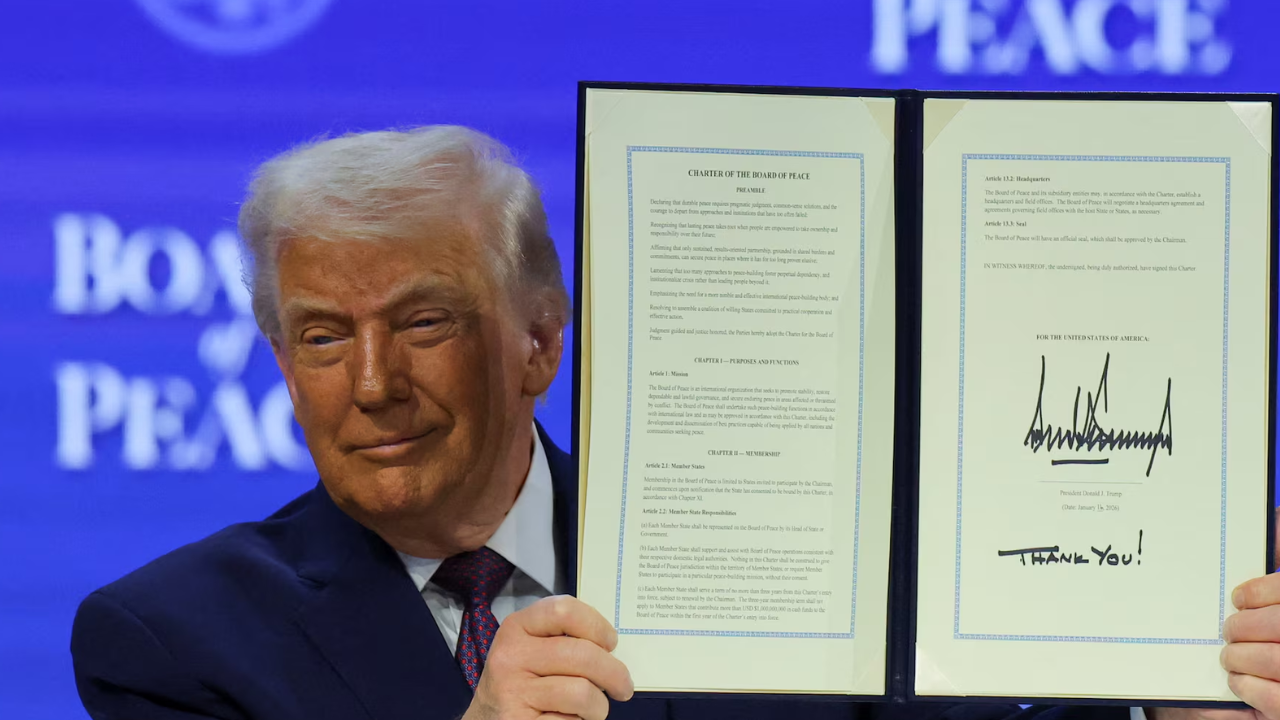
Despite receiving an invitation from US President Donald Trump to join the proposed ‘Board of Peace’, India has not formally associated itself with the initiative so far.
India was absent from the ceremony held in Davos where 20 world leaders, including President Trump and Pakistan Prime Minister Shehbaz Sharif, signed the board’s charter. The absence has triggered discussion in Indian diplomatic and media circles, with some linking New Delhi’s hesitation to concerns surrounding the Kashmir dispute.
President Trump has said the board’s primary objective is to make the ceasefire between Israel and Hamas in Gaza permanent and to supervise an interim administrative setup in the Palestinian territory.
“This is not just for America, but for the whole world. I think we can spread it to other places. Like we did successfully in Gaza,” Trump said while outlining the initiative.
However, some observers in India believe joining the board could expose the disputed region of held Kashmir to increased international or US involvement. Trump has on several occasions offered to mediate between India and Pakistan on Kashmir, particularly following the May 2025 escalation between the two countries. India has consistently rejected third-party mediation on the issue.
According to a BBC Hindi report, the Board of Peace is being formed at a time when the US is withdrawing from several United Nations bodies, raising questions about whether the initiative is intended to undermine the UN’s role.
Concerns have also been raised that the board could reinforce a unipolar global order led by the US.
In an editorial, The Hindu described Pakistan’s decision to join the board as “a warning signal to India”. The paper pointed to Trump’s tendency to project himself as a global peacemaker, citing his claims of resolving several international disputes during his first year in office.
“If Trump decides to include the Kashmir dispute in his peace plans, the Peace Board will try to resolve it. Once it joins the board, it will also be difficult for India to object to the deployment of its troops in the international peacekeeping force,” the editorial said.
Former Indian ambassador to the United Nations Syed Akbaruddin wrote in the Times of India that a Security Council resolution limits the board’s mandate until December 31, 2027, and requires it to submit reports every six months.
He noted that these provisions were included to prevent the arrangement from becoming permanent. In contrast, Akbaruddin wrote that Trump’s peace initiative has no defined timeline and “could be used outside Gaza as well”.
He added that some UN officials have indicated the framework could be applied to other conflict zones.
Former Indian ambassador to Nepal and Vietnam Ranjit Roy said the decision presents difficulties for New Delhi.
“India’s dilemma has increased. Whether India accepts it or rejects it, it will have an impact. I think the risks of joining the Peace Board are high. First of all, Trump is its chairman and it seems pointless to expect justice from his transactional approach,” BBC Hindi quoted him as saying.
“It is not clear whether each country will have the same status in this,” Roy said.
The Hindu also noted that tensions in US-India relations and ongoing trade negotiations may be factors behind India’s decision not to reject the invitation outright, warning that doing so could provoke a response similar to Trump’s past disagreements with the French president.