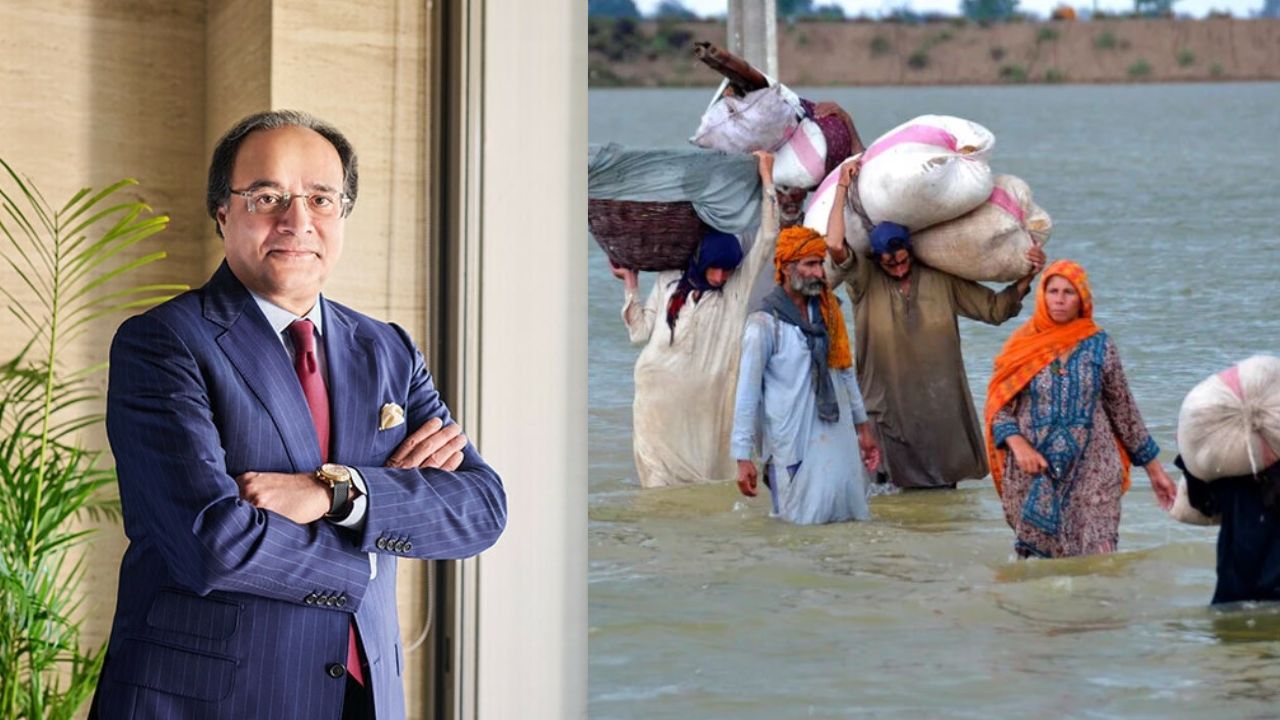
Finance Minister Muhammad Aurangzeb has said that the country does not need any flood-related assistance from the United Nations (UN) as Pakistan has ample resources for rescue and relief efforts.
Addressing the Pakistan Business Summit as a keynote speaker in Peshawar, Aurangzeb said that the funds from the country’s Rs4.3 trillion development budget could be repurposed with effective prioritisation and coordination between the federal and provincial governments.
The statements come as Pakistan informs the International Monetary Fund (IMF) of economic losses amounting to Rs371 billion in the aftermath of recent floods, severely damaging infrastructure and agriculture.
The government had at the time of the annual budget set a real GDP growth target of 4.2% for the ongoing fiscal year; however, in light of the flood-related damages, authorities have projected a downward revision of the target by 0.3% points, bringing it to 3.9%.
Speaking at the occasion, Aurangzeb also said that Pakistan had made a significant improvement in remittances, which reached $38 billion last year and were projected to grow to $41-43 billion in the current fiscal year.
The minister said that Pakistan successfully repaid $500 million in Eurobond obligations in September this year without market disruption and it is well-positioned to repay the $1.3 billion Eurobond in April 2026.
The conference was the first major business activity in Peshawar in years as policymakers, investors and corporate leaders from across the country participated in the event under the theme of “Shaping What’s Next”.
The summit was also addressed by acting president and Senate chairman Yusuf Raza Gilani, KP Governor Faisal Karim Kundi, Federal Minister for Privatisation Mohammad Ali, KP Advisor for Finance Muzammil Aslam, former minister Mohammad Azfar Ahsan and others.
Aurangzeb said that the remittance inflows into the formal economy had increased. “Last year, we had $38 billion in remittances. This year, we expect $41-43 billion,” he said.
He maintained that the policy rate, which remains at 11%, is expected to be lowered in the ongoing fiscal year. “Although the policy rate is very much the domain of the central bank, I think there is enough cushion that we can continue to push the rate south during the course of this fiscal year.”
The finance minister also said that the Federal Board of Revenue (FBR) had been reduced to a tax collection forum, and economic policymaking had been shifted to the finance division.
On the privatisation front, Aurangzeb told the participants that 24 state-owned enterprises had been handed over to the Privatisation Commission.
On foreign direct investment and the road to the international market, he said that recent visits to Beijing, Riyadh and New York yielded tangible results.