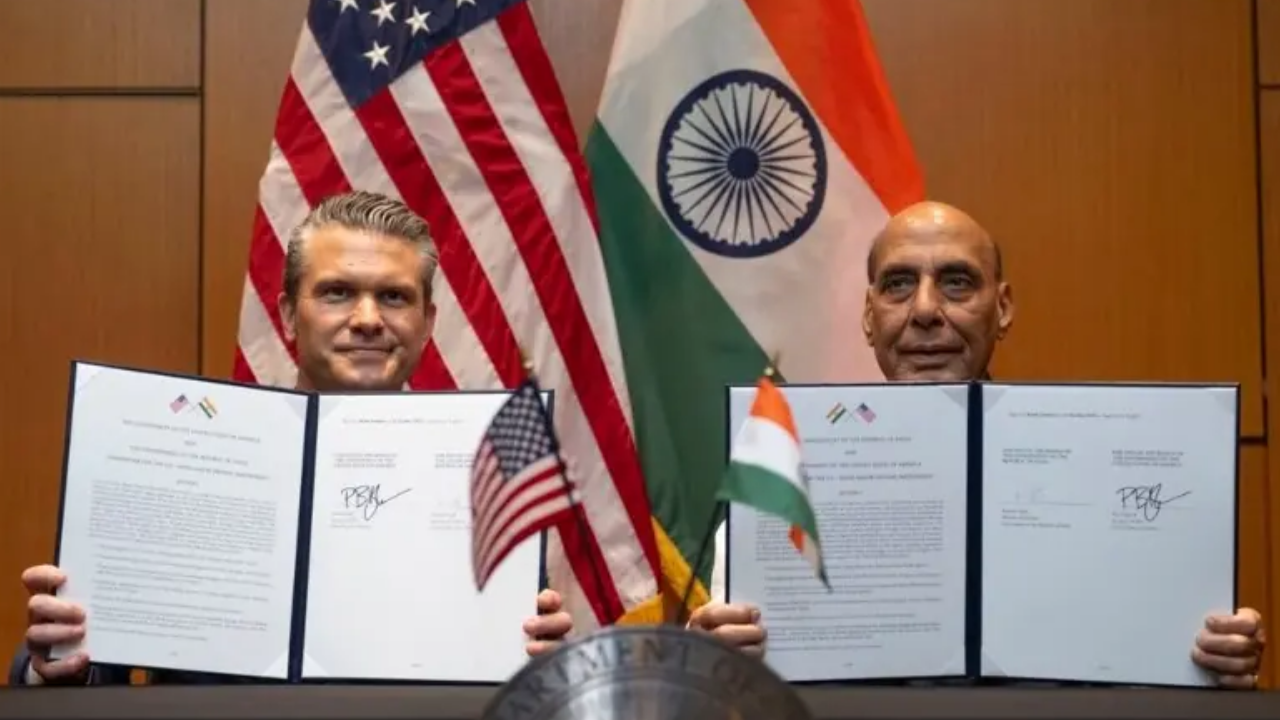
The United States has entered into a 10-year defence framework agreement with India, US Defence Secretary Pete Hegseth announced on Friday.
The framework seeks to enhance coordination, information sharing, and technological collaboration between the two armed forces. Hegseth characterized it as a fundamental element for maintaining regional stability and deterrence.
“Our defence relations have reached unprecedented levels,” Hegseth remarked in a post on X (formerly Twitter) after his discussion with Indian Defence Minister Rajnath Singh. The meeting occurred on the sidelines of the ASEAN Defence Ministers’ Meeting-Plus set to begin on Saturday in Kuala Lumpur.
Hegseth expressed gratitude to Singh for the ongoing partnership between Washington and New Delhi. He referred to the US-India relationship as “consequential,” highlighting that the strategic alignment is grounded in shared interests, mutual trust, and a dedication to a secure Indo-Pacific region.
Hegseth referred to the defense framework as “ambitious.” He stated it provides a guide for deeper military collaboration and highlights the United States’ long-term commitment to collective security and partnership.
The agreement follows a recent meeting between US Secretary of State Marco Rubio and India’s Foreign Minister Subrahmanyam Jaishankar in Malaysia. This encounter represented the highest-level engagement since the United States enacted sanctions on Russian oil firms last week, which target significant sources of crude supplies for India.
Jaishankar posted a photo on social media of himself and Rubio shaking hands. He conveyed his appreciation for discussions concerning bilateral relations along with regional and global matters.
Relations between Washington and New Delhi have been strained since May of this year when India refused to credit President Donald Trump for bringing a ceasefire to military clashes with Pakistan. The US raised tariffs on India to 50 percent in August. US officials claimed that India was aiding Russia’s war in Ukraine by acquiring discounted oil from Moscow.
Trump had a conversation with Prime Minister Narendra Modi last week, indicating that Modi had agreed to cut back on Russian oil imports; however, India has not verified this assertion.
Additionally, the United States recently imposed a one-time fee of $100,000 for H-1B skilled worker visas, with India comprising about three-quarters of the annual recipients. Indian officials stated that this decision could have humanitarian repercussions and cautioned that it might disrupt families affected by the new policy.