Author: Mehreen Burney

  • Flood money spent on ceremonial events, refreshments, souvenirs: NDMA audit report reveals unauthorised expenditure

    Flood money spent on ceremonial events, refreshments, souvenirs: NDMA audit report reveals unauthorised expenditure

    The audit report of the National Disaster Management Authority (NDMA) for FY 2023-24 reveals unauthorised expenditure of Rs. 23.254 million from the National Disaster Management Fund (NDMF) on ‘unauthorized’ event management services, with large payments processed on a single day. The money was reportedly spent on ceremonial events such as inaugurations, post-rescue events, and simulation exercises, including payments for refreshments, souvenirs, printing, and related services.

    According to reporters, these expenses were not aligned with the NDMA Act, which restricts the fund’s use to “emergency preparedness, response, mitigation, relief, and reconstruction”. NDMA management defended the spending as part of a shift from “reactive” to “proactive” disaster management, but the audit rejected this explanation. The matter was not regularised as no DAC meeting was held.


    But this is not the only area where authorities fell short.


    Similarly, locals and analysts have criticised the government for having poor radar systems that would not timely forecast heavy rains. In 2018, $210 million were allotted for the Pakistan Hydromet and Climate Services Project, including $188 million worth of World Bank credit, to improve weather forecasting and disaster management with new radar systems. However, the funds have not been utilised effectively to date, with experts reportedly citing bureaucratic failures.

    After the 2022 floods, Pakistan got over $10 billion in pledges at a Geneva donor conference for recovery and climate resilience. But by mid-2024, most of that money still had not reportedly reached communities.

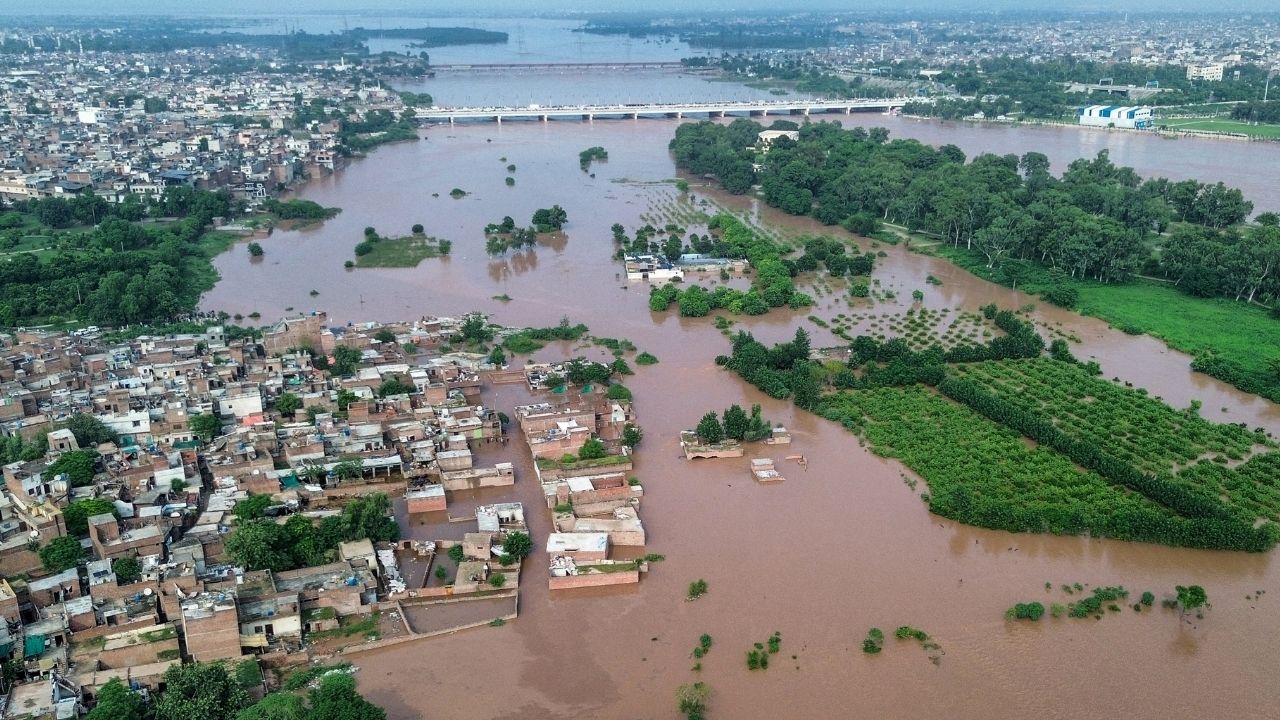
    This year, in 2025, eastern Pakistan is on high alert as floodwaters from Punjab are flowing down towards Sindh and are expected to hit by September 2 to 3, according to Senior Minister Sharjeel Inam Memon.

    Floods 2025

    On June 26 began the spells of torrential rains and flash floods. By August 15, heavy rains and increased flash floods in Khyber Pakhtunkhwa wreaked havoc, killing at least 460 people and injuring over 245 others, according to the Provincial Disaster Management Authority (PDMA).

    In Punjab, where around 1.5 million lives are at risk, at least 30 people have died after India opened major dams, including the Salal and Baglihar dams on the Chenab River, releasing water into Pakistan and worsening levels in the Sutlej, Ravi, and Chenab rivers.

    The Current reached out to Idrees Mahsud, Member of Disaster Risk Reduction at the National Disaster Management Authority (NDMA), who stated that “All preparations to facilitate victims and animals are in place,” adding that “obviously it can’t be an ideal situation.”

    “Our main priority is to evacuate people. Camp management is very important; it has its own SOPs, and we are trying our best within the given resources to provide all facilities to the affectees, including medical relief camps, which are available everywhere and largely staffed by volunteers. This is a disaster situation; nothing can be ideal,” he said.

    Flooding in the Chenab river has submerged 991 villages, Sialkot flooding has affected 395 villages, 127 in Jhang, 124 in Multan, 48 in Chiniot, 66 in Gujrat, 51 in Khanewal, 45 in Hafizabad, 41 in Sargodha, 35 in Mandi Bahauddin, and 19 villages in Wazirabad.

    According to Relief Commissioner Nabeel Javed, more than 2,308 villages across Punjab had been underwater, and 481,000 people have been evacuated to safer areas. 511 relief camps have been set up by the provincial administration where flood affectees are being provided food and shelter, along with 351 medical camps and 321 veterinary camps. Moreover, more than 405,000 animals have also been moved to different places.

    Iterating that over 1.4 million people have been rescued and are in relief camps, Mahsud said: “Which government on this earth has been responding better than this government?”

    He clarified that the NDMA is not claiming to provide “two-star or four-star hotel facilities” in these camps. “Relief camps mean you save a human being and help them sustain for a few days, until they are able to return to their homes once the water recedes, with whatever means are available.”

    Mahsud further said that if any camp faces issues, people are encouraged to inform the authorities so they can verify and resolve the problems. “We try to facilitate people in every way, from camps and shelter to medical treatment and medicines.”

    So far, this year, at least 800 people have died across Pakistan in the flooding, while 1,018 have been injured, 6,630 houses damaged, and 5,548 livestock killed, according to the National Disaster Management Authority (NDMA).

    What’s next?

    These floods are yet to hit Sindh, where Guddu Barrage will receive inflows of 700,000–800,000 cusecs early next week. The province’s Senior Minister Sharjeel Inam Memon warns that around 1.6 million people across 1,657 villages could be at risk.

    Meanwhile, Chief Minister Syed Murad Ali Shah, over 52,000 families along the Indus are under threat. He has directed authorities to set up over 500 relief camps along embankments to safeguard people and livestock, while more than 30,000 personnel of Rescue-1122 and 178 boats have been deployed in northern and southern districts.

    Previously, the 2022 floods had affected 33 million people in Pakistan and destroyed 897,014 houses and damaged another 1,391,467. The climatic disaster also killed 1,164,270 livestock, primarily in Balochistan, while access to flood-hit areas was severely hindered by damage to 13,115 kilometres of roads and the destruction of 439 bridges.
  • Justice delayed, not denied: IBA lecturer wins gender discrimination case after 2.5 years

    Justice delayed, not denied: IBA lecturer wins gender discrimination case after 2.5 years

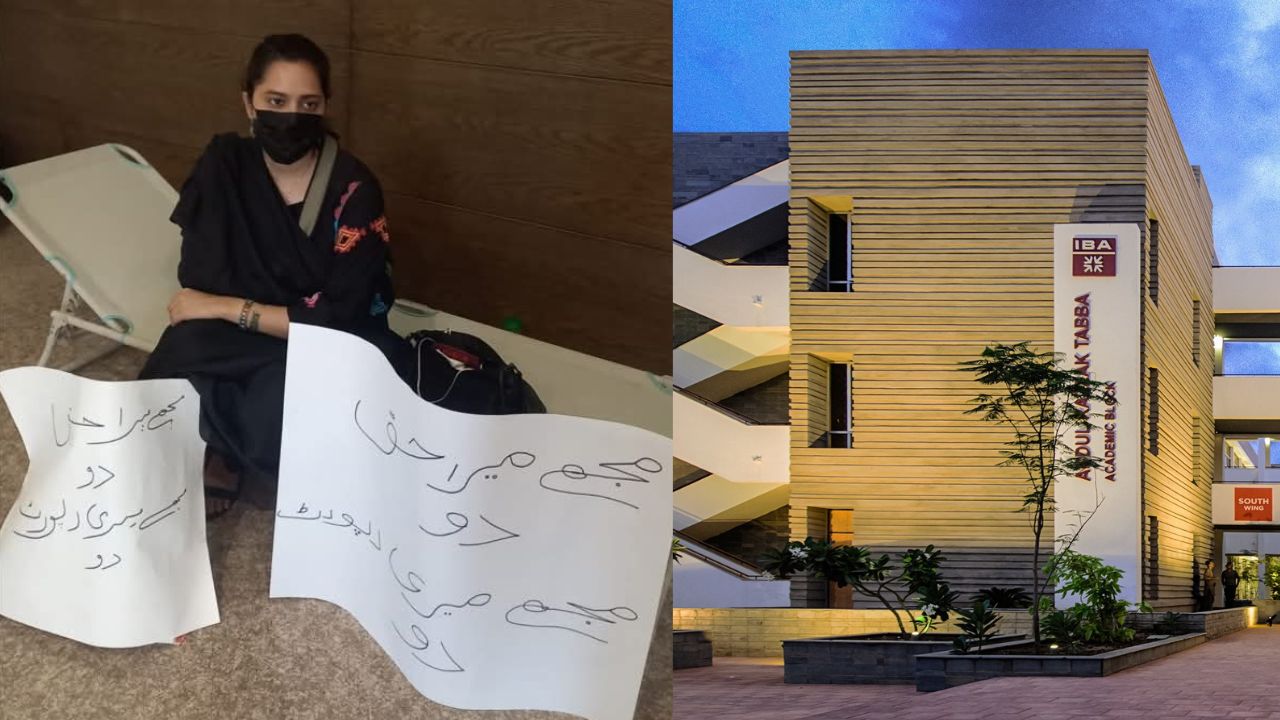
    After 2.5 years of legal battle, humanities expert Zahra Sabri has won the gender discrimination case against Karachi’s Institute of Business Administration (IBA) for evicting the only two single female residents of the varsity’s Visiting Faculty Residence (VFR).


    As per the details, Ombudsman Sindh on Jun 13 upheld the verdict of the institute’s Anti-Harassment Committee (AHC), mandating compensation, a formal apology and policy reforms over discrimination faced by the two women, including Zahra who, at the time, worked as a South Asian History and Literatures lecturer at IBA.


    According to Zahra, in December 2022, she and her colleague were asked to vacate their accommodation on short notice of three days.


    “No male or married faculty members were asked to evict,” she had stated in her complaint against the orders issued by Registrar Dr Mohammad Asad llyas and ratified by IBA’s Executive Director (ED) Dr Syed Akbar Zaidi.


    She had also highlighted “unprofessional remarks” by the registrar who told Zahra and her colleague to “find a husband so that they also be allowed to stay at the VFR”.


    While Zahra’s appeal against the move had led to an AHC ruling mandating compensation, apology and reforms, justice was denied following the Jan 2023 internal complaint under Pakistan’s Protection Against Harassment of Women at the Workplace Act of 2010 as IBA ED Dr Zaidi, who had been designated as the ‘competent authority’ under said act, dismissed the AHC’s rulings despite being legally obligated to implement the recommendations without alteration.


    After being denied timely legal access to her AHC report, Zahra took her case to the Ombudsman Sindh. She also communally and individually wrote and reached out to a number of board members, formally bringing to their notice the on-campus violation of the law.


    “They received my complaint, reviewed it, and their responses were not supportive or helpful towards me in any way at all,” Zahra tells The Current.


    However, last week, the Ombudsman overturned the IBA ED’s refusal to implement the verdict as the assigned competent authority. According to the Ombudsman Sindh, Dr Zaidi, in capacity of competent authority, was obligated to implement the AHC’s recommendations within one week, with “no power to modify, alter, set-aside or refuse”, which he failed to implement, violating the rules under the Act. 


    According to the ruling, he also compromised his neutrality as competent authority after he appeared as a witness in the inquiry proceedings in support of the other respondent and accused, Registrar Dr Ilyas. 


    The Ombudsman further ruled that the IBA Board of Governors and its Human Resources (HR) committee had no legal standing to override the inquiry findings, as under the 2010 Act, only the Ombudsman has appellate authority over such decisions.

    Overruling the IBA ED’s refusal from August 2023, the ombudsperson ordered varsity to appoint a new competent authority within a week to ensure the AHC’s findings were acted upon.


    The order called for the implementation of AHC’s recommendations within a week, including the payment of Rs300,000 to Zahra for harassment, a written apology from IBA for gender-based discrimination, and the creation and consistent enforcement of clear, non-discriminatory housing policies.


    In case of non-compliance, IBA can face contempt proceedings under Section 10(1)(vi) of the 2010 Act.

    Meanwhile, the Sindh High Court (SHC) has issued notices to respondents on a petition filed by the IBA, challenging an order of the provincial ombudsman for protection against harassment of women at workplaces. The SHC has also directed that the compensation amount and apology letter not be handed over to the former lecturer until the petition is decided.


    ‘WEIGHT OF THE WAIT’

    According to the Forum of Pakistan Ombudsman, it takes an average of 55 to 70 days to reach a decision in a case, but in practice, it can take longer — from months to even years.


    It also states that no adverse action can be taken against the complainant or witnesses under Section 4(3)(d) of the Protection Against Harassment of Women at the Workplace Act, 2010.

    Moreover, the employer is not allowed to create a hostile environment or pressurise the complainant, and the inquiry committee must ensure this, as outlined in Section 4(3)(e) of the same Act.


    Zahra Sabri had joined IBA in Jun 2021, but her time on campus was made difficult. “I feel that the main challenge and burden of this [legal] process has been the waiting. I would call it the ‘weight of the wait,’” she says, adding that organisations often manage to create a very hostile work environment for harassment complainants in various subtle and unsubtle ways.

    “It can be quite difficult for a harassment victim to have a normal and peaceful work life, as she awaits the judgment for her case,” Zahra tells The Current.


    ‘ZAHRA VS IBA’


    In July 2023, Zahra resigned in protest against the administration’s failure to support her in her legal battle. She recalls that at the time, “like all women,” she had two choices: to continue working with a “smile and bear it” or formally file a complaint against people in power, and risk retaliatory actions from senior management — even if it came at the expense of her successful career.


    A male colleague publicly advised Zahra to “keep shining with charming smiles”, ignore “little things in professional life”, and focus on her “bright career path”.  Others told her not to “make a noise”, lecturing her on being “patient”. 


    Amidst the pressure and knowing the strenuous procedure of a legal battle that was expected to affect professionally and financially, Zahra asked herself: “Would I have any right anymore to talk to students in my History/Literature classes about the importance of standing for women’s rights, when I had not even stood up for my own?”


    “My choosing to stand up for the principle of women’s rights and gender equity somehow, and totally unnecessarily, made me the target of institutional retaliation,” she says. 


    Despite the situation becoming a “heavy burden”, Zahra refused to give up on her teaching and extracurricular educational activities on campus.


    “I didn’t wish for any incident of harassment or discrimination by any male colleague to make me scale myself back as an educationist or professional in any way within the organisation.” 


    ‘MORE THAN OP-EDS’


    “Today, if we enjoy certain rights in academic workplaces, it is because certain people took time away from their academic commitments to take a stand for something right and just,” Zahra says.


    She believes academia is more than just writing op-eds, books and research papers, or posting on social media about human rights. “If you don’t have what it takes to show support or action against workplace harassment and discrimination in your own work environment, then all your commentary and writings are totally worthless, not to mention hypocritical.” 


    According to the recently issued World Economic Forum’s (WEF) Global Gender Gap Report 2025, Pakistan ranks lowest among 148 countries with 56.7 percent gender parity. This is reportedly the highest since 2006.


    “Clearly, Pakistan is a very difficult place for women to be in the workplace. It’s all the more important and urgent for our academics to be action-oriented, not just talk-oriented. It’s very, very hard, but this is what we need,” Zahra acknowledges.


    The way forward, according to her, is not necessarily a deep structural reform but a more “effective implementation and oversight in the current system and structure”.


    She believes that educational institutions like IBA play a crucial role in Pakistan’s public-sector institutions, having the “ability to cater to the needs of an immensely talented and promising middle-class demographic of students”.


    “I believe that the university’s administrators should be putting their financial and intellectual resources to more effective and respectful use.”

  • Colonisation of the nose: How rhinoplasty is redefining confidence in South Asia and the Middle East

    Colonisation of the nose: How rhinoplasty is redefining confidence in South Asia and the Middle East

    Sara had an uneventful childhood, without cutting remarks on her looks until she entered university. “I never knew that a nose could be a standard of beauty,” she says. She still remembers how her “friend” would make fun of her nose and “jokingly” body-shame her “in normal conversations.”


    “I became very insecure and even considered saving money for rhinoplasty and other procedures,” Sara recalls. Things reached the point where she realised the problem was not her nose or her body.


    “It turned out I only needed to get rid of my friend, and everything went back to normal.”


    The privilege of mental silence while staring into one’s own reflection is not something that many women enjoy.


    Nose job for a better life


    The new year in Iran began with the country lowering the eligible age for cosmetic surgery to 14 for girls and 16 for boys, down from the previous age of 18. The change in eligibility has been deemed “scientifically appropriate” for the procedure, Ibrahim Rezmpa, a board member of the Iranian Rhinology Association, told Anadolu Agency.


    This decision takes into account factors such as physical and emotional development.


    Going down the rabbit hole, it turns out that plastic surgery, particularly rhinoplasty, is very common in Iran, and its demand continues to increase with existing social pressure, media influence (particularly from the West), and cultural norms that push the youth to meet beauty standards which often paves the way for better marriage proposals or better job opportunities.


    As of 2022, Iran ranks 12th globally in cosmetic surgeries. However, doctors claim that the actual number of surgeries could place Iran among the top five worldwide, as many procedures go unreported.


    These beauty standards do not only prevail across several Middle Eastern countries, including the United Arab Emirates (UAE) and Saudi Arabia, but extend well into South Asia, where the measure of beauty, historically skewed by racism during the colonial era, was never fixed.


    A similar trend has been prevalent in Pakistan’s entertainment industry, with a number of celebrities subtly revealing their nose surgeries — and most of them owning up to it.


    Sarwat Gilani openly discussed her rhinoplasty, which was an accidental route taken after a fall she suffered, requiring reconstructive surgery.


    Actor Zahid Ahmed, in a confessional YouTube video in 2020, openly expressed regret over his rhinoplasty, which did not go as he had planned. He shared how his insecurities about his nose were self-created, and he would feel “conscious” and “nervous” when the camera focused on his left side, thinking his nose lacked symmetry. He shared his experience as a cautionary tale for people to carefully consider such decisions, encouraging them to embrace themselves.


    In 2023, however, actress Naimal Khawar faced heavy criticism on social media after fans speculated she had undergone plastic surgery, including a nose job and lip fillers. Naimal responded only after a few supporters spoke out in her defense, thanking them and adding, “I wish more people could show kindness on social media.”


    Walking, talking ‘Snapchat filters’


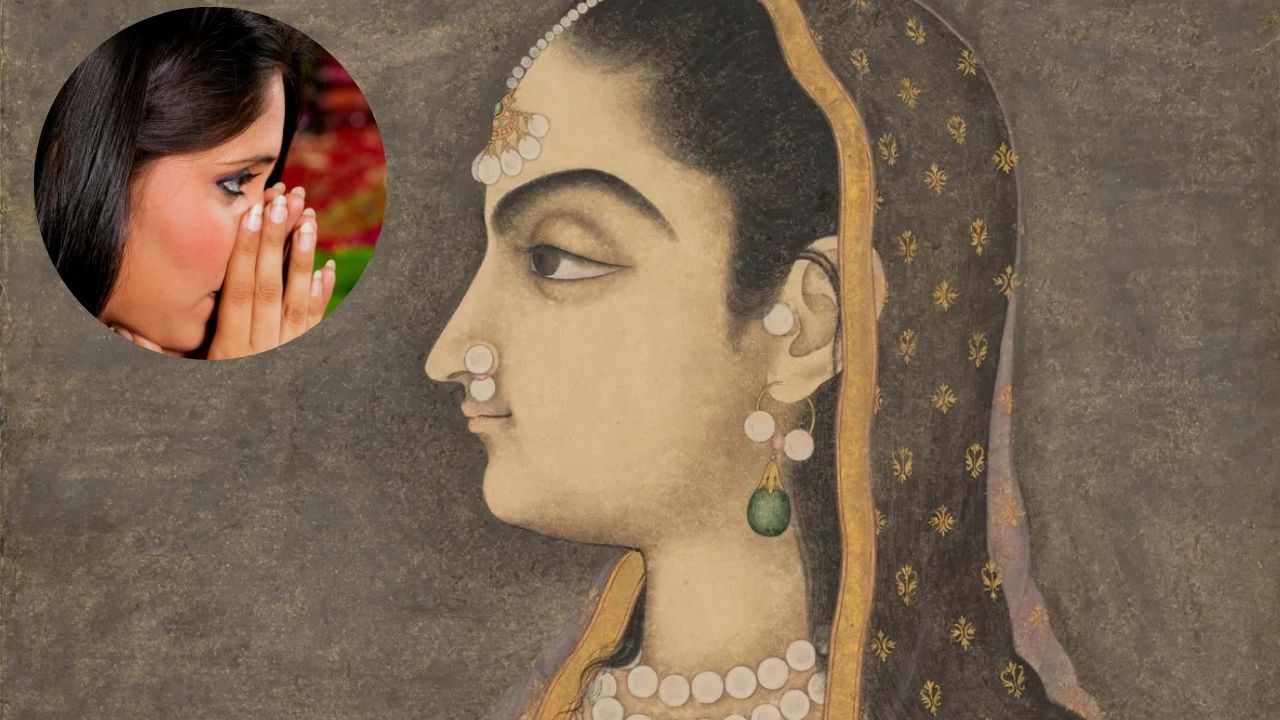
    The dorsal hump, high bridge, prominent projection, bulbous tip, and wide nostrils are features society often sneers at.


    Mashal, born and raised in Saudi Arabia, only considered rhinoplasty after her classmates, extended family, and “desi aunties” criticised the nose on her “perfectly fine” face while she was living in Pakistan for higher education.


    “I’ve heard comments like, ‘You’re pretty overall, but your nose ruins your beauty,’ and ‘You should get your nose fixed—it makes your side profile ugly.’


    “I lost my confidence and stopped going out. People used to stare at me weirdly, which made me uncomfortable,” she recalls years later. 


    These standards loom over Mashal’s life in Saudi Arabia as well, where, as she describes, women focus heavily on achieving facial symmetry and striving for a “doll-like appearance with extraordinary features.”


    A study published by the National Institutes of Health, titled Interest in Rhinoplasty and Awareness of Postoperative Complications Among Female High School Students in Taif, Saudi Arabia, shows a sharp rise in rhinoplasty procedures in recent years. As of 2024, they account for 30 percent of “all” cosmetic surgeries in the country, with social media strongly influencing young women to change their appearance.


    “You’ll see lip fillers, Botox, eyebrow tattoos, fox eye lifts, and jaw lifts very commonly here.


    “If I could sum it up in one statement, I’d say they’re turning themselves into a Snapchat filter. They’re obsessed with Snapchat filters,” Mashal remarks.


    ‘Rhinoplasty transformed me’


    For 35-year-old Nida from Lahore, the decision to opt for rhinoplasty was not about seeking social validation or meeting beauty standards. “It was about removing a barrier that had been holding me back for years,” she reveals.


    Nida considered rhinoplasty in her 20s. “I always knew I wasn’t completely happy with my nose. For years, I found myself editing photos or avoiding the camera altogether, worried about how it might look.”


    Although she knew convincing her loved ones would not be easy, and that some might see it as superficial, she felt it was deeply personal. “It wasn’t about vanity—it was about feeling comfortable in my own skin.”


    Despite her nerves, Nida was “determined” as she believed it would make a difference in her life. 


    “And it did—rhinoplasty transformed the way I saw myself. It wasn’t just a physical change; it was a shift in how I felt every day. No longer having to worry or feel insecure about my nose was truly life-changing.


    “Some might not understand, and that’s okay.”


    For Nida, rhinoplasty was about removing a psychological barrier holding her back. “My confidence soared, and I finally felt free to embrace myself fully. Sometimes, self-love means making the changes that allow you to show up as the best version of yourself—and for me, this was one of those changes.”


    A study by Army Medical College titled A Comparative Analysis of Body Image, Life Satisfaction, and Self-Esteem of Patients Before and After Rhinoplasty found that rhinoplasty significantly improved how people perceived themselves, with life satisfaction increasing fivefold, body image improving by 19 times, and self-esteem rising 26 times after surgery.


    The middle class showed the most motivation for rhinoplasty, and younger participants were more driven by aesthetic changes.


    Dr Namrah works at HBS General Hospital, Islamabad, as an ENT specialist and head and neck surgeon. She performs rhinoplasty not only for beautification but also because many of her patients have genuine issues with  breathing and suffer from nasal blockage.


    She, however, points out that a number of factors are taken into consideration before performing rhinoplasty. “We have a thorough method to streamline our patients and filter out those who have body dysmorphic disorder.”


    Patients who are diagnosed with body dysmorphia are referred for psychotherapy.


    “As a result, the satisfaction level is generally high among my patients. It helps them feel better about themselves, and they usually feel much happier after the procedure.”


    The Current reached out to a women’s support group, asking them to share their experiences of being shamed for their noses and how it affected their lives. Here’s what they have to say:

    “I am in my early 20s and yes, I do consider it [rhinoplasty] sometimes. I might get it later on in life if my parents fail to convince me otherwise. This conscience regarding my imperfections mainly stems from what I’ve seen around me, particularly the ‘acceptable standards of beauty’ both in real life and on social media. Yes, that societal pressure does overwhelm me sometimes, but I think practising positive affirmations helps me shake off those notions. It’s hard to accept that, but then I think I’m just beautiful and unique the way Allah made me.” – Fatima

    “I had an issue, but somehow I’m okay with it now. Interestingly, I did nothing, yet people still think I have gone through nose surgery. I have a big, fat nose, but now I know my angles and realise that I am more than my nose. So it’s perfect.” – Faryal

    “Comments were plenty, but I was too lazy to be bothered. Never believed in public opinion.” – Zareena

    “I was 13 when my aunt made a comment about my imperfect nose. I spent the next 2 years with my hand in front of my nose, fully believing it was an offense to people talking to me. I love it now, wouldn’t want another. We only think Kim Kardashian is beautiful because she isn’t real— I mean, all that plastic. Natural beauty just isn’t acceptable anymore. It wasn’t the case back in the ’80s and ’90s, when you saw all sorts of faces in the cinematic world. Now, they’re all cookie-cutter images.

    Love my nose. Love the dorsal hump. I think we need to appreciate women with larger noses. Actress Mahira Khan looked beautiful to me before she changed her nose.” – Shafaq

    “I have enough money to afford one, and it’s become so common now that it almost feels expected, especially here in Saudi, where every girl looks perfect thanks to access to good surgeons. It’s like getting veneers. I’ve definitely been resisting it since my husband isn’t happy about it, plus I know I got my nose from my dad, which I should’ve been proud of. But for some reason, it made him look super attractive, or so people said. It doesn’t have the same effect on me, though, I feel. I haven’t accepted it because, with so much perfection around me, it’s getting harder to live with my own imperfections over time.” – Hafsa

    *For privacy reasons, all names in this article have been changed or omitted.

  • Daily round-up: Oct. 29, 2024

    Daily round-up: Oct. 29, 2024

    1. Did you know that suicide risk is highest on Mondays around the globe? A research study led by Yoonhee Kim, an associate professor at the University of Tokyo, has connected the beginning of the workweek to an increase in cases.


      15-18% of worldwide suicides have been recorded on a Monday — a pattern observed in many countries across North America, Asia, and Europe.

      The analysis, which examined data from 740 locations in 26 countries over nearly 50 years, reveals that weekends generally have lower suicide rates in most regions.

      However, in Central and South America, Finland, and South Africa, the chances of suicide increase over the weekend, indicating the cultural and societal factors that influence mental health trends across the globe.

      2. Google is developing an AI technology called “Project Jarvis” that can control computers and do tasks like research and shopping through a web browser, particularly Chrome.

        It will carry out online tasks by interpreting screenshots and interacting with web pages.

        The AI will be publically shared in December along with the Gemini language model, but this timeline isn’t certain. Google may first test Jarvis with a small group to fix any issues.

        3. According to Interior Minister Mohsin Raza Naqvi, about 45,000 to 50,000 passport applications are being received by the ministry on daily — a number that exceeds the production capacity and is consequently creating a backlog.

          The Machine Readable Passport (MRP) system was established in 2004 for 30 regional offices and 10 missions abroad, which has not been upgraded despite the number of offices increasing to 223 and missions to 93.

          Now, the production facility can only manage 20,000 to 22,000 applications per day, which has caused long delays. To tackle the issue, the government has made the production facility operational 24/7 in three shifts.

          The move has been made after reports of citizens facing delays of up to two months, affecting patients in need of urgent medical treatment, students applying to foreign universities, and those seeking work visas.

          4. Pakistan’s opener, Fakhar Zaman, is reportedly considering retirement after being dropped from the Pakistan Cricket Board’s (PCB) central contract, according to Urdupoint.

            The batter has been asked to undergo another fitness test in January, revealing double standards. Usman Khan stopped during the third round of the 2-kilometre run but not only received a contract but also made it into the squad.

            5. People in Karachi have recently been actively protesting various issues. This week began with a Climate March, where participants carried placards and banners against climate change, highlighting anti-environmental policies.

              Participants also held the Palestinian flag.

              Speakers at the Friar Hall Climate March addressed issues such as deforestation, rising sea levels, and melting glaciers in a heatwave-wrapped world.

              For more daily updates, sign up for our Newsletter.

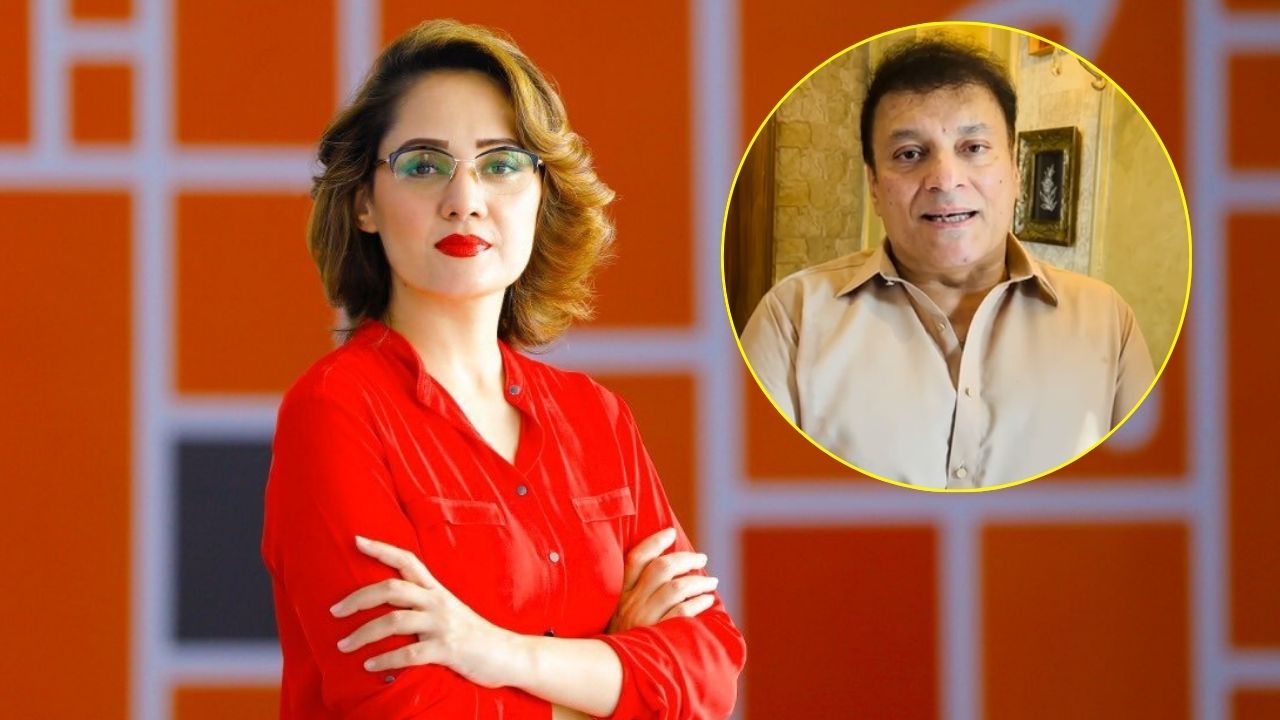
            1. Exclusive: ‘Not the first time he’s apologised,’ Gharidah Farooqi reveals interaction with Dr Omer Adil

              Exclusive: ‘Not the first time he’s apologised,’ Gharidah Farooqi reveals interaction with Dr Omer Adil

              One month after passing misogynistic remarks against renowned television anchor Gharidah Farooqi, Dr Omer Adil has publicly apologised.

              On a podcast hosted by Zohaib Butt, Dil Ki Baat, in July, film critic and orthopaedic surgeon Adil claimed that female anchors in Pakistan’s media industry are “handpicked by a seth or somebody else to go and host a stupid program”, adding that they are treated extraordinarily in comparison to their male counterparts.

              He made these comments during a segment of the podcast that primarily targeted Gharidah Farooqi and used derogatory language, including vulgar abuse. He further claimed that the producers had ‘no guts’ to criticise women anchors for their mistakes.

              This was followed by a massive backlash from the journalist community across Pakistan, particularly women who are, time and again, subjected to harassment and sexist commentary. 

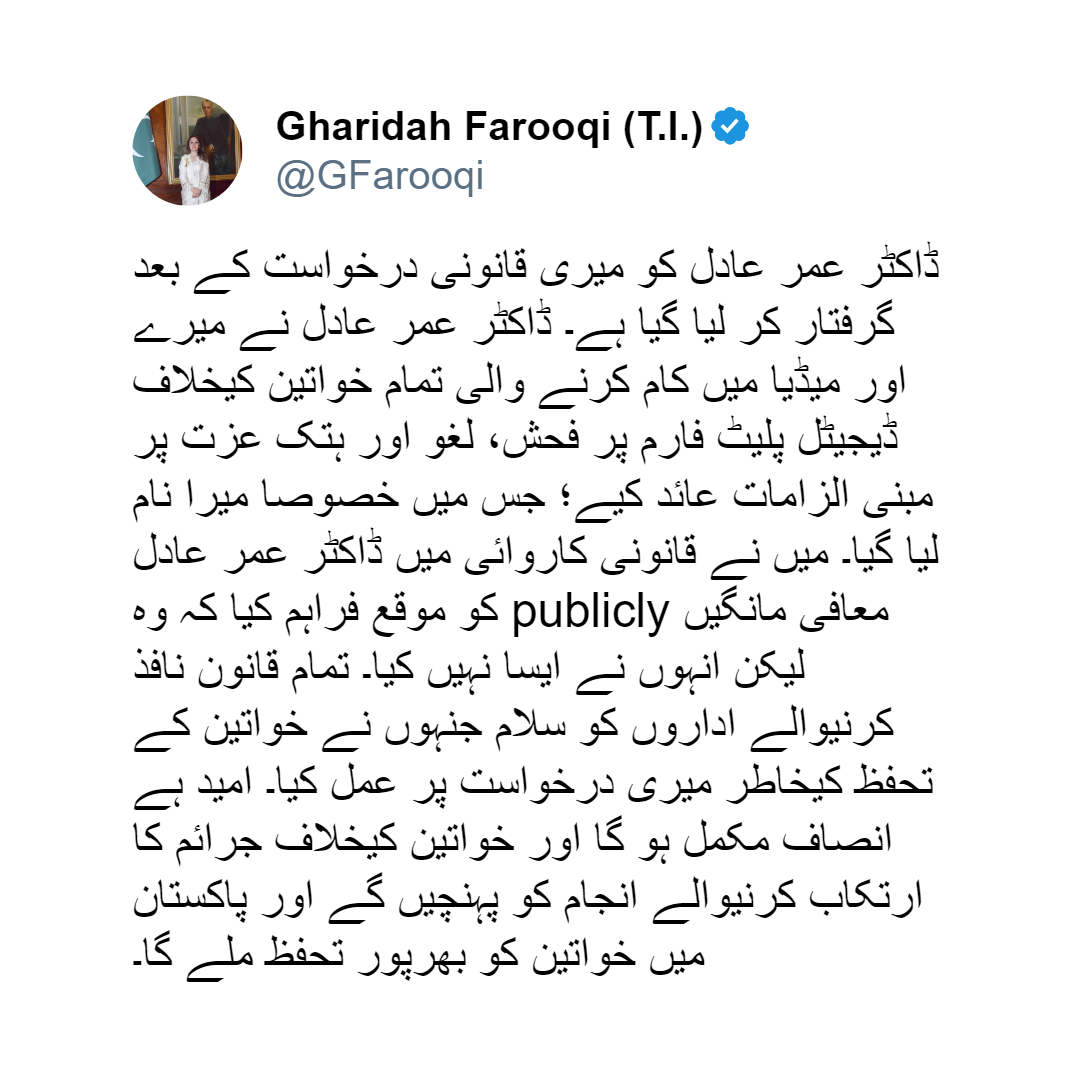
              On August 6, Gharidah Farooqi updated on X (formerly Twitter) that Dr. Adil had been arrested by the Federal Investigation Agency (FIA). 

              On August 24, Dr Omer Adil posted an “unconditional, wholehearted and sincere apology” to Gharidah Farooqi.

              https://youtu.be/xwsZl7WQBPQ?si=cjp81-JI-bChR-dK

              But speaking with The Current, Gharida Farooqi revealed that it is not the first time that Omer Adil apologised to her.

              “Dr. Umar Adil contacted me many weeks ago, shortly after he was granted bail following his arrest by the FIA after I filed a complaint. He called and apologised for about 20 to 30 minutes, insisting that he had been trapped and ended up saying things in the podcast that he did not intend.

              He seemed to be playing the victim,” she recalls.

              Gharidah then demanded that he issue an apology on his official YouTube channel for a duration equal to the time he spent making those offensive remarks on the podcast, to which he agreed.

              The apology, however, was delayed due to alleged technical issues. During this time, he posted a brief video but then vanished again.

              Although the case was receiving widespread attention, the FIA only detained Adil after Farooqi filed a complaint, which ultimately led to his public apology.

              Fight against digital violence

              Ghareeda Farooqi has long been subjected to online violence. From rape threats to even death threats, she has been targeted by “malicious campaigns”.

              “I have been fighting against not just cyberbullying but cyberviolence against myself since 2014. I was the first female journalist who was made the victim of digital violence against women, as well as planned campaigns organised by political parties”, she says.

              Women Press Freedom has documented at least a dozen organised troll campaigns against Gharida, reportedly the “highest number of organised digital violence we have ever documented against a journalist in the region” after Indian journalist Rana Ayyub.

              “People have forged videos and pictures using my face, including pornographic content,” she recalls.

              “So far, I have filed almost ten complaints with the FIA; not even one has been addressed, and no culprit has been arrested.”

            2. ‘Please do something,’ students push Hamid Mir to file petition against internet disruption

              ‘Please do something,’ students push Hamid Mir to file petition against internet disruption

              The month of August has been the worst for the digital space in Pakistan since February 2024.

              The tech industry has expressed serious concerns about the internet slowdown, warning that it could cost the debt-ridden nation up to $300 million.

              Amid the ongoing issues, senior journalist Hamid Mir took the matter to the Islamabad High Court (IHC), filing a petition through Advocate Imaan Mazari against the internet slowdown.

              Mir argued on behalf of the journalist community, which is struggling to perform its duties due to reliance on connectivity and communication. He further noted that the issue impacts those in e-commerce, students, freelancers, and others.

              The petition also highlights that no prior consultation or deliberation took place between the government and relevant stakeholders before the installation of the firewall, which has contributed to the ongoing struggles of the business and tech community.

              This lack of transparency has fueled doubts and rumours about the nature of the firewall.

              But did Hamid Mir file the petition solely because of the struggles faced by journalists?

              “Frankly speaking, I filed the petition after receiving messages from many students who said they could not leave Pakistan but were finding it difficult to study here,” Mir told The Current, revealing that internet disruptions have also impacted students pursuing online studies, prompting them to seek intervention from the authorities — which Mir decided to do on their behalf.

              “I also face pressure from my own family, who cannot stay in this country anymore. They have asked me to do something to restore internet and social media if we are to remain here,” he explained, reflecting on the growing discontent among the youth.

              Given the current circumstances, the petition argues that installation cannot proceed without consulting relevant stakeholders and that only “reasonable restrictions” may be imposed by law, based on the “principles of necessity and proportionality.”

              The respondents are also asked to provide reports on the firewall’s objectives, status, and impact on citizens’ rights, including details on internet surveillance. Meanwhile, the petition calls for halting the firewall installation and ensuring uninterrupted internet access for citizens until the issue is resolved.

            3. ‘It’s not possible’; Reporting in internet-challenged Pakistan

              ‘It’s not possible’; Reporting in internet-challenged Pakistan

              With the primary shift from newspapers to television channels and now to digital media applications, the dissemination of information has become increasingly competitive for newsrooms, with the latest updates just a click away.

              “Delays can be managed with newspapers, but today everything is in your hands—specifically, mobile phones,” says Raees Ansari, Bureau Chief of Geo News in Lahore.

              “Every single second is crucial in reporting now; some footage needs to be sent and put on air instantly. But due to poor network conditions and slow WhatsApp, content is not being sent on time, which is affecting our professional activities,” he reveals.

              Over the past week, internet users across Pakistan have reported network disruptions, with WhatsApp, Facebook, and Instagram experiencing slowdowns, hindering online activities. The Pakistan Telecommunication Authority (PTA) has denied any connection between these issues and the alleged firewall installation.

              Since the ban on X (formerly Twitter) on February 17, 2024, many have turned to Virtual Private Networks (VPNs). The ongoing disturbances, however, have complicated internet usage, which is crucial for a number of professions.

              Sumaira Raja, an investigative reporter, who is mostly found out on the field, complains of encountering issues with not only the internet but also phone signals which often prevents her from conveying news on time.

              “I also experience delays with receiving beepers, as head office frequently reports that the number is not available due to poor signals. This situation makes it very difficult to do my job. I’ve tried using a VPN, but it hasn’t worked,” Raja says.

              Sports journalist Faizan Lakhani recalls when javelin champion Arshad Nadeem returned to Pakistan on August 17 after winning the gold medal at the Paris Olympics, all the visuals sent through WhatsApp by reporters were delayed, and they struggled to download them unless they used a VPN.

              “This situation is very challenging and affects our workflow. When reporters are working on a story or covering an event, they need to stay connected with the desk. We usually rely on voice notes to pass instructions, but since we started encountering this issue, we are struggling with that method too,” he says.

              “We have been told that the network disruption is because of the firewall installation. While things are becoming easier around the world, it has been getting harder for us. Everything is happening with the help of technology and the current situation is a major challenge.” says Ansari.

              What’s happening?

              A highly placed source in the IT industry identifies that filtering of content delivery networks (CDNs) through Firewall is causing content to be routed via internet backbone rather than CDNs.

              “This means that around 4 TBs of internet traffic previously served through CDNs, hosted in Pakistan, is becoming ineffective. When all traffic goes on backbone bypassing CDNs, it’s causing massive slowdown at many western destinations that’s happening now,” he explains.

              Recently, Fiverr, an online marketplace for freelance services, warned clients that Pakistani freelancers may experience delays due to internet issues and the use of VPNs to change their locations.

              “Brace for impact. God save the internet in Pakistan”, says the IT expert.

              Background

              It all started on February 17, 2024, about a week into the new government, when X (formerly Twitter) was banned.

              Initially, amid the uproar, the government remained silent on the matter while the Pakistan Telecommunication Authority (PTA) seemed aloof until the High Courts of Sindh and Islamabad intervened. The PTA eventually admitted that the ban on X was imposed on the orders of the Ministry of Interior based on reports from intelligence agencies.

              The government eventually justified the ban by attributing it to national security concerns, citing ‘digital terrorism‘ and online propaganda as among the threats.

              Earlier in August, Provincial Information Minister Azma Bokhari stated that the government is not against social media but wants to focus on rules and regulations, which, if enforced, could lead to the removal of the ban on X.

              The disruption has now extended beyond X, affecting other widely used apps along with the internet.

              Ironically, since the February 2024 election, the new government has emphasised the need to grow the tech industry in Pakistan.

              In March, Lahore Knowledge Park (a science park) was handed over to the Punjab Central Business District Development Authority with the approval of Chief Minister Punjab Maryam Nawaz, with the goal of establishing Pakistan’s largest IT city.

              In June, Prime Minister Shehbaz Sharif visited Shenzhen— the tech hub in China— in hopes of future collaboration. Ironically, he posted on X (Twitter), expressing how “impressed” he was by the “city’s skyline and development that symbolizes modern-day China.”

              Given the lack of proper infrastructure in the country amid burgeoning surveillance, how will Pakistan evolve in the rapidly transforming digital world? It remains to be seen – but likely we won’t be able to download it.

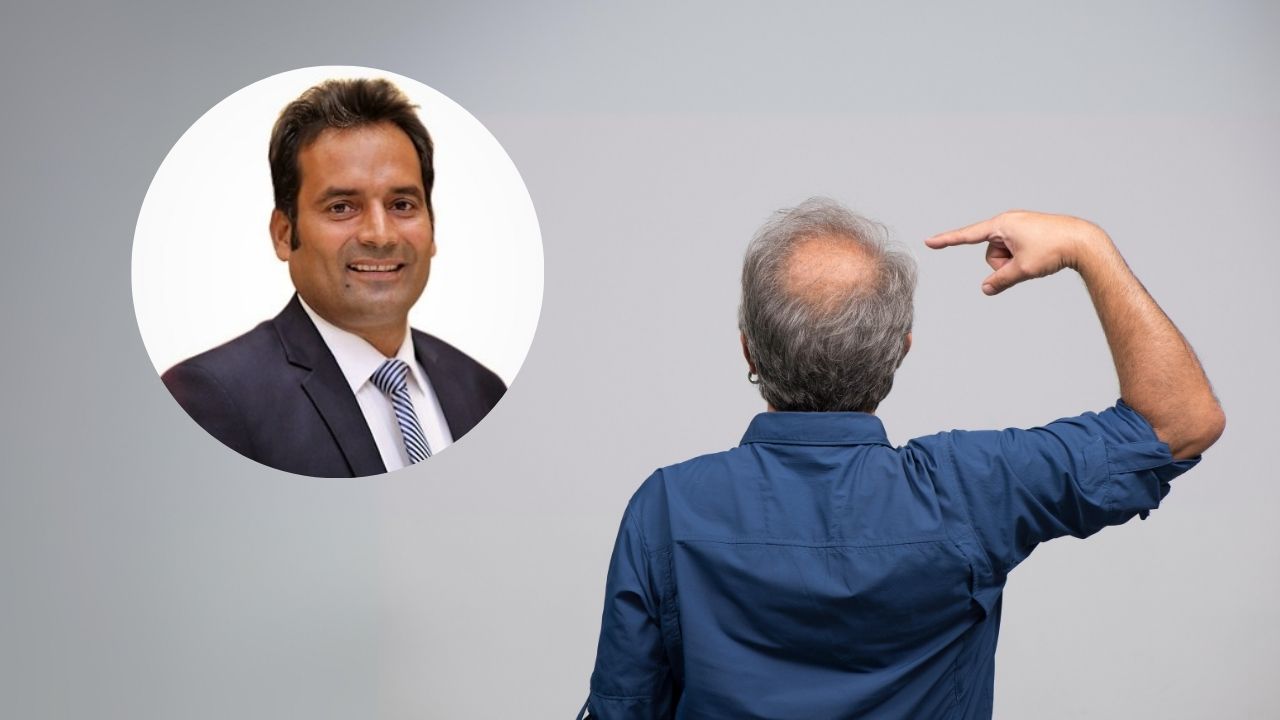
            4. Exclusive: Pakistani scientist on the verge of curing baldness

              Exclusive: Pakistani scientist on the verge of curing baldness

              Unexpected discoveries have long been a catalyst for scientific research, leading to major breakthroughs in fields ranging from medicine to technology.

              Now, in an unexpected development, scientists have discovered a crucial piece of the puzzle: hereditary baldness, also known as androgenic alopecia.

              Dr. Muhammad Yar, a tenured associate professor at COMSATS University Islamabad and a biomaterial researcher, and Sheila MacNeil, an Emeritus Professor of Tissue Engineering at the University of Sheffield in the UK, are the two minds behind this latest development.

              Years ago, Dr. Muhammad Yar was working on the development of biomaterials for advanced wound care i.e. dressings (medical gels) which can help faster healing of chronic wounds, and agents which can support new blood vessels formation known as angiogenesis.

              So, in 2014, during a visit to the University of Sheffield, Dr. Muhammad Yar discussed the angiogenic potential of 2-deoxy-D-ribose with Professor Sheila MacNeil.

              Following their discussion, they decided to test the compound together.

              From chickens to rats

              Initially, when the dressing gel, containing 2-deoxyribose, was tested on chicken fertilised eggs, a lot of new increased blood vessels were seen growing towards tested material.

              “We were really happy and then we went towards patent filing. A company was interested in its commercialization as wound care drafting for diabetic and burn patients,” he recalls.

              The deoxyribose gel was then tested on full-thickness wounds, where it successfully promoted healing. It was, however, also observed that longer and thicker hair grew along the edges of the wounds.

              “We thought that 2-deoxy-D-ribose is doing something else as well. Apart from helping in faster regeneration, it’s helping in faster growth of hair as well,” he says.

              And that is how, after working on the development of wound healing, they dived into the possible baldness treatment.

              They tested the deoxyribose gel on mice with testosterone-driven hair loss and applied a small amount of the gel to their bare areas.

              In weeks time, the fur grew back thicker and longer, showing results comparable to minoxidil, the well-known hair loss treatment sold as Rogaine, which doesn’t actually prevent hair loss and often results in minimal regrowth in some cases.

              “This is working really nicely,” Dr. Muhammad Yar updates on the latest developments.

              Happy news for bald people?

              With ‘impressive results’ in mice, the scientists believe there’s a good chance that 2-deoxyribose will be tested on humans next.

              Dr. Muhammad Yar confirms that while testing on humans is the goal, it will first require further lab work to understand the mechanism of action of 2-deoxyribose and to obtain approvals from regulatory bodies.

              “We are expecting around a year and a half to two years’ time before we test this on humans.”

              If deoxyribose gel proves effective on humans, it could treat alopecia and support hair regrowth after chemotherapy.

              Why does Pakistan lag behind?

              When asked why it’s rare to hear about Pakistani scientists working on groundbreaking research, Dr. Muhammad Yar believes that the key is in translational research.

              “We have to develop something in the lab and put this in the market. This is very, very important for economic uplift in Pakistan as well as for the universities.”

              He also asserts the need for business training programs for faculty and students at Universities.

              “The research which academics are doing at the universities is really important. There is a space in the market evaluation and business knowledge among faculty and students that could help translate these technologies from the lab to the clinic,” he points out.

            5. ‘Inspiring Pakistan’s youth’; The Current featured on the Google News Initiative

              ‘Inspiring Pakistan’s youth’; The Current featured on the Google News Initiative

              In 2020, The Current won the Google News Initiative (GNI) Innovation Challenge, becoming the only media organization in Pakistan to achieve this highly regarded position within just a year of its launch.

              Four years down the road, we continue to grow alongside the ever-evolving news consumption habits of youth in the digital age.

              But that’s not all.

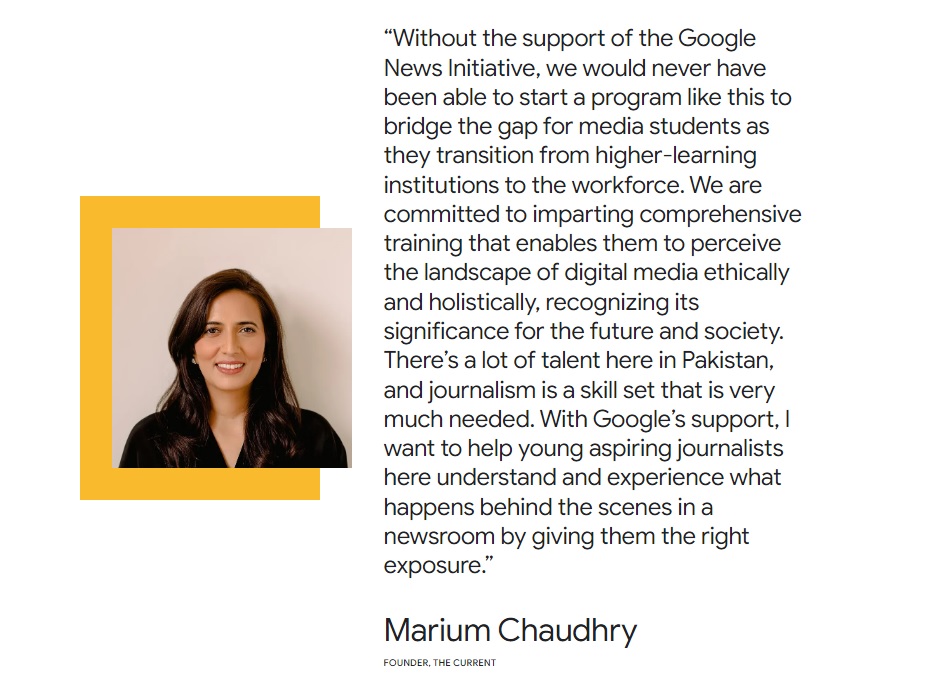
              In 2021, The Current opened the doors of its digital newsroom to the youth of Pakistan by starting a membership program called ‘Aap Ki Awaaz,’ which provides aspiring journalists with a platform to gain practical experience in digital media and prepare them for responsible information communication for tomorrow.

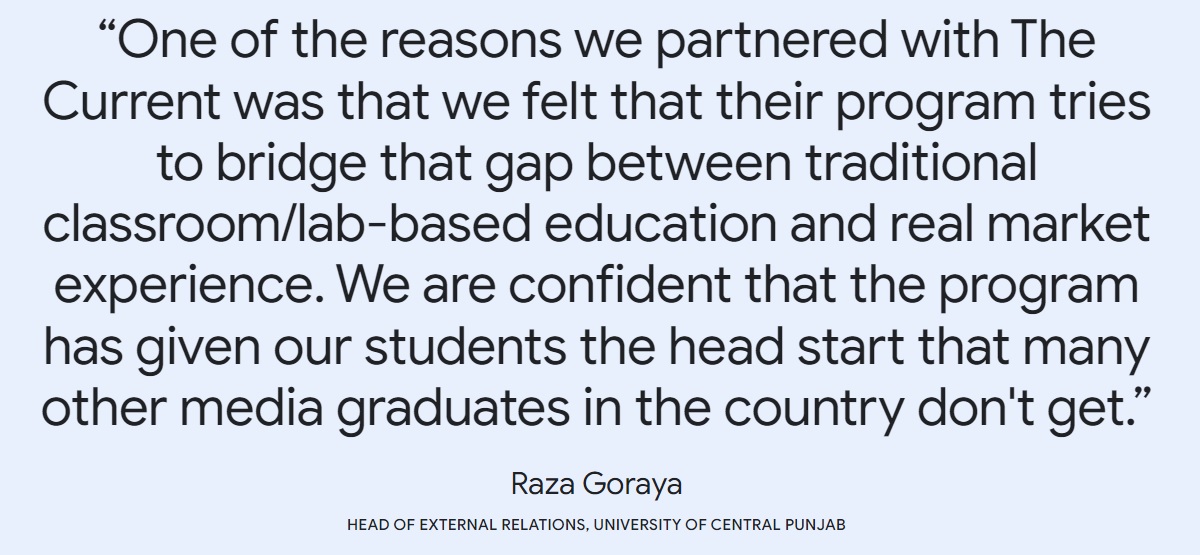
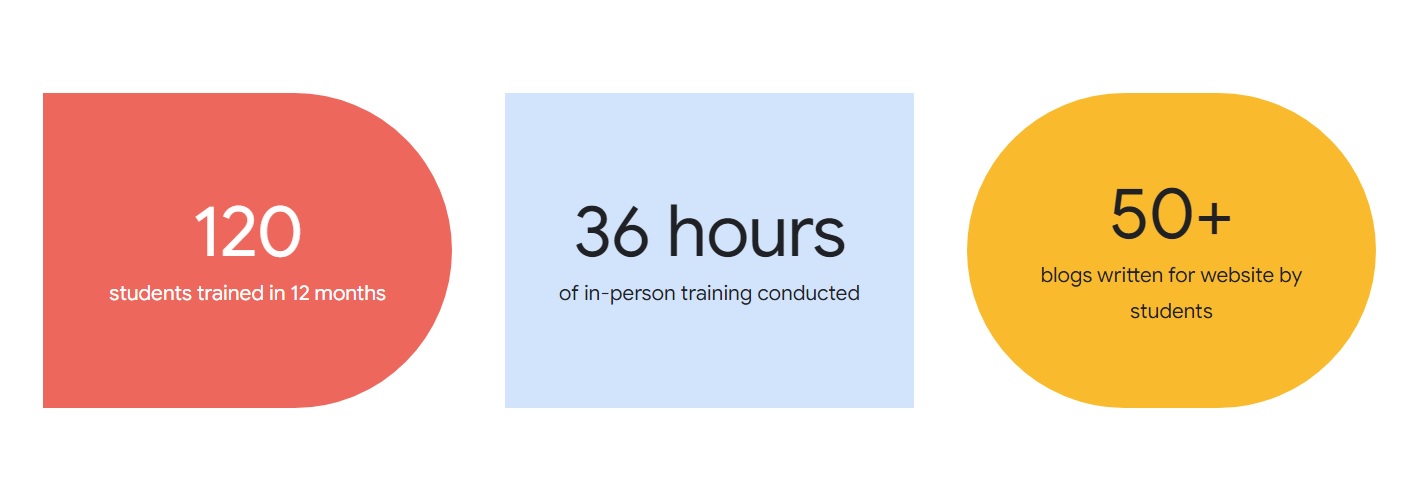
              Having collaborated with the University of Central Punjab and Punjab University, The Current has worked with 120 students, conducting workshops featuring Pakistan’s renowned journalists and digital personalities. Above all, we have provided them with a space to unleash their creativity.

              So far, Aap Ki Awaaz has published more than 50 blogs written by these students.

              In 2024, 12 of our young members joined The Current’s coverage of Pakistan’s general election, tagging along with our reporters, monitoring election results, writing real-time stories, participating in live podcasts, and gaining firsthand experience of this major political event.

              And oh! About a year ago, we launched our newsletter, which now has more than 1,500 subscribers and an open rate of 28 percent (which is growing!).

              The Google News Initiative covered our work and the work we plan to do. Join us, support us by becoming a member or subscribing to our free newsletter so we continue to help our community and our country.

            6. No relief for babies: Heavy tax on formula milk

              No relief for babies: Heavy tax on formula milk

              The budget for 2024-25 was unveiled this Wednesday, on June 12, by Finance Minister Muhammad Aurangzeb.

              As the government depends on the International Monetary Fund’s (IMF) bailout package, citizens were further burdened with heavy taxes as per the administration’s commitments to the lender. Milk products for infants, a necessary item for many families, will now carry an 18 per cent tax.

              But why is this issue noteworthy?

              On January 21, 2022, the Finance (Supplementary) Bill—a ‘mini budget’—was passed by the National Assembly following extensive debate over the proposed taxes by the Pakistan Tehreek Pakistan (PTI) government. Among the contentious proposals was a 17 per cent sales tax on locally produced infant formula milk, classified as a “luxury product.”

              This classification sparked heavy criticism from both the public and the opposition, who argued that labelling a basic necessity for children as a luxury was unjust. In response, the-then Finance Minister Shaukat Tarin promised to push for the exclusion of children’s milk products from the Bill.

              However, two years later, heavy taxes are being imposed on infant milk products once again.

              According to Statista, a German data-centric platform, the Baby Milk & Infant Formula Market in Pakistan is projected to grow by 0.76 per cent from 2024 to 2029. This trend indicates increasing reliance on infant milk products due to various reasons.

              Traditionally, in South Asian countries like Pakistan, reliance on infant milk products is frowned upon, with a cultural preference for breastfeeding. However, several factors can make breastfeeding unfeasible.

              Certain health conditions, such as infections or breast surgeries, can prevent mothers from breastfeeding. Additionally, some mothers can not produce enough milk due to lactation insufficiency. In other cases, babies are born with conditions like galactosemia, which prevents them from digesting breast milk. Furthermore, specific nutritional deficiencies can not be addressed by breast milk alone and require formula milk supplementation.

              Moreover, not every mother is comfortable with breastfeeding, and many prefer to use formula milk to feed their children. Working mothers, in particular, may not have the flexibility to breastfeed and thus rely on formula milk.