Author: Urwa Khurshid

  • Pakistan’s first Human Milk Bank: victim of religious conspiracy or a logistical issue?

    Pakistan’s first Human Milk Bank: victim of religious conspiracy or a logistical issue?

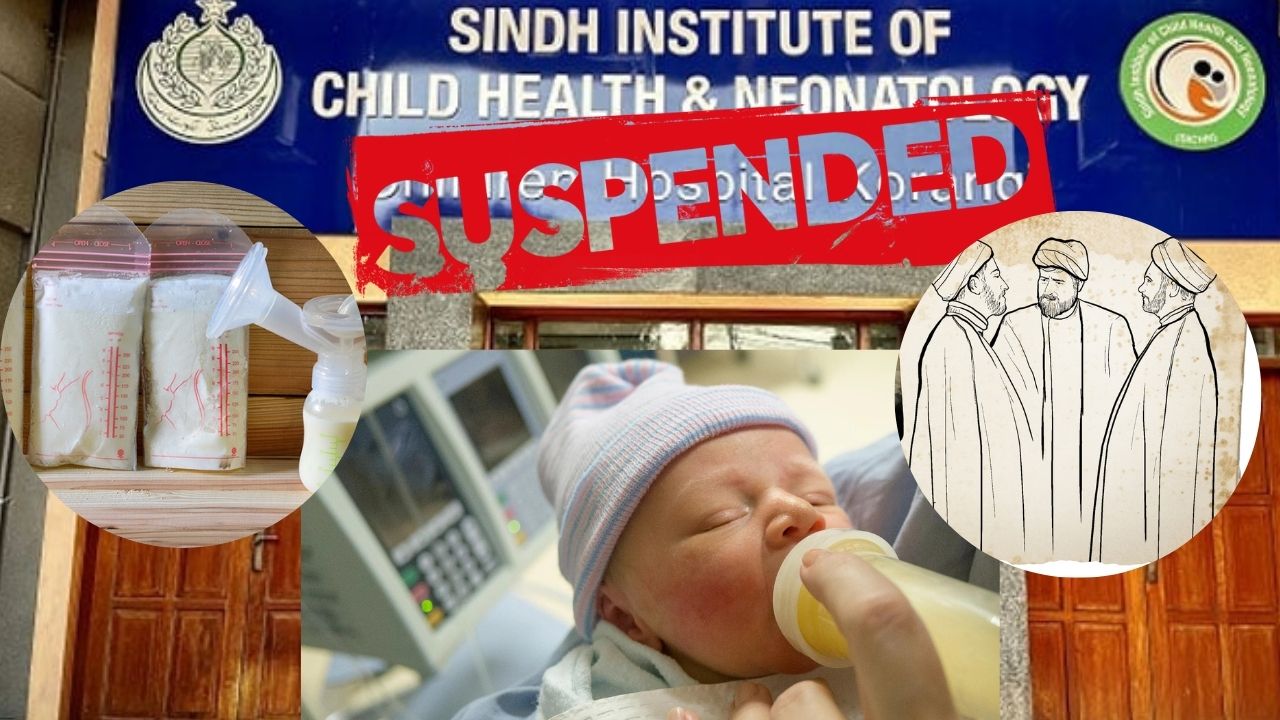
    The establishment and suspension of the first ever human milk bank in Pakistan is an issue that has been making headlines all over the world.

    While local media pinpoint the very nature of the issue to be controversial, international media frames it as an example of the perpetuated backwardness of our society. What perturbed me the most was the fact that the project started after getting approval from a prestigious religious body, Darul Uloom Karachi, patronized by Mufti Taqi Usmani. The approval got suspended because of a revised fatwa from the same institute.


    What led to the suspension just two weeks after the inauguration, and how will this impact the mortality rate of premature children?

    The human milk bank has been in the works since last year. I talked to the Executive Director of SICHN, Professor Jamal Raza, who explained that the institute had formally applied for the fatwa and, after six months of waiting, had an interview at Darul Ifta of Darl Uloom Karachi where they answered all the questions asked by distinguished muftis. “Subsequently, the fatwa was given last December, after which the equipment was procured from the UK and other places as it is not available in Pakistan,” Jamal said.


    The first fatwa, issued on December 25, 2023, laid out basic tenets of Islam for breast feeding in a detailed manner. That document has been reviewed by The Current.

    It outlined eight conditions that need to be followed.
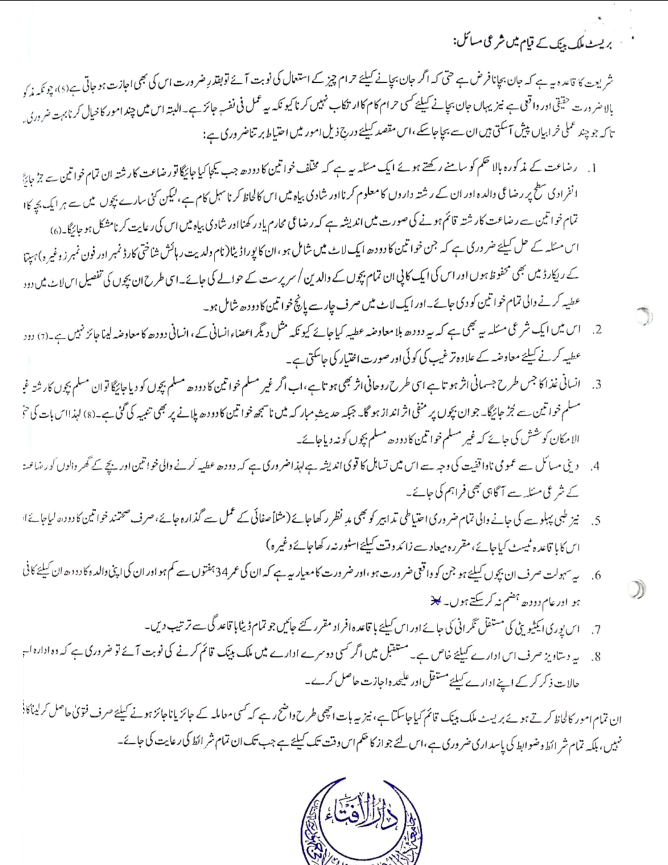
    The first and foremost condition was regarding the age of the child. The exclusive facility of breast milk is to be given to premature children with a gestation period of less than 34 weeks and less than 2 kilogrammes of weight.

    The tenet strictly suggests a bond of milk kinship (Raḍāʿah), stating that a parent-child bond is formed when a woman gives milk to a baby who isn’t biologically related to her. To avoid future incestuous marriages between milk siblings and relations, the tenet says, the foster relationship must be clearly shared. The fatwa delineates that the bio-data of all the women in one lot (with a maximum of four to five women) must be kept in the hospital’s record and shared with the parents of the child and vice versa.

    The second condition extrapolates that the act of donating milk for the child should be done voluntarily and free of cost, just like the donation of organs.

    The third condition explains the spiritual impact of the milk bond, because of which it is imperative that only the breast milk of Muslim women is given to the children.

    The fourth condition makes it mandatory for the women and families of the children to be educated about Shariah laws regarding the practice of Raḍāʿah.

    Further conditions stress that the milk be cleaned and pasteurized, not stored for long, and only given to children who need it most desperately and cannot digest powdered milk.

    The last two conditions demand that the whole activity be supervised by a group of people and assert that this provisional permission is specific to SICHN. If some other institute wants to open the same facility, then it would have to ask for it.

    On June 10, 2024, Pakistan’s first Shariah-compliant ‘Human Milk Bank’ was inaugurated by Sindh Health Minister Dr Azra Pechuho. It was set up in collaboration with UNICEF.

    Journalist Waqar Bhatti wrote in The News that Prof Jamal Raza, who spoke at the inauguration ceremony, described mother’s milk as the ‘original fast food’, emphasizing that it delivered all the necessary nutrients, healthy components, and disease-fighting properties that a newborn needs.

    Bhatti’s report elaborated that Pakistan has a neonatal mortality rate (NMR) of 41 deaths per 1000 live births, which is one of the highest in the world, and this facility in Sindh understands that a mother’s breast milk is the best source of food and has all the antibodies that may protect the immunity of children.

    Bhatti, while talking to journalists Mehtab Haider and Waqar Gillani, identified the artificial powdered milk industry as the real reason behind mothers shying away from feeding their children, not realizing that this is extremely harmful to a child’s health. As for the suspension, he claimed that the wayward discourse on social media actually misguided Mufti Taqi Usmani; otherwise, the facility was really proving to be helpful.

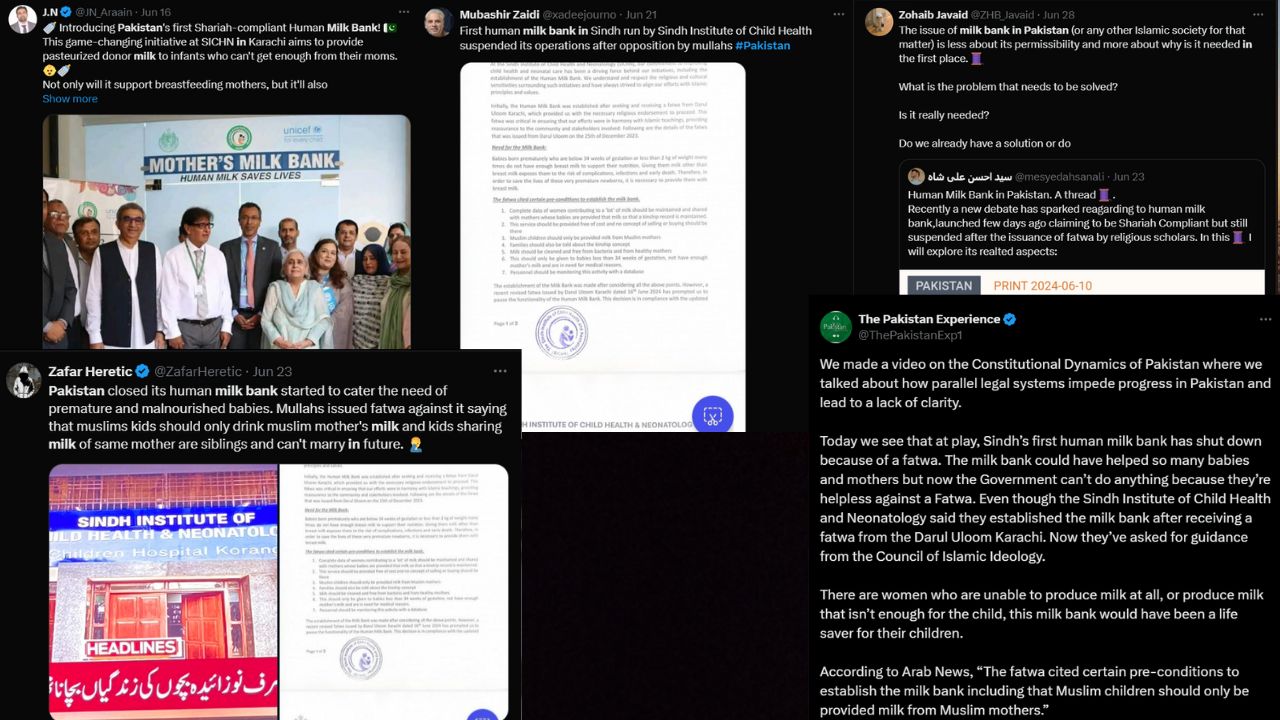
    Since the inauguration, public sentiment has been against the establishment of the milk bank.

    In a YouTube video made by Urdu Point, host Shabana asks the public about the opening of the milk bank in Sindh. All the people she talked to voiced their opinions against establishing the bank, stating religious reasons.

    The reaction on social media was mixed; it either pronounced the suspension a “conspiracy of mullahs” or called it a decision in accordance with Islamic rules.
    “The second fatwa directly did not mentioned this fatwa but was in response to some other question which we are not aware of, as we were not approached for any clarification nor our centre was visited for procedural verification,” Jamal Raza stressed while talking to TheCurrent.

    Emphasising that they don’t intend to do anything remotely unislamic and open to all sort of suggestions, Raza added, “We feel that most of the criticism was based around lack of information to the general public and the general tendency to criticise without fact finding, thus if any religious body is willing to sit down with us to understand the process, they should not have any objection to the establishment of this bank.”

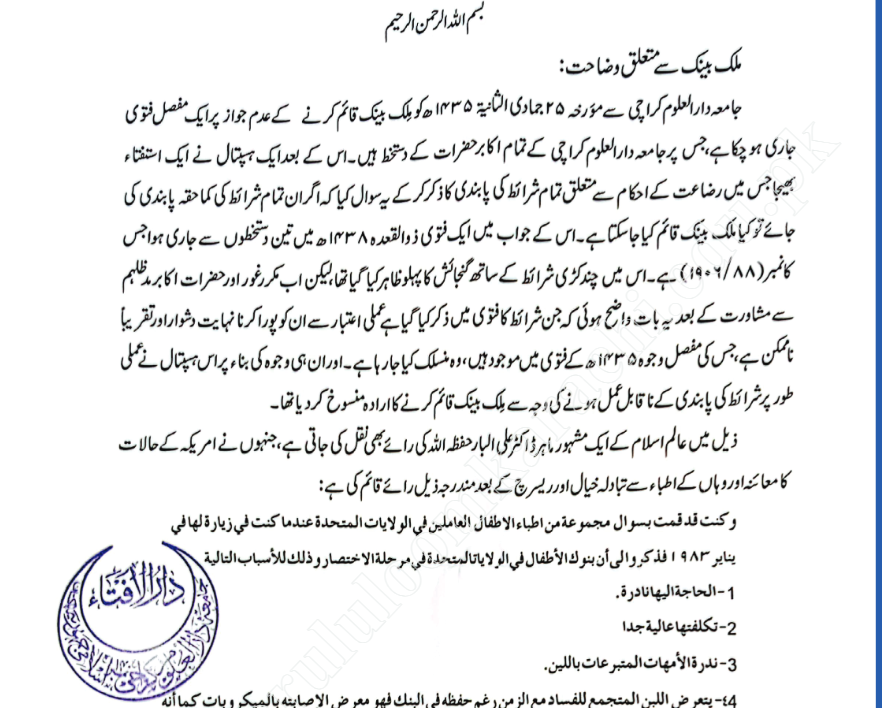
    A revised fatwa issued by Darul Uloom Karachi dated June 16, 2024, prompted SICHN to discontinue the functionality of the Human Milk Bank and seek further guidance from Dar ul Uloom and Islamic Ideology Council.

    I tried to talk to Dar ul Uloom about why they felt the need to have a revised fatwa and know the reason for taking back the permission they accorded earlier. The singular answer from all the multiple scholars I talked to stated that the revised fatwa is the only response they want to put out there and that they are not going to entertain any other query about this issue.

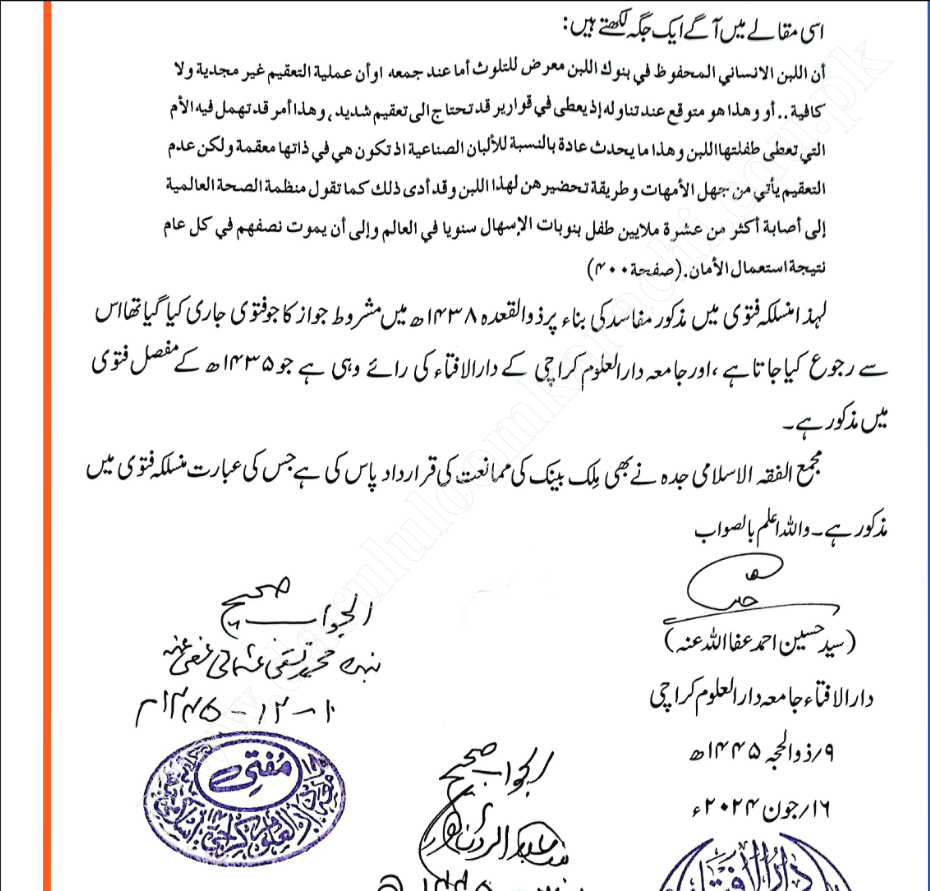
    The revised Fatwa available on Dar ul Uloom Karachi’s official website includes a detailed analysis of the establishment of a milk bank that did not comply with Shariah laws because of the demanding maintenance of the concept of kinship at the facility as observed by the scholars sitting in Dar ul Ifta. It quotes an American scholar and a Jeddah’s Islamic think tank declining the establishment of a milk bank along with a detailed note from Mufti Taqi Usmani extrapolating other religious concerns entailing the issue of breast milk bank but no word on the specific issue of the establishment of milk bank in the city.
    In a panel discussion about the Human Milk Bank on Samaa TV’s Mufti Online, Dr. Shawana Mufti, a prominent gynaecologist practising in America, shared her take on the issue of establishing a milk bank in the country. She highlighted that the idea is not feasible in the present socio-economic conditions of Pakistan, especially considering the high protocols there are for the milk donors to meet in the countries where they are operational. She started off by saying that she respects the opinion of all the scholars and the tenets of Islam and she totally agrees with all the scholars here, saying that this wouldn’t be successful in Pakistan because the idea of a milk bank to be formed was coined in the West as it was found out that for children who are premature at birth and can only survive if given the breastfeed. “Here they start with screening as it is checked what is the social and medical history of donor mother,” she stressed. Further, Shawana laid out how strict the screening criteria for a donor mother are, to the extent that it is considered that the mother takes painkillers or any sort of narcotics, “In Pakistan, a regular woman doesn’t even go to a doctor until she is dying or expecting a child. The financial stress in the country would never be up to the screening criteria (of international standard). Who will donate milk here? The elite women won’t donate milk here.”

    Her argument was seconded by Professor Naaureed Fatima in the panel as she said that this is sadly a reality that elite class won’t donate and the commoners are so unaware about the complexity of the milk kinship that it requires a campaign to educate them about that. In this case, a milk bank in Pakistan is not a feasible idea.

    I talked to Mufti Sohail Sialwi from Nottingham, UK, who opined that the basic rules delineated in both the fatwas are the same. It is clearly stated in the first fatwa that conditional permission is given because the strict criteria are hard to fulfil. That is why the fatwa asserted not just keeping a strict record but also educating both the parents and donor women about the complexities of the concept of Raḍāʿah. However, in the second fatwa, the verdict is shared after analysing the conditions in which record-keeping is an uphill task, and even if things are recorded, tempering them isn’t very difficult as the incidents of these records getting destroyed, burnt and modified. Thus, in a country like ours, the officers (liable to be corrupt or oblivious to sensitivity) cannot be trusted with a sensitive issue like this.

    The matter now rests with the Islamic Ideology Council, the most high-profile religious authority in the country. I talked to the Chairman of the Islamic Ideology Council, Dr. Raghib Naeemi, who informed me that a delegation from SICHN came to the Council to defend their case, and the discussion around the topic is ongoing. However, a simple Google search revealed that a similar issue rose in 2014, and the IIC ruled against the legitimacy of a human milk bank.
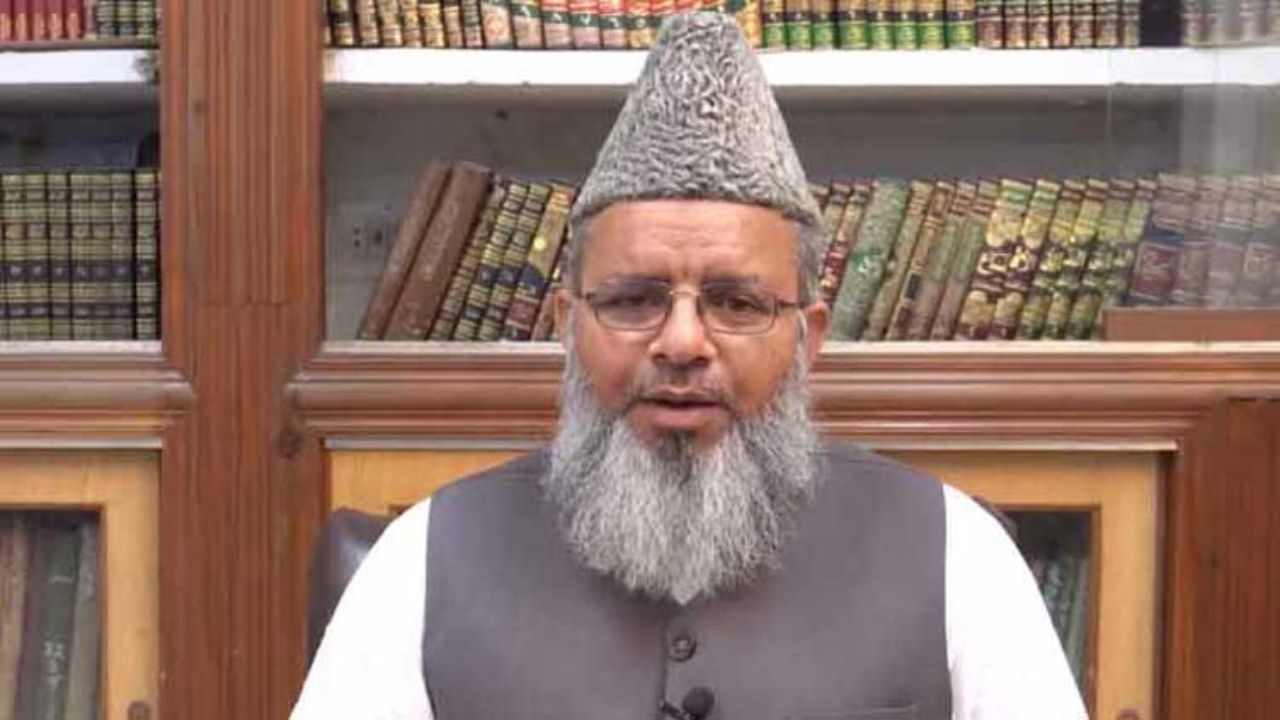
    Dr. Raghib Naeemi, Chairman of the Islamic Ideology Council

    Islam as a religion defines the social fabric of the Pakistani nation. The concept of milk donation is considered esteemed and sacred for Muslims as derived from the religious tradition inspired by the life of the Prophet (PBUH). The need of the hour is a large-scale awareness campaign patronized by the government addressing all the misconceptions and educating mothers to not just breastfeed their children but also donate milk to premature children. The government could curb neonatal mortality by advertising for lactating mothers to feed their children inside the hospitals or even for children who, for some reason, cannot have their mother’s milk fed. Although involving money in this activity is proscribed, a form of recognition for such mothers could be to facilitate them with a healthy diet and transportation for the time they feed the child. In this way, the government can easily record these mothers and ensure the exclusivity and intimacy of the donor mother-child bond at the core of the concept of Raḍāʿah.
  • Exclusive info: how is the police investigating the viral beating case?

    Exclusive info: how is the police investigating the viral beating case?

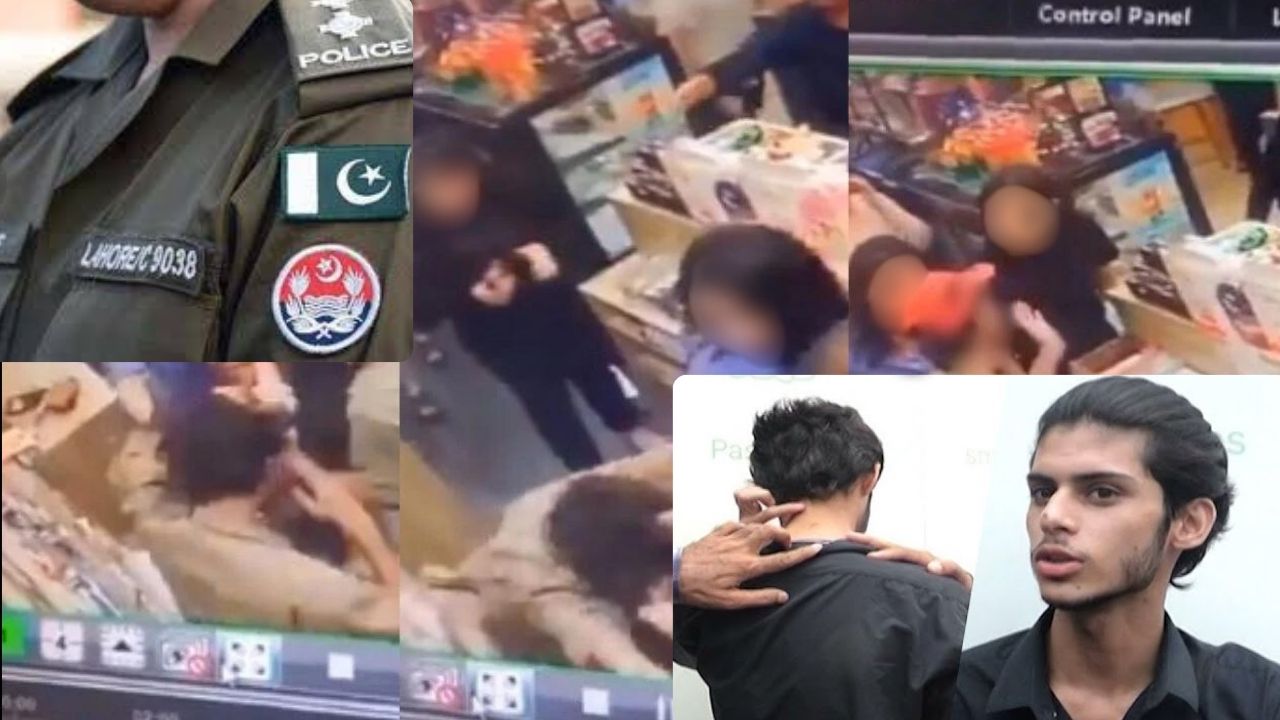
    Following the CCTV footage of three girls beating up a salesman in a shop in Lahore and the widespread criticism over the police’s handling of the alleged harassment case, local police are now actively finding out what happened.

    In the viral video, the girls appear to have initiated the assault, with the boy at the receiving end of their blows. However, it was reported that the salesman was arrested on allegations of harassment posed by the girls. This instigated a debate on social media where netizens demanded the arrest of the girls for allegedly using the “woman card.”

    THE POLICE VERSION

    DIG Lahore Operations Faisal Kamran, while talking to Dawn, said the CCTV footage was presented in court by the boys in their defence, led to the case being dismissed.

    The DIG also stated that the police approached the young man to file a complaint against the girls, if they wish to proceed with legal action.

    The Current talked to the Superintendent of Police (SP), Dr. Ayaz, who stated that women’s harassment laws require an immediate response from the police. He said the police responded to the complaint filed by the girls, took the boys to the police station, and booked them instantly. “It was the honourable court’s decision to decide the case,” he stressed. “The police is committed to performing their duties, and as per law, we have a time of 14 days according to which we are conducting our investigation,” he added.

    SP Ayaz confirmed that the medical checkup of both the girl and boy has been done, and all aspects of the case are being investigated, including the harassment and assault allegations. This particular case is registered under Article 509-1 and will proceed under charges of ‘insulting modesty or causing sexual harassment’, Ayaz informed.

    Addressing social media speculation about the girl being the daughter of a lawyer, DIG Kamran clarified that the girl’s mother informed the police that her husband had passed away.

    THE GIRLS

    One of the three girls, on condition of anonymity, talked to The Current and explained how she, along with her friends, went to the shop to have coffee and do some shopping. According to her, she was chitchatting with her friends when the salesman started passing lewd comments about them, asking the girls if they were on “night duty,” implying that they were prostitutes. The comments enraged her friend who told him to behave and as the situation escalated, they first got into a verbal brawl with two boys which eventually took the form of a physical fight. She claimed that they hurled curses at them and pulled the hair of the boy. He also struck a girl, causing her nose to bleed and tore her shirt.

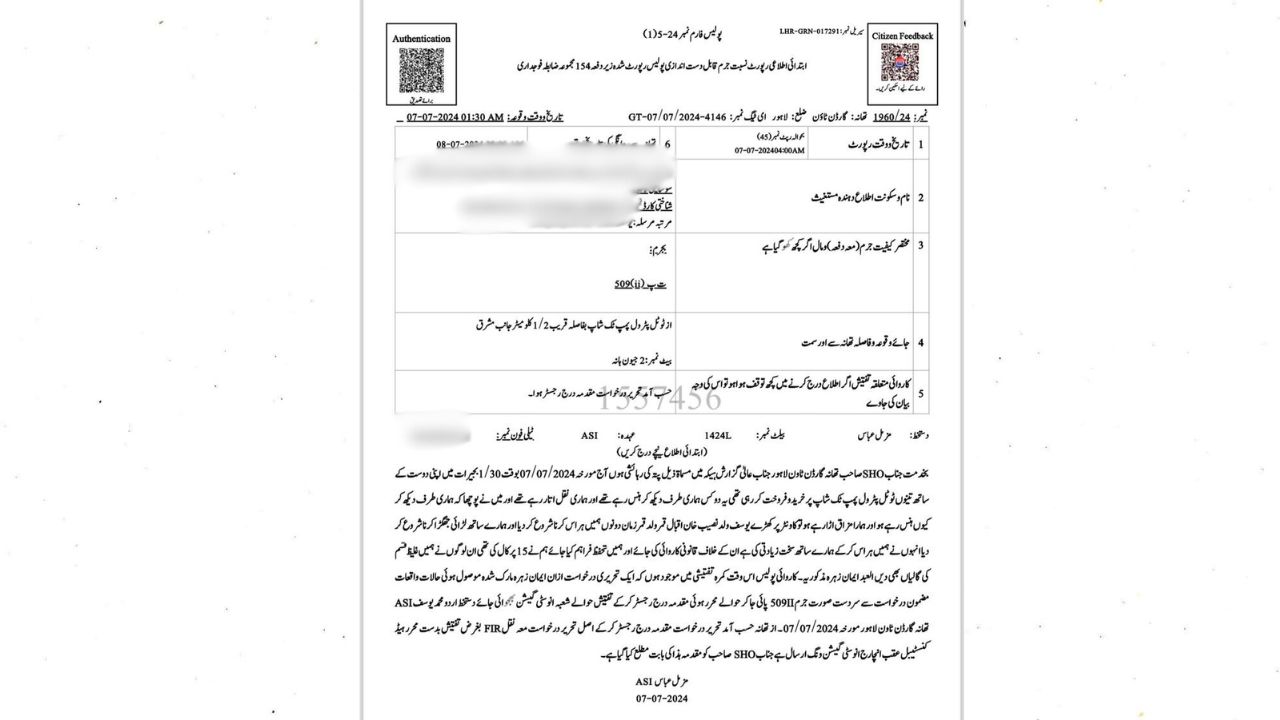
    She said that they stayed there until they called the police and got the FIR registered, an official copy of which is present with The Current. The man who made their video was asked not to do so because of their vulnerable condition, but he did not comply.

    A digital copy of FIR shared by the girl.

    The girl said that at the police station, the boy apologised, and a “raazi nama” was signed. She stressed that in police custody, the shopkeeper said that the CCTV footage was not available as it was deleted. However, it surfaced on social media, two days after the incident, in what she described as an effort to defame them. In a traumatised tone, she said that they are under extreme pressure and because of her public profile on Instagram, she has gotten rape and death threats after the video went viral.

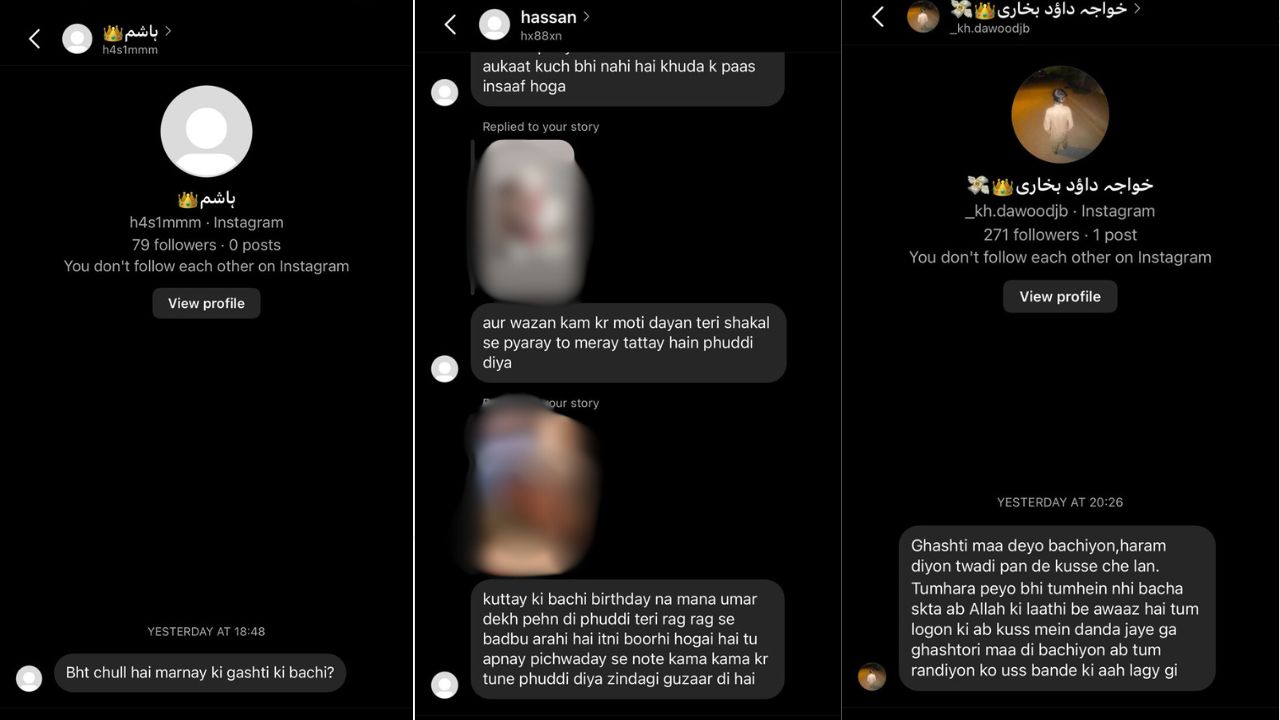
    The screenshots shared by the girl depict the threatening and abusive language used by men sliding into her DMs.

    More than once, she said that the viral video does not present the whole version and lacks the actual audio. She stressed that if the audio was released, it would support her version of the story. “I don’t understand, how can people think that it could have happened without a reason. We are not mad that we just got up and started beating someone. There was a reason, and in all honesty, we are not ashamed of it,” she shared.

    She made it a point to mention that she does not belong to an elite background but from an upper-middle-class household, and the criticism that the girls weren’t ‘dressed properly’ is sexist and violates their right to freedom of choice.

    THE GUY’S VERSION

    The viral footage showed only one boy being assaulted by the girls in the presence of the shop owner and other visitors who eventually intervened. Yasir Shami from Urdu Point was seen talking to the boy, Yousuf, who was beaten up by the girl. Yousuf vehemently denied any allegations of harassment. “I was laughing at something my colleague said, and the ladies misheard and started coming inside the counter area. I told them they couldn’t do that but she still made her way inside and started beating me,” he said. “I did defend myself as much as I could, but not much as she was a woman,” he claimed. He also denied any claim of cursing the girls.

    REPORTED NEWS

    Journalist Ahmed Faraz, while talking on the show Geo Pakistan, explained that only one FIR is registered in any case, and all elements are explored and investigated under that.

  • Punjab Ombudsman buys expensive phones worth Rs. 76 lacs, govt denies any involvement

    Punjab Ombudsman buys expensive phones worth Rs. 76 lacs, govt denies any involvement

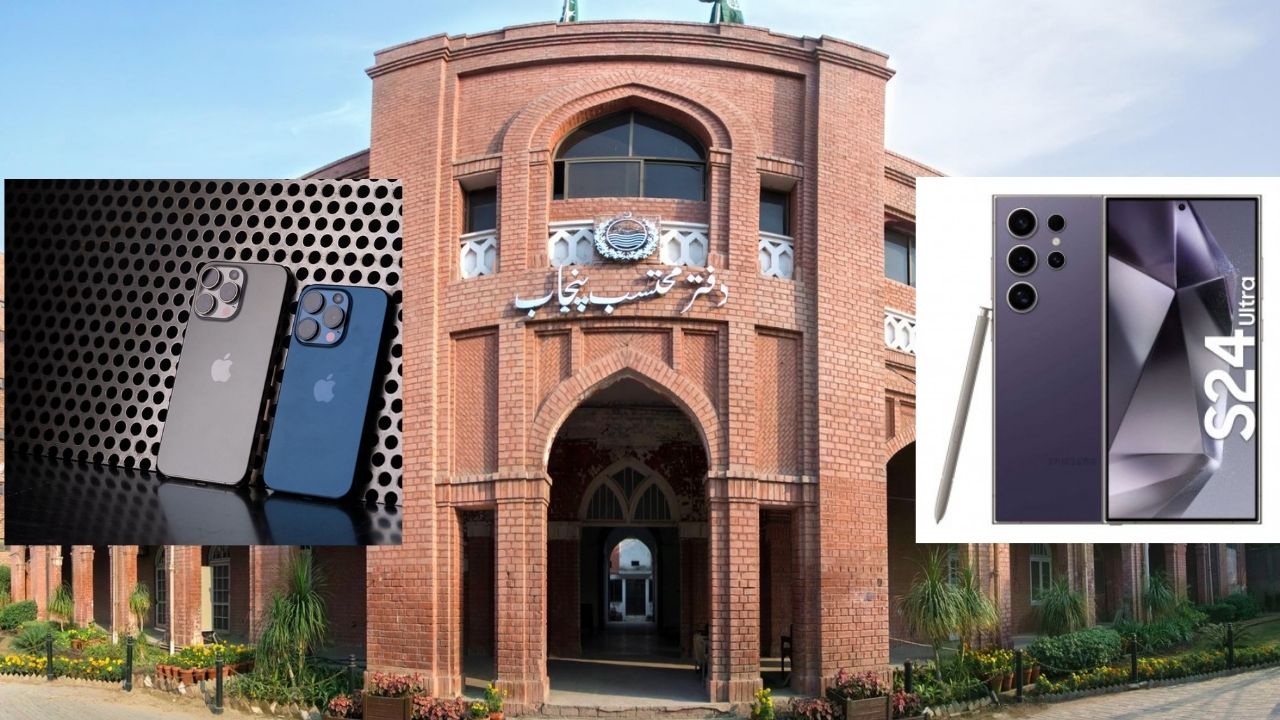
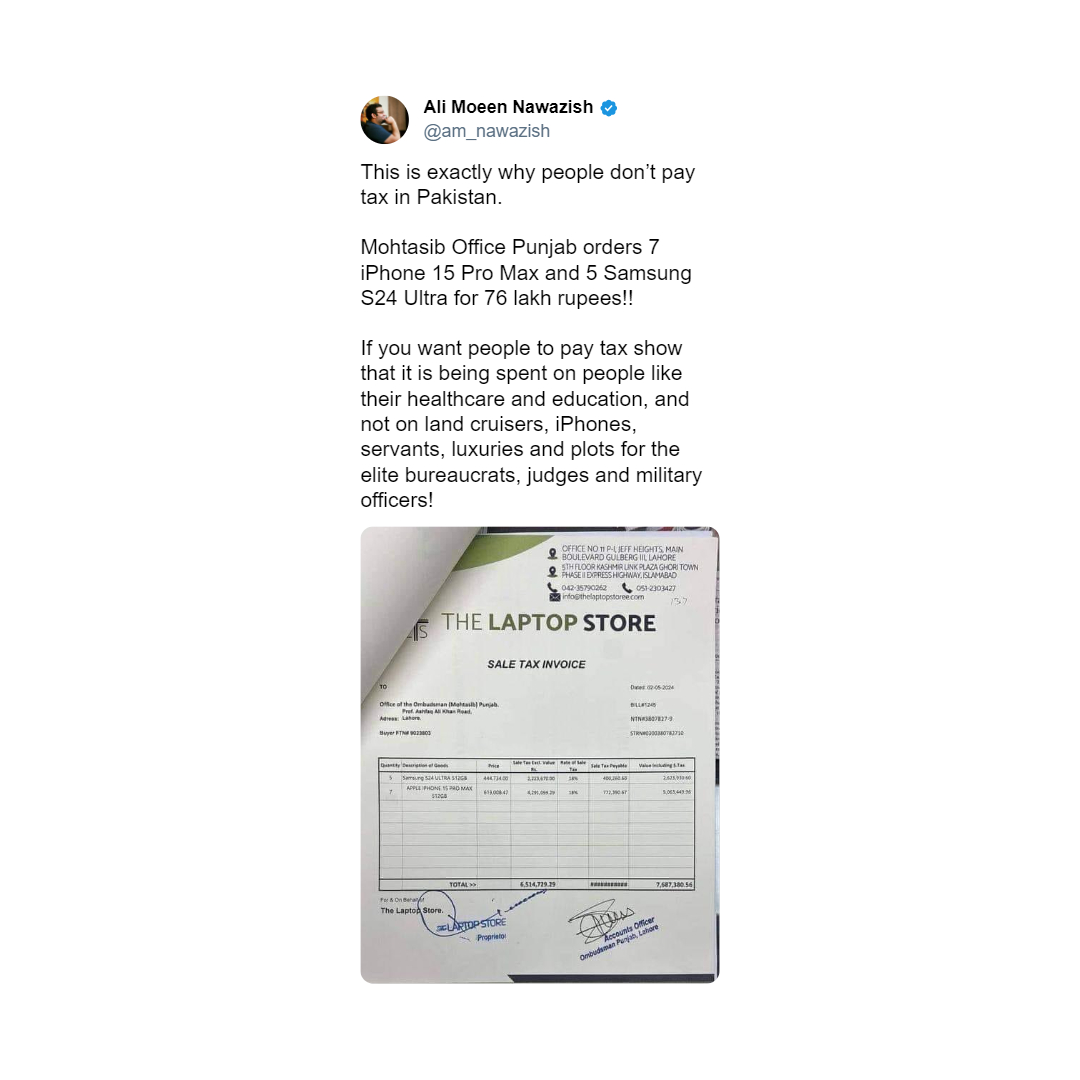
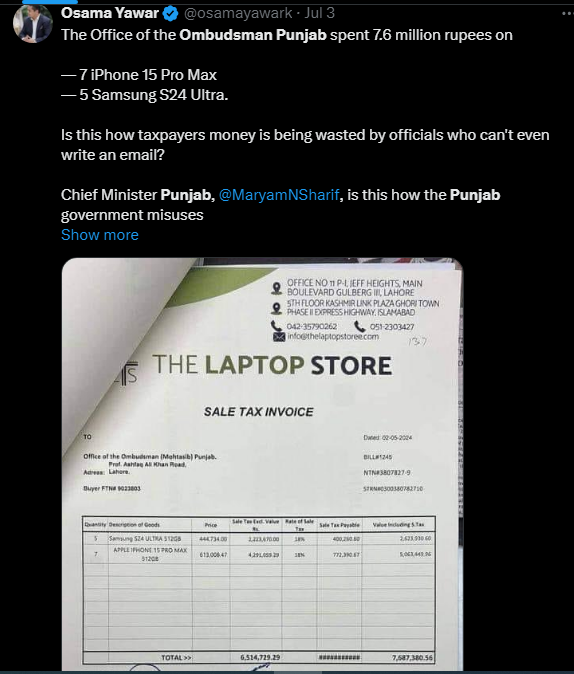
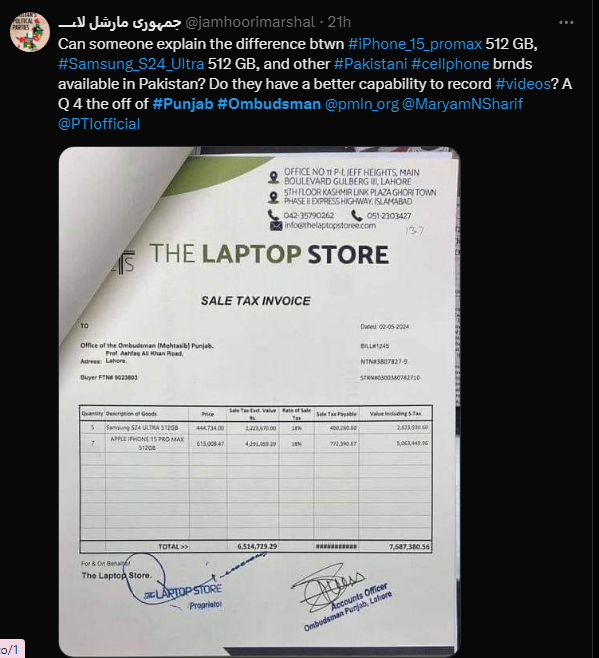
    An official notification of a “sale tax invoice” from the Punjab Ombudsman placing an order of five Samsung Galaxy S24 and seven iPhone Pro Max worth Rs. 76 lacs created a stir on social media. Netizens criticised the government for wasting money, but the government claimed otherwise.

    A number of X (formerly Twitter) users criticised the government for spending extravagantly on such accessories. Journalist and academic Ali Moeen Nwazish posted on X: “This is exactly why people don’t pay tax in Pakistan. If you want people to pay tax, show that it is being spent on people like their healthcare and education, and not on land cruisers, iPhones, servants, luxuries and plots for the elite bureaucrats, judges and military officers.”

    Another user named Osama Yawar shared the notification with the caption, “Is this how taxpayers money is being wasted by officials who can’t even write an email?”

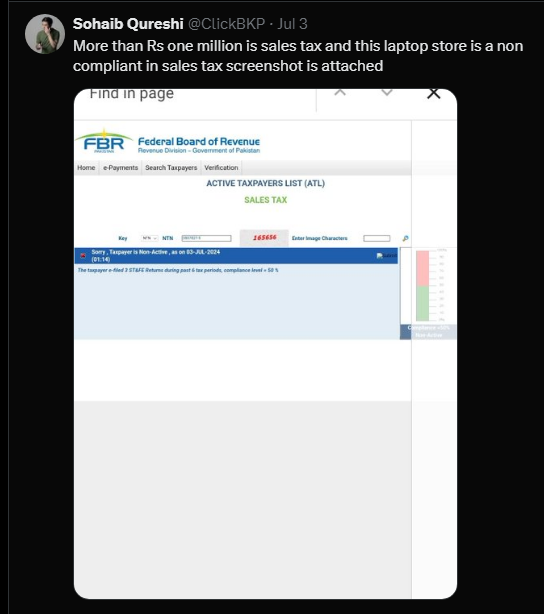
    To put more fuel to the fire, a citizen named Sohaib Qureshi, claiming to be an expert on E-Commerce, shared that the company The Laptop Store, with which the Ombudsman has placed an order, is allegedly non-filer. To prove his claim, Sohaib attached a screenshot from the FBR website where the company has no record of tax to its name. “More than one million is a sales tax but this laptop store is non compliant in sales tax,” Sohaib wrote.

    Punjab’s Information Minister Azma Bukhari told The Current that Punjab’s Ombudsman is an autonomous body and does not come under Punjab government, “It’s from an autonomous body, not by Punjab government,” she said.

    However, the Punjab Ombudsman was reluctant to respond to our request for confirmation of the viral notification. Even after multiple calls, there was no explicit answer, but an inside source revealed that this is a normal process and it seems authentic as it has the signature of the accounts officer of Punjab’s Ombudsman. The same source elaborated that the Punjab Ombudsman has its own budget and works independently. The phones are not for personal use but for official use only.


    An account titled Jmhoori Martial Law asked people to explain the difference between Iphone 15 pro max with 512 GB and Samsaung Galaxy with the same storage. “Other Pakistani brands available in Pakistan, do they have better capability to record videos?” the handle asked.

    The Ombudsman office is empowered to entertain complaints against any department commission or office of the Provincial Government or a statutory corporation or other institution established or controlled by the Provincial Government but does not include the High Court and the Courts working under the supervision of High Court and Provincial Assembly and its Secretariat, explains the official website as its primary function.

  • Review: Umr-o-Ayyar: A marriage of convenience between debilitating story-line and topnotch VFX

    Review: Umr-o-Ayyar: A marriage of convenience between debilitating story-line and topnotch VFX

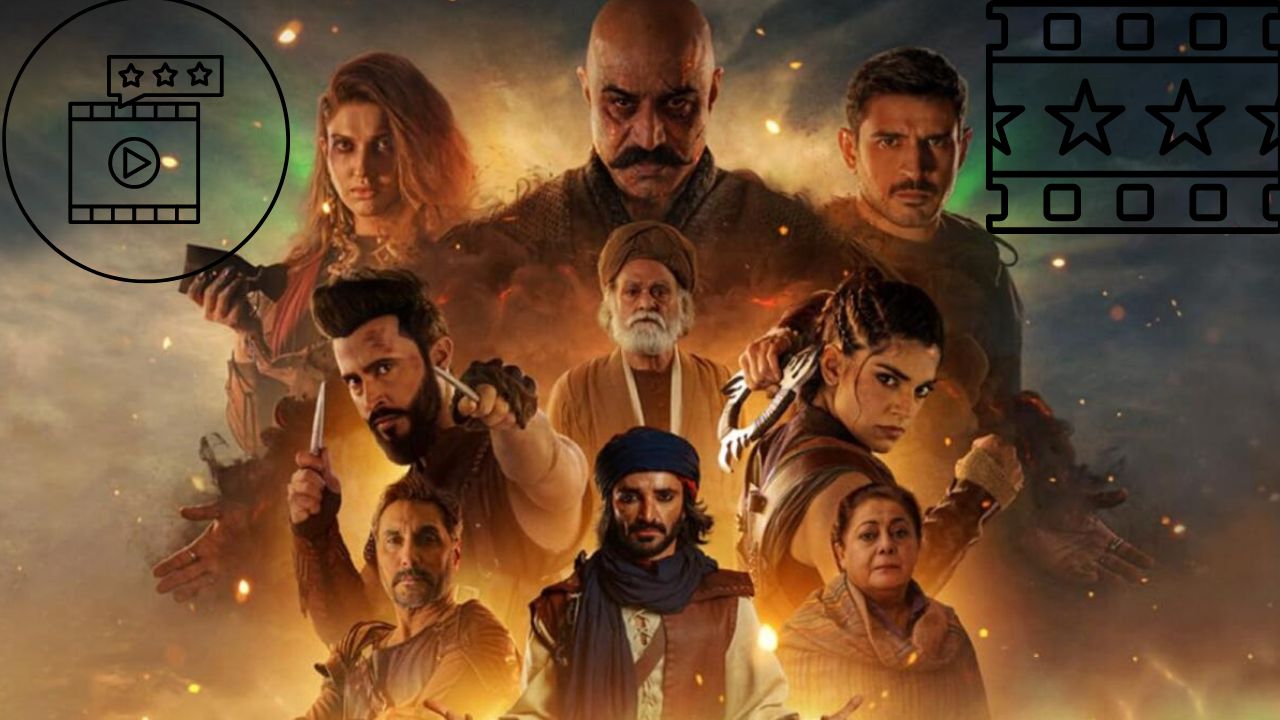
    Umr-o-Ayyar is everything I could not have imagined: badly written fanfic and a thrilling display of VFX-laden action unknown to Pakistani films.

    Invited to the premier on behalf of The Current, I recalled all I had ever known about the character of Umr-o-Ayyar. Having been an avid reader of the legendary series of Dastaan-e-Ameer-i-Hamza and Talism Hoshruba, I was a fan of the conniving, quirky character of Umr-o-Ayyar, a friend and close confidant of the protagonist, Ameer-i-Hamza, but a legend in himself. The expectations were a little too high. The reality was a bit of a downer.

    It was a marriage of convenience between the magical world of Harry Potter and the legendary period drama of Ertugrul.


    My father, a master in Arabic language and literature, always told me that the name’s correct pronunciation was Ammar-Ayyar and not Umr-o-Ayyar, as per the rules of the Arabic language. Ammar, the protagonist played by Usman Mukhtar, really marked the right box with the name, but unfortunately, that’s about it.

    His portrayal of the ‘clueless chosen one’ who remained true to character till the end made him look stupid more than likeable. Just like it was said about Harry Potter that magic still surprised him, Usman embodied the same traits, keeping his quintessential baffled expression intact whether it was his Schrodinger phase or him as an Ayyar.


    The hero’s entourage, comprised of Ali Kazmi Salman Shaukat and Sanam Saeed, did leave their mark. It was the story that let them down. Manzar Sehbai’s Guru is there to mentally prepare the chosen, pure-blood Ammar Ayyar just like Master Shifu did with Po in Kung Fu Panda, but his styling, like that of Ertugrul’s Ibn Arabi, seemed out of place in the uber-cool setting. His verbose speeches and boasting of the power to know it all led to an all too predictable ending.

    Director Azfar Jafri, known for family entertainers like Janaan and Heer Maan Ja falls short on this period cum super-hero cum action genre. Despite the fact that the two legends featuring the titular character are quite internalised in our language and culture, the movie comes across as an adaption of foreign celluloid. It has elements of Harry Potter’s pure-bloodedness, Voldemort’s black magic, inconsequential mention of physics, a motor-bike chase, Marvel’s VFX, fight sequences, and a world of supernatural elements ironically being dealt with both guns and knives. Consequently, the original plot, if there was any, got lost.


    A sign of a flawed storyline is that the movie does not reflect much on the very conflict of the plot as to why the two parties are at war with each other. Ayyars, weak enough to get possessed, riding on bikes, and combating magic with internal powers, guns, and daggers made it all funny, even funnier than the comic reliefs in the film.


    The best thing about the movie was the villains. The plot was driven by Sana’s Cheno, inspired by Bellatrix Lestrange, and Laqqa-a desi Voldemort- played by Faran Tahir. They were visibly ominous, and however flawed their dialogues were, their actions made more sense as they acted their part well. At one point in the film, Laqqa, the villain, has his first showdown with Ammar Ayyar, the hero, where the former says to the latter, “I am extremely disappointed after meeting you.” As an audience, you agree with him because such is the extent of Ammar’s incorrigibility. While it is not a well-written character, it performed even worse.


    Hamza Ali Abbasi’s styling and acting take the cake. During those five minutes of his guest appearance, you are reminded of the beauty of the original tale. His portrayal of the OG, vivacious and witty Umr-o-Ayyar, who has especially come to knock some sense in the hero, made me reminisce about the accessories he owned, such as “zanbeel,” a satchel he used to carry everywhere that contained all the things under the sun, including the jinns he had entrapped. Alas! Its a lost opportunity.


    While the storyline keeps boggling the mind, VFX in the final showdown really gives that larger-than-life experience. It deserves all the praise for being groundbreaking in Pakistani cinema. It’s the story which is the hamartia, a fatal flaw of this presumed epic of a film. The title, Umr-o-Ayyar-A New Beginning, indicates that the makers intend to make a series under the same banner. The next effort should not be as frivolous as this one.
    Overall, the movie is a good one-time watch that really lacks originality.

  • Khodâhâfez Raisi – Remembering the Iranian President live on GCU’s stage

    Khodâhâfez Raisi – Remembering the Iranian President live on GCU’s stage

    Ebrahim Raisi is no more. Newspapers and various other outlets have published countless obituaries both coming from the tainted western lens and that of religiously coloured frame. I, on the other hand, want to present an account of listening to Raisi’s speech once and was inspired by the depth of his words and the resolution in his tone.

    “If Israel violates the sovereignty of the Iranian state again, the reaction will be different and who knows the Zionist regime will not exist,” the one who said these words is now buried in a freshly dug grave in Mashhad but certainly not forgotten.

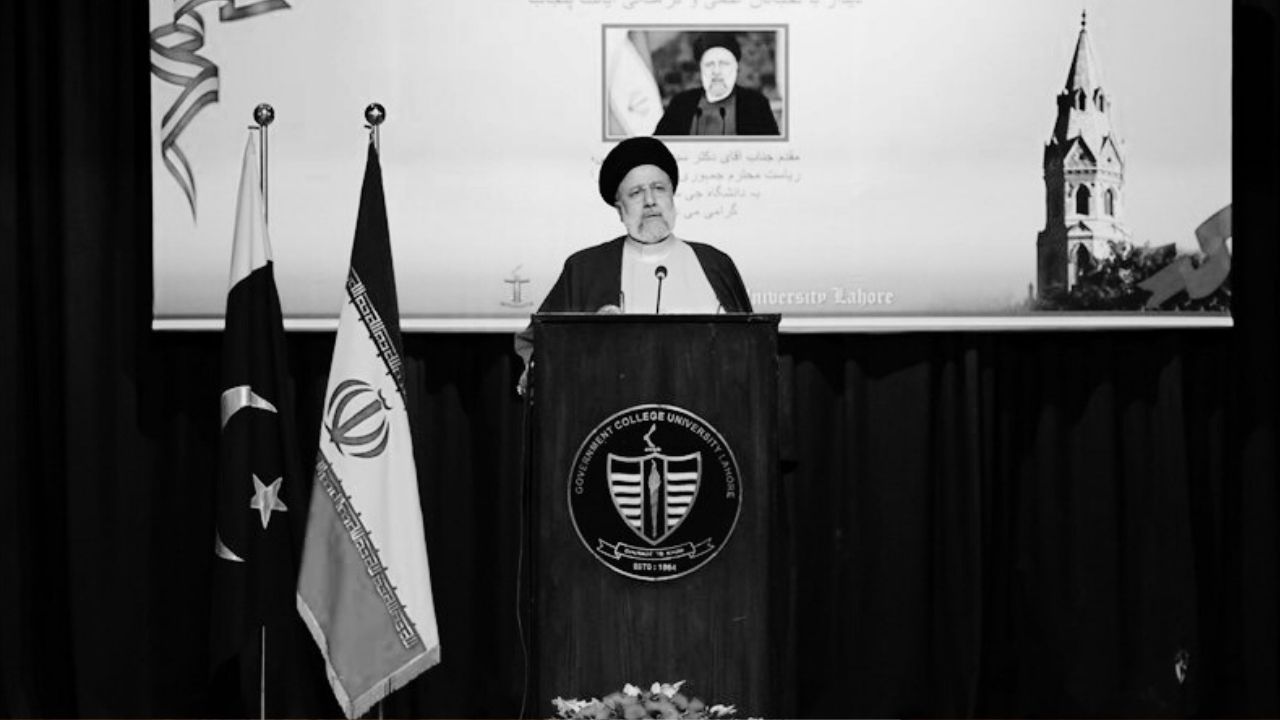
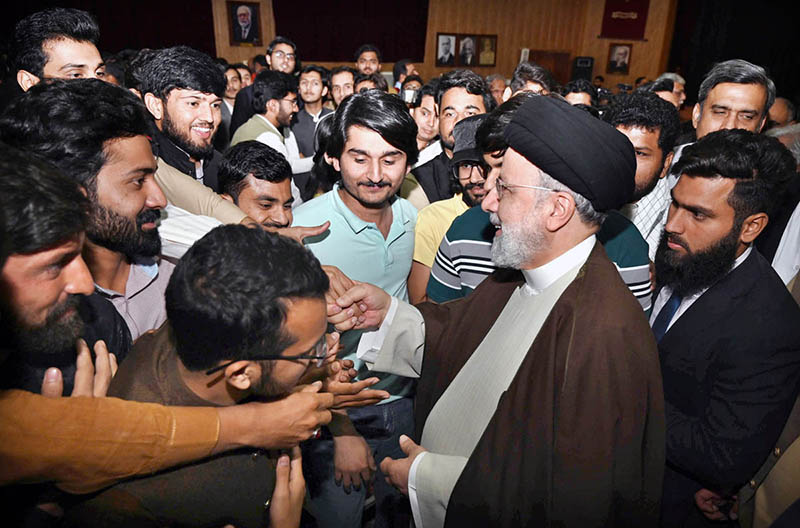
    Ebrahim Raisi (1960-2024) said these words in front of the students and teachers at Government College University Lahore, my alma mater. It was surreal, to witness a head-of-state speak in the prestigious Bukhari Auditorium. While the security and arrangements made it all very unapproachable, when he arrived it was warm and almost palpable.

    APP41-230424 LAHORE: April 23 – President of the Islamic Republic of Iran Dr. Seyyed Ebrahim Raisi shaking hand with students during his visit the Government College University (GC) Lahore. APP/MTF/MAF/TZD

    April 23 was the day I went to the university after a long time, not just to attend an esteemed ceremony but also covering it for The Current. The day was bright and because it was a public holiday in the city, I reached GCU Lahore almost gliding through the air early in the day at 8:30 am.


    A crowd of selected people, all ready to bear witness to history in the making could be seen under the gothic lady.

    Although no gadget was allowed inside, I managed to grab a pen and paper and took notes of the speech which is a piece of literature in true sense of the word. References of Iqbal’s poetry with the messages of the reawakening of youth made it worth lending an ear to.

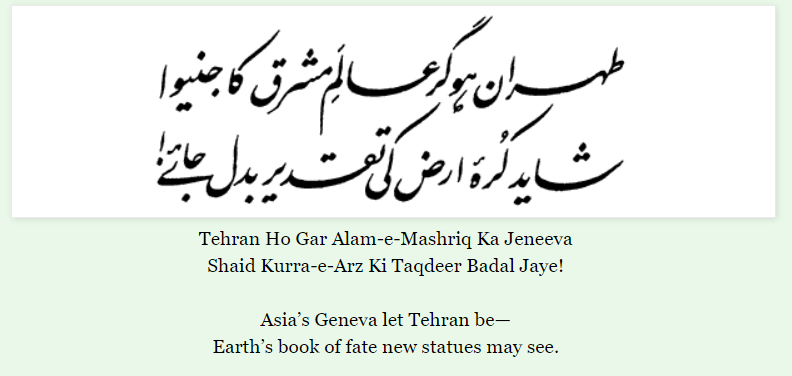
    The Vice Chancellor started her address paying tribute to the resilient power and the great potential held by the land of Persians. In Allama Iqbal’s words. “Tehran ho gar Alam e Mahriq ka Geneva, Shayed Kurra-e-Arz ki Taqdeer badal jaye.” The verse implies that if Tehran becomes the Geneva of the East, the fate of the world will surely change.

    It turned out that Iranian President Raisi was not just fully familiar with the work of our national poet but remembered him as Iqbal Lahori for his work in Persian. He was pleased to be present in the institution where Iqbal studied and taught; and to be in Lahore, the city from where the revolution against oppressive colonial rule started.

    While he stressed about the hybridization of knowledge and faith as the key to success in life, he stressed on Iqbal being the best example as someone who combined both excellently. As he moved on, like an expert orator, he felt the pulse of the audience and drew a comparison between the East and West. We believe the people of the East are higher than that of the West because of how they understand the “creation of knowledge”, Raisi quoted the Supreme Leader of Iran, Ayatollah Ali Khamenei.

    He laid out his vision by saying, “The West is somehow trying to have a monopoly in the field of knowledge and Science, but we the people of East can change that.” He emphasised the role of universities in imparting a deeper understanding of the current situation and the pivotal role of faith along with seeking knowledge.

    He substantiated his argument by pointing out how the West claims to have championed freedom of speech and human rights but the brutal ways with which University students setting up protests and encampments in Europe and America against Israeli occupation of Gaza are dealt with is a testimony to the innate contradiction between the claim and the practice.

    “Today the liberation of Palestine is not just an issue of the Islamic world but of the world as well,” he said in a passionate tone and with this the audience was totally invested and they were applauding him even before the interpreter translated his words. Raisi predicted that hate is brewing in the hearts of people against United States and this Zionist regime in Palestinian territory and this will take revenge from them.

    We are usually so used to of seeing leaders just chanting out popular things and hardly something literary Raisi gave the audience a minor jolt as he quoted 12th-century Muslim philosopher Ibn Arabi precisely from the text Fusus ul Hikam where he brought up the killing of children by Pharaoh only to prevent the birth of Prophet Moses. However, Allah was with Moses. Meanwhile, the nation of Moses was being created. He said that the same will be translated with Israel killing Palestinian children relentlessly.

    He spoke like a warrior, someone who has stayed resilient in the worst of pressure. “If you stand against our nation, we will stand against yours”, Raisi said affirmatively. As he moved towards the end he put an emphasis on the support of Palestine as the common point of relation between Pakistan and Iran.

    Coming full circle, Raisi left his mark with his final words which I quoted in the beginning. There are problems and issues of governance in every state of the world but what stands out is the resilience and the will to face opposition with head held high. With his words, Raisi inspired students to stand tall in the worst of situations and stand on the right side of history. The memory will forever be etched in my mind.

  • World Bank withdraws from Mauripur road citing light pollution; Sindh govt insists on keeping artificial lights

    World Bank withdraws from Mauripur road citing light pollution; Sindh govt insists on keeping artificial lights

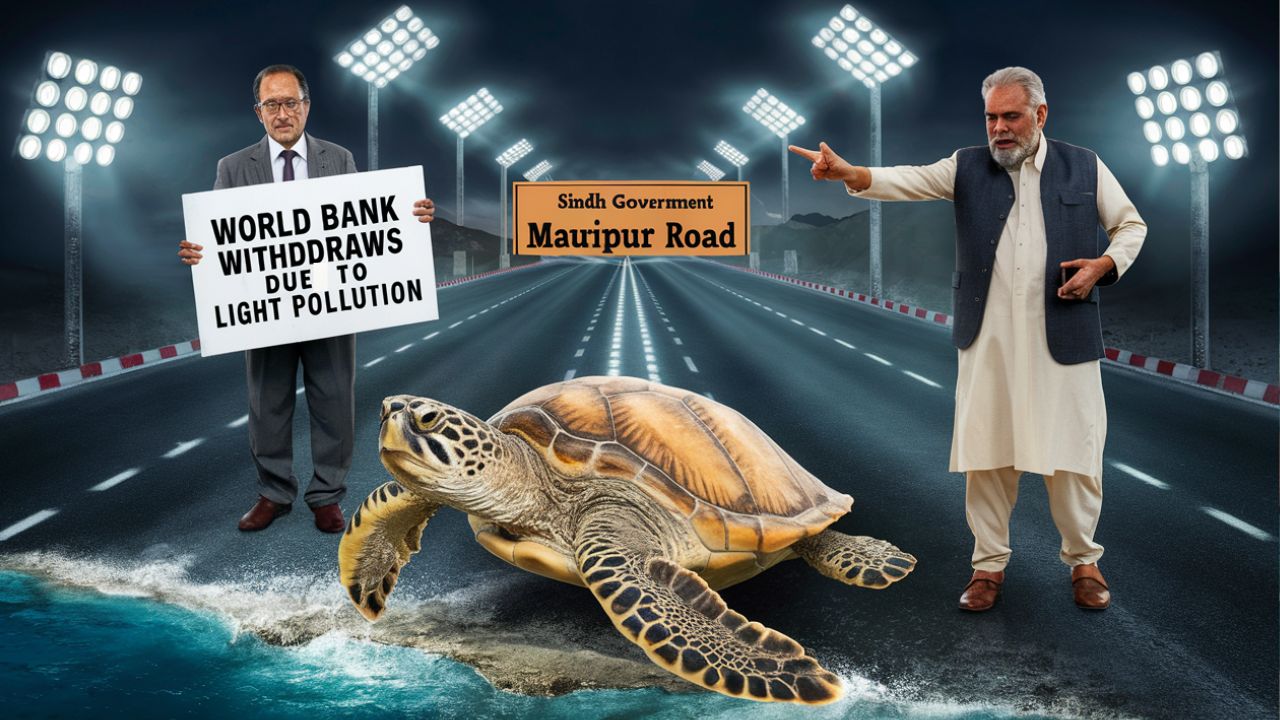
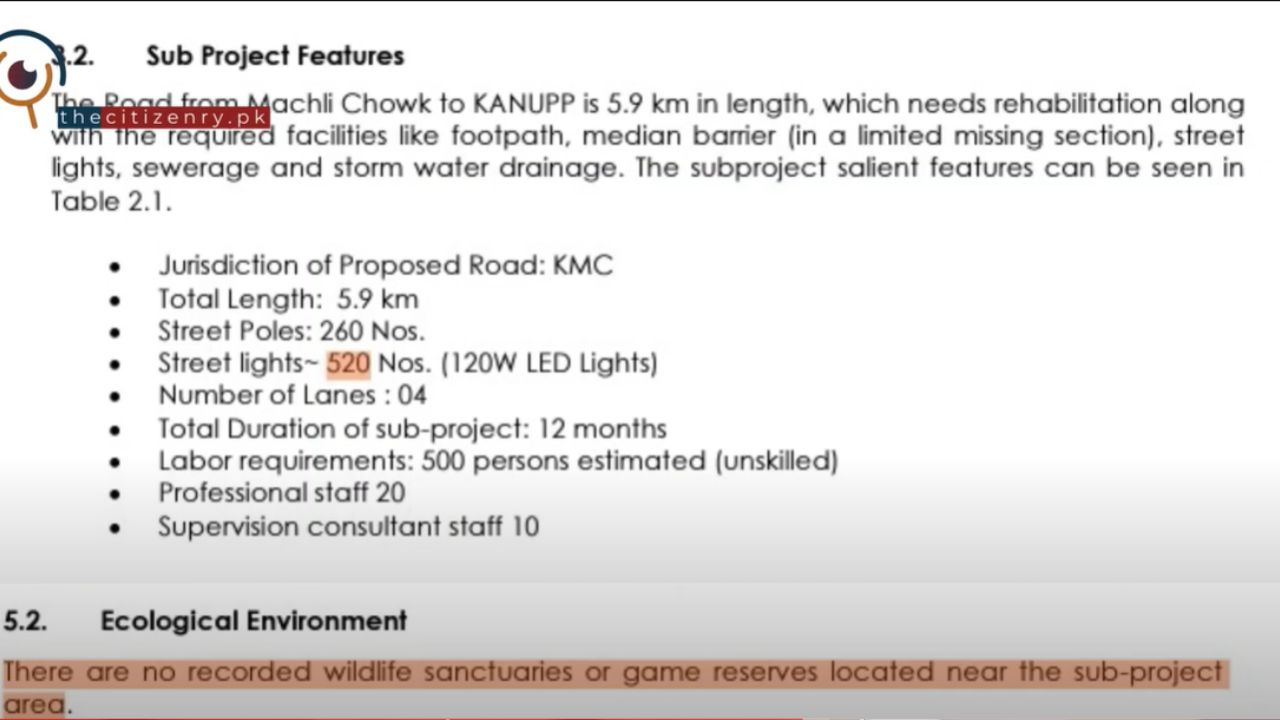
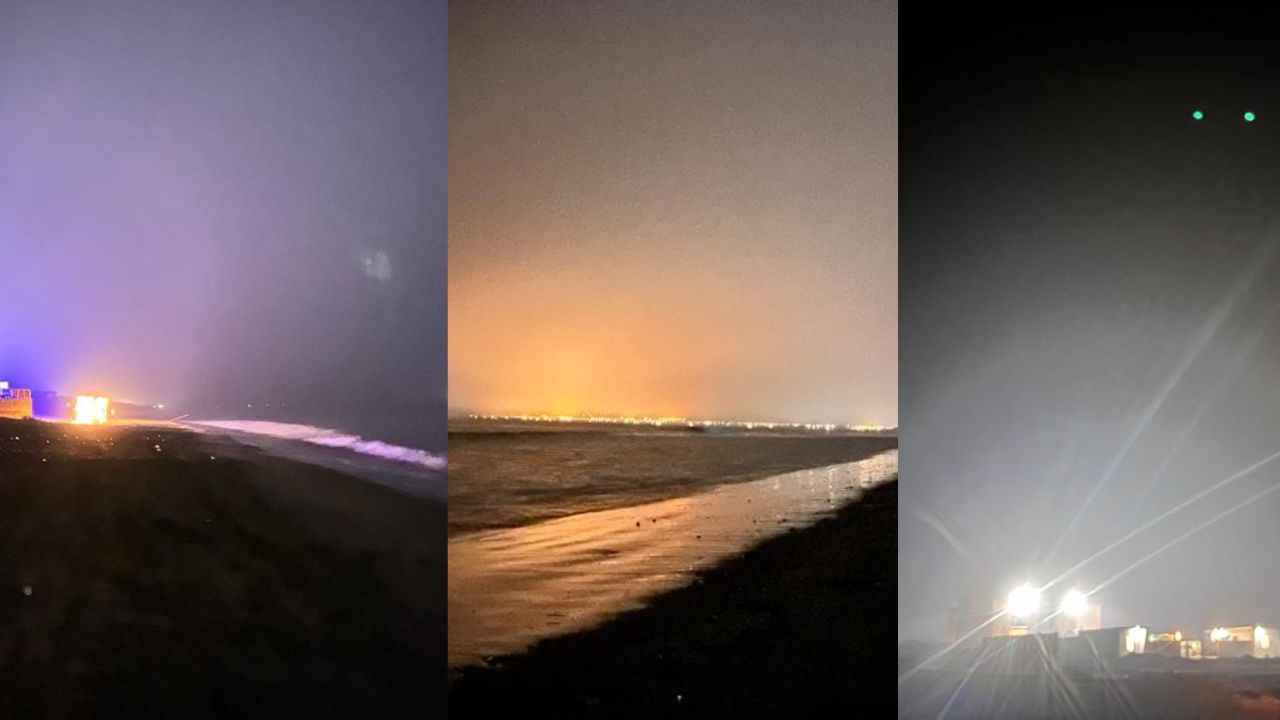
    The World Bank has decided to pull funding from the second phase of 5.9 kilometre Mauripur Road, which is part of the Competitive and Livable City of Karachi (CLICK) project. A total of 520 harsh white LED lights installed at the road have become the bone of contention after it was noted that they were disturbing the hatching season of turtles coming to the marine beach to lay eggs.

    The lights in the city of lights are surprisingly proving to be hazardous for the endangered species which visit the city to ensure their sustenance and enhance their population. Journalist Oonib Azam working for The Citizenry.pk has formulated a detailed report about the installation of the white lights as part of the rehabilitation program of the Mauripur road from Machli Chowk to the Karachi Nuclear Power Plant (KANUPP). He not just did the research but also played an instrumental role in convincing this Bretton Woods institution to rethink about their investment in this particular area.

    Background of CLICK

    CLICK is a development project by the World Bank to improve “urban management, service delivery and the business environment of Karachi.” Four components of the project involve capacity building of Local Councils and granting them performance-based grants, modernizing urban Property Tax administration, improvement in city competitiveness, and building capacity of local government regarding the technical assistance for solid waste management. The total project cost is a hefty 240 million dollars and it spans over 30 districts of Sindh, six divisions, 25 town municipal corporations, and 209 Karachi UCs.

    Detrimental artificial lights for the turtles

    Sindh Wild Life Department told Oonib that repelled by Artificial Light at Night (ALAN) in the last season, an estimated 250 female turtles turned back to the sea without laying eggs. The same artificial lights disorientate young hatchlings and they get crushed under cars or are eaten up by stray dogs.

    “A female turtle travels all the way to Australian beaches and returns to Karachi’s coast, to lay its eggs at the same coordinates where she layed eggs the last time. This shows how sensitive turtles are to their natural environment,” Oonib quotes a report by Dr. Umair bin Zamir.

    Mauripur road project

    Oonib explained to The Current how his research about the sanctuaries lead to awareness of turtles’ sensitivity to harsh white light. People attending picnics disrupted the whole process with torch lights just for the adventure. Huts in the surrounding areas put up huge flashlights and third and most glaringly, lamppost lights installed on the roadside in the neighbourhood.

    Mauripur road project is a sub-project of the World Bank’s CLICK project which costs 840 million rupees. Because it was a Category B project it required Karachi Metropolitan Corporation (KMC) to submit an Environmental and Social Management Plan (ESMP) to the World Bank. The Citizenry report lays out how the KMC blatantly missed out on the turtle sanctuaries. It also stresses that turtles were a common sight in the area since the project is surrounded by beaches.

    It was in sheer contrast with the World Bank’s policy (Environment Management Framework) of explicitly protecting the environment while ensuring a sustainable poverty reduction and development of societies at the same time.

    Here, Oonib contacted the World Bank via Abedalrazq F. Khalil, manager of Uraban Development, Resilience and Land Practice for the South Asian region and shared all the intel he gathered in his research. It was revealed in that email exchange that World Bank was told that the road was about 5-8 kilometres away from the turtle hatching site. In a video report by The Citizenry, Oonib and Hunain Ameen discussed how Sanspit beach, Turtle Beach and Hawksbay Beach are in a row some kilometres apart as per Sindh Wildlife department’s maps.

    It is important to mention that the 520 street lights are actually installed on a road the road from Machli Chowk to KANUUP Road runs parallel to Hawksbay Beach at a few 100-meter distances.

    The Current has gone through the email exchanges between the Bank’s representative and journalist Oonib Azam and it is apparent that the Bretton Wood body was not entirely aware of the possible repercussions of proceeding with the project but after concerns were raised it was concluded that it will not move forward with the second phase.


    “Light shielding and use of red lights is being considered by the PIU [Program Implementation Unit] as one of the mitigation measures. After consulting with relevant expert, we would have the CLICK PIU implement them,” Abedalrazq asserted.

    As he was asked by the journalist about the operation policy of the World Bank regarding critical habitats being triggered for this project only or for the entire project, the respondent answered, “when CLICK was prepared, impacts on natural habitat were not envisaged and hence the Operational Policy 4.04 was not triggered. If a certain policy is triggered during preparation or implementation, it applies to the entire project.”

    Current status of the project

    Unsurprisingly, the World Bank has pulled funding for the Mauripur project. As a result, local authorities are being directed to implement mitigation measures proposed by the Sindh Wildlife Marine Turtle Conservation. They have proposed the replacement of bright white lights by red lights. Ironically, the email exchange reveals that the PIU office in Karachi plans to cover the lights with a cellophane which can change the white colour to red. As this solution is not durable, the journalist requested Bank authorities to intervene who then asked authorities to change the lights to amber LEDs rather than covering them with a cellophane shield.

    The Current asked Oonib about the current status of the project and he described it to be in a lull. “The current status is that city authorities are not ready to change the lights to amber/red as recommended by the World Bank”.

    We reached out to Murtaza Wahab multiple times for his perspective on the issue and also the spokesperson of the KMC, Ali Hassan Sajid, yet there was no response from them. While Murtaza committed to responding to it at first, he later did not.

    Sindh Wildlife Authority maintains that the lights installed on the nearby hotels and huts are more hazardous for the marine life especially turtles compared to the streetlights but it cannot be denied that these lights of 120 watts are inflicting perils on these turtles to a great extent as well.

    Climate change is hitting home. Humans have been the perpetrators of the suffering of other creatures and it is time we actually employ durable techniques which can prove to be a relief for the ecosystem rather than being a pain in the name of development.

  • COMSATS director accused of domestic abuse by wife

    COMSATS director accused of domestic abuse by wife

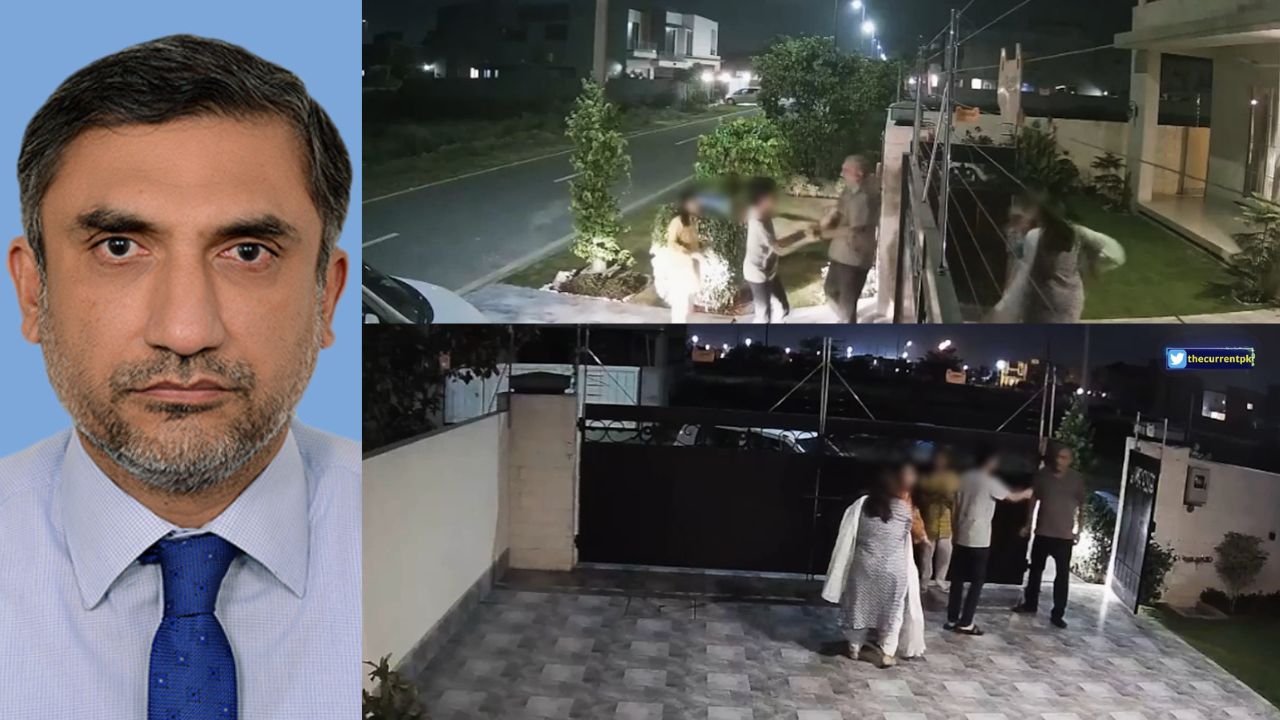
    COMSATS director Dr. Syed Asad Hussain has been accused by his wife of subjecting her to abuse in front of their children.

    CCTV footage available with The Current shows that Asad Hussain, in a fit of fury, pushed his wife. Eventually, their children came out and tried to shield their mother. While the professor did not hold back, the children made an effort to bring the mother inside and expel their father from the gate.

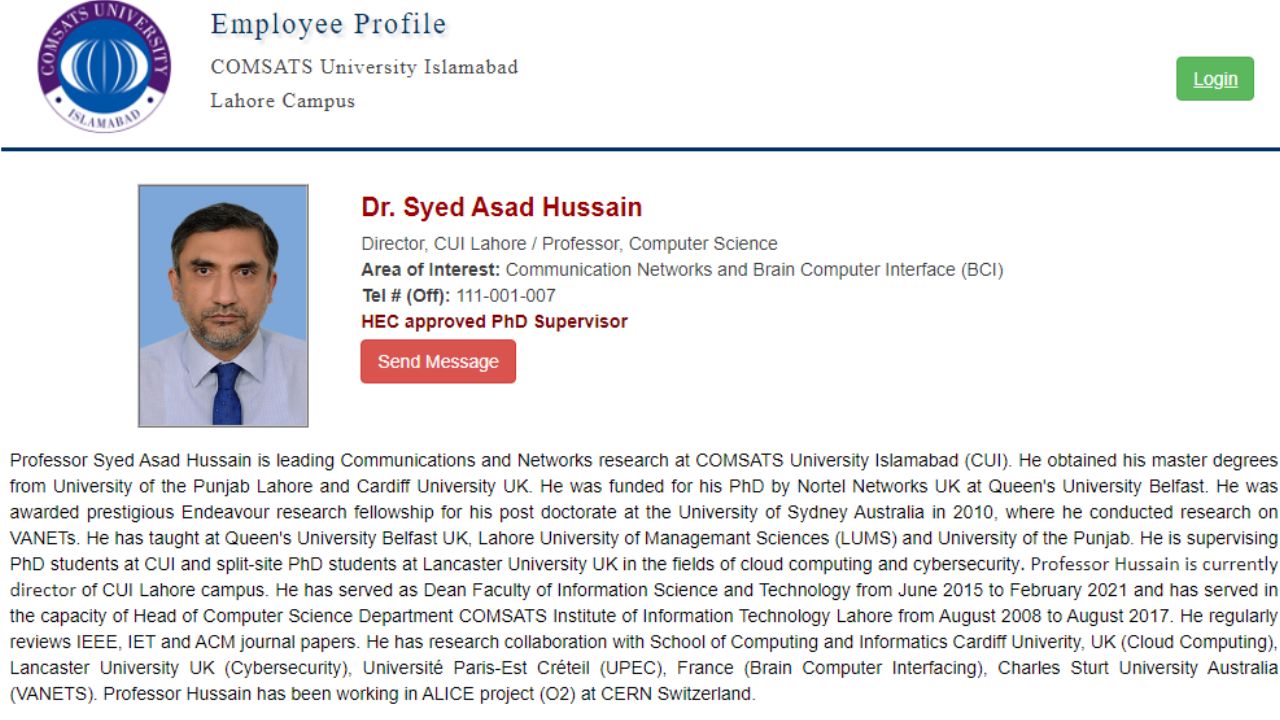
    COMSATS website explains that Dr. Asad Hussain is the Director, having studied at Cardiff University and postgraduate University of Sydney Australia in 2010.

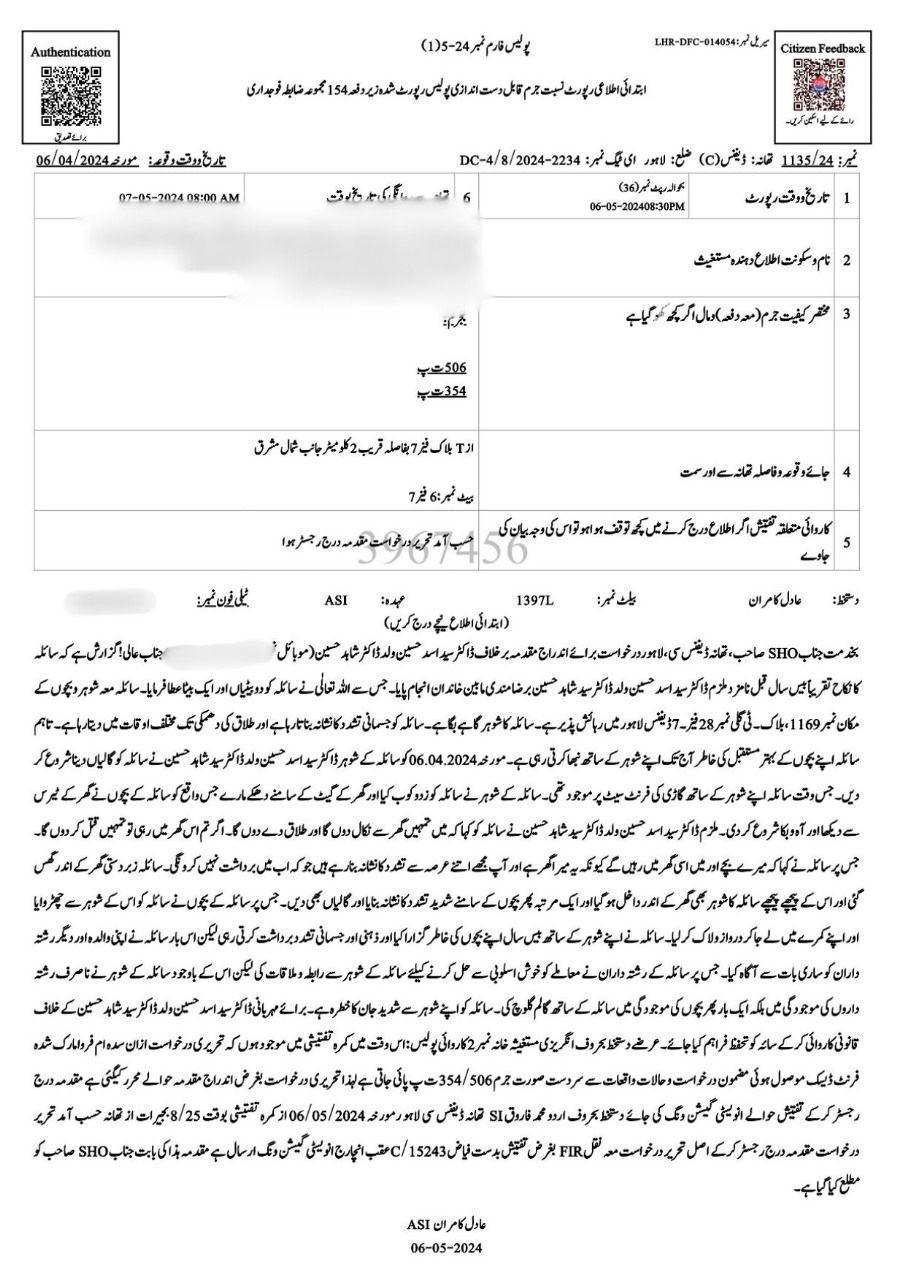
    In the First Investigation Report (FIR) registered with the police of an upscale housing society in Lahore, the victim states that in 20 years of marriage, her husband has allegedly physically abused her multiple times and has threatened her with divorce. However, she kept silent because of her three children.

    On April 3, the husband started cursing her in front of the front gate of the house and pushed her in the car which the children witnessed from the terrace and rushed to help their mother. He again threatened to kick her out of the house or kill her. The children and victim took a stand and told him that the house is theirs. They eventually push him out of the main gate.

    FIR states that while the children and mother tried to reconcile, Dr. Asad misbehaved and hurled abuses at them in front of the extended family. Thus, the victim requested the police to provide her with security as this has put her life at risk.

    The Current has confirmed with ASI Adil Kamran of the police station where the FIR was registered yet no action has taken place till the time the story is being published.

  • ‘Mein aapki har bat sunon ga, taqreeban manon ga’, says Chairman Avicenna

    ‘Mein aapki har bat sunon ga, taqreeban manon ga’, says Chairman Avicenna

    The controversy of Avicenna Medical College where the students had levelled serious allegations against the chairman and college administration has taken a turn as the Principal cum Chairman Abdul Waheed Sheikh has agreed to the demands of the students.

    Background

    The matter of the medical college being a torture cell has been in the news ever since 2018 when The Express Tribune reported a viral video of a man destroying the cell phones of the students and the college turning into a prison for the young learners. As recently as two days ago (April 28), following the news of a student Mahnoor Nadeem allegedly committing suicide because of the strict policies of the college while it was claimed she died of a heart attack, the matter was all over social media. Netizens expressed concerns over the claims of torture, heavy fines, and verbal abuse and so it got the momentum.

    Read More: Torture, verbal abuse, heavy fines; shocking revelations about Avicenna Medical College

    Students Protest

    Yesterday (Monday) students and parents launched a protest against the torturous policies of the college and as it got media attention, chairman Sheikh came out to address the protesting students who kept on chanting, “We want Justice”.

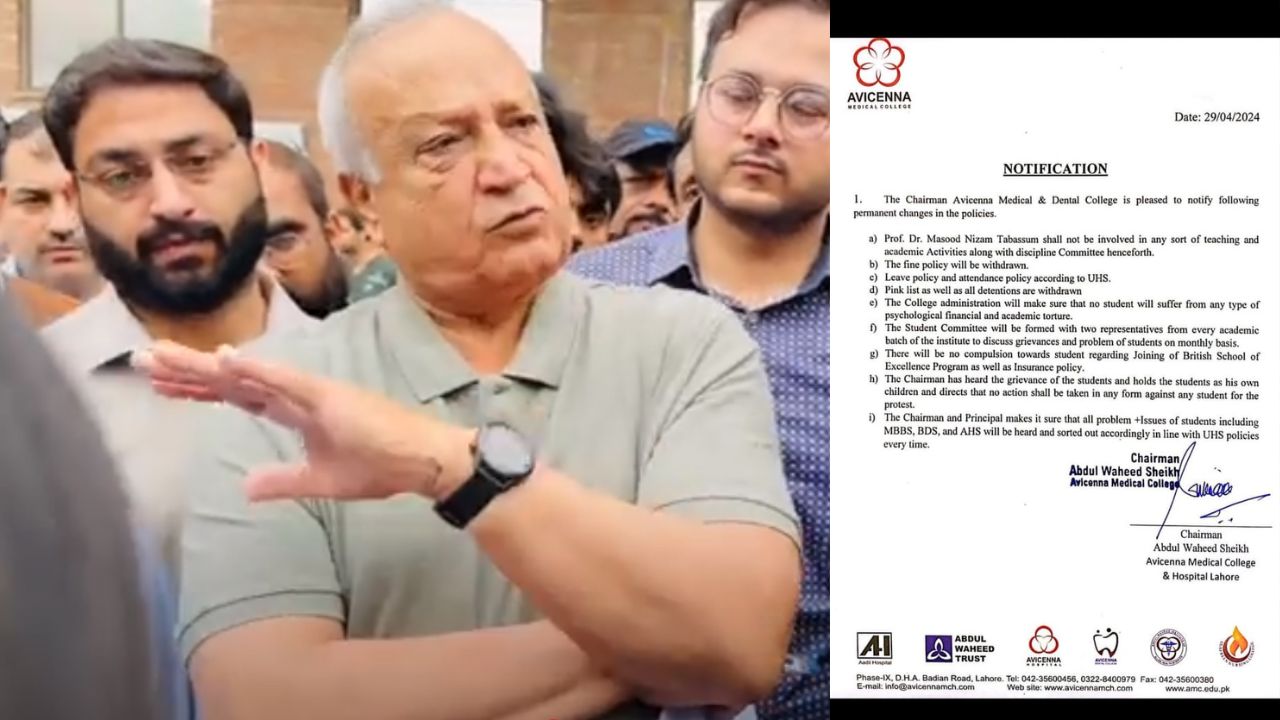
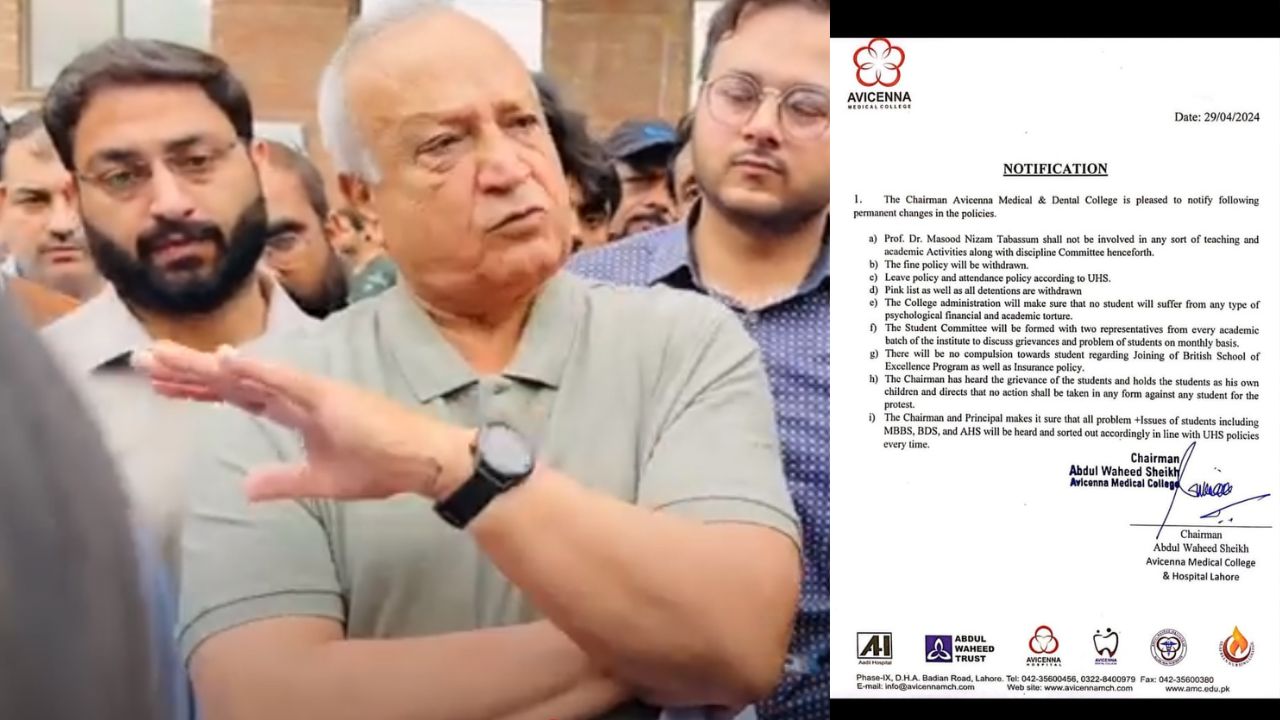
    He assured them of compensation for the grievances of the past. He started off by saying that “I will be more sympathetic in the future”. Moreover, he said, “Mein apki har bat sunon ga, taqreeban manon ga” which can be translated as, “I will listen to you and will almost accept everything as well.” Later, while addressing the crowd, Sheikh announced that the “pink list” policy of punishing students will be terminated. Additionally, there shall be no fines in the future and the policy of issuing a leave will be in accordance with the monitoring body of UHS (University of Health Sciences). He promised the students that no action would be taken against those who are protesting.

    In a video released by students on YouTube channel Digital Diary 7127, it can be seen how the fine policy and the clause of action against the students was deliberated with the Chairman and then he finally agrees to it.

    Professor M.N Tabassum, who was allegedly fired from King Edward Medical University on allegations of sexual harassment, will not be involved in any sort of teaching and academic activities along with the discipline committee.

    The Current got a hold of the exclusive footage of the Chairman talking to the media where the reporter asks him about being known for using abusive language with female students, but he denies it altogether. When he is asked about physical torture and viral videos he said, “It used to happen in the past, probably before 2015 but it does not happen anymore.” The students behind the camera can be heard saying, “Woh mukar gaya hai” meaning “He has backtracked.”

    Response of the students

    The same student who shared the video with The Current on the condition of confidentiality explained how fellow students are reacting to it. Do you think the matter is resolved now, The Current asked. “For now, yes, but in the long run, I don’t know. Because the thing that has been going on for so long and on such big scale… it can’t be resolved just like this.”


    “According to many students we might have gotten this off our backs but we will still face the consequences,” the student expressed concern.

    She also alleged how the administration is making crores of rupees with fines and exempting them will be a huge loss for them which is highly unlikely for them to let go of.

    Social media reactions

    Netizens reacted to the video in which the Chairman is pledging to address the students’ demand. Hmad Nawaz wrote, “Concern after being exposed is always hollow.” She urged the people in authority who can even remotely help with “the cause to initiate a governmental inquiry into Avicenna Medical College’s torture story.”

    As the whole protest ended with the students praying for the dead student, Mahnoor Nadeem, Dr Ahmad Rehan Khan on Twitter asked for the end of the mistreatment of the students by the college and “hold perpetrators responsible” before moving forward.

  • Torture, verbal abuse, heavy fines; shocking revelations about Avicenna Medical College

    Torture, verbal abuse, heavy fines; shocking revelations about Avicenna Medical College

    Following the death of a student at Avicenna Medical College and after scores of shocking stories of fellow students are being shared by netizens, the Pakistan Medical and Dental Council (PMDC) is taking notice of the death of the student and launching an investigation.

    The monitoring body of medical colleges, University of Health Sciences (UHS) has taken up the serious complaints of students regarding alleged heavy fines, harassment, torture and physical punishments. It has directed all the affiliated public and private sector medical colleges of Punjab to establish ‘Students Counselling Cells’ (SCCs). The cells must have senior faculty members, including teachers from the psychiatry departments, besides the students themselves to address the issues of alleged harassment of any kind and other such complaints. It declared the setting up of cells mandatory to prevent reported incidents like the one that recently surfaced at the Avicenna Medical College in Lahore.

    The decision was made in a meeting chaired by UHS Vice Chancellor Prof Dr Ahsan Waheed Rathore, exclusively called after the death of a female student, Mahnoor Nadeem, of the Avicenna Medical College, followed by a protest by its students.

    “It is our duty to ensure the holistic well-being of our students, particularly in light of the demanding nature of professional education in the medical and dental fields,” reads a letter issued by the Vice Chancellor to all the 12 public and 44 private medical institutes of Punjab. The letter was addressed to the principals of the medical colleges.

    Answer within 72 hours

    Additionally, the Avicenna Medical College has been directed to give its point of view within 72 hours so that ‘responsibility can be ascertained’.

    “The PMDC, as the apex regulatory body for medical and dental education in Pakistan, is deeply saddened by the loss of a promising medical student and extends its heartfelt condolences to the family and loved ones affected by this unfortunate incident,” the statement read.

    PMDC President Prof Dr Rizwan Taj stated, “We are deeply concerned about the circumstances leading to the untimely demise of a medical student and are committed to ensuring that justice is served. The welfare and well-being of students are of paramount importance to us, and any form of misconduct or mistreatment will not be tolerated.”

    He also added that the deceased student’s family will be welcomed to reach out to the council to file the complaint.reported Dawn.

    What happened at Avicenna?

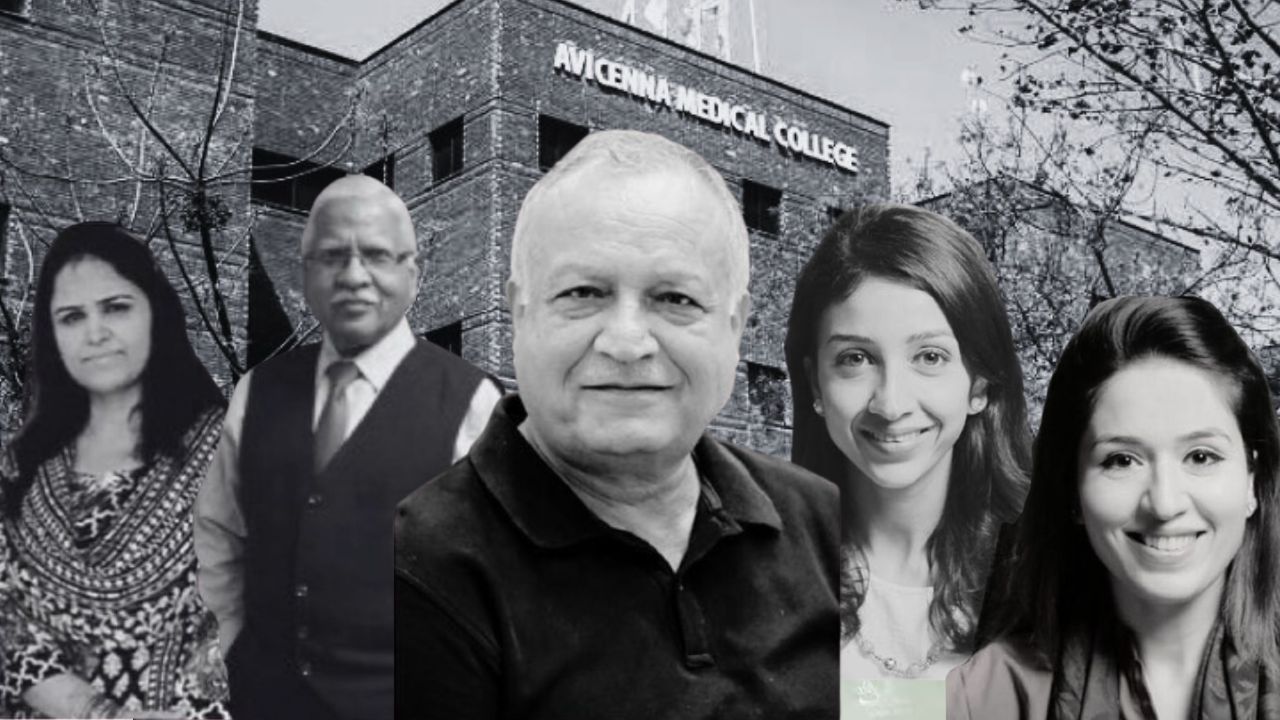
    An Instagram handle ‘thenewspaper.pk’ shared a report slider detailing the alleged abuse students at Avicenna Medical College had to face by the management of the college. The slider was titled, “Avicenna Takes Another Life: Student found dead”. It laid out how the chairman, Abdul Waheed Sheikh, along with his daughters — both at key positions of the administration — are allegedly ‘abusing students mentally and financially’.

    The imposition of heavy fines

    The report detailed that heavy fines are allegedly imposed on students, as much as Rs60,000. Students are also not allowed to take any days off. Quoting the statement of a student in the slider, allegedly Sheikh said to a student, “Your father is alive, isn’t he? Ask for a leave when he dies.” According to the report, Sheikh’s daughters — Shandana Sheikh and Fazilda Sheikh — in-charge of leave applications and finances respectively are also allegedly complicit in the reported exploitation of students.

    The slider also explains how Mahnoor Nadeem, the student who according to them committed suicide, was stressed, according to her mother. The slider details that even though she was a bright student, Mahnoor was allegedly made to sit on floor for four hours as punishment and her ‘total fine for last year was 92,000 rupees’. A day before her death, Mahnoor had reportedly gone to ask for a leave as she was not feeling well but her ‘request was declined by management’.

    Alleged ‘Torture’

    Another slider by the same handled is titled as, “Horrors at Avicenna: Student testimonials and proof” and contains an alleged audio where Abdul Waheed Sheikh can be heard abusing a student using curse words like “motherfucker” whereas the student is apologising, asserting that his name has been wrongly added to a list. Another alleged video shows the chairman tearing up the shirt of the student because it was not properly tucked in. The report also mentions that girls in the college are allegedly verbally ‘abused and character assasinated’ for not wearing a dupatta.

    According to details, in 2018, The Express Tribune reported on a viral video of a man destroying cell phones of students at the college.

    The Instagram account has also posted the video and in the background a person can be heard saying, “I’ve said break them, break them.”

    Students are reportedly not allowed to bring phones with cameras to the colllege. This video was reportedly secretly filmed by one student to show how the phones were smashed.

    According to the Instagram post, the head of the Human Resource department, Amna Haroon allegedly kept track of all ‘posts on social media so if someone speaks against the college, he or she has to pay fines, and worse than that is the non-issuance of roll number slip.

    The Current talked to a student at the college and upon the condition of confidentiality, the student revealed that the attendance made mandatory by the monitory body (University of Health Sciences-UHS) of medical colleges is 85 per cent but students are not allowed any leave. “My phuppo (paternal aunt) passed away but they did not grant me leave.”


    She recounted that the punishment for failing a test in the college is that a student is made to sit for hours on the floor outside the chairman office. This policy is called “pink list” and according to the student, any teacher can impose it. “Fans and AC are turned off as punishment,” the student shared.


    She recounted that the punishment for failing a test in the college is that a student is made to sit for hours on the floor outside the chairman office. This policy is called “pink list” and according to the student, any teacher can impose it. “Fans and AC are turned off as punishment,” the student shared.

    “The thing that I personally witnessed was that on our white coat ceremony, a boy’s shirt was untucked and he [Chairman Sheikh] called that boy: ‘Oye kuttey kay bachey idher ao tumhari shirt kyu bahir ha, isko 20,000 ka fine lagao.’ (O you son of a dog, why is your shirt not tucked in the pants? He should be fined 20 thousand rupees.)”

    The student also revealed that when students had any issues, “the chairman and his daughter say ‘they damn care’.”

    The student further added that students were allegedly financial exploitated as well. The student described how a practical notebook worth Rs3,000 is being given to students for Rs7,200. “If we don’t buy these, they tear our books,” she shared.

    Student Protest and the Chairman’s reaction

    Students and parents protested outside the college on April 29, in support of Mahnoor and against the alleged abuse faced by students at the college. “We are in medical college. We don’t deserve this,” said the student talking to The Current.

    Chairman Sheikh came out to address the protesting students and parents, as seen in a video shared on social media. A YouTube channel Digital Diary 7127 shared those videos but are now deleted.

    While the videos of Sheikh addressing the student protest have been deleted from YouTube, we have a recording.

    Sheikh assured students of ‘compensation for the grievances of the past’. He started off by saying, “I will be more sympathetic in the future.” Moreover, he said, “Mein aap ki har bat sunon ga, taqreeban manon ga” which can be translated as, “I will listen to you and will almost agree with you as well.”

    Later, while addressing the crowd, Sheikh announced that the “pink list” policy of punishing students will be terminated. Additionally, there shall be no fines in the future and the policy of issuing a leave will be in accordance with the monitoring body of UHS (University of Health Sciences). He promised the students that no action will be taken against those who are protesting.

    It was also notified that Professor M.N Tabassum, who was allegedly fired from King Edward Medical University on allegations of sexual harassment, will not be involved in any sort of teaching and academic activities.

    In another video on social media, a reporter asks Sheikh about the allegation that he uses abusive language with female students, which he denies it altogether. When he is asked about alleged physical altercations in viral videos, he said, “It used to happen in the past, probably before 2015 but it does not happen anymore.” The students behind the camera can be heard saying, “Woh mukar gaya hai” meaning “He has backtracked.”

    Student response

    The Current spoke with another student on the condition of anonymity. When asked if the student felt the issue was resolved, the student said, “For now, yes, but in the long run I don’t know. This thing has been going on for so long and on such big scale… it can’t be resolved just like this. According to many students we might have gotten this off our backs but we will still face the consequences,” the student said.

    Netizens reacted to the video in which Sheikh is pledging to address the students’ demand. Hmad Nawaz wrote, “Concern after being exposed is always hollow.”

    Dr Ahmad Rehan Khan on Twitter asked for the end of mistreatment of the students by the college and to “hold perpetrators responsible”.

  • Is GCU’s administration backing alleged harassers?

    Is GCU’s administration backing alleged harassers?

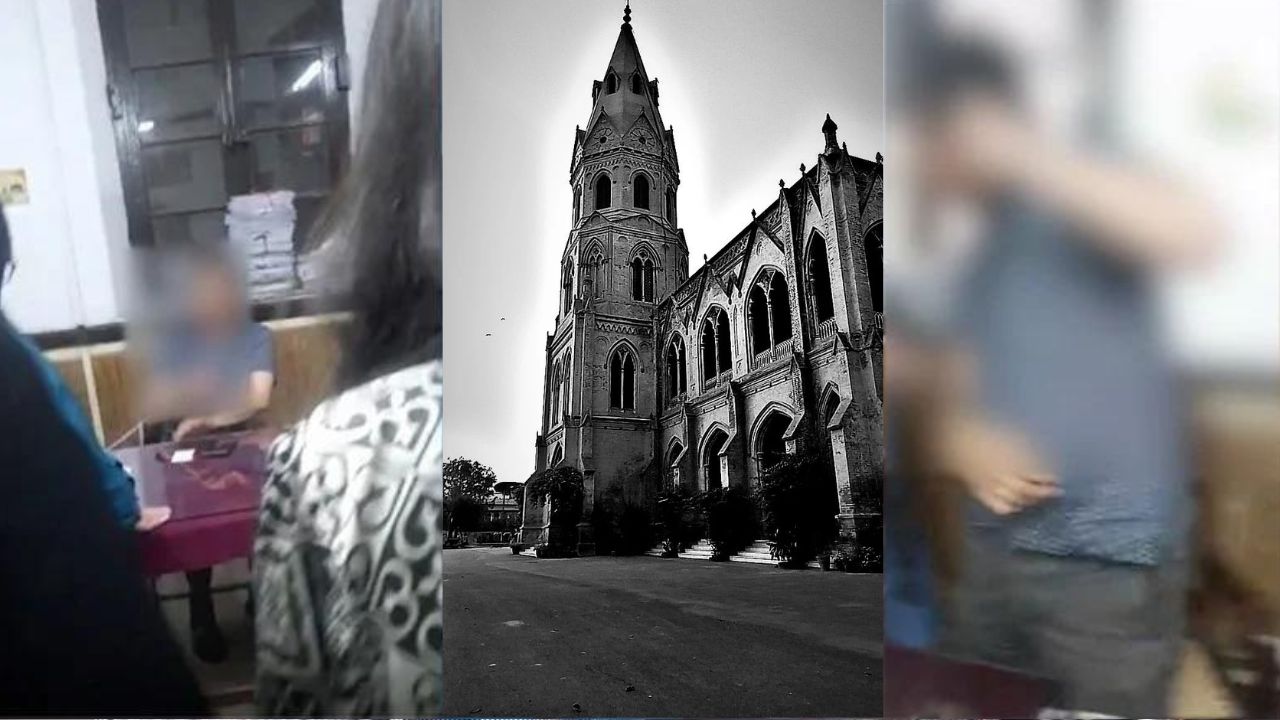
    A video of a professor being beaten by a student is doing the rounds on both mainstream and social media and has invited a myriad of views and interpretations. The details around the incident are more appalling than disconcerting, including allegations that the alleged harasser Dr Mehboob is being backed by the administration, more so by the Head of the Department, Dr Sajjad Ali Khan.


    The video that went viral on March 20 featured a woman throwing hard-bound thesis books, among other things, at the professor who is trying to avoid them. Other girls in the office can be heard expressing their shock. The victim, who was later identified as Zaliha Javaid, remained unfazed, hurling abuses towards him while pulling his hair.


    University records laid out that Zaliha is an alumni-a graduate of the Biotechnology Department back in 2016. Owing to the standard education policy, in the first two years of the four-year programme, all the students have to study four courses of Compulsory English throughout the degree. This connects the dots. Many publications painted it as a case of on-campus harassment but it is evident that she was a former student.


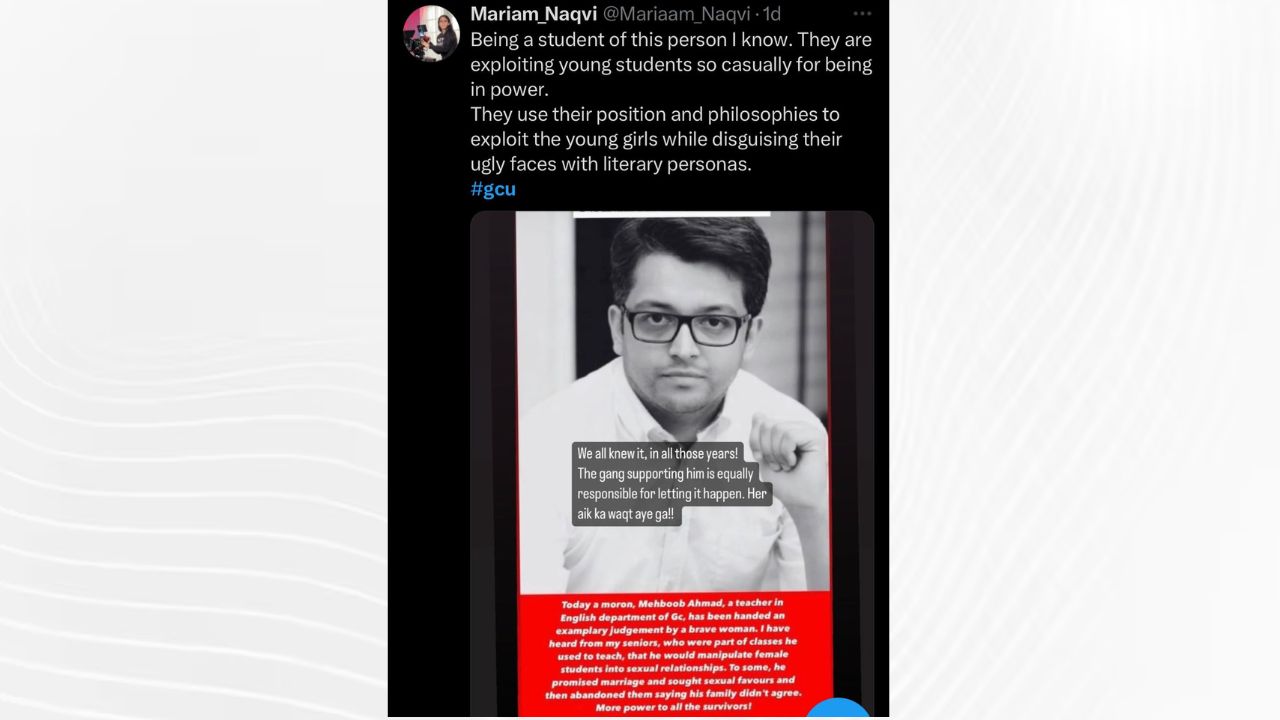
    As the video came out, many ex-students start posting about his problematic behaviour. Mariam Naqvi on Twitter posted a screenshot of a student who recalled incidents quoted by some seniors about the manipulative behaviour of Dr Mehboob and how he “promised marriage and sought sexual favours from students and then abandoned them saying his family did not agree.” Marium shared that, “being a student of this person I know.” She shared how people like him exploit young students using their power.


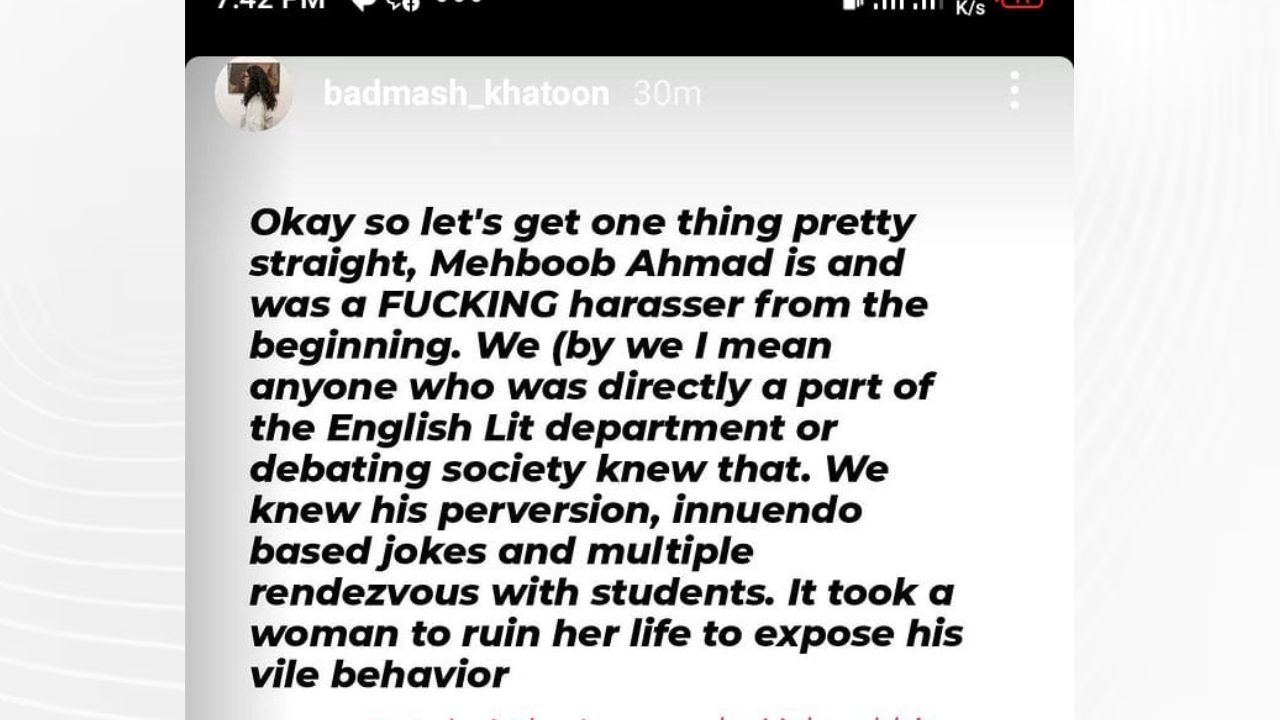
    Shireen aka BadmaashKhatoon posted in a story on Instagram the allegation that the professor has been a harasser from the beginning and many from the literature department and the debating society knew that. “It took a woman to ruin her life to expose his vile behaviour,” she stated.

    An audio clip of another former female student is also making rounds accusing that “a network of harassers” has been operating inside the university which force students to get involved in explicit activities.


    Students talked to The Current on the condition of anonymity, sharing how the professor lacked decency and was rude with them. “He does not even know how to talk properly. He fail students in bulk and exploits them. He is the reason our degrees are getting delayed,” a female student elaborated.


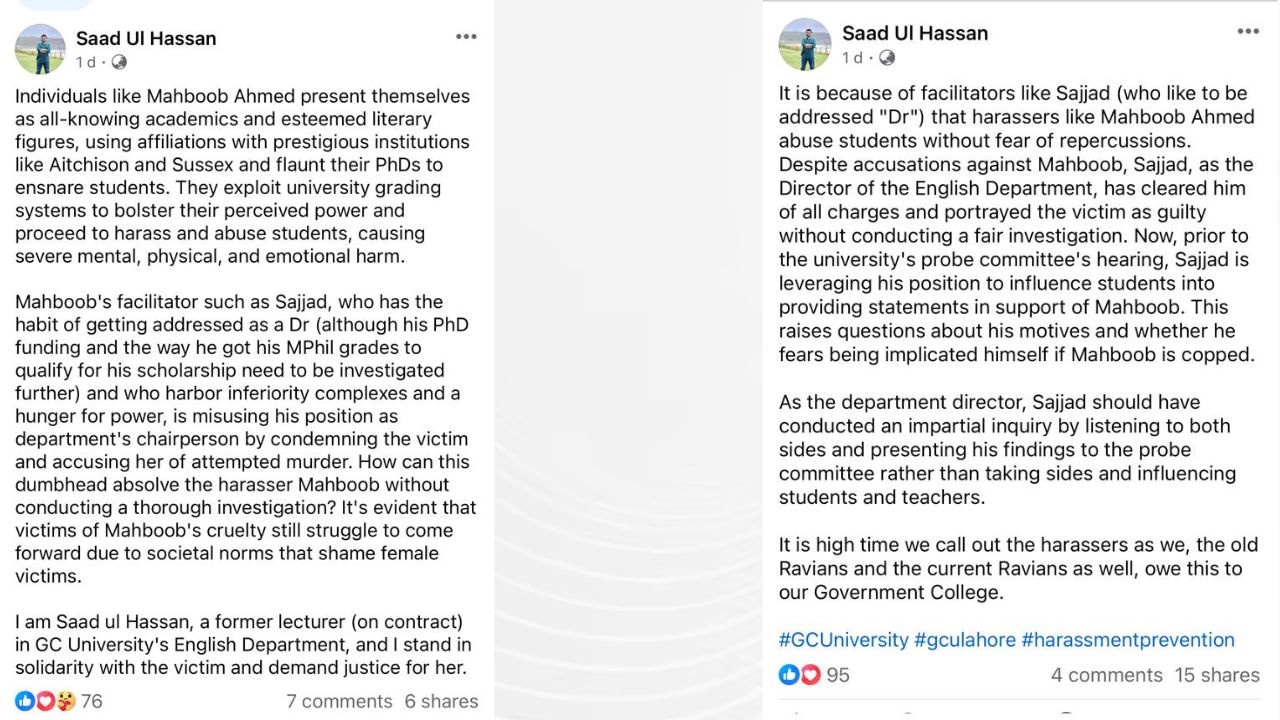
    Former lecturer at the English Department and currently a news anchor Saad ul Hassan related, “Individuals like Mehboob Ahmed…exploit university grading systems to bolster their perceived power and proceed to harass and abuse students, causing severe mental, physical and emotional harm.”


    Saad went on to allege that this is because of facilitators like Dr Sajjad, the Head of the English Department, that harassers like Mehboob Ahmed abuse students without fear of repercussions. Dr Sajjad will use his leverage “to influence students into providing statements in support of Mehboob,” according to Saad.


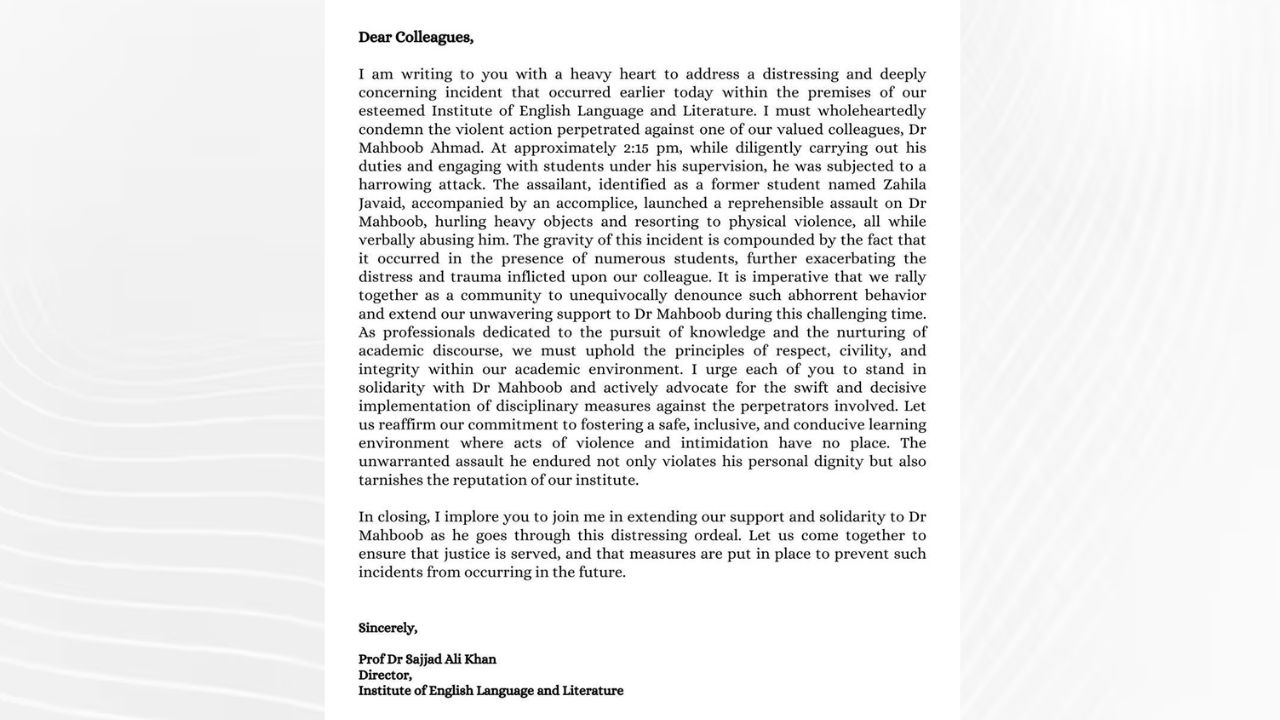
    HOD Dr Sajjad’s statement refers to Zaliha as “the assailant” who was “accompanied by an accomplice”. In his message to his colleagues he laid out the timing of the incident and how Dr. Mehboob was subjected to a harrowing attack. He implored the faculty to join him ‘in support and solidarity to Dr Mehboob”.


    The statement by the university director also lays out how violent Zaliha was. It is important to mention that he avoids taking the name of the professor but appreciates him for his professionalism. He further stated that an investigation has started.


    The partiality hinted clearly in the statements coming out from inside the university raise questions and has been widely criticised.


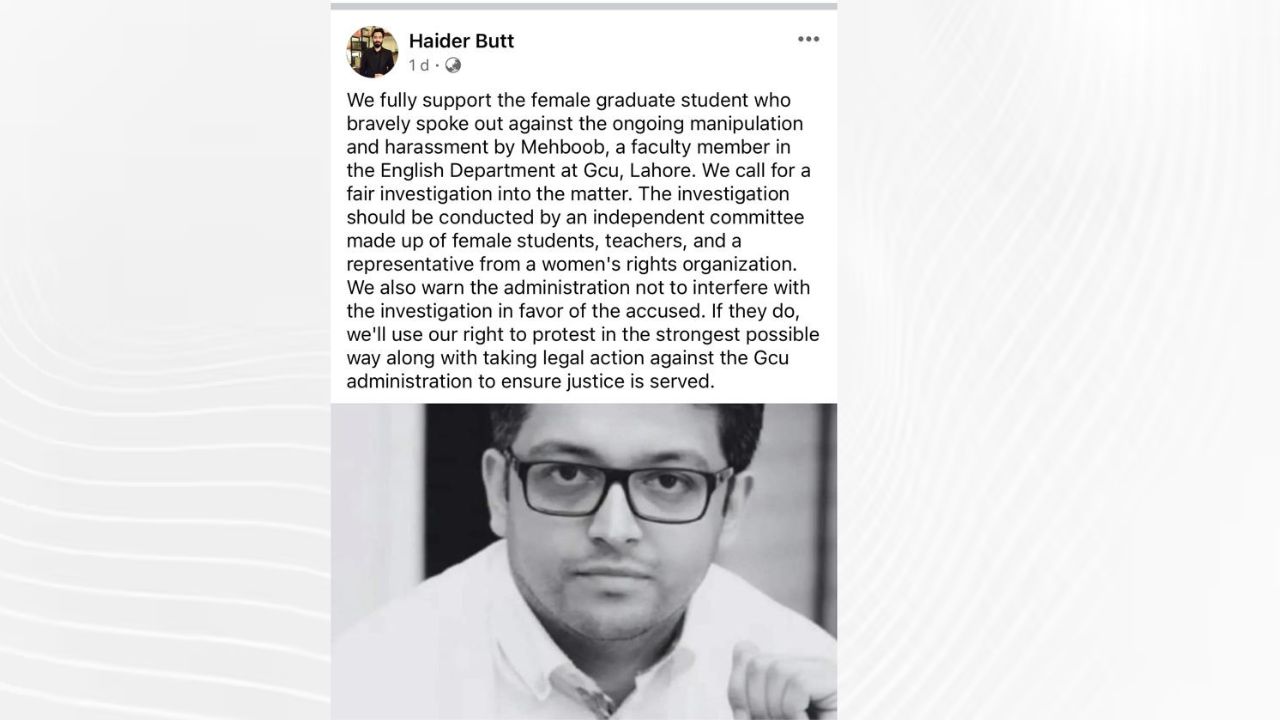
    Former student and students’ rights activist, Haider Butt from the platform of Progressive Student’s Collective wrote that, “We call for a fair investigation into the matter. The investigation should be conducted by an independent committee.”


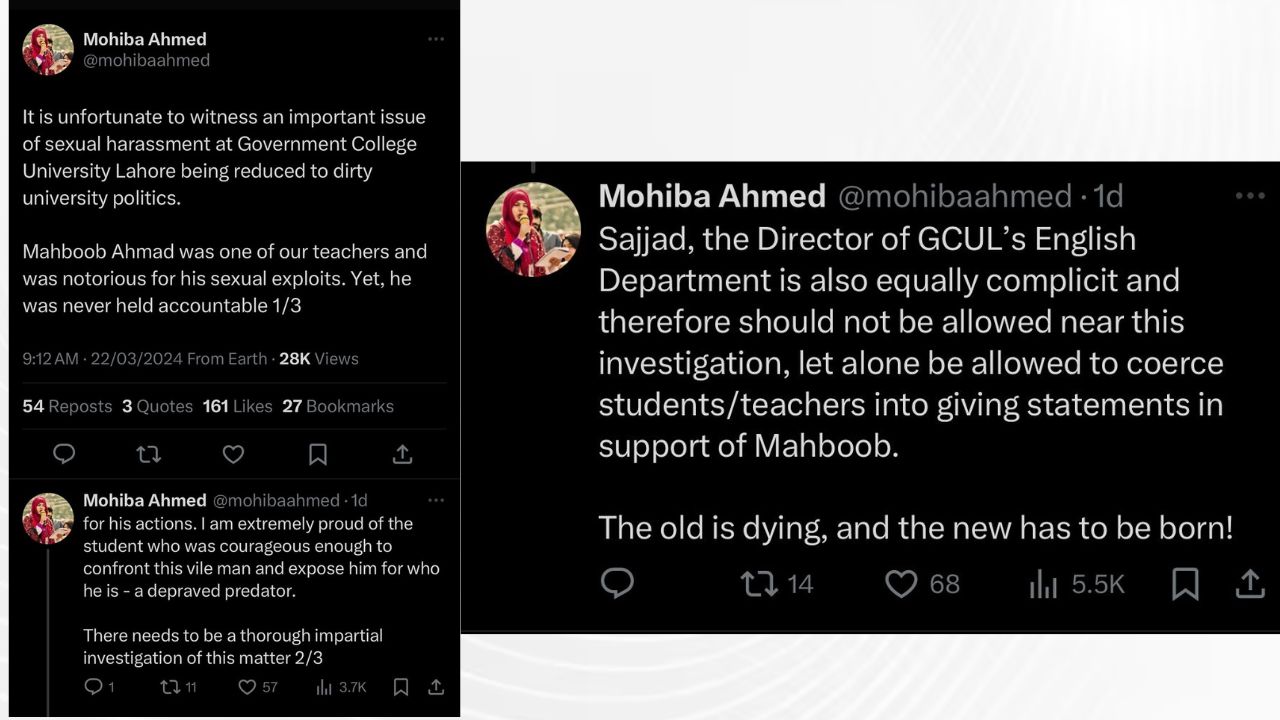
    Mohiba Ahmed, a former graduate and a prominent women’s rights activist, posted on X, “It is unfortunate to witness an important issue of sexual harassment at Government College University Lahore being reduced to dirty university politics.” She recounted how Mehboob Ahmed was notorious for his sexual exploits. “Yet he was never held accountable for his actions,” she lamented. She held HOD Dr Sajjad complicit and stressed that “he should not be allowed near this investigation.”

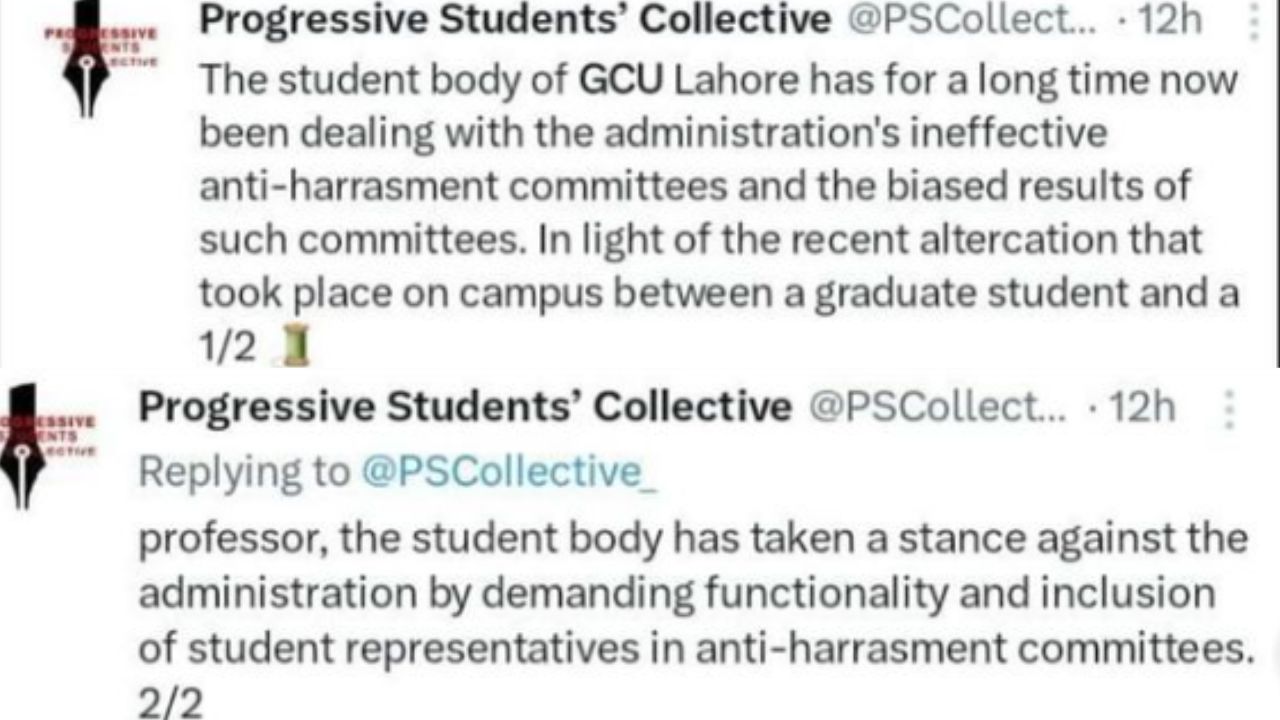
    The investigation into the matter is the key yet the efficacy makes it questionable as the statement from Progressive Students Collective Lahore explains that, “the student body of GCU Lahore has been dealing with the administration’s ineffective anti-harassment committees and the biased result of such committees.”


    Reinstating professors allegedly involved in harassment

    The bottom line is this dilemma which promotes the predatory behaviour rampant in the educational institutions. In 2018 a student from the batch of 2017-2021 took up the case of a professor from the history department, Saeed Butt, who was accused of passing innuendos and sexual harassment. It took months for the investigation to start, only when the new Vice Chancellor took charge. After a number of students presented their testimonies, the result was not favourable as the professor continued working meanwhile, and even though expelled afterwards, he has resumed working with the change of the administration.  This is one example. Lecturer Javaid Bajwa from Physical Education Deaprtment ousted for the allegations of sexual harassment is reinstated as well. It is a proof that the university is at their side.


    This one individual has exposed more than what was already out: harassment, manipulation of students, department politics and how the university administration plays party to this perverse behaviour by not condemning the action and the doer.