Category: Education

  • HEC reportedly revises policy for PhD admissions

    HEC reportedly revises policy for PhD admissions

    The Higher Education Commission (HEC) has reportedly revised its policy for PhD admissions on January 1, 2021.

    According to reports, under the revised policy, students can also apply for PhD directly after four-year BS programs. The policy states that the minimum duration of a PhD degree will be three years while the maximum duration of the degree will be eight years.

    It has also abolished the requirement of having a previous qualification in the same discipline in order to apply for a specific PhD program.

    In case of non-implementation or violation of the policy, HEC would take action against universities ranging from warnings, suspension or revocation of NOC for admissions, and non-verification of credentials.

    Meanwhile, the Federation of All Pakistan Universities Academic Staff Association (FAPUASA) has expressed serious concerns and rejected the revised policy by the HEC.

    It is pertinent to add that the HEC has not yet officially announced the new policy.

  • Chomsky says Pakistan has no future if it doesn’t come out of world of ‘religious superstition’

    Chomsky says Pakistan has no future if it doesn’t come out of world of ‘religious superstition’

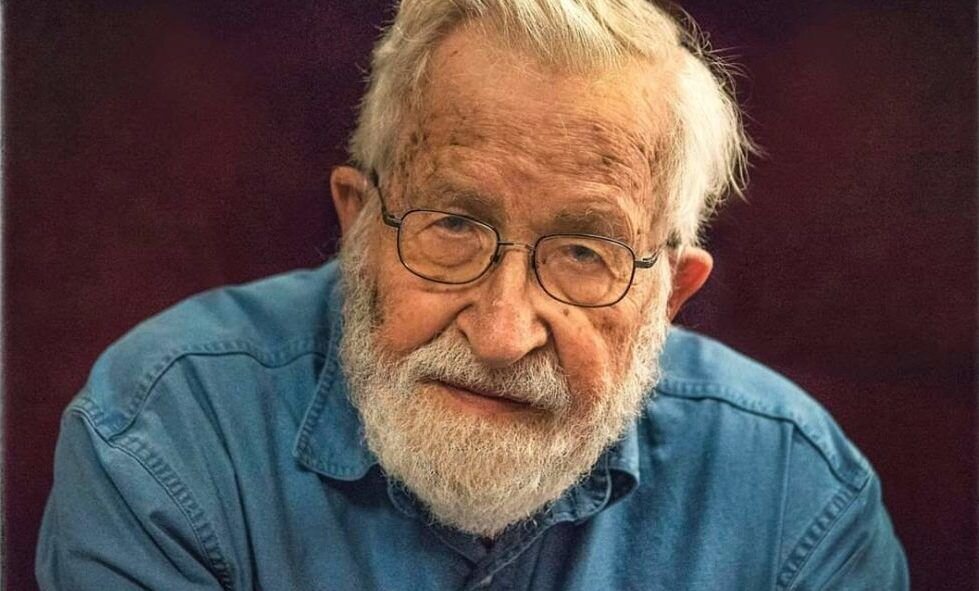
    Professor Noam Chomsky, renowned linguist and analytic philosopher, has said that Pakistan lacks “serious scientists” to preserve a rational education system to deal with the reality of the world.

    Speaking at a seminar organised by Karachi’s Habib University, Prof Chomsky said it’s sad that science has virtually disappeared from the country’s educational system.

    “Pakistan used to have an advanced scientific establishment, Nobel Prize laureates [Abdus Salam] and so on,” the American linguist said. “Now science has virtually disappeared from the educational system.” “Pakistan has no future if it is going to live in a world of religious superstition,” he said.

    During the lecture, Chomsky talked about a number of issues, including climate change, nuclear weapons, and the rise of populist leaders.

    Speaking about Indian PM Narendra Modi, the US professor said India is destroying the remnants of Indian secular democracy, crushing the Muslim rights and placing Kashmir under a brutal rule. “Pakistan is not too far behind,” the philosopher said, referring to the rights abuses in the country.

    Speaking about Iran-US ties under outgoing president Donald Trump, he said the Trump admin “is in a state where it is willing to do anything”. He said the tensions between US and Iran boiled over after Trump came to power.

    The assassination of Iranian general Qasem Soleimani in a US airstrike in Baghdad and the recent killing of its nuclear scientist Mohsen Fakhrizadeh near Tehran have further escalated these tensions. Iranian authorities have pointed fingers at two US allies – Saudi Arabia and Israel.

    “There is a possibility of war,” he said, adding that Iran has no “match for the US war machine” because its relatively low defence expenditure. But Iran would respond by attacking Saudi oil installations and other US allies in the region and that could lead to a full-blown war, said Chomsky.

    Speaking about sanctions imposed on Iran by the US government, Prof Chomsky was of the view that “sanctions against Iran have absolutely no legitimacy”. These sanctions “are means of torturing and terrorizing the Iranian population”. He said the people of Iran have to suffer from those sanctions because the Iranian government is not obeying the US orders.

    He also talked about Iran’s nuclear programme, saying it is very likely that Iran wants to use it as ‘deterrent’. Chomsky believes the countries that want to rampage freely in the region don’t want deterrents, and the US is one of them and its “Israeli client” another.

    “They don’t want a deterrent,” Chomsky said. The US doesn’t even admit that Israel has nuclear weapons, let alone getting its nuclear war inspected, the American philosopher said, pointing out the problems with the US approach towards the Middle East region.

  • PM welcomes children back to school, deletes tweet after realising schools are re-opening tomorrow

    PM welcomes children back to school, deletes tweet after realising schools are re-opening tomorrow

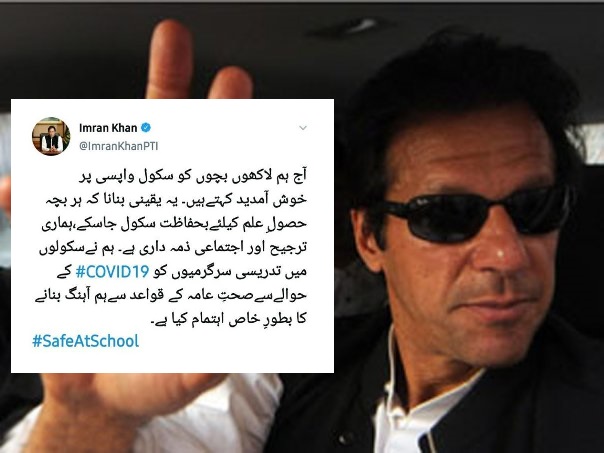
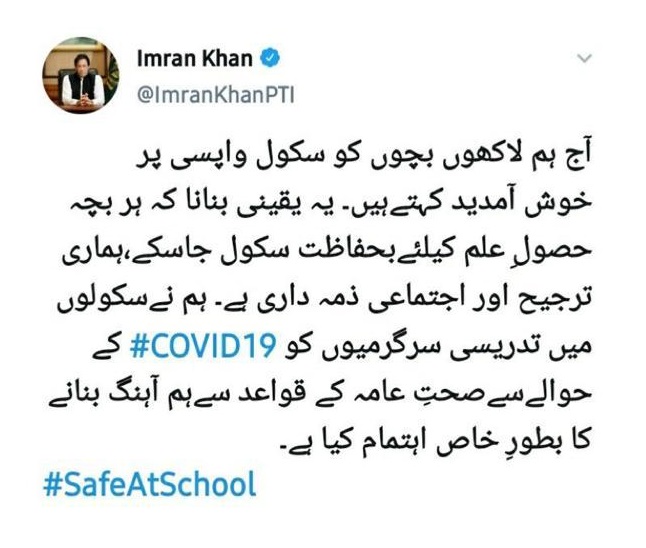
    Confusing days and dates once again, Prime Minister (PM) Imran Khan on Monday tweeted to welcome children back to school after a long coronavirus break, only to delete the post after realising that educational institutions won’t be re-opening until tomorrow.

    As per the details, the premier took to Twitter and wrote:

    While he deleted the tweet soon after, in a subsequent tweet PM Imran said:

    “Tomorrow we will welcome millions of children back to school. It is our priority and collective responsibility to ensure that every child can go to school safely to learn. We have worked to ensure that school operations are aligned with public health safety rules on #COVID19,” he wrote.

    This isn’t the first time that the premier, on top of several verbal blunders, has confused the dates.

    Earlier this year, he had asked Muslims “to offer special Nuwafil prayers and seek Allah’s blessings and forgiveness on the occasion of Shabe Baraat tonight”, later deleting his tweet when people had told him the night had already been observed a day ago.

    Mid-Sha’ban or Shabe Baraat is a holiday observed by Muslim communities on the night between 14 and 15 of the Islamic month of Sha’ban. It is regarded as a night when the fortunes of individuals for the coming year are decided and when Allah forgives sinners.

    Twitterati, as usual, had not let go of PM Imran’s faux pas easy.

  • Educational institutions to re-open on Sept 15?

    Educational institutions to re-open on Sept 15?

    Federal Education Minister Shafqat Mahmood on Monday chaired a meeting of provincial education ministers to make a final decision on whether to reopen educational institutes across the country from September 15, The News reported.

    According to reports, the Higher Education Commission’s (HEC) chairperson and executive director, Special Assistant to the Prime Minister (SAPM) on Health Dr Faisal Sultan, and officials of the health department were also present at the Inter-Provincial Education Ministers Conference (IPEMC), which aimed to compile the final recommendations regarding the opening of educational institutes.

    The recommendations to resume educational activities would be sent to the National Command Operation Centre (NCOC) for further deliberations among all the stakeholders.

    The meeting was set to also focus on finalising the standard operating procedures (SOPs) in this regard. Educational institutes across Pakistan had been shut down back on March 13 in a bid to curb the spread of the deadly coronavirus.

    The Single National Curriculum (SNC), a short curriculum for the current academic year, examinations in 2021, and establishment of anti-harassment bodies in the provinces were also on the meeting’s agenda.

    A discussion on the transition plans related to the Basic Education Community Schools (BECS) and National Commission for Human Development (NCHD) was also planned for the IPEMC.

    In this regard, Sindh Education Minister Saeed Ghani said all educational institutes were to open between September 15 and 30.

    All classes starting Grade 9 and up, as well as all universities, would reopen from Sept 15, while Grade 6-8 classes would resume by Sept 22, Ghani said, adding, however, that pre-primary and primary classes would reopen on Sept 30.

    The provincial minister warned that the schools in any area that may witness a rise in the number of coronavirus cases would be closed.

    Wearing face masks would be mandatory in the schools and strict action was to be taken in case of violation of the coronavirus-related SOPs, he added.

    Moreover, Punjab Education Minister Dr Murad Raas said there would be “no double shift”.

    “Alternative day schedule to be followed by all public & private schools,” Raas said on Twitter.

    Separately, in Khyber Pakhtunkhwa (KP), the provincial education department has decided to conduct coronary tests on school staff and students.

    “Health Department’s teams will be visiting public and private educational institutions to conduct random tests of teachers / staff / students / canteen vendors and all those persons who are working within the premises of educational institutions in an effort to detect COVID-19 positive cases and prevent the spread of disease,” a notification shared on the Twitter account of the ruling PTI’s KP chapter stated.

  • Naya Pakistan: Matric pass PTI MPA becomes new chairperson of Punjab Education Foundation

    The recent “election” of the new chairperson of the Punjab Education Foundation (PEF) has attracted widespread social media attention after it was revealed that he himself holds only a matriculation or secondary school certificate.

    Established in 1991, PEF is an autonomous statutory body to encourage and promote education on non-commercial/non-profit basis. Since then, it has come a long way to arrange free quality education for the deserving children at their doorsteps.

    On July 27, the first meeting of the newly-constituted Board of Governors (BoG) of the PEF was held in which the members, through consensus, elected Sardar Aftab Akbar as the new chairperson.

    According to the Punjab Assembly’s official website, the academic qualification of Akbar, a Pakistan Tehreek-e-Insaf (PTI) MPA from PP-23 (Chakwal-III), is matriculation. He has served as the tehsil nazim in Chakwal from 2005 to 2010, while still serves as a member of the Primary and Secondary Healthcare as well as Committee on Privileges of the Punjab Assembly.

    It is pertinent to mention here that the PEF has been in the limelight these days for non-payment to its partner schools across Punjab. The owners and teaching and non-teaching staff of PEF partner schools had protested recently outside the Punjab Assembly and the Governor House. They had even tried to reach Zaman Park over the non-payment issue that has made them unable to pay salaries to teaching and non-teaching staff besides clearing building rents and utility bills etc.

    Punjab School Education Minister Dr Murad Raas, with regard to non-payments, says that PEF had already paid 50 per cent of the payment to the schools and remaining payment would be made only after verification of the students enrolled in these schools. He said previously some 250,000 fake enrolments were detected at many PEF partner schools and since millions of rupees were to be paid to the schools, verification of students was a must.

    The minister said many PEF partner schools were in fact beneficiaries of the Pakistan Muslim League-Nawaz (PML-N) and the government would not waste public money on fake enrolments. He said the PEF initiative was aimed to bring out of school children into schools and not to financially support fake enrolments. Dr Muard Raas further said he had also apprised Prime Minister (PM) Imran Khan about the issue in a recent meeting who had assured full support.

  • Complete details of educational institutions’ reopening on Sept 15

    Complete details of educational institutions’ reopening on Sept 15

    Federal Education Minister Shafqat Mahmood has announced the reopening of education institutes, including Madaris, public and private schools, colleges and universities, across the country from September 15.

    All education institutes will open their administrative and academic offices from July 15 onwards to begin preparations for safe reopening and ensure the implementation of SOPs.

    Education facilities will reopen based on clear and detailed standard operating procedures (SOPs) for safe education facility reopening. Three important criteria are essential for the conduct of exams: masks, physical distancing of 6 feet, and open and airy spaces for the conduct of exams.

    Universities will allow students that are in far-fetch areas to attend on-campus classes before September 15, 2020. But the universities must ensure 30% hotel occupancy. These students will be called after Eidul Azha under strict SOPs.

    The education minister further said that “universities had been permitted to allow their PhD level students or those who wanted to do their research work in laboratories, to physically attend before the 15th of September”.

    This attempt is being made to fix the academic loss of students from remote areas during the COVID-19 pandemic. “A health check will be mandatory for such students and faculty members who will attend universities before September 15”, he remarked.

    The vocational and technical training institutions will allow students who were getting on the job training to continue their training in industries, while the students who were getting training in classrooms can only attend their training from the 15th of September.

    Vocational institutions have also been permitted to call their teaching staff before the 15th of September for training regarding SOPs, the minister said.

    The decisions have been made in consultation with the Health Department and National Command & Control Centre (NCOC).

  • HEC orders universities to resume online classes

    The Higher Education Commission (HEC) has directed all universities and accredited institutions with sufficient resources to resume online classes as the government-ordered closure of schools, colleges and universities remains in place amid the spread of new coronavirus — COVID-19 — across Pakistan.

    In an official notification, HEC has reportedly asked all universities which have well-built learning management systems (LMS) to initiate online classes. However, universities facing technological, technical or spatial limitations can remain closed for academic activities till May 31 and mark the said period as summer vacations.

    In the meantime, these universities should make arrangements for conducting online classes in case the closure is extended because of the global pandemic, the notification read further.

    “Such universities shall plan, acquire, train and shall be able to execute an LMS from June 1 so that [the] ongoing semester could resume even in an eventuality of the extended closure of universities.”

    On Thursday, the federal government announced that education institutions across Pakistan would remain closed till May 31. The government also announced that the closure would be treated as summer vacations and if the coronavirus outbreak was dealt with in the meantime, the institutions would reopen in June.

    At a time when higher education institutions in Pakistan and elsewhere in the world are fast shifting to online learning in the wake of closures to contain the spread of coronavirus, Pakistani students took to social media last week and demanded the authorities converted closures into semester break.

    “We reject online education” popped up as one of the top trends in Pakistan on the microblogging website Twitter and the hash tag remained on the top for quite some time with most of the tweeters expressing concerns over no or poor internet connectivity and lack of, what they termed, “effectiveness” of the online education.

    They demanded that the institutions instead of shifting to online education should convert closures in semester breaks and hold on-campuses classes when campuses reopen in summer.

    According to The News, there are around 40 million students enrolled in public and private sector schools, colleges and universities of Pakistan. Of these, 24 million students are enrolled in primary schools, 7.6 million in middle schools, 4 million and over 1.5 million at secondary and higher secondary levels, respectively.

    Punjab alone has around 13 million students enrolled in government schools. This shows that in terms of numbers the real affectees are particularly the schoolchildren for whom there is no online education facility during the current countrywide closures.

  • Coronavirus: SAT exams cancelled

    Coronavirus: SAT exams cancelled

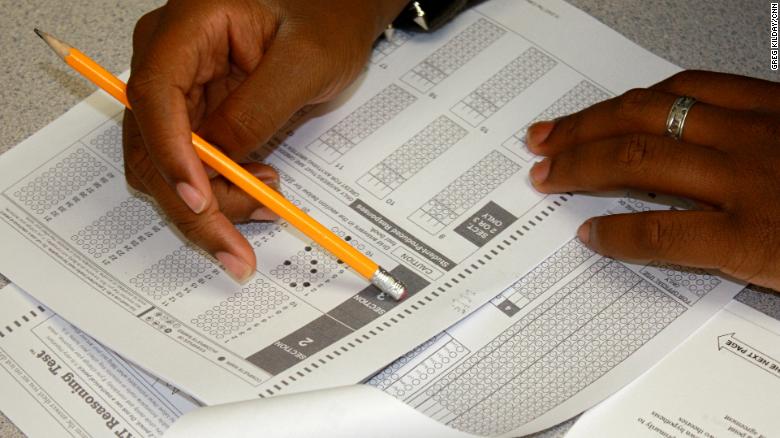
    The College Board has announced that it has cancelled two upcoming SAT exams due to coronavirus concerns.

    Tests scheduled for May and makeup exams for the March have also cancelled and registered students will receive full refunds, the College Board said in a statement.

    A new date has not yet been announced for additional SAT testing opportunities.

    “The College Board will remain focused on student safety and ensuring all students have the tools they need to work, and opportunities to receive the credit they have earned, during this challenging time,” the statement read.

    The news comes as schools nationwide have temporarily shut down over coronavirus alarms. Many colleges and universities have also moved to online classes.

  • GCU Lahore denies ‘terminating’ political science teacher ‘for being too political’

    Government College University (GCU) Lahore has denied “terminating” a contractual faculty member of the Department of Political Science, Zagum Abbas, “for being vocal about issues facing students, cultivating a culture of dialogue and encouraging his students to engage in political activities”.

    Zagum, in a Facebook post on Wednesday night, had said that his contract was not extended because he “taught his students to question everything that had been fed to them”.

    According to Zagum, he was “verbally” informed of the decision. “After four years of service to GCU, the administration didn’t even have the decency to provide written notice of termination.” He had further said that he was accused of being “political” and “vocal against the issues facing students and teachers on campus”.

    He had, however, not disclosed the nature of the issues.

    “I want to state proudly that I invited my students to be open, rational and taught them to engage in critical debates. I cultivated a culture of dialogue and engagement and taught my students to question everything which had been fed to them. These were the activities that the myopic men on campus could neither digest nor tolerate.”

    Highlighting his teaching career, Zagum had said he loved his job enough to live away from his family in Gilgit, believing that at least he was “contributing something meaningful to society and the country at large”.

    While support from colleagues and student activists is pouring in for the teacher, the varsity has clarified the termination and welcomed Zagum to apply for a regular appointment “since contractual appointments are subject to workload”.

    “Contractual appointments are subject to workload and classes, as determined by the head of the department. Currently, the workload at the political science department is complete,” a GCU spokesperson told The Current.

    “However, Zagum is welcome to apply for a regular appointment at GCU whenever a post is advertised. If he has any constructive suggestions towards improving the working conditions of contract employees, he is encouraged to provide his feedback directly to the GCU vice chancellor (VC). We wish him all the success in the future,” the spokesperson added.