As per official data, last year Canada issued nearly one million study permits, about three times that of a decade ago, and now they are changing their policy.
In response to a housing shortage aggravated by explosive growth in foreign student numbers, Canada has announced a temporary two-year cap on the intake of international students.
Last year, the country issued nearly one million study permits, triple the figures from a decade ago, according to government data. The new proposal aims to reduce the intake by almost a third.
Canada’s Immigration Minister, Marc Miller, revealed that the Liberal government will implement a two-year cap on student visas, resulting in the issuance of approximately 364,000 visas in 2024.
The plan also includes limitations on post-graduate work permits for foreign students, potentially encouraging them to return to their home countries.
Previously viewed as a straightforward path to permanent residency, these permits will now be subject to stricter regulations.
However, those pursuing master’s or post-doctorate programs will still be eligible for a three-year work permit.
Additionally, spouses of international students enrolled in undergraduate and college programs will no longer be eligible for permits, Miller stated.
The acceptance of new study permit applications in 2025 will be reassessed at the end of the current year.
The government’s decision comes in response to the surge in international students, creating a housing crisis and driving up rents across the country.
December 2023 saw a 7.7 per cent year-on-year increase in rents nationwide, according to Statscan. Prime Minister Justin Trudeau’s popularity has been dented mainly due to the affordability crisis, and opposition Conservative Party leader Pierre Poilievre has taken a commanding lead over Trudeau in opinion polls ahead of an election next year.
Concerns about the quality of education provided by some institutions have also prompted the government to reevaluate its immigration policies.
The move will not only affect the housing market but will also have economic implications. International students contribute approximately C$22 billion ($16.4 billion) annually to the Canadian economy.
This decision will likely impact educational institutions that expanded their campuses in anticipation of a continuous influx of students.
Ontario, the most populous province, has been the primary recipient of international students. Some businesses, including restaurants and the retail sector, have warned of potential labor shortages due to the cap on foreign students.
Canada’s move will have repercussions for Canadian banks, as international students are required to have Guaranteed Investment Certificates (GICs) of over C$20,000, covering living expenses.
Most foreign students, approximately 40%, hail from India, with China coming in second at around 12%, based on official data from 2022.
In response to these changes, the University of Toronto has expressed its readiness to collaborate with all levels of government to ensure that the allocation of study permits considers institutions like U of T and addresses challenges in the system.
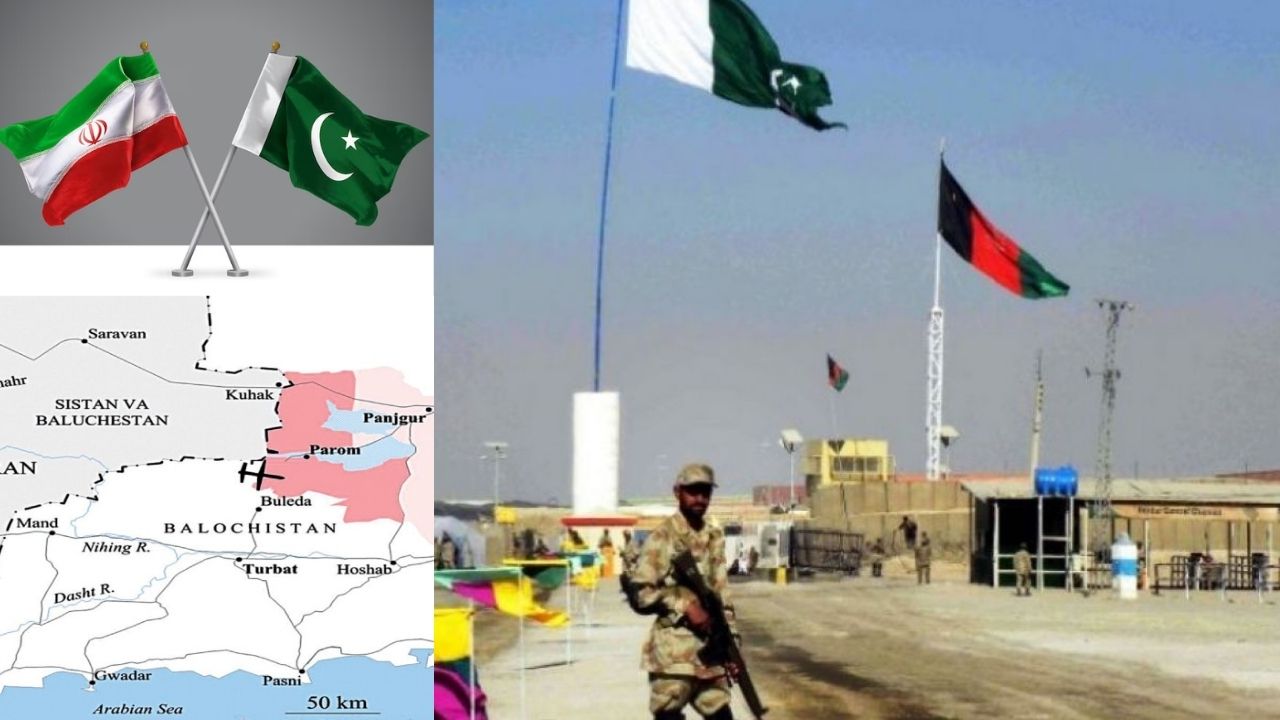
Following Operation Marg Bar Sarmachar, Pakistan and Iran have mutually agreed that ambassadors of both countries will return to their respective posts by January 26, 2024 and the Iranian Foreign Minister is going to visit on January 29, 2024.
In a joint statement issued on Monday, the Foreign Office said that at the invitation of Foreign Minister Jalil Abbas Jilani, his Iranian counterpart Hossein Amir Abdollahian will undertake a visit to Pakistan on January 29.
In a post on X, Pakistan’s Ambassador to Iran Mudassir Tipu said he was “so delighted that leaderships of both Pakistan and Iran so deftly handled a challenging moment astutely- swiftly putting relations back on track”.
I am so delighted that leaderships of both and so deftly handled a challenging moment astutely- swiftly putting relations back on track. We have great potential ahead & both brotherly countries must collectively promote peace & development in region .
Along with that the Foreign Office (FO) said on Monday that Iran’s foreign minister Hossein Amir Abdollahian would visit Pakistan on January 29.
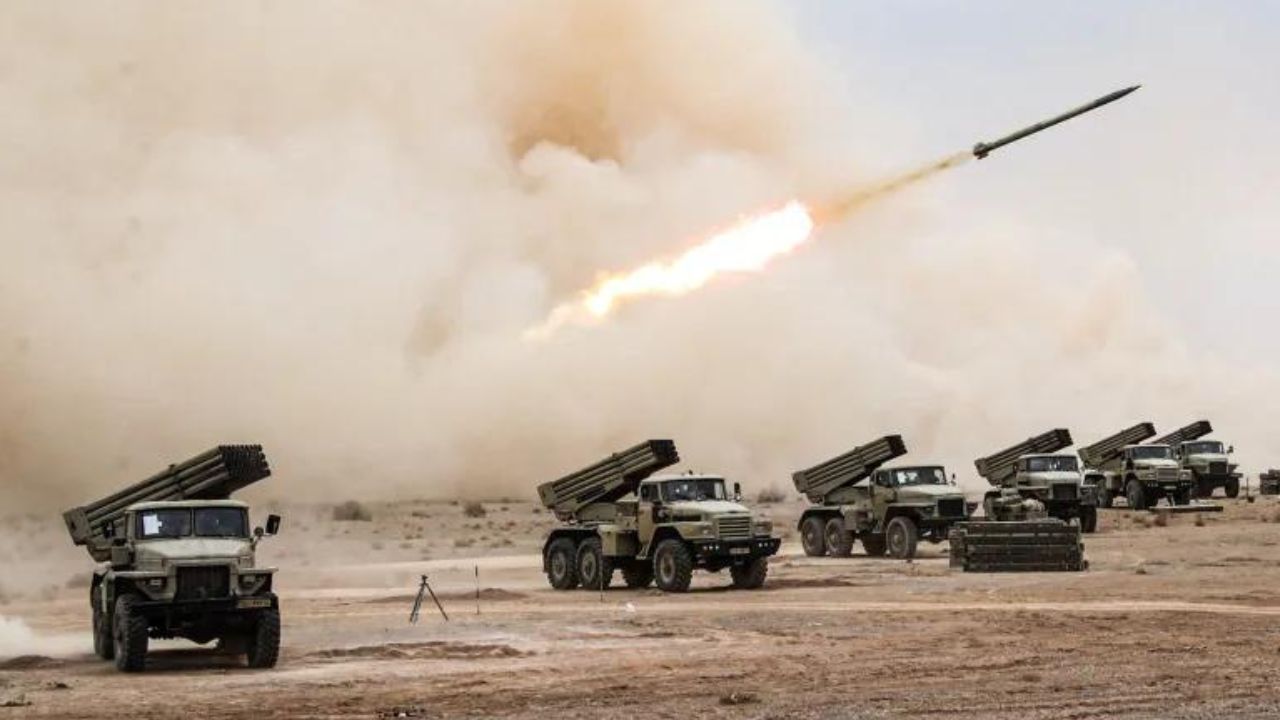
The visit comes days after tensions escalated between the two countries following an Iranian air strike in Pakistan, leading Islamabad to strike terrorist hideouts in the neighbouring country’s Sistan-Baluchestan province.
“Following the telephone conversation between the foreign ministers of Pakistan and the Islamic Republic of Iran, it has been mutually agreed that ambassadors of both countries may return to their respective posts by January 26, 2024,” the FO said in a statement.
The FO said that the Iranian foreign minister would travel to Pakistan on Jan 29 at the invitation of FM Jilani.
: PR NO. 2️⃣3️⃣/2️⃣0️⃣2️⃣4️⃣
Joint Press Statement of the Islamic Republic of Pakistan and the Islamic Republic of Iran
Previously, Pakistan has targeted terrorist hideouts inside Iran in response to the violation of Pakistan’s sovereignty by the Iranian Revolutionary Guard that killed two children and injured three girls.
Hideouts used by terrorist organisations namely Balochistan Liberation Army and Balochistan Liberation Front were successfully struck in an intelligence based operation, code name ‘Marg Bar Sarmachar’, ISPR has stated in a recently released statement.
According to a statement by the Foreign Office (FO), a number of terrorists were killed during the intelligence-based operation codenamed ‘Marg Bar Sarmachar’. Meanwhile, Iran’s IRNA news agency reported that nine people, including seven “non-Iranian nationals”, were killed in the strike targeting a village near the city of Saravan.
The Khorasan Diary reported, that “7 BLF millitants involved in attacks in Pakistan have been killed/injured in Pakistan’s strikes in Iran.”
7 BLF MILITANTS INVOLVED IN ATTACKS IN PAKISTAN HAVE BEEN KILLED/INJURED IN PAKISTANS STRIKES IN IRAN.
A top Pakistani security official told The Khorasan Diary that 7 militants wanted to Pakistan have been killed or injured in the strike in Shamesar, Iran.
In a video posted, it can be seen the damage caused by Pakistani Strikes in approximately 200 kilometres away from PAK-Iran border.
TKD MONITORING: A video uploaded by news outlets of Saravan city at dawn shows at least one site hit by Pakistan early this morning. Multiple bodies are under the debris it states. Saravan city in Sistan wa Balochistan province of Iran is approximately 200 kilometres from… pic.twitter.com/LrLr58iMBO
Publication The Khorasan Diary also claimed that Jaishul Adal, the same militant group, Iran claimed to have targeted has taken the responsibility for the attack on Saravan Corps of Sistan Wa Baluchistan province, Colonel Hossein Ali Javadanfar, adding that the security official was assassinated along with two of his guards.”
ALERT: The deputy commander of the Saravan Corps of Sistan Wa Baluchistan province, Colonel Hossein Ali Javadanfar, was shot dead when he was returning from an administrative mission on the Khash-Zahedan road, Iran. Iranian state media reported. Jaishul Adal, a militant group… pic.twitter.com/LiizDcCVFT
Previously, The Iranian strikes were part of a series of attacks carried out by the country in recent days in Syria and Iraq as a response to recent terrorist attacks on its territory. They have heightened concerns about regional stability, particularly amid ongoing conflicts in the Middle East.
Pakistan undertook a series of highly coordinated and specifically targeted precision military strikes against terrorist hideouts in Siestan-o-Baluchistan province of Iran. A number of terrorists were killed during the Intelligence-based operation – codenamed ‘Marg Bar Sarmachar’, says the official statement released by the Foreign Office of Pakistan.
“Last night’s unprovoked and blatant breach of Pakistan’s sovereignty by Iran is a violation of international law and the purposes and principles of the Charter of the United Nations,” FO Spokesperson Mumtaz Zahra Baloch said in a statement on Wednesday.
A context to the response by the Foreign Office
Foreign Ofiice of Pakistan provided a detailed context to Operation Marg Bar Sarmachar.
“Over the last several years, in our engagements with Iran, Pakistan has consistently shared its serious concerns about the safe havens and sanctuaries enjoyed by Pakistani origin terrorists calling themselves Sarmachars on the ungoverned spaces inside Iran. Pakistan also shared multiple dossiers with concrete evidence of the presence and activities of these terrorists. However, because of lack of action on our serious concerns, these so-called Sarmachars continued to spill the blood of innocent Pakistanis with impunity. This morning’s action was taken in light of credible intelligence of impending large-scale terrorist activities by these so called Sarmachars,” the statement read.
The Foreign Office described the action as a part of its resolve to “defend its national security against all threats.” Moreover it mainatianed that “Pakistan fully respects the sovereignty and territorial integrity of the Islamic Republic of Iran. The sole objective of today’s act was in pursuit of Pakistan’s own security and national interest which is paramount and cannot be compromised.”
Strict monitoring of Air Space
Geo News’ Azaz Syed quotes Civil Aviation Authority that amid the escalation of tensions in Islamabad-Tehran ties, Pakistan has started strict monitoring of all flights from the West including Iran.
Meeting of Foreign Minister with Iranian Counterpart
Caretaker Foreign Minister Jalil Abbas Jilani Wednesday told his Irani counterpart that no country should follow its path of launching an attack on a neighbouring nation’s soil against the menace of terrorism unilaterally.
“No country in the region should tread this perilous path,” Jilani told Iran’s FM Hossein Amir-Abdollahian during a telephone call hours after Tehran claimed it had targeted “terrorists” in Pakistan.
Iranian response
There is a group called Jaishal Adal, which is an Iranian terrorist group that have taken refuge on Pakistan-Iran border. Several times we have talked to Pakistani security officials that this group killed our security personnel and we responded by killing Iranian terrorist on Pakistani soil. I have spoken to my Pakistani counterpart, the Foreign Minister of Pakistan, we do respect the sovereignty of Pakistan but we don’t allow our national security be compromised and be played with. We have no hesitations when it comes to our national interest and those terrorist groups inside Pakistan and those affiliated with Israel” the Iranian Foreign Minister Hossein Amir Abdollahian said while speaking in Davos at The World Economic Forum.
WE RESPECT PAKISTANS SOVEREIGNTY BUT WILL NOT COMPROMISE ON OUR NATIONAL SECURITY SAYS IRANIAN FOREIGN MINISTER
There is a group called Jaishal Adal, which is an Iranian terrorist group that have taken refuse on Pakistan-Iran border. Several times we have talked to Pakistani… pic.twitter.com/NHLrTyCwqn
India India in a statement from the Ministry of External Affairs said, “This is a matter between Iran and Pakistan. Insofar as India is concerned, we have an uncompromising position of zero tolerance towards terrorism. We understand actions that countries take in their self-defence.”
China, close partners of Iran and Pakistan, urged restraint, with foreign ministry spokeswoman Mao Ning saying both should “avoid actions that would lead to an escalation of tension”.
United States of America
The United States, meanwhile, condemned the Iranian strikes in Pakistan, Iraq and Syria, with State Department spokesman Matthew Miller saying Tehran had violated the “sovereign borders of three of its neighbours in just the past couple of days”.
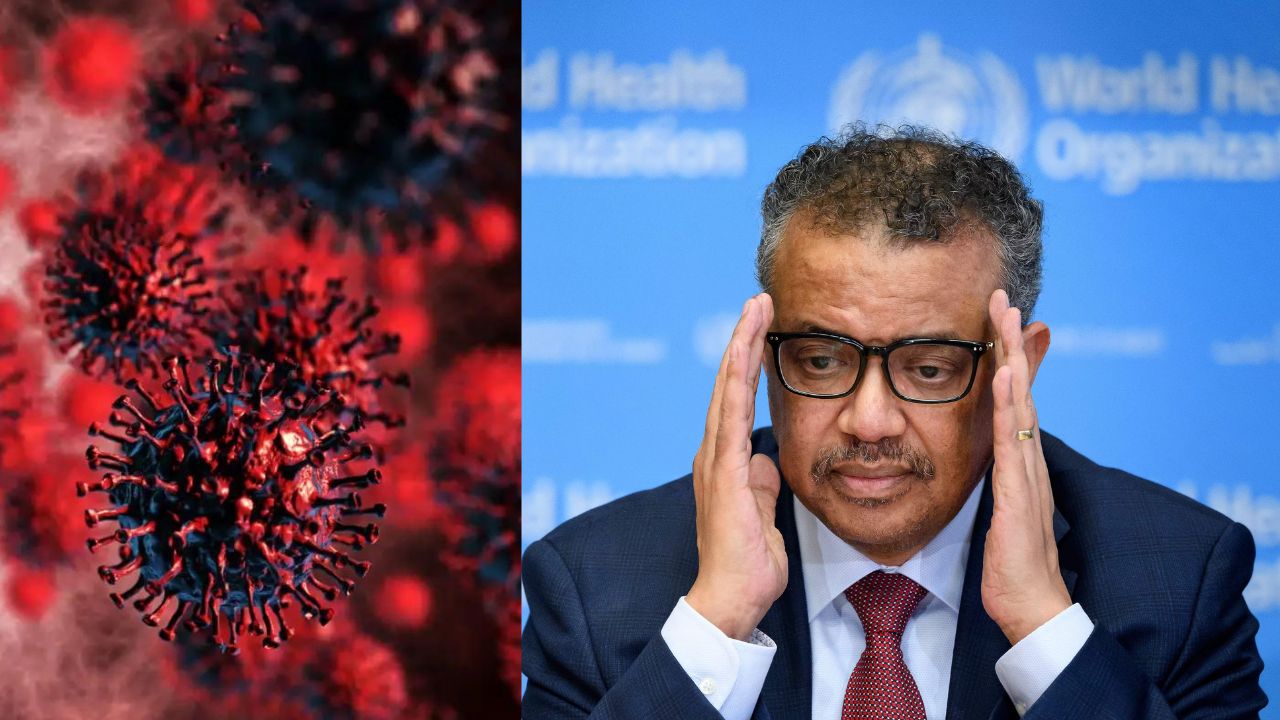
Director General of the World Health Organization (WHO) Dr. Tedros Adhanom has said that Disease X is a global problem that we need to be prepared for.
Addressing the World Economic Forum in Davos, Switzerland, the WHO head talked the next possible global epidemic, dubbed Disease X.
The name was first added to the WHO list in 2018, before the emergence of Covid-19.
Dr. Tedros Adhanom said, “You can call Covid the first Disease X and it may happen again in the future.”
He acknowledged that some people will say that such a warning will spread fear, but pointed out that it is better to be prepared for everything because it has happened many times in our history and now we have to start preparing for the next epidemic.
Dr. Tedros said that the world learned from the Covid epidemic how to deal with the next epidemic.
WHO discussed plans for a global agreement to prevent future pandemics in 2021.
The head of the WHO said in Davos that the agreement to prevent epidemics will be the most important to protect the world from future epidemics. So far, many countries could not agree on the terms of this agreement.
Dr. Tedros Adhanom stated that the negotiations between the member states are going on and WHO expects the agreement to be reached in time. “If our generation does not do it, we do not think the next generation will do it. Because this is about a common enemy and without a shared response, starting from the preparedness … we will face the same problem as COVID,” added the WHO chief.
Reminding his audience that the deadline for the pandemic agreement is May 2024, he said that he hopes countries will reach this pandemic agreement by that time.
He went on to say that if this generation who has first-hand experienced a pandemic cannot do it, he does not think the next generation will be able to do so.
“So for our children and grandchildren’s sake, … we have to prepare the world for the future,” added Ghebreyesus.
Pakistan confirmed on Wednesday that Iran carried out an air strike on its territory that killed two children and injured three girls after Tehran launched attacks in Iraq and Syria against what it called “anti-Iranian terrorist groups”.
As of yet, Pakistan has expelled Iranian ambassador from Pakistan, and has suspended all high level visits in response.
Pakistan expels Iranian ambassador and recalls its own from Tehran plus suspends all high level visits to and from Iran. This was the only way to respond to Iranian aggression. Iran must know it cannot cross the red line with Pakistan. By not responding to Iran’s violation in…
Iran offered no immediate official comment but its state-run Nour News agency said the attack destroyed the Pakistan headquarters of the jihadist group Jaish al-Adl (Army of Justice).
However, Iran’s semi-official Tasnim news agency that, “Two key strongholds of the Jaysh al-Dhulm (Jaish al-Adl) terrorist group in Pakistan” were “specifically targeted and successfully demolished by a combination of missile and drone attacks”, cites Dawn.
Tasnim reported that the “focal point of this operation was the region known as Kouh-Sabz (green mountain)” in Balochistan.
Local authorities said they had also received information about such an attack but had no further details at the time of going to print. Reports from the area suggested that a missile hit a mosque, partially damaging it and injuring some people.
In its statement, the foreign office described the incident as an “illegal act”.
: PR NO. 1️⃣5️⃣/2️⃣0️⃣2️⃣4️⃣
Pakistan’s Strong Condemnation of the Unprovoked Violation of its Air Space
Formed in 2012, Jaish al-Adl is blacklisted by Iran as a terrorist group and has carried out several attacks on Iranian soil in recent years.
The strike came after Iran launched missile attacks on “spy headquarters” and “terrorist” targets in Syria, and in Iraq’s autonomous Kurdistan region.
The Iranian strikes add to multiple crises across the Middle East, with Israel waging a war against Hamas in Gaza and pro-Palestinian Huthi rebels in Yemen attacking commercial vessels in the Red Sea.
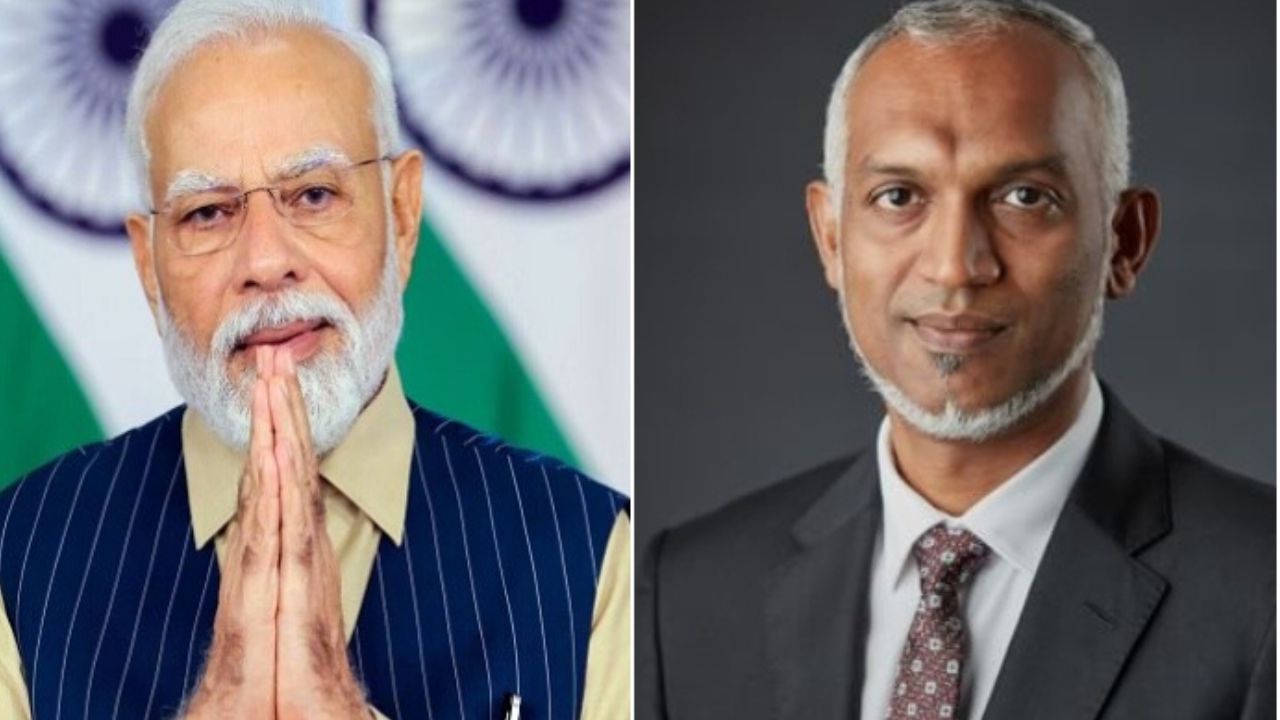
Amidst the ongoing tension between India and Maldives, Mohammad Muizzu, the President of the latter country, has given an ultimatum to India to withdraw its troops from his country by March 15.
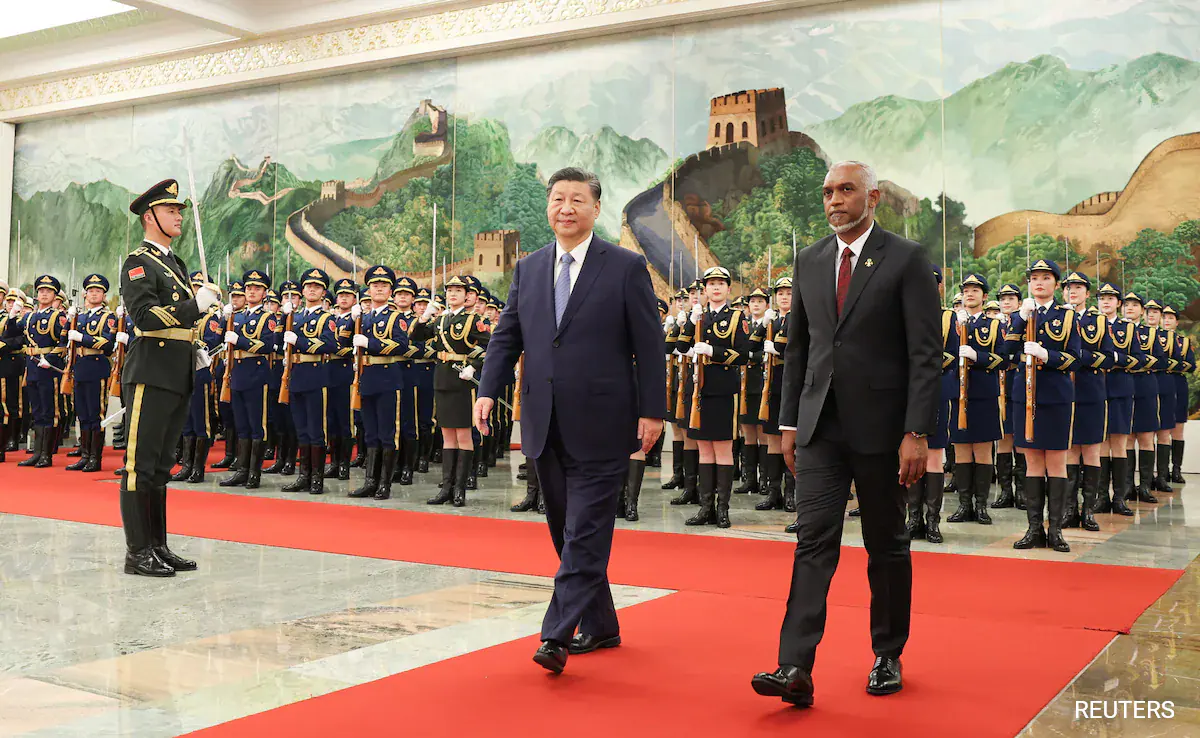
Muizzu, who recently returned from a visit to China, formally asked India to end its army presence in his territory, Abdallah Nazim Ibrahim, the public policy secretary to the president’s office, said at a press briefing.
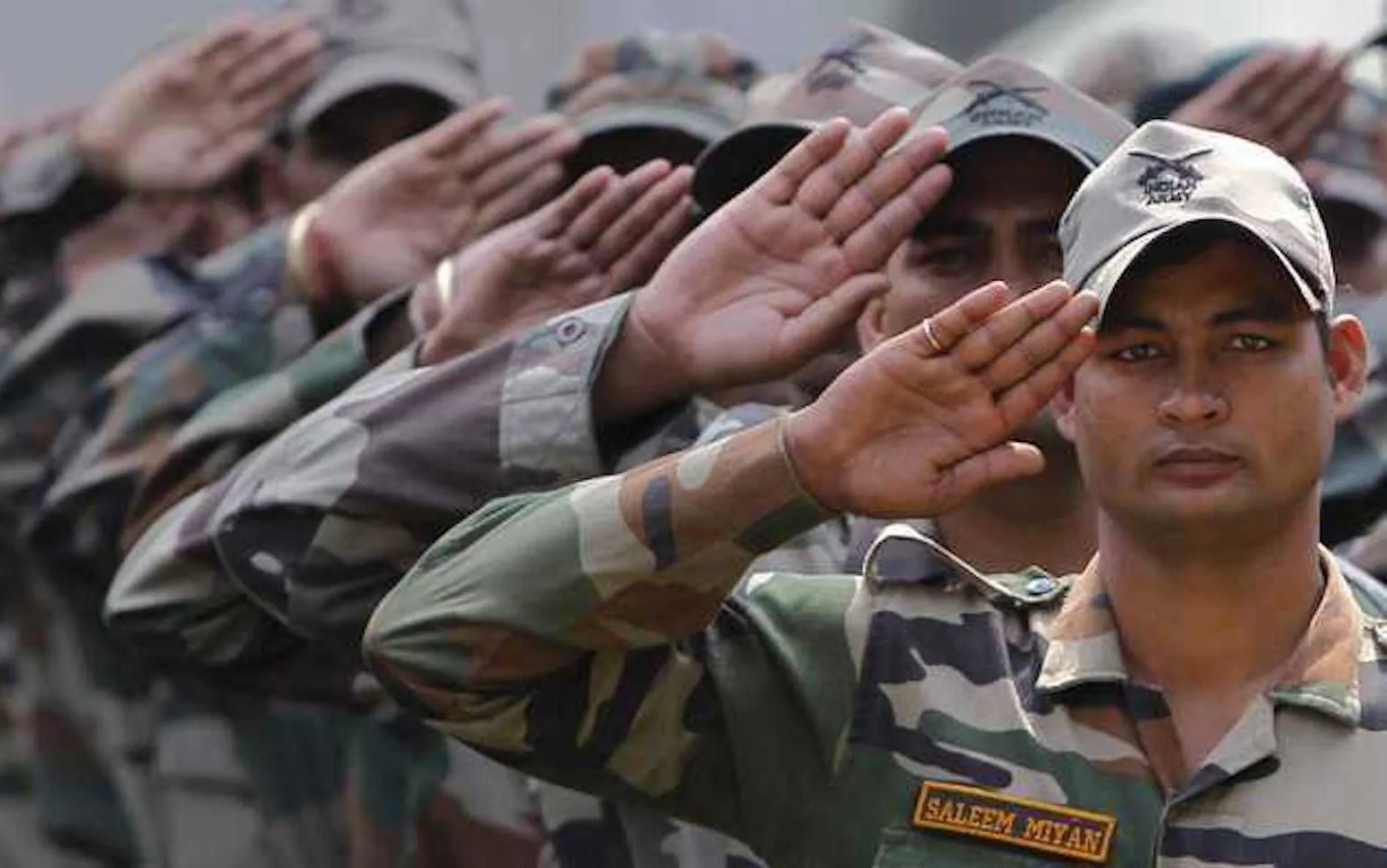
According to the latest government figures, there are 88 Indian military personnel in the Maldives. “Indian Military personnel cannot stay in the Maldives. This is the policy of the President and that of his administration,” he said.
The Indian Ministry of External Affairs has not yet responded to the news.
Relations between India and Maldives have been strained since the formation of the government of the new President in the island nation.
Three months ago, Mueez raised the slogan “India out” in the election and demanded their withdrawal from Maldives.
In a departure from tradition, Muizzu chose Turkey and China instead of India for his first visit, stating that his government reiterated its commitment to withdraw the Indian army from the strategically important region of the country.
Indian troops were deployed at the request of the then government to protect against the threat of insurgency and the Sri Lankan Tamil Tigers. The Indian troops have been stationed in the Maldives since 1988, for non-combat duties including flying, training, and surveillance.
While foreign policy experts conclude that this change of policy is because of his tilt towards China, the President has declared, “We aren’t in anyone’s backyard. We are an independent and sovereign state”. Without naming any country, he said, “We may be small, but that doesn’t give you the license to bully us.”
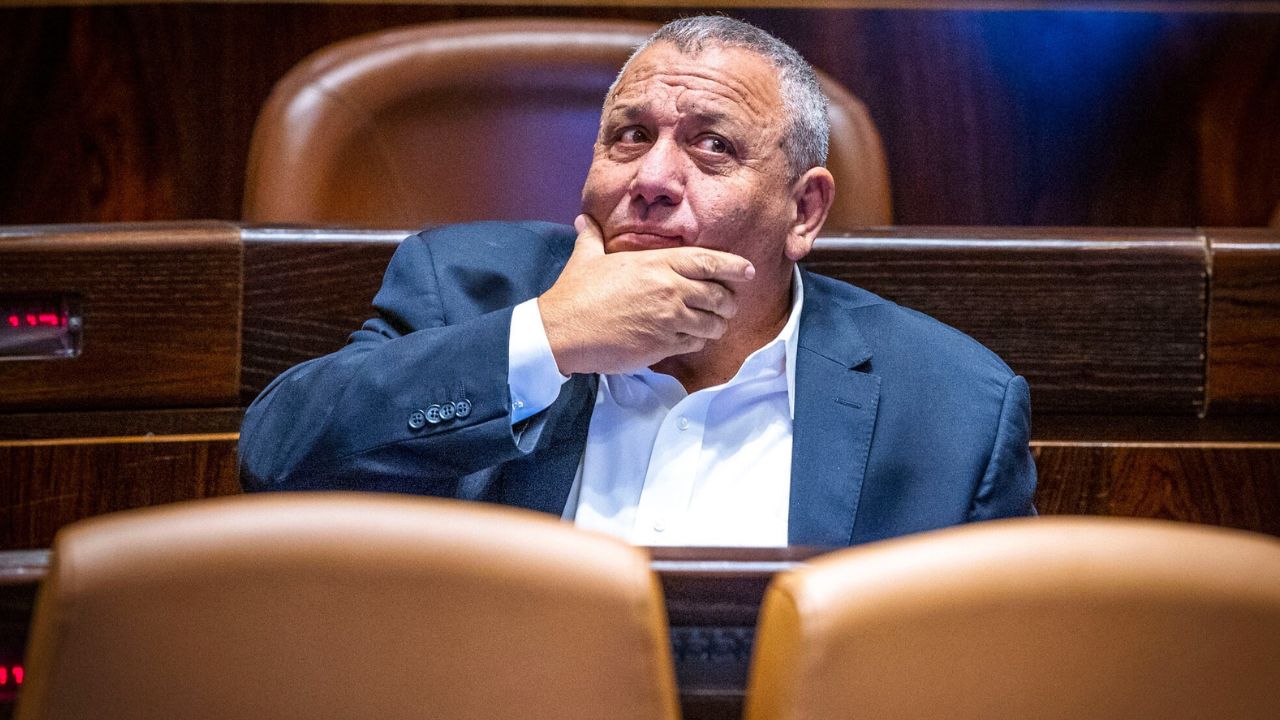
A member of the Israeli war cabinet, Gadi Eisenkot, has told Prime Minister Benjamin Netanyahu in a meeting to “stop lying” to himself.
The Times of Israel has reported that while addressing the cabinet, Eisenkot stated, “We have to stop lying to ourselves, to show courage, and to lead to a large deal which will bring home the hostages. Your time is running out, and each day that passes endangers their lives.”
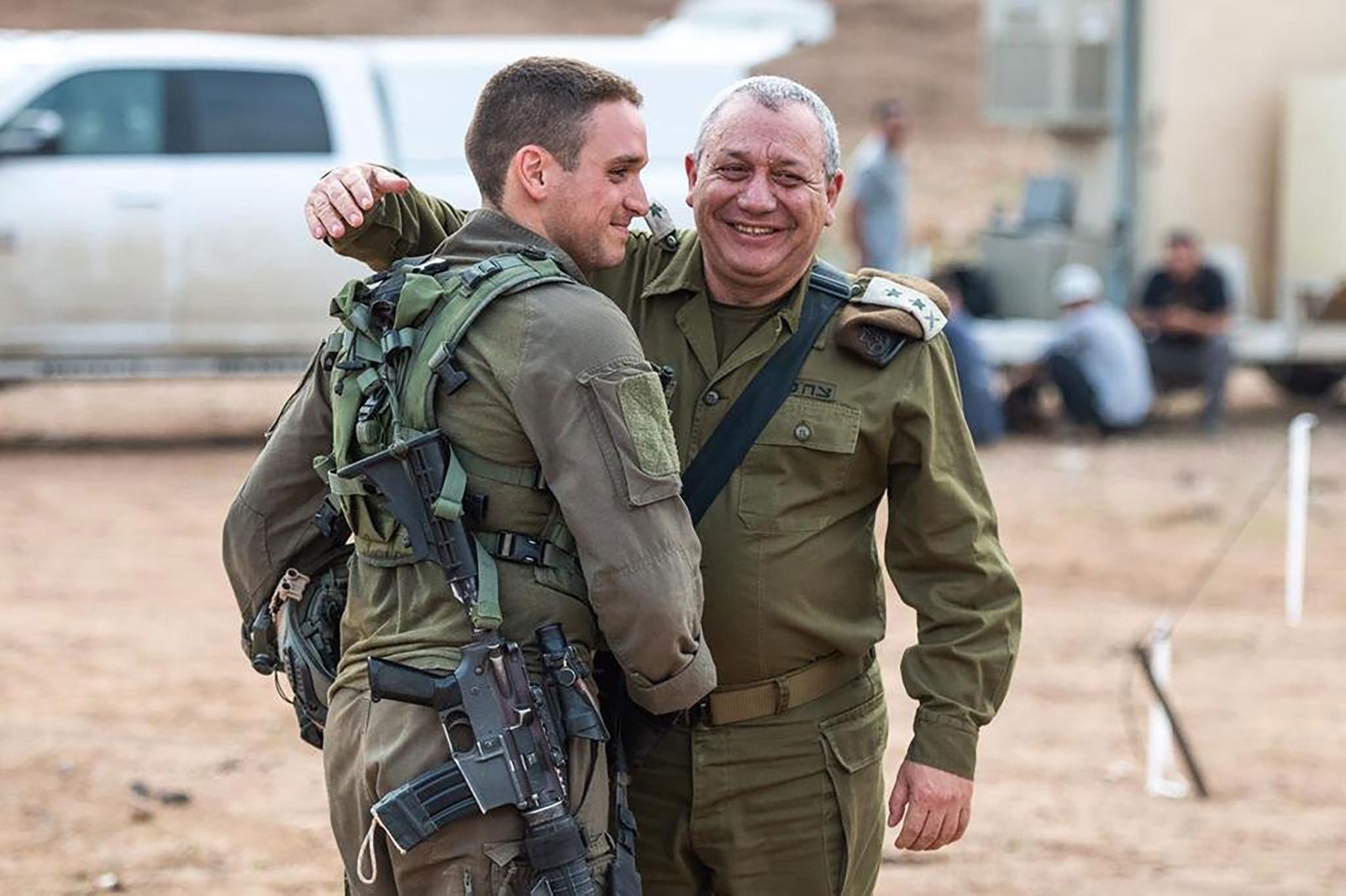
The minister’s son and nephew were both killed fighting in Gaza, leading him to believe that Israel’s leaders are lying to themselves.
Gadi Eisenkot with his deceased son.
However, Netanyahu and Defense Minister Yoav Gallant dismissed the criticism, reiterating their belief that only added military pressure will lead to such a deal.
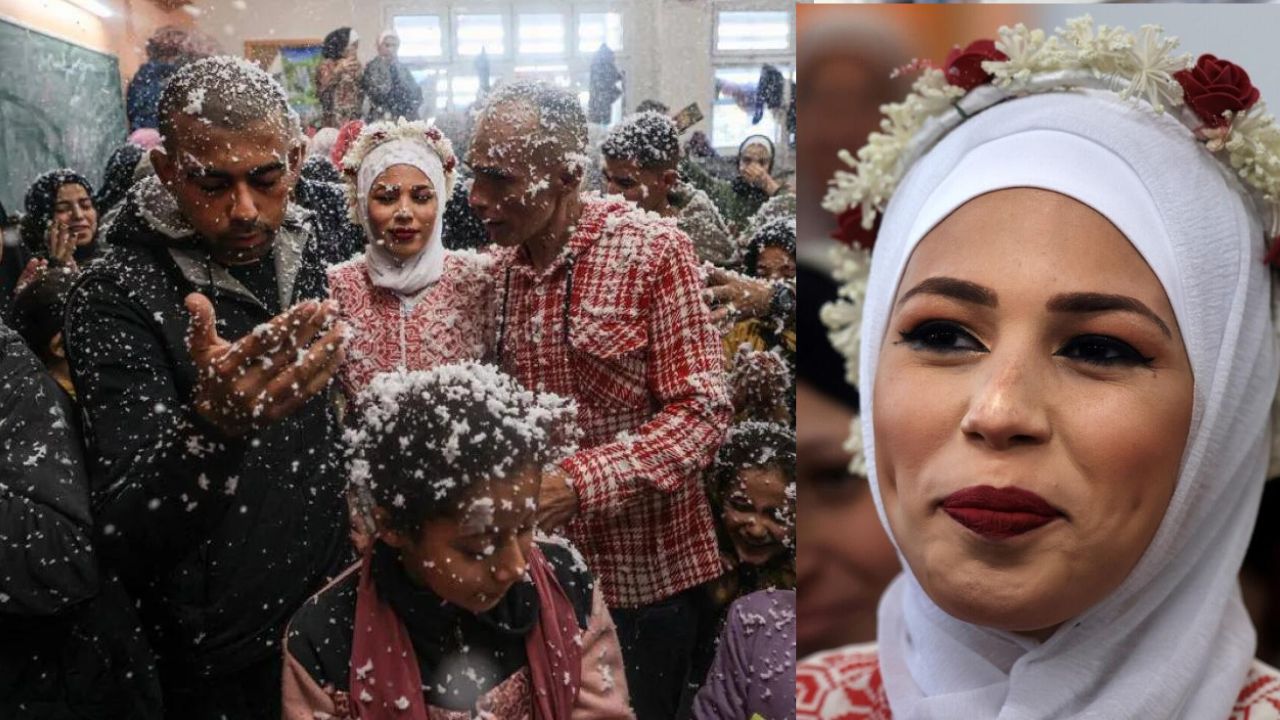
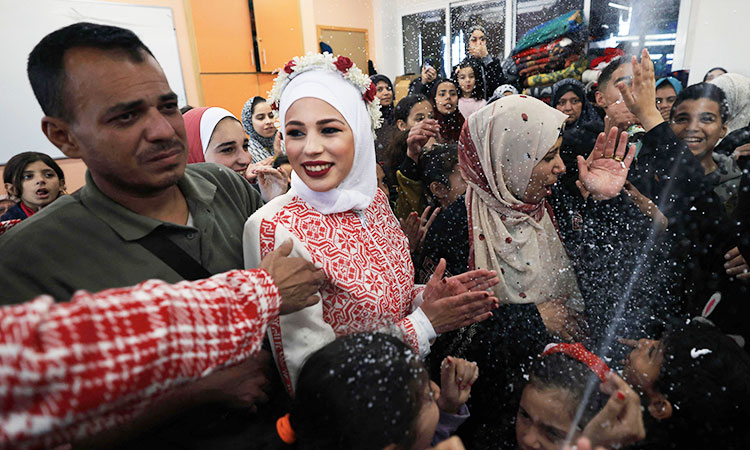
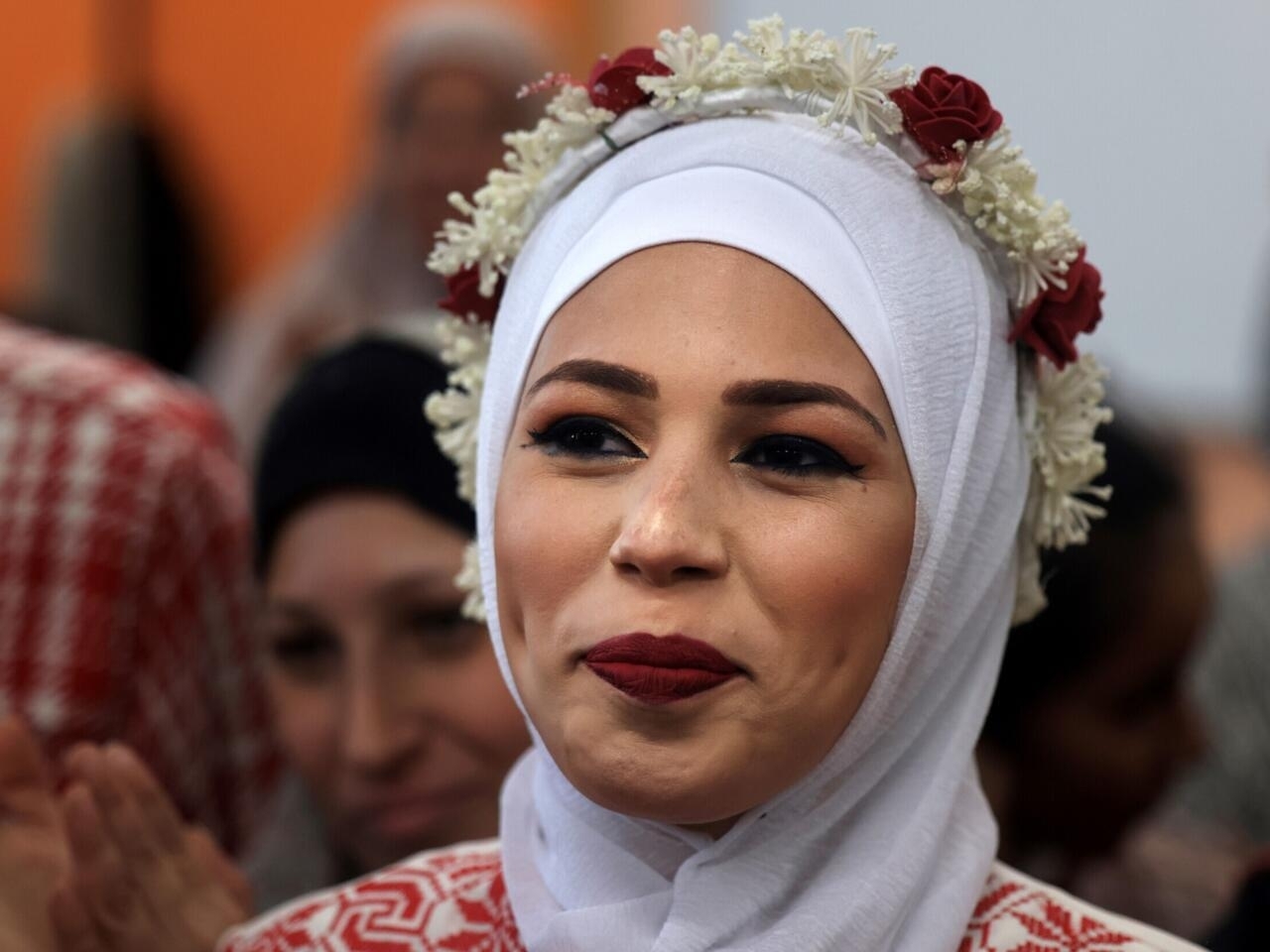
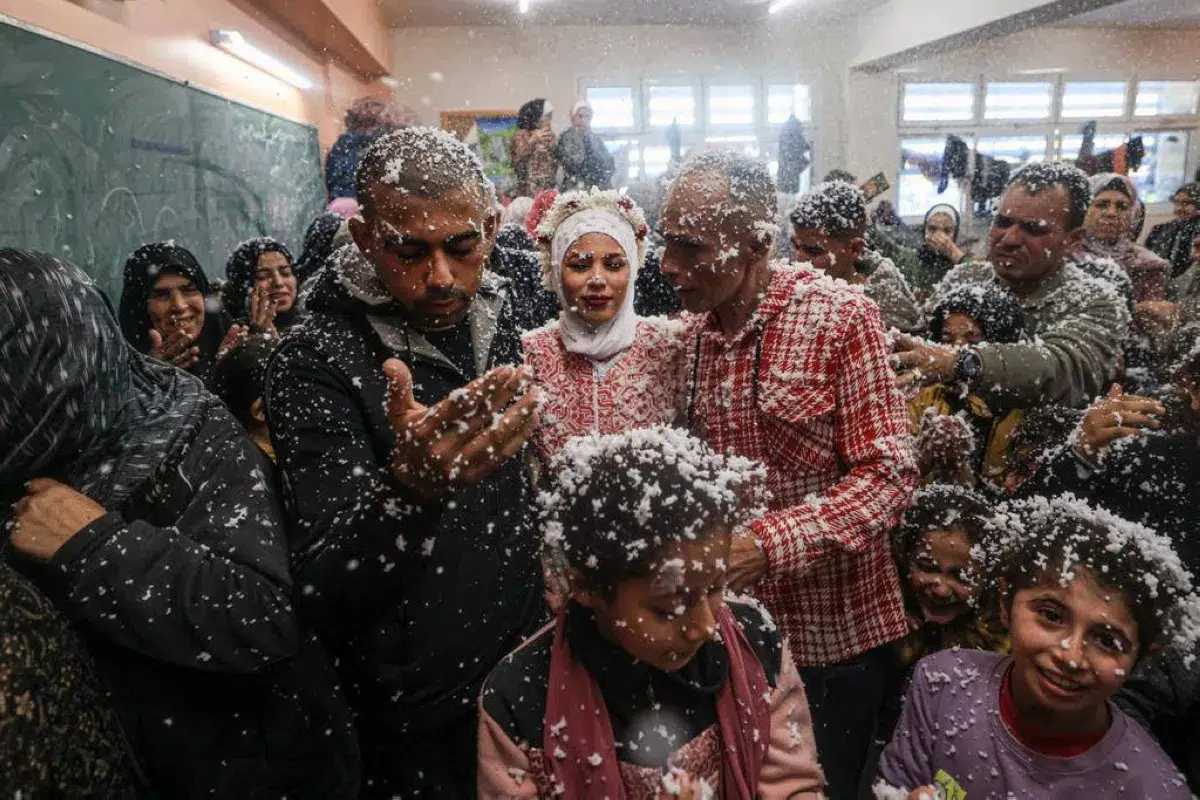
Surrounded by family and friends, clapping and cheering, Gaza woman Afnan Jibril beams a brilliant smile on her wedding day, determined to celebrate even as war rages.
“We are a people that love life, despite death, murders and destruction,” said her father, Mohamed Jibril.
Relatives were gathered on Friday for the wartime wedding in a tiny room at an abandoned school building in the besieged Gaza Strip’s southern city of Rafah, near the frontier with Egypt.
The city has suffered daily Israeli bombardment, and the families of both bride and groom are among hundreds of thousands of Palestinians who have fled the fighting further north.
“The usual preparations for marriage are not possible, and traditional ceremonies are not feasible,” said the bride’s father. “However, clothes are available, although they are scarce and expensive.”
Afnan, 17, donning a crown of flowers and pristine white dress with stark red embroidery, and her partner Mustafa Shamlakh, 26, want to make the most of their rare chance to celebrate.
They dance and laugh as guests spray white mousse around the room.
But eventually they have to face reality.
Israel’s relentless military campaign, triggered by attacks by Palestinian militants, has killed at least 23,843 people, mostly women and children, in Gaza, according to the health ministry in the Hamas-run territory.
The war began when Hamas militants launched an unprecedented attack on October 7, which resulted in about 1,140 deaths in Israel, mostly civilians, according to an AFP tally based on official figures.
The newlyweds make up part of another grim tally — those displaced by the violence, which UN estimates put at 1.9 million Palestinians out of a total population in Gaza of 2.4 million.
“The house where the groom was supposed to live was destroyed,” Ayman Shamlakh, the groom’s uncle, told AFP.
As the war went on, both families felt there was nothing to be gained from waiting and they agreed to the marriage.
After the school celebration, the couple head for a ceremony set to take place in a tent.
As they dive into a waiting black SUV, surrounded by a massive crowd of well-wishers, it almost looks like any other wedding day.
“We are all living through the same tragedy,” said Ayman Shamlakh. “However, we must continue to live, and life should go on.”
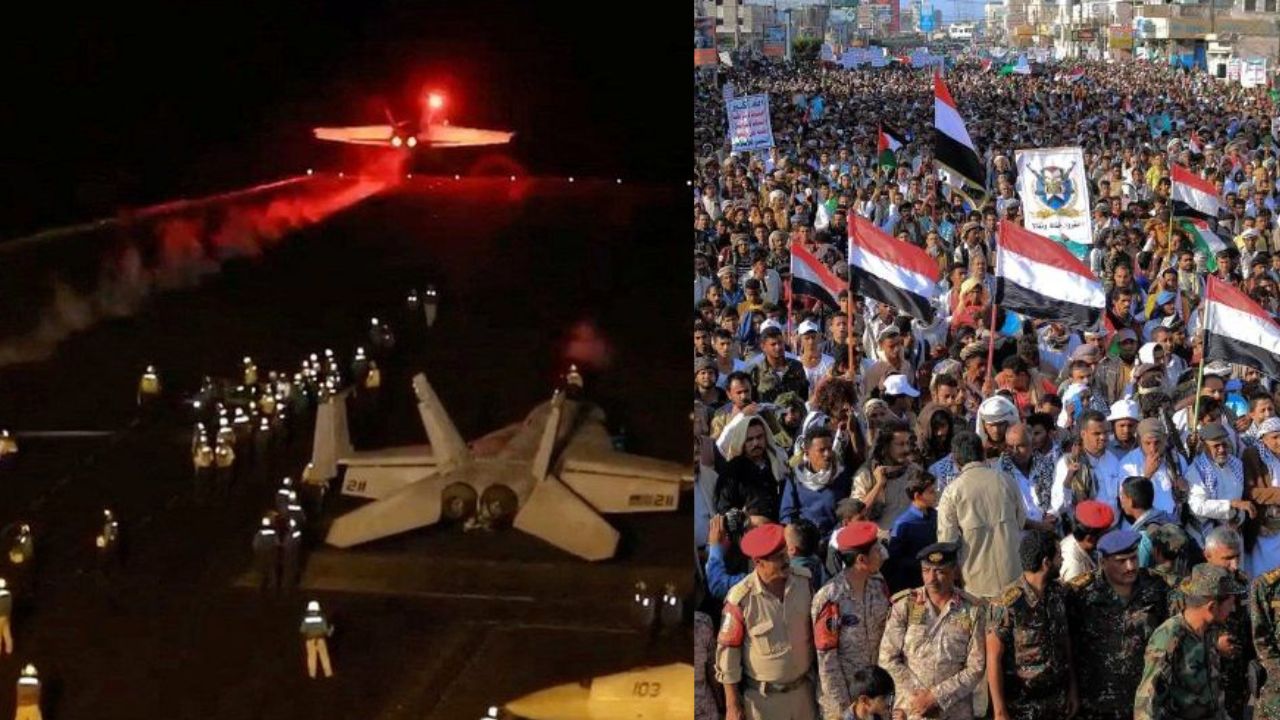
American and British forces have launched fresh raids on Yemen’s capital, Houthi rebel forces confirmed on Saturday, a day after the allies carried out dozens of strikes on the country.
The latest raids targeted Al-Dailami airbase in Sanaa, which has been under Houthi control since 2014, a statement released on their official media stated. “The American-British enemy is targeting the capital, Sanaa, with a number of raids,” Al-Masirah TV posted on X, formerly Twitter, citing its correspondent in Sanaa.”The American-British aggression targeted the Al-Dailami base in the capital, Sanaa,” it added.
Raids on Yemen follow weeks of Houthi attacks on Israel’s ships in the commercial Red Sea in protest against the war on Gaza.
The strike on a Houthi radar site comes a day after scores of attacks across the country heightened fears that Israel’s aggression on Gaza could engulf the whole Arab region.
The Houthis warned that US and British interests were “legitimate targets” after the initial strikes. Britain, the United States and eight allies said strikes carried out on Friday had aimed to “de-escalate tensions”, but the Houthis vowed to continue their attacks. Hussein al-Ezzi, the rebels’ deputy foreign minister, said the United States and Britain would “have to prepare to pay a heavy price”.
The rebels have controlled much of Yemen since a civil war erupted in 2014 and are part of the “axis of resistance” against Israel and its allies.
Violence involving these groups in Yemen, Lebanon, Iraq, and Syria has surged since the war in Gaza began in early October.
BREAKING: Massive United States fleet of warships seen off the coast of Yemen.
The mainstream media does not want you to SHARE this!
UN chief Antonio Guterres called on all sides “not to escalate” in the interest of regional peace and stability, his spokesman Stephane Dujarric said.
The UN Security Council held an emergency meeting on Friday, days after adopting a resolution demanding the Houthis immediately stop their attacks.
At the meeting, US Ambassador Linda Thomas-Greenfield warned that no ship was safe from the threat posed by Houthis to shipping in the Red Sea.
Russian ambassador Vassili Nebenzia denounced the “blatant armed aggression” against the entire population of the country.
Red Sea attacks and the politics of the Middle East
The Houthis have intensified attacks on what they deem Israeli-linked shipping in the Red Sea- through which 12 percent of global maritime trade normally passes- since October 7.
The United States and Britain launched strikes on Friday that targeted nearly 30 locations using more than 150 ammunitions, US General Douglas Sims said, updating earlier figures, and President Joe Biden said he did not believe there were civilian casualties.
Biden called the strikes a successful “defensive action” after the “unprecedented” Red Sea attacks and said he would act again if the Houthis continued their “outrageous behaviour”.
British Prime Minister Rishi Sunak said the Houthis’ breach of international law warranted the “strong signal”, with his government publishing its legal position justifying the strikes as lawful and “proportionate”.
Nasser Kanani, spokesman for Iran’s foreign ministry, said the Western strikes would fuel “insecurity and instability in the region” while “diverting” attention from Gaza.
The Houthis fired “at least one” anti-ship ballistic missile in retaliation on Friday that caused no damage, according to Sims.
The United States said it did not seek conflict with Iran, with National Security Council spokesman John Kirby telling MSNBC there was “no reason” for an escalation.
Middle Eastern leaders voiced concern at the violence, with Turkish President Recep Tayyip Erdogan describing the strikes on Yemen as disproportionate and saying: “It is as if they aspire to turn the Red Sea into a bloodbath.”
Saudi Arabia said it “is following with great concern the military operations” and called for “self-restraint and avoiding escalation”. The kingdom is trying to extricate itself from a nine-year war with the Huthis, though fighting has largely been on hold since a truce in early 2022.
Palestinian freedom fighting group Hamas said it would hold Britain and the United States “responsible for the repercussions on regional security”.
‘Death to America’
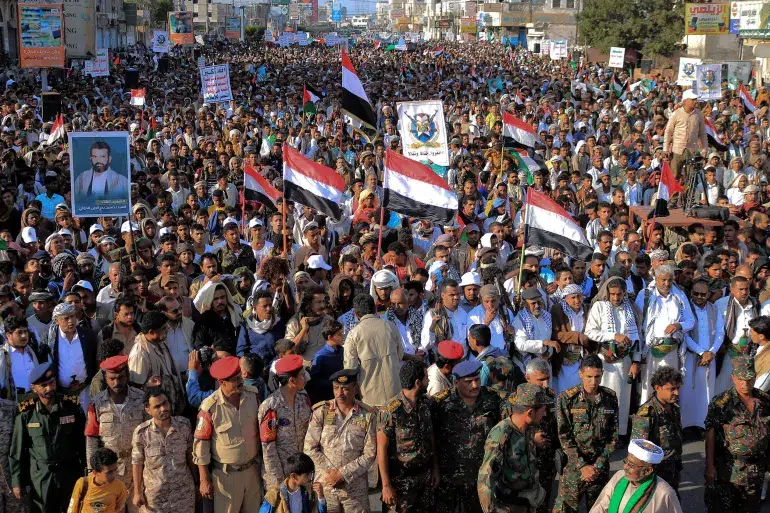
Hundreds of thousands of people, some carrying Kalashnikov assault rifles, gathered in Yemen’s capital Sanaa on Friday to protest, many waving Yemeni and Palestinian flags and holding portraits of Huthi leader Abdulmalik al-Huthi, an AFP journalist reported.
5 million people protested in Yemen today. Does The United States and Israel know what they got themselves into? This is terrifying, pic.twitter.com/MBRw9f8X5r
In Tehran, hundreds rallied against the United States, Britain, and Israel, burning the three countries’ flags outside the UK embassy while voicing support for Gazans and Yemenis, an AFP correspondent reported.
In Gaza, Palestinians lauded Houthi support and condemned Britain and the United States. “No one is standing with us but Yemen,” said Fouad al-Ghalaini, one of hundreds of thousands of Palestinians left homeless by Israel’s bombardment of Gaza City
Social media is a big source of arguments, being the quickest source to share information worldwide. A single picture, especially if posted by someone important, can cause chaos between countries.
Prime Minister of India, Narendra Modi, posted about his recent trip to Lakshadweep on X (former Twitter).
“In addition to the scenic beauty, Lakshadweep’s tranquility is also mesmerising. It gave me an opportunity to reflect on how to work even harder for the welfare of 140 crore Indians,” the caption read.
In addition to the scenic beauty, Lakshadweep's tranquility is also mesmerising. It gave me an opportunity to reflect on how to work even harder for the welfare of 140 crore Indians. pic.twitter.com/VeQi6gmjIM
Social media erupted with calls for boycott of Maldives tours after Maldivian politician Zahid Rameez made objectionable remarks regarding Modi’s visit to Lakshadweep.
The incident led to the trending of the hashtag #BoycottMaldives on X in India.
The controversy unfolded when Rameez, a member of the Progressive Party, responded to a claim suggesting that PM Modi’s visit was a setback for the Maldives and would boost tourism in Lakshadweep.
Rameez mocked Indians, stating that competing with the Maldives for tourism was “delusional.” He questioned how India could match the level of service and cleanliness offered by the island nation, adding that the permanent smell in Indian rooms would be a significant drawback.
Rameez’s remarks ignited a heated exchange on the microblogging site, with many users sharply criticizing him.
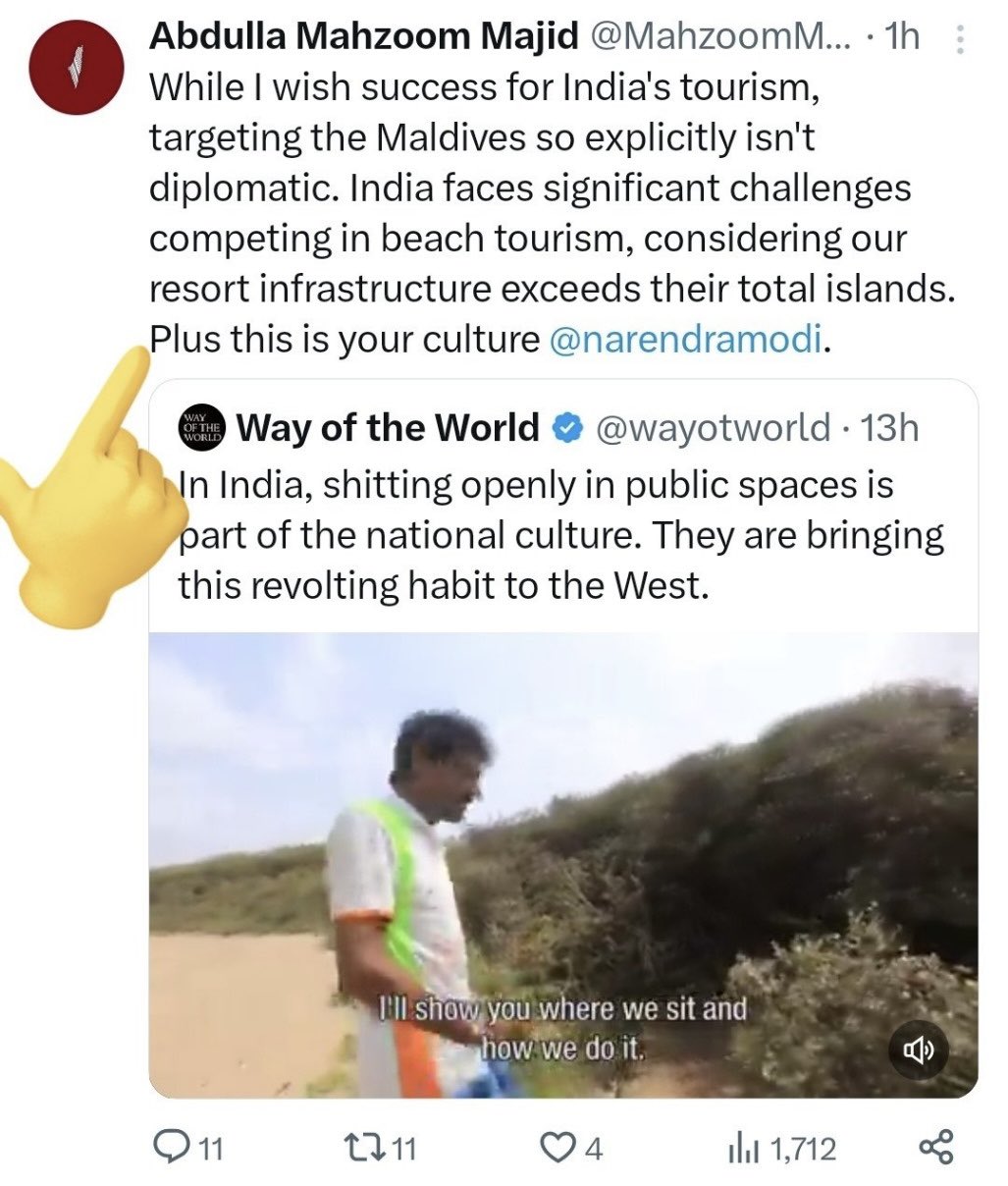
Deputy Minister of the Ministry of Youth Empowerment Maldives, Abdulla Mahzoom Majid, also criticised Modi and said, “While I wish success for India’s tourism, targeting the Maldives so explicitly isn’t diplomatic. India faces significant challenges competing in beach tourism, considering our resort infrastructure exceeds their total islands. Plus this is your culture @narendramodi.”
Subsequently, the hashtag #BoycottMaldives gained traction on social media, with influencers joining the call for a boycott.
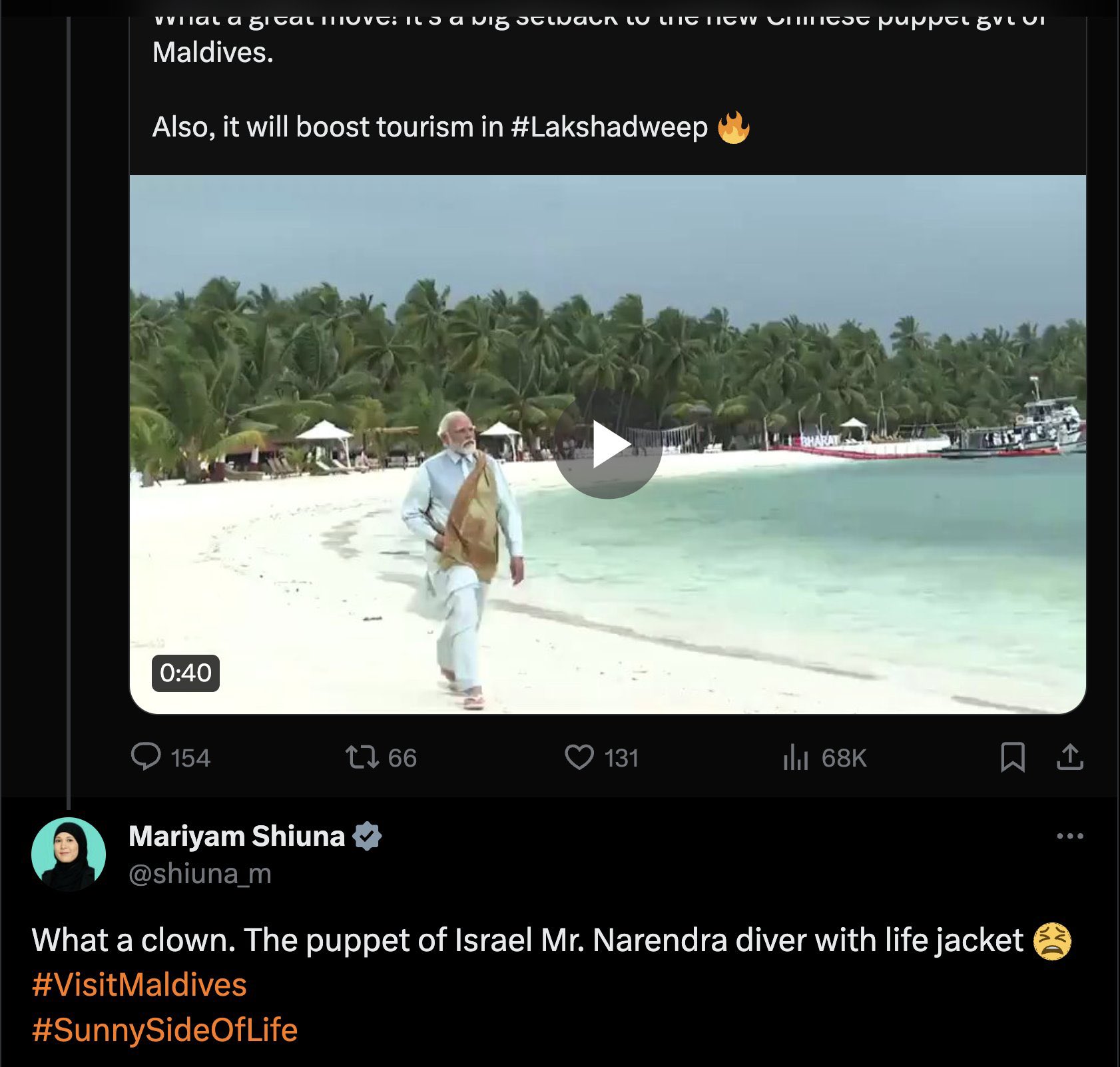
Adding fuel to the fire, Maldivian minister Mariyam Shiuna also made derogatory comments against Prime Minister Narendra Modi in a now-deleted post, further fueling the outrage.
Former President Nasheed urged the Maldivian government to distance itself from the offensive comments made by Shiuna and provide clear assurance to India that they do not reflect official government policy.
“What appalling language by Maldives Government official @shiuna_m towards the leader of a key ally, that is instrumental for Maldives’ security and prosperity. @MMuizzu gov must distance itself from these comments and give clear assurance to India they do not reflect gov policy.”
What appalling language by Maldives Government official @shiuna_m towards the leader of a key ally, that is instrumental for Maldives’ security and prosperity. @MMuizzu gov must distance itself from these comments and give clear assurance to India they do not reflect gov policy.
In response to the growing calls for a boycott, several Indian celebrities, including Akshay Kumar and Sachin Tendulkar, took to social media.
Came across comments from prominent public figures from Maldives passing hateful and racist comments on Indians. Surprised that they are doing this to a country that sends them the maximum number of tourists. We are good to our neighbors but why should we tolerate such… pic.twitter.com/DXRqkQFguN
250+ days since we rang in my 50th birthday in Sindhudurg!
The coastal town offered everything we wanted, and more. Gorgeous locations combined with wonderful hospitality left us with a treasure trove of memories.
They promoted the hashtag ‘#ExploreIndianIslands,’ encouraging fellow citizens to support domestic tourism.
Former Indian cricketer Akash Chopra urged Indians to choose wisely in light of the political tensions, emphasizing the importance of national dignity.
‘India Out’ was a part of the manifesto. Maldives voted for it. Now, it’s up to us, Indians, to choose wisely. I know that my family will. Jai Hind 🇮🇳
It is so cool to see our Hon PM Narendrabhai Modi at the beautiful clean n stunning beaches of Lakshadweep, and the best part is that yeh hamare India mein hain.
Minister of Foreign Affairs of Maldives, Moosa Zameer, said, “The recent remarks against foreign leaders and our close neighbours are unacceptable and do not reflect the official position of the Government of #Maldives. We remain committed to fostering a positive and constructive dialogue with all our partners, especially our neighbours, based on mutual respect and understanding.”
The recent remarks against foreign leaders and our close neighbours are unacceptable and do not reflect the official position of the Government of #Maldives.
We remain committed to fostering a positive and constructive dialogue with all our partners, especially our neighbours,…
As the controversy continues to unfold, diplomatic relations between India and the Maldives face a test, with the tourism industry caught in the crossfire of political tensions.
Four people have been killed and 40 hospitalised after consuming tainted alcohol in southern Tunisia, an official said.
An inquiry has been opened and the person who supplied the alcohol has been arrested, Fethi Baccouche, a spokesman for the Medenine court, told AFP.
An analysis of the alcohol is underway to determine what was behind the mass poisoning.
Of the 40 surviving victims, most left hospital but some were transferred to the capital Tunis for treatment, Baccouche said, without providing exact numbers.
Poisonings from incorrectly produced or adulterated alcohol are common in Tunisia and often fatal.
In 2021, Tunisian health authorities announced five deaths and the hospitalisation of 25 more in Kasserine in the country’s west after they drank contaminated alcohol.
And in May 2020, 39 people were poisoned, including six who died, after drinking methanol near the city of Kairouan.
The consumption of home-made alcohol is common in some working-class neighbourhoods of Tunis and remote regions of the country where poverty rates are high.
The alcohol, which is illegal, is often much cheaper than that sold in shops.