Category: National

  • Opposition parties criticise PTI govt over TLP protests

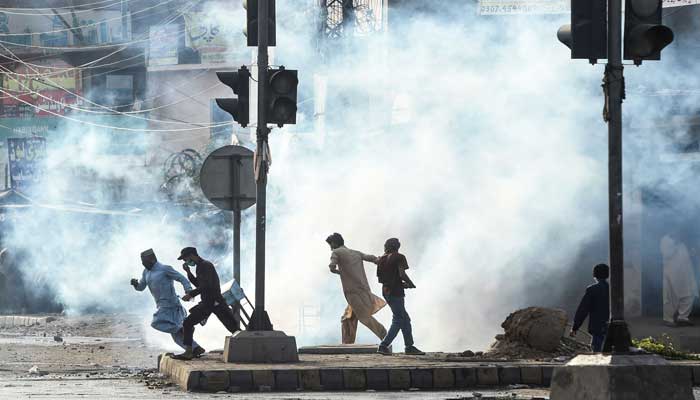
    Sunday’s clashes between the Punjab Police and Tehreek-e-Labbaik Pakistan (TLP) workers led to reactions from various political parties as well as religious groups. Here is a recap:

    Maulana Fazlur Rehman

    Addressing the media on Sunday night,  Jamiat Ulema Islam-Fazl (JUI-F) chief Maulana Fazlur Rehman said that this situation should be resolved wisely. He said that if the TLP comes to Islamabad, the JUI-F will support them. He criticised the government for declaring TLP a terrorist party.

    Bilawal Bhutto-Zardari

    Chairman Pakistan People’s Party (PPP) Bilawal Bhutto-Zardari condemned the violence in Lahore and other parts of the country. He expressed grief over the loss of lives, including those of policemen and civilians, as the direct result of the PTI government’s inability to handle the situation peacefully.

    “The real fight is about fighting against the root of the festering problem, not in just responding to the symptoms. Why has the selected government not bothered to implement the National Action Plan, or even discuss arising challenges in parliament,” said Mr Bhutto. He pointed out that the tendency to foster and coddle pressure groups through instigating ethnic, religious and sectarian hatred had begun during Zia’s regime, to squeeze mainstream national political parties. He added that it was painfully clear that we have failed to understand that no one can consistently play with fire without getting burnt themselves.

    Shahid Khaqan Abbasi

    PML-N leader Shahid Khaqan Abbasi strongly condemned the violence in Lahore. In a statement, Mr Abbasi said that the Pakistan Democratic Movement (PDM) believes that “Namoos-e-Risalat (sanctity of prophethood) is the foundation of a Muslim’s ideology. No Muslim can compromise on it.” He criticised the government for its failure to establish peace in the country. “PDM stresses that peace and stability will only be established in Pakistan when it is run according to the Constitution and people’s wishes,” added Abbasi.

    Mufti Muneebur Rehman

    On Sunday night, former Ruet-e-Hilal Committee chairperson Mufti Muneebur Rehman called for a countrywide strike the next day (Monday). Several otherst religious leaders have supported Mufti Muneeb’s strike call, including Maulana Fazlur Rehman.

    Mustafa Nawaz Khokhar:

    PPP Senator Mustafa Nawaz Khokhar called Maulana Fazl’s statement “irresponsible”. He said that it is not right to use what happened in Lahore for political point-scoring. Khokhar also said that Mufti Muneeb is also settling a score with the government after he was removed from his post as the chairperson of Ruet-e-Hilal Committee. Khokhar asked why the government had signed an illegal and unconstitutional agreement with the TLP back in November.

    Agreement signed between PTI govt and TLP in Nov 2020

    Sindh High Court Bar Association 

    The Sindh High Court Bar Association condemned the utter failure of the PTI government to peacefully resolve this crisis. “The government’s reaction has swung from willful blindness to disproportionate and lethal force.” It also condemned the “unconstitutional gagging of electronic media in relation to the protests”.

    Meanwhile, Geo News reported that  a delegation of ulema led by Sahibzada Hamid Raza met the banned TLP chief Saad Rizvi in jail on Monday and urged him to end the protests taking place in the country by releasing a video message.
  • Round Three: Sheikh Rasheed to meet TLP workers tonight

    Round Three: Sheikh Rasheed to meet TLP workers tonight

    At 10 PM tonight, Interior Minister Sheikh Rashid and Religious Affairs Minister Pir Noorul Haq Qadri will, yet again meet workers of the recently banned Tehreek-e-Labaik Pakistan (TLP) for a third round of talks.

    Information Minister Fawad Chaudhry tweeted that the second round of talks had ended earlier today.

    The first round, led by Punjab Governor Chaudhry Sarwar, had taken place yesterday after which 11 police hostages were released by the TLP. The first talks took place after a day of clashes between workers and the police.

    Although Prime Minister Khan, in his address to the nation, clearly said that the approach taken by the TLP to the French backing of blasphemous cartoons is wrong, the TLP has put forward four demands. They want the French ambassador to be sent back to France, the part chief Saad Rizvi to be released, the ban on the party to be removed and the arrested workers to be released. PM Khan has clearly stated that his approach, which includes uniting the Muslim world should be adopted by the country, and that the TLP is trying to show that they ‘feel more passionate’ about the Holy Prophet (PBUH) which is not true.

    It remains to be seen what happens in the meetings between the TLP and the government. However, PM Khan mentioned that the violent protests done by the banned party had led to the killing of four police officers, 800 officers injured, 40 police cars destroyed and millions of rupees lost in the destruction of private property.

  • TLP’s way is not the answer – PM Khan addresses the nation

    TLP’s way is not the answer – PM Khan addresses the nation

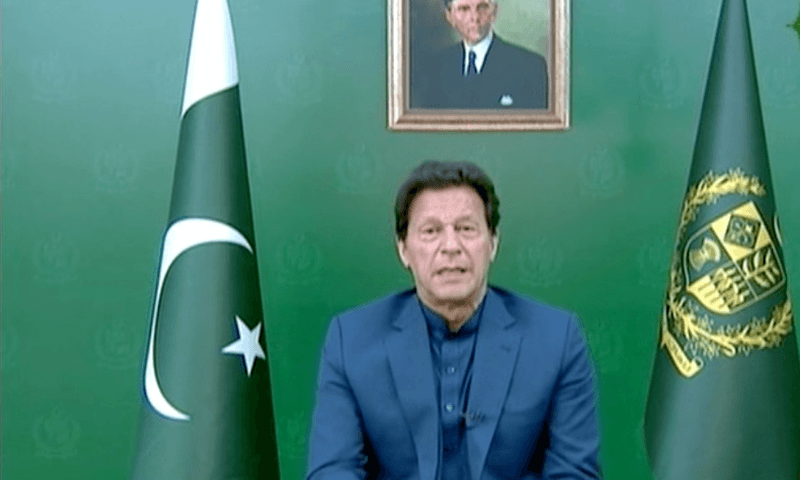
    Prime Minister Imran Khan addressed the nation earlier today, giving a detailed update on the prevalent security situation in the country. He said that he decided to do this after the tense situation last week.

    PM said Pakistan is the only country to have been made in the name of Islam. “I have travelled the entire Pakistan. Our people love the Prophet (PBUH) with all their heart. Whenever there is anything blasphemous, we do not tolerate it. Any Muslim in any part of the world gets hurt by such blasphemous content. We are no different.”

    PM Khan said that last week, the TLP tried to show as if it loves the Prophet (PBUH) more than others. “What the TLP wants, we also want — i.e. no blasphemy against our Prophet (PBUH),” but he stated that the approach is and should be different to dealing with the issue.

    “TLP has demanded that the French Ambassador should be sent back, ” the PM said, “we have a different approach from them but our (government’s) goal is the same.”

    He repeatedly stated that he understands the way western countries think and nothing we do in our country will change the way the West thinks. “I understand the West and this approach will not help. The West has made this an issue of freedom of speech and this (riots in Pakistan) will not make a difference to France.”

    He then stated the loss of life and property that the violent riots had caused in Pakistan. “Four police officers lost their lives and 800 were injured, ” Khan stated, “40 police cars were burnt and millions of rupees in damages were caused to personal properties.” He also stated that many oxygen cylinders were not able to make it to corona patients due to the riots.

    He then explained his approach to the nation. “Our rupee is finally stabilising, our economy is getting better. When we send France’s ambassador back, we break relations with the European Union (EU),” he emphasised, “Which means we lose our textile exports to the EU. This means we lose jobs and poverty will increase. We will lose, not France.”

    He explained that he had been developing his approach since 2019 when he first addressed the United Nations and told the world that the actions of the West hurt the Muslim world. Therefore, he suggests that the Muslim world come together and in a united front, state that blasphemy against the Holy Prophet (PBUH) is unacceptable. He went on to say that if the West does not stop hurting Muslim sentiments – like they have for the Jews and the Holocaust – then the Muslim world should boycott trade with the West.

    “We tried to explain this to TLP,” Khan said, “We were in discussions with them and said we can bring this up in the assembly. But we realised they were preparing for something else and soon thereafter, they announced that they would do a dharna. Which is when our discussions with them stopped.”

    Khan also made a pertinent point as to the riots affecting Pakistan and no one else. “The crime happens somewhere else, and we hurt ourselves? How does that make sense?” he asked, “We need to come together. Our economy is getting better. The country is going in the right direction. This is not the time to hurt our country.”

    PM Khan also gave the example of former PM Nawaz Sharif not raising his voice against Salman Rushdie and his blasphemous book, ‘The Satanic Verses’. “I am speaking up against blasphemy done by the West but former PM Nawaz Sharif did not when Salman Rushdie’s book came out.”

    PML-N’s Ahsan Iqbal later tweeted that the book did not in fact come out during the tenure of Sharif. It came out in 1988. Sharif came to power in 1990.

  • PM Imran to address the nation today at 4:30pm

    PM Imran to address the nation today at 4:30pm

    Prime Minister Imran Khan will address the nation at 4:30 pm today. During his speech, PM Imran will take the nation into confidence over the security situation in the country due to violent protests by the recently banned Tehreek-e-Labbaik Pakistan (TLP).

    Eleven policemen and five other security officials who were taken hostage on Sunday were released by TLP Monday morning after a successful round of talks with the Punjab government.

    Interior Minister Sheikh Rashid said that the PM will deliver a historic speech today.

    Addressing the groundbreaking ceremony for the Margalla Highway in Islamabad, PM Imran said that it was unfortunate how political and religious parties in the country misuse Islam and damage their own country. PM said that he was saddened that many times our love [for the Holy Prophet (PBUH)] is misused. He said we all love our Prophet (PBUH).

    “I haven’t seen as much affection and respect for the Holy Prophet (PBUH) in any country other than Pakistan,” remarked the premier.

    Religious parties and traders have called for a countrywide strike today in support of the banned TLP.

  • Policemen taken hostage by TLP released after successful talks with Punjab govt

    Policemen taken hostage by TLP released after successful talks with Punjab govt

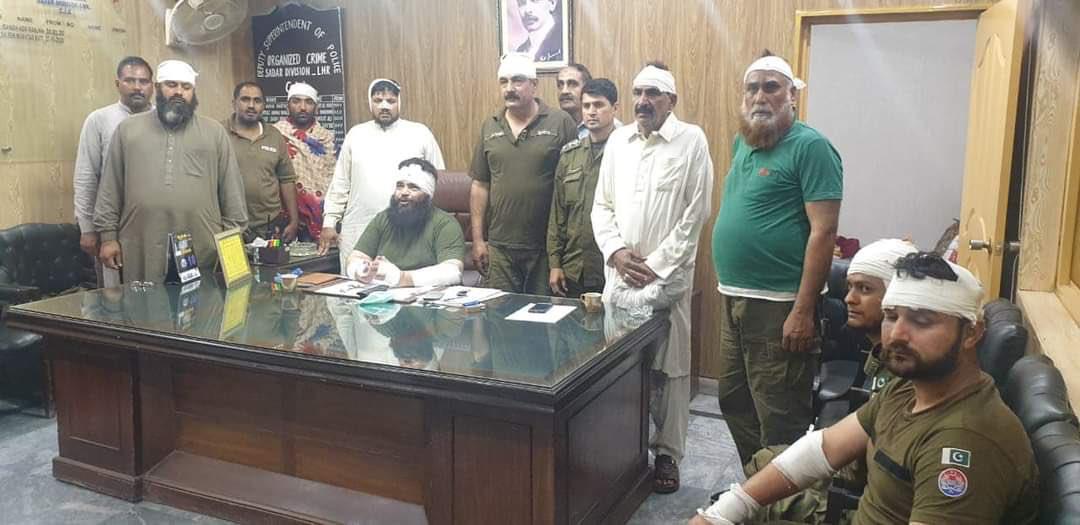
    Federal Minister for Interior Sheikh Rashid Ahmed announced this morning that after a successful first round of talks between the Punjab government and the recently banned Tehreek-e-Labbaik Pakistan (TLP), 11 policemen who had been taken hostage on Sunday have been released.

    In a video statement released in the wee hours of April 19, Rasheed said that the first round of talks was successful and he was hopeful that the second round of talks after sehri would also be fruitful. The minister hoped that matters would be resolved amicably. Four demands have been put forth by the proscribed party: 1) release of TLP leader Saad Rivi, 2) Lift the ban on TLP, 3) FIRs against TLP workers be quashed and TLP workers released, 4) expel the French ambassador.

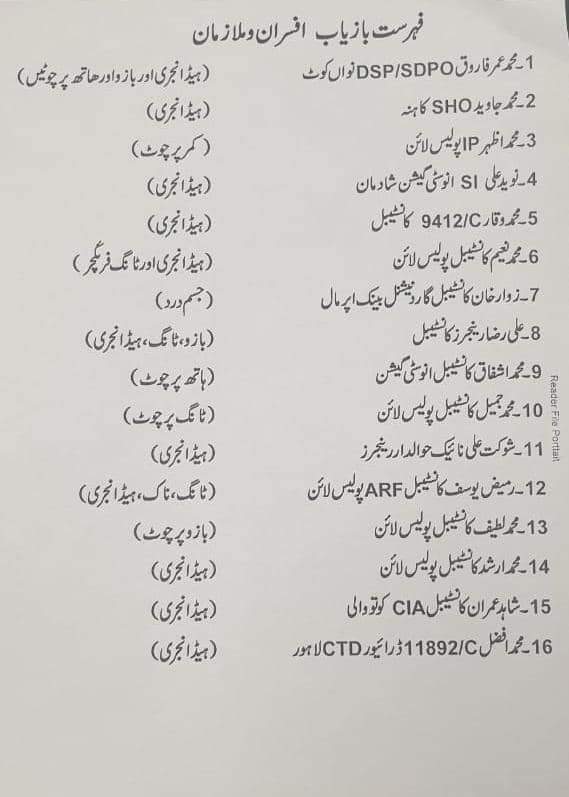
    As per the list released to the media, the total number of released hostages was 16, which included 11 policemen and other staff members. Most of the officials had head injuries as well as other injuries due to torture. Geo News had reported that the hostages were kept in the basement of a mosque.

    List of policemen and security staff released

    Dawn reported that Lahore CCPO Ghulam Mehmood Dogar had participated in the operation to free the officials. “Police contingents, as well as Rangers, have been deployed at sensitive areas across the city,” said the spokesperson for the Lahore Police.

    Countrywide protests erupted on Monday after security forces detained TLP chief Saad Hussain Rizvi in Lahore. Rizvi’s detention quickly sparked violent protests by TLP workers in cities around the country. Videos of policemen being beaten up by the protesters went viral on social media. Some police officials tweeted about the writ of the state.

    Later, the government had taken the decision to ban TLP under Section 11(B) of the Anti-Terrorism Act, 1997.

    On Sunday, violence erupted in Lahore’s Chowk Yateem Khana after the TLP workers attacked a police station and abducted the DSP, according to the Punjab Police. A statement by the Punjab Police said that “miscreants were armed and attacked Rangers/Police”.

  • PM wants world to look at blasphemy like Holocaust

    Prime Minister Imran Khan on Saturday urged the Western countries to outlaw rising instances of blasphemy, just as some countries restrict anti-Semitic speech or Holocaust denial.

    In a series of tweets, the prime minister condemned “extreme right politicians” in the West who “deliberately indulge” in willful and intentional provocations under the “guise of freedom of speech”.

    The premier made it clear that the government took action against TLP under the anti-terrorism law when it challenged the writ of the state and used street violence, as no one can be above the law and the country’s constitution.

    “Let me make [it] clear to people here and abroad [that] our government only took action against TLP under our anti-terrorist law when they challenged the writ of the state, used street violence and attacked the public and law enforcers. No one can be above the law and the Constitution,” the premier said in his tweets.

  • PTI govt’s fourth finance minister in two years here for only six months?

    PTI govt’s fourth finance minister in two years here for only six months?

    As the government has decided to appoint Shaukat Fayyaz Ahmed Tarin as the new minister of finance and revenue, it needs to get him elected as the member of parliament within six months to have him continue in office, reports said.

    This is the same as witnessed in Hafeez Shaikh’s case earlier.

    In yet another shuffle in the federal cabinet, Prime Minister Imran Khan on Friday removed Hammad Azhar from the Finance Ministry less than a month after his appointment and replaced him with Tarin.

    Prime Minister Imran, instead of appointing Tarin as his adviser on finance, appointed the banking wizard as the finance minister, for which, as per law, he needs to be a member of parliament within six months.

    While most ministers have to be elected representatives – i.e. members of the National Assembly (NA) or Senate – there is a clause in the Constitution that allows short-term appointments of non-elected ministers.

    According to clause nine of Article 91 of the Constitution, a non-elected person can be appointed a federal minister for six months once during the five-year tenure of the NA.

    “A minister, who, for any period of six consecutive months, is not a member of the National Assembly, shall, at the expiration of that period, cease to be a minister and shall not before the dissolution of that assembly be again appointed a minister unless he is elected a member of that assembly,” reads the clause.

    It is worth mentioning here that Tarin had become a senator and the federal finance minister in former president Asif Ali Zardari’s government.

    According to an official at the Finance Ministry, Tarin, who was the finance minister during the Pakistan People’s Party (PPP) tenure, would help the government in resolving many issues. As he had completed the 7th National Finance Commission (NFC), he may play an important role in resolving the longstanding issues related to the next NFC. No NFC award was given after the 7th NFC as differences between the Centre and provinces remained unresolved.

    As Tarin had also signed the International Monetary Fund (IMF) programme during the PPP government, he may also handle matters with the IMF to complete the existing loan programme signed by the Pakistan Tehreek-e-Insaf (PTI) government. Islamabad had signed the 39-month bailout programme with the IMF to avert sovereign default because of a balance-of-payment crisis.

    As the finance minister under the PPP government, Tarin had signed the bailout programme with the IMF under that government and concluded the seventh NFC Award. However, he left the ministry without completing his tenure to start his own bank, Silk Bank, where he served on the top slot.

    These changes come at a time when Pakistan has just received another $500 million from the IMF as part of the $6 billion bailout package it signed in July 2019.
    The third and latest tranche of the program brings the total borrowing for budget support to $2 billion.

    Tarin was already a member of the prime minister’s Economic Advisory Council. He is a banker by profession and worked as the president of HBL in 1997. In 2000, he built Union Bank, which was later sold to Standard Chartered Bank.

    Earlier this month, it was reported that the government had made an offer to Tarin to join the federal cabinet as special assistant or adviser to the PM, but he linked his joining the federal cabinet with the decision on an accountability reference that he has been facing for nearly a decade.

    He had that said he would not accept the offer, which he claimed had been made for a second time, unless a case against him filed by the National Accountability Bureau (NAB) was disposed of.

  • UAE-brokered Pak-India peace a ‘tactical move’

    United Arab Emirates-brokered backdoor diplomacy has brought a thaw in otherwise mounting tensions between nuclear-armed Pakistan and India, but it is no more than a “tactical move”, foreign media reports quoted local experts as saying.

    Senior Pakistani and Indian intelligence officials held a series of secret meetings in Dubai in January this year in an attempt to stem the escalating tensions along the Line of Control (LoC), a de facto border that divides the disputed Kashmir valley between the two neighbors.

    Last month, the two militaries agreed to honor the 2003 cease-fire along the LoC, followed by an exchange of letters between the two premiers, which was widely viewed as an outcome of the backdoor diplomacy.

    The UAE’s ambassador to the US, Yousef Al Otaiba, confirmed Wednesday that the Gulf state is mediating between New Delhi and Islamabad to help them reach a “healthy and functional” relationship.

    Addressing a virtual session with Stanford University’s Hoover Institution, Otaiba said his country had a role behind the cease-fire at the Kashmir border, which hopefully ultimately would get relations back to a “healthy level.”

    “The ongoing cease-fire [at the Kashmir border] is certainly the outcome of the backdoor diplomacy, which is benefitting Kashmiris living on both sides of the border,” retired Lt. Gen. Talat Masood, an Islamabad-based defense analyst, told Anadolu Agency.

    “But this is all merely tactical. How long this (thaw) survives, we’ll have to wait and see,” said Masood, who served in the Pakistan Army from 1952 to 1990.

    This, he added, is not the first time that back-channel contacts have helped ease tensions between the two arch rivals.

    “It has happened on several occasions,” he said.

    Echoing Masood’s view, Ikram Sehgal, a Karachi-based defense and security expert, appeared to be skeptical about the significance of the latest developments.

    “Certainly, the UAE has interests both in India and Pakistan, and it will do its best to normalise things between the two neighbors. But in the given circumstances, it will not last long,” Sehgal told Anadolu Agency, referring to a host of land and sea disputes between the two neighbors, mainly over Kashmir.

    “One should try to be optimistic about these developments, which, although, are not very significant,” he maintained.

    Relations between India and Pakistan plummeted to a new low after August 2019, when India scrapped the longstanding special status of Jammu and Kashmir, prompting Islamabad to downgrade its diplomatic ties with New Delhi.

    Islamabad says the normalisation of ties with New Delhi is linked to a review of the Aug. 5 decision and ultimate resolution of the Kashmir dispute.

    ‘NO CHANGE IN STANCE ON KASHMIR’:

    Masood does not see any change in both countries’ stand on Kashmir following the back-channel diplomacy.

    “There is a zero chance of change in India’s current position on Kashmir. It will not reverse its August 2019 decision because it feels that Pakistan cannot do anything except for diplomatic lobbying,” he went on to argue, adding “New Delhi is more interested in talks on trade, business and tourism, whereas Islamabad’s focus is on Kashmir.”

    “India will be happy with backdoor or open diplomacy as long as it serves to maintain the current status on Kashmir,” he further said.

    “In my opinion, open and backdoor diplomatic contacts will continue, however the level of flexibility to resolve the disputes is the most important factor to watch.”
    Sharing a similar view, Sehgal, who is editor of a local defense magazine, Defense Journal of Pakistan, said New Delhi’s “downplaying” of actual issues with Islamabad is the main hurdle in the normalisation of ties.

    CHINA FACTOR:

    The two experts believe that normalisation of ties between Pakistan and India will benefit both countries but may offend Islamabad’s longtime ally China.
    “Normalisation of ties [with Pakistan] will help India focus on China and the economy, whereas it will benefit Islamabad in terms of trade and the economy,” Masood said, adding that the move, however, may irk China, which sees India as a US proxy in the region.

    Sehgal said “China is our diehard supporter on Kashmir and other issues. We cannot afford to displease it at the cost of relations with India.”

    India and China confront each other along the Line of Actual Control (LAC), a de facto border line between the two nations in the Ladakh region of the disputed Jammu and Kashmir region, where 20 Indian soldiers were killed last June.

    Border tensions between the two countries span over seven decades. China claims territory in India’s northeast, while New Delhi accuses Beijing of occupying its territory in the Aksai Chin plateau in the Himalayas, including part of the Ladakh region.

    “This is all not as simple as it seems. Many geopolitical and geoeconomic factors are involved in this process,” said Masood.

    “We may say it’s another good beginning, but a rocky terrain lies ahead.”

  • Cabinet reshuffled, again

    Prime Minister Imran Khan has once again reshuffled the federal cabinet, appointing Shaukat Tareen as new finance minister.

    Tareen has replaced federal minister Hammad Azhar, who was appointed as the country’s finance minister a few weeks ago when the premier replaced him with Dr Abdul Hafeez Shaikh.

    Other changes include Khusro Bakhtiar as the minister for industries and production, Shibli Faraz as the minister for science and technology, replacing Fawad Chaudhry, who has been appointed as the minister for information and broadcasting, replacing Faraz.

    Omar Ayub has been appointed as the minister for economic affairs, replacing Khusro Bakhtiar.

    Last month, Faraz had shared the premier’s intentions on reshuffling the cabinet, saying that he was bringing in a new team.

    Prior to that, the government had asked Hafeez Shaikh to step down and appointed Azhar in his place.

    Faraz said decisions were made keeping in view the realities of the country and that the PTI regime wished to give relief to the poor.

    “When a new individual comes along, they come up with new ideas,” he had said.

    Reports had earlier quoted sources as saying that PM Imran was considering bringing about important changes to the cabinet on a “big scale”, adding that ministers who did not perform up to the expectations will be removed from their portfolios.

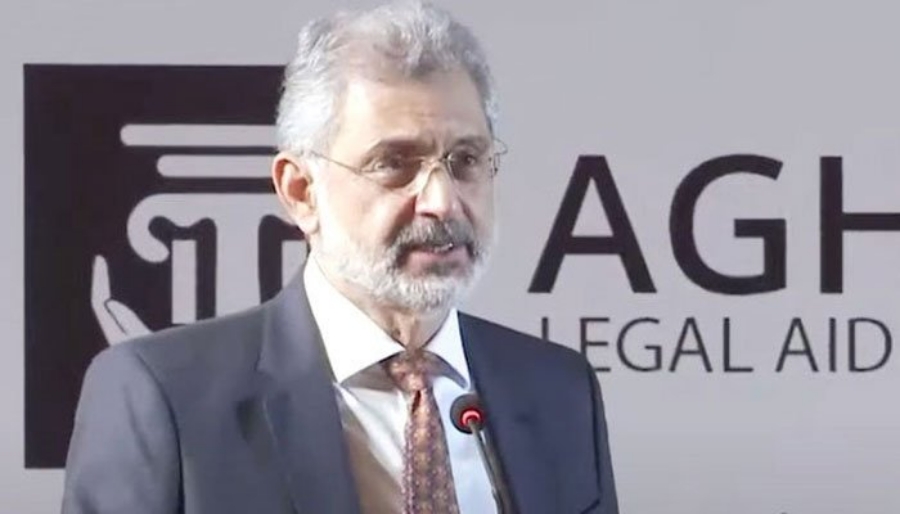
  • ‘CJP Khosa backstabbed me’: Justice Isa accuses SC of acting maliciously

    ‘CJP Khosa backstabbed me’: Justice Isa accuses SC of acting maliciously

    Justice Qazi Faez Isa has alleged that the Supreme Judicial Council (SJC) acted “maliciously” against him and never gave him the chance to defend himself, adding the SJC did a massacre of justice.

    The SC judge made the comments on Thursday while presenting his arguments for a review petition against the Supreme Court’s (SC) ruling on the presidential reference filed against him.

    Criticising former chief justice Asif Saeed Khosa, the judge said that the former top judge “stabbed me in the back” without listening to his point of view. “My fellow judges in the SJC declared me a madman,” said Justice Isa.

    He further said that his fellow judge, Justice Azmat Saeed, had been a friend and had disappointed him (Justice Isa) with his judgement on the matter. “Today, the former judge is a favourite of the ruling party,” Justice Isa alleged.

    The judge complained to the bench that Law Minister Farogh Naseem had made “serious allegations” against him and his wife. “The decision to quash the reference against me was based on the Constitution and law. My wife was not a party to the case, yet the decision was against her,” said Justice Isa.

    He alleged that Naseem had “no respect for the court” and that “his ministry is more important to him”. “This is the first time that a law minister has declared the Constitution of Pakistan to be in conflict with fundamental rights,” said the SC judge.

    He further complained to the court asking why, even after the end of the hearing, the law minister kept submitting written arguments to the court.

    He also asked why the Federal Board of Revenue (FBR) was ordered to complete its investigation before the detailed verdict was issued in his case, alleging that Tax Commissioner Zulfiqar Ahmed went ahead with the investigations only due to the court’s pressure. He further added that President Arif Alvi “did not even bother” to respond to the three letters he sent to him on the presidential reference.

    “I did not even get a copy of the reference, but it was run on the media. Fifth generation war was started against me and my family,” said Justice Isa.

    Talking about his verdict in the Faizabad dharna case, Justice Isa claimed that the government wants to remove him from the apex court over his verdict in the Faizabad sit-in case but vowed that he will fight “till the last drop of blood” and not give up.

    Justice Isa regretted that everyone other than former Tehreek-e-Labbaik Pakistan (TLP) chief Khadim Hussain Rizvi filed a review petition challenging his findings. “[Even the] PTI (Pakistan Tehreek-e-Insaf) and MQM (Muttahida Qaumi Movement) also filed an appeal against the Faizabad sit-in decision. The PTI’s review petition said that I am not qualified to be a judge. I really am not qualified to be a judge because I talk about fundamental rights,” said Justice Isa.

    The SC judge appealed to the court to hear the instant case in the mornings so it can be wrapped up at the earliest because Justice Manzoor Ahmad Malik, part of the bench, is retiring soon.

    However, one of the judges reminded him that time had been lost due to a related petition filed by Justice Isa himself.

    “You are just now remembering that there is less time,” observed Justice Bandial, reminding the judge that he “wasted the complete month of March by filing an application for the live coverage of his hearing”.

    Justice Isa responded that he had requested live coverage of the case as it was “important” to restore his “image”, which he believes has been tarnished in front of the public.

    “A person’s image is in the hands of Allah and you should trust him,” said Justice Bandial in response.

    Justice Isa retorted saying that he was more worried about the SC, and that he himself was “nothing in front of it.”

    The court, after hearing the arguments, adjourned the hearing till April 19.