Category: Tech

  • No cyberattacks on ATMs across country, clarifies 1LINK

    No cyberattacks on ATMs across country, clarifies 1LINK

    1LINK, one of the largest interbank networks in Pakistan, has denied social media rumours that ATMs will be closed for the next two to three days on fears of a cyberattack.

    The clarification came forward in a notification by 1LINK after social media was abuzz with rumours that ATMs would remain closed for a few days, asking customers to avoid using ATMs.

    The message also warned people not to conduct any online transactions during this time and claimed that this alleged cyberattack report was also aired on BBC radio.

    In its response, BBC Urdu also dismissed the claim that no such thing has been aired.

    “Thus far, no cyber threat has been observed on the ATM and online banking ecosystem in this context, and the financial service industry remains vigilant as ever before,” the notification by 1LINK read.

  • ‘Please do something,’ students push Hamid Mir to file petition against internet disruption

    ‘Please do something,’ students push Hamid Mir to file petition against internet disruption

    The month of August has been the worst for the digital space in Pakistan since February 2024.

    The tech industry has expressed serious concerns about the internet slowdown, warning that it could cost the debt-ridden nation up to $300 million.

    Amid the ongoing issues, senior journalist Hamid Mir took the matter to the Islamabad High Court (IHC), filing a petition through Advocate Imaan Mazari against the internet slowdown.

    Mir argued on behalf of the journalist community, which is struggling to perform its duties due to reliance on connectivity and communication. He further noted that the issue impacts those in e-commerce, students, freelancers, and others.

    The petition also highlights that no prior consultation or deliberation took place between the government and relevant stakeholders before the installation of the firewall, which has contributed to the ongoing struggles of the business and tech community.

    This lack of transparency has fueled doubts and rumours about the nature of the firewall.

    But did Hamid Mir file the petition solely because of the struggles faced by journalists?

    “Frankly speaking, I filed the petition after receiving messages from many students who said they could not leave Pakistan but were finding it difficult to study here,” Mir told The Current, revealing that internet disruptions have also impacted students pursuing online studies, prompting them to seek intervention from the authorities — which Mir decided to do on their behalf.

    “I also face pressure from my own family, who cannot stay in this country anymore. They have asked me to do something to restore internet and social media if we are to remain here,” he explained, reflecting on the growing discontent among the youth.

    Given the current circumstances, the petition argues that installation cannot proceed without consulting relevant stakeholders and that only “reasonable restrictions” may be imposed by law, based on the “principles of necessity and proportionality.”

    The respondents are also asked to provide reports on the firewall’s objectives, status, and impact on citizens’ rights, including details on internet surveillance. Meanwhile, the petition calls for halting the firewall installation and ensuring uninterrupted internet access for citizens until the issue is resolved.

  • Multinational companies plan to leave Pakistan as internet disruptions continue, says PBC

    Multinational companies plan to leave Pakistan as internet disruptions continue, says PBC

    The Pakistan Business Council (PBC) warned on Friday that numerous multinational companies are planning to relocate their offices from Pakistan, with many having already left the country, due to severe internet disruptions.

    “Many multinational companies (MNCs) are either planning to relocate their back offices from Pakistan or have already done so, as the reported imposition of a firewall causes widespread internet disruptions across the country,” the PBC stated.

    Alarm bells went off when the Dubai Chamber of Commerce released a report highlighting that 3,968 Pakistani companies were registered in Dubai between January and June 2024.

    Pakistan ranked second among the top countries whose companies registered in Dubai, signalling an exodus of businesses from Pakistan.

    Hundreds of thousands of skilled and unskilled workers already exist in the country in search of better opportunities abroad.

    “While we struggle with the costs of idle capacity in power generation leading to unemployment and loss of exports and tax revenue, we now have to contend with the threat of idle capacity in the emerging software sector due to poor firewall execution,” lamented the body.

    The tech industry has expressed serious concerns about the internet slowdown, warning that it could cost the debt-ridden nation up to $300 million.

  • Update on petition against slowdown of Internet in Pakistan

    Update on petition against slowdown of Internet in Pakistan

    The Lahore High Court (LHC) reserved its decision on the petition against the slowdown of the Internet across the country.

    At the beginning of the hearing, the court adjourned it by ordering the federal government counsel to appear at 12 noon after taking instructions from the relevant authorities.

    On the resumption of the hearing after a break, Justice Shakeel Ahmed remarked that this is a public interest plea. The court will pass appropriate orders on it, but I am reserving the decision now.

    Federal lawyer Rana Nauman said that the court requested that we give us time to file a detailed report on the Internet shutdown. Later, the judge asked the lawyer if this was a sign of your seriousness; you did not have adequate information.

    Later, the court reserved the decision.

    Earlier, the Lahore High Court (LHC), during the hearing of a petition against the slowdown of the internet, ordered the federal government’s lawyer to appear at 12 noon after taking instructions from relevant authorities.

    The petitioner had said, “Internet has been slowed down in Pakistan due to unknown reasons, and IT-related businesses are being badly affected by this shutdown. The world is moving to the latest technology, and Pakistan’s IT sector is being destroyed. Pakistani companies and youth are earning billions of foreign exchange from IT.”

    The sudden slowdown of the Internet and social media apps in the country, without any prior notice or reason, is a clear violation of fundamental rights. This action has not only disrupted daily life but also hindered the freedom of expression and access to information.

    The court requested that the government be bound not to shut down the Internet in the future. Justice Shakeel Ahmed of the High Court will hear the request today.

  • Extremely slow internet may threaten survival of e-commerce: ISPs

    Extremely slow internet may threaten survival of e-commerce: ISPs

    The Internet Server Providers (ISPs) Association has stated that the internet speed in Pakistan has decreased by 30 to 40 per cent, which may threaten the survival of e-commerce and other digital platforms.

    “The government’s decision to increase security and surveillance has had the unintended consequence of reducing internet speeds by 30 to 40 percent over the past few weeks. Internet slowdowns have created chaos for online and Internet-dependent businesses,, particularly affecting call centres, e-commerce professionals, the online working class, and electronic businesses,” ISPs wrote in a statement.

    “The sectors that underpin Pakistan’s burgeoning digital economy are now grappling with the challenge of staying afloat. The threat of slow internet speeds looms large, endangering the survival of these businesses. The situation has become so dire that many entrepreneurs contemplate relocating their operations to other countries. If this trend persists, we could witness a significant exodus of businesses from Pakistan,” ISPs added.

    The government’s experimental implementation of the firewall has reduced the speed of social media in Pakistan and raised fears about the future of Internet-based businesses in the country.

    Internet services have been severely affected in the country for several days now, and people connected with online businesses and domestic users have started to suspect that the internet is not working. Whether connecting on WhatsApp, shopping online, uploading a photo, or watching a video, internet speed has become a topic of discussion across the country.

  • PTA responds to internet service problems across Pakistan

    PTA responds to internet service problems across Pakistan

    The Pakistan Telecommunications Authority (PTA) addressed complaints about slow internet across Pakistan on Thursday.

    A Senate Standing Committee on Information Technology meeting, led by Palwasha Khan, discussed the issue, according to ARY News.

    Senators Afnanullah Khan and Humayun Mohmand highlighted that many e-commerce platforms are leaving Pakistan due to poor internet speeds. Khan also noted that users are experiencing difficulties uploading or downloading media files on WhatsApp.

    “You’ve messed up the business activities,” Senator Humayun pointed out to PTA and IT ministry officials at the meeting. In response, the IT Secretary stated, “The problem with internet services is due to cellular networks, not WiFi.”

    The PTA official added that they have not yet received any formal complaints about slow internet speeds in the country.

    The PTA officials were expected to provide information about firewall installations during the meeting, but due to their unavailability, the meeting was postponed.

    The Pakistani government has installed a firewall across Internet Service Providers (ISPs) to manage social media. This decision followed the introduction of the Defamation Law 2024 by the Punjab government. The firewall aims to control social media and regulate internet traffic using deep packet inspection (DPI) technology to monitor data in detail.

  • Want to generate an ideal A.I. image? Here’s how

    Want to generate an ideal A.I. image? Here’s how

    Do you struggle with generating accurate images using artificial intelligence (AI)?

    To create an effective prompt for an image, be mindful of including elements such as the type of image you want, the main subject, important details about the subject, any desired style or design features, and the overall look you envision for the image.

    Here’s a simple guide to creating an image prompt:

    Art Type: Choose the medium you want, such as a photograph, drawing, sketch, oil painting, or 3D image.

    Main Focus: Define what the image should focus on—whether it’s a person, animal, object, or an abstract concept.

    Specifics: Detail the key elements of your image, including colours, shapes, sizes, and textures. Specify the style you prefer, such as “abstract,” “minimalist,” or “surreal.”

    Composition: Describe how you want the image arranged. Include details about the art style, lighting, aspect ratio, and camera angles. Additionally, provide information about the background and setting.

    Type of Art: Photograph
    Subject: Marvel character Thanos
    Details: Holding a big size rusty blade
    Style: Pop art

    Extra Details: The Viking is holding a large, rusty blade in a monochrome photo, standing in front of Times Square, New York.

    Final Prompt: Generate a pop art style image featuring the Marvel character Thanos, holding up a large, rusty blade in a monochrome photo, standing in front of Times Square, New York.

    The more specific and detailed you are, the better the final image will be.

    Here is the final result

    Image generated by ideogram.ai

  • ‘It’s not possible’; Reporting in internet-challenged Pakistan

    ‘It’s not possible’; Reporting in internet-challenged Pakistan

    With the primary shift from newspapers to television channels and now to digital media applications, the dissemination of information has become increasingly competitive for newsrooms, with the latest updates just a click away.

    “Delays can be managed with newspapers, but today everything is in your hands—specifically, mobile phones,” says Raees Ansari, Bureau Chief of Geo News in Lahore.

    “Every single second is crucial in reporting now; some footage needs to be sent and put on air instantly. But due to poor network conditions and slow WhatsApp, content is not being sent on time, which is affecting our professional activities,” he reveals.

    Over the past week, internet users across Pakistan have reported network disruptions, with WhatsApp, Facebook, and Instagram experiencing slowdowns, hindering online activities. The Pakistan Telecommunication Authority (PTA) has denied any connection between these issues and the alleged firewall installation.

    Since the ban on X (formerly Twitter) on February 17, 2024, many have turned to Virtual Private Networks (VPNs). The ongoing disturbances, however, have complicated internet usage, which is crucial for a number of professions.

    Sumaira Raja, an investigative reporter, who is mostly found out on the field, complains of encountering issues with not only the internet but also phone signals which often prevents her from conveying news on time.

    “I also experience delays with receiving beepers, as head office frequently reports that the number is not available due to poor signals. This situation makes it very difficult to do my job. I’ve tried using a VPN, but it hasn’t worked,” Raja says.

    Sports journalist Faizan Lakhani recalls when javelin champion Arshad Nadeem returned to Pakistan on August 17 after winning the gold medal at the Paris Olympics, all the visuals sent through WhatsApp by reporters were delayed, and they struggled to download them unless they used a VPN.

    “This situation is very challenging and affects our workflow. When reporters are working on a story or covering an event, they need to stay connected with the desk. We usually rely on voice notes to pass instructions, but since we started encountering this issue, we are struggling with that method too,” he says.

    “We have been told that the network disruption is because of the firewall installation. While things are becoming easier around the world, it has been getting harder for us. Everything is happening with the help of technology and the current situation is a major challenge.” says Ansari.

    What’s happening?

    A highly placed source in the IT industry identifies that filtering of content delivery networks (CDNs) through Firewall is causing content to be routed via internet backbone rather than CDNs.

    “This means that around 4 TBs of internet traffic previously served through CDNs, hosted in Pakistan, is becoming ineffective. When all traffic goes on backbone bypassing CDNs, it’s causing massive slowdown at many western destinations that’s happening now,” he explains.

    Recently, Fiverr, an online marketplace for freelance services, warned clients that Pakistani freelancers may experience delays due to internet issues and the use of VPNs to change their locations.

    “Brace for impact. God save the internet in Pakistan”, says the IT expert.

    Background

    It all started on February 17, 2024, about a week into the new government, when X (formerly Twitter) was banned.

    Initially, amid the uproar, the government remained silent on the matter while the Pakistan Telecommunication Authority (PTA) seemed aloof until the High Courts of Sindh and Islamabad intervened. The PTA eventually admitted that the ban on X was imposed on the orders of the Ministry of Interior based on reports from intelligence agencies.

    The government eventually justified the ban by attributing it to national security concerns, citing ‘digital terrorism‘ and online propaganda as among the threats.

    Earlier in August, Provincial Information Minister Azma Bokhari stated that the government is not against social media but wants to focus on rules and regulations, which, if enforced, could lead to the removal of the ban on X.

    The disruption has now extended beyond X, affecting other widely used apps along with the internet.

    Ironically, since the February 2024 election, the new government has emphasised the need to grow the tech industry in Pakistan.

    In March, Lahore Knowledge Park (a science park) was handed over to the Punjab Central Business District Development Authority with the approval of Chief Minister Punjab Maryam Nawaz, with the goal of establishing Pakistan’s largest IT city.

    In June, Prime Minister Shehbaz Sharif visited Shenzhen— the tech hub in China— in hopes of future collaboration. Ironically, he posted on X (Twitter), expressing how “impressed” he was by the “city’s skyline and development that symbolizes modern-day China.”

    Given the lack of proper infrastructure in the country amid burgeoning surveillance, how will Pakistan evolve in the rapidly transforming digital world? It remains to be seen – but likely we won’t be able to download it.


  • Fiverr lists Pakistani freelancers as ‘unavailable’ amid internet disruption

    Fiverr lists Pakistani freelancers as ‘unavailable’ amid internet disruption

    Internet services in Pakistan have been disrupted for nearly a week, causing a slow speed connection and issues with apps like WhatsApp, Facebook, and Fiverr. Users, who are also dealing with a ban on X (formerly Twitter), are turning to Virtual Private Networks (VPN) to use the app. Fiverr has warned clients that Pakistani freelancers might experience delays due to internet problems and changing their locations due to VPNs.

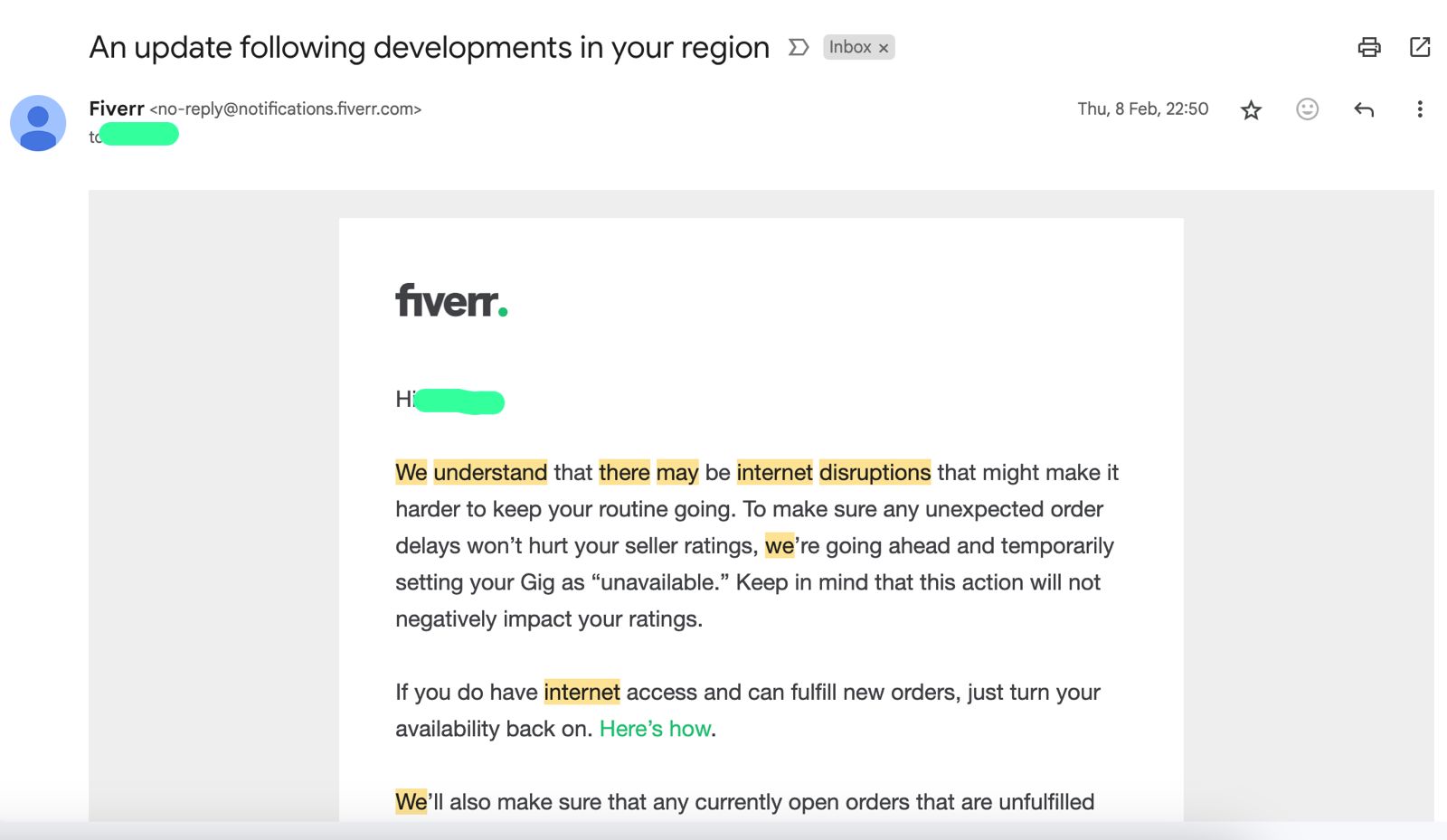
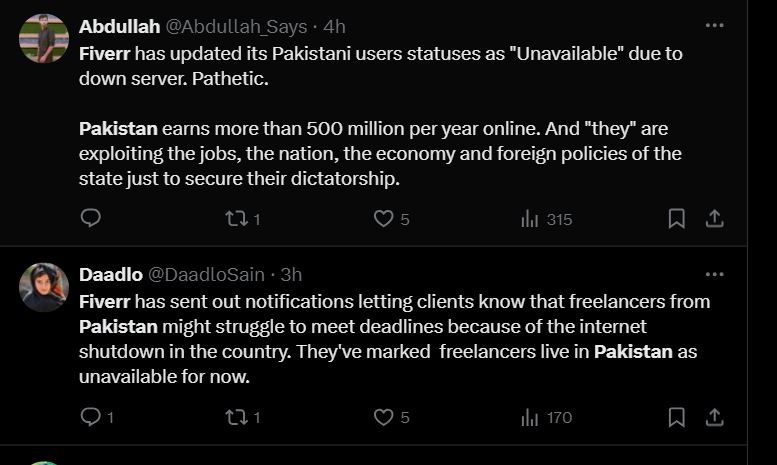
    Fiverr also flagged Pakistan freelancers as ‘unavailable’, making it difficult for them to get new orders.

    A social media user shared an email from Fiverr stating, “We understand that there may be Internet disruption in your area that might make it harder to keep your routine going. To ensure any unexpected order delays won’t hurt your ratings, we’re temporarily setting your availability status and Gig(s) as unavailable.” It further mentioned that this action will not negatively impact the ratings of any service provider.

    Social media users who are already dealing with serious problems shared many posts about their worries over internet disruptions. They criticised the government’s decision and requested Fiverr to remove the limitations.

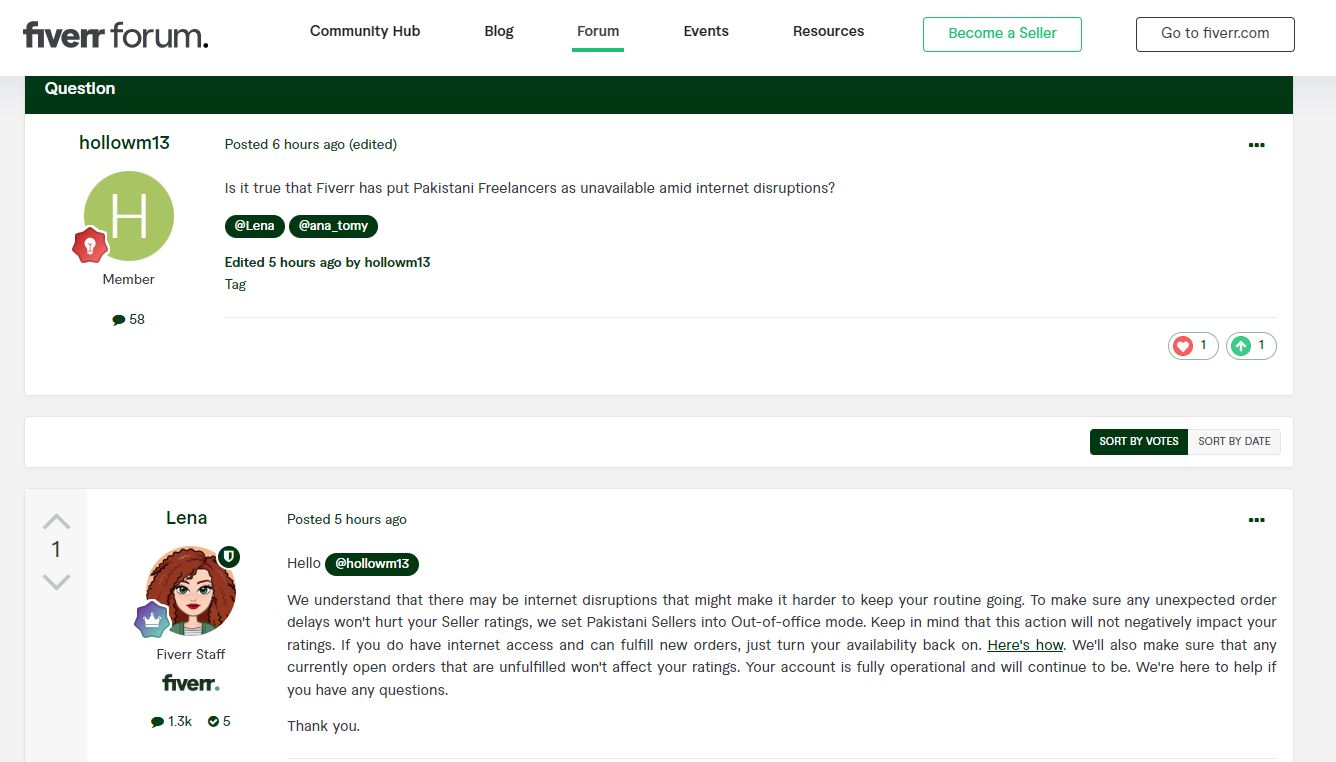
    A user asked Fiver’s staff team, Lena, “Is it true that Fiverr has made Pakistani freelancers unavailable amid internet disruptions? To which she replied, yes, here you can check.

    What is the economic impact of this internet shutdown?

    The impact of internet disruptions can be severe. In May 2023, Pakistan experienced a major internet outage that caused significant financial losses. The telecom industry lost around PKR 2.46 billion in just 72 hours, and the IT sector suffered damages of about PKR 10 billion. These disruptions show how important it is to have a reliable internet infrastructure.

  • Shehbaz Sharif announces one million smartphones for students on merit

    Shehbaz Sharif announces one million smartphones for students on merit

    Prime Minister of Pakistan, Shehbaz Sharif, has announced to give smartphones to one million students on merit.

    According to Sama, Shehbaz Sharif, while giving the good news, said, “The students will be given smartphones and laptops. We will send students to China for higher education in agriculture. Immediately after August 14, I will announce a five-year program, 2 lakh youth will be given annual free Information Technology (IT) training.”

    He also clapped for Arshad Nadeem from the Prime Minister Youth Program.