Blog

  • West Indies call in Lara, Richards and Lloyd to revive Caribbean cricket

    West Indies call in Lara, Richards and Lloyd to revive Caribbean cricket

    West Indies Cricket Board (CWI) has called an emergency meeting following their embarrassing collapse against Australia in the Test match, where they were bowled out for just 27 runs in Jamaica, resulting in a 0-3 series whitewash.

    CWI President Kishore Shallow took immediate action, inviting some of the region’s greatest former players for urgent discussions to assess the disastrous performance and plan concrete steps for improvement.

    Country’s legends Brian Lara, Clive Lloyd and Sir Vivian Richards have all been invited to share their insights. Other respected former cricketers, including Shivnarine Chanderpaul, Desmond Haynes and Ian Bradshaw, will also attend the high-level meeting.

    “The defeat hurt me deeply, just like every West Indies fan. But this is not the time for blame — it is a test of our strength and unity. We must work together,” Shallow said while announcing the meeting.

    He added that the session would not be a mere formality but would lead to real, practical actions to revive West Indies cricket. The focus will be on rebuilding the team’s mindset, with special emphasis on developing young players and putting the team in a strong position before the next white-ball series against Pakistan.

    The former players are expected to offer realistic and workable recommendations, drawing on their wealth of experience to guide the struggling side back on track.

  • ‘You’re not alone’: Faysal Quraishi’s emotional message for artists after Humaira Asghar’s death

    ‘You’re not alone’: Faysal Quraishi’s emotional message for artists after Humaira Asghar’s death

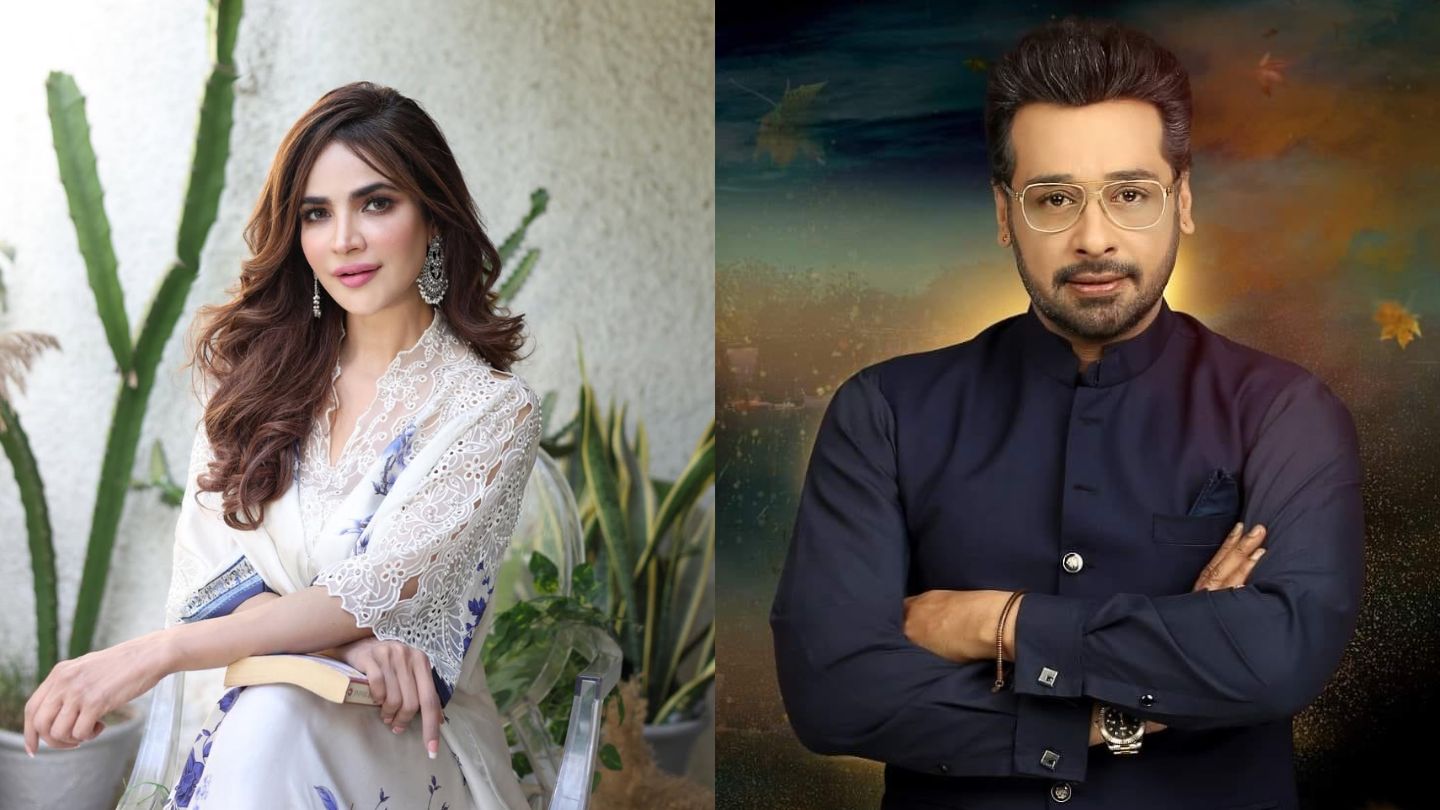
    Days after the tragic cases of actors Humaira Asghar and Ayesha Khan’s deaths made headlines, Pakistani actor and host Faysal Quraishi has released an important video message for all artists in the entertainment industry.

    Faysal Quraishi alluded to his fellow artists, urging them not to suffer in silence. “If you’re facing any kind of problem, don’t consider yourself alone. Contact me, me and other actors are here to help,” he said.

    He shared that ACT Pakistan, an organisation established to support artists, had recently held a Quran recitation following the death of actresses Ayesha Khan and Humaira Asghar. “There are people in ACT to help artists who will support them in every possible way, whether it’s financial problems or health issues,” he added.

    Faysal emphasised the ACT team’s dedication, saying, “Along with me, Hina Bayat, Atiqa Odho, Umair Rana and others are available 24 hours a day. So please, contact us if anyone is facing any kind of problem.”

    This video of Faysal Quraishi is now going viral on social media, with users appreciating his genuine concern and support for fellow artists.

    Fans flooded the comment section with appreciation and emotional reactions. One user wrote, “You’re a true legend Faysal bhai, always standing by everyone!”

    One added, “Much needed initiative. Artists deserve this kind of support.” Another commented, “Respect for Faisal Qureshi for stepping up. May Allah reward you.”

    One wrote, “This is what unity in the industry looks like. Love and respect to all involved.” Another fan said, “JazakAllah for the encouraging words… true inspiration.” One user expressed, “Thank you for these important realizations @faysalquraishi.”

    Another heartfelt comment read: “Appreciated. What is lost can’t come back, but at least so many people can share their problems in critical situations, emotionally, financially, and even spiritually. That is life. Jee le zindagi jab tak hai jaan. JazakAllah Khair.”

  • PTI rift deepens as Salman Raja publicly loses it over viral tweet

    PTI rift deepens as Salman Raja publicly loses it over viral tweet

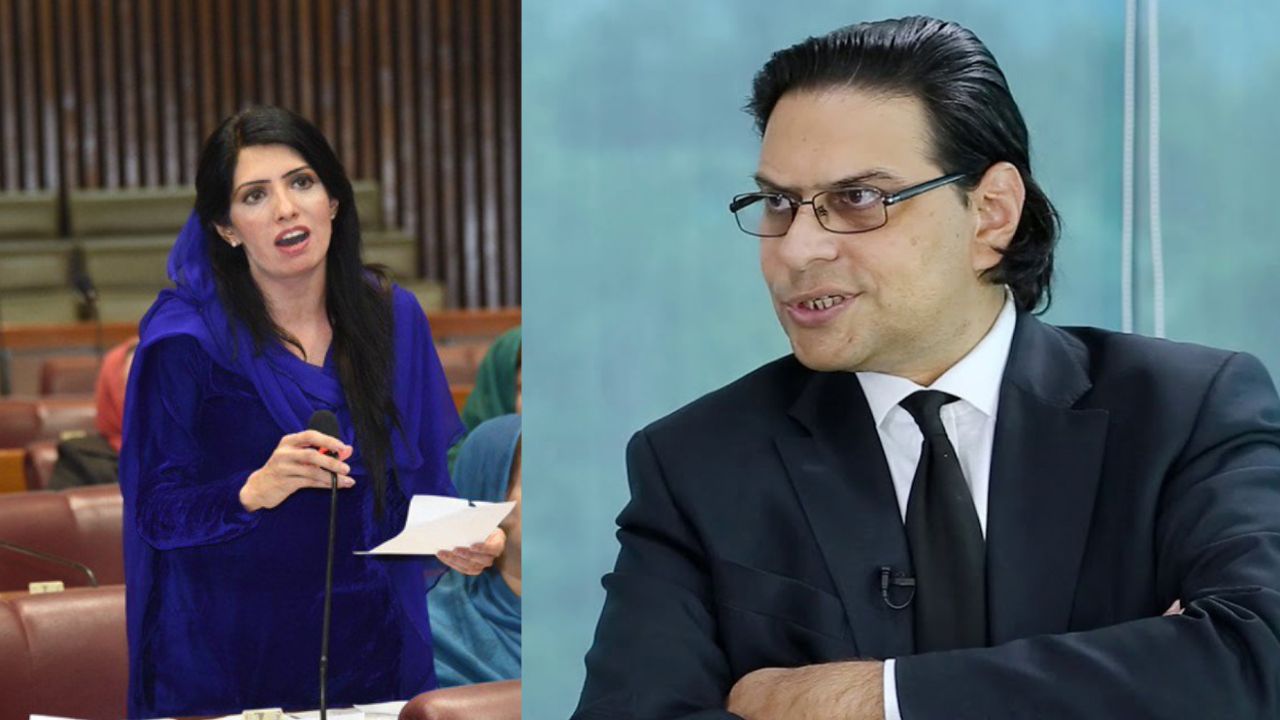
    Pakistan Tehreek-e-Insaf (PTI) Secretary General Salman Akram Raja has criticised PTI Punjab Chief Organiser Aliya Hamza Malik over her recent post on X (formerly Twitter) about the party’s press conference in Lahore.

    Speaking to the media outside the Adiala jail in Rawalpindi on Tuesday, Raja furiously said that Aliya Hamza should not have posted about the party’s conference on social media. He alleged that the controversy stemmed from ‘stupidity and conspiracy’, adding that those who didn’t attend the event did so voluntarily, downplaying the invitation issue. 

    Questioning the motive behind the step taken by Aliya Hamza, Raja warned that similar posts by party members would not be tolerated in the future.

    He clarified that attending the press conference was not mandatory and said he only went because Khyber Pakhtunkhwa (KP) Chief Minister Ali Amin Gandapur was present, adding that it wouldn’t have looked appropriate for the CM to hold a solo presser.

    When asked whether Aliya Hamza was being removed from her party position, he denied it, but stressed that members must focus on their responsibilities and avoid unnecessary actions like posting tweets.

    “Alya Hamza’s job is to mobilise Punjab … not to tweet,” he said.

    “We will run a movement under the orders of the [party] founder,” he added.

    He also said that those who made mistakes should apologise, and that further communication on the matter was not required.

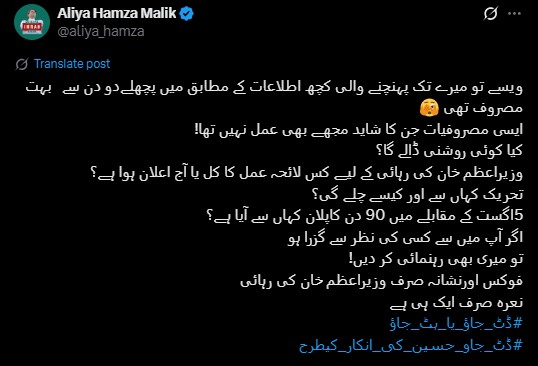
    On July 13, in a post on X (formerly Twitter), the PTI Punjab chief organiser posted a sarcastic and taunting tweet against the PTI leadership, raising several questions.

    “According to some information that has reached me, I’ve apparently been very busy for the past two days, so busy, in fact, that even I wasn’t aware of it! Would someone care to shed some light on this?” she wrote.

    Taking a jibe at the July 12 presser held by PTI senior leaders, including Gandapur, where they gave a 90-day ultimatum for PTI founder Imran Khan’s release, Aliya Hamza asked, “Has any strategy been announced yesterday or today for the release of Prime Minister Khan. Where and how will the movement begin? Where did the 90-day plan come from, in comparison to August 5?”

    “If any of you have come across this information, please guide me too! The focus and the target must be solely the release of Prime Minister Khan. There is only one slogan! (sic),” she concluded.

  • Ian Bishop hails Shaheen Afridi as ‘Baby Starc’

    Ian Bishop hails Shaheen Afridi as ‘Baby Starc’

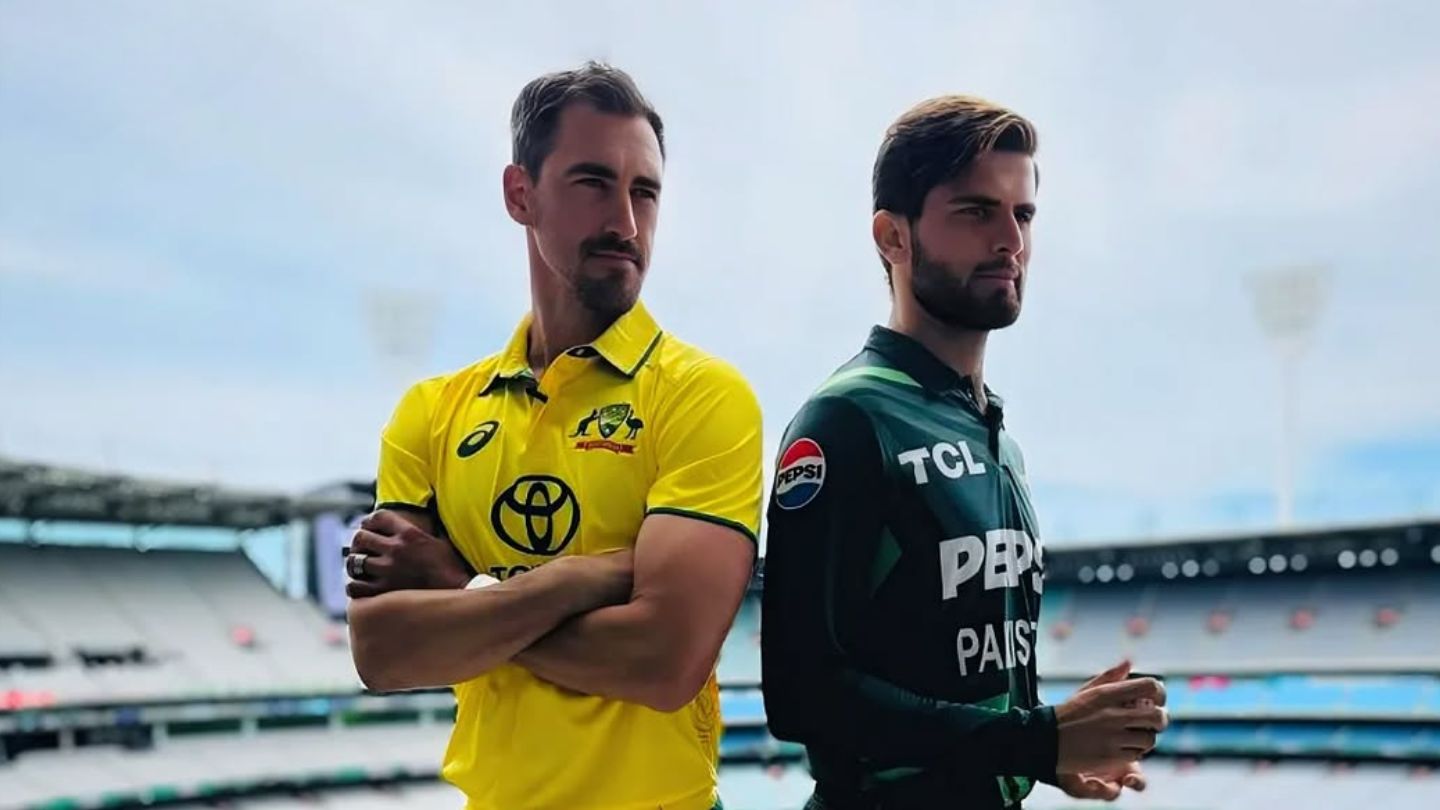
    Former West Indies fast bowler and renowned commentator Ian Bishop has compared Pakistan’s left-arm pace spearhead Shaheen Shah Afridi to Australia’s Mitchell Starc, calling him a “baby Starc” for his ability to consistently uproot stumps.

    Bishop made the remark on Tuesday during the third and final day of the third Test between West Indies and Australia, when Starc ripped through the home side’s top and middle order, grabbing five wickets in just 15 balls.

    Sharing his analysis in the commentary box, the veteran pacer advised batters to guard their stumps carefully when facing Starc and Pakistan’s Shaheen Afridi.

    “Mitchell Starc and Shaheen Shah Afridi are well known for this. Watch your stumps and protect them,” Bishop warned while on air.

    He also spoke about some of the greatest pacers in cricket history, praising legends like Australia’s Glenn McGrath and West Indies’ Curtly Ambrose and Courtney Walsh for intimidating batters with relentless line and length.

    “What I love about international cricket is how bowlers like Glenn McGrath frightened batters around the world with their line and length. Curtly Ambrose and Courtney Walsh were the same. Josh Hazlewood is similar now,” Bishop added.

    Speaking about Shaheen’s bright future, Bishop said, “Then you have Shaheen Afridi, the young upcoming star pacer. I thought he is their very own baby Starc. Quite different but very similar in effect.”

    Since making his international debut against the West Indies in 2018, Shaheen Afridi has represented Pakistan in 31 Tests, 64 ODIs, and 79 T20Is, claiming an impressive 345 wickets across formats, including seven five-wicket hauls in an innings.

    The left-arm quick was named the ICC Men’s Cricketer of the Year in 2021 for his stellar performances across formats, most notably his fiery spells in the 2021 T20 World Cup that helped Pakistan reach the semi-finals.

  • Arshad Nadeem to undergo surgery in England, may miss upcoming events

    Arshad Nadeem to undergo surgery in England, may miss upcoming events

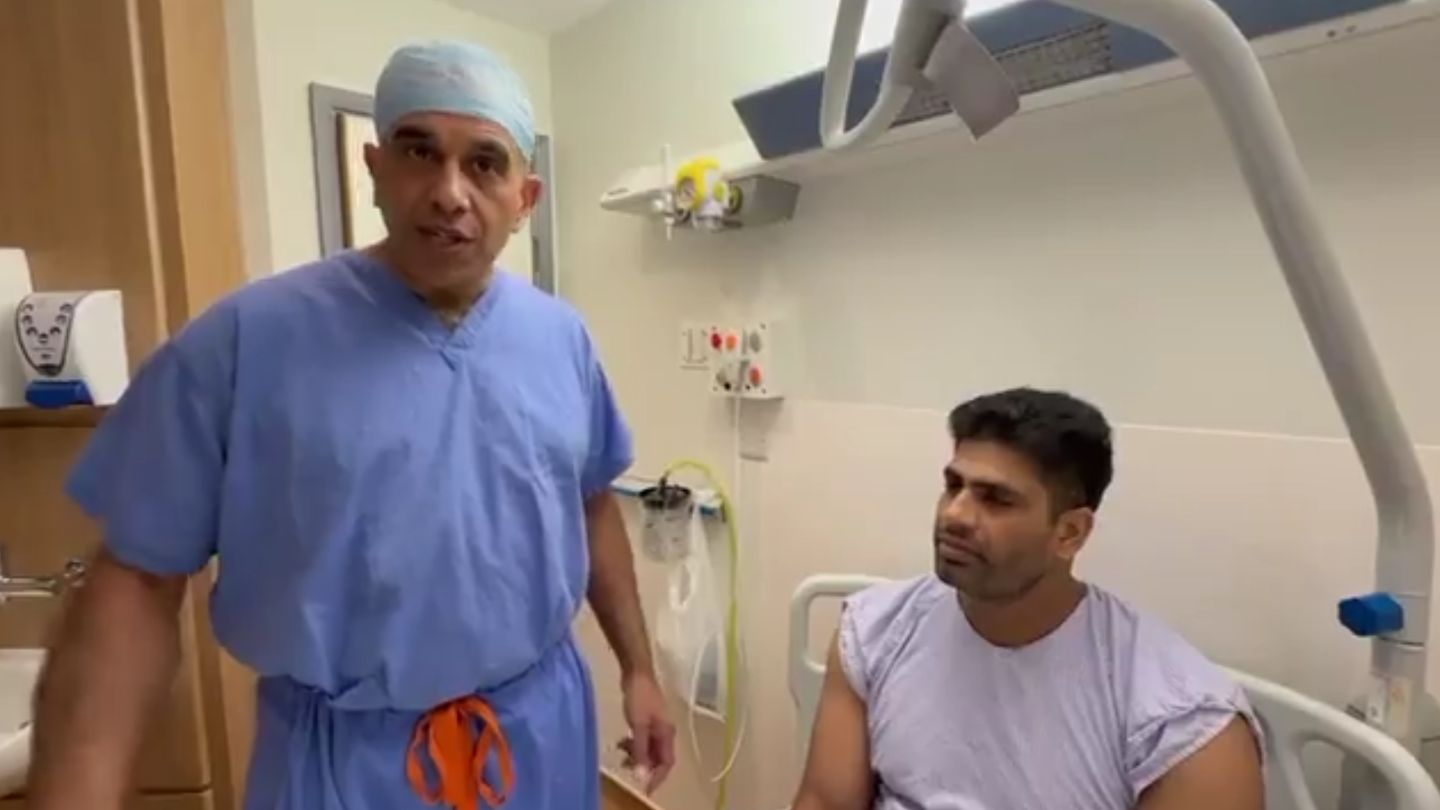
    Pakistan’s javelin star Arshad Nadeem faces an uncertain return to international athletics as he prepares for surgery in England to treat a persistent muscle injury.

    The Olympic hero has been struggling with a calf muscle issue that has disrupted his training since earlier this year. He recently travelled to the UK for treatment, and he is now set to undergo surgery, followed by a crucial rehabilitation phase.

    Dr Ali Bajwa, a renowned orthopaedic specialist based in Cambridge and one of the key figures overseeing Arshad’s treatment, confirmed that the process will be slow but steady.

    “Please pray for Arshad’s recovery,” said Dr Bajwa. “We want the treatment to go well so he can return to international competition. The process will take time, but we are hopeful.”

    Arshad spoke about the injury in an interview with a private news channel last week, sharing how the pain had restricted his training intensity since his return from international events earlier this year.

    He is set to participate in the Diamond League in Poland on August 16, but his participation now remains uncertain as his focus shifts to long-term recovery.

    His absence is a blow to Pakistan’s preparations for the upcoming World Athletics Championships, but doctors have made it clear that there will be no shortcuts in his recovery.

    Arshad Nadeem shot to fame after winning gold at the Paris Olympics 2024 with a record-breaking throw of 92.97 metres, securing Pakistan’s first-ever gold medal in athletics. He added another gold at the Asian Athletics Championships earlier this year, strengthening his status as one of the country’s greatest sports icons.

    For now, his fans and the nation’s sporting fraternity must wait and hope for his successful recovery and return to competition with the same power and determination that made him a legend.

  • ADB pushes five percent GST on digital transactions to encourage digital payments

    ADB pushes five percent GST on digital transactions to encourage digital payments

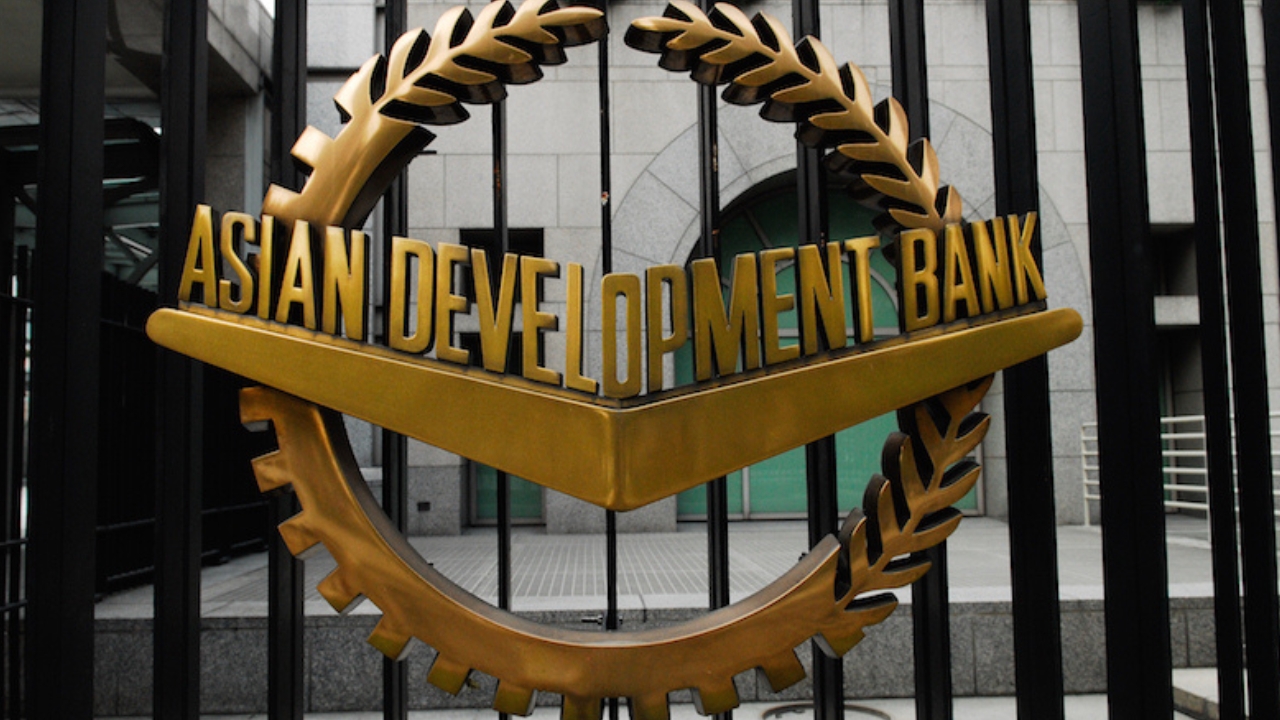
    The Asian Development Bank’s (ADB) latest report suggests that Pakistan implement a five percent general sales tax (GST) on all digital transactions to encourage a shift toward digital payments.

    The report published on Monday suggests that this will decrease inefficiencies in cash-based transactions and will help Islamabad for documentation purposes. This could help the Federal Board of Revenue (FBR) increase compliance rates with existing tax laws, allowing for a potential rise in government revenues.

    The regional lender’s report in consideration pertains to Pakistan’s Digital Ecosystem, wherein the creditor warned that high taxes on domestic digital infrastructure could hamper economic growth, slow down the expansion of digital services, and reduce the influx of foreign investments.

    The report suggests that the ADB should “rationalise all digital infrastructure taxes, both direct and indirect, making them competitive against a basket of countries, and fix sector tax rates for at least 10 years”. Rationalising digital infrastructure taxes will likely serve to increase investment inflows, lower service costs, and encourage network expansion, which could boost digital access, reduce the digital divide, and promote economic development through wider digital adoption.

    As per the report, the domestic digital infrastructure bears a large burden in the shape of “high taxation”. The report suggests that taxes on this sector in Pakistan are among some of the highest in the world. Moreover, the report has outlined how “the tax policies tend not to be very consistent”.

    Highlighting the inconsistency in policies, the report has underlined how women and other disadvantaged groups face “asymmetric cost and cultural barriers to accessing the internet.” If Pakistan lowers the barriers to entry for these marginalised groups, the use of digital financial services is likely to increase significantly.

    One of the primary barriers to digital transactions is the low rate of broadband subscriptions, which indicates that only 56.5 percent of Pakistanis have access to the internet. This figure could be vastly improved if provinces reduce the extortionate 19.5 percent sales tax which they charge on internet service usage.

    The report has also prescribed Pakistan with certain measures to boost digital transactions. These measures include collaborating with international entities to design public–private partnerships (PPPs), offering affordable smartphones and bumping up device ownership for Pakistanis, especially disadvantaged groups such as women.

  • Ahsan Khan calls for peace in face of Indian warmongers at British Parliament event

    Ahsan Khan calls for peace in face of Indian warmongers at British Parliament event

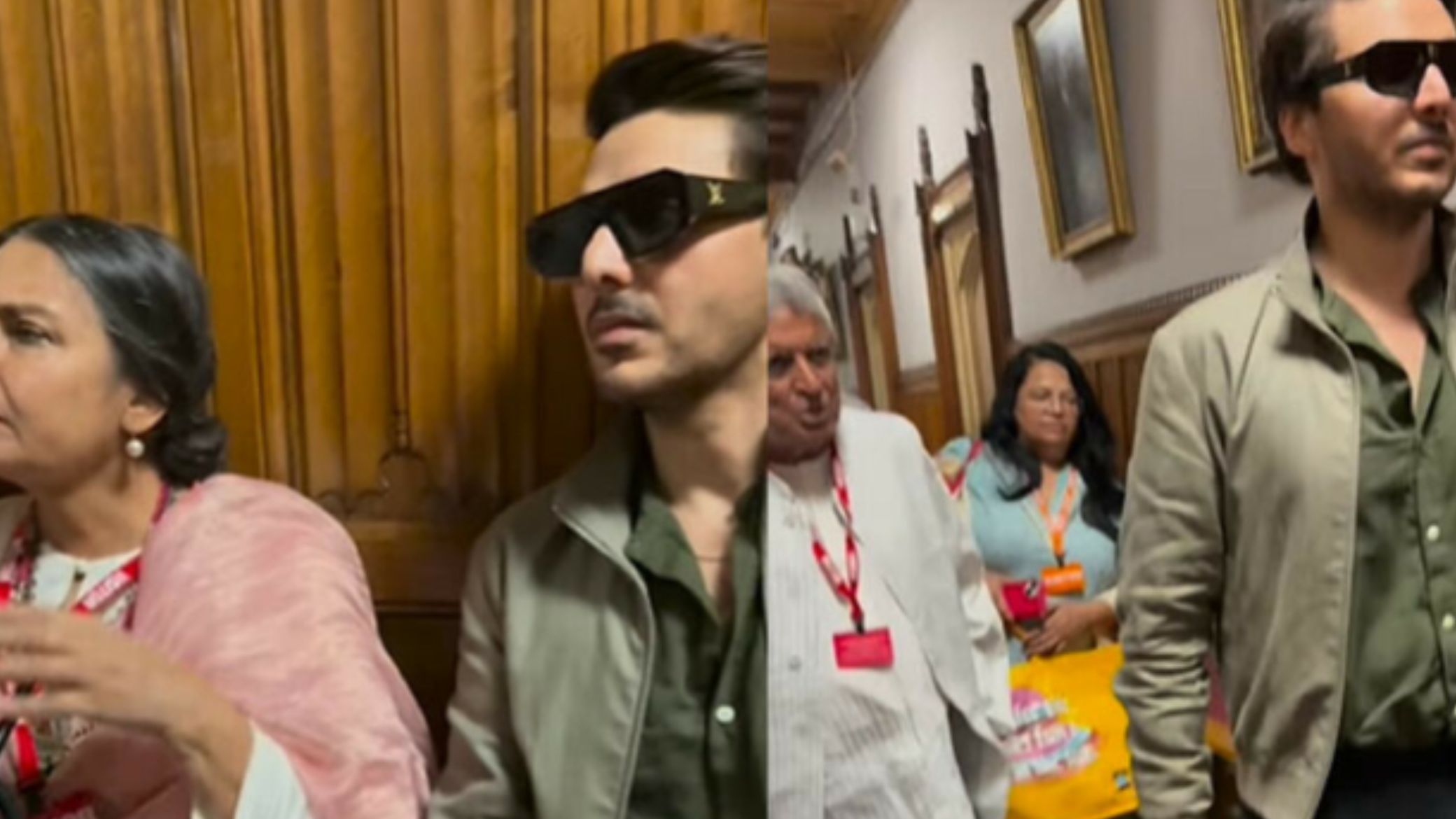
    Pakistani actor Ahsan Khan recently attended a literary event at the British Parliament in London, where he was seen alongside Indian writer and lyricist Javed Akhtar and legendary actress Shabana Azmi. 

    During the event, Ahsan Khan delivered a message about peace, unity, and shared culture. In his speech, he said, “My dear friends Tariq Faizi, they always organise the best events, they gather everyone together, and this time too, I got the chance to participate here. I would like to thank everyone for being a part of this event.”

    Speaking about the gathering, he added, “It looks so beautiful when we see people from different communities, different regions, and different countries coming together in one place and talking about love and peace. Because, as you mentioned earlier, all over the world you see that everything opposite to peace is happening, so it’s very important to talk about peace.”

    He emphasized the importance of language in building bridges saying, “And I believe my purpose for coming here was only this, that I got the opportunity to meet such amazing people. Along with that, our language, the one I am speaking in right now, is understood everywhere, in India, Pakistan, Bangladesh, UAE.”

    Ahsan Khan also praised the blend of languages created through Indian cinema and Pakistani dramas saying, “I feel that Pakistani series and Indian cinema have created such a beautiful blend in this language, because it includes Hindi, Urdu, and our regional languages like Punjabi, Pashto, Sindhi, and then Bengali and many other languages all mixed together to make a kind of hybrid language.”

    He added, “I believe this is a language we all understand and we enjoy it so much, whether it’s our TV series, cinema, poetry, music, conversations about an artist or actor, we watch it all with so much happiness.”

    Ending his speech with a powerful note, he said, “The message should simply be, I feel, that just as everyone listens to this language and feels a sense of belonging through it, in the same way, it’s very important that we, no matter where we are representing ourselves from, we represent our countries too.”

    “Just speak good things so that our words have an impact far and wide, and through this language, through cinema, through television, let’s always talk about peace,” he added.

    The event took place at a time when political tensions between Pakistan and India have recently made headlines, especially following Javed Akhtar’s controversial statements about Pakistan earlier this year. Despite that backdrop, the gathering sent a strong message of cultural unity.

    Other prominent personalities from both Pakistan and India were also present, along with British Parliament members, journalists, and literature enthusiasts. Ahsan Khan and Javed Akhtar also engaged in conversations about language, literature, and the shared cultural history of the region, highlighting the power of dialogue over division.

  • Fuel prices likely to rise by up to Rs6.50 per litre

    Fuel prices likely to rise by up to Rs6.50 per litre

    Fuel prices are expected to rise by up to Rs6.50 per litre, driven by higher import premiums and global petroleum prices. This projected increase in prices is expected from July 16, after which prices will remain fixed for the upcoming fortnight.

    According to data from reports, the price of high-speed diesel (HSD) could witness a staggering Rs6.50 per litre hike. Moreover, reports suggest that petrol prices could rise by approximately Rs5.25 per litre, causing strain on consumers. 


    If implemented, this would be the second consecutive increase in fuel prices since the start of fiscal year (FY) 2025-26, on July 1, 2025. The price of petrol was hiked up by Rs8.36 per litre on June 30, causing its price to swell to Rs266.79 per litre.


    The price of HSD increased on June 30th, too, rising by Rs10.39 to its current price level of Rs272.98 per litre. Reports reveal that the ex-depot price of HSD is likely to reach a whopping Rs279.48 per litre after witnessing a 2.5 percent increase.


    Similarly, a two percent increase in petrol prices is also expected, causing analysts to predict that the price of the commodity is likely to sit at Rs272.04 for the upcoming fortnight. However, it merits a mention that these are only estimates and that the federal government has not yet released the final prices for the coming two weeks.


    However, data from reports indicates a potential decline in the prices of light diesel oil and kerosene by Rs2.25 per litre and Rs3.80 per litre, respectively. While this could help consumers, according to reports, the collective benefits from the drop in prices of the aforementioned commodities do not outweigh the costs of the hikes in the prices of HSD and petrol.

    This is because an increase in HSD prices directly increases the prices of food, as it is widely used in the agricultural sector to power tractors and other mechanised farm equipment. Moreover, reports reveal that transporters have been increasing fares in advance of the expected increase in fuel prices.

    Accoridng to analysts, Islamabad is responsible for the sky-high fuel prices as the federal government charges a colossal Rs98 per litre on both petrol and HSD. A breakdown of the charges levied on consumers by Islamabad suggests that the petroleum development levy (PDL) makes up the largest portion of this charge, amounting to approximately Rs78 per litre. A Rs20 to Rs21 per litre customs duty is also imposed on fuel.

  • More than 50% of KP residents say no to joining PTI protests: survey

    More than 50% of KP residents say no to joining PTI protests: survey

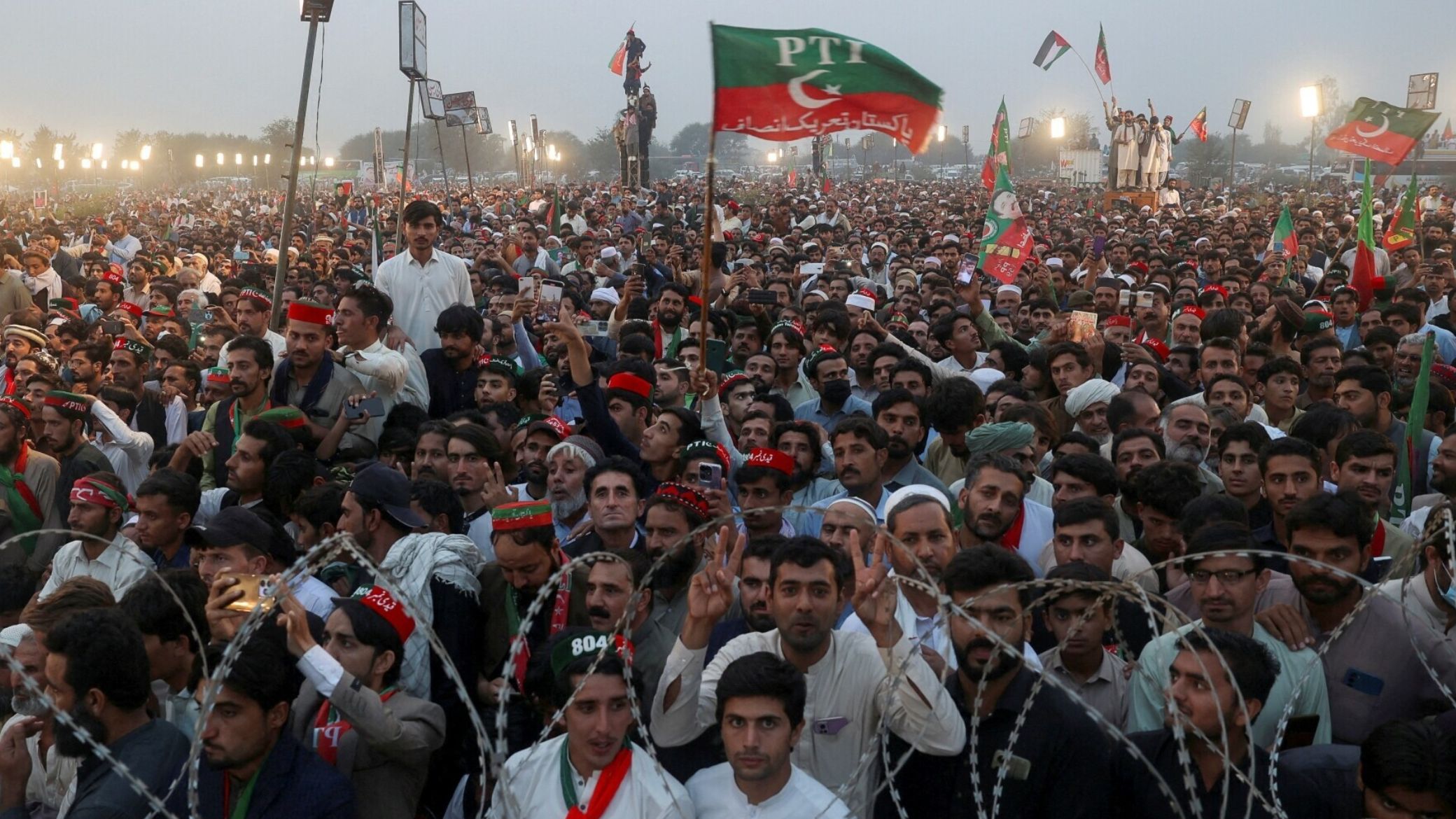
    More than half of Khyber Pakhtunkhwa (KP) residents have rejected the idea of participating in future Pakistan Tehreek-e-Insaf (PTI)-led protests, according to a new survey conducted by Gallup Pakistan.

    Reported by a private media outlet, the survey reveals that a large majority of residents in KP prefer collaboration with the federal government instead of street agitation.

    The province-wide poll, conducted between February and March 2025 and involving 3,000 respondents, shows that 85 percent of KP residents support working with the federal government for the province’s development. Only 10 percent opposed cooperation, while five percent chose not to respond.

    Interestingly, while most respondents back collaborative governance, nearly two-thirds believe that targeted protests can still play a role in pushing for change at the federal level. This indicates a public that wants development through coordination but still sees protest as a legitimate last resort.

    Across political lines, 86 percent of PTI voters, 93 percent of PML-N supporters, 87 percent of JUI-F backers and 86 percent of ANP constituencies favoured federal cooperation.

    When asked about future PTI-led protests, 53 percent of respondents rejected participation, 40 percent planned to join, and 7 percent were undecided. Regarding past sit-ins and demonstrations, 60 percent criticised the provincial government for allowing such activities to distract from governance and public welfare, while 32 percent supported them and 8 percent did not answer.

    Despite some resistance to protest culture, 60 percent still consider protests against the federal government a valid way to demand change. About 32 percent disagreed, while 8 percent did not respond.

    The survey also compared provincial leadership. Around 50 percent of KP residents rated Punjab Chief Minister Maryam Nawaz’s performance better than that of KP Chief Minister Ali Amin Gandapur, while 39 percent said Gandapur was performing better. Among PTI supporters, 37 percent also rated Maryam’s performance higher.

    When asked whether Gandapur should be replaced, 47 percent favoured removing him, 40 percent opposed the idea, and 13 percent did not respond.

    A majority of respondents (53 percent) expressed dissatisfaction with the government’s efforts to curb corruption, while 49 percent were unhappy with employment opportunities. However, 47 percent approved of the government’s work to provide jobs.

    In terms of public services, 64 percent were satisfied with healthcare and access to clean water, while 34 and 35 percent respectively, expressed dissatisfaction. Access to education was seen positively by 62 percent, though 36 percent remained unhappy.

    During PTI’s 13 years of rule in KP, 59 percent said roads improved, 53 percent saw better public transport, and 50 percent noticed better sanitation. However, 54 percent said no further development had happened since the 2024 elections.

    Concerns remain about the lack of progress in public transport and sanitation, with 61 percent and 58 percent, respectively, saying the situation is unsatisfactory. Even PTI voters echoed this, with nearly half saying there had been no recent work in these areas.

    While 74 percent acknowledged better access to clean water and education, and 66 percent cited improved roads, many still criticised other amenities. About 81 percent were unhappy with libraries, 77 percent with parks, 70 percent with community centres, and 66 percent with gas supply.

    The survey also highlighted that southern districts like DI Khan lag behind other regions in basic facilities. Overall, the findings reflect mixed public sentiment, with some recognition of progress but deep concerns over governance, corruption and regional inequalities that could shape KP’s political landscape in the coming months.

  • Humaira Asghar messaged for help but no one replied, investigation reveals

    Humaira Asghar messaged for help but no one replied, investigation reveals

    Authorities are expanding their investigation into the death of Pakistani actress and model Humaira Asghar Ali to determine whether it was natural, accidental, a suicide, or a murder, according to reports.

    Humaira was reportedly going through a severe financial crisis for months before her death and had tried to reach out for help.

    According to reports citing the investigation team, Humaira approached at least 10 people, including her brother Salman, on October 7, 2024, sending them a WhatsApp message that read, “Hello, I want to talk to you,” but did not receive any response. Reports add that she also contacted close friends for financial assistance, but her requests went unanswered.

    As per the investigators, the team has decided to question a total of 63 individuals, many of whom have already recorded their statements. The team is also analysing digital and forensic evidence gathered from Humaira’s mobile phones, tablet and laptop. Investigators found the device passwords written in her personal diary.

    Sources said no medications were found at the scene and that Humaira’s hands were reportedly clutched to her chest when discovered. Her gym trainer told investigators that Humaira followed a strict fitness routine, working out three hours every day.

    Humaira’s decomposed body was discovered on July 8, 2025, when Gizri Police, accompanied by a court bailiff, broke into her fourth-floor rented apartment in the Ittehad Commercial Area of Karachi’s Defence Housing Authority (DHA) to enforce an eviction order. Her landlord had gone to court after Humaira failed to pay rent since April 2024.

    According to neighbours, they noticed a foul odour coming from the flat, but the vacant apartment next door, which had been unoccupied until February 2025, likely delayed the discovery.

    Both the main door and balcony door of the apartment were locked from the inside, which suggests Humaira was alone at the time of her death, according to the investigation team.