Tag: Donald Trump

  • US halts strikes on Iranian energy sites for 10 days as Hormuz tensions persist, talks continue

    US halts strikes on Iranian energy sites for 10 days as Hormuz tensions persist, talks continue

    President of the United States (US) Donald Trump has said that Washington DC will pause strikes on Iranian energy facilities for 10 days, citing ongoing talks with Tehran, as the closure of the Strait of Hormuz continues to disrupt global energy flows.

    In a post on Truth Social, Trump said on Thursday that the pause would remain in place until April 6. “As per the Iranian government request, please let this statement serve to represent that I am pausing the period of Energy Plant destruction by 10 Days to Monday, April 6, 2026, at 8 P.M., Eastern Time,” he wrote. 

    He added that “talks are ongoing and, despite erroneous statements to the contrary by the fake news media and others, they are going very well.”

    The announcement comes as the Strait of Hormuz remains effectively closed for nearly four weeks, halting most maritime traffic through one of the world’s key energy corridors. The waterway is used for the transit of around 20 percent of global oil and natural gas supplies, along with shipments of fertilisers.

    Trump has linked the pause in strikes to broader efforts aimed at reopening the strait, even as he has previously warned Tehran of consequences if it does not comply. He has also moved to deploy additional US troops to the Middle East and considered naval escorts for oil tankers passing through the region.

    Despite the pause, the status of negotiations remains unclear. Iran has expressed distrust toward the US, while US officials have indicated that talks are ongoing but fluid.

    According to a Wall Street Journal report, Iran has not requested a 10-day halt to strikes on its energy infrastructure.

    US Secretary of State Marco Rubio said that intermediary countries are facilitating communication between the two sides. “There’s a growing amount of energy that’s been flowing through the straits, not as much as should be flowing, but some of it has picked up,” he said, adding that “there’s been some progress in regards to the exchange of messages, but that’s an ongoing and fluid process.”

    Rubio also said that the Strait of Hormuz “can be open tomorrow if Iran stops threatening global shipping,” and called on countries that support international law to respond to the situation.

    Separately, JD Vance said that Iran’s “conventional military” had been “effectively destroyed” during the conflict. “They don’t have the ability to hit us like they could have even a few weeks ago,” he said, adding that the situation “gives us options.”

    Meanwhile, Rafael Grossi, head of the International Atomic Energy Agency (IAEA), warned of the risks associated with strikes on Iran’s nuclear infrastructure. Referring to the Bushehr nuclear power plant, he said “damage to the facility could result in a major radiological accident affecting a large area in Iran and beyond,” and called for restraint and adherence to nuclear safety principles.

    Iran continues to retain leverage over the Strait of Hormuz through its geographic position and use of drones and sea mines, which complicate efforts to secure the route. Iranian officials have also indicated they are charging fees for the passage of some vessels through the strait, following reports that tankers have paid large sums to cross.
  • Trump claims strikes on Iran prevented ‘World War III’ as regional death toll climbs

    Trump claims strikes on Iran prevented ‘World War III’ as regional death toll climbs

    US President Donald Trump has claimed that his administration’s illegal military actions against Iran prevented a nuclear conflict that would have evolved into “World War III.” Speaking from the Oval Office, Trump stated that had he not “decimated” Iran’s nuclear programme, Tehran would have possessed a nuclear weapon within a month and used it against Israel and the wider Middle East.

    “A nuclear war that would have evolved into World War III, and more important, this is a war that there would have been nothing left,” Trump said. He reiterated that Iran currently has “no navy, no air force, no anti-aircraft weapons, and no leadership.” 

    Referring to communications between Washington DC and Tehran, he remarked, “My biggest problem is I have no idea who we’re talking to because nobody ever heard of any of these people, they’re all dead.”

    Trump also noted that while the US is destroying Iranian minelaying ships in the Strait of Hormuz, the threat to navigation remains. “All it takes is one,” he said, adding that “it’s a little unfair. You win a war, but they have no right to be doing what they’re doing.”

    The Israeli government has also released images showing Prime Minister Benjamin Netanyahu ordering the “elimination” of senior Iranian figures. Israeli Defence Minister Israel Katz claimed that Iran’s National Security Chief Ali Larijani and Basij paramilitary head Gholamreza Soleimani were killed in overnight strikes. 

    While Israeli officials told Reuters that Larijani was a specific target of raids in Tehran, Shiraz, and Tabriz, his fate remains unconfirmed.

    A handwritten letter in Farsi was recently posted to Larijani’s X account, purportedly written for the funerals of Iranian navy personnel. If Larijani’s death is confirmed, he would be the most senior official killed since the death of Supreme Leader Ayatollah Ali Khamenei on the first day of the conflict.

    The Israeli military confirmed that dozens of jets targeted Iranian security command centres, including the Intelligence Ministry and Basij militia sites. Meanwhile, Iran’s internet blackout has entered its 18th day. Tehran’s governor, Mohammad Sadegh Motamadian, reported that 12,000 buildings in the capital have been damaged or destroyed, with at least 503 deaths and 5,700 injuries recorded in the province so far.

    Regional spillover continues as the UAE Ministry of Defence confirmed its air defences intercepted missiles and drones targeting the country. Similar interceptions were reported in Qatar and Saudi Arabia, where six drones were destroyed in the eastern region. British Airways has suspended all flights to the Middle East until the end of May.

    In response to the strikes, Iran’s Parliament Speaker Mohammad Bagher Ghalibaf stated that the US would not dictate the post-war order in the Middle East. “The order here will change, but it will not be an order in which the will of the United States prevails,” he said, calling for a “regional, indigenous order.”

    China has announced it will provide emergency humanitarian assistance to Iran, Lebanon, Jordan, and Iraq to alleviate the humanitarian impact of the three-week conflict.

  • Nationwide blackout hits Cuba; Trump says he can ‘take’ country

    Nationwide blackout hits Cuba; Trump says he can ‘take’ country

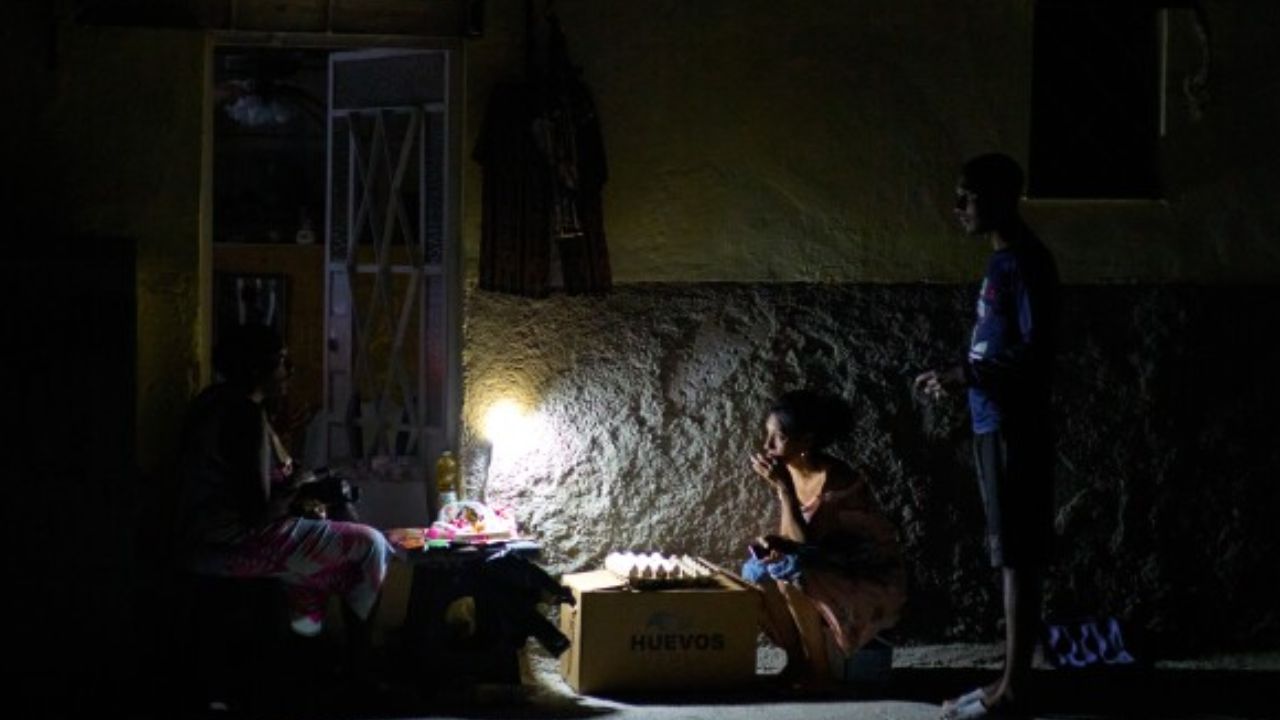
    Cuba was hit by a nationwide blackout on Monday after its national power grid collapsed, leaving millions without electricity, as US continued its blockade of fuel. 

    The state-owned grid operator stated that no faults were detected in the units operating at the time of the collapse and that efforts were underway to restore power across the country.


    The outage comes amid an ongoing energy crisis linked to fuel shortages. Cuban authorities have said the country has not received oil shipments for three months, affecting electricity generation and leading to repeated power cuts.

    Officials have attributed the shortages to US restrictions on fuel supplies. 


    Fuel prices have also risen on the unofficial market, with reports indicating petrol costs reaching up to $9 per litre meaning it costs more than $300 to fill up a car’s gas tank which is more than most Cubans earn in a year.


    The blackout coincided with remarks by US President Donald Trump, who said he could “take” Cuba as Washington DC and Havana hold talks on their bilateral relationship.

    “I do believe I’ll be … having the honor of taking Cuba. That’s a big honor. Taking Cuba in some form,” Trump told reporters.

    “I mean, whether I free it, take it. Think I can do anything I want with it. You want to know the truth,” he added at the Oval Office.

    According to a report by The New York Times, US officials have indicated that removing Cuban President Miguel Diaz-Canel from office is a key objective in the talks, citing people familiar with the matter. The report said US negotiators have conveyed this position to Cuban counterparts.

    Cuba has maintained that it will not accept external interference in its internal affairs and has treated such proposals as a condition that could halt any agreement.

    Diaz-Canel said last week that any talks with the United States (US) should be based on “the principles of equality and respect for the political systems of both countries, sovereignty and self-determination.”


    Trump has also increased pressure on Cuba by halting Venezuelan oil shipments and warning of tariffs on countries supplying oil to the island.

  • Muslim advisor resigns from Trump religious panel after anti-Zionist commissioner’s dismissal

    Muslim advisor resigns from Trump religious panel after anti-Zionist commissioner’s dismissal

    Sameerah Munshi, the only Muslim woman serving on the Advisory Board of Lay Leaders for the Religious Liberties Commission, has resigned in protest of the White House’s removal of anti-Zionist Catholic commissioner Carrie Prejean-Boller. Munshi’s resignation letter, obtained by Middle East Eye on Thursday, cited what she described as “hostile” behavior towards Muslims and a lack of respect for religious beliefs.

    Prejean-Boller, who confirmed that she was fired on X on Thursday, said that her removal was due to her opposition to Israel’s genocide in Gaza and her insistence that Catholicism and Zionism are not compatible. Her dismissal followed a viral video clip from a February commission meeting, in which she argued against the compatibility of the two.

    Munshi, in her resignation letter, wrote: “If we are not free in America to abide by our religious beliefs and hold fast to them despite others’ disagreement, then in what country are we free to do so?” She added that the commission treated Muslim members with hostility and mocked their faith.

    The commission, established under the Department of Justice in May 2025, reports directly to the president. There are no Muslim commissioners, only three appointed as advisors: Munshi; Ismail Royer, director of the Religious Freedom Institute; and scholar Sheikh Hamza Yusuf. 

    Munshi said she began to feel isolated after testifying in September 2025 about students’ rights to protest Israel’s actions in Palestine. “After I testified about Palestine, I stopped receiving the witness lists before each hearing, so I don’t know if that was a coincidence, if it was organizational, just a miscommunication on their end, or if they literally held it against me about what I testified on,” she said.

    Munshi described developing a connection with Prejean-Boller after the meeting. “Carrie has been wonderful. We’ve become pretty good friends at this point, and we’ve shared a lot,” she said. She also noted that Prejean-Boller respects Muslims, a quality she said she has rarely seen in conservative circles.

    Prejean-Boller has also spoken out against the US-Israeli war on Iran, which Munshi cited as another reason for her resignation. Munshi wrote: “This government’s unlawful killing of children and civilians in Iran is at the urging of a genocidal state… It is painfully obvious through their actions that this administration has no regard for the Constitution’s protection of free expression and religious liberty, nor its detailing of war powers.”

    After the February hearing clip gained attention, Jason Bedrick of The Heritage Foundation claimed Munshi provided Prejean-Boller with talking points. 

    Munshi denied the claim, stating: “I deny providing her talking points. Me and Carrie were texting during the hearing… That morning I was in that meeting… it was a joke. It was a clown show in there. And I was frustrated. Carrie was frustrated. She told me to start recording her in case they didn’t call on her.”

    Prejean-Boller said she felt sidelined because of her advocacy for Palestinians and for wearing a Palestinian flag pin. “I had to do it. I knew that it had to be done because of what I’d seen, and the poor Palestinian people… I had to speak for them. I couldn’t just sit there in this fancy room with important people and allow them to just disregard Palestinians as human beings,” she said.

    Prejean-Boller added: “I am disgusted. I am absolutely disgusted with this president. He betrayed the American people, and he’s betrayed our constitution.” 

    The genocide Gaza has killed over 72,000 Palestinians, including 651 since a ceasefire brokered by the Trump administration. Lawmakers are now examining possible violations of the Federal Advisory Committee Act, including concerns over transparency, balance, and fair representation.

    Munshi clarified that her resignation was not due to fear or intimidation but a response to what she described as injustice within the commission.

  • Trump-Epstein ‘Titanic’ statue pops up in Washington DC

    Trump-Epstein ‘Titanic’ statue pops up in Washington DC

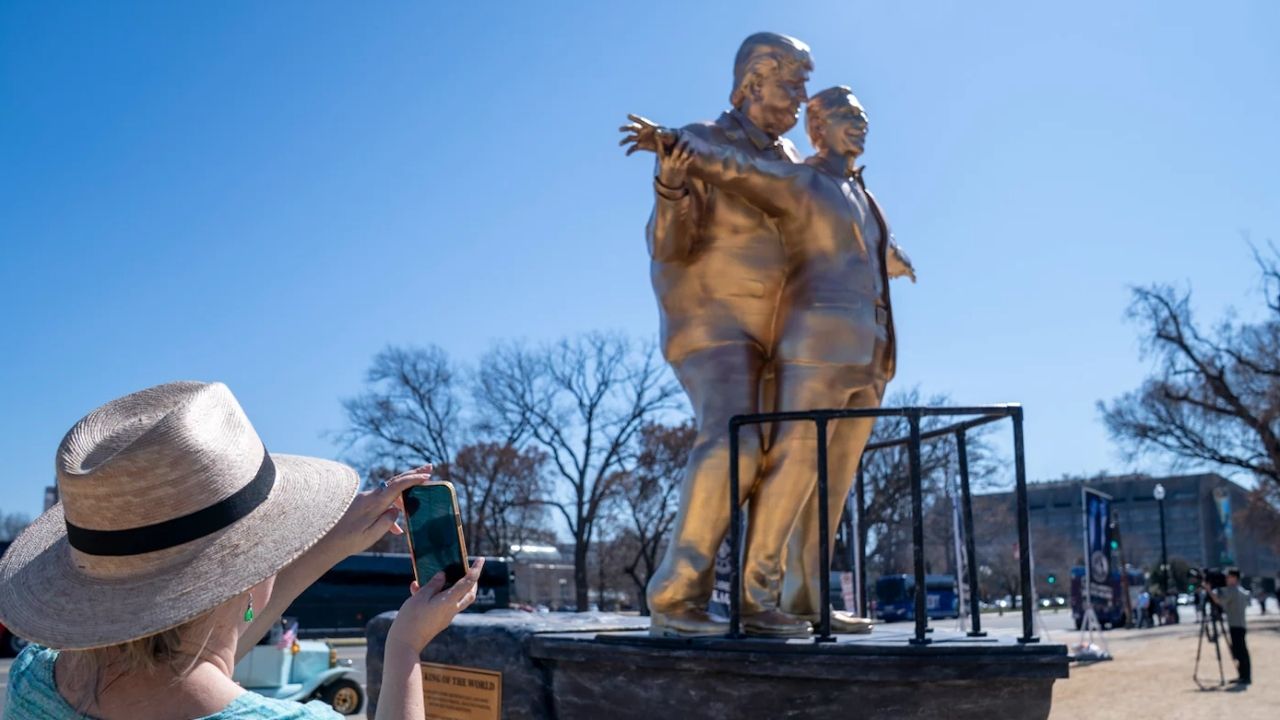
    An anonymous group of artists have installed a statue of US President Donald Trump and convicted sex offender Jeffrey Epstein on the National Mall in Washington DC on Tuesday, depicting the pair in a pose referencing a scene from the film Titanic.

    The installation, nearly 12 feet tall, shows Trump embracing Epstein. Plaques placed at the base of the statue read: “The tragic love story between Jack and Rose was built on luxurious travel, raucous parties, and secret nude sketches. This monument honors the bond between Donald Trump and Jeffrey Epstein, a friendship seemingly built on luxurious travel, raucous parties and secret nude sketches.”

    Ten banners were also placed nearby displaying a photograph of Trump and Epstein together alongside the words “Make America Safe Again”. The banners carry the insignia of the United States Department of Justice with the word “Justice” redacted.

    Trump had a long-standing association with Epstein, who died in jail in 2019 while facing sex trafficking charges. Trump has said he knew Epstein socially in Florida and that the two stopped interacting in the mid-2000s. He has also maintained that he was unaware of Epstein’s criminal conduct.

    The statue has been placed on Third Street NW between Jefferson and Madison drives and is the third installation by the artists depicting Trump and Epstein. In January, the group installed a replica of a birthday note and drawing bearing Trump’s name that appeared in a 2003 collection of messages for Epstein. Trump has denied writing the note and told reporters the signature was not his.

    In September, the same artists placed a bronze statue titled “Best Friends Forever” that showed Trump and Epstein holding hands.

    The artists identify themselves as “The Secret Handshake”, though their identities remain unknown. 

    According to the newspaper, the group uses an intermediary to obtain permits from the National Park Service for installations on the Mall. A copy of the permit reviewed by the publication shows the end date for the installation redacted.

    It remains unclear whether the redaction was made by the Park Service or was included as part of the installation.

    A spokesperson for the White House said that the statue reflects political hypocrisy.

    “When will these wealthy Democrat donors create sculptures of Democrats … who continued to solicit money and meetings from Epstein after he was convicted as a sex offender?” spokesperson Abigail Jackson asked in a statement.

    The National Mall has previously hosted protest art and installations aimed at highlighting political and social issues. Near the statue, a colorectal cancer awareness display featuring blue flags has also been installed on the Mall.

  • Pakistani man says he was pressured by Iran to kill Trump

    Pakistani man says he was pressured by Iran to kill Trump

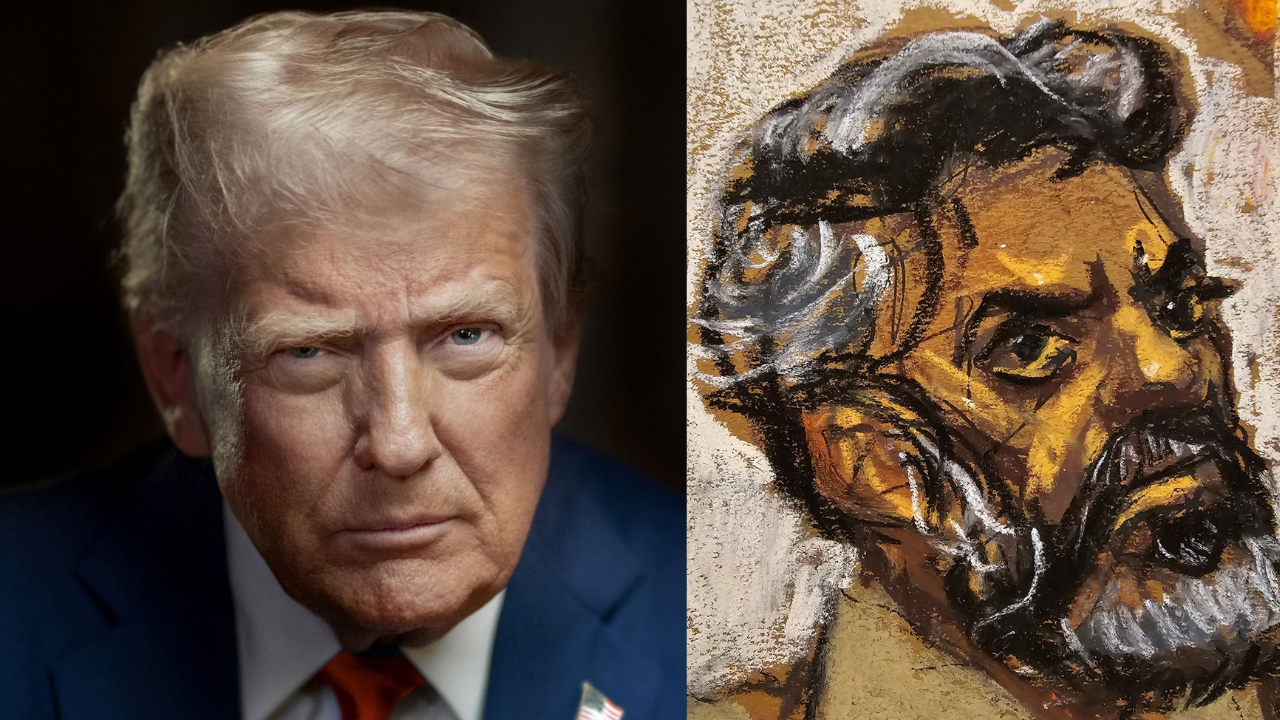
    A Pakistani man accused of plotting to kill  United States (US) President Donald Trump told jurors that he did not willingly collaborate with Iran’s Islamic Revolutionary Guard Corps (IRGC) in the plan, media reports have stated. 


    The Justice Department has alleged that Asif Merchant attempted to recruit individuals in the US to target Trump and other American politicians. The alleged plot was reportedly in retaliation for Washington’s killing of IRGC commander Qassem Soleimani.

    The IRGC, which combines military, economic, and intelligence influence, plays a central role in Iran’s operations.

    Merchant told the court, “I was not wanting to do this so willingly,” adding that he participated in the plot to protect his family in Tehran. He stated that he had never been explicitly ordered to kill a particular individual, but that his Iranian handler had mentioned three potential targets during conversations in the Iranian capital.

    Those named included Trump, Joe Biden, and Nikki Haley, a Republican candidate in the 2024 presidential election.

    Prosecutors have dismissed Merchant’s claims, citing a “lack of evidentiary support for a true duress or coercion,” according to a letter sent to the judge overseeing the case.

    The trial began last week, just days before Trump reportedly authorized strikes in Iran carried out alongside Israel. The strikes killed Iran’s Supreme Leader Ayatollah Ali Khamenei and other top officials.

  • Iran hits 27 US bases and Israeli command headquarters

    Iran hits 27 US bases and Israeli command headquarters

    This morning, Iranian state media has confirmed that Supreme Leader Ayatollah Ali Khamenei was martyred at his office in the joint US-Israeli strikes yesterday. His daughter, son-in-law and grandson were martyred in the same wave of attacks and a 40-day national mourning period has been announced.

    Trump made the claim yesterday saying that, ‘one of the most evil people in History, is dead’, adding that, “he [Khamenei] was unable to avoid our Intelligence and Highly Sophisticated Tracking Systems and, working closely with Israel, there was not a thing he, or the other leaders that have been killed along with him, could do…Hopefully, the IRGC [Islamic Revolutionary Guard Corps] and Police will peacefully merge with the Iranian Patriots.”

    Khamenei, 86, had led Iran since 1989, succeeding Ayatollah Ruhollah Khomeini after the 1979 Islamic Revolution. He ruled for more than three decades and held ultimate authority over the government, military and judiciary while serving as the country’s highest religious authority.

    Khamenei consolidated the power of the Islamic Revolutionary Guard Corps (IRGC), endured sweeping sanctions, and repeatedly insisted Iran’s nuclear programme was civilian. His death is the most dramatic rupture in Iran’s leadership since the revolution.

    What happened?

    On Saturday around noon, news of the US-Israel airstrikes in Tehran were confirmed. Multiple cities were targeted, including Tehran, Qom, Esfahan and Khoramabad. The Pentagon confirmed its involvement in the strikes, labeling their operation as “Operaton Epic Fury,” and Trump stated that the US had launched “major combat operations” to eliminate threats from Iran and prevent it from obtaining nuclear weapons.

    Within the hour, Iran confirmed that they would retaliate. Israel soon after, made the first claim, telling Reuters, that Ayatollah Khamenei was killed in the strikes.

    By 2PM, Iran had launched missiles towards Israel and explosions were heard in cities in northern Israel.

    Iran, then, targeted US based in Qatar, Kuwait, UAE and Bahrain and explosions were heard in Doha, Riyadh, Dubai and Abu Dhabi. Dubai was hit in a few areas, including a hotel and the airport, but primarily due to drone debris and faced no major casualties.

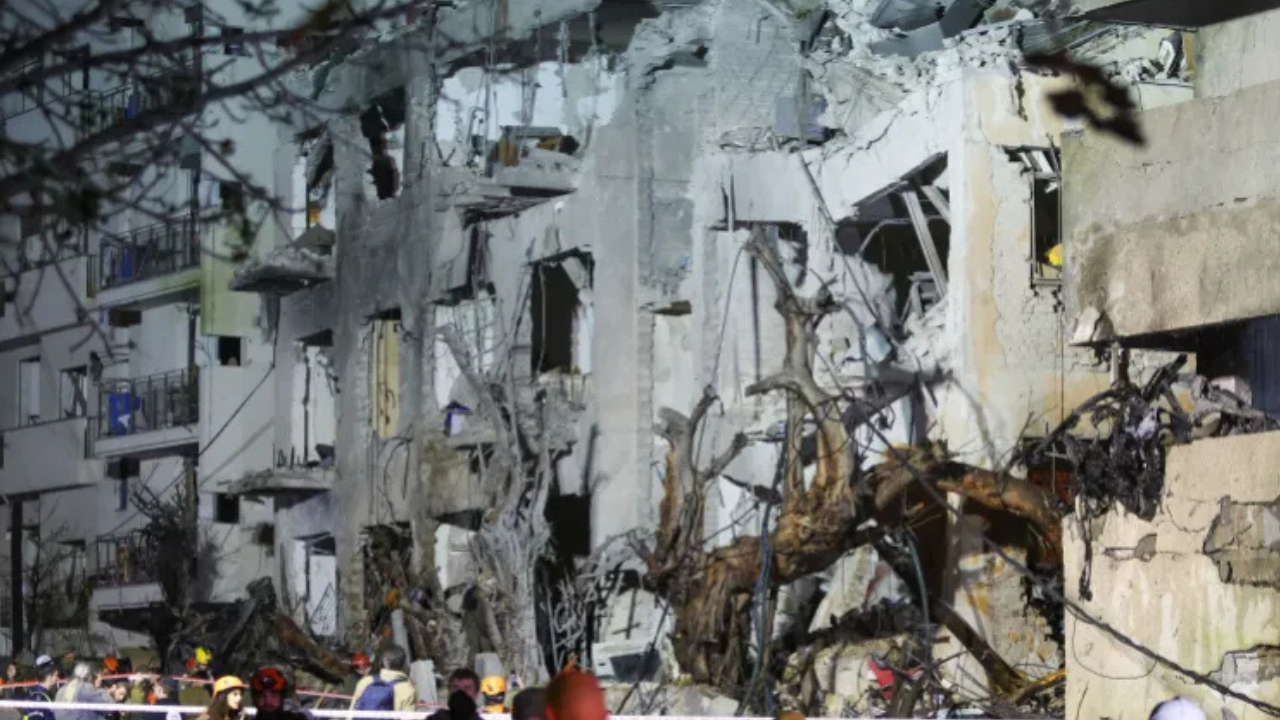
    Iran’s Red Crescent said more than 200 killed and 747 were injured across 24 provinces in Iran, the most devastating hit being on a girls’ elementary school in Minab, a city in the Hormozgan province of southern Iran, killing 108 people.

    A UN emergency session was called and Iran’s ambassador told the UN Security Council that civilians were killed in the Israeli strikes including 100 children in school. Pakistan became the only Muslim country to condemn the US-Israel attack on Iran at the UN session, alongside Russia and China, while also condemning Iran’s retaliatory attacks on the Gulf nations.

    The biggest question remained as Iran kept denying the news: Was Khamenei dead? Iran said no, adding that Khamenei was alive and ‘commanding the field’.

    Earlier this morning, Iranian state media confirmed that Ayatollah Ali Khamenei was martyred in the strikes.

    What is happening now and expected?

    The latest updates right now is that Iran has announced attacks on 27 US bases in Middle East. Reuters is reporting that the sounds of explosions were heard in Dubai.

    According to the Iranian state media, the IRGC has said that it is carrying out a ‘sixth wave of attacks’, with an “extensive missile and drone” attacks on Israel and US military bases in the region.

    Iran has claimed that 27 US bases, as well as the Israeli Tel Nof airbase, the Israeli army’s command headquarters at HaKirya in Tel Aviv, and a large defence industrial complex in the same city, were attacked. The forces added that they will, “implement a different and harsh step of revenge, with successive, regrettable slaps”.

    Meanwhile, the Israeli military has warned its residents not to share the locations of areas hit in Israel by Iran. In a post on X, the Israeli military also said that they should remain in their ‘protective bunkers’ unless told to leave.

    New leadership in Iran

    A three-person transitional council (president, judiciary chief, Guardian Council jurist) will assume leadership duties as Iran also confirmed that senior Iranian official Ali Shamkhani and the chief of the IRGC, Mohammad Pakpour were also killed.

    US-Israel position

    Trump has announced “major combat operations” in Iran and that bombing will continue “uninterrupted throughout the week or as long as necessary.” He also said that diplomacy may now be “much easier,” with new Iranian leadership. At home, Trump is being severely criticised over bypassing Congress before launching attacks with Israel.

    Global reaction

    Several countries have shut their airspace amid missile exchanges as the UN calls for immediate de-escalation. China has called for a halt to military action, Oman says that the negotiations were going well and were undermined and Russia has criticised the US negotiations as a “cover”.

  • Trump says Pakistan is doing ‘terrifically well’ amid clashes with Afghanistan

    Trump says Pakistan is doing ‘terrifically well’ amid clashes with Afghanistan

    The President of the United States of America, Donald Trump, has commented on Pakistan’s military action against the Afghan Taliban, saying “Pakistan is doing terrifically well.” 

    Speaking to reporters during a media interaction, Trump was asked about Pakistan’s strikes against the Afghan Taliban. In response to being asked whether he would intervene, he said, “Well, I would, but I get along with Pakistan, as you know, very well. Very, very well.”

    Referring to Pakistan’s civilian and military leadership, Trump said, “They have a great prime minister, a great general there, a great leader, two of the people I really respect a lot,” referring to Prime Minister Shehbaz Sharif and Chief of Defence Forces and Chief of the Army Staff Field Marshal General Asim Munir. “And I think that Pakistan is doing terrifically well.”

    In a separate statement, the United States expressed support for Pakistan following its military action inside Afghanistan after cross-border clashes. Allison Hooker, the US under Secretary of State for Political Affairs, said Washington DC was monitoring developments.


    “We continue to monitor the situation closely and express support for Pakistan’s right to defend itself against Taliban attacks,” Hooker wrote on X after talks with a Pakistani counterpart.

    The situation also drew a response from the United Nations. UN Secretary-General Antonio Guterres who called for an immediate ceasefire between Pakistan and Afghanistan following the escalation.

    “He is deeply concerned by the escalation of violence we’re seeing between Afghanistan and Pakistan, and the impact that violence is having on civilian populations,” UN spokesman Stephane Dujarric said. “He calls for an immediate cessation of hostilities, and he reiterates his call on the parties to resolve any differences through diplomacy.”

    The International Committee of the Red Cross also urged restraint. ICRC President Mirjana Spoljaric said civilians must be protected and access to healthcare ensured.

    “We are witnessing a profound escalation of hostilities between Afghanistan and Pakistan,” she said, calling for “restraint and de-escalation.”

    Pakistan launched Operation Ghazab ul-Haq on Friday after unprovoked cross-border firing from Afghanistan across multiple areas. An update shared by Minister for Information Attaullah Tarar on X at on February 28 said losses attributed to the Afghan Taliban included 331 killed, over 500 injured, 104 check posts destroyed, 22 posts captured, 163 tanks and armed vehicles destroyed, and 37 locations across Afghanistan targeted by air.

  • Trump vows new 10 percent tariff after Supreme Court strikes down emergency levies

    Trump vows new 10 percent tariff after Supreme Court strikes down emergency levies

    US President Donald Trump has said that he will impose a fresh global tariff of 10 percent on US trading partners after the US Supreme Court ruled that his earlier tariff regime, introduced under emergency powers, was unlawful.

    In a 6-3 decision, the court held that the International Emergency Economic Powers Act (IEEPA) does not give the president authority to impose tariffs. The ruling upheld earlier lower court decisions that found Trump exceeded his powers by using the law to levy import taxes. Three liberal justices joined three conservatives in the majority.

    Trump responded by signalling he would continue pursuing tariffs through other legal means. Speaking to reporters, he said he would move forward “using alternative authorities” and criticised members of the court, saying they lacked “the courage to do what’s right for the country”.

    He also said that trade negotiations conducted while the tariffs were in place would not be affected. Asked about talks with India, Trump said, “The India deal is on,” and added that tariffs introduced under different statutes would replace those struck down by the court. “All the deals, we’re just going to do it a different way,” he said.

    Trump defended his approach to trade policy, stating, “In order to protect our country, a president can actually charge more tariffs than I was charging in the past.” He also said, “The Supreme Court’s decision today made a president’s ability to both regulate trade and impose tariffs more powerful and more crystal clear, rather than less.”

    The court ruled that the Constitution grants Congress the authority to impose taxes and tariffs, not the president acting alone. In its opinion, the court said that if Congress had intended to grant tariff powers under IEEPA, it “would have done so expressly, as it consistently has in other tariff statutes”.

    The legal challenge was brought by businesses affected by the tariffs along with 12 US states, most governed by Democrats. The case focused on Trump’s use of IEEPA, a law historically used to impose sanctions or freeze assets during national emergencies rather than levy import duties.

    Canada welcomed the ruling, with its trade minister saying the tariffs were “unjustified”. The United Kingdom said it would work with Washington to assess how the decision could affect the bilateral trade deal. Germany and the European Union said they were in contact with the US administration and were analysing the ruling. 

    Trump has used tariffs as a central element of his economic and foreign policy since returning to office, initiating disputes with multiple trading partners. He has argued that tariffs are necessary for US economic security. In November, he said that without them “the rest of the world would laugh at us”.

    Administration officials said the government would attempt to preserve as many tariffs as possible by invoking other statutory provisions. 

    According to economists at the Penn-Wharton Budget Model, tariffs imposed under IEEPA generated more than $175 billion. The Congressional Budget Office has estimated that if all existing tariffs remain in place, they could generate about $300 billion annually over the next decade. US Treasury data showed net customs duty receipts reached $195 billion in fiscal 2025.

  • Trump directs review and release of US files on aliens, UFOs

    Trump directs review and release of US files on aliens, UFOs

    US President Donald Trump has said that he will direct federal agencies, including the Department of Defense, to begin identifying and releasing government files related to aliens and extraterrestrial life.

    The statement came hours after Trump criticised former president Barack Obama for remarks made during a podcast interview in which Obama said “Aliens are real.”

    “He’s not supposed to be doing that,” Trump told reporters aboard Air Force One. 

    “He made a big mistake.”

    When asked whether he believes aliens exist, Trump said: “Well, I don’t know if they’re real or not.”

    Obama made the initial comments in an interview with podcast host Brian Tyler Cohen, released last Saturday.

    “They’re real, but I haven’t seen them, and they’re not being kept in Area 51,” Obama said.

    “There’s no underground facility unless there’s this enormous conspiracy and they hid it from the president of the United States.”

    Obama later clarified his position in a post on Instagram, stating: “I saw no evidence during my presidency that extraterrestrials have made contact with us. Really!”

    He added that, given the size of the universe, he believes it is statistically possible that life exists beyond Earth.

    There was no indication that Obama relied on classified information during the interview. 

    On Thursday, Trump wrote on Truth Social that “based on the tremendous interest shown,” he would seek the release of files “related to alien and extraterrestrial life, unidentified aerial phenomena (UAP), and unidentified flying objects (UFOs), and any and all other information connected to these highly complex, but extremely interesting and important, matters.”

    In a 2024 report, the Pentagon said there was “no evidence” that the US government had encountered alien life and that most unidentified sightings were attributed to ordinary objects.

    In 2023, the US House of Representatives held a panel on unidentified anomalous phenomena, commonly known as UFOs. The hearing did not produce confirmation of alien life.