Tag: Facebook

  • Google, Facebook and Twitter threaten to shut services in Pakistan

    Google, Facebook and Twitter threaten to shut services in Pakistan

    When PTI’s government unveiled some of the world’s most sweeping censorship rules for the internet, global internet companies like Facebook, Google and Twitter threatened to shut services in the country, a step which would leave 70 million internet users in digital darkness, New York Times reported

    Through the Asia Internet Coalition, they wrote a letter to Prime Minister Imran Khan, warning him that “the rules as currently written would make it extremely difficult for AIC Members to make their services available to Pakistani users and businesses.”

    READ MORE: Punjab govt’s first-ever digital payment method collects Rs1 billion

    This undemocratic policy of PTI’s government faced severe backlash from rights groups forcing the government to retreat. Pakistani officials, this week, pledged to review regulations by doing a broad-based consultation process with all relevant stakeholders of civil society and technology companies.

    Pakistan’s digital censorship law will give power to the government to take-down a wide range of content. These laws can be easily abused by the powerful if they consider any sort of content harmful, distasteful or simply a threat to their interests.

    The unified resistance by Facebook, Google, Twitter and other tech companies in Pakistan is highly unusual. Companies often protest these types of regulations, but to leave a country is very unusual. Google pulled its search engine out of China in 2010 rather than submit to government censorship of search results.

    READ MORE: OGRA to drastically cut down petrol prices

    Under the new regulations, formally known as the Citizen Protection (Against Online Harm) Rules 2020, social media services must remove or block content within 24 hours of a request from a newly appointed officer, called the national coordinator.

    Companies must also prevent the live-streaming of any type of content the authorities say is objectionable.

    In addition, the companies must open permanent offices in Islamabad and set up servers to store data in the country. Violations of the law are subject to fines of more than $3 million, with the authorities even empowered to block services entirely.

    READ MORE: Christian youngster killed for ‘polluting’ tube-well water by bathing in it

    The new laws are a direct threat to the digital economic future for Pakistan. This will also decrease freedom of expression, increase censorship and diminish digital rights.

    What is interesting to note is that PM Khan rose to power in Pakistan in 2018 largely because of his party’s strong presence on social media. But now that he is in charge, and he is very intolerant towards online criticism.

    Pakistan’s powerful military is also averse to debates on social media platforms, especially on Twitter, which is used by critics to question human rights violations and Pak-military’s involvement in politics.

  • Facebook CEO shares views on social media regulations

    Mark Zuckerberg, the chief executive officer (CEO) of Facebook, has said that the social media giant is working to counter online election interferences, Business Recorder reported.

    According to reports, Mark, while speaking at the Munich Security Conference in Germany, said that so far there were no well-defined rules to regulate social media, however, the subject had been brought to debate for privacy and security reasons.

    Read more: WhatsApp reaches 2 billion users

    In his opinion, social media should be regulated with a system somewhere between the existing rules used for telecommunication and media industries.

    “Right now there are two frameworks that I think people have for existing industries – there’s like newspapers and existing media, and then there are the telecommunication type models, which is ‘the data just flows through you’, but you’re not going to hold a telecom responsible if someone says something harmful on a phone line.”

    Read more: PTI’s new social media laws: Are you in some sort of danger?

    “I actually think where we should be is somewhere in between,” he said.

    Facebook and social media giants including Twitter and Alphabet’s Google have come under increasing pressure to better combat governments and political groups using their platforms to spread false and misleading information.

    Read more: The inconvenient truth about Pakistan’s economy

    Mark maintained he had employed 35,000 people to review online content and implement security measures to counter fake news and privacy protection.

  • WhatsApp reaches 2 billion users

    WhatsApp reaches 2 billion users

    Facebook-owned instant messenger — WhatsApp — has crossed 2 billion users around the world, and on this success, has reaffirmed its commitment to strong encryption to protect the privacy of users’ data.

    WhatsApp, which was acquired by Facebook in 2014, turned into the most widely-used free messaging app that provides free text, voice and video communication services; enabling more than 2 billion people to have conversations from anywhere in the world.

    “Strong encryption is a necessity in modern life. We will not compromise on security because that would make people less safe,” WhatsApp said in an official statement. “For even more protection, we work with top security experts and employ industry-leading technology to stop misuse as well as provide controls and ways to report issues without sacrificing privacy.”

    The social network is working to extend end-to-end encryption across its messaging applications, including Facebook Messenger and Instagram.

    In a recent statement, Facebook had said some 2.89 billion people globally were daily users of at least one of its services. The growth has attracted more attention of regulators and activists concerned over the dominance of major tech platforms.

  • YouTube, Facebook content moderators sign PTSD disclosure

    YouTube, Facebook content moderators sign PTSD disclosure

    Technology and media company Verge has published a detailed report on Facebook and YouTube’s ‘content moderation’ processes in which people have to sign a form that says:

    “I understand the content I will be reviewing may be disturbing, It is possible that reviewing such content may impact my mental health, and it could even lead to Post Traumatic Stress Disorder (PTSD). I will take full advantage of the weCare program and seek additional mental health services if needed. I will tell my supervisor/or my HR People Adviser if I believe that the work is negatively affecting my mental health.”

    However, this policy is not for everyone, here is the reason why.

    According to the report, only new joiners were asked to sign the forms, whereas existing employees were being sent the form as an update. In addition, this policy is being implemented in a company called ‘Accenture.’

    The Accenture is a multinational company that provides content moderation services to various social media platforms like Facebook, Twitter, and Google. The job of content moderation is outsourced because a huge amount of Data is posted on social media platforms. It is certainly not possible for the company to moderate all content on its own.

    However, the nature of the job is gruesome because the moderators have to view highly sexual and violent content which results in severe mental health issues. The reports come as Facebook faces lawsuits from former content moderators over a range of mental health issues in California and Ireland.

    Cases of PTSD and other mental health issues have been on the rise among content moderators. In 2019 The Verge published a behind the senses report of the Facebook Moderators.

    One moderator quoted in that report said he “sleeps with a gun by his side” after doing the job.

    Mental health experts say understanding the psychological strains of this job does not mitigate its risks.

  • How to reduce social media’s toxicity

    How to reduce social media’s toxicity

    You often decide to take a break from social media that is called “toxic” by a large number of people.

    Toxic social media is disturbing the sanity of their minds because there are tons of disturbing news out there. Despite deactivating all social media profiles, you see them coming back again. Yes, it is addictive, but here is what you can do to reduce its toxicity.

    1. UNFOLLOW ON FACEBOOK

    Most of us have Facebook profiles along with other 1.5 billion people who use it every day. We all started with sharing pictures on our profiles, or with our friends, but now it has turned into a battlefield of narratives between people. The best thing you can do is to ‘unfollow‘ those people who you want to avoid.

    Facebook is structured in a way that it will show you everything that you have searched in the past or what your friends are discussing, but when you unfollow someone, you’ll no longer see their activities or discussions.

    In some circumstances, you cannot unfriend or block a person, because of the reaction that you will get would be proportional to a threat of breakup or a divorce. So unfollow that person to cut down negativity.

    2. Stop tapping on everything on Instagram 

    Although you might have control over what you follow on Instagram, you may turn off comments on your posts, or you do not follow hashtags that you do not like. But, what about the search tab that shows you the weirdest stuff you cannot even imagine in your nightmare. Here come the algorithms of Instagram.

    If you are tapping on the pictures of dogs, 50-60% of the picture you might see would be of dogs – the rest of the pictures will depend on the previous searches done from your account. So, if you want to cut down what you see in the search tab, skip it for a few days and tap on only those items that you want to follow.

    3. Twitter is not easy

    Cutting toxicity on Facebook or Instagram might be little convenient, but handling Twitter in this regard is tricky. You might follow a writer that posted something you like, but their next tweet ruins your entire day, what you can do about it? Here is what you can do.

    To block or unfollow that most toxic account would be just right. But if you like the real tweets of someone’s account and do not like their retweets, you can simply turn off retweet on a per-account basis. Moreover, you can use quality and advance filters to censor the words you do not like.

    These are few tools you can tweak to filter toxicity, but if you really want to cut down of social media poison; discipline yourself. The biggest filter one can use is to have positive thinking, but that is another topic for some other day.

  • TikTok beats Facebook to become second most-downloaded app in world

    TikTok beats Facebook to become second most-downloaded app in world

    TikTok, a video-sharing social networking app, has beaten Facebook to become the second most downloaded app in the world in 2019. The platform owned by China-based ByteDance came second to Whatsapp in terms of downloads.

    As per market analyst Sensor Tower’s ranking, both TikTok and its Chinese counterpart Douyin amassed a total of 740 million downloads in 2019. The reports consist of worldwide downloads for Google Play Store, iPhone and iPad. They, however, did not include data from Apple apps, pre-installed Google apps and Android downloads from third-party stores based in China.

    The company is making efforts to monetize the app, it had a successful year in terms of revenue grossing over $176.9 million in 2019.

  • Woman arrested for deceiving men on Facebook using niece’s picture

    Woman arrested for deceiving men on Facebook using niece’s picture

    Cyber-crime wing of the Federal Investigation Agency (FIA) has arrested a woman in Karachi for defrauding people on Facebook by using pictures of her niece.

    As per reports, the woman used pictures of her niece to make friends on Facebook. She would ask men for gifts and mobile top-ups. 

    A man had been talking to the woman for almost seven years, mistaking her for a young girl. The man didn’t know he was talking to a 60-year-old woman.

    The complaint was filed by the woman’s niece after the man found her real profile on Facebook. He informed her that someone is using her pictures to trap men from a fake account.

    According to the girl, the man told her that he had filed a complaint with the FIA. The accused woman confessed to her crime. She had met the man on a Facebook group and he had asked her to share her pictures. She said, “I shared with him the picture of my niece. What I did was wrong.”

  • Facebook blocks Radio Pakistan’s live streaming of Indian atrocities in Kashmir

    Facebook blocks Radio Pakistan’s live streaming of Indian atrocities in Kashmir

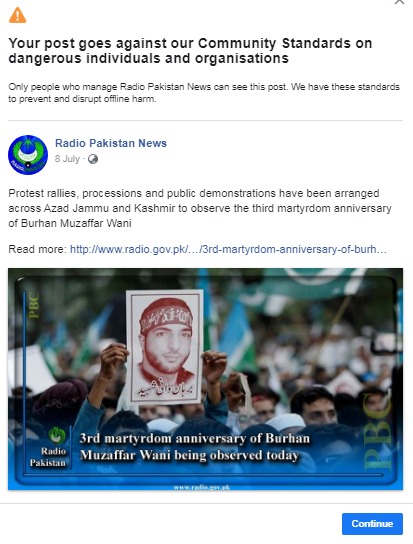
    Facebook has blocked Pakistan Broadcasting Corporation’s (PBC) live streaming of Indian atrocities and military lockdown in Indian occupied Kashmir (IoK), Radio Pakistan reported.

    According to the details, Radio Pakistan (RP) has shared screenshots of warning message from Facebook from back in May and July on its website, saying, “your post goes against our Community Standards on dangerous individuals and organisations.”

    According to the the screenshots shared by RP, the warning was given on posts that displayed the picture of Kashmiri freedom fighter Burhan Muzaffar Wani and in another post that mentioned Zakir Musa — a mujahid commander — in the headline.

    However, Radio Pakistan after the blockage its live streaming from Facebook has said on Monday that it has made “alternate arrangements on YouTube for live streaming for its viewers.”

    It is important to note that RP has been highlighting the voice of the people of IoK and exposing Indian atrocities and gross human rights violations at every major platform including social media.

    In addition to Facebook, the micro-blogging website Twitter had also suspended hundreds of accounts and removed multiple posts from Pakistan that were raising voice against Indian brutalities in Kashmir, reportedly under pressure from India.

    Pakistan Telecommunication Authority (PTA) had earlier approached both social media platforms and submitted complaints against their actions.

  • ‘Can locate users even if they opt-out of tracking,’ reveals Facebook

    The social media giant, Facebook has revealed that it can determine where users are even if they choose-out of having their whereabouts tracked, The Express Tribune reported.

    According to the details, Facebook in its letter sent to United States (US) senators explained the ways it can use to figure out where people are after they have selected not to share precise location data with the company.

    The social media network, contended that knowing a user’s location has benefits ranging from showing ads for nearby shops to fighting hackers and battling misinformation.

    Republican Senator Josh Hawley in a tweet said, “There is no opting out. No control over your personal information,” adding that, “That’s Big Tech. And that’s why Congress needs to take action.”

    Facebook said that the clues for figuring out someone’s location include being tagged in a photo at a specific place or a check-in at a location such as at a restaurant during a dinner with friends or a hotel.

    Along with location information shared in posts by users, their whereabouts can be noted with the help of devices connecting to the internet, which are given IP addresses. Those IP addresses include locations, although they are a a bit imprecise when it comes to mobile devices linking through telecom services that might only note a town or city.

    The tech giant had recently said that it is ready for a data privacy law which will go into effect in its home state of California at the start of next year.

    The California Consumer Privacy Act (CCPA) will give internet users the right to see what data is being collected by the big tech companies and with whom it is shared.

  • Facebook to pay users $600 for taking survey

    Facebook to pay users $600 for taking survey

    Facebook will pay $600 to users sharing opinions on its new application “Viewpoint” that will be introduced to facilitate its market research purpose.

    Viewpoint will give back users a voluntarily control to participate in market research, surveys and different programme, for which Facebook has announced to pay $600 a year.

    The purpose of the application is to collect information directly from the users to improve the performance of its products like Facebook, Whatsapp, Instagram, Oculus, Portal and others.

    “Today, we’re introducing Facebook Viewpoints, a new market research app that rewards people for participating in surveys, tasks, and research. We believe the best way to make products better is to get insights directly from people who use them. We’ll use these insights to improve products like Facebook, Instagram, WhatsApp, Portal and Oculus, and to benefit the broader community,” Facebook Product Manager Erez Naveh said.

    The participants will be paid through PayPal after scoring a set number of points in the programme. The users will also be asked to carry out various tasks to acquire feedback to improve the product or service, such as assisting the company’s artificial intelligence technology.