Tag: Gilgit Baltistan

  • Brazilian tourist dies while paragliding without permit in Gilgit Baltistan

    Brazilian tourist dies while paragliding without permit in Gilgit Baltistan

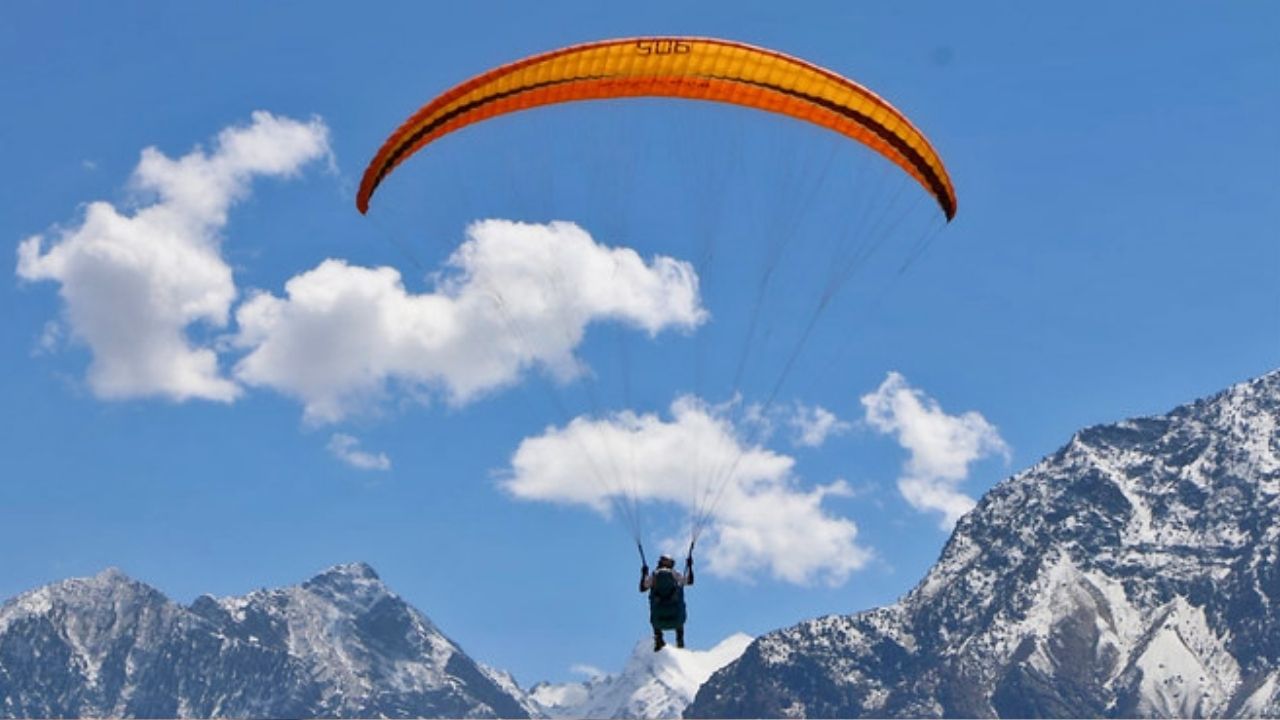
    A Brazilian citizen fell and died while paragliding in the Shigar district of Gilgit Baltistan on Thursday.


    Shigar DC Waliullah Falahi told Dawn that the tourist, identified as Raineri Rodrigo Chaddad, started the adventure from a mountain in Askoli Shigar.
    Raineri didn’t have a permit for the activity, and he died on the spot after the fall.


    DC asserted that action will be taken against the managing director of the victim’s tour operator who allowed him to take part in the activity without the requisite permit. An autopsy will be carried out shortly.

    While Pakistan’s dangerous adventure sports are generally considered safe, the weather can turn quite fast. Three Japanese climbers have been declared dead in less than a month while descending one of the highest mountains in northern Pakistan.

  • Glacial outburst expected in Gilgit Baltistan 

    Glacial outburst expected in Gilgit Baltistan 

    People of Gilgit-Baltistan have been warned of possible Glacial Lake Outburst Floods (Glof) events and floods this week due to the rising temperature in the region.

    Pakistan Meteorological Department on Monday alerted local authorities that daytime temperatures in GB and Khyber Pakhtunkhwa are expected to remain four to six degrees Celsius, higher than normal, between May 21 and 27. 

    Wind and thunderstorms are also expected in this time span, reports Dawn.

    Glof and flash floods are likely to affect vulnerable snow-covered and glaciated areas of Gilgit Baltistan and the Chitral district of Khyber Pakhtunkhwa. 

    Local authorities have asked people living near glaciers should take precautionary measures. Tourists have also been advised to be careful during rain.

    In 2022, flash floods and Glofs hit many villages in the Hunza, Nagar, Ghizer, Astore, Skardu, and Gilgit districts of GB.

  • Police say 20 killed in mountain bus accident in Pakistan

    Police say 20 killed in mountain bus accident in Pakistan

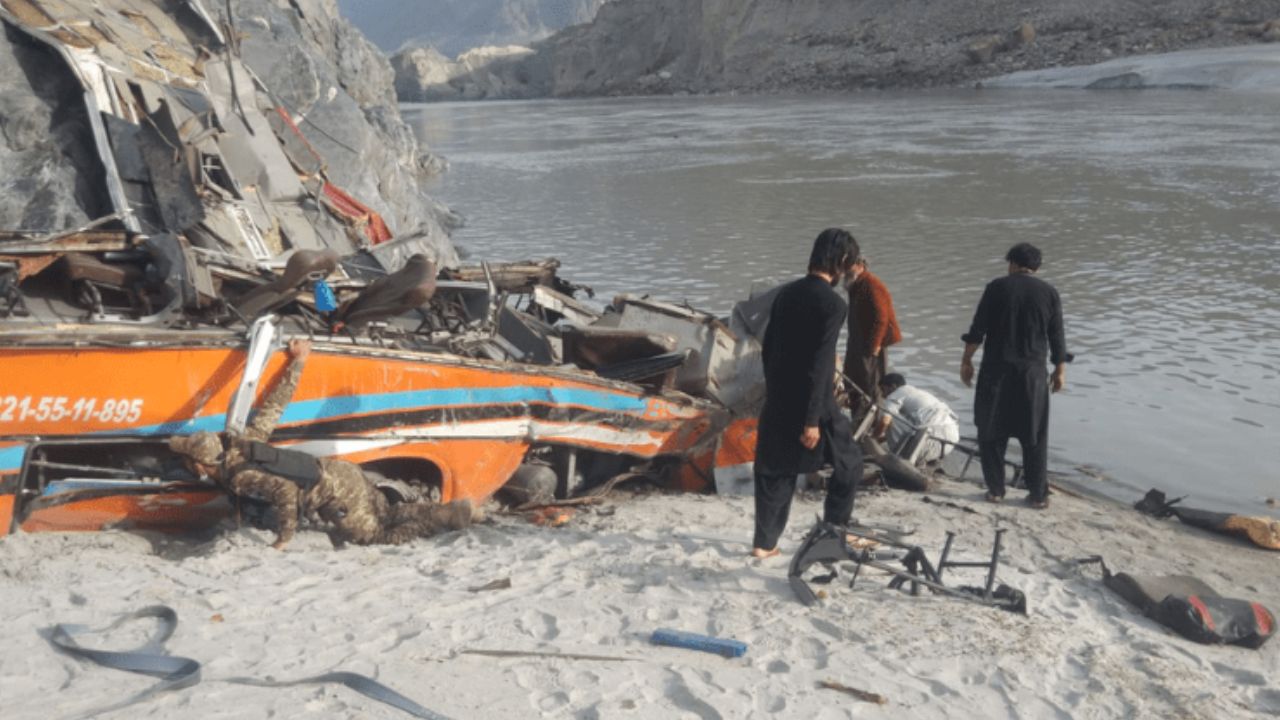
    At least 20 people were killed on Friday when a bus plunged into a deep valley in Pakistan’s mountainous northern region, police said.

    The driver lost control of the vehicle on a bend near the city of Chilas, in the Gilgit-Baltistan region, around dawn, falling into a rocky ravine where the River Indus flows.

    “The local Ulema (Muslim leader) announced the news of the accident from the loudspeaker of the mosque and urged the people to donate blood for the injured,” Azmat Shah, a police official in the city told AFP.

    “Rescue operations have been completed. Among the 21 injured, the condition of five is very critical.”

    The bus was travelling from the capital Islamabad to Gilgit.

    Road accidents with high fatalities are common in Pakistan, where safety measures are lax, driver training is poor and transport infrastructure often decrepit.

  • Ali Amin Gandapur elected KP chief minister

    Ali Amin Gandapur elected KP chief minister

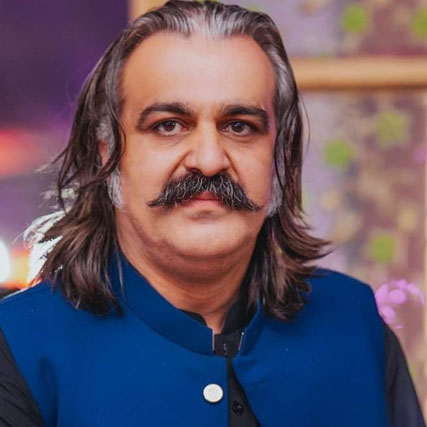
    Ali Amin Gandapur, leader of the Pakistan Tehreek-e-Insaf (PTI), contested as an independent candidate in the recent elections in Khyber Pakhtunkhwa. He won the vote to become the new chief minister of the province on Friday afternoon, after the voting finished in the Khyber Pakhtunkhwa (KP) Assembly.

    PTI founder Imran Khan has nominated Ali Amin Gandapur as the party’s candidate for KP Chief Minister. There is a high chance of his winning based on the number of PTI-backed members in the provincial assembly.

    The former federal minister decided to contest the top provincial post in an independent capacity after refusing to join the Sunni Ittehad Council (SIC) — the party which was joined by PTI-backed independent winners to claim their seats.

    Gandapur was the former federal minister of Kashmir affairs and Gilgit-Baltistan during the PTI government in the centre from October 2018 to April 2022.

    Previously, he was a member of the KP Assembly from 2013 to 2018 and served as provincial minister of Khyber Pakhtunkhwa for revenue.

  • What are Google trends saying about your search history of popular party leaders?

    What are Google trends saying about your search history of popular party leaders?

    Google Trends offer an insight into the popularity and curiosity political leaders enjoy among the masses. As the elections are drawing near, we took a peak into the data Google Trends have recorded over the last 30 days.


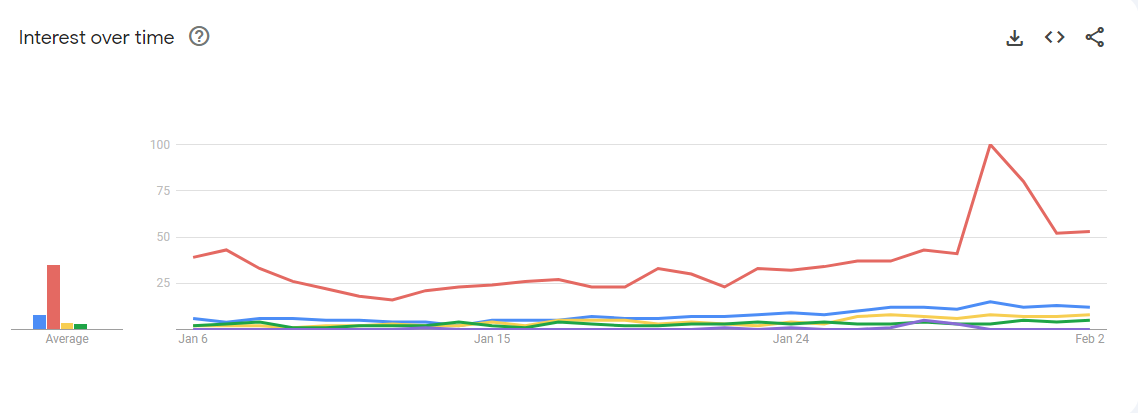
    The highest and ever-increasing line graph is Imran Khan’s. The highest peak was shown on January 30 with Khan hitting the record 100 score whereas his contemporaries, Nawaz stood on 15, Maryam Nawaz at eight, Bilawal-Bhutto Zardari at three, and Hamza Shehbaz being the lowest: less than one.

    However, it is important to note that Imran’s progressively increasing arc starts dropping successively in the days after Jan 30.


    On the other hand, except for Hamza Shehbaz, the other three is slowly on an upward trend.


    Breakdown of regions


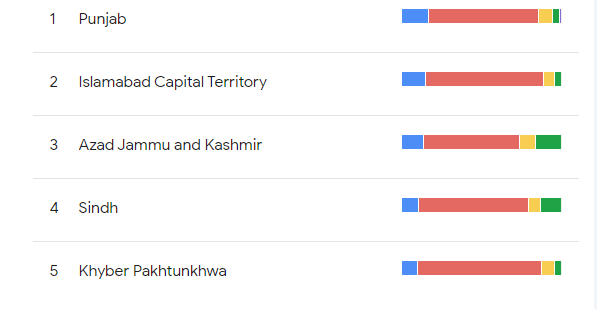
    PTI founder and jailed leader Imran Khan is most popular all over Pakistan according to Google Trends.


    Punjab


    In Punjab, the most popular choices for Chief Ministership, Hamza Shehbaz, and Maryam Nawaz contrary to popular perception, are not being searched so much. After Khan winning with more than 69 percent of searches, Nawaz Sharif is at 17 percent while Maryam is at nine percent. It appears that people in Punjab are comparatively more interested in Bilawal than Hamza who has 1 percent searches from all over the province.


    However, it is important to note that out of all the provinces, Punjab has shown more interest in PML-N leader Nawaz Sharif. Sindh has shown the most interest after Punjab, which is 11 percent, 10 percent in Khyber Pakhtunkhwa, nine percent in Balochistan, and seven percent in former FATA.


    Sindh


    After Imran Khan (69 percent) former Foreign Minister and Chairman of Pakistan People’s Party, Bilawal Bhutto Zardari is unsurprisingly most popular in Sindh with 13 percent of Google searches. Second in line is Punjab and third is Balochistan. After him is Nawaz (11 percent) followed by Maryam (7 percent).


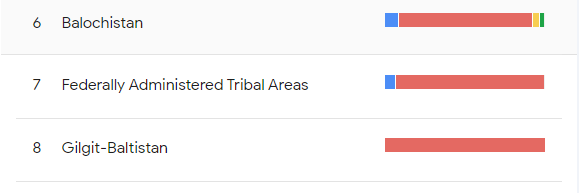
    Balochistan


    Imran Khan leading the slot here with 84 percent followed by Nawaz (9 percent), Maryam (4 percent), and Biawal Bhutto (3 percent). Hamza does not invoke public curiosity even the slightest.


    Gilgit Baltistan


    Imran Khan has a 100 percent popularity rate in Gilgit Baltistan, where it seems no other party leader stands a chance, implying that there were minor searches of them in GB.


    Former FATA


    Interestingly, in the former federally administered tribal areas, only Imran Khan and Nawaz Sharif were searched for, Khan at 93 per cent of searches and Nawaz at seven percent.


    Though Google search and Google trends are not the ultimate parameter of a party leader’s popularity, they certainly are proof of what netizens are most interested in and the social media footing of a politician.

  • Suicide rate at an all time high in Gilgit Baltistan

    Suicide rate at an all time high in Gilgit Baltistan

    An astounding 85 people have committed suicide since January 2022 in Gilgit Baltistan, including 50 males and 35 females.

    In a shocking revelation made by the Pamir Times, the numbers are showing a grim and a less-talked-about reality of Gilgit Baltistan region where contrary to popular belief, more men and boys are dying by taking their own lives compared to girls and women.

    Due to the stigma attached to suicide, not all cases are reported in the media. Sometimes even homicides are presented as suicides to save the perpetrators.

    There could be a number of factors which are pushing people to the brink but at the heart of it is deteriorating state of mental health among the inhabitants of the region.

    Even though the Government has in recent years made mental health a priority by making a helpline to offer support and counselling, the efforts are not enough.

  • Local bodies election happening after 18 years in Gilgit-Baltistan  

    Local bodies election happening after 18 years in Gilgit-Baltistan  

    Long awaited local bodies elections are going to take place in Gilgit-Baltistan (GB) for the first time in 18 years. Preparations are in full swing for the upcoming polls.

    GB Chief Election Commissioner Raja Shahbaz Khan has said that local body elections will be held in the last week of November. The process of delimitation is in progress, but the demarcation process is already complete.

    The Local Bodies Act 2014 took place on July 20, 2023, in GB. Raja Shahbaz Khan also described that, after door-to-door verification, the voter list has been compiled and will soon be made public.

    On the other hand, the Election Commission of Pakistan (ECP) has also arranged a training workshop for government officials in the region.

    The workshop’s fundamental purpose was to provide training to commissioners, deputy commissioners, and assistant commissioners from Gilgit, Diamer, and Baltistan divisions.

    While addressing the closing ceremony of the workshop, GB Chief Minister Haji Gulbar Khan said that local bodies election is the priority of the government.

  • Wet autumn or dry winter? The forecast is here

    Wet autumn or dry winter? The forecast is here

    Last week’s spell of rain helped bid farewell to summers. So, what’s next? Will we have more rains to make autumn a wet one? Or are we heading for our traditional dry winters?

    Read on for details.

    One last spell of monsoon is about to hit the upper parts of Pakistan and will likely impact the entire country.
    A weather advisory issued by the Pakistan Meteorological Department (PMD) said that the westerly rain-producing wave is likely to enter upper regions of the country on the evening or night of Thursday, September 28.

    Under the system, moderate to heavy rains with wind and thunderstorms is expected in Chitral, Dir, Swat, Shangla, Buner, Mansehra, Kohistan, Abbottabad, areas of Kashmir including Neelum valley, Muzaffarabad, Poonch, Hattian, Bagh, Haveli, Sudhanoti, Kotli, Bhimber, Mirpur, and areas of Gilgit Baltistan including Diamir, Astore, Ghizer, Skardu, Hunza, Gilgit, Ghanche, Shigar from September 28 to 30.

    Isolated spells of rain and thunderstorm with hailstorms are also expected in Kohat, Peshawar, Mardan, Swabi, Nowshera, Haripur, Kurram, Waziristan, Bannu, Dera Ismail Khan, Murree, Galliyat, Islamabad, Rawalpindi, Attock, Chakwal, Jhelum, Mianwali, Sargodha, Khushab, Faisalabad, Toba Tek Singh, Jhang, Mandi Bahauddin, Hafizabad, Gujranwala, Gujrat, Sialkot, Narowal, Lahore, Kasur, and Sheikhupura between September 28 and 29.

    Meanwhile, Zhob, Barkhan, Layyah, Bhakkar, Dera Ghazi Khan, Okara, Pakpattan, Sahiwal, Multan, Bahawalpur and Bahawalnagar are also expected to witness similar weather conditions during the said period.
    Moreover, snowfall is expected over the high mountains of the upper areas of Khyber Pakhtunkhwa, Kashmir, and Gilgit-Baltistan during this period.

    Under the possible impacts, the Met Office has also predicted a significant drop in the temperature in the areas affected by the spell.
    PMD advised farmers and tourists to manage their crop activities and remain cautious to avoid any untoward situation during the period, respectively.

    Meanwhile, the general public has been advised to stay at safe places during windstorms, lightning, and downpours as loose structures like electric poles, solar panels, billboards etc. may be damaged by the gusts.

  • Major weather change on its way in Pakistan

    The Pakistan Meteorological Department (PMD) has issued a forecast for heavy rainfall spanning from September 22 to September 24, affecting various regions of the country. Read the story to see if it will rain in your city or not.

    Met Office has confirmed that weak to moderate moist currents from the Arabian Sea are likely to penetrate in upper parts of the country from September 22, 2023. A westerly wave is also likely to affect the upper parts on September 22.

    Under the influence of this weather system rain/wind-thundershowers (with few moderate to heavy falls) are expected in:

    Kashmir (Neelum valley, Muzaffarabad, Poonch, Hattian, Bagh, Haveli, Sudhanoti, Kotli, Bhimber, Mirpur)

    Gilgit Baltistan (Diamir, Astore, Ghizer, Skardu, Hunza, Gilgit, Ghanche, Shigar)

    Punjab: Murree, Galliyat, Islamabad, Rawalpindi, Attock, Chakwal, Jhelum, Mandi Bahauddin, Hafizabad, Gujranwala, Gujrat, Sialkot, Narowal, Lahore, Kasur, Sheikhupura.

    Chitral, Dir, Swat, Shangla, Buner, Kurram, Mansehra, Kohistan, Abbottabad, Haripur, Kohat, Peshawar, Mardan, Swabi and Nowshera from 22nd to 24th September with occasional gaps.

    Rain/wind-thundershower is also expected in Lakki Marwat, Dera Ismail Khan, Bannu, Karak, Waziristan, Mianwali, Sargodha, Khushab, Faisalabad, Toba Tek Singh, Jhang, Bhakkar, Layyah, Dera Ghazi Khan, Multan and Bahawalnagar on 23rd & 24th September with occasional gaps.

    Possible Impacts:

    Moderate to heavy falls may cause urban flooding in low-lying areas of Lahore, Gujranwala, and Rawalpindi on the said dates.

    Moderate to heavy rains may trigger landslides in the vulnerable areas of Murree, Galliyat, Kashmir, Gilgit Baltistan, Chitral, Dir, Swat, Kohistan, Shangla, Buner, Mansehra & Abbottabad from September 22-24.

    Farmers are advised to manage their crop activities accordingly. Tourists and travelers are advised to remain cautious to avoid any untoward situation during the period.

    Wind thunderstorms may damage loose structures like electric poles, solar panels, etc. The general public is advised to stay at safe places during windstorms/lightning/moderate/heavy rains.
  • Melting glacier causes Indus to stop flowing, locals and infrastructure at risk

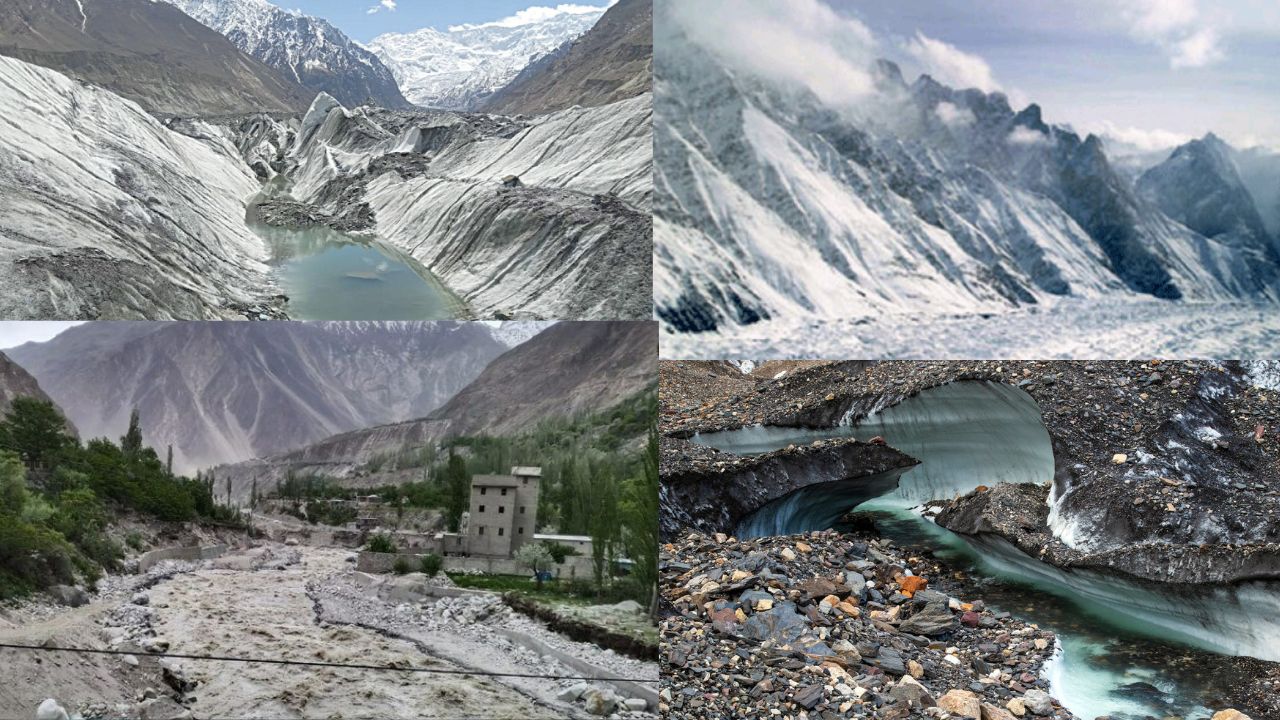
    Melting glacier causes Indus to stop flowing, locals and infrastructure at risk

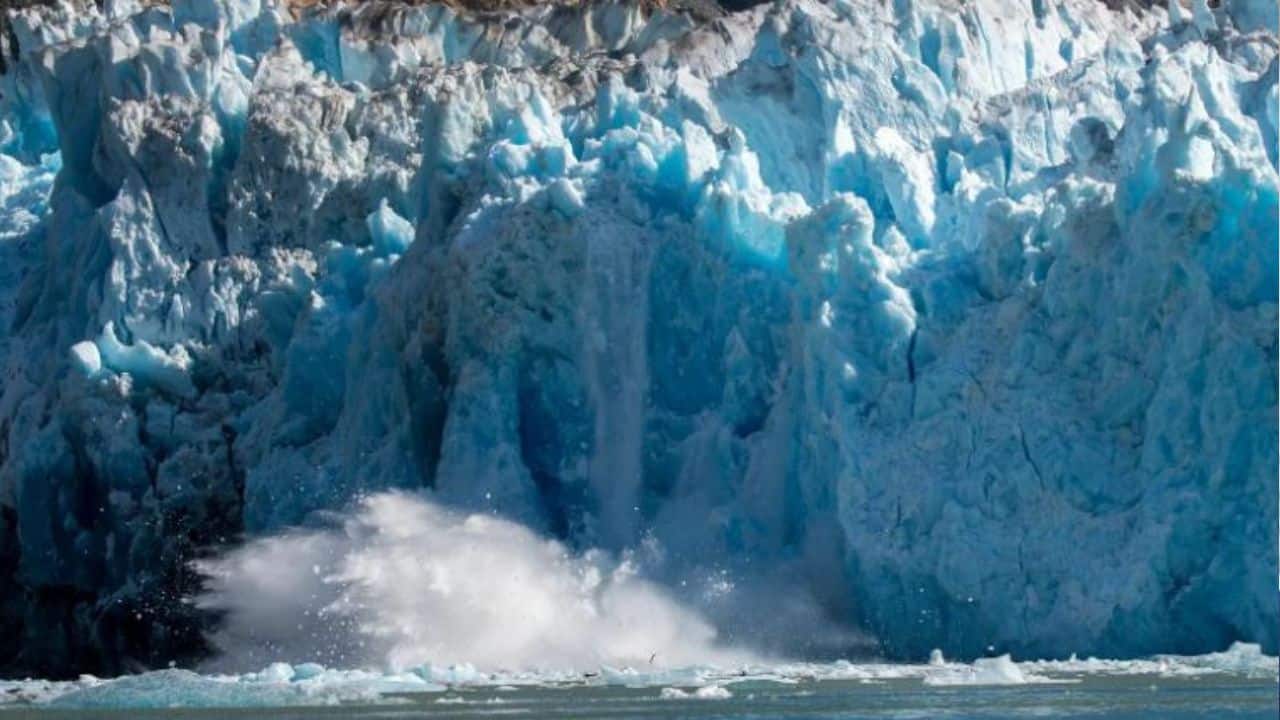
    The Indus River has stopped flowing due to the melting of a glacier, which has emerged as an eminent threat to the surrounding population in Diamer district of Gilgit-Baltistan.

    There is a fear of damage to the adjacent population due to the hold in water flow of the Indus River, reported Geo News. The rising water level has started touching the Labcher Bridge that could result in damaging the structure.

    Following the water blockage in Indus, the Raikot Mathath drain has also flooded and the drain water has entered the water channel of the Raikot Power House [Raikot is a village situated along the Indus River].

    Flooding in the drain has further caused a power outage in Gonar farm and Goharabad areas. Furthermore, a house and crops were also damaged.