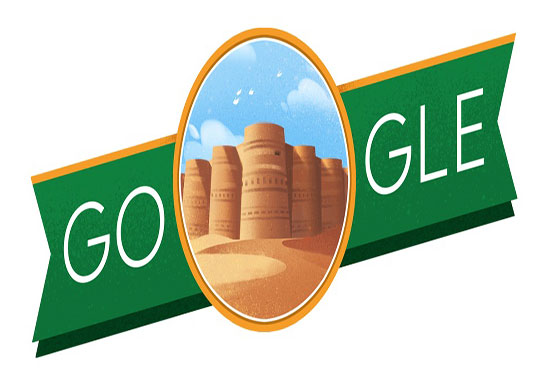
Google has released a doodle artwork of medieval Derawar Fort located in the Cholistan Desert of Punjab to mark Pakistan’s 75th Independence Day.
“Seventy-four years ago today, Pakistan achieved independence. Today’s doodle celebrates Pakistan Independence Day, a public holiday commemorating the day on which the nation became a sovereign republic.
“Pakistanis across the subcontinent join to celebrate their freedom and honour the centuries of history that comprise its cultural foundation,” read a statement by Google accompanying the doodle.
Huawei has been sued in California federal court for creating a “backdoor” that allowed it to collect sensitive data “important to Pakistan’s national security”, reports Reuters.
Business Efficiency Solutions (BES), a California-based IT consultant company, filed a complaint against the China-based tech giant on Wednesday, August 11.
According to the complaint, Huawei subcontracted with BES in 2016 for its $150 million bid to develop software for a Pakistani government programme providing new technology for police and law enforcement in Lahore. BES said it created software for the project that collects data from government agencies, controls access to buildings, monitors social media and manages drones, among other things.
Huawei officials allegedly demanded that BES send this information to the company in China for testing, and BES said it agreed to the demand but terminated its authorisation to use the technology after Huawei revoked its access to the testing laboratory.
The complaint said Huawei has yet to return any of the confidential software design tools or uninstall the software, as BES said it had agreed to.
BES said Huawei later demanded it install its data-aggregation software – used by Pakistani law enforcement to collect and analyse “sensitive data from different sources and government agencies” – in its Chinese lab, “this time not merely for testing purposes but with full access to data at the Lahore Safe City project.” BES said it agreed, under threat of termination and withheld payments, after Huawei said it had approval from the Pakistani government.
Huawei has yet to respond to the lawsuit filed by BES through its legal team. BES also did not share any more information beyond the case that it filed in the federal court.
The IT consulting firm also accused Huawei of stealing the “trade secrets, and other intellectual properties in its possessions after officials of the China tech company demanded it for testing.”
Up until now, the lawsuit alleged that Huawei has not returned the software design tools to BES.
Moreover, BES said that it only allowed Huawei to use the software with full access as the latter threatened that they will not be paid, which the Chinese giant has yet to do for some of the software in the project.
Huawei is a Chinese firm that has been banned in the United States (US) after it was accused of being a security risk. Thus, Google forcibly removed its services from the devices of the Chinese phone maker.
However, Huawei recently decided to live without Google by debuting its own operating system across all of its devices.
For the longest time, our country’s private sector has dealt with obstacles that don’t fully allow small companies to flourish. These obstacles combined with lack of opportunities cause a lot of frustration and reduce the ability to move forward.
In some respects, startups are not too different. After all, they also take birth in the same corporate culture. So naturally one wonders if regulations, opportunities, efficiency, and the business environment were more conducive, would our entrepreneurs be able to do things differently?
Could there be an area where progressive rules were introduced and one could monitor the changes and see if that made a major difference to the mechanics of the industry?
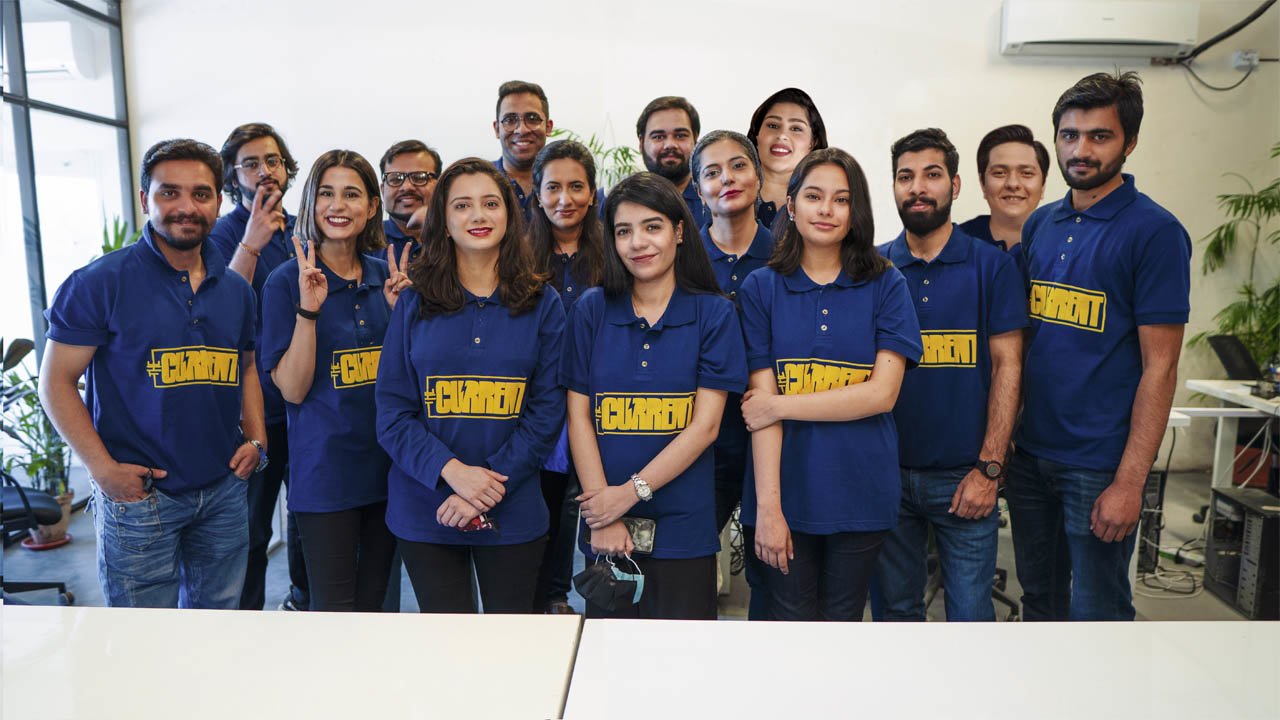
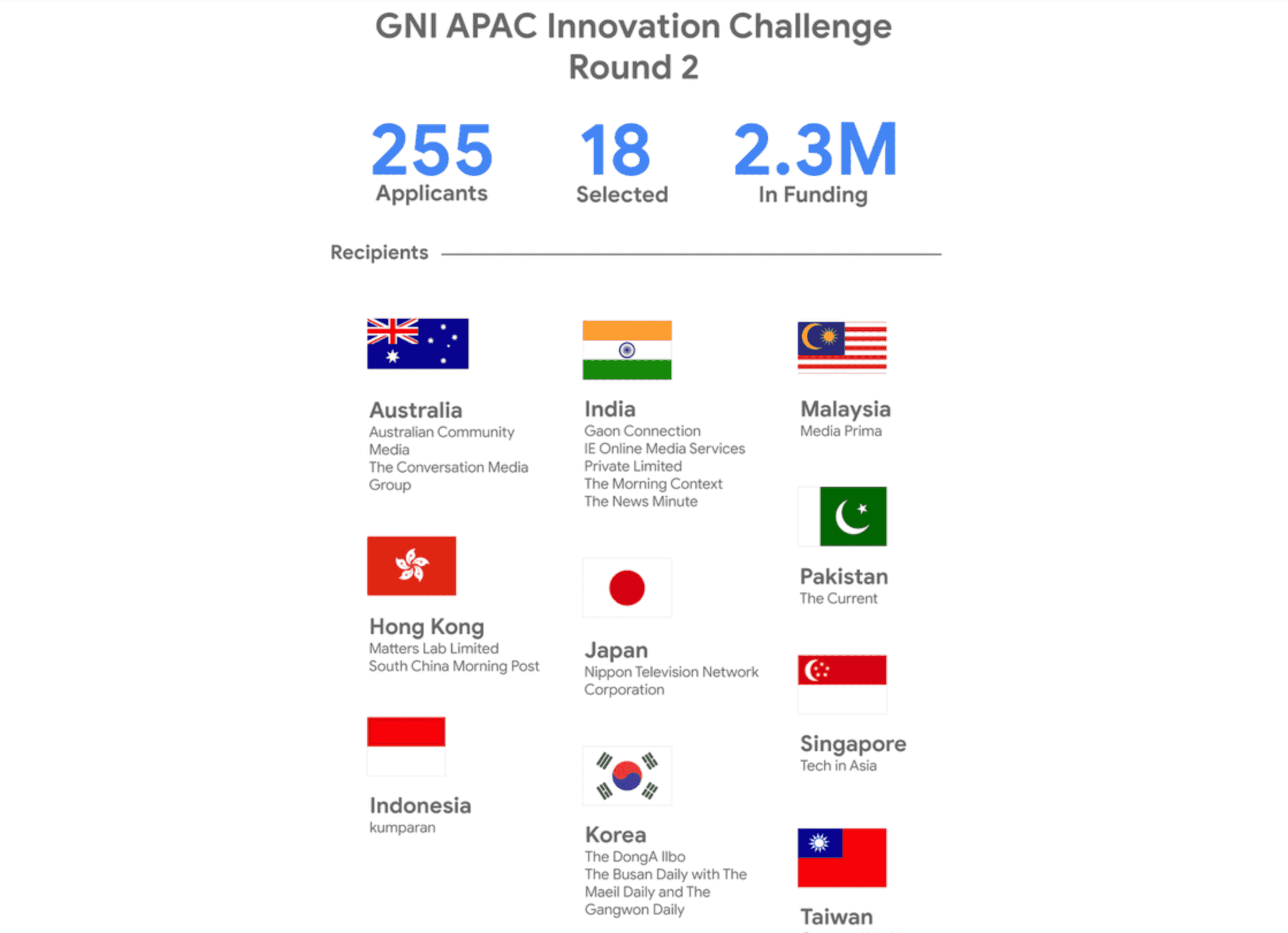
The Current, Pakistan’s first digital news-lifestyle platform that simplifies news for Pakistani millennials, is a startup. After winning the Google News Innovation Challenge in 2020, we faced immense challenges. When Google was sending over the first half of our grant, we were unable to meet the requirements to open a US Dollar bank account. We reached out to six different banks and were refused every time. Frustrated, we kept at it, until one bank took a chance and allowed us to open the account, granted we provide details that the money was indeed coming in from Google. We did and waited for our money to come in. When it did, the bank sent it back, citing that, according to State Bank regulations, getting the money into the country would be tough. Desperate, we appealed to the then Science and Technology Minister, Fawad Chaudhry, as well as contacting State Bank’s President Reza Baqir. Chaudhry was receptive and got us in touch with the right people to help us get our grant across. We were lucky that tech giant Google was in the picture. We finally got our money through and now, will be launching Pakistan’s first membership program.
The Current now comes around bearing good news for all startups. After we became the catalyst that pushed the State Bank of Pakistan (SBP) to understand the issues being faced by tech startups, the SBP introduced a new policy to facilitate startups and provide them a way to get their money home.
“You won the Google grant and there were issues bringing the money to Pakistan. Since I was the Science and Technology Minister at the time, I discussed the issue with Reza Baqir (President State Bank of Pakistan). Since the State Bank is in very capable hands, they made a new policy to facilitate startups,” says Fawad.
Chaudhry further added, “The credit goes to State Bank President, his team and to The Current, the reason why this issue was highlighted in the first place.”
SBP officially removed a major obstacle that has been subsequently thwarting the growth of the startup companies by allowing them to avail foreign loans as convertible debt.
Startup firms face funding issues due to the unavailability of collateral or security. Foreign investors, including equity funds and angel investors, show interest in startups but they try to cover the risk through alternative means like high return on loan, reports Dawn.
A company may raise funds from abroad in the form of convertible debt, i.e. the lender shall have the option to convert the loan into the equity of the borrowing company.
“It is expected that this initiative will help in attracting more foreign investment as it will provide another option to the international investors to invest in startup companies operating in Pakistan,” said the SBP.
We at The Current are immensely happy that we have helped carve a way and provide an easier path for Pakistani startups.
Google has fired the co-head of the ethical Artificial Intelligence (AI) team Margaret Mitchell for violating the security policies stated by the company.
The previous AI ethics researcher Timmit Gebru, a widely respected leader in AI ethics research, was also fired over similar accusations.
Mitchell is known for co-authoring a groundbreaking paper that showed facial recognition to be less accurate at identifying women and people of colour. The system can end up discriminating against them.
Mitchell also used automated scripts to look through her email to find evidence of discrimination against her co-workers.
Her views were directed at Google AI’s head Jeff Dean and CEO of Google Sundar Pichai; resulting in losing her corporate email access. Her activities were investigated, which led to the termination of Mitchell as well.
According to Axios, Google said in a statement regarding Mitchell’s firing: “After conducting a review of this manager’s conduct, we confirmed that there were multiple violations of our code of conduct, as well as of our security policies, which included the exfiltration of confidential business-sensitive documents and private data of other employees.”
These recent terminations have stirred a lot of heat for Google regarding diversity. As of now, Marian Croak, a Vice President in the engineering organisation is leading a new centre of expertise on responsible AI within Google.
Pakistan’s e-commerce marketing size has increased to Rs96 billion in the first quarter of the financial year 2021 as compared to Rs71 billion in the first quarter of the financial year 2020.
This was informed during the fourth meeting of the National e-Commerce Council (NeCC), chaired by Abdul Razak Dawood, advisor to Prime Minister (PM) on commerce.
NeCC is a body of representatives from the public and private sector, established under the National e-Commerce Policy approved by the cabinet in October 2019.
According to officials, the NeCC discussed operationalisation of cross border e-commerce procedures, incentives to promote e-commerce, ways to introduce international payment services.
Furthermore, deliberations on the mercantile stock exchange, digital on-boarding services, reports of the consultative committee on Women Economic Empowerment (WEE), e-commerce business facilitation portal, consumer protection councils, availability of broadband to remote areas, Trade Development Authority of Pakistan (TDAP) a digital transformation process, and collaboration with Small and Medium Enterprises Development Authority (SMEDA) on e-commerce related matters were also discussed.
The Federal Board of Revenue (FBR) informed the meeting on the legal framework updates, including e-commerce rules regarding the mechanism of imports goods clearance, and return of goods policy.
The State Bank of Pakistan (SBP) also gave a detailed presentation on efforts to promote cross-border e-commerce.
The National Institutional Facilitation Technologies (NIFT) informed the meeting that they are developing a payment solution for cross border/international payments in collaboration with the SBP through which people outside of Pakistan will be able to pay through Paypal, Google Pay and Apple Pay. Payments within Pakistan will be processed through the help.
NIFT said that the payment system was to become functional by the end of 2020 but the diversion of efforts towards COVID affected the plan badly.
Meanwhile, the sub-committee on financial inclusion and digitization shared its progress of conducting three webinars for freelancers, mobile wallets, account-based solutions and card-based payments.
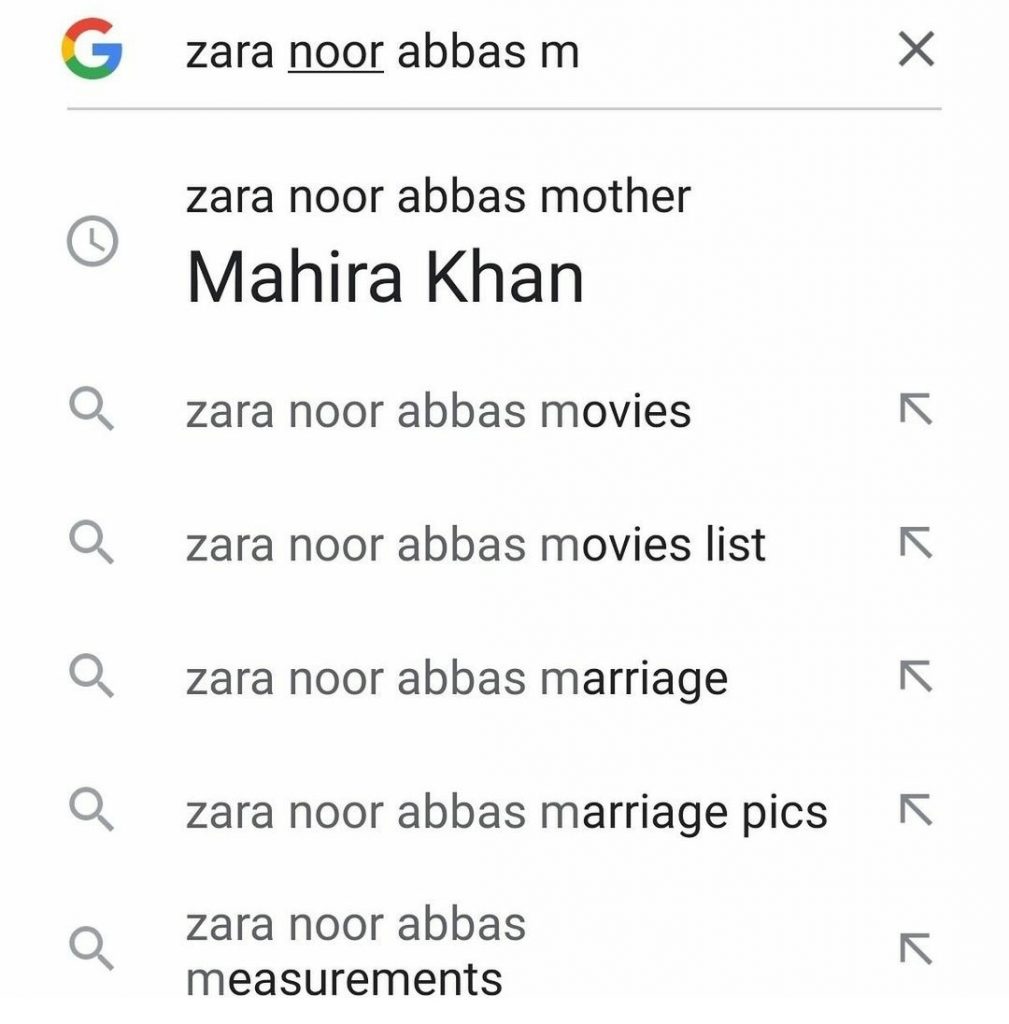
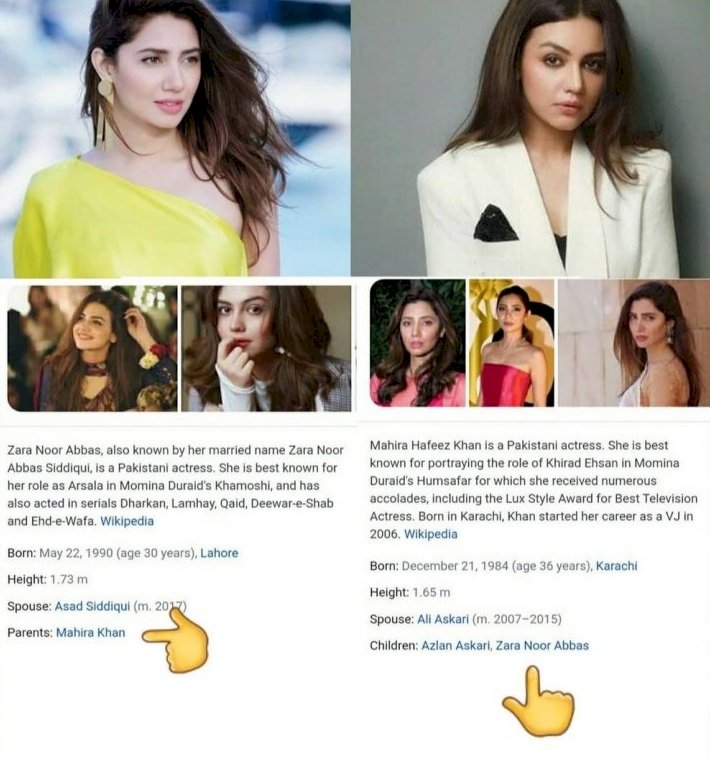
Google has reportedly listed Mahira Khan as Zara Noor Abbas’ mother.
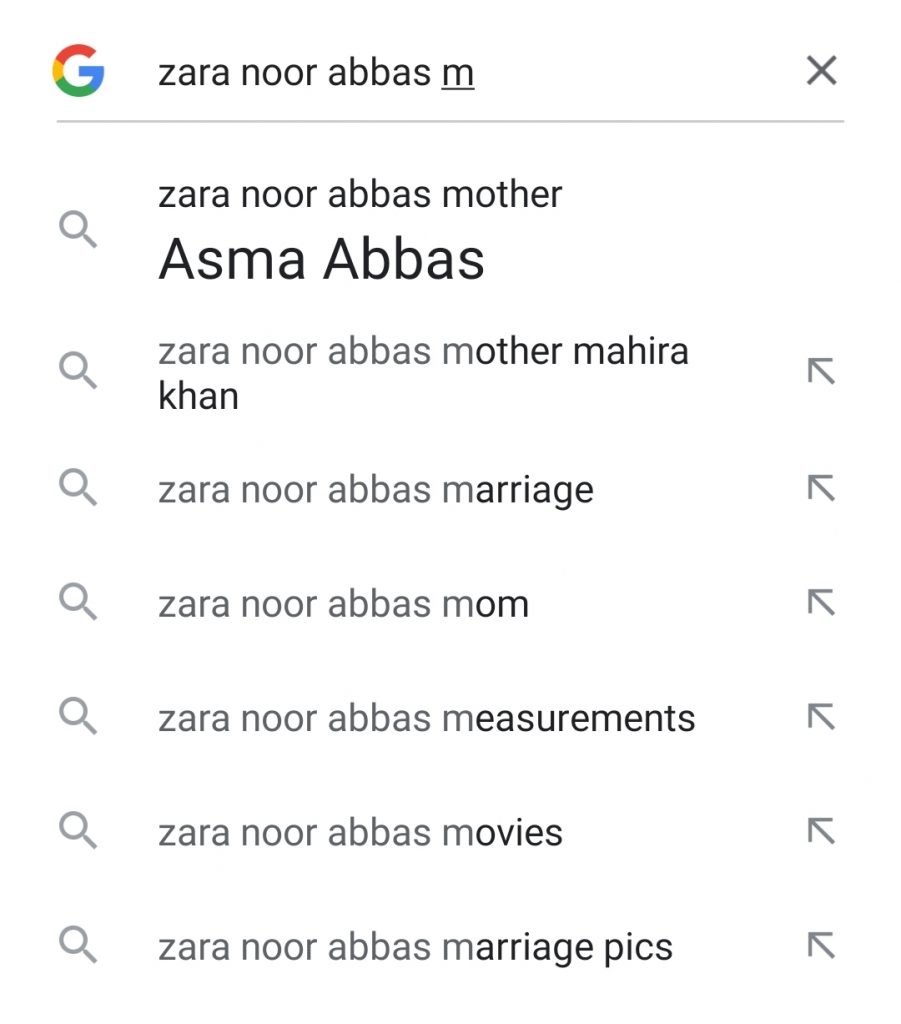
While it is unclear why and how it happened, a screenshot of search has gone viral on social media. Meanwhile, in reality, the Khamoshi star is the daughter of Asma Abbas and niece of veteran actor Bushra Ansari.
Later, the information on Wikipedia was corrected with Asma listed as Zara’s mother.
Goes on to show that even Google and Wikipedia can mess things up and sometimes give incorrect information.
Earlier, Google had listed Esra Bilgiç as Yasir Hussain’s mother.
The Pakistan Telecommunication Authority (PTA) has issued notices to Google and Wikipedia over the dissemination of “sacrilegious content” on their platforms, saying a legal action will be taken in case of a failure to remove the content.
In a press release shared on its Twitter handle, the PTA said that the action against the tech giant and the online encyclopedia was taken after “complaints regarding misleading search results associated with ‘Present Khalifa of Islam’ and unauthentic version of Holy Quran uploaded by Ahmadiyya Community on Google Play Store” were received.
Press Release: PTA issues Notices to Google Inc. and Wikipedia on account of disseminating sacrilegious content through the platforms. pic.twitter.com/AhG9PHCJS1
Calling it a matter of a “very serious nature”, the PTA approached Google with the directives “to immediately remove the unlawful content”.
“The platform has been issued with the notice under Removal and Blocking of Unlawful Online Content (Procedure, Oversight and Safeguard) Rules 2020 (“Rules”) to remove the sacrilegious content to avoid any legal action by the regulator,” it added.
According to the PTA, people also registered complaints against Wikipedia for “hosting of caricatures of Holy Prophet (PBUH) and dissemination of misleading, wrong, deceptive and deceitful information through articles portraying Mirza Masroor Ahmad as a Muslim”.
“After extensive communication on the matter, Wikipedia has been finally served with the notice to remove the sacrilegious content to avoid any legal action,” the statement added.
“In case the platforms remain non-compliant, PTA shall be constrained to initiate further action under Prevention of Electronic Crimes Act 2016 (PECA) and Rules 2020,” said the regulatory authority.
Moiz Sayed, who is Google’s Industry Head for Pakistan, Bangladesh, and Sri Lanka has shed light on what brands in Pakistan can achieve if marketers adopt a shift in mindset and break away from traditional forms of marketing and advertising in the digital era.
Compared to the 90s, the way Pakistanis communicate and connect has changed drastically. “Pakistan now has 169 million cellular subscribers, 85 million 3G+ subscribers, and 87 million broadband, subscribers.”
In the digital era,advertisement budgets appear to follow a traditional model, based on strategies that have succeeded in the past. “I’ve realised our industry believes Pakistan has limited internet penetration and poor access to smartphones, thus thinking digital won’t have sufficient reach.”
Here are some of the facts presented in the article regarding Pakistan’s digital scene that you did not know :
Fact 1 :Despite being in the digital era 65-70% of current ad spend being allocated to TV by default in Pakistan.
Fact 2 :Most brands only leverage 20%-30% of the available reach on YouTube among their target audience.
Fact 3 :Over 90% of the campaigns don’t capture their full target audience because of low funding.
Fact 4 : YouTube brand campaigns Drove an 89% increase in awareness and consideration of brands.
Fact 5 :95% brands saw a significant offline sales lift after a YouTube campaign.
Fact 6 : YouTube has a reach of over 36 million people
Fact 7 : Watch time for YouTube has grown to 45% from 2019 to 2020
How Nestlé Pakistan challenged traditional thinking
The company focused on their Cerelac brand.They did a two-years of brand activity, which included studying media investments, impressions, sales volume, and revenue across TV and YouTube.
This is what they found out :
67% incremental increase in sales per dollar on YouTube than TV.
The study revealed that even without increasing the overall media budget, they could improve the incremental sales per dollar by 21% by simply reducing the dark periods of online video.
Constant coverage on YouTube could generate 40% more impressions per week than the 2019 average.
A similar study from Nestle Australia revealed that in more than 93% cases, YouTube had greater incremental sales per impressions than TV.
After the analysis, Nestle has since taken a more data-centric approach, rather than only relying on their past experience to guide their media strategy. Moiz suggests that experiment with new channels to keep up with ever-changing consumer behaviors.
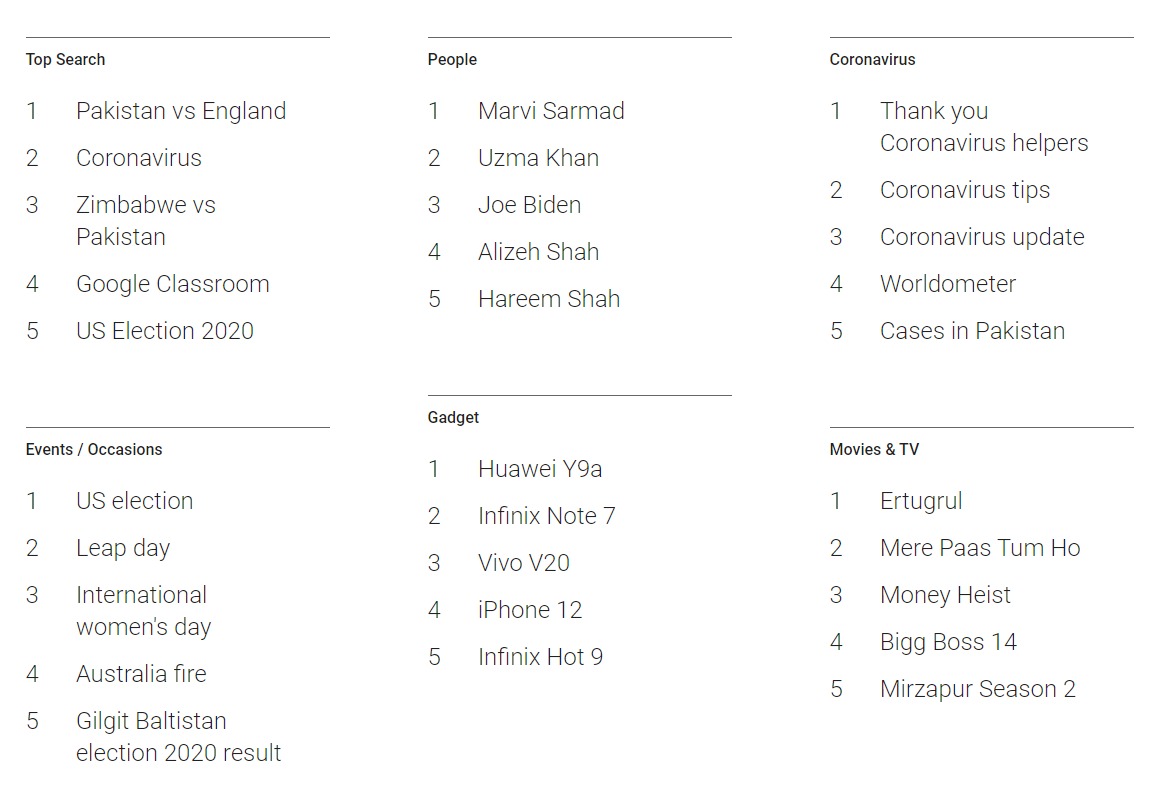
To say that 2020 has been a rollercoaster would be an understatement. Though the coronavirus pandemic pretty much defined 2020, there were lots of other things that kept Pakistanis engaged throughout the year. Some that we might even have forgotten.
Lucky for us, Google released its annual ‘Year in Search‘ list on Wednesday, giving us a quick roundup of the year and reminding us of our obsessions which included Diriliş: Ertuğrul, Meray Paas Tum Ho, Money Heist, Sarah Khan and Falak Shabbir’s wedding and Pakistan vs England series besides of course corona.
Meanwhile, check out the complete lists here:
Top Search
Pakistan vs England
Coronavirus
Zimbabwe vs Pakistan
Google Classroom
US Election 2020
PSL 2020
India vs New Zealand
England vs Australia
England vs West Indies
Worldometers
People
Marvi Sarmad
Uzma Khan
Joe Biden
Alizeh Shah
Hareem Shah
Minahil Malik
Falak Shabir
Asim Azhar
Esra Bilgiç
Sarah Khan
Events/Occasions
US elections
Leap day
International women’s day
Australia fire
Gilgit Baltistan election 2020 result
Beirut blast
Motorway incident
Kabaddi world cup 2020
Under 19 world cup
Khabib vs Gaethje
Movies & TV
Ertuğrul
Mere Paas Tum Ho
Money Heist
Bigg Boss 14
Mirzapur Season 2
Deewangi
Mera Dil Mera Dushman
Kuruluş: Osman
Ehd-e-Wafa
Joker
Gadgets
Huawei Y9a
Infinix Note 7
Vivo V20
iPhone 12
Infinix Hot 9
OPPO F17 Pro
Vivo S1
Vivo Y20
Vivo Y51
Huawei Y6p
According to Google, these lists are based on search terms that had the highest spike this year as compared to the previous year (2019).