Claim: Imran Khan misquoted President Ronald Reagan’s statement at the UN General Assembly session
Fact: Imran Khan misquoted President Ronald Reagan’s statement at the UN General Assembly session
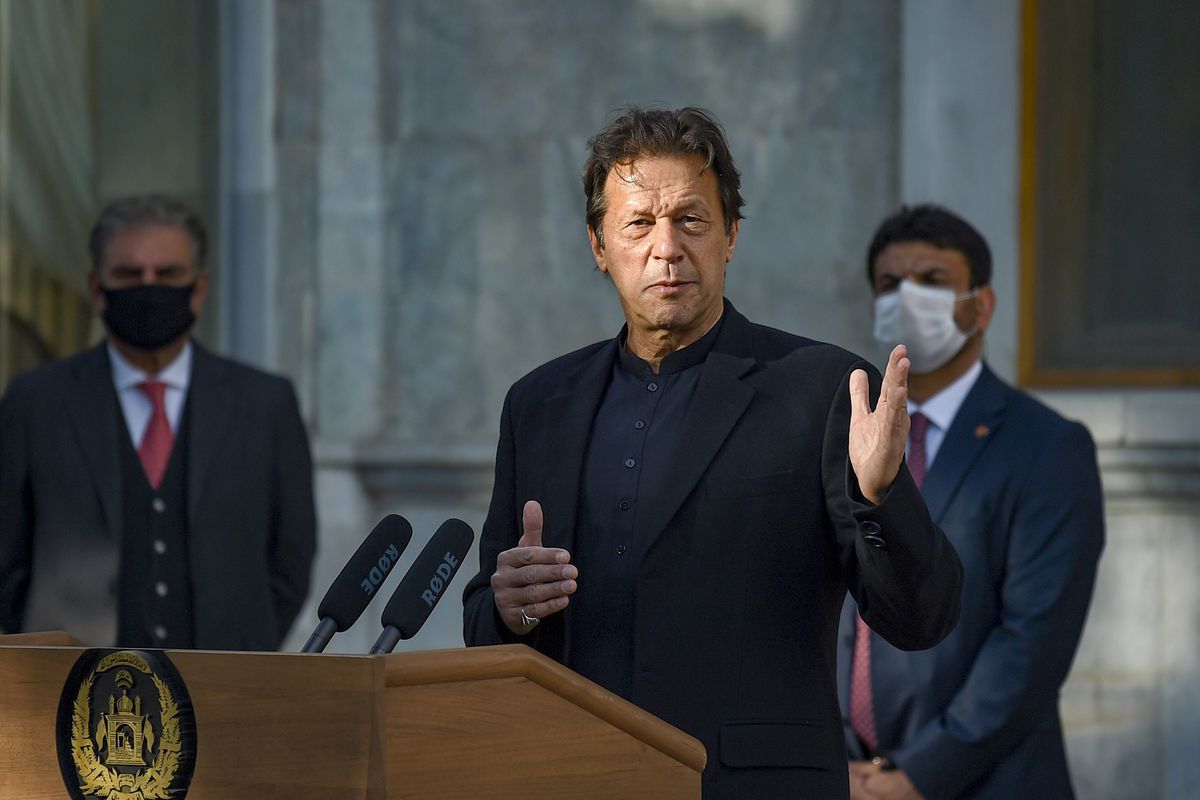
Prime Minister Imran Khan misquoted United States President Ronald Reagan’s statement, while delivering his address to the 76th session of the United Nations General Assembly (UNGA) on September 25, 2021,
PM Khan claimed that in the 1980s, former US President Ronald Reagan compared the Afghan mujahideen fighting against Soviet forces to the Founding Fathers of the United States.
Focal person to Chief Minister Punjab, Azhar Mashwani, took to Twitter and shared the video clip where the former president can be heard comparing Afghan Mujahideen as “moral equals of founding fathers of USA”.
If you watch the video attentively, you will find a minor glitch. The video is 0:48 seconds long.
At 0:37-0:45 seconds, Reagan says: “They are our brothers, these freedom fighters, who we owe them our help. You know the truth about them, you know who they are fighting and why.”
However, from 0:45 seconds to 0:48 seconds, there is a slight change in the sound of the president. The pitch of the sound is a bit higher as compared to the entire video. The words spoken by the president during these seconds are, “They are the moral equal of our founding fathers.”
Actual quote of the former US President, “In making mention of freedom fighters, all of us are privileged to have in our midst tonight one of the brave commanders who lead the Afghan freedom fighters—Abdul Haq. Abdul Haq, we are with you.”
And the non doctored, un-edited video where President Reagan describing Nicaraguam rebels (not Afghan freedom fighters) as moral equivalent of American founding fathers….
“They are our brothers, these freedom fighters, and we owe them our help. I’ve spoken recently of the freedom fighters of Nicaragua. You know the truth about them. You know who they’re fighting and why. They are the moral equal of our Founding Fathers and the brave men and women of the French Resistance,” said Reagan.
The anecdote that PM Khan shared about Ronald Reagan comparing the mujahideen to the Founding Fathers is a commonly made mistake and there is actually no truth to it. Reagan had actually compared Nicaraguan rebel fighters to the Founding Fathers, a comment which has since been wrongly connected to the mujahideen.
However, this is not the first time that the premier made this mistake. In 2019, PM Khan while speaking at an event at the Council on Foreign Relations (CFR) think tank in New York on Monday, September 23, claimed that in the 1980’s former Ronald Reagan compared the Afghan Mujahideen fighting against Soviet forces to the Founding Fathers of the United States.
Journalist Gharidah Farooqi raised this issue initially. She took to Twitter and said, “What an international embarrassment that too at the #UNGA forum this time. US Pres RonaldRegan NEVER compared ‘mujahideen’ to Founding Fathers. It’s a FAKE NEWS. PM Khan refers to a fake “news item” to launch a case at such a prestigious forum! Who wrote speech for PM Khan? Fire him.”
What an international embarrassment that too at #UNGA forum this time. US Pres RonaldRegan NEVER compared ‘mujahideen’ to Founding Fathers. It’s a FAKE NEWS. PM Khan refers to a fake “news item” to launch 🇵🇰case at such a prestigious forum! Who wrote speech for PM Khan? Fire him. pic.twitter.com/UaSLOOkeea
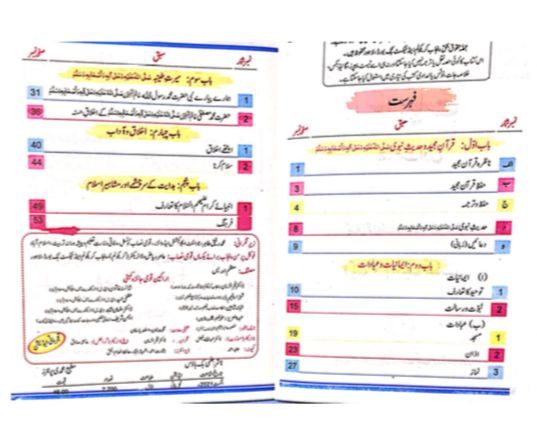
On August 16, 2021, Prime Minister Imran Khan officially launched the Single National Curriculum (SNC). The newly launched curriculum was prepared by the National Curriculum Council (NCC) and the Ministry of Federal Education, in consultation with the provinces. According to PM Khan, “SNC would transform the nation into a unified one.”
What is SNC?
According to the Ministry of Federal Education and Professional Training, the SNC is a ‘uniform’ system of education, which means the same curriculum for everyone. All public schools, private schools, and madrassas were meant to have the same curriculum so that the learning outcomes are similar and without any discrimination in teaching standards. This is not the first time SNC was imposed in Pakistan. It was previously introduced in 2006 by Former President Musharraf. Whereas the previous SNC was a curriculum-based initiative, the one introduced by the PTI government is imposing the use of the textbooks produced by the provincial boards.
Is it being implemented across the country?
No. Sindh has decided not to implement the curriculum since education is a provincial issue. Only Punjab and Khyber Pakhtunkhwa have enforced it so far. However, many schools in both provinces — including the prestigious Aitchison College, Lahore — expressed their concerns over the books in the curriculum. The Director of the National Curriculum Council (NCC), Dr Mariam Chughtai, has also said that madrassas will implement the SNC syllabus in five to six years, which undermines the reason why the government had wanted to introduce the SNC in Pakistan – to bring madrassas into the mainstream so students would be able to get jobs in other professions after they graduated.
Controversies surrounding the SNC
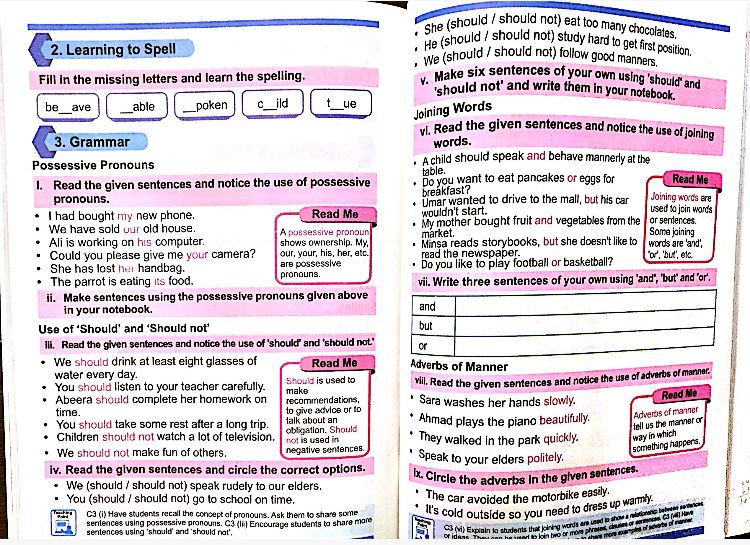
After the SNC syllabus was imposed on schools across Punjab, many controversies surrounding the books and the curriculum came forward. From the disparity in gender representation, the reinforcement of patriarchal gender roles, the lack of female heroes, and religious texts in the non-religious books.
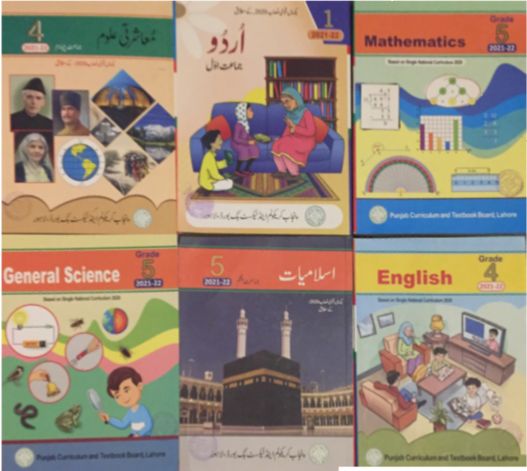
To see if the criticism is valid, The Current analysed the following books published under the Punjab Textbook Board (PTB):
Urdu books from grades 1 to 5, English books from grades 1-5, Mathematics books grades 1, 2, 4, and 5, General Science grades 4-5, Waqfiyat Aama grade 1 and 3, Social Studies 4-5, and Islamiat grade 1- 5.
Two books were not available at the time of research. Grade 3 Math and Waqfiyat Aama grade 2, which have not been included in the study.
The analysis here has been divided into two parts.
Part one comprises the data analysis of all the books included in the SNC by the Punjab Text Book board.
Part two comprises the data analysis of individual subjects being taught to the students.
We studied the total number of male and female representations in the books, a comparison of the eastern and western wear of both genders, the presence of religious (Islam and others) content in non-religious books, and studying the distribution of power roles assigned to both men and women.
Here is the list of most common criticism against the curriculum and the evidence we found:
SUMMARY OF CONTENT IN ALL SNC BOOKS
1- Disparity in Gender Representation:
One of the most debatable points in the entire SNC is the representation of men and women.
After a thorough evaluation, we found that the concerns about the disparity in gender representation are TRUE.
The study reveals that a total of 60.2 percent of the books have images of men, including boys and only 39.4 percent of the books have images of women, including girls.
2-Women represented in hijab vs non-hijab, and women in western clothes:
What the women are wearing became a source of contention in the discussion about the SNC, with critics suggesting that the women should equally represent the country in terms of the hijab, eastern clothes, and the choice to wear western wear.
It is TRUE that there is no equal representation of women’s appearance in the books.
Women’s appearance was divided into three categories.
A) Number of women wearing eastern clothes with hijab.
B) Number of women wearing eastern clothes without hijab.
C) Number of women wearing western clothes.
Our research shows that 41.6% of all women and girls in the SNC books are wearing a hijab, 28.9% are wearing eastern clothes without a hijab, and 29.4% of the images show girls wearing western wear. It is important to note that in the western wear percentage, almost all of the images are of young girls. Older women are not shown wearing western wear.
3-Men represented in eastern vs western clothes:
Since the appearance of women in eastern wear and hijab became controversial, we also studied how many times men appeared in western or eastern wear.
A massive 79.9 percent of men were seen wearing western clothes, in comparison to 20 percent dressed in eastern clothes.
4- More men in ‘power roles’ compared to women:
Another controversy suggested that the books did not show women in positions of ‘power’, and they were mostly listed as helpers or homemakers. While there were many images that showed women in ‘inferior roles’ to men, there were women that were shown in roles of power.
This controversy is TRUE.
We defined power roles shown in the books as doctor, pilot, lawyer, police officer, traffic warden, army sports personality, etc and after analysing all the books, we found that a men are given power roles three times more than women. The results in the graphic below are based on the total number of images shown of men and women in all the SNC Punjab books.
I
5. Religious content in non-religious books
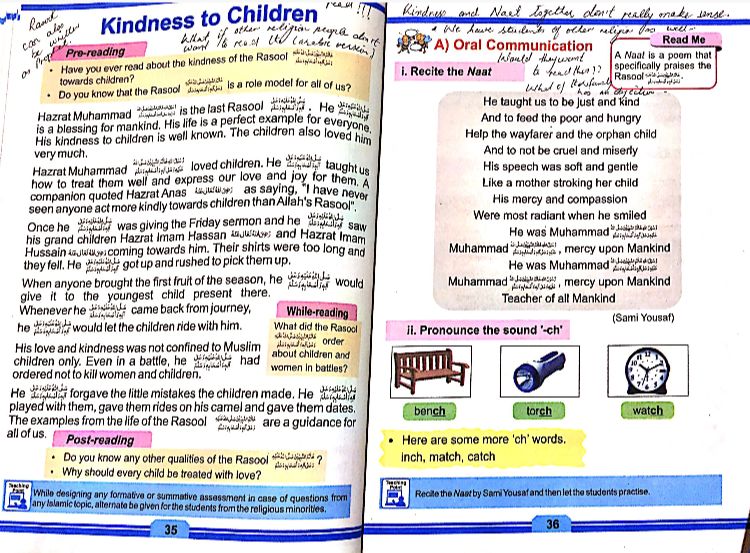
In almost all the books which were studied, we saw the presence of religious references or mentions in non-religious books. Minorities felt their rights were being compromised since books that are not for religious studies should not have references to a specific religion, which may come under the context of ‘preaching’.
In our analysis, we saw a total of 7.77 percent of religious text in all SNC non-religious books, which lends TRUTH to the fact that there is religious content in non-religious books.
Religious content is present in 7.7 percent of English, Math, Social Studies, Urdu, Science, and General Knowledge books.
7.47 percent of books have references to Islam while 0.27 percent mention other religions in all non-religious books.
Dr Mariam Chughtai, while answering a question for The Current about the religious references in non-religious books, did not provide a clear answer but stated that these are model books that require changes.
SNC BOOKS ANALYSIS – SUBJECT ANALYSIS
This section of the report comprises an analysis of individual subjects being taught to students. The subjects under study were, Urdu books from grades 1-5, English books from grades 1-5, Mathematics books grades 1, 2,4, and 5, General Science grades 4- 5, Waqfiyat Aama (General Knowledge) grades 1-3, Muashrati Uloom (Social Studies) grades 4-5.
The graphical representation of the subject-wise evaluation is as follows:
English:
In 668 pages of English books, 58.1 percent have male representation while females have 41.8 percent.
29.7 percent of women are seen with Hijab and 70.2 percent are without Hijab.
There is a total of 9.8 percent presence of religious text in English books. This is based on the total number of pages in English books.
Mathematics:
In 672 pages of the Math books, when gender representation was analysed, 51.1 percent of the books have male representation and 48.8 percent have female representation.
A total of 53.9 percent of females are seen without hijab and 46 percent are seen wearing hijab.
The Math books have a 4.1 percent presence of religious text. This is based on the total number of pages in Math books.
Urdu:
The five Urdu books comprising 791 pages. A total of 59.7 percent presence of males are seen as compared to 40.4 percent of females.
58.5 percent of women/girls are seen wearing hijab and 41.4 percent are seen without hijab.
12.8 percent of religious text is present in Urdu books. This is based on the total number of pages in Urdu books.
General Science:
Out of 310 pages, 76.8 percent have male representation as compared to 23.1 percent female representation.
64 percent of women/girls are seen without hijab and 36 percent of women/girls are seen with hijab.
The General Science books have a 0.96 percent presence of religious content. This is based on the total number of pages in Science books.
Waqfiyat Aama (General Knowledge):
49.5 percent of male images are seen in comparison to 50.15 percent of females.
23.1 percent of females are seen with hijab and 76.8 percent without hijab.
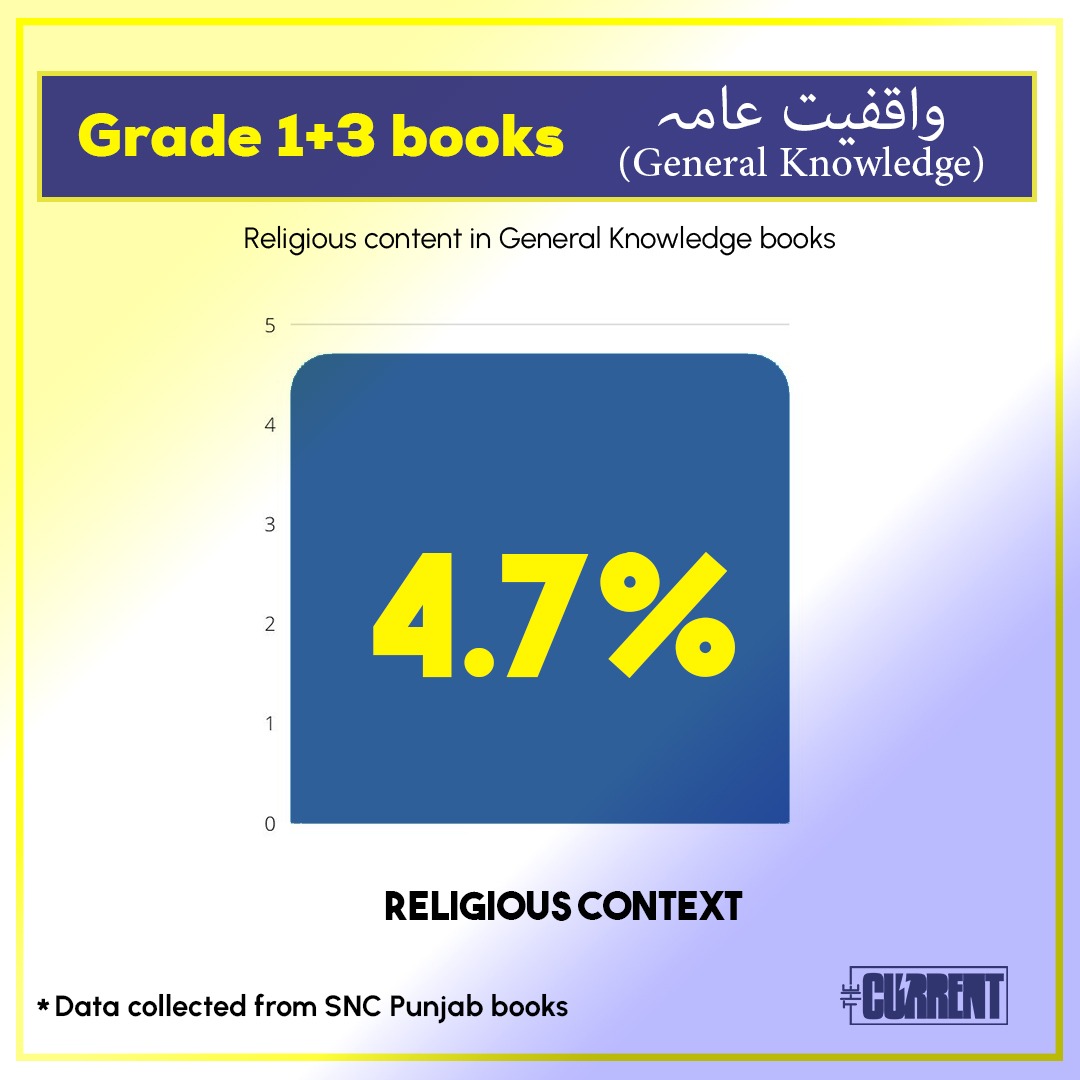
There is a 4.7 percent presence of religious text in the books studied. This is based on the total number of pages in General Knowledge books.
Muasharti Uloom (Social Studies):
From 234 pages analysed, 65.1 percent of men/boys are represented in the books and 34.8 percent of females are shown.
36.8 percent of females are seen without hijab and 63.1 percent are seen with hijab.
10.2 percent of religious content is present in the books. This is based on the total number of pages in Social Studies books.
The last portion of the report highlights the pros and cons, which we have observed in almost all the books. We have provided both positive and negative outcomes deduced from the books after careful analysis.
The positive outcome deduced from the books:
1. The books are locally published and designed. The books are affordable, with a total set for one grade set at Rs. 800 per child according to Dr Chughtai.
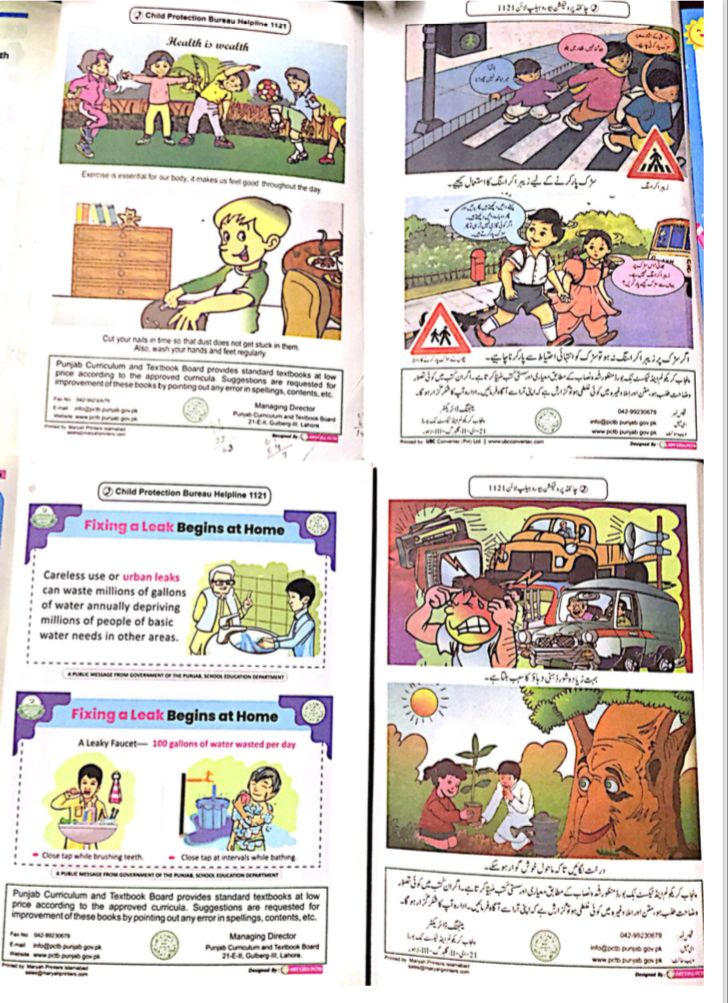
2. There is a public service message printed at the end of each book to raise awareness against talking to strangers, crossing the road, exercising, and even information about fighting dengue.
The possible negative impact of the books
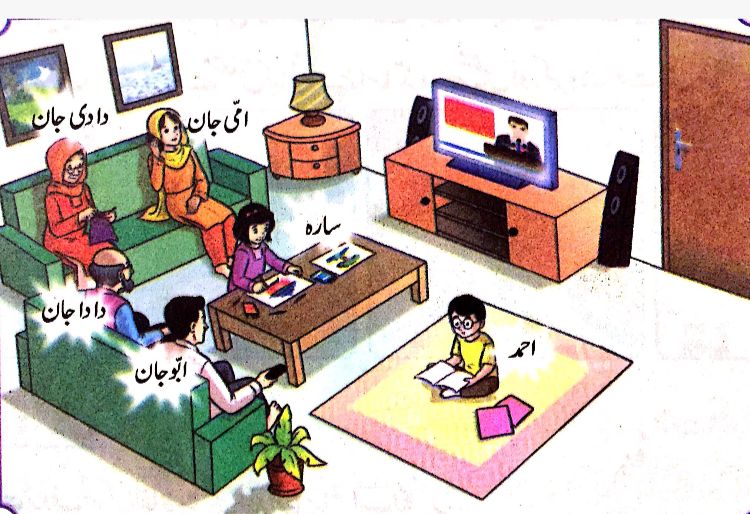
1. After analysing the books, we deduced that mostly nuclear families have been shown in the books. No representation of single parents or children being raised by guardians is seen. Moreover, the presence of both parents is seen as almost essential in all stories in the books.
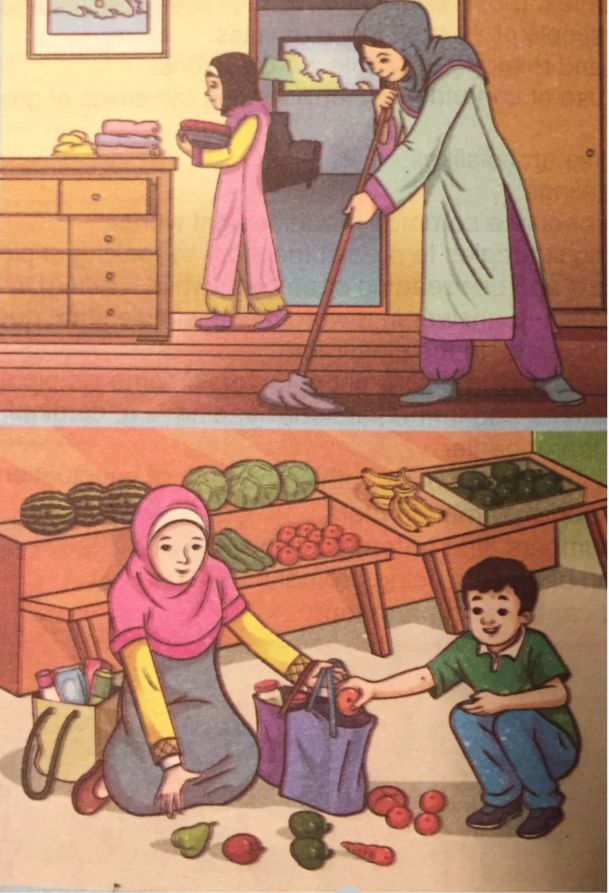
2. Women are mostly shown doing domestic work, taking care of the family, and looking after their children. In stories as well, they seem to come second to their male counterparts.
3. As discussed in detail above, there is the presence of religious text in non-religious books.
4. The stylisation of the books are difficult to understand, fonts and texts are way too clustered. The quality of the pages is not refined, making them unattractive and confusing for students.
CONCLUSION:
According to NCC director, Dr Chughtai, the curriculum is an evolving process and the books can be changed in future publications, based on the response by schools and parents. The biggest hurdle to the books is that the teachers have not been trained in teaching these new books and according to Dr Chughtai, it is up to the school to teach and implement the books. There are no worksheets given with the books and from initial student reactions, students are confused and wary of books that are laid out in a clustered fashion. There is also the subject of a language change. Where students study general knowledge, a precursor to Science, in Urdu, they switch to difficult English in grades 4-5.
While the government should be commended in trying to create a national syllabus, the forced enforcement of the books along with the lack of supplemental information and training will make this very difficult for teachers and students. Moreover, parents should be given a choice as to what they want their children to study. This implementation should be a free choice rather than that of enforcement. What would have been a practical approach is that the government should have improved the structure of the government/public schools, provided better teacher training, spent more on financially improving the conditions rather than lowering the standard for all.
*Graphics credits: Asma Ahmad (Graphic Designer)
How did we collect the data?
The percentage of male characters in the books: Divided the total number of male by the total number of characters. The percentage of female characters in the books: Divided the total number of female by the total number of characters.
The percentage of Islam: Divided the Islamic pictures or references given in the books by the number of total pages of all books. The percentage of other religion: Divided the other religions pictures or reference given in the books by the number of total pages of all books.
The percentage of female power roles: Divided the number of female by the total number of characters (female and male). The percentage of male power roles: Divided the total number of male by the total number of characters (female and male).
The same process/calculation/method was applied to the findings of each book.
American Magazine ‘Newsweek’ has published an exclusive interview with Pakistani Prime Minister (PM) Imran Khan, conducted by its Senior Foreign Policy Writer Tom O’Connor.
PM Khan talked about the troubles occurring in Afghanistan, China–Pakistan Economic Corridor (CPEC), the US emerging close relations with Pakistan’s top rival India and shed some light on Sino-US rivalry.
In reply to a question by Tom about recognising the new Islamic Emirate of Afghanistan, PM Khan said, “Pakistan is obliged to engage with the de-facto authorities in Afghanistan to prevent an economic and humanitarian collapse.”
“Once a government in Kabul establishes control over the entire country, it would legally qualify for recognition. However, Pakistan would prefer to reach a decision regarding recognition of the new government together with other neighbors of Afghanistan,” he added.
He stressed that the authorities in Kabul [Taliban] need to neutralise terrorist groups present in Afghanistan, particularly the Tehreek-i-Taliban Pakistan (TTP) and said, “Pakistan will work with the authorities in Afghanistan to halt TTP and other terrorism from there.”
While answering the question about the US and China’s influence in South Asia after Washington’s withdrawal from Afghanistan, Khan stated, “The US can work with a new government in Afghanistan to promote common interests and regional stability and can play an important and positive role in Afghanistan by providing humanitarian assistance.”
“But if China offers economic support to Afghanistan, it’s natural that the Afghans will accept it. The Taliban have welcomed the prospects of being incorporated in the CPEC and establishing close relations with China,” he added.
Talking about the close ties between the US and India, PM Khan stated, “We understand that the U.S. military support to India is designed to contain China. However India will never confront China, especially not to serve U.S. strategic objectives. India’s purpose in arming itself so massively is to establish its hegemony in South Asia and especially to threaten and coerce Pakistan.”
“We believe that the current US-China rivalry is unnecessary and contrary to the interests of both these global powers,” he said while hoping that both countries will reach the same conclusion in the near future.
He concluded by saying that Afghanistan will only be stabilized through help and that the U.S., China and Russia and all other countries must “contribute” to reconstructing the country.
Prime Minister Imran Khan will address the United Nations General Assembly (UNGA) today. His speech is going to focus on raising his voice against Indian atrocities in Occupied Kashmir and speak about the humanitarian crisis in Afghanistan.
The prime minister will speak at 1:30am Pakistan Standard Time (PST) on September 25 [4:30 pm, September 24, Eastern Standard Time]. As per reports, the prime minister is seventh on the list of speakers to address the UNGA today in the afternoon session.
The premier’s policy address will serve to enhance Pakistan’s diplomatic outreach and engagement with its international partners and key institutions.
“Just like this fake government, its vaccination record and entry data for vaccines is also fake,” said Pakistan Muslim League-Nawaz (PML-N) Vice President Maryam Nawaz when asked about the issue of fake vaccination data for Nawaz Sharif uploaded by National Database and Registration Authority (NADRA) portal. Maryam said she is concerned that the wrong entry of vaccination data can be an international embarrassment for Pakistan.
Maryam was talking to the media after she appeared before the Islamabad High Court (IHC) in a case against her conviction in Avenfield reference.
اگر یہ آپکا سسٹم ہے اگر اس طرح سے آپکا اندراج کیا جارہا ہے تو انکی نااہلی پہ اسکا انٹرنیشنل رد عمل آسکتا ہے جس پہ مجھے تشویش ہے.اس حکومت کی ہر چیز کی طرح انکا جو ویکسی نیشن کا اندراج ہے وہ بھی جعلی ہے.@MaryamNSharifpic.twitter.com/TqwlDKTI7j
Nawaz Sharif, who is currently in London for medical treatment, has received first dose of Sinovac vaccine in Lahore as per the data uploaded on NADRA portal. As per reports, this false information was entered using Nawaz Sharif’s CNIC at Government Kot Khawaja Saeed Hospital.
Most Beautiful Faces of 2021 was trending on Pakistani Twitter after social media users nominated different personalities including Shahid Afridi, Prime Minister Imran Khan, a Big Boss contestant Shehnaz Gill and many other personalities.
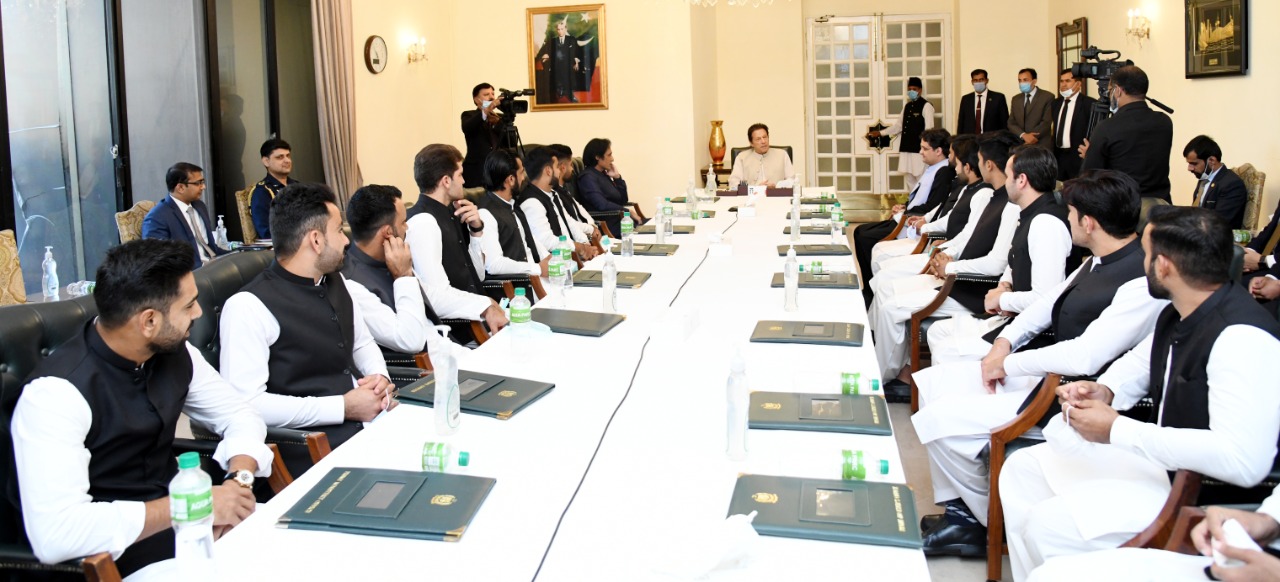
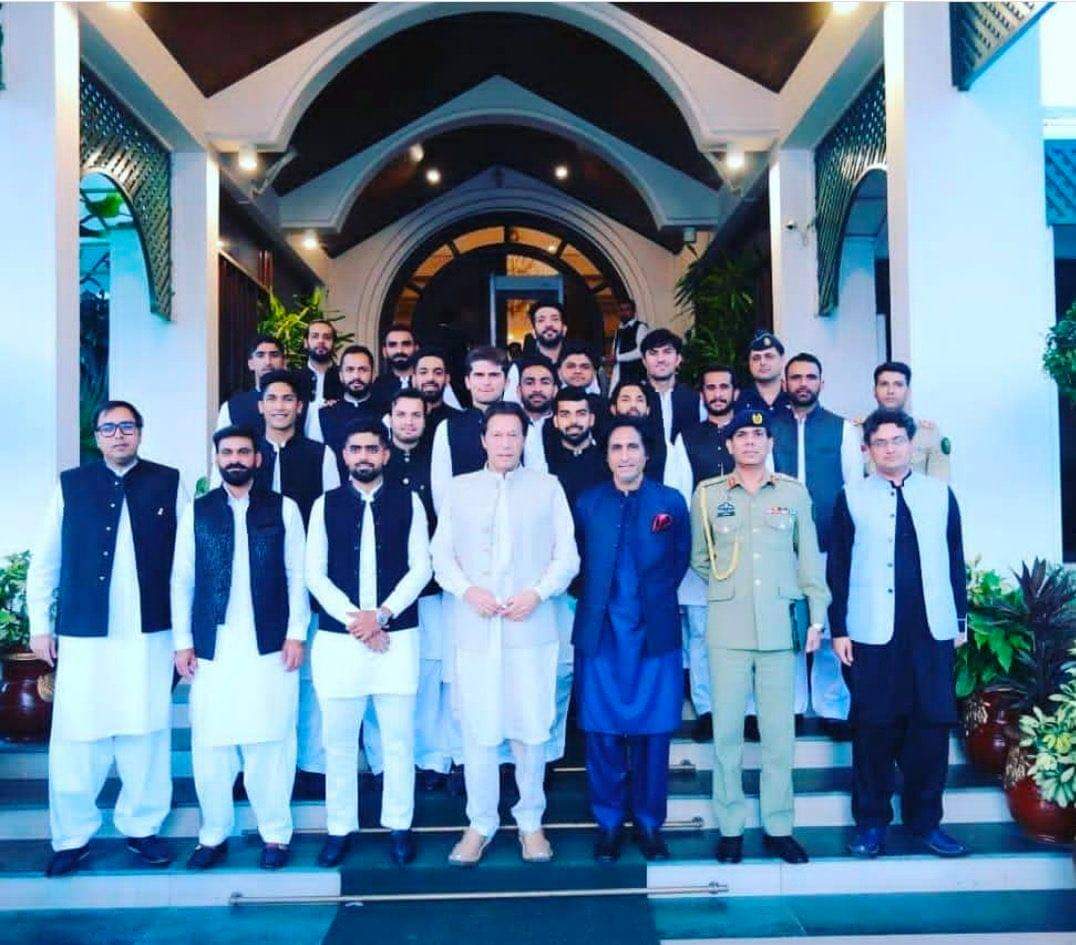
The meeting started with the introduction of the national cricket team. PM Khan also gave cricket tips to the players and shared his experience as a sportsman with the players.
“The path to success is the path of truth and honesty, one way is of honour and the other is of wealth. You have to break the idol of wealth,” advised PM Khan.
“You have to play for the team and your nation. The eyes of the nation are on you and we want to see you succeed,” said the premier.
Prime Minister Imran with T20 World Cup squad
PM Khan reaffirmed that the Pakistani cricket team is extremely talented and the whole world recognises the talent of Pakistan.
“When you step on the field, play with confidence and a winning spirit, because a team which avoids defeats never really wins,” said PM Khan, adding, “Play aggressively, a team that plays with a defensive approach never wins.”
The prime minister said, “Be a strong and hard-working team. The entire nation is banking on you.”
Prime Minister Imran Khan, while giving an interview to BBC, said that it was likely that Afghanistan could descend into a civil war if the Taliban fail to form an inclusive government.
"Pakistan will face fallout in case of humanitarian crisis in Afghanistan,"
“If they do not include all the factions, sooner or later they will have a civil war,” said PM Khan. “That would mean an unstable, chaotic Afghanistan and an ideal place for terrorists. That is a worry.”
Speaking on women and their education, PM Khan stated that the girls of Afghanistan would soon be able to attend schools. He said preventing women from acquiring education in Afghanistan would be un-Islamic.
“If anyone has any idea of what our religion was, it was a liberation of women, and so whenever the idea that women should not get educated, it’s just not Islamic. It might have been some rural culture in Afghanistan but it has nothing to do with religion,” said PM Khan.
“The statements they have made since they assumed power, I mean it’s very encouraging,” said the premier. “They have said they will give education to women and allow them to work. They have said they will give amnesty. The soil will not be used for terrorism by anyone.”
PM Khan reiterated that the statements made by the Taliban were encouraging but where they go from here is unknown to all.
“What they [Taliban] do from now onwards, we can only hope to persuade them and encourage them, incentivise them in that direction. But you know sitting today, what happens, where they will go, I’m afraid, I don’t know,” says PM Khan.
“Afghan are strong people, their women are very strong, give them time and they will assert their rights,” said the premier.
"Give Afghan women time. They will assert their rights,"
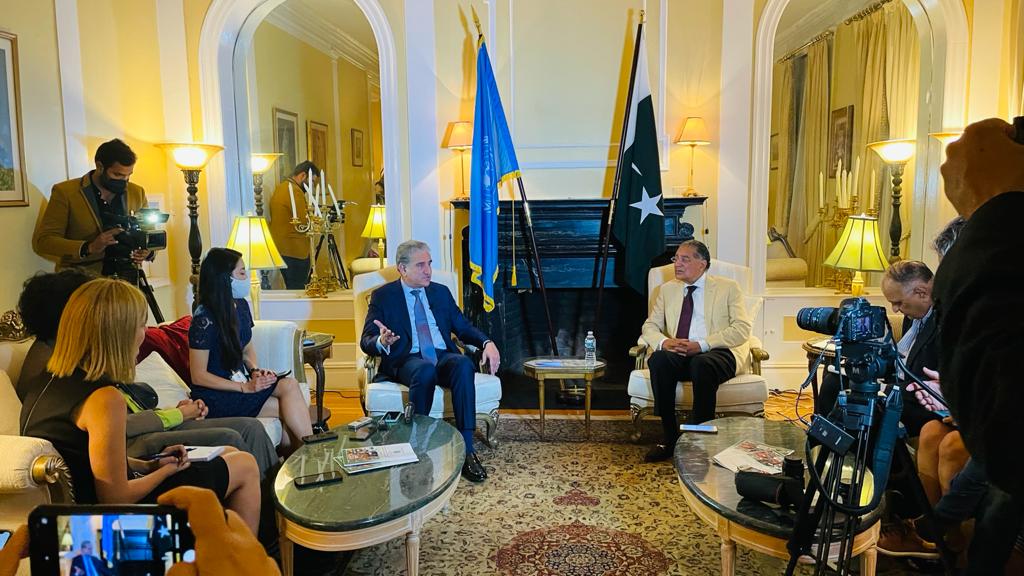
Foreign Minister Shah Mahmood Qureshi, during a meeting with the United Nations (UN) press representatives, said, “I don’t think anybody is in a rush to recognise the Taliban at this stage and they [Taliban] should keep an eye on that.”
The minister who is in New York for five days to attend the 76th session of the United Nations General Assembly (UNGA), stated that the world is watching Afghanistan. If they [Taliban] want recognition they have to be more sensitive and more open to international opinion, he added.
Met with @UN correspondents today & shared my intention to highlight Pakistan’s perspectives on a number of issues at #UNGA, in particular on the need for equitable socio-economic development, stabilisation of #Afghanistan and a just resolution of the Jammu & Kashmir dispute. pic.twitter.com/GO3NAFeltq
He insisted on stating that Afghanistan should have an inclusive government in order to have stability and peace in the region, and expressed hope that the Afghan Taliban would live up to their promise to allow girls and women in educational institutions.
Moreover, he urged the United States and other countries that have frozen money from the former Afghan government to release it because “that’s Afghan money that should be spent on Afghan people”.
“I think freezing the assets is not helping the situation. I would strongly urge the powers that be that they should revisit that policy and think of an unfreeze,” Shah told reporters.
According to an official statement issued by the Foreign Office, Prime Minister Imran Khan will address the UNGA via a video link on September 24th.
High-level segment of 76th Session of UN General Assembly is going to be held from 21-27 September 2021 in New York. PM @ImranKhanPTI will deliver the policy address outlining Pakistan's perspective on key global and regional issues. #UNGA#UNGA76@UN
Special Assistant to the Prime Minister (SAPM) on Power and Petroleum Tabish Gauhar has reportedly stepped down from his position after almost one year of his appointment.
According to sources, Prime Minister Imran Khan asked for the former’s resignation as he [Imran Khan] and the Minister for Energy Hammad Azhar weren’t evidently happy with his performance, reports Samaa News.
“After a year of public service, I’ve decided to call it a day to return to my family. It’s been the privilege of a lifetime to serve the country, to the best of my abilities, in an honorary capacity. I shall remain indebted to the PM for giving me this opportunity,” Gauhar tweeted.
While publicly accepting the numerous challenges in the energy sector, he added: “No doubt that under the able leadership of Azhar, the MOE [Ministry of Energy] team will continue to stay the course on structural reforms.”
Whilst the challenges in the energy sector are manifold, I have no doubt that under the able leadership of Hammad Azhar, the MOE team will continue to stay the course on structural reforms. May Allah continue to bless Pakistan – Ameen. (2/2)
According to Geo News, the development comes after Gauhar and Federal Minister for Maritime Affairs Ali Zaidi developed rifts on the controversy sparked over the Engro LNG terminal’s dry-docking. Other disagreements included the Pakistan Stream Gas Pipeline (PSGP) project and Gauhar’s stance in favour of laying down the North-South Pipeline with the help of local gas companies.
Last month, he had written a letter to Hammad Azhar, pointing out multiple challenges in the energy sector.
Gauhar had resigned from his post earlier this year but at the time his resignation had not been accepted. Later, Gauhar had lodged a complaint with the premier, pleading that two cabinet members were interfering in the affairs of the Ministry of Energy.
After this news, a total of 11 Special ministers have resigned so far.
Zulfi Bukhari as SAPM on Overseas Pakistanis
Dr Ishrat Hussain as SAPM on Institutional Reforms and Austerity
Tabish Gauhar as SAPM on Power and Petroleum
Lt Gen Asim Bajwa as SAPM onChina-Pakistan Economic Corridor (CPEC) affairs
Firdaus Ashiq Awan as Special Assistant to Punjab Chief Minister on Information
Dr Zafar Mirza as SAPM on Health
Tania Aidrus as SAPM on Digital Pakistan
Shahzad Qasim as SAPM on Coordination of Marketing and Development of Mineral Resources
Dr Waqar Masood Khan as SAPM on Finance and Revenue