Tag: National Assembly

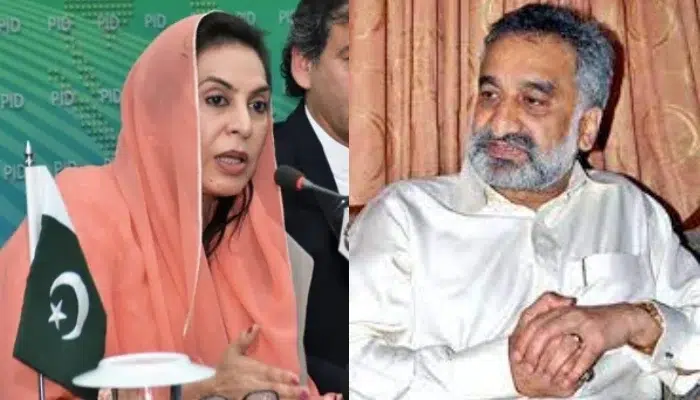
  • Sindh High Court allows Zulfiqar Mirza, Fahmida Mirza to contest elections

    Sindh High Court allows Zulfiqar Mirza, Fahmida Mirza to contest elections

    The Sindh High Court has on Thursday allowed former interior minister Zulfiqar Mirza and his wife, former Speaker of the National Assembly (NA), Fahmida Mirza to contest the general elections.

    The Court heard the constitutional petitions filed against the rejection of the couple’s nomination papers.

    Fahmida Mirza and Zulfiqar Mirza submitted nomination papers from National Assembly Constituency NA 223, while Zulfiqar Mirza also submitted papers from PS 70, 71, and 72.

    Both nomination papers were rejected by the returning officers, and an election tribunal accused them of being bank defaulters.

    However, the Sindh High Court approved the constitutional petitions of both candidates and allowed them to contest the elections.

  • Enforced Disappearance Bill never went missing, claims Chairman Senate

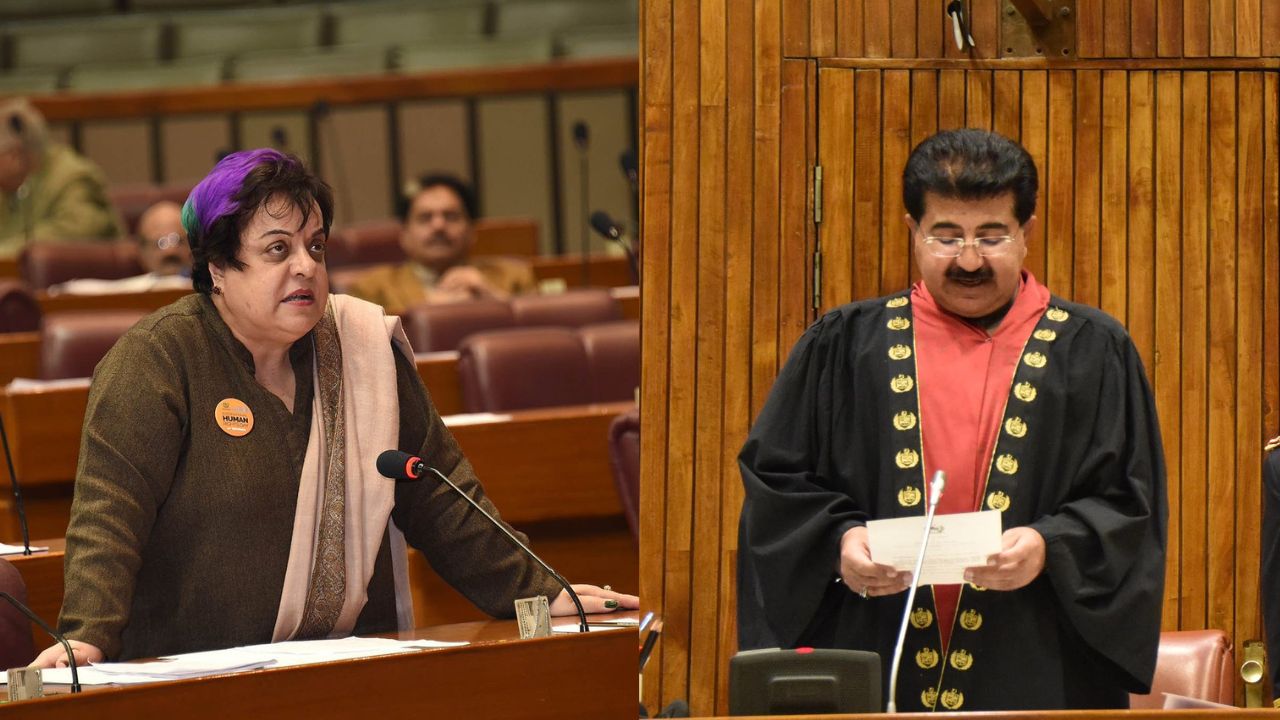
    Enforced Disappearance Bill never went missing, claims Chairman Senate

    In response to recent speculations surrounding the Criminal Law (Amendment) Bill 2021, the Senate Secretariat has issued a statement on Monday, debunking claims of the bill on enforced disappearances going “missing.”

    The Senate Secretariat clarified that the bill was duly passed by the National Assembly (NA) and subsequently returned to the NA after receiving approval from the Senate.

    https://twitter.com/OfficeSenate/status/1744311661509382327?s=20

    The Criminal Law (Amendment) Bill 2021, designed to introduce amendments to the Pakistan Penal Code (PPC) and Code of Criminal Procedure, received approval from the NA on November 8, 2021.

    Former human rights minister Shireen Mazari had previously voiced concerns about the bill’s status, suggesting that it had disappeared after being forwarded to the Senate.

    In its official statement, the Senate Secretariat refuted these claims, providing a detailed timeline of the bill’s progress. According to the Secretariat, the bill was initially introduced in the NA by the then-interior minister on January 7, 2021. After successfully passing the NA on November 8, 2021, the bill was transmitted to the Senate on November 10, 2021, adhering to constitutional and procedural requirements.

    Addressing the allegations raised by Shireen Mazari, the Senate Secretariat clarified that the bill was presented in the Senate on July 29, 2022. Subsequently, it was referred to the standing committee for a comprehensive consideration and report.

    “The Bill was passed by the Senate on 20th October, 2022 with some amendments. Accordingly, in pursuance of clause (2) of Article 70 of the Constitution of Pakistan, 1973 and rule 125 of the Rules of Procedure and Conduct of Business in the Senate, 2012, the Bill was returned to the originating House, i.e. the National Assembly of Pakistan on 20th October, 2022,” the statement said.

    The Secretariat underscored that, by Article 70 of the Constitution of Pakistan, 1973, and Rule 125 of the Rules of Procedure and Conduct of Business in the Senate, 2012, the bill was returned to its originating House, the National Assembly, on October 20, 2022, after securing approval in the Senate.

    The statement concluded by emphasizing that the bill was never missing, and it is not currently pending in the Senate Secretariat. Instead, it has been appropriately returned to the National Assembly after completing the required legislative process in the Senate. The Senate Secretariat reiterated its commitment to upholding constitutional and procedural standards in handling legislative matters.
  • No surveys; PEMRA to take action against media channels violating ECP’s Code of Conduct

    No surveys; PEMRA to take action against media channels violating ECP’s Code of Conduct

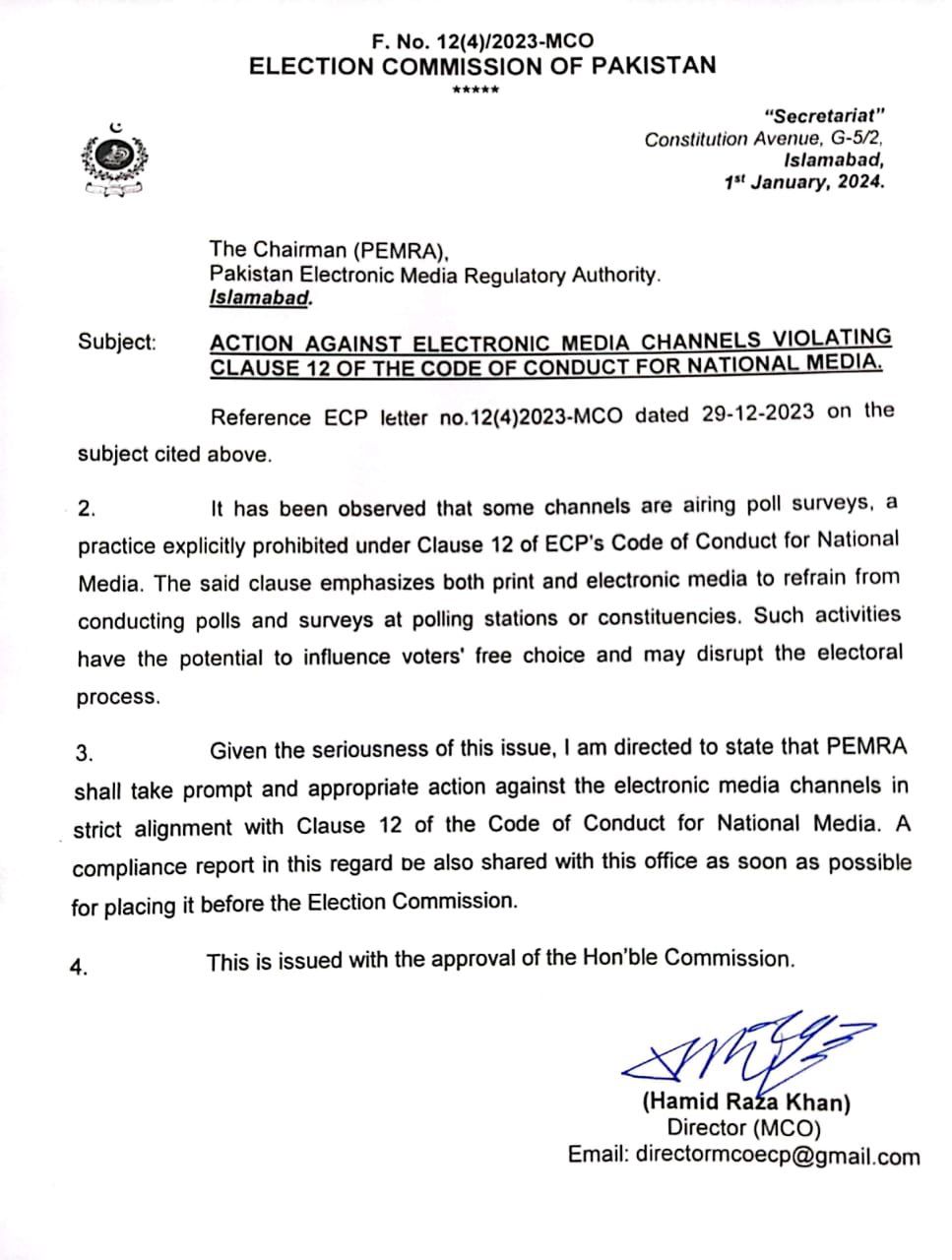
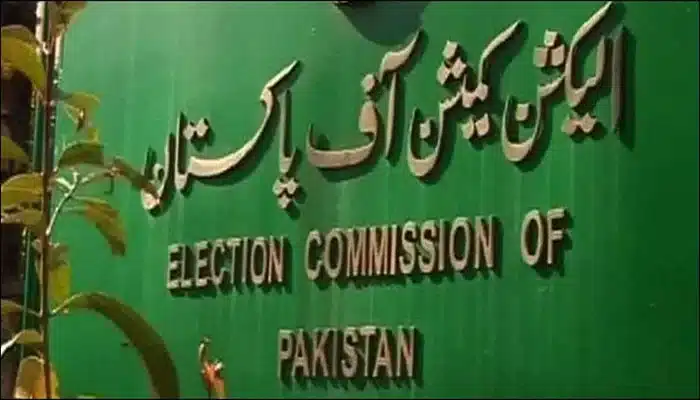
    The Election Commission of Pakistan (ECP) has officially communicated with the Pakistan Electronic Media Regulatory Authority (PEMRA), seeking strict action against media channels found violating the established code of conduct for the upcoming February 8 polls.

    The letter explicitly points out the airing of voting surveys by certain media channels. This practice, as per the ECP’s Code of Conduct for National Media, is prohibited under Clause 12.

    According to Clause 12, individuals working in print, electronic, and social media are prohibited from obstructing the election process and are required to display accreditation cards provided by the Election Commission.

    The ECP emphasized that both print and social media should refrain from conducting polls and surveys at polling stations or constituencies. The electoral watchdog stated that such activities have the potential to influence voters’ free choice and may disrupt the electoral process.

    The letter stated, “Given the seriousness of this issue, I am directed to state that PEMRA shall take prompt and appropriate action against the electronic media channels in strict alignment with Clause 12 of the Code of Conduct for National Media. A compliance report in this regard be also shared with this office as soon as possible for placing it before the Election Commission.”

    The ECP’s comprehensive 18-point code of conduct for media during elections includes provisions preventing the dissemination of content that reflects opinions prejudicial to the sovereignty, uprightness, or security of Pakistan. It also prohibits statements that could harm national solidarity or create a law and order situation.

    The regulatory framework extends to personal attacks on candidates or political parties in media content, mandating that any allegations should include comments from both sides. Monitoring responsibilities are delegated to Pemra, Pakistan Telecommunication Authority, Press Information Department, and the Cyber Wing and Digital Media Wing of the Ministry of Information and Broadcasting.

    The ECP further emphasized that these authorities are accountable for monitoring political parties’ and candidates’ coverage during election campaigns through electronic channels, print, and social media. Details of payments made by political parties and candidates must be submitted within 10 days after the poll day.

    The Election Commission of Pakistan warns that, in case of any violation of this Code of Conduct, it reserves the right to withdraw accreditation from individual journalists or media organizations. The authority to determine violations also rests with the electoral body. The media is also prohibited from airing unofficial results of a polling station until one hour after the close of the poll during the polling process coverage.

  • PEMRA nay laga dee TV channels pay aik aur pabandi

    PEMRA nay laga dee TV channels pay aik aur pabandi

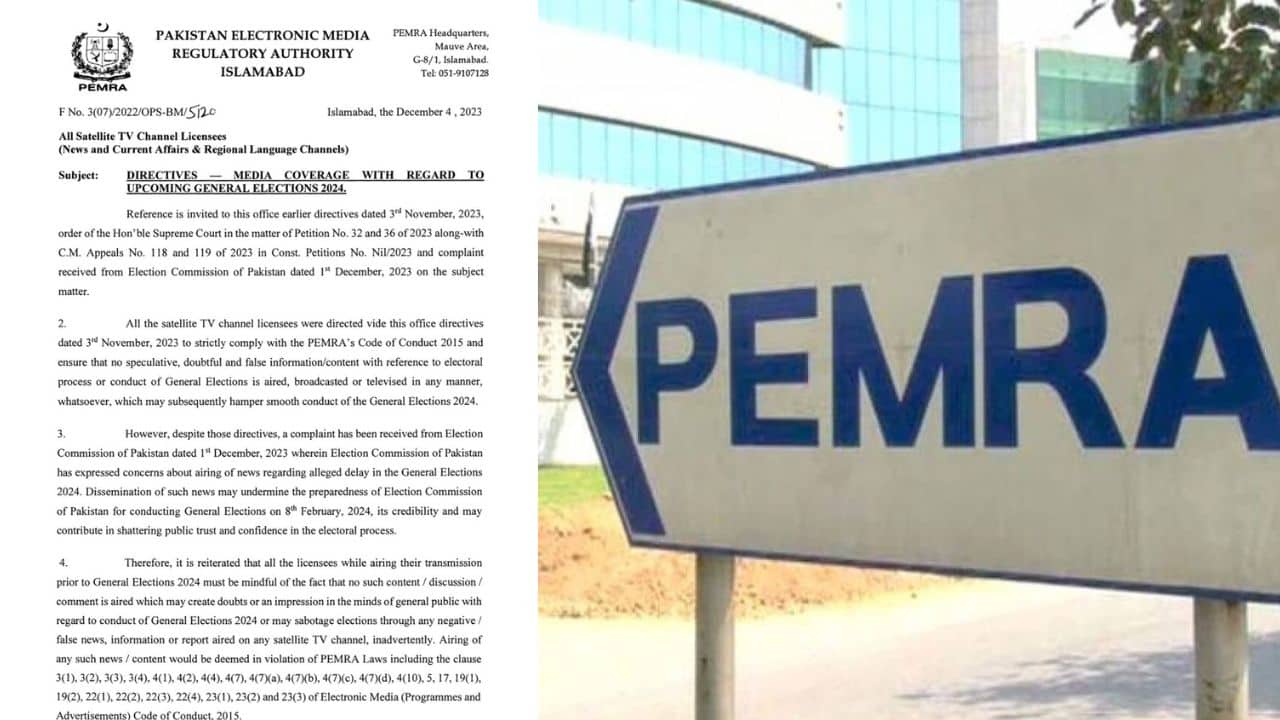
    Pakistan Electronic Media Regulatory Authority (PEMRA) has barred television channels from airing anything that casts doubt on the electoral process.

    The notification, issued on November 3, states, “All the satellite TV channel licensees were directed vide this office directives dated 3* November, 2023 to strictly comply with the PEMRA’s Code of Conduct 2015 and ensure that no speculative, doubtful and false information/content with reference to electoral process or conduct of General Elections is aired, broadcasted or televised in any manner, whatsoever, which may subsequently hamper smooth conduct of the General Elections 2024.”

    It further says that all the licensees, while airing their transmission before General Elections 2024, must be mindful of the fact that no such content/discussion / comment is aired which may create doubts or an impression in the minds of the public about the polls or may sabotage elections through any negative/false news, information or report aired on any satellite TV channel, inadvertently.

    Anchor Person Mohammad Malick took to X (former Twitter) and wrote, “Has Pemra gone absolutely bonkers? media barred from even discussing the possibility of flawed election process by EC. All media outlets & journo orgs must outrightly reject this ridiculous ‘unholy commandment’. this is brazen censorship and must be resisted.”

    Secretary General South Asian Free Media Association (SAFMA) Imtiaz Alam said, “Indeed, Election Commission of Pakistan should be respected, but it must earn respect by ensuring even-playing field fo all and transparently conducting electoral process. However, PEMRA order must be rejected. Media must critically evaluate the conduct of elections and ECP.”

  • When will ECP issue schedule of general elections in Pakistan?

    When will ECP issue schedule of general elections in Pakistan?

    The Election Commission of Pakistan (ECP) revealed on Friday that the eagerly awaited schedule for the general polls will be issued 54 days before the February 8 elections, as per Geo News.

    The Chief Election Commissioner (CEC), Sikandar Sultan Raja, said during an informal discussion with journalists that the election body is diligently working on completing all prerequisites for the upcoming polls.

    In June, the Pakistan Democratic Movement (PDM) government amended Section 57 of the Elections Act, empowering the ECP to set the general election date while defining a timeline of procedures from the announcement of the schedule to the polling day.

    CEC Sikandar Sultan Raja assured that the election schedule, appointment of returning officers (ROs), and district returning officers (DROs) will be announced promptly. He mentioned that updated constituency lists had already been released, and the ECP was proactively handling election-related responsibilities ahead of schedule.

    Despite concerns and speculations in political circles about potential delays in the already postponed polls, the ECP recently issued the final list of delimitation of constituencies for national and provincial assemblies, dismissing reports of possible delays.

    According to the notification issued by the ECP, the National Assembly (NA) has a total of 266 seats; 60 seats are reserved for women and 10 for religious minorities.

    Balochistan has a total of 20 NA seats, including 16 general and four reserved seats for women; Khyber Pakhtunkhwa has 45 general NA seats and 10 reserved seats for women; Sindh has a total of 75 NA seats, of which 61 are general and the remaining 14 are reserved for women.

    On the other hand, considering population, Punjab is a big province, and it has 141 NA seats, of which 32 are reserved for women. The federal capital has three general NA seats, with no reserved seat for women.

    Article 106 pertains to the constituencies of the four provincial legislatures. According to this article, Balochistan comprises 51 general seats, with 11 reserved for women and three for non-Muslims, making a total of 65 seats.

    In the case of Khyber Pakhtunkhwa, there are 115 general seats, along with 26 reserved for women and four for non-Muslims, bringing the total number of seats in the legislature to 145.

  • How many seats will be in the National Assembly in upcoming elections?

    How many seats will be in the National Assembly in upcoming elections?

    Amid rumours of delay in the elections, the Election Commission of Pakistan (ECP) has released the final list of delimitation of constituencies in the national and four provincial assemblies.

    This progress paves the roads for the election schedule, which is more likely to be announced in the first week of December, as per the electoral body.

    Previously, the ECP had said that the final list of delimitations for constituencies would be published on December 15, but it was later revised to November 30.

    According to the notification issued by the ECP, the National Assembly (NA) has a total of 266 seats; 60 seats are reserved for women and 10 for religious minorities.

    Balochistan has a total of 20 NA seats, including 16 general and four reserved seats for women; Khyber Pakhtunkhwa has 45 general NA seats and 10 reserved seats for women; Sindh has a total of 75 NA seats, of which 61 are general and the remaining 14 are reserved for women.

    On the other hand, considering population, Punjab is a big province, and it has 141 NA seats, of which 32 are reserved for women. The federal capital has three general NA seats, with no reserved seat for women.

    Article 106 pertains to the constituencies of the four provincial legislatures. According to this article, Balochistan comprises 51 general seats, with 11 reserved for women and three for non-Muslims, making a total of 65 seats.

    In the case of Khyber Pakhtunkhwa, there are 115 general seats, along with 26 reserved for women and four for non-Muslims, bringing the total number of seats in the legislature to 145.

  • Asad Qaider arrested again in May 9 riots case

    Asad Qaider arrested again in May 9 riots case

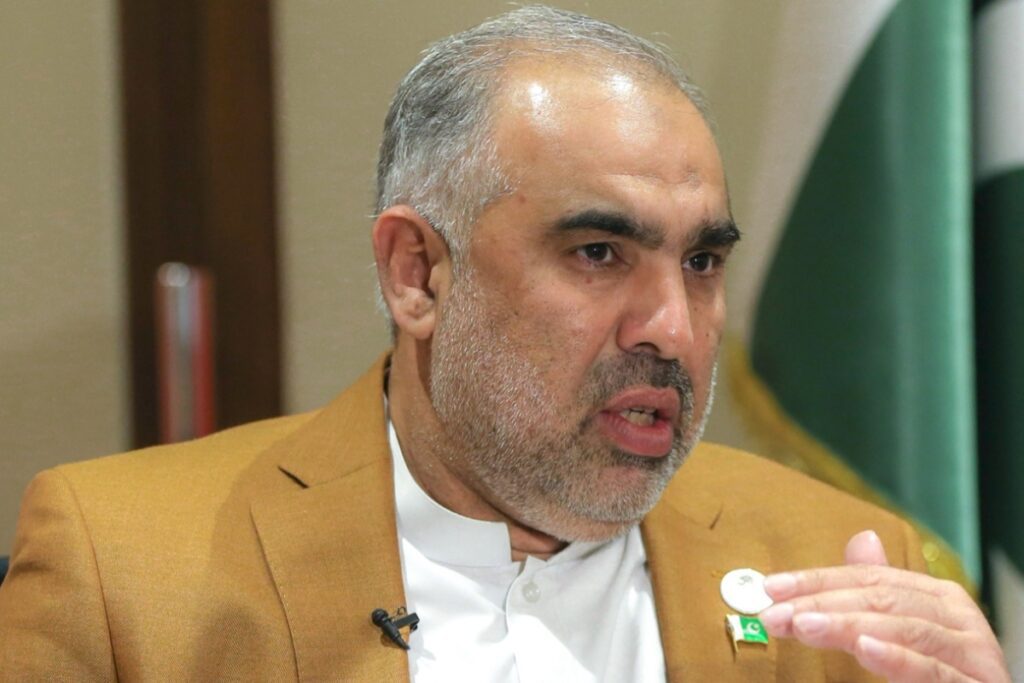
    Pakistan Tehreek-e-Insaf (PTI) senior leader and former Speaker of the National Assembly (NA), Asad Qaiser, got arrested again from Swabi jail on Thursday in a case related to May 9 riots after getting bail in a corruption case, Geo News has reported.

    Charsadda police arrested the PTI leader from inside Swabi jail and shifted him to an unidentified location.

    The May 9 riots were triggered after the arrest of PTI Chairman Imran Khan in the £190 million UK settlement case. Hundreds of PTI workers and leaders have been put behind bars for their involvement in violent protests and attacks on military installations, including Jinnah House and the General Headquarters (GHQ) in Rawalpindi. The military termed May 9 a ‘Black Day’ and decided to try protesters under the Army Act.

    During the PTI leader’s re-arrest, he said in a video message, “We will continue our struggle to win the upcoming election next year on February 8.”

    “Neither we are afraid, nor will we backtrack.”

    Asad Qaiser also claimed that his party will win elections with a huge majority if a level playing field is provided to all political parties.

    Without naming anyone, the PTI leader accused: “They have already declared a person prime minister.”

  • Kya Malik Riaz ka interview Imran Khan ko muskhkil mein daal sakta hai?

    Kya Malik Riaz ka interview Imran Khan ko muskhkil mein daal sakta hai?

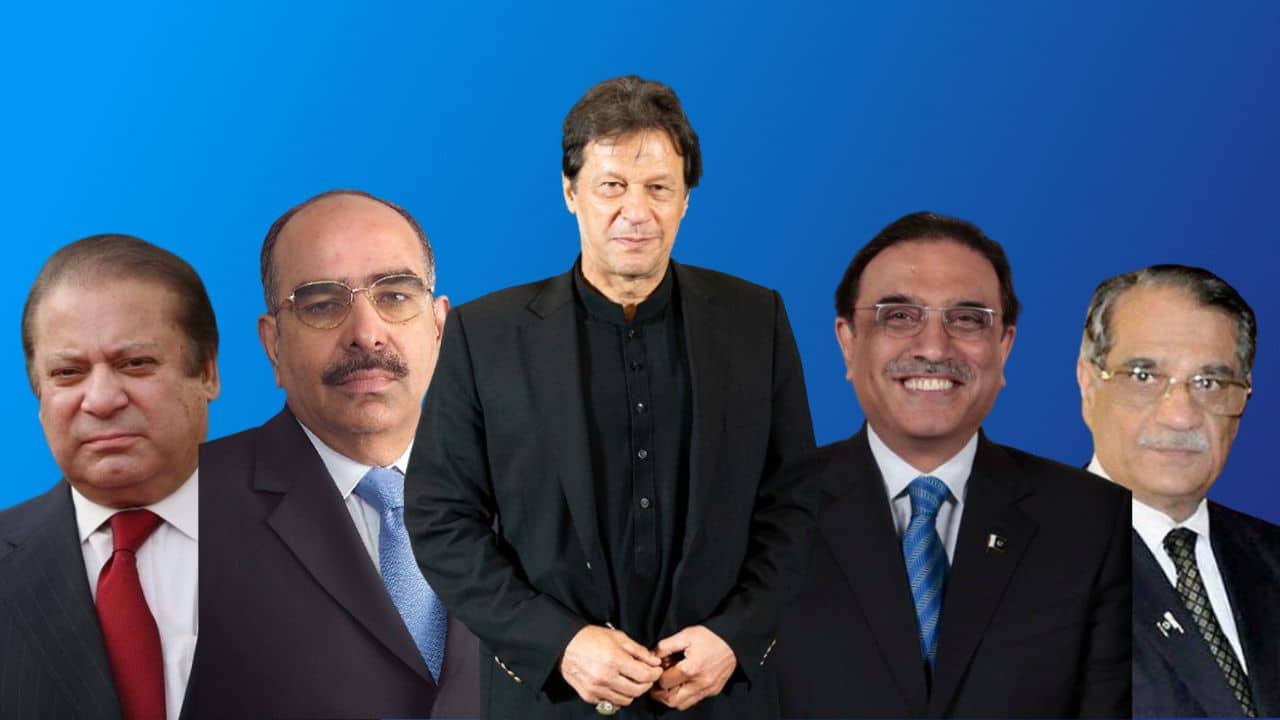
    Pakistan is watching a wave of interviews and the latest twist in this unfolding drama has been disclosed by senior journalist Javed Chaudhry in a recent vlog, hinting that Malik Riaz, a property tycoon, is poised to unravel a series of explosive revelations in the days to come.

    Javed Chaudhry’s vlog, providing a sneak peek into an upcoming interview with Malik Riaz, outlined three key points that are expected to rock the political landscape.

    First and foremost, the interview is anticipated to shed light on the staggering Rs460 billion penalty imposed on Bahria Town by the Supreme Court. Riaz is expected to reveal what Saqib Nisar got in return for favors. He will also delve into the details of the 460 billion rupees fiasco.

    Furthermore, the property tycoon is predicted to make startling claims regarding the 2014 protest, alleging that influential figures orchestrated the demonstration to unseat then-Prime Minister Nawaz Sharif.

    The revelations will also cover how the sit-in was sponsored and from where and how food was provided.

    Riaz will also talk about why he advised Nawaz Sharif to leave the country for three months after his resignation.

    Riaz is also anticipated to discuss his role in preventing a collaborative effort between Asif Zardari and Nawaz Sharif against Imran Khan, shedding light on the intricate dynamics that shaped Pakistan’s political landscape.

    Riaz will also openly talk about who played what role during Imran Khan’s government and how they all benefited from it.

    While specific details of the upcoming interview were not disclosed by Chaudhry, he expressed confidence that Malik Riaz’s revelations would be nothing short of bombshells, suggesting a turbulent period ahead for Pakistani politics.

  • Supreme Court upholds Practice & Procedure Act 2023

    Supreme Court upholds Practice & Procedure Act 2023

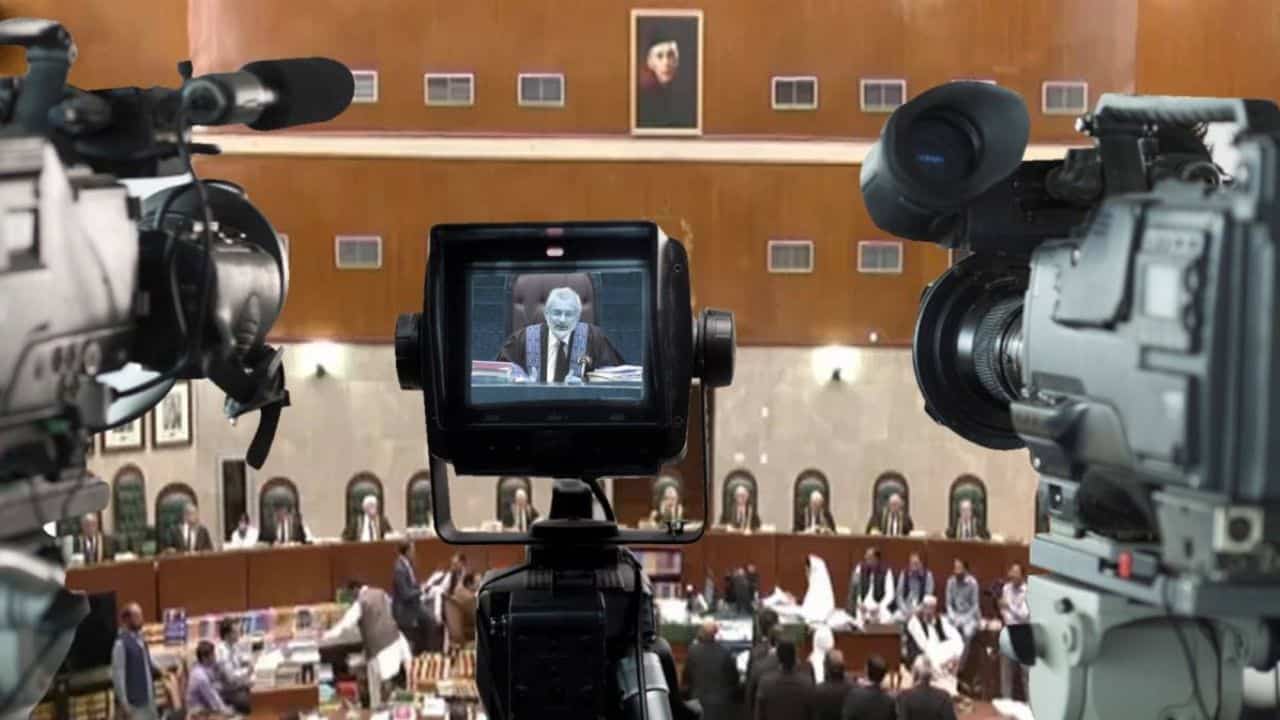
    The Supreme Court (SC) has issued a verdict in favour of the SC (Practice and Procedure) Act, 2023, dismissing petitions challenging its validity.

    Headed by Chief Justice Qazi Faez Isa, the SC full bench consisted of Justice Sardar Tariq Masood, Justice Ahsan, Justice Syed Mansoor Ali Shah, Justice Akhtar, Justice Yahya Afridi, Justice Aminuddin Khan, Justice Naqvi, Justice Jamal Khan Mandokhel, Justice Mazhar, Justice Ayesha, Justice Athar Minallah, Justice Rizvi, Justice Waheed and Justice Musarrat Hilali.

    The decision was upheld by 10-5 majority.

    While reading out the order, CJP Isa noted that five members of the full court bench — Justice Ijazul Ahsan, Justice Munib Akhtar, Justice Sayyed Mazahir Ali Akbar Naqvi, Justice Ayesha A Malik, and Justice Shahid Waheed — had opposed the law.

    The decision on the SC (Practice and Procedure) Act, 2023, case was delivered after the completion of all arguments. Attorney General Mansoor Awan presented a comprehensive case in favor of the act, leading to the full court’s decision in support of the legislation.

    The SC (Practice and Procedure) Act, 2023, has been a subject of considerable debate and legal scrutiny, with various petitions seeking its annulment. However, the apex court has preserved the Act, emphasising its continued relevance in the legal system.

    However, by an 8-7 decision, the majority of judges have decided against the provision of law wherein retrospective right of appeal was given in the Act.

    The Supreme Court (Practice & Procedure) Act, 2023, which has been at the centre of legal debate and judicial proceedings, introduced several crucial provisions, reshaping the functioning of the Supreme Court of Pakistan:

    1. Sou Motu Notice: The Act granted the power of taking suo motu notice to a three-member committee, consisting of senior judges, including the Chief Justice. This provision aimed to facilitate the initiation of legal proceedings in the apex court and ensure transparency. It also included the right to appeal.
    2. Constitution of Benches: According to the Act, every case, matter, or appeal brought before the Supreme Court would be heard and decided by a bench formed by a committee comprising the Chief Justice and the two most senior judges. Decisions of the committee would be made by a majority vote.
    3. Original Jurisdiction: When exercising the apex court’s original jurisdiction, the Act mandated that any matter invoking the use of Article 184(3) must first be presented before the committee.
    4. Interpretation of the Constitution: In cases where the interpretation of the Constitution was necessary, the Act stipulated that the committee would assemble a bench consisting of no fewer than five Supreme Court judges.
    5. Right to Appeal: In instances where a decision was made by a Supreme Court bench exercising Article 184(3) jurisdiction, the Act allowed for an appeal to be filed within 30 days of the bench’s order. This appeal would be scheduled for a hearing within a period not exceeding 14 days.
    6. Retrospective Right of Appeal: The Act also extended the right of appeal retrospectively to individuals who had been affected by an order made under Article 184(3) before the commencement of the SC (Practice and Procedure) Act, 2023, provided that the appeal was filed within 30 days of the Act’s implementation.
    7. Choice of Counsel: Parties involved in legal proceedings were granted the right to select their counsel for filing a review application under Article 188 of the Constitution.
    8. Urgency and Interim Relief: The Act outlined that any application claiming urgency or seeking interim relief in a case, appeal, or matter would be scheduled for a hearing within 14 days from the date of filing.
  • IMF delegation to evaluate Pakistan’s economic performance during November visit

    IMF delegation to evaluate Pakistan’s economic performance during November visit

    The International Monetary Fund (IMF) is gearing up for a vital visit to Pakistan, scheduled for November. The purpose of this visit is to assess Pakistan’s economic performance, particularly focusing on the period from July to September.

    Reliable sources in financial circles have shared that this visit is part of an ongoing review following the extension of the loan programme. Representatives from the IMF and the caretaker administration will engage in important discussions to gauge Pakistan’s progress and its adherence to the outlined economic targets.

    Reports from ARY News indicate that Pakistan is on track to receive the next portion of financial assistance, which amounts to $700 million from the $3 billion loan programme. This development underscores Pakistan’s dedication to meeting the IMF’s conditions aimed at boosting economic stability and growth.

    Forecasts suggest that the IMF is set to disburse around $1.8 billion in funds to Pakistan by March 2024. This positive outlook reflects the gradual restoration of investor confidence and the promising trajectory of Pakistan’s economy.

    However, the release of these funds hinges on Pakistan’s successful completion of two critical economic reviews. This underscores Pakistan’s commitment to implementing structural reforms and achieving sustainable economic development.