Tag: Pakistan Stock Exchange

  • Pakistan’s stock market closes above 75,000 mark for the first time

    Pakistan’s stock market closes above 75,000 mark for the first time

    The Pakistan Stock Exchange’s (PSX) KSE-100 index achieved a historic milestone on Friday, closing above 75,000 points for the first time ever. This marked the seventh consecutive session of gains, reflecting a strong buying momentum in the market.

    The trading session opened on a positive note, with bullish investors driving the market upward throughout the day. The KSE-100 Index ultimately settled at 75,342.35 points, an increase of 411.65 points or 0.55 per cent from the previous close.

    Significant buying activity was observed across various sectors, including oil and gas exploration, fertilisers, refineries, pharmaceuticals, cement, and chemicals, contributing to the robust market performance.

    The surge follows Thursday’s session, where the index gained 267 points to close just shy of the 75,000 mark, fueled by positive market sentiments.

    Market experts attribute this unprecedented rise to several favorable factors. These include the commencement of discussions with the International Monetary Fund (IMF) for a new loan programme and anticipations of a potential interest rate cut in the upcoming monetary policy meeting.

    Such developments have bolstered investor confidence, leading to increased market activity and record-high levels at the PSX.


  • PSX surges to record high as KSE-100 closes above 73,000 points

    PSX surges to record high as KSE-100 closes above 73,000 points

    After a series of subdued sessions, the Pakistan Stock Exchange (PSX) saw a resurgence of buying on Friday, propelling its benchmark KSE-100 index above the 73,000 mark for the first time in history.

    The positive momentum reflected renewed investor confidence amid signs of economic stability.

    The KSE-100 index opened on a bullish note, reaching an intra-day high of 73,449.37 before settling at 73,085.50, a gain of 427.45 points or 0.59 per cent by the close of trading.

    Despite some sporadic selling during the day, the bulls largely controlled the market, resulting in a robust session.

    Industries driving the surge

    Key sectors that drove the surge included cement, chemical, oil and gas exploration companies, and oil marketing companies (OMCs). Index-heavy stocks such as Lucky Cement (LUCK), Oil and Gas Development Company (OGDC), Pakistan Petroleum Limited (PPL), Pakistan State Oil (PSO), Sui Northern Gas Pipelines Limited (SNGPL), and Sui Southern Gas Company (SSGC) closed in the green, contributing significantly to the overall upward trend.

    Market experts attribute the surge to a combination of improved economic indicators and investor expectations.

    Pakistan’s foreign exchange reserves and remittances have shown positive growth, suggesting a stabilising economy.

    Additionally, there is anticipation of a potential policy rate cut in the upcoming Monetary Policy Committee (MPC) meeting on June 10, following a recent decline in the inflation rate.

    On Thursday, the KSE-100 index had a marginal increase in a largely range-bound session, closing at 72,658.05, a gain of 56.24 points, or 0.08 per cent.

    The strong close on Friday underscores a more optimistic outlook for the market as investors continue to monitor key economic developments and policy changes.

  • PSX hits new high amid optimistic economic trends

    PSX hits new high amid optimistic economic trends

    The Pakistan Stock Exchange (PSX) soared to yet another record high on Wednesday, buoyed by positive economic indicators.

    A decrease in inflation sparked expectations of monetary easing, seen as a significant boost to commercial activity and, consequently, corporate earnings.

    Closing at 67,756.03 points, the benchmark KSE-100 index surged by a substantial 869.77 points or 1.30 per cent.

    Investors were particularly drawn to the cyclical sector, with significant investments flowing into cement and steel companies.

    This interest was largely fueled by reports indicating a rise in both local and international cement dispatches for March.

    However, sectors such as transport, technology, communication, and commercial banking also garnered attention from investors.

    Additionally, the government’s privatisation initiatives, particularly the proposed sale of State-Owned Enterprises (SOEs), injected optimism into the market.

    There’s a prevailing belief that these companies could experience improved profitability and efficiency under private ownership.

    Notably, on Tuesday, the Privatisation Commission initiated the process of selling off Pakistan International Airlines (PIA), inviting expressions of interest (EOIs) from potential buyers.

  • PSX hits historic high: KSE-100 closes at record-breaking 67,142

    PSX hits historic high: KSE-100 closes at record-breaking 67,142

    Pakistan Stock Exchange’s (PSX) KSE-100 index surged to unprecedented heights in Thursday’s trading, culminating at a historic peak of 67,142.12, marking a substantial uptick of 594.34 points or 0.89 per cent.

    Throughout the trading day, the index demonstrated unwavering positivity, cresting at an intraday zenith of 67,246.03 (+698.24) and a nadir of 66,690.94 (+143.15) points, reflecting robust investor sentiment and confidence in the market’s trajectory.

    Trading activity was buoyant, with the KSE-100 index witnessing a total turnover of 231.314 million shares, underlining robust investor participation and liquidity in the market.

    The stellar performance of the KSE-100 index was underpinned by the commendable contributions of various sectors, notably Commercial Banks, which bolstered the index with 184.39 points, followed by Fertiliser (89.9 points), Cement (85.95 points), Oil & Gas Exploration Companies (49.32 points), and Oil & Gas Marketing Companies (27.36 points).

    Conversely, certain sectors experienced marginal declines, with Leather & Tanneries leading the downturn with 6.69 points, trailed by Transport (2.26 points), Real Estate Investment Trust (0.69 points), Miscellaneous (0.35 points), and Modarabas (0.31 points), albeit their impact remained subdued in the broader market context.

    In parallel, the Pakistani rupee (PKR) demonstrated resilience against the US dollar in the interbank market, appreciating marginally by approximately 1 paisa.

    The currency closed the trading session at PKR 278.03 per USD, exhibiting strength compared to the preceding session’s closure at PKR 278.04 per USD.

    During intraday trading, the rupee reached a peak bid of 278.1 and a trough ask of 278, reflecting stability and confidence in the domestic currency’s valuation.

    In the open market, exchange companies quoted the dollar at PKR 278.04 for buying and PKR 280.41 for selling, indicative of prevailing market dynamics and demand-supply dynamics.

  • Toyota manufacturer in Pakistan halts car production amid parts shortage

    Toyota manufacturer in Pakistan halts car production amid parts shortage

    Indus Motor Company (IMC), the manufacturer of Toyota vehicles in Pakistan, has declared a temporary shutdown of its production plant for a duration of six days.

    The decision stems from the company’s concern over low inventory levels and a shortage of essential components, as disclosed in a formal notice submitted to the Pakistan Stock Exchange (PSX).

    The notice specified, “Based on the current low level of inventory of manufactured vehicles and the shortage of parts and components for vehicle manufacturing, due to supply chain challenges, the company has decided to close its production plant from March 6th, 2024, to March 11th, 2024 (both days inclusive).”

    Pakistan’s automotive sector is grappling with various challenges, including the nation’s sluggish economic growth, surging inflation rates, and elevated borrowing costs, all of which are contributing to a decline in vehicle sales.

    To address these challenges, Indus Motor Company recently announced its board’s approval of an investment of approximately Rs3 billion.

    This investment aims to enhance the localization of production, a crucial step in the company’s broader strategy to consistently increase the localization of parts and components in locally manufactured vehicles. 

    This temporary shutdown underscores the broader challenges facing the automotive industry in Pakistan and reflects IMC’s proactive approach to managing its production in response to current market conditions.

  • Indus Motor Company invests Rs3 billion to boost local auto production

    Indus Motor Company invests Rs3 billion to boost local auto production

    In a significant move within Pakistan’s automotive sector, Indus Motor Company Limited (INDU) has greenlit an investment of approximately Rs3 billion (around $10.76 million) aimed at bolstering the localisation of production.

    The company, renowned for being the manufacturer of Toyota-brand vehicles in the country, disclosed this pivotal development in a notice submitted to the Pakistan Stock Exchange (PSX) on Thursday.

    The announcement conveyed, “We are pleased to announce that the Board of Directors, in its meeting held on February 21, 2024, has approved an investment of around Rs3 billion to be made by the company for additional localization of parts and components of various existing vehicles.”

    Indus Motor revealed that this investment aligns with the company’s overarching strategy to continually augment the localization of parts and components of vehicles manufactured within the country.

    This move is poised to curtail the outflow of foreign exchange and foster growth within the local auto industry.

    “The announced investment shall be made towards expenditure in plant and machinery, moulds, dies, equipment, and related expenses for localization of parts and components to be manufactured locally for various existing vehicles,” stated Indus Motor.

    The timeline for this substantial investment is set to conclude by the third quarter of the calendar year 2025.

    Indus Motor has previously indicated its commitment to increasing product localization. Notably, the company introduced its Hybrid Electric Vehicle (HEV) Corolla Cross last year, emphasising that 50 per cent of its value was localized.

    CEO Ali Asghar Jamali highlighted that, after accounting for government taxes, over 50 per cent of the Corolla Cross’s value comprises localised parts, distinguishing it among other assembled hybrids in the country.

  • Pakistan Stock Exchange to halt trading activity on February 8

    Pakistan Stock Exchange to halt trading activity on February 8

    In an official notice sent to all Trading Rights Entitlement (TRE) certificate holders, the Pakistan Stock Exchange Limited (PSX) has announced the closure of the exchange on Thursday, February 8, 2024. 

    This decision is attributed to the upcoming general election scheduled to take place on that day, as declared by the Election Commission of Pakistan.

    All TRE certificate Holders, along with the staff and concerned parties, are duly informed about the closure on February 8, 2024, which has been declared a public holiday by the Election Commission of Pakistan in conjunction with the national general election, PSX noted.

    Furthermore, it is pertinent to note that the PSX will also remain closed on Monday, February 5, 2024, in observance of Kashmir Day.

    Investors and market participants are urged to plan their activities accordingly, considering the temporary closure of the Pakistan Stock Exchange on these specified dates.

  • PSX declines by nearly 1% amid investor focus on Monetary Policy meeting

    PSX declines by nearly 1% amid investor focus on Monetary Policy meeting

    In today’s financial update, the Pakistan Stock Exchange (PSX) opened the week on a downbeat note, as the benchmark KSE-100 index experienced a decline of 628.33 points, or 0.98 per cent, settling at 63,184.74 by 10:20 am PST.

    Investor focus is keenly directed towards the impending Monetary Policy Committee meeting later today. 

    Expectations loom large that the central bank will maintain the policy rate unchanged, although some are optimistic about the possibility of a marginal rate cut.

    The KSE-100 index witnessed a trading volume of 19.534 million shares. Notably, the underperformance is attributed to key sectors, with fertiliser, commercial banks, oil and gas exploration companies, oil and gas marketing companies, and cement collectively contributing to the index’s dip by 138.49, 135.75, 111.02, 40.79, and 39.84 points, respectively.

    Specific companies weighing down the index include EFERT with 81.35 points, PPL with 56.52 points, OGDC with 45.06 points, MEBL with 39.27 points, and MCB with 30.37 points.

    In the broader market scenario, the All-Share index is trading at 42,871.61, witnessing a net loss of 341.49 points.

    It is noteworthy that during the fiscal year, the KSE-100 displayed substantial growth, gaining 21,732 points, or 52.43 per cent. In the ongoing calendar year, there has been a cumulative increase of 734 points, equivalent to 1.17 per cent. 

    Investors are navigating a dynamic landscape, closely monitoring the evolving economic indicators and anticipating the outcomes of the central bank’s policy decisions.

  • PSX starts 2024 with 1,554 points surge in KSE-100 index

    PSX starts 2024 with 1,554 points surge in KSE-100 index

    The Pakistan Stock Exchange (PSX) commenced the year 2024 on a positive note, witnessing a noteworthy surge in its key benchmark, the KSE-100 index.

    The index exhibited a robust increase of 1,554.63 points, or 2.49 per cent, reaching 63,839.67 during the morning trading session.

    This promising start follows a remarkable performance in 2023, where the KSE-100 index recorded a substantial gain of 54.5 per cent, marking the highest yearly return since 2009.

    Concluding the previous year at 62,451 points, the index gained 21,632 points and earned the distinction of being the fourth best-performing stock market in 2023.

    During Monday’s session, the KSE-100 index found support from key sectors, with oil and gas exploration companies contributing 398.36 points, commercial banks adding 395.29 points, the fertiliser sector contributing 130.32 points, oil and gas marketing companies with 109.21 points, and power generation and distribution contributing 109.02 points.

    Noteworthy companies driving the index upwards include PPL with 172.23 points, OGDC with 162.5 points, HUBC with 84.59 points, UBL with 82.81 points, and MCB with 77.46 points.

    In the broader market context, the All-Share index is trading at 42,803.03, reflecting a net gain of 886.75 points.

    It’s important to note that this information is based on an intraday update, capturing the current dynamics of the market.

  • Gold prices surge in Pakistan: 24-karat soars to Rs217,600 per tola

    Gold prices surge in Pakistan: 24-karat soars to Rs217,600 per tola

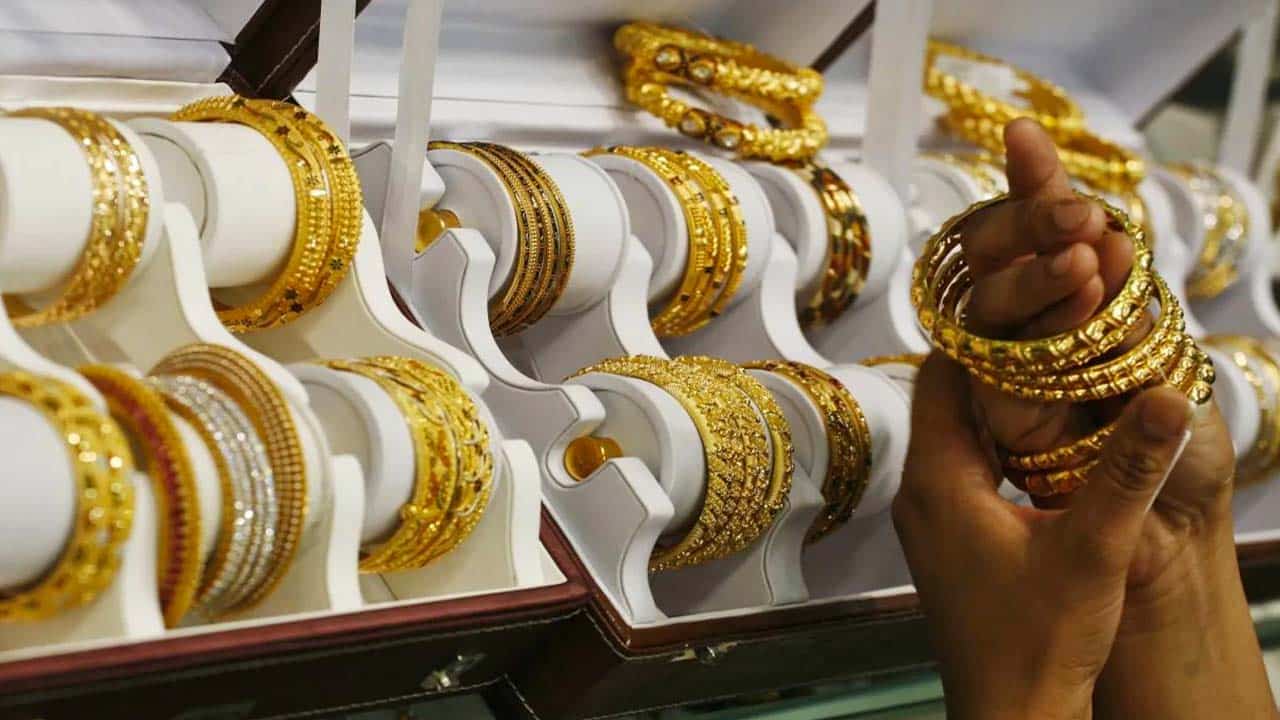
    The price of 24-karat gold per tola witnessed a surge, rising by Rs400 and reaching Rs217,600 on Tuesday, as compared to its previous closing at Rs217,200.

    Similarly, the cost of 10 grammes of 24-karat gold also experienced an uptick, increasing by Rs343 to Rs186,557 from Rs186,214.

    Meanwhile, the rates for 10 grammes of 22-karat gold climbed to Rs171,011 from Rs170,696, as reported by the All Sindh Sarafa Jewellers Association.

    In contrast, both the per-tola and 10-gramme silver prices remained stable at Rs2,670 and Rs2,289.09, respectively.

    On a global scale, the price of gold saw an increment of $4, reaching $2,047 from $2,043, according to the Association.

    Simultaneously, the Pakistan Stock Exchange (PSX) witnessed a significant downturn in intra-day trading on Tuesday, with the benchmark KSE-100 index plummeting by over 2,600 points.

    The PSX reported a loss of 2,633 points, causing the 100 index to dip below the 63,000-point threshold, trading at 62,571 around 2:30 pm.

    This decline comes after a sustained bullish trend lasting over a month, which followed the successful conclusion of a staff-level agreement with the International Monetary Fund (IMF).

    Market analysts attribute the bearish trend to stocks in the exploration and production (E&P), fertiliser, and banking sectors.

    Throughout the session, profit-taking was evident, contributing to the index fluctuating by over 2,500 points.