Tag: Pakistan

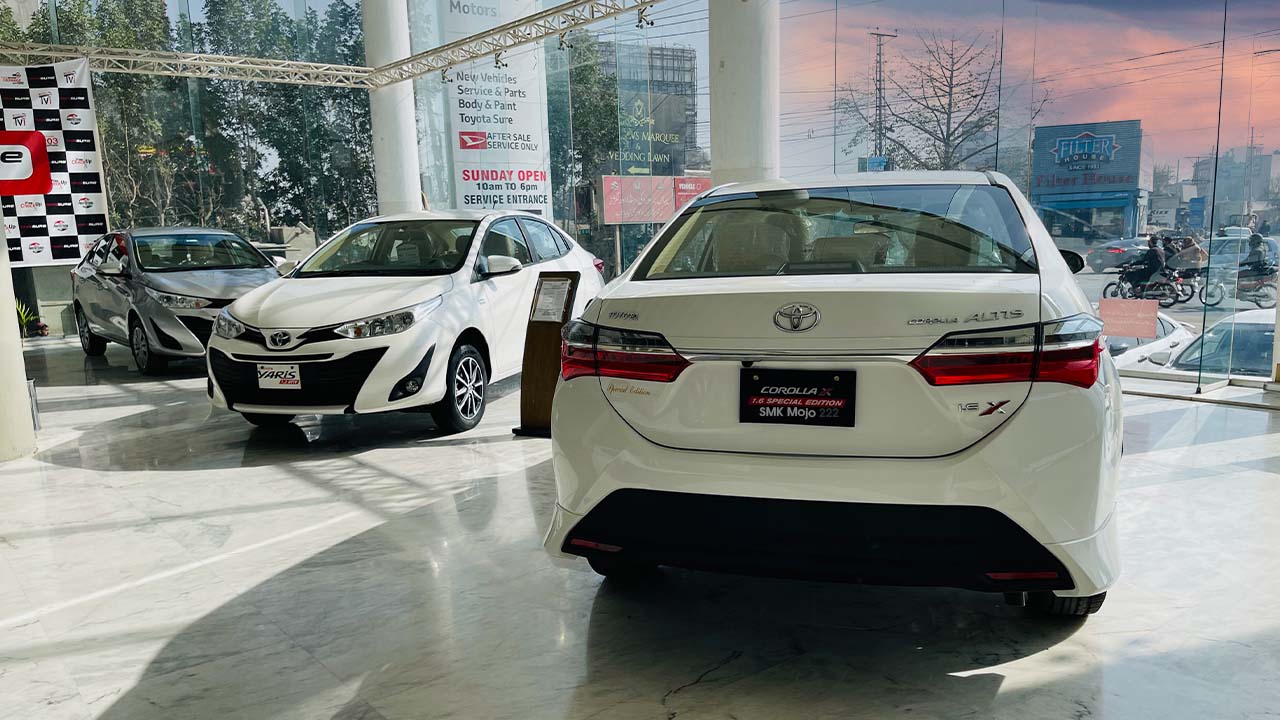
  • Crisis on wheels: Pakistan’s automotive industry grapples with mass layoffs and 70% sales drop

    Crisis on wheels: Pakistan’s automotive industry grapples with mass layoffs and 70% sales drop

    The automotive industry in Pakistan is facing a severe setback as thousands of workers were laid off due to a decline in vehicle and spare parts sales. The government’s ban on raw material imports, coupled with the depreciation of the rupee and soaring inflation, has caused a significant strain on the industry. With foreign exchange reserves dwindling and the local currency hitting historic lows against the US dollar, the economic crisis has reached unprecedented levels.

    Pakistan finds itself in the midst of its most formidable economic crisis to date, as the State Bank of Pakistan’s foreign exchange reserves have plummeted to a mere $4 billion. This amount is barely sufficient to cover three weeks of imports, raising concerns about the country’s economic stability. The ban on raw material imports, implemented to prevent the outflow of US dollars, has caused a sharp decline in industrial output and triggered widespread layoffs and unemployment.

    Dollar crunch and inflation

    In the midst of the worsening dollar crunch, commercial banks have also halted the opening of letters of credit (LCs), leaving importers in a state of uncertainty regarding the provision of the necessary funds for already placed orders. This further exacerbates the challenges faced by the automotive industry, hindering its ability to procure essential raw materials and sustain production.

    The country is grappling with soaring inflation rates, which surpassed 36 per cent in April, the highest recorded since 1964. As a result, consumer purchasing power has diminished significantly, leading to a sharp decline in vehicle sales. Munir Karim Bana, Chairman of the Pakistan Association of Automotive Parts and Accessories Manufacturers (PAAPAM), laments the dire situation, stating that thousands of workers have been laid off, and production has ground to a halt. The closure of auto manufacturing plants has further exacerbated the industry’s challenges.

    Auto parts manufacturers are grappling with demurrage charges as raw materials worth billions of rupees remain stuck at the Karachi port. PAAPAM, responsible for supplying approximately 90 per cent of local vehicle parts, is bearing the burden of these charges. Furthermore, with production units closed, income streams have dried up, exacerbating the financial strain on the industry.

    Rana Ihsan Afzal, the coordinator to Prime Minister Shehbaz Sharif on commerce and industry, acknowledges that the automotive industry’s full efficiency may not be restored until the revival of the IMF bailout program. As a sector heavily reliant on imports and foreign currency, the automotive industry is particularly vulnerable to the country’s economic challenges. The delay in the staff-level agreement on the ninth review of the IMF bailout deal signed in 2019 has further hampered the industry’s prospects.

    Revival prospects and government assurance

    Amid the decline in sales and mass layoffs, the coordinator to the Prime Minister expressed his concern but assured that the government is tirelessly working to revive the economy. The coordinator acknowledges the temporary phase that necessitates import restrictions on the automotive industry to protect foreign exchange reserves. However, he remains optimistic that once reserves are replenished, the industry will experience a significant upturn.

    Pakistan’s automotive industry is facing a dire crisis, with plummeting sales, layoffs, and manufacturing plant closures. The ban on raw material imports, along with the economic challenges of soaring inflation and dwindling foreign exchange reserves, has pushed the industry to the brink. Despite the difficulties, the government is committed to revitalizing the sector and assuaging the concerns of manufacturers.
  • Sindh lawyers team up against a female judge for exposing water scam

    Sindh lawyers team up against a female judge for exposing water scam

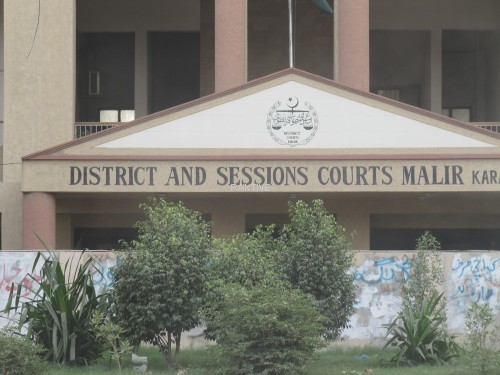
    Sadaf Khokhar, a female jurist posted as a District and Sessions Judge at the Malir court in Karachi, has exposed a scam in which water from Karachi court’s RO filter plant was being illegally sold for profit.

    After she exposed the scam, lawyers from different groups of the province pitted themselves against the female judge.

    She had a sign displayed at the court’s RO filter plant last week on Thursday, May 11, prohibiting the sale of the water.

    Given the lack of access to clean drinking water for those who visit this court, the Malir Bar Association requested authorisation to establish a RO plant in 2021.

    However, when senior civil judge and supervisory officer Khurram Amin Khan paid a surprise visit to the RO facility last week, he discovered that a man by the name of Hajan Ali was peddling packed bottles of water from it.

    Hajan Ali informed the civil judge that he had a contract in place to sell the water with the current elected Malir Bar Association board.

    At the plant, the civil judge discovered bottles and packing materials.

    Justice Khokhar was then informed by the civil judge about the scam. “[D]istilled water is being sold commercially,” Khokhar said in a letter she wrote to the registrar of the Sindh High Court on May 13.

    “The RO plant is donated and being maintained at the [cost of] court/public exchequer (electricity etc).”

    The District Bar Association then promptly organised a strike, scheduled for the following day.

    The lawyers accused the female judge of harassing and humiliating the lawyers of the Malir Bar and stopping the service of drinking water.

    According to the Malir Bar lawyers, the female judge had violated the law,and they had declared a strike that would last until Monday, May 15.

    The case then moved on to further courts, with the Sindh Bar Council bringing it before the Chief Justice of the Sindh High Court by May 18.

    The Chief Justice Ahmad Ali M Sheikh was informed about the judge’s behaviour by the Sindh Bar Council, the Sindh High Court Bar Association, the Karachi Bar Association, and the Malir Bar Association.

    However, they were dissatisfied with the judge’s response.

    Amir Saleem, the president of the Karachi Bar, said on May 20, they will go on strike in protest of the Chief Justice’s and District and Sessions Judge Sadaf Khokhar’s lack of cooperation.

    On Monday, May 22, the strike was still in effect. Her transfer out is what the solicitors desire.

  • Transgender activist Shehzadi Rai, Twitter users criticise ‘Guru’ for hiring cis man to play intersex character

    Express Entertainment has recently released the teaser trailer of the upcoming drama ‘Guru’ about an intersex character, with the main character to be played by Ali Rehman Khan.

    The announcement has received backlash on social media, with transgender activists like Shehzadi Rai taking to Twitter to criticise how such castings prevent opportunities for members of the khwajasira community to tell their own stories:

    “Cisgender men taking opportunities in acting roles that intended for transgender individuals. It is important to promote diversity and inclusivity in all fields, including acting. Kuch tu chor do.”

    Speaking to The Current on the use of ‘intersex’ to describe the khwajasira community, as well as giving third gender roles to men, Rai said:

    “People who do not want to declare themselves as intersex, why are you pushing the label on them? And roles that are about the third gender, you should give them to people who identify under it. A man’s role would be played by a man, while a woman’s role would be played by a woman.”

    Other Twitter users have slammed the announcement as a disservice to the khwajasira community, by profitting of their stories but refusing to lift up members of the community. One user added:

    “Most Pakistani celebrities will never utter a word in support of the khawajasira community when their rights are being taken away but would be the first ones to accept roles to portray khawajasira characters in dramas. Token inclusion at its finest.”

    Another user compared the response of this casting to the backlash the film ‘Joyland’ had received, for which the transgender actress Alina Khan had been cast, and how the backlash began because an actual person from the marginalized community had stepped forward to tell their own story:

    “This is hypocrisy. When Joyland featured an actual khwajasira person, the entire country is up in arms. But we seem to be totally okay with basing our movies and shows on their lives as long as we’re not actually giving them opportunities in the process.”

    Many also criticised Express Entertainment for representing a marginalised community with someone who does not belong to it.

    “Express tv really think they are making difference by representing marginalised community featuring a cis man in mainstream media & capitalising from it? when u could hire someone from the community because Im sure there are talented trans people who deserve this opportunity.”

  • Gold price in Pakistan is currently Rs5,000 higher than global market rate

    Gold price in Pakistan is currently Rs5,000 higher than global market rate

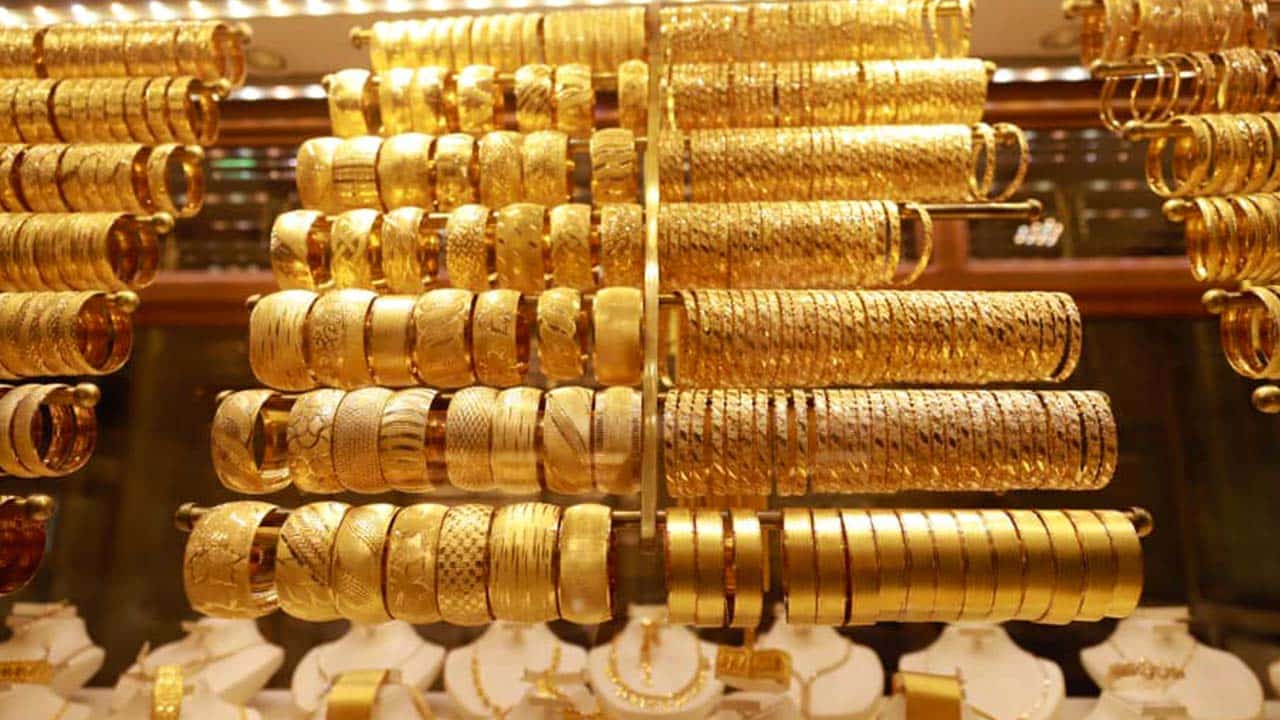
    The price of gold continued to increase in Pakistan on Monday, following the gains of last week. According to the All Pakistan Sarafa Gems and Jewellers Association, the rate of 24-carat gold rose by Rs2,000 per tola and Rs1,714 per 10 grammes, settling at Rs237,300 and Rs203,446, respectively.

    In the international market, the gold rate declined by $5, reaching $1,972 per ounce. Throughout last week, the rate of gold experienced fluctuations in both the domestic and international markets, amidst uncertainty surrounding the raising of the US debt limit.

    If the US debt limit, which is currently capped at $31.4 trillion, is not raised, it could trigger the first-ever US default.

    According to Geo, recent volatility in the domestic gold market can be attributed to various factors, including economic and political turmoil, high inflation, and currency depreciation. In such times, people tend to prefer buying yellow metal as a safe investment and a hedge.

    On May 10, the safe-haven bullion reached an all-time high of Rs240,000 per tola, driven by increased political uncertainty following the arrest of Imran Khan, the Chairman of Pakistan Tehreek-e-Insaf (PTI). However, it subsequently dropped in line with the decline in the international rate.

    Pakistan’s gold price peaks above global market levels

    The jewellers’ body also highlighted that local gold in Pakistan is currently overpriced by Rs5,000 per tola compared to the Dubai bullion market. Consequently, the Pakistani gold market is presently more expensive than the world market.

    Data shared by the association revealed a significant jump in the price of silver, with an increase of Rs50 per tola and Rs42.87 per 10 grammes, settling at Rs2,900 and Rs2,486.28, respectively.

  • ‘Jhoom’ has intrigued audiences with a fresh take on enemies-to-lovers story

    The highly anticipated drama ‘Jhoom’ hit television screens across the country last week with Zara Noor Abbas and Haroon Kadwani starring as male leads in the exhilarating ‘enemies to lovers story’ between an older woman and a young man.

    Maryam (played by Abbas) is a doctor who has dedicated her life to her younger brother’s upbringing, adopting a ‘take no crap’ attitude from men while working long shifts at the hospital. While Kadwani essays Arryan, a former car engineer who has anger issues that emerged after his mother left his family.

    The first few episodes have released on media platforms and fans are already in love with the chemistry between Abbas and Kadwani, applauding the makers of the show for choosing to tackle age gap marriages while deciding to make their female lead an older and financially independent woman.

    https://twitter.com/apkokiyubataun/status/1659969693330059265?s=20
    https://twitter.com/kansafatima9/status/1659698244119851008?s=20
    https://twitter.com/HourlySyrup/status/1658088975230291969?s=20

    Something Haute founder Aamna Isani called it ‘intriguing’:

    “Two episodes of Jhoom certainly have intrigued me. It’s fresh. And appears to be thought provoking beyond the obvious. #Jhoom.”

    Here’s to hoping that the drama keeps us captivated with a gorgeous story, and hopefully not go down the ‘Tere Bin’ route?

    Finger’s crossed.

  • Imran challenges judicial commission investigating audio leaks

    Pakistan Tehreek-e-Insaf (PTI) Chairman Imran Khan, has challenged the three-member judicial commission that has been established by the government to look into a spate of audio leaks involving senior judges and the judiciary.

    The former Prime Minister (PM) on Monday moved the Supreme Court of Pakistan against the formation of the judicial commission. The petition was submitted by Imran Khan’s attorney, Babar Awan.

    In his petition, the PTI leader has said that no judge could be nominated to the judicial commission without the Chief Justice of Pakistan’s approval.

    He further said that the proper forum for any probe or taking action against any judge was the Supreme Judicial Council.

    On Monday, the judicial commission decided to make its proceedings public.

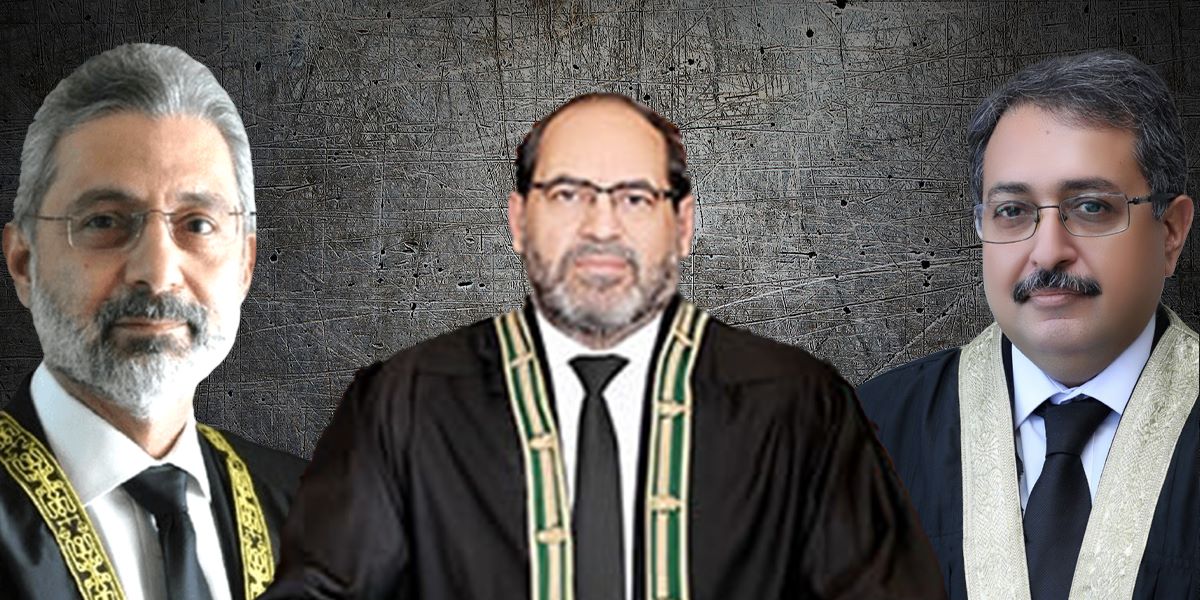
    Justice Qazi Faez Isa, Chief Justice of the Balochistan High Court Naeem Akhtar Afghan, and Chief Justice of the Islamabad High Court Aamer Farooq, are part of the commission.

    Attorney General Mansoor Usman Awan appeared in the first meeting of the commission.

    Justice Qazi inquired from the attorney general that under which law the government formed the commission.

    The Attorney General said that this commission was formed under the Commission of Inquiry Act 2016.

    The federal government on Satur­day notified the formation of the commission to probe audio clips leaked on social media over the previous months.

  • Audio leaks commission to make proceedings public

    Audio leaks commission to make proceedings public

    The three-member judicial commission that was established to look into the audio leaks involving judges and the judiciary has decide to make its proceedings public.

    Justice Qazi Faez Isa, Chief Justice of the Balochistan High Court, Naeem Akhtar Afghan, and Chief Justice of the Islamabad High Court, Aamer Farooq, are part of the commission.

    Attorney General Mansoor Usman Awan appeared in the first meeting of the commission.

    Justice Qazi inquired from the attorney general that under which law the government formed the commission.

    The Attorney General said that this commission was formed under the Commission of Inquiry Act 2016.

  • Pakistan is making desperate efforts to revive IMF programme before deadline

    Pakistan is making desperate efforts to revive IMF programme before deadline

    Pakistan is facing a critical situation as it seeks to revive its stalled Extended Fund Facility (EFF) programme with the International Monetary Fund (IMF). The $6.5 billion programme is set to expire on June 30, and negotiations for the ninth review, due last November, have not been successful.

    Efforts to reach a Staff Level Agreement (SLA) with the IMF have been ongoing, but disagreements persist regarding the conditions set by the Fund. The SLA must be signed before Pakistan unveils its 2023-24 budget on June 9, or the current programme will fail.

    According to The News, two options are being considered. The first involves signing the SLA immediately, requesting approval from the IMF Executive Board for the next $1 billion tranche, and extending the EFF programme for a few months to complete the 10th and 11th reviews. The second option is to combine the 9th and 10th reviews, share budgetary figures with the IMF, and sign the SLA after the budget announcement. If approved by parliament, the IMF’s Executive Board could then grant an extension for the completion of the 11th Review by July or August 2023.

    However, finding a solution is proving challenging. Maintaining the status quo will not lead to any breakthroughs, and consensus must be reached between Pakistan and the IMF. Political uncertainty, inadequate economic management, and the inability to secure sufficient external financing have hindered progress.

    Without an IMF programme, Pakistan’s options are limited. The risk of default would increase, and reserves would remain weak. Although there are options available, such as striking the SLA in the next few days or combining reviews, they are becoming increasingly difficult. Life without the IMF would require seeking financing from other sources at higher costs.

    It is crucial for Pakistan to resolve its differences with the IMF and secure the continuation of the EFF programme. Failure to do so would have severe consequences for economic stability and future financing prospects.

  • Imran Khan suspects he can be arrested on Tuesday

    Pakistan Tehreek-e-Insaf (PTI) Chairman Imran Khan has said that he might get arrested again when he appears before a court in Islamabad on Tuesday.

    “On Tuesday, I’m going to appear before court in Islamabad for various bails and there are 80% chances that I will be arrested,” Imran said that while speaking to Fareed Zakaria on CNN.

    “Everything is being done just to dismantle our democracy, so right now, as we speak, over 10,000 workers have been arrested. My entire senior leadership is in jail,” he added.

    Imran Khan further said that the government is taking such actions against him because they fear they would lose upcoming elections.

  • Miscreants who attacked army installations will face military court, says PM Shehbaz

    Miscreants who attacked army installations will face military court, says PM Shehbaz

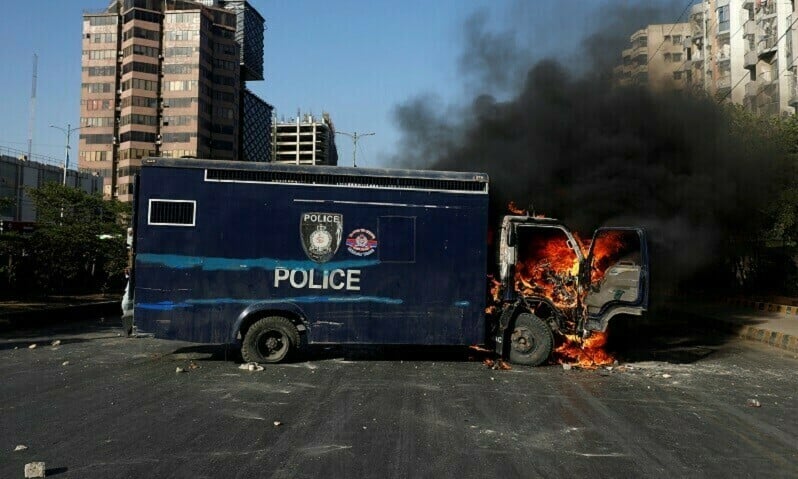
    Prime Minister (PM) Shehbaz Sharif has announced that miscreants involved in attacks on army installations and civil properties during the violent protests if May 9, will be tried in military courts and anti-terrorism courts (ATCs).

    Chairing a meeting on the law and order situation in Lahore on Sunday, PM Shehbaz said everyone who is involved in incidents of May 9 will be dealt with an iron hand.

    He added that the day will always be remembered as a “black day” in the history of Pakistan. He went on to say that the rioters “turned into enemies of the country” and carried out the attack on the GHQ.

    After Pakistan Tehreek-e-Insaf (PTI) Chairman Imran Khan’s arrest, his supporters came out on the streets and allegedly attacked army installations which included Corps Commander’s House (Jinnah House) in Lahore Cantt and the General Headquarters (GHQ) in Rawalpindi.