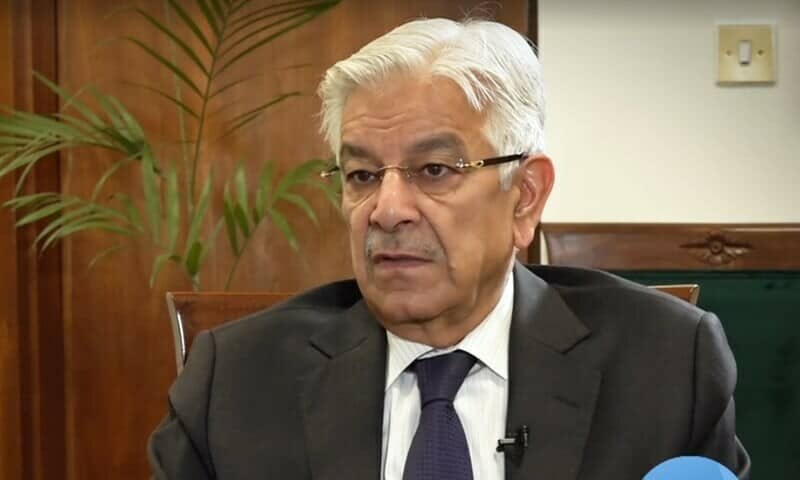
Defence Minister Khawaja Asif appeared on Geo News’ programme ‘Shahzeb Khanzada Kay Saath’ on Monday. During the programme, Asif said that the decision to try Pakistan Tehreek-e-Insaf (PTI) workers under the Pakistan Army Act was yet to be made.
While talking about charging the protesters, the minister said, “If not the Army Act, then should we try them under ‘hooliganism act’?”
“They will face the law for whatever they have done. No one will go scot-free, not even Imran Khan,” he added.
The minister also clarified that the government has no plans to ban PTI.
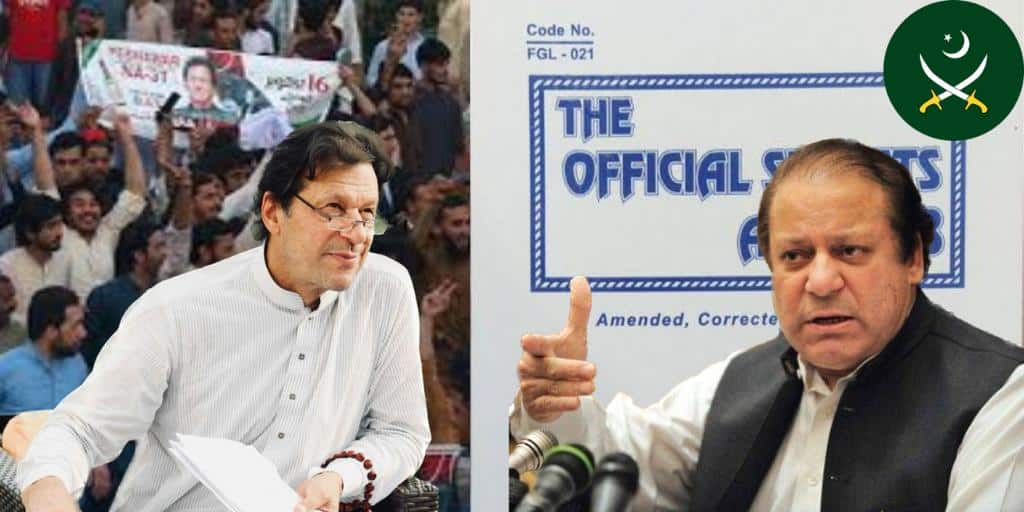
A Corps Commander Conference held in Rawalpindi on Monday, decided that the rioters who attacked military installations and buildings during the protests led by Pakistan Tehreek-e-Insaf (PTI) supporters, will be tried under the Army Act and Official Secret Act.
A Special Corps Commander Conference held at the General Headquarters (GHQ) and presided by Chief of Army Staff General Asim Munir has decided that the planners, instigators, abettors and perpetrators of the attacks on military installations and buildings during the protests led by Pakistan Tehreek-e-Insaf (PTI) supporters will be tried under relevant Pakistani laws, including the Army Act and Official Secret Act. The statement released by the ISPR after the Corps Commanders meeting is not just unprecedented but is being seen as a violation of human rights and fundamental freedoms.
In a statement, Aurat March Lahore said: “Use of military laws and courts to try civilians, the complete absence of due process, transparency and accountability flies in the face of the pretence of democracy under the current PDM regime… State institutions and monuments are not more important than people’s fundamental rights and lives. Respect must be earned through actions, not through the force of draconian laws.”
It must be noted that if convicted under the Army Act, a person can be sentenced to life imprisonment or be handed a death sentence. Pakistan is going through one of its worst crises ever with the entire system tethering on the brink of collapse. From the military establishment to the judicial establishment, all institutions have lost their credibility. It is high time that political parties and parliament take charge of the situation and make sure that the law is followed instead of going down the path of military trials which offer no transparency.
A word of caution: if the PDM government go down this path and allows civilian rioters to be tried under military laws, the same will one day be applied to their leadership, their supporters and workers. We have seen history repeat itself too many times to not learn a lesson. Democracy is not about punishing your opponents; it is about ensuring that no one is targeted unjustly for their political views. Rioters, when identified, should be prosecuted as per the law of the land in courts, not military courts. If PTI justified arbitrary arrests, detentions and draconian punishments, PDM should refrain from doing so. Politics isn’t about personal enmity.
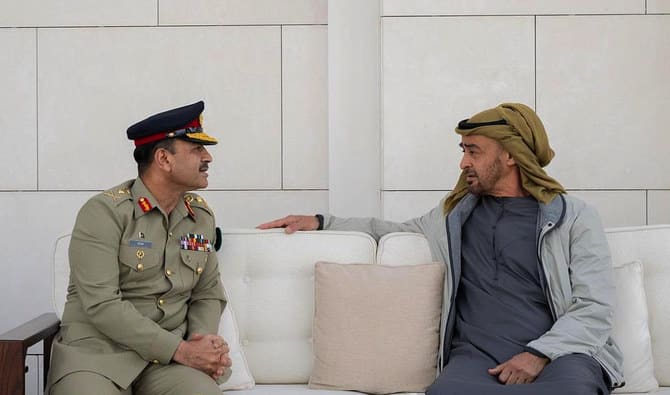
United Arab Emirates (UAE) President Mohammed bin Zayed Al Nahyan has telephoned Chief of Army Staff (COAS) General Asim Munir.
According to media reports, bilateral defense and military relations were discussed, with both emphasising the need to further promote mutual defense and military cooperation.
The conversation has taken place while the country is gripped in political chaos. Recently, after Pakistan Tehreek-e-Insaf (PTI) Chairman Imran Khan’s arrest, his supporters attacked military installations.
Khan has also openly named COAS Munir for his arrest and accused him of spreading anarchy just to save his seat.
The International Monetary Fund (IMF) has denied recent reports that it is seeking fresh financing from Pakistan, stating that Pakistan’s external financing requirements have remained unchanged throughout talks with the Fund.
The clarification comes after a report by the Express Tribune suggested that the IMF had increased its demand for additional financing to $8 billion, up from an unmet condition of $6 billion, in order to ensure debt repayments for the May-December 2023 period.
According to Reuters, IMF Resident Representative Esther Pérez Ruiz confirmed that the country’s external funding requirements had not changed, and that discussions were centered around a review to unlock $1.1 billion in financing as part of a $6.5 billion IMF package.
Despite ongoing talks, a staff-level agreement on the review has been delayed since November, and the IMF has reiterated that commitments on external financing from friendly countries will be necessary before it can release bailout funds.
Pakistan’s central bank reserves currently stand at $4.38 billion, equivalent to barely a month’s worth of imports.
The government is expected to present an overall budget deficit of 5.1 per cent of the GDP for the fiscal year 2023-24, as stated in the delayed Budget Strategy Paper (BSP) to be presented before the federal cabinet. A recent report by The News highlighted that the paper will be tabled amid the government’s failure to revive the stalled International Monetary Fund (IMF) programme.
The budget-making process has already been affected by uncertainty on both the IMF and political fronts. Nonetheless, the government has decided to present the next budget on June 9. Despite failing to reach a staff-level agreement with the IMF, the government will present the BSP for a medium-term period of three years. The proposed federal government budget deficit stands at 6.4 per cent of the GDP, while the overall deficit of the country is estimated to be lowered to 5.1 per cent of the GDP for the next financial year.
In addition, the BSP for the upcoming fiscal year has proposed an allocation of Rs1.7 trillion for the defence budget compared to Rs1.56 trillion in the outgoing fiscal year. The overall primary surplus of budget deficit is estimated to be 0.3 per cent of the GDP for the next fiscal year, up from the previous projection of 0.2 per cent for the outgoing year.
The Federal Board of Revenue (FBR) has been set a target of Rs9.2 trillion for the next budget, and the finance ministry suggests this is on the higher side. The FBR estimates that it could collect Rs7.2 trillion in the outgoing fiscal year against the targeted Rs7.64 trillion. In the next budget, the FBR could collect up to Rs8.6 trillion, subject to import restrictions being lifted, which could boost revenue collection. The government is projecting a GDP growth rate of 3.4 per cent for the next fiscal year, while inflation is expected to hover around 21 per cent.
According to the IMF’s latest press briefing, the country may experience stagflation, which means low growth and higher inflation rates. If stagflation continues, it could lead to rising poverty and unemployment in Pakistan. The current account deficit is estimated to be approximately $8 billion for the next budget, and there is hope that import restrictions will be gradually lifted during the next financial year.
The BSP has to be approved by the federal government under the Public Finance Management Act, which states that the paper must contain quantified macroeconomic and fiscal projections for the medium-term, be approved by April 15 of each year, and published on the Finance Division’s official website. Upon approval, the Finance Division will issue indicative budget ceilings to ministries and divisions.
The minister for finance will also discuss the budget strategy paper with the Standing Committees for Finance and Revenue in the Senate and the National Assembly. The government may extend the deadline mentioned in Sub-section (1) of the PFM Act in case of an extreme requirement.
More than 60 domestic and international flights from various airlines have been cancelled due to the unstable situation in Pakistan, with many other flights being uncertain about their arrival and departure.
The cancellations have affected flights to major cities such as Karachi, Lahore, and Islamabad, where the number of passengers has decreased.
According to the airport schedule, more than 60 domestic and foreign flights from various airlines have been cancelled, including flights from Karachi to Jeddah, Madinah, Muscat, Dubai, Riyadh, Baghdad, and Baku. The arrival and departure schedule of Karachi Airport provides a comprehensive list of the affected flights, including those cancelled between Karachi and Islamabad, Lahore, Turbat, and Peshawar.
To ensure that their travel plans are not disrupted, passengers are advised to check with their airlines for the latest updates on flight status.
According to Minute Mirror, the following flights have been canceled according to the arrival and departure schedule of Karachi Airport:
Karachi to Jeddah: ER 811 and ER 812
Karachi to Medina: PK 743
Salam Air flight to Muscat: OV 292
Emirates Air flights to Dubai: EK 605 and 604, EK 609 and 608
Karachi to Muscat: WY 323 and 324
Karachi to Riyadh: PK 729
Flight to Baghdad: IF 331 and IF 332
PIA flight from Baku to Karachi: K 154
The following flights have been canceled between Karachi and Islamabad:
PK369
PF121
PF122
9P670
9P871
PA200
PF127
ER502
The following flights have been canceled between Lahore and Islamabad:
PK302
PK303
9P840
9P841
PF141
ER520
PA406
PK306
PF147
The following flights have been canceled between Karachi and Turbat:
PK501
The following flights have been canceled between Karachi and Peshawar:
If you’re looking to apply for studying abroad without any agent fees, follow these steps:
Steps to follow for studying abroad
Research:
Start by researching different universities and courses in the country you want to study in. Look for universities that offer scholarships or have affordable tuition fees for international students.
Choose a University:
Select a few universities that align with your academic goals and preferences. Consider factors like program quality, reputation, location, cost of living, and scholarship opportunities.
Check University Websites:
Visit the official websites of the selected universities and explore their admission sections. Look for information about the application process, required documents, deadlines, and any specific requirements for international students.
Fulfill Admission Requirements:
Ensure that you meet the admission requirements for your chosen university and program. This may include submitting academic transcripts, standardized test scores (such as the SAT or TOEFL), letters of recommendation, and a statement of purpose.
Apply Online:
Most universities provide an online application system. Create an account on the university’s admission portal and fill out the application form. Provide accurate and detailed information about your academic background, personal details, and any other required information.
Write a Statement of Purpose:
Draft a compelling statement of purpose (SOP) that explains your motivation for studying abroad, your academic and career goals, and how the chosen program aligns with them. Highlight your strengths and unique qualities that make you a suitable candidate.
Obtain Recommendation Letters:
Reach out to your professors, mentors, or employers who can write strong recommendation letters for you. Provide them with the necessary information about the university, program, and your achievements, so they can write personalized letters highlighting your skills and abilities.
Financial Planning:
Research scholarships, grants, or financial aid options available for international students. Many universities and external organizations offer scholarships based on merit, need, or specific criteria. Additionally, consider your personal finances and develop a plan to cover your tuition fees, living expenses, and any other costs.
Submit Application and Documents:
Complete the online application form and upload all required documents, including your academic transcripts, test scores, SOP, and recommendation letters. Ensure that all documents are properly attested or certified, if required.
Pay Application Fees:
Some universities charge an application fee. Check the payment methods accepted by the university and submit the application fee online.
Track Application Status:
After submitting your application, keep track of its status through the university’s admission portal or online system. Check for any additional documents or steps required.
Visa Application:
Once you receive an acceptance letter from a university, you’ll need to apply for a student visa. Research the visa requirements of the country you’ll be studying in and gather all the necessary documents, such as proof of admission, financial statements, and a valid passport.
Prepare for Interviews (if required):
Some universities may require an interview as part of the application process. Prepare for interviews by researching common interview questions and practicing your responses.
Follow Up:
Maintain regular communication with the university’s admission office to ensure that your application is complete and to address any inquiries or additional requirements.
Remember, while you can apply directly to universities, it’s always a good idea to seek guidance from educational consultants or study abroad forums to gather insights and advice from students who have gone through the application process.
The Asia Internet Coalition (AIC), an industry association of major internet and technology companies, has released a statement urging the Pakistani government to consider the serious consequences of their recent actions on the people and economy of the country.
The AIC has called for the immediate restoration of internet access in Pakistan. Jeff Paine, the Managing Director of the AIC, has expressed concern that the government’s actions will damage the country’s reputation as an investment destination, and has urged the government to focus on the opportunities presented by the digital economy to promote overall economic growth.
More than one hundred prominent members of the Pakistani business community, tech entrepreneurs, and civil society have condemned the government’s use of partial and complete internet shutdowns, as well as targeted content and app blocking.
These actions have been taken in response to recent nationwide protests. Tens of millions of Pakistanis rely on internet-dependent services for essential business activities, and by blocking or shutting down these services, the government is limiting civic space, creating economic uncertainty, and disrupting access to healthcare, emergency services, and financial services.
The government’s decision to shut down mobile internet services across the country has resulted in significant revenue losses for mobile phone companies and online taxi and bike services. This decision was made in response to the arrest of former Prime Minister Imran Khan, which led to nationwide protests.
As a result of the internet shutdown, online taxi and bike services have been unavailable for the past two days, causing inconvenience to commuters who depend on these services for transportation.
According to sources in the Pakistan Telecommunication Authority, there are no plans to restore internet access in the country today.
Pakistan has informed the International Monetary Fund (IMF) that it will not be implementing a fuel subsidy programme during ongoing negotiations for a $1.1 billion bailout for the country.
The IMF has stated that it will continue to engage with the government on the loan, despite increasing political tensions.
Prime Minister had previously proposed a fuel subsidy scheme in March, which would charge higher rates to affluent consumers to subsidise prices for the poor who have been hit hard by inflation.
However, the government has now committed not to implement this programme in the current fiscal year or beyond. Instead, it will not introduce new tax exemptions and will allow a market-based exchange rate for the rupee currency.
The IMF has said that Pakistan needs significant additional financing to complete the long-delayed ninth review of its bailout package.
Obtaining commitments of significant additional financing is essential before the IMF approves the release of pending bailout funds that are crucial for Pakistan to resolve an acute balance of payments crisis.
According to Dawn, the State Bank of Pakistan’s reserves fell to $4.38 billon on Thursday, which is barely a month’s worth of imports. The IMF has emphasised that Pakistan faces stagflation, large financing needs, and has been affected by several shocks, including severe floods.