Tag: Pakistan

  • Pakistan blamed for spread of coronavirus to Muslim World

    Pakistan blamed for spread of coronavirus to Muslim World

    The first two cases of the new coronavirus in the Gaza Strip — a war-shattered Palestinian territory with a fragile health system — were confirmed in men who attended a mass religious gathering 10 days ago in Pakistan, United States’ (US) National Public Radio (NPR) has quoted an Islamabad-based Palestinian diplomat as saying.

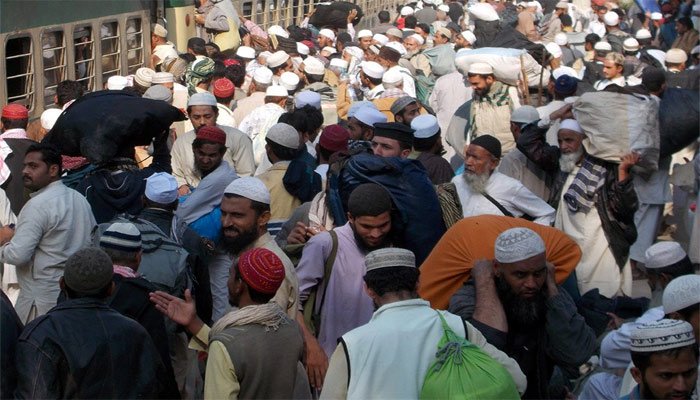
    The diplomat said the men were part of a two-day gathering that ended March 12. The gathering of the Tablighi Jamaata global Muslim missionary group, brought together tens of thousands of preachers from some 80 countries and raised concerns about the virus’ spread in Pakistan and beyond.

    The Pakistani authorities had urged for the cancellation of the five-day Tablighi Ijtema congregation hosted annually near Lahore but organisers from the movement had ignored government advice to postpone, The News reported.

    A longtime Pakistani Tablighi Jamaat member, Arif Rana, said the gathering was canceled on March 12 because of rain — attendees sleep in the open. But Azhar Mashwani, focal person to the Punjab chief minister (CM) on digital media, said that it ended because of coronavirus fears.

    Most attendees were Pakistani, but at least a few thousand came from other countries, Rana told NPR.

    Omar al-Tabatibi said his 79-year-old grandfather, Mohammed, and friend Amer Doghmosh had attended the Lahore event.

    Previous statements from health officials had misidentified the men as being between 30 and 40. “My grandfather learnt about the conference by chance from a friend while he was in Pakistan so he wanted to attend,” Tabatibi said.

    After returning from Pakistan, his grandfather stayed several days in Egypt before taking the long journey overland to Gaza, Tabatibi said. “Maybe, my grandfather caught corona in Egypt and not Pakistan, no one knows,” he added.

    Five preachers from Kyrgyzstan stayed in a mosque in Islamabad after attending the Tablighi Jamaat gathering and have also tested positive, said a senior health official who did not want to be named because he was not authorised to speak to the press.

    On Twitter, Muhammad Hamza Shafqaat, the deputy commissioner of Islamabad, accused the Kyrgyz group of “criminal carelessness” because “they knew that one of them had symptoms and they kept on roaming around”.

    Concerns have also been raised in Southeast Asia about infection after a Tablighi Jamaat gathering outside Kuala Lumpur, Malaysia, in late February and early March. Malaysian media reported that more than half of the country’s known coronavirus cases were traced to the gathering. Preachers who attended also spread the virus to Brunei and Thailand, The New York Times reported, saying the gathering created “the largest known viral vector in Southeast Asia”.

  • Coronavirus: PM Imran walks out of high-level meeting ‘paid for by Bilawal’

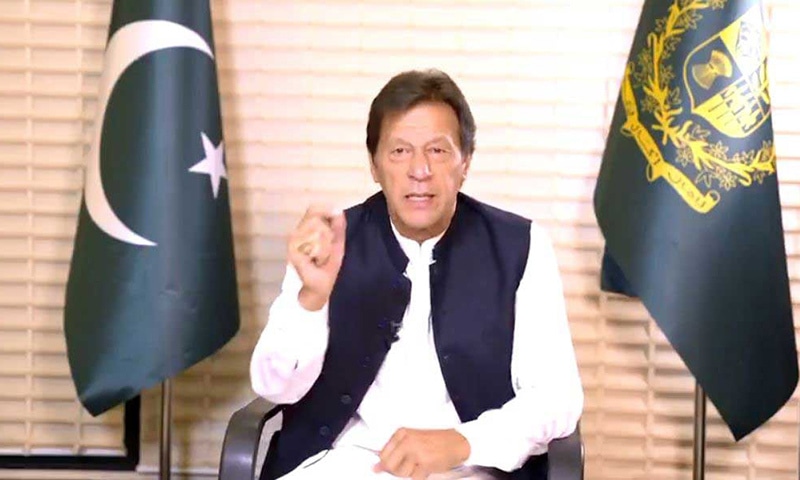
    In what is being termed as his “non-serious attitude towards a health crisis”, Prime Minister (PM) Imran Khan on Wednesday walked out after addressing parliamentary leaders on the coronavirus outbreak via video link that, according to sources, was paid for by Pakistan People’s Party (PPP) chief Bilawal Bhutto-Zardari.

    “The link… the subscription of the software is owned by the PPP and was shared with the government for the emergency moot as it only had Skype and couldn’t manage,” sources informed The Current.

    Earlier, the premier said he wanted all political parties to unite on one forum and fight against COVID-19. “All political parties and provinces will be included in the victory against corona[virus],” he reportedly said in his address at the parliamentary leaders’ conference that he later left midway, drawing a strong reaction from opposition leaders.

    Leader of the Opposition in the National Assembly and Pakistan Muslim League-Nawaz (PML-N) President Shehbaz Sharif also left the meeting in protest over the “carefree attitude” of PM Imran while the country suffered because of what Shehbaz said was the worst health crisis in its history.

    With the PPP chief following suit, Shehbaz tweeted:

    Meanwhile, party sources informed The Current that Bilawal will soon be addressing a press conference over the events that marred Wednesday’s high-level meeting between national leaders.

  • Think the bridal masks were just a meme? Think again

    Think the bridal masks were just a meme? Think again

    The coronavirus outbreak has drastically changed our lives and has put a halt to our social activities including our favourite past time: weddings.

    The spread of the virus has postponed or even cancelled many events. But amid all this, some programs have remained unchanged and a few people found a unique way to market their products. We have seen bridal masks memes on social media but who would have thought that this would go this far that some people will actually start making and selling them.

    These masks have zarri and dabka work on them and are being sold for two to three thousand rupees. We are truly living in strange times.

    https://twitter.com/SaharHGhazi/status/1241355421354463232?s=20

  • VIDEO: Azaan against coronavirus echoes from mosques, rooftops across country

    VIDEO: Azaan against coronavirus echoes from mosques, rooftops across country

    In a rather uncommon occurrence, Azaan [call for prayer] on Tuesday echoed across Pakistan at 10 pm — long after Isha prayers — as the nation prayed for mercy to protect them from coronavirus, SAMAA reported.

    Maulana Bashir Farooqui, the chairperson of the Saylani Welfare Trust, and other religious scholars had urged prayer leaders to do so.

    The muezzins and the people complied with Maulana Farooqui’s instructions and as a result, the call for prayer was heard across the country at 10 pm. Other than mosques, Farooqui had also asked people to do the same from the rooftops of their residences.

    According to Maulana Farooqui, Prophet Muhammad (PBUH) used to recite the Azaan at the time of difficulties.

    By the time this report was filed, Pakistan had reported 990 known cases of the new coronavirus. The virus has claimed more than 18,000 lives worldwide, while Pakistan has reported seven deaths since February 26, when the first case was reported in the country.

  • Cleaner hands, bluer skies: what has coronavirus done for us?

    Deaths, economic meltdown and a planet on lockdown: the coronavirus pandemic has brought us waves of bad news, but squint and you might just see a few bright spots, AFP reported.

    From better hygiene that has reduced other infectious diseases to people reaching out as they self-isolate, here are some slivers of silver linings during a bleak moment.

    WASH YOUR HANDS!

    The message from health professionals has been clear from the start of the outbreak: wash your hands.

    Everyone from celebrities to politicians has had a go at demonstrating correct technique — including singing “Happy Birthday” twice through to make sure you scrub long enough, and hand sanitiser has flown off the shelves.

    All that extra hygiene appears to be paying off, at least in some countries, including Japan, where the number of flu cases appears to be sharply down.

    Japan recorded 7.21 million cases by early March — usually around the peak of the flu season that runs until May.

    That was far below figures for previous years, including the 21.04 million infections seen during the 2017/18 season.

    “We estimate that one of the reasons behind it is that people are now much more aware of the need to wash hands… given the spread of the new coronavirus,” Japanese health ministry official Daisha Inoue told AFP.

    CARBON CURBS

    Factory shutdowns, travel bans and a squeeze on demand spell economic disaster, but it isn’t all bad news for the environment.

    In the four weeks to March 1, China’s CO2 emissions fell 200 million tonnes, or 25 percent, compared to the same period last year, according to the Centre for Research on Energy and Clean Air.

    That’s a decline equivalent to annual CO2 emissions from Argentina, Egypt or Vietnam.

    The slowdown in China also saw coal consumption at power plants there down 36 percent, and the use of oil at refineries drop by nearly as much.

    Air travel is also grinding to a virtual halt, achieving at least a short-term drop-off in emissions from a highly polluting industry.

    And there have been other environmental benefits, including crystal-clear waters in Venice canals usually choked with tourist-laden boats.

    Unfortunately, experts say the cleaner air may be short-lived.

    Once the health crisis is over, experts expect countries will double down to try to make up for lost time, with climate change concerns likely to be sidelined in a race to recover economic growth.

    SAVE THE PANGOLIANS

    The source of the coronavirus remains in question, but early tracking focused on a market in China’s Wuhan where a variety of live wildlife was on sale for consumption.

    A number of animals, including bats and the highly endangered pangolin, have been identified as possible culprits for the virus.

    As a result, China in February declared an immediate and “comprehensive” ban on the trade and consumption of wild animals that was welcomed by environmentalists.

    Beijing implemented similar measures following the SARS outbreak in the early 2000s, but the trade and consumption of wild animals, including bats and snakes, made a comeback.

    This time the ban is permanent, raising hopes that it could end the local trade in wildlife.

    “I do think the government has seen the toll it takes on national economy and society is much bigger than the benefit that wild-eating business brings,” said Jeff He, China director at the International Fund for Animal Welfare.

    Reports linking the virus to the pangolin have also scared off would-be consumers of the scaly mammals elsewhere, with bushmeat vendors in Gabon reporting a plunge in sales.

    APART, TOGETHER

    One of the most difficult aspects of the stringent lockdowns imposed to slow the spread of the virus has been loneliness, with families and friends forced to endure weeks or even months apart.

    But some people have found the measures are creating a sense of community spirit and prompting them to make more of an effort to check in with family and reconnect with friends.

    In Colombia, where a nearly three-week period of self-isolation is now in place, 43-year-old Andrea Uribe has organised everything from group exercise classes to family talent shows using video messaging programs including Zoom.

    “I have called my parents more often, I have talked to friends that I usually don’t talk to… I have organised Zoom meetings with friends in multiple countries,” Uribe, who works in development, told AFP.

    “It is wonderful to be forced to be there for one another. It has made me more creative. It just shows that we need to be present in people’s lives.”

  • Coronavirus: Info Ministry shares fake news about Chinese help, then deletes tweet

    Coronavirus: Info Ministry shares fake news about Chinese help, then deletes tweet

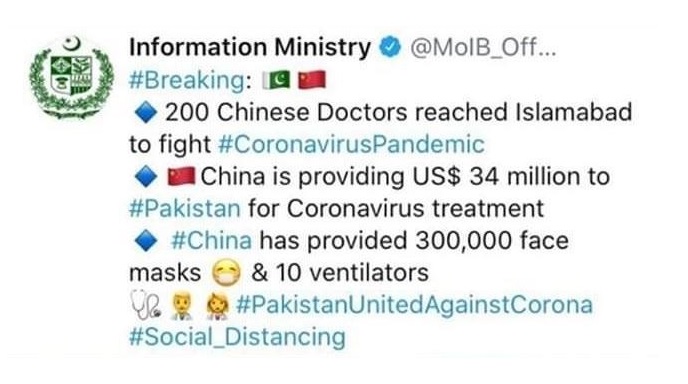
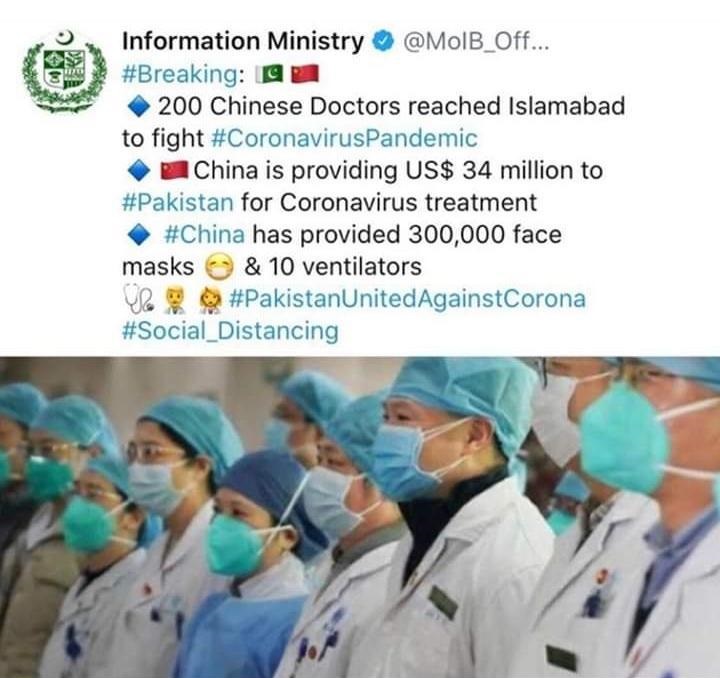
    In a rather embarrassing development for the government, the Information Ministry has shared fake claims regarding Chinese help for Pakistan amid the outbreak of the new coronavirus — COVID-19 — and later deleted its tweet.

    As per the details, the Information Ministry, which is responsible to release government information to the public and international communities, on Sunday in a now-deleted tweet claimed that 200 Chinese doctors had reached Islamabad to help the country fight the coronavirus pandemic.

    It also said that China was providing Pakistan with $34 million for treatment of the infected.

    The same was tweeted by Radio Pakistan as well.

    Since the the national public broadcaster for radio also deleted its tweet, an archived version of it can be viewed here.

    Speaking to The Current, an official, on the condition of anonymity, confirmed not only that the two claims were fake, but also that the tweets had been deleted after it was pointed out.

    They, however, said that China had given Pakistan $4 million in aid and the claim pertaining to the provision of 300,000 medical face masks besides 10 ventilators was also true.

    This was confirmed by Economic Affairs Minister Hammad Azhar as well.

    Taking to Twitter, he wrote:

    “They have also undertaken to arrange for much greater number of ventilators,” the minister added.

  • VIDEO: Minister Saeed Ghani tests positive for coronavirus

    VIDEO: Minister Saeed Ghani tests positive for coronavirus

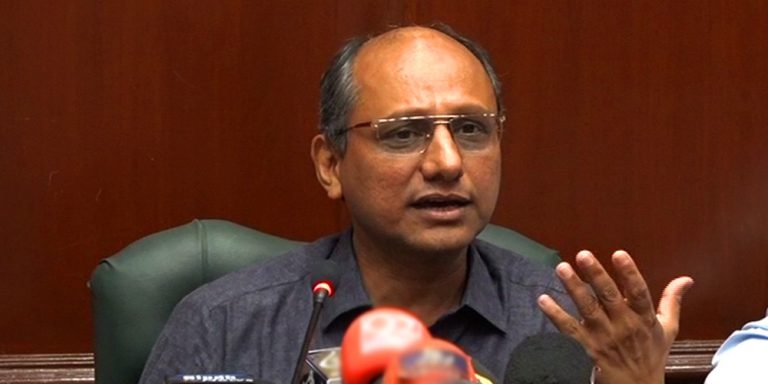
    Sindh Education Minister Saeed Ghani tested positive for coronavirus on Monday. 

    The minister tweeted a video message to reveal that he had tested positive for the virus.

    “The previous day I got myself tested for the coronavirus and the results came back positive,” he said. “However, I am not feeling any of the symptoms of the virus and feel completely fine.”

    In the video message, Ghani went on to advise people he came into contact with a few days ago to isolate themselves and go into quarantine. 

    “If your health deteriorates further, please get yourselves checked by a doctor,” he said. “I consider it my responsibility to inform people so that those who came into contact with me can also quarantine and self-isolate themselves as I may have transmitted the infection to them.”

  • Pakistan is the happiest country in South Asia, 66th in the world

    Pakistan is the happiest country in South Asia, 66th in the world

    The United Nations (UN) on World Happiness Day (March 20) released its World Happiness Report which ranked 156 nations according to how happy their citizens are. The report placed Pakistan on the 66th position making it the happiest country in South Asia. Pakistan was previously at the 67th position and has improved its ranking in the recent report. Meanwhile, India has slipped from the 140th to the 144th position, making it one of the most unhappy nations in the world.

    The happiest nation in the world is Finland, who is receiving the honour for the third consecutive year. At number two and three is Denmark and Switzerland followed by Iceland at number four and Norway at number 5.

    Countries are ranked on six key variables that support well-being including income, freedom, trust, healthy life expectancy, social support and generosity.

    One of the authors of the report John Helliwell in a statement said, “The happiest countries are those ‘where people feel a sense of belonging’, where they trust and enjoy each other and their shared institutions. There is also more resilience, because shared trust reduces the burden of hardships, and thereby lessens the inequality of well-being.”

    However, the impact of the lockdowns imposed by several countries due to the impact of the coronavirus outbreak has not been taken into account. Much of the data was collected in the years 2018 and 2019. The author of the report predicts that the lockdown conditions imposed on residents could, paradoxically, boost happiness in future.

    In a first, the report also compared happiness and well-being in different cities. While Helsinki in Finland topped the list, Karachi was declared the happiest city of Pakistani and South Asia at number 117 followed by Lahore on the 122nd spot. The happiest cities in the world include Aarhus, Denmark (2), Wellington, New Zealand (3), Zurich, Switzerland (4), Copenhagen, Denmark (5) and Bergen, Norway (6).

    On the other hand, Kabul is the least happy city followed by Sanaa in Yemen and Palestine’s Gaza.

  • Are you kidding us, Khan Sahib?

    Are you kidding us, Khan Sahib?

    Coronavirus pandemic has changed the dynamics of the entire world. Self-isolation, a concept most of us are not familiar with, will slowly but surely become necessary in the coming days. As Canadian Prime Minister (PM) Justin Trudeau said, “For a little while, this will be our new normal.”

    But while Trudeau and very few other world leaders, including New Zealand’s Jacinda Ardern, declare war on the pandemic, others, among whom is PM Imran Khan, still don’t appear to be understanding the gravity of the situation at hand.

    Four coronavirus patients have died in Pakistan — three in Khyber Pakhtunkhwa (KP) and one in Sindh. The number of cases is rapidly increasing (645 in less than a month), and if a nationwide lockdown isn’t put in place, it will continue to rise exponentially.

    After sticking to his mantra of ‘ghabrana nahi hai [don’t panic]’ for the past few days, the premier does no longer seem very sure if the masses should panic or not.

    “Pakistan cannot afford to impose a total lockdown. 25% of the people in the country live below the poverty line,” PM Imran said in his second address to the nation in three days on Sunday. “What will happen to them if I go ahead with the lockdown?”

    The premier added that if the economic situation of the country had been like that of Italy and China, he would have thought about imposing a lockdown. “Let me tell you what a lockdown is. A lockdown means putting a curfew and restricting people to their homes with the military on the streets,” he said.

    The situation escalated in Italy and China, Khan Sahib, evidently because the authorities didn’t impose a lockdown until it was too late.

    Your address to the nation and recent interaction with journalists were not exactly what we had hoped for. We understand you are worried about the poor, the daily wagers, the economy and many other things.

    But…

    After shutting down as much as the provincial governments already have, after the closure of educational institutions and the bearish trend in PSX amid global sell-out on COVID-19 fears, what further closures would a total lockdown entail?

    All international air operations are already closed. Most borders are closed. Wedding halls, shopping malls, restaurants are already shut. Massive unemployment has already been created. Moving towards total lockdown at this stage will presumably have a very little marginal impact.

    Is it paralysis of analysis which appears to be the hallmark of decision-making behind closed doors in Islamabad for quite some time now?

    In case of a total lockdown, what matters the most is taking care of the neglected segments of society – that they keep on receiving life support cash allowances or food aid. For starters, 50% of the budget of both civil and defence annual development programmes should be placed in a welfare account for such activities.

    Welfare… isn’t that what you promised, Khan Sahib?

    We know that a lockdown or delaying a lockdown is akin to be caught between a rock and a hard place. We understand that this is an immensely difficult and unforeseen situation but the government must act fast.

    Let’s learn from the mistakes made by countries that are the worst-hit by the new coronavirus, and try not to repeat them. 

    Lockdown does not mean that coronavirus cases will end, but it will definitely flatten the curve. This is what Pakistan needs to do. Our healthcare facilities are not equipped to deal with the impending crisis.

  • VIDEO: President wants a ‘volunteer force’ to fight coronavirus in Pakistan

    VIDEO: President wants a ‘volunteer force’ to fight coronavirus in Pakistan

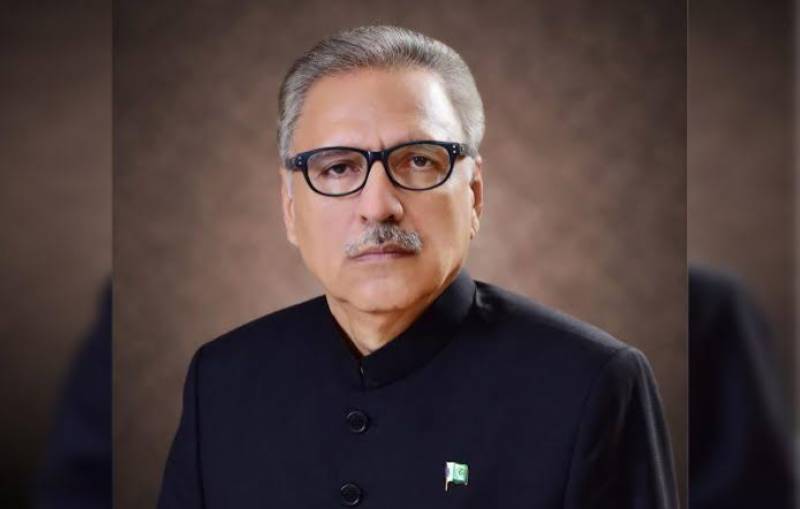
    Urging the nation to show unity in the persisting difficult time, President Dr Arif Alvi has stressed the need to form a China-like volunteer force in Pakistan to fight the new coronavirus.

    President Alvi, in a video message, said China has fought the coronavirus pandemic on the national-level and formed a force of volunteers which was also needed in Pakistan.

    He said that people must unite to face the challenge instead of panicking, and asked clerics to raise awareness regarding COVID-19. The president also asked media houses to play their role in spreading awareness so that people adopt prevention measures.

    WATCH VIDEO:

    The president said that China was facing isolation and extreme criticism from the West over the spread of coronavirus, but, he added, the Chinese leadership has appreciated Pakistan for exhibiting full confidence in Beijing and not bringing back students.

    He admitted that the Pakistani students, who had shown concerns over not being repatriated from China, studying in 15 different universities in the virus-hit country had also now changed their opinion after being looked after by Chinese authorities in a better way.

    “I have thanked Chinese President Xi Jinping over taking good care of them [Pakistani students in Wuhan/Hubei].”

    He also said the Chinese exhibited great resilience and unity against COVID-19 pandemic and Pakistan should learn from their experience to combat the disease.

    The president added that during his trip to the erstwhile epicentre of the virus, he held hours-long discussions with the Chinese leadership over effective measures adopted by Beijing to contain COVID-19.