Tag: PSX

  • Pakistan Stock Exchange gains over 2,300 points on revived investor confidence after signing IMF agreement

    Pakistan Stock Exchange gains over 2,300 points on revived investor confidence after signing IMF agreement

    The Pakistan Stock Exchange (PSX) experienced a substantial increase of over 2,300 points on Monday, fueled by renewed investor confidence after the signing of a staff-level agreement between Pakistan and the International Monetary Fund (IMF) on Friday.

    At 12:00 pm, the benchmark KSE-100 index of the Pakistan Stock Exchange surged by 2,381 points, currently trading at 43,833 points.

    Market experts attribute this bullish trend in the PSX to the revival of the loan programme with the international lender.

    Last week, Pakistan officially signed a staff-level agreement worth $3 billion with the International Monetary Fund (IMF). The signing ceremony took place in Lahore and was attended by Prime Minister Shehbaz Sharif, Finance Minister Ishaq Dar, and Information Minister Marriyum Aurangzeb.

    The International Monetary Fund (IMF) announced the successful completion of a “Stand-By Arrangement” between the global financial institution and Pakistan.

    The staff-level agreement, valued at $3 billion for a duration of 9 months, was reached through virtual negotiations conducted by IMF Mission Chief Nathan Porter and his team, who maintained continuous communication with Pakistani authorities.

    The final approval of this agreement will be granted by the IMF’s executive board, expected to occur in mid-July. Once approved, Pakistan will be eligible to receive the $3 billion loan.
  • Pakistani rupee witnesses biggest single-day decline against dollar in more than two decades

    Pakistani rupee witnesses biggest single-day decline against dollar in more than two decades

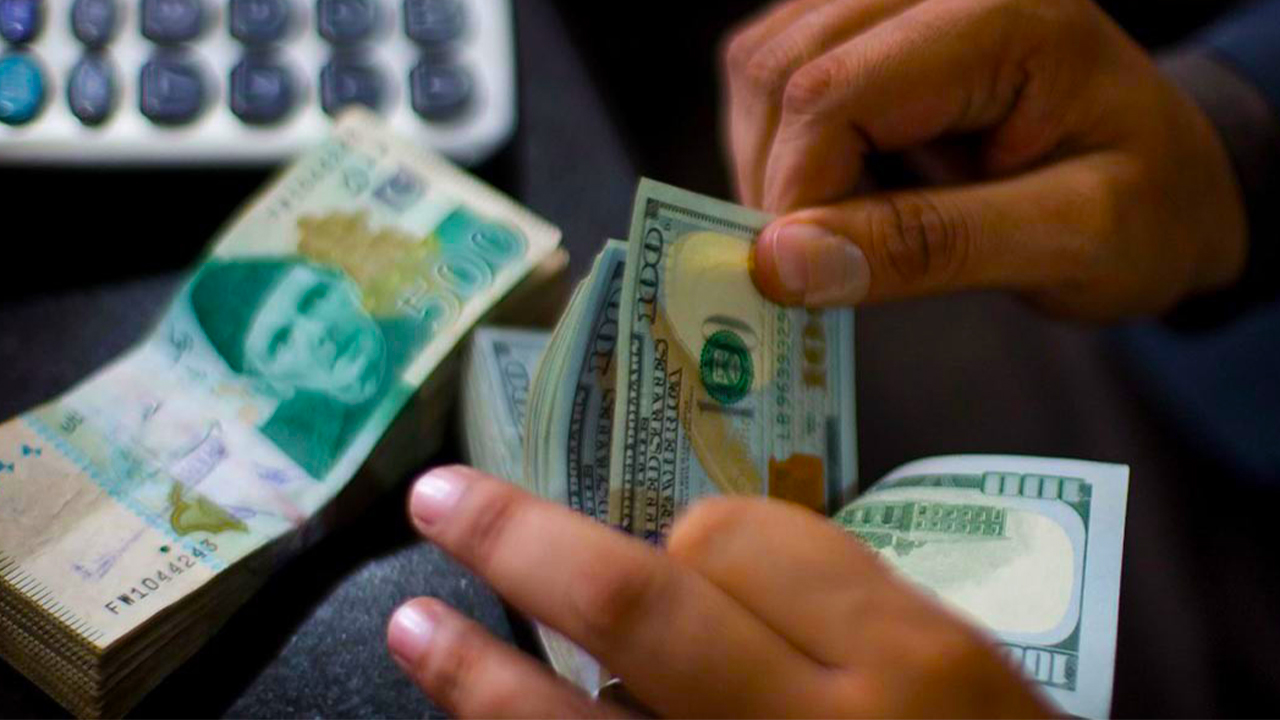
    Pakistani rupee dropped significantly against the US dollar in the interbank market on Thursday, as it fell more than 9 per cent during the intraday trade. Around 1:30 PM, the dollar’s intraday quote was Rs254.75, which represents a depreciation of Rs23.86.

    According to Ismail Iqbal Securities, “This is the largest single-day decline in both absolute and percentage terms, at least since 2000.”

    Earlier in the day the local unit was trading under Rs231.

    Experts predicted that as Pakistan attempted to meet the International Monetary Fund’s (IMF) requirements to renew its bailout programme, the local currency would depreciate significantly in the coming days.

    While speaking to Brecorder, the Head of Research at Ismail Iqbal Securities Limited, Fahad Rauf, said it seems like the rupee has been let go today.

    “This is a market-driven rate,” Rauf said. “This is a sign that we are moving closer to reviving the stalled IMF programme.”

    The market expert said the development was much-needed, as capping the interbank rate only led to the creation of the grey market. He said that the development will improve the greenback supply to a significant extent.

    On Wednesday, the rupee registered a loss for the 26th successive session against the dollar to settle at Rs230.89, a decrease of Re0.49 or 0.21 per cent.

    Pakistani rupee on Thursday fell 9.61 per cent or Rs24.54 to a shocking all-time low of Rs255.43, according to the State Bank of Pakistan (SBP).

  • Pakistan stocks lose more than 1,400 points due to political uncertainty

    Pakistan stocks lose more than 1,400 points due to political uncertainty

    Political unrest caused significant selling pressure on the Pakistan Stock Exchange (PSX), which saw the benchmark KSE-100 Index lose more than 1,400 points on Tuesday during trading.

    The KSE-100 Index was down 1,432.25 points, or 3.5 per cent, at 39,538.57 around 3 o’clock, below the 40,000-mark, according to the PSX website.

    Investors were under pressure to sell their shares across the board due to Pakistan’s escalating political unpredictability and economic uncertainties.

    For a while now, there has been pressure on the market. Just last week, the benchmark KSE-100 Index dropped nearly 550 points due to domestic and global events, and the PSX experienced intense selling pressure. On Friday, it increased to close higher, but this week started off negatively once more.

    Experts claim that market pressure is resulting from the Pakistan Tehreek-e-(PTI) Insaf’s announcement that it will dissolve the Punjab and Khyber Pakhtunkhwa assemblies, according to Brecorder.

    In particular, the pressure has intensified since Monday’s event.

    A worsening economic crisis is accompanied by louder political clamour as foreign exchange reserves drop to dangerously low levels and negotiations with the International Monetary Fund (IMF) keep getting postponed.

    Analysts have also stated that although the World Bank’s approval of $1.692 billion for flood relief efforts in Sindh should have had a positive effect, political commotion is also obscuring this good news.

    Pakistan’s stock market is expected to remain under pressure till Friday until clarity is achieved on the political front.

  • PSX witnesses recovery as KSE-100 index surpasses 41,000-mark

    PSX witnesses recovery as KSE-100 index surpasses 41,000-mark

    The week started off well for shares at the Pakistan Stock Exchange (PSX), with analysts attributing the rise to the Pakistani rupee’s robust rebound, which was supported by a drop in global oil prices.

    By 10:45 AM, the benchmark KSE-100 index had risen 411 points, or 1.01 per cent, to 41,031 points.

    The PSX had optimistic activity in early trade, according to Ahsan Mehanti of Arif Habib Corporation, as a result of a higher rupee and the impending appointment of a new finance minister, which is expected to stabilise economic uncertainties.

    At 10 AM, the Pakistani rupee was trading at Rs235.5 per US dollar, up Rs4.15 from earlier today.

    Furthermore, Ishaq Dar is scheduled to return to Pakistan today and take charge as Pakistan’s finance minister. Senior PML-N officials met Miftah Ismail on Sunday after he submitted his resignation. Dar’s appointment as finance minister was announced by Nawaz Sharif and PM Shehbaz, according to a statement issued following the meeting.

    Amir Shehzad, the director at First National Equities Limited, concurred with Mehanti’s assessment, stating that the sentiment that built in anticipation of Dar’s return and the optimism that the situation would get under control was the main driver of the index’s advances and a reason for increased investor confidence.

    The industry with the greatest potential to raise the index’s point total, according to Shehzad, is cement.

    Raza Jafri, Head of Research at Intermarket Securities, stated that the KSE-100 was recovering as a result of a number of factors, including lower oil prices, the West’s apparent willingness to consider Pakistan’s requests for debt restructuring, and the belief that Senator Dar might be able to control the PKR.

    No negative political developments over the weekend are also fostering positive sentiments, he continued.

    In light of the terrible floods, which are estimated to have cost $30 billion in losses, PM Shehbaz had last week made a plea to the globe and wealthy nations for an immediate debt relief.

  • Pakistan continues to face liquidity crunch despite IMF programme’s revival

    Pakistan continues to face liquidity crunch despite IMF programme’s revival

    Even though the International Monetary Fund (IMF) programme has resumed after a seven-month hiatus, Pakistan continues to struggle with a major dollar liquidity crunch as the catastrophic floods have exacerbated the macroeconomic conditions.

    According to Geo, since many politicians and economists advocated for Pakistan to ask the IMF for a Rapid Financing Instrument (RFI) or Natural Calamity Response-related Funding Facility, the Pakistani government has not yet submitted a new request in anticipation of the Washington-based international lender’s unenthusiastic response.

    After being put on hold in February 2022 by the previous PTI-led government’s provision of unfunded fuel and energy subsidies, the IMF project under $6.5 billion was restarted in late August.

    Since then, there has been pressure on Pakistan’s currency; nevertheless, the recent devastating floods have hurt the economy, contrary to what experts had anticipated would happen with the restart of the IMF programme.

    The rupee has dropped 9 per cent against the US dollar in recent days due to intense pressure on the currency rate.

    According to reports, the issue has gotten worse as demand for imports has multiplied and there are not enough dollars in the country. Pakistan’s macroeconomic risks are not going away without greater dollar inflows.

    The early estimates of damages have now increased to almost $18 billion as a result of the severe flooding, with Pakistan’s agriculture industry taking the biggest hit.

    The worst agricultural performance will put pressure on rising import demand for commodities, and if Pakistan cannot attract the appropriate levels of dollar inflows, food shortages may occur in the ongoing financial year.

    In contrast to the projected aim of 3.9 per cent for the current fiscal year 2022–2023, the agriculture growth could remain zero or perhaps turn negative.

  • Intraday trade: PKR resumes downward spiral against US dollar, falls to Rs223

    Intraday trade: PKR resumes downward spiral against US dollar, falls to Rs223

    The Pakistani rupee was trading between Rs222-223 on Wednesday as losses against the US dollar persisted in the early hours of trading.

    During intra-day trading, the rupee was quoted at Rs222.49 at roughly 10:30 am, depreciating by Rs1.07 or 0.48 per cent against the US dollar.

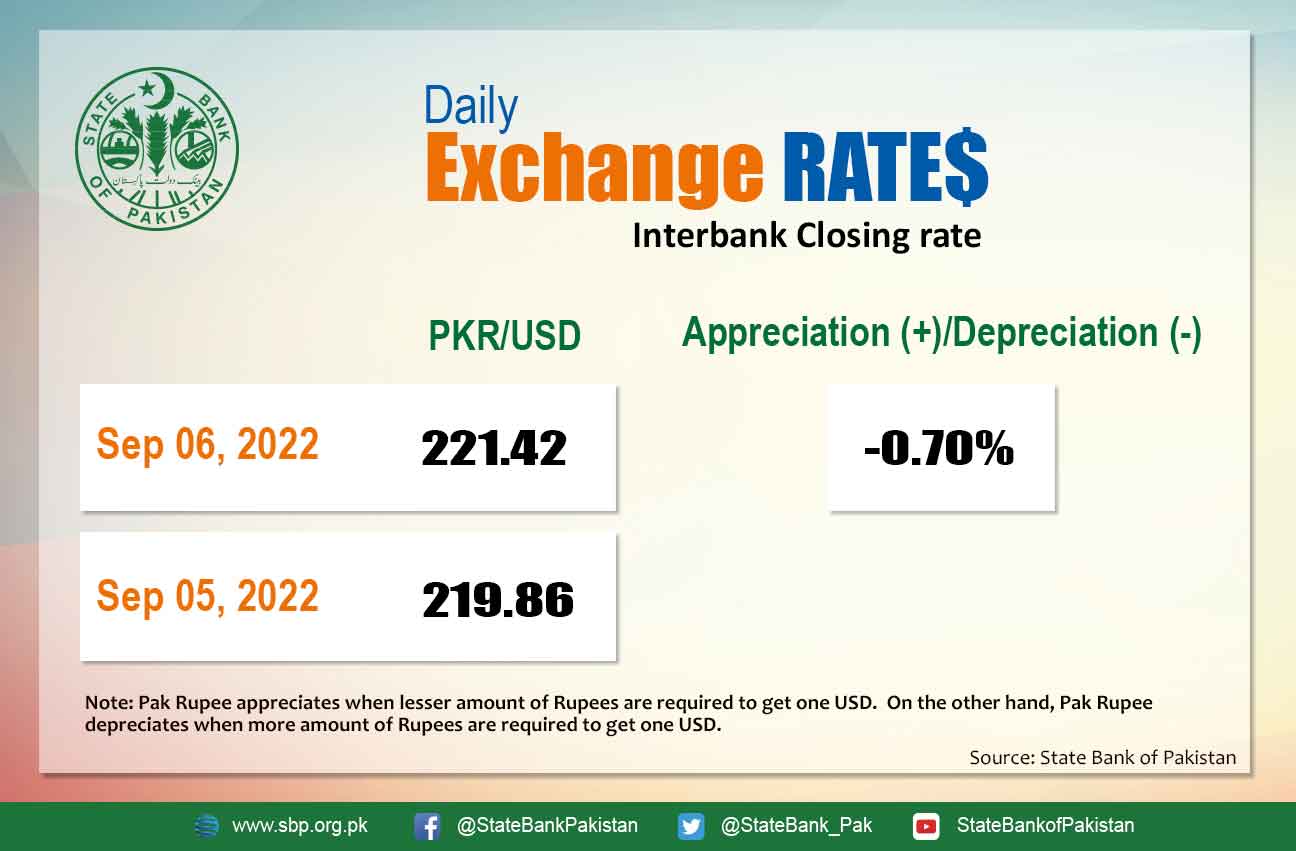
    The local unit lost for the third session in a row on Tuesday, falling down Rs1.56 or 0.7 per cent against the dollar to close at Rs221.42.

    According to analysts, the government’s decision to let the duty-free import of edible commodities to promote food security after floods severely damaged the nation’s agriculture sector has led to a spike in demand for dollars on the local market.

    However, the dollar is also strengthening globally. On Wednesday, after U.S. economic data supported the notion that the Federal Reserve will continue with policy tightening, it reached fresh highs against the yen and the Australian and New Zealand dollars.

    The US dollar index, which compares the value of the dollar to six important rival currencies, increased 0.08 per cent to Rs110.43, remaining close to the 20-year high set on Tuesday of Rs110.57.

    On Wednesday, oil prices, a major factor in determining currency parity, fell more than $1 to their lowest level since before Russia invaded Ukraine as COVID-19 restrictions in the world’s top crude importer China and anticipation of further interest rate increases stoked concerns about a global economic slowdown and a decline in fuel demand.

  • Pakistani rupee loses Rs2.01 against dollar to close at Rs216.66

    Pakistani rupee loses Rs2.01 against dollar to close at Rs216.66

    On Monday, the Pakistani rupee (PKR) remained under pressure to start the week, falling Rs2.01, or 0.93 per cent, versus the US dollar in the interbank market.

    The local currency dropped from Friday’s closing rate of Rs214.65 to Monday’s closing rate of Rs216.66 per dollar, according to the State Bank of Pakistan.

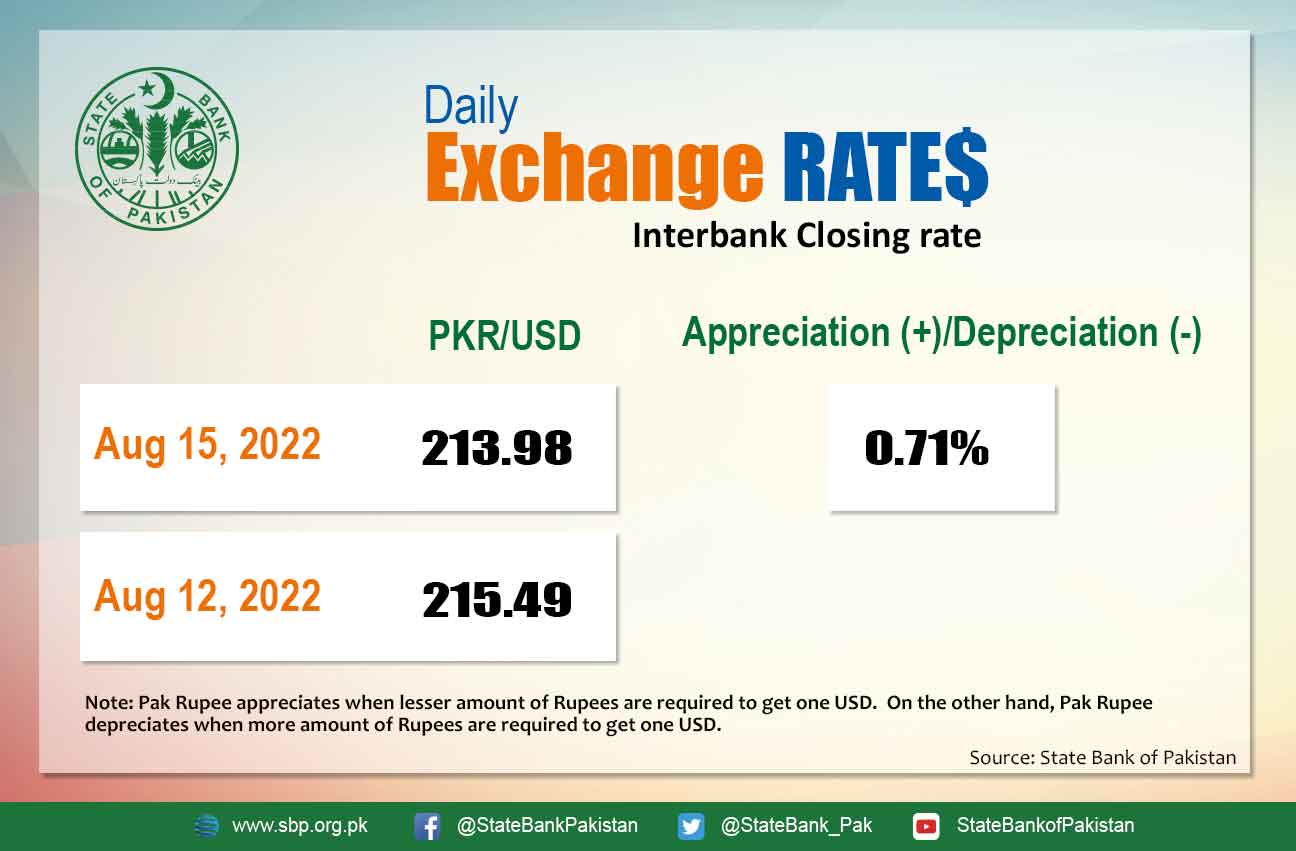
    The dollar fluctuated between Rs213-214 during the previous week. It ended at Rs214.65 on Friday after ending at Rs213.98 on Monday. Last week, the rupee lost 0.31 per cent of its value against the dollar.

    The KSE 100-index of the Pakistan Stock Exchange (PSX), on the other hand, experienced a bearish trend on Monday, shedding 443.99 points, or 1.03 per cent, and finishing at 42,826.66 points as opposed to 43,270.65 points on the last working day.

    When compared to the previous trading day, when 306,208,580 shares were traded, a total of 194,667,559 shares were traded on Monday (today). The price of the shares was Rs5.331 billion as opposed to Rs6.393 billion on Friday.

  • PSX surpasses 43,000-mark as IMF tranche inches closer

    PSX surpasses 43,000-mark as IMF tranche inches closer

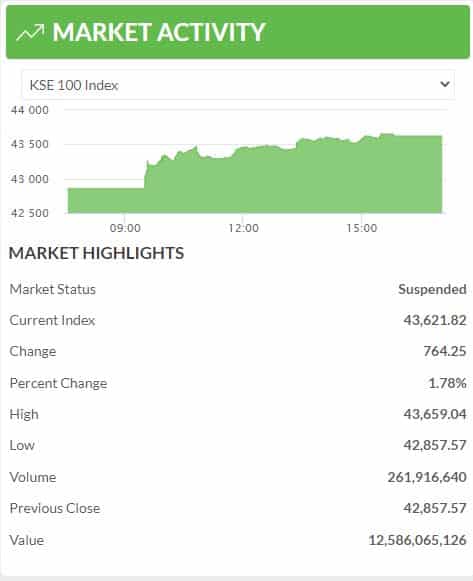
    As trading began on Monday, the Pakistan Stock Exchange (PSX) resumed its upward trend, rising more than 700 points to cross the 43,000-mark.

    The benchmark KSE-100 index gained 764.25 points, or 1.78 per cent, from its previous finish of 42,857.57.

    PSX – August 15, 2022

    The benchmark KSE-100 index increased by 731.54 points, or 1.71 per cent, by 2:13 pm to reach 43,589.11 points, according to the PSX website.

    Additionally strengthening by Rs1.51, the Pakistani rupee (PKR) ended the day at Rs213.98. Since last week, the local currency has been steadily rising against the US dollar.

    Rupee latest closing -August 15, 2022

    The IMF’s letter of intent and Saudi Arabia’s pledge of more support were among the good developments over the weekend that contributed to the index’s strong start.

    The rupee’s robust rebound and the IMF tranche anticipated at the end of this month can be credited for the upward trend.

  • SBP’s foreign exchange reserves dropped to $7.83 billion

    SBP’s foreign exchange reserves dropped to $7.83 billion

    Owing to debt payments, the State Bank of Pakistan’s (SBP) foreign exchange reserves fell to $7.83 billion as of August 5 from $8.385 billion in the last week.

    It is worth noting that this is the lowest level in over three years, according to figures released by the SBP.

    Pakistan’s overall foreign exchange reserves were $27.067 billion as of August 2021 but fell to $13.561 billion as of August 5, 2022.

    The most recent figures on the country’s foreign exchange holdings came when the reserves were quickly running out due to a $6 billion IMF programme that was stalled and the country was experiencing a lack of external funding.

    Due to debt payments and a lack of external finance, the central bank’s foreign reserves decreased by $555 million or 6.6 per cent every week.

    To reach $13.561 billion, Pakistan’s total liquid foreign reserves decreased by $648 million, or 4.6 per cent, and its commercial banks’ holdings fell by $5.730 billion, or 1.6 per cent.

    The SBP’s reserves are sufficient to cover imports for just over a month, according to The News. The reverse decline was brought on by paying off foreign debt.

    According to the central bank, debt repayments may slow down over the following three weeks of this month.

    On the other hand, the Pakistani rupee continued its upward trend against the US dollar for the ninth day, adding Rs3.38 to trade at Rs215.50 in intraday trade on Friday. The KSE-100 index likewise witnessed an increase of 386 points.

  • Pakistani rupee continues to recover, PSX witnesses bullish trend

    Pakistani rupee continues to recover, PSX witnesses bullish trend

    The dollar was trading at Rs223 on Thursday, as the Pakistani rupee (PKR) increased by Rs5.79 in interbank trade to extend its winning streak versus the dollar to five days.

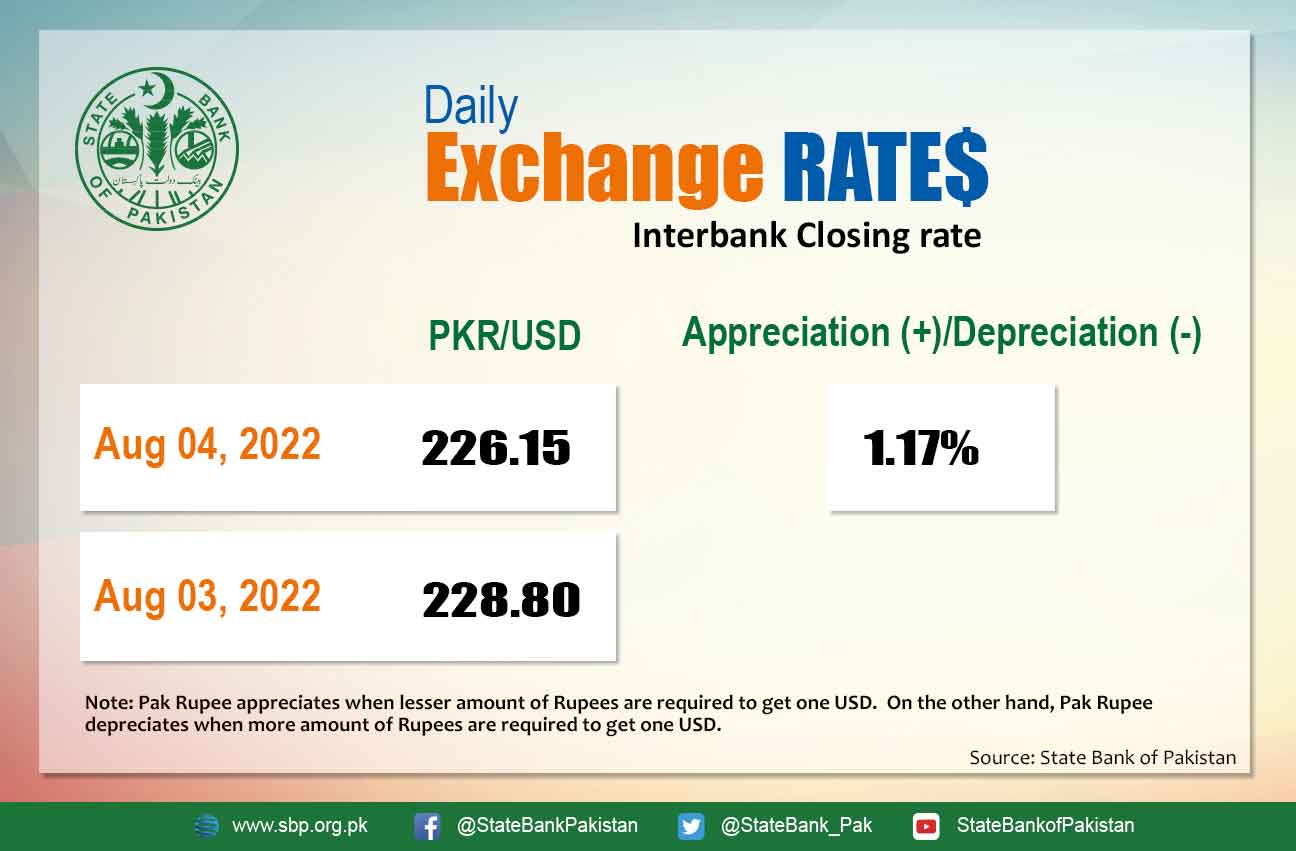
    The Pakistani rupee increased against the US dollar for the fifth day in a row, rising Rs2.65 to close at Rs226.15.

    US dollar to Pakistani rupee rate – 4 August 2022

    As the market opened on a good note and remained optimistic with heavy volumes in nearly all sectors for a while, the benchmark KSE-100 likewise rose up to 500 points before 12:00 pm. However, as of 1:40 pm, the market fell by 290 points.

    On Wednesday, the rupee gained the most against foreign currencies in a single day, ending the day at Rs228.80. The dollar’s decline versus the rupee reached its biggest level since November 2, 1998, when it dropped by Rs5.10.

    The local currency is strengthening as a result of increased export inflows and reduced import expenditures, with optimism that the cash-strapped nation was getting closer to winning an IMF bailout bolstering confidence.

    A board meeting is provisionally scheduled for late August after sufficient finance assurances are secured, according to a statement released on Tuesday by Esther Perez Ruiz, the IMF’s Resident Representative for Pakistan.

    Read more: Pakistan rupee appreciates Rs9.58 against US dollar, closes at Rs228.8

    The dollar may devalue between Rs180 and Rs190 against the Pakistani rupee if the IMF releases the $1.2 billion tranche in August, according to Malik Bostan, chairman of the Exchange Companies Association of Pakistan (ECAP).