Tag: Supreme Court

  • Govt vs Supreme Court: Ruling alliance rejects ‘controversial’ bench constituted to hear pleas on SC bill

    Govt vs Supreme Court: Ruling alliance rejects ‘controversial’ bench constituted to hear pleas on SC bill

    The ruling alliance on Thursday rejected the eight-member bench constituted earlier in the day to hear petitions challenging the Supreme Court (Practice and Procedure) Bill 2023.

    In a harshly worded statement, the coalition government vowed to resist attempts to remove parliament’s authority and interfere in its constitutional scope. The ruling parties further said, “such a move was never seen in the history of Pakistan and the Supreme Court”.

    The statement mentioned that top court judges — Justice Faez Isa and Justice Aminuddin Khan  — had in their earlier judgments openly expressed their objection to the “one-man show”, biased and dictatorial behaviour and the formation of special benches, while criticising the unchecked powers the Chief Justice of the apex court holds.

    “The constitution of the controversial bench in haste and fixing the bill for hearing, apart from the will and intent, also clearly expresses the decision to come, which is sad and tantamount to murder of justice,” the ruling alliance maintained.

    “With the formation of the eight-member controversial bench, the facts stated in the judgments of these honourable judges have become clearer,” the statement read.

    “The constitution of the controversial bench in haste and fixing the bill for hearing, apart from the will and intent, also clearly expresses the decision to come which is sad and tantamount to murder of justice,” the ruling alliance maintained.

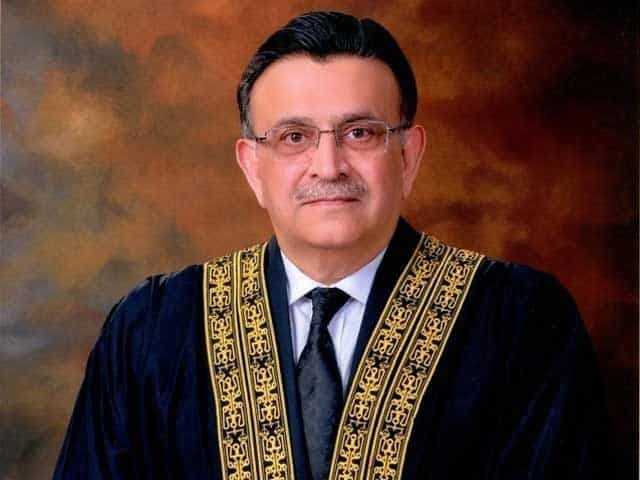
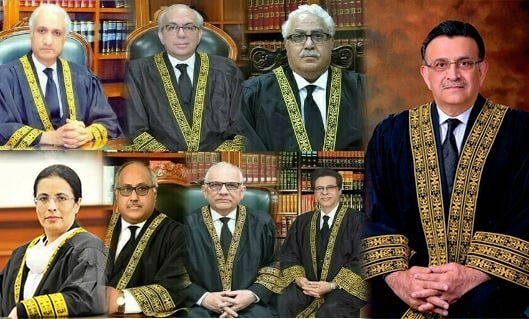
    The bench set to hear plea against the bill comprises of Chief Justice of Pakistan Umar Ata Bnadial, Justice Ijazul Ahsan, Justice Munib Akhtar, Justice Sayyed Mazahar Ali Akbar Naqvi, Justice Mohammad Ali Mazhar, Justice Ayesha A. Malik, Justice Syed Hasan Azhar Rizvi and Justice Shahid Waheed.

    The Supreme Court (Practice and Procedure) Bill 2023, is aimed at depriving the office of the CJP of powers to take suo motu notice in an individual capacity. It was initially passed by both houses of parliament and sent to the president for his assent. However, President Dr Arif Alvi had sent it back, saying that the proposed law travelled “beyond the competence of parliament”.

    The formation of the bench was met with surprise from the legal fraternity as the bill is yet to become law.

  • Cabinet approves bill seeking parliament validation for election funds

    Cabinet approves bill seeking parliament validation for election funds

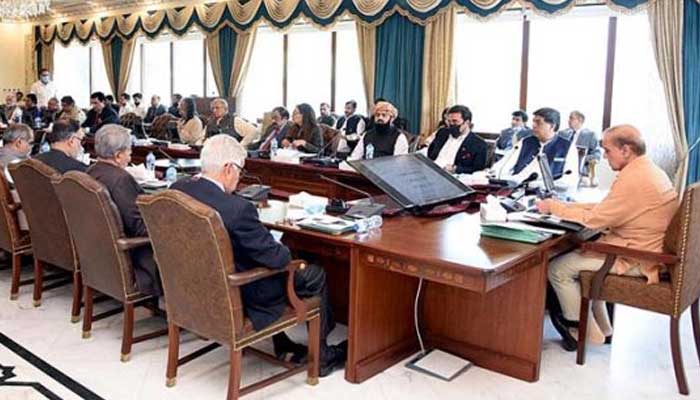
    The federal cabinet on Monday approved a summary prepared by the Ministry of Finance seeking to release funds for the Election Commission of Pakistan (ECP) to hold elections in Punjab on May 14 as ordered by the Supreme Court, which will now be forwarded to the parliament.

    Finance Minister Ishaq Dar presented the bill before parliament today.

    Earlier today, a meeting chaired by Prime Minister (PM) Shehbaz Sharif, decided to send the matter to the parliament, observing that the Lower House was supreme and whatever decision it would make, would be acceptable.

    On Sunday the cabinet decided to refer to parliament the issue of the release of funds to the ECP for holding elections in Punjab.

    The cabinet asked Dar to prepare a summary for the guidance of the Parliament.

    It is pertinent to mention here that the SC has ordered that federal government to release Rs21 billion by April 10 for holding polls in Punjab.

  • Justice Faiz Isa questions disposal of his order to stop all suo motu proceedings

    Justice Faiz Isa questions disposal of his order to stop all suo motu proceedings

    Supreme Court (SC) Justice Qazi Faiz Isa has raised multiple questions over the verdict of a six-member larger bench of the Supreme Court which deposed his order that all suo motu proceedings should be stopped.

    In a nine-page note issued on Saturday, Justice Isa maintained that as the gathering in a court of six distinguished judges was not permissible under the Constitution or under any law, “the Supreme Court’s order dated 29 March 2023 passed in Case No 4 could not have been set aside by the 4 April Note”.

    Justice Isa noted that the Constitution did not confer jurisdiction on a bench or on judges of the SC (no matter how many in number) to sit in an appeal over an order of the top court.

    The judge further pointed out that Ishrat Ali, a federal government employee, was sent on deputation to the SC to work as its registrar.

    He maintained that Ishrat Ali was “withdrawn” by the federal government, however, he refused to abide by the order.

    It is pertinent to mention here that Justice Faiz had asked the registrar to resign for issuing a circular, discarding his judicial order related to suo motu proceedings.

    Earlier, a six-member bench of the Supreme Court was formed in unusual haste to deliberate on Justice Faez Isa’s order freezing all the suo motu notices. The bench closed the case after a hearing that lasted a total of five minutes.

  • Govt demands resignation from Chief Justice Bandial

    Govt demands resignation from Chief Justice Bandial

    Federal Minister for Information and Broadcasting Marriyum Aurangzeb, in a press conference on Friday, demanded Chief Justice of Pakistan (CJP) Umar Ata Bandial’s resignation after Justice Athar Minallah’s hard-hitting note that said that the suo motu case of the delay in holding polls in Khyber Pakhtunkhwa and Punjab was dismissed by 4-3.

    Calling the CJP “controversial”, Aurangzeb stated that when the court’s proceedings become controversial with judges of the top court refusing to accept the judgement, how will the people accept the verdict.

    “Justice Minallah’s note is a question mark,” she said.

    Without naming Pakistan Tehreek-e-Insaf (PTI) Chairman Imran Khan, the minister said that it is not acceptable for the government that a breacher of the constitution is facilitated by the judiciary.

    She added that parliament will decide about elections, not Imran Khan.

    It is pertinent to mention that CJP Bandial is set to retire by September this year, after which Justice Qazi Faez Isa will become the new chief justice.

  • ‘Party ka secretary-general’: Sherry Rehman lashes out at Alvi for returning SC bill to parliament for review

    President Dr Arif Alvi has sent back the Supreme Court bill for revision.

    The Supreme Court (Practice and Procedure) Bill 2023, which aims to clip the powers of the chief justice of Pakistan, sailed through both houses of parliament and was sent to the president to be signed into law.

    However, the president sent the bill back to parliament for revision under Article 75 of the Constitution.

    In his detailed reply, which he also posted on Twitter, the president said that he thought it fit and proper to return the bill, in accordance with the Constitution, with “the request for reconsideration in order to meet the scrutiny about its validity (if assailed in the court of law)”.

    Alvi pointed out several aspects that need consideration after an in-depth consideration.

    President Alvi said that SC Rules 1980 had been “made and in force duly validated and adopted by the Constitution itself” under enabling provisions such as Article 191 of the Constitution which empowers the top court to make rules regulating the practice and procedure of the court.

    “These time-tested rules are being followed ever since the year 1980 —any tinkering with the same may tantamount to interference with the internal working of the Court, its autonomy and independence,” the letter stated.

    The purpose of the proposed bill is to provide a procedure for exercising preliminary jurisdiction and appealing.

    “It may be admirable, but can it be done without a constitutional amendment?” President Alvi questioned.

    He further said it is a settled law that constitutional provisions cannot be amended by ordinary legislation. “The Constitution is the supreme law; the father of all laws,” he added.

    The president further maintains that the Constitution is not a general law, but an embodiment of laws above fundamental principles, supreme law and other laws.

    Article 191 of the Constitution empowers the Supreme Court to make rules to regulate judicial proceedings and procedure.

    Calling out the President, Federal Minister for Climate Change, Sherry Rehman tweeted, “President Arif Alvi sent the bill back to the Supreme Court for review and proved that he is not the President of the country but is still the Secretary-General of Tehreek-e-Insaaf. He has seen every decision of Parliament from Tehreek-e-Insaaf’s point of view. Even before receiving the bill, he had given his stand on it in an interview.”

    “He is following his party policy, not the constitutional position of the President. The President is saying that this bill is beyond the power of the Parliament. For three and a half years, he has been running the President’s House like an ordinance factory. How can he know the powers of the parliament? President, do not teach the Parliament how to legislate,” tweeted Rehman.

  • Crisis in SC deepens as Athar Minallah says that election suo motu case was dismissed by 4-3

    Crisis in SC deepens as Athar Minallah says that election suo motu case was dismissed by 4-3

    The crisis in the Supreme Court of Pakistan has deepened after another judge said that the suo motu case of delayed polls in Punjab and Khyber Pakhtunkhwa (KP) was dismissed by 4-3.

    Former Islamabad High Court (IHCJ) Chief Justice (CJ) Justice Athar Minallah released a detailed note, agreeing with Justice Jamal Khan Mandokhail and Justice Mansoor Ali Shah “particularly regarding the final outcome of the petitions and the suo motu assumption of jurisdiction by a majority of 4 to 3 because this was the understanding in the meeting held in the anteroom on 27.02.2023. It is noted that I had not recused nor had any reason to dissociate myself.”

    Justices Shah and Mandokhail had argued against the decision of taking suo motu by Chief Justice of Pakistan (CJP) Umar Ata Bandial.

    Following are the main points given by Minallah in his note:

    • He said that he read Mansoor Ali Shah and Mandokhail’s notes and agreed that the SC verdict was 4-3.
    • Referring to Munib Akhtar’s own judgment saying CJP’s power to take suo motu and form benches has “created imbalance, which ought to be corrected,” he noted that CJP’s power to form benches under SC Rules must be exercised transparently and fairly.
    • He pointed out that Pakistan Tehreek-e-Insaf (PTI) itself went to Lahore High Court (LHC) first, which allowed petitions and directed election in 90 days. So then why should SC wade into dispute, he asked.
    • Justice Minallah wrote that the court is being dragged into a political crisis, emphasising that the crisis escalated when PTI chose to resign from National Assembly instead of sitting in Opposition. He further said that the dissolution of the provincial assemblies was part of a political strategy.
    • Says SC has the duty to inspire public trust and not appear politically partisan. Everyone (including SC) has to take a step back and not stand on ego.
    • He called the political climate in the country “toxic”, saying that “it is inconceivable that political parties will even agree to have a dialogue, let alone arriving at a consensus.”
    • He said: “It is the duty of the Court to ensure that political stakeholders are not encouraged to bring their disputes to the courts for judicial settlement by bypassing the institutions and forums created under the Constitution. It weakens the Majlise-Shoora (Parliament) and the forums meant for political dialogue and, simultaneously, harm the judicial branch of the State by prejudicing public trust in its independence and impartiality.”
    • “When politicians do not approach the appropriate forums and bring their disputes to the courts, the former may win or lose the case, but inevitably the court is the loser”, he ended the note.

  • PTI approaches Supreme Court to hold elections in KP within 90 days

    PTI approaches Supreme Court to hold elections in KP within 90 days

    After Supreme Court’s (SC) verdict to hold Punjab polls on May 14, the Pakistan Tehreek-e-Insaf (PTI) has approached the top court to direct the Election Commission of Pakistan (ECP) to hold elections in Khyber Pakhtunkhwa within the 90-day period since the assembly’s dissolution.

    The former ruling party has requested the apex court to set aside KP Governor Haji Ghulam Ali’s notification to postpone the elections by five months and direct the ECP to conduct the polls “not later than 90 days subject to the barest minimum to that timeframe”.

    The PTI has argued that the “ECP has no jurisdiction or power to amend the Constitution” and hold elections beyond the constitutional period of 90 days. The electoral body also has “no power or jurisdiction to overrule or review” the Supreme Court’s verdict, the petition argues.

    On the matter of the KP Governor citing security concerns as the reason behind the delay, the PTI has stated in its petition that the “Constitution of Pakistan does not recognise any such illegal excuses” like “so-called financial constraints or a perceived law and order situation or lack of availability of adequate personnel”.

    After the ECP issued a delay notification for Punjab Assembly, Governor Ali also proposed October 8 for polls in KP.

  • Parliament rejects the verdict of Supreme Court

    The National Assembly (NA) has passed a resolution rejecting the verdict of the three-member bench of the Supreme Court about holding polls in Punjab on May 14.

    The resolution was moved by Balochistan Awami Party lawmaker Khalid Magsi and approved by a majority of the lawmakers. 

    Previously, the govt demanded a full bench for the hearing of the suo moto case, however, many judges recused themselves from the hearings.

    Earlier, Pakistan Muslim League-Nawaz (PML-N) Supremo Nawaz Sharif urged the parliament to file a reference of misconduct against Chief Justice Bandial, Justice Ijazul Ahsan and Justice Munib Akhtar who gave the verdict.

  • ECP announces polls in Punjab on May 14, issues schedule

    ECP announces polls in Punjab on May 14, issues schedule

    The Election Commission of Pakistan’s (ECP) on Wednesday announced that polls in Punjab will be held on May 14 as directed by the Supreme Court.

    As per the revised schedule, the process will start from appeals against acceptance or rejection of nomination papers which can be filed by April 10, while the appellate tribunal will decide the appeals by April 17.

    Revised lists of candidates for each constituency will be published on April 18, while candidates can withdraw their nominations by April 19.

    Election symbols will be allotted on April 20, while polling will be held on May 14.

  • Ap ko tab jazbaati hona chahiye tha jab Nawaz Sharif ko nikala gaya, Maryam tells Chief Justice

    Ap ko tab jazbaati hona chahiye tha jab Nawaz Sharif ko nikala gaya, Maryam tells Chief Justice

    Pakistan Muslim League-Nawaz (PML-N) Senior Vice President Maryam Nawaz, speaking at a lawyers’ convention, criticised Chief Justice of Pakistan (CJP) Umar Ata Bandial after the Supreme Court (SC) verdict of holding of Punjab polls on May 14.

    “I saw tickers on TV attributed to the CJP, that said that the chief justice got emotional during the hearing.”

    “He should have felt emotional when an elected prime minister [Nawaz Sharif] was ousted on the basis of an expired Iqama (work permit),” she said about the controversial decision that ousted her father from power.

    “An election won by Nawaz was handed over to Imran … why didn’t you get emotional then? Why didn’t you get emotional when your brother [judge] Justice Qazi Faez Isa was suffering?” Maryam asked.

    Regarding the verdict which was given by the three-member bench, she asked, “How can the CJP expect us to accept a decision that even his brother judges are not accepting it? He discluded the judges who had raised legal reservations and instead brought those judges who favoured him.”

    She also pointed out CJ’s remarks about parliamentarians. Bandial had said: “Today when you go to parliament, you find people addressing the parliament who were till yesterday in captivity, imprisoned, declared traitors. They are now talking over there, and being respected because they are representatives of the people.”

    “Instead of taunting Shehbaz Sharif and the entire government for going to jail, the CJP could have mentioned that those who went to jail were imprisoned due to fake cases,” she stated, recalling the number of cases registered against PML-N leaders and the times they appeared before courts.

    “Our leaders like Rana Sanaullah remained in jail for six months and they had a smile on their faces when they were freed. But Imran and his men are getting bail within two hours,” she criticised.

    She also gave an example of herself being in Adiala Jail for months.

    Addressing the CJP again, Maryam said: “You encouraged the man who violated the Constitution and now he is causing anarchy in the country.”

    She claimed that Imran and “his facilitators” have a plan in store, which Maryam claimed was to be executed by September before the new CJP takes charge.

    Prime Minister Shehbaz Sharif also criticised Bandial’s remarks and said that it is a matter of pride for him that he has been released by the high court on merit in false and fabricated cases.

    “It is our right under the Constitution to express our views in the parliament,” he said

    Earlier, supremo Nawaz Sharif urged the parliament to file a reference of misconduct against Chief Justice Bandial, Justice Ijazul Ahsan and Justice Munib Akhtar who decided on the Punjab election date.

    Calling the verdict a reflection of a “one-man show” in the judiciary, Nawaz argued that one individual should not be allowed to hold multiple functions, such as the prime minister, defence minister, Election Commission of Pakistan (ECP), and above all, parliament.