Tag: TECH

  • Apple’s latest product meets hilarious criticism on social media

    Apple’s latest product meets hilarious criticism on social media

    Apple’s latest product, a knitted phone strap called the iPhone Pocket, has the internet laughing at the design and the price. 

    The tech giant has said that the Pocket, developed with Japanese fashion designer Issey Miyake, can be worn in a multitude of ways including directly on the body, tied on to a laptop bag or handbag and can be carried by hand. 

    The product comes in two sizes: a shorter size that is available in eight colours and can be bought for $149.95 while a longer version is available in three colours and retails for an eye watering $229.95. 

    Molly Anderson, Apple’s Vice-President of Design, has said, “The color palette of iPhone Pocket was intentionally designed to mix and match with all our iPhone models and colors — allowing users to create their own personalized combination.”

    Apple itself said in a statement earlier this week that the iPhone Pocket was, “Born from the idea of creating an additional pocket, its understated design fully encloses iPhone, expanding to fit more of a user’s everyday items.” 

    The flowery description has not stopped the internet from roasting the company. On social media, many made fun of the Pocket in hilarious ways, targeting its design and price for creative jokes. 

    One X (formerly Twitter) user simply asked, “Do they not know we have pockets?” 

    Another user wrote, “It’s 2025. We were promised flying cars but got $150 socks for our iPhones instead.” 

    One account called it a “cut up sock” while another termed it a test : “iPhone Pocket is an IQ test. Do you want a pocket for $230 or keep the phone in your actual pocket for $0” while many accounts simply compared it to a “a thong for your phone”. 


    One shrewd user however pointed out that even if one percent of Apple users buy the sock, it will generate billions in revenue.

  • Over a million people show ‘suic*dal intent’ on ChatGPT every week, says OpenAI

    Over a million people show ‘suic*dal intent’ on ChatGPT every week, says OpenAI

    OpenAI has revealed that it has been working closely with over 170 mental health professionals to minimise harmful or inappropriate responses during sensitive conversations as over a million people show “suicidal intent” on ChatGPT every week.

    The data was revealed as the company announced major updates to its chatbot, aiming to better identify and support users experiencing mental health crises, marking one of OpenAI’s clearest acknowledgements of how artificial intelligence can sometimes worsen mental health challenges.

    According to the company’s findings, around 0.07 per cent of ChatGPT’s weekly active users —approximately 560,000 out of 800 million — show possible signs of experiencing mental health emergencies, including symptoms related to psychosis or mania.

    OpenAI emphasised that such cases are difficult to measure accurately and that these findings are based on early analysis.

    The update also comes as OpenAI faces growing scrutiny following a widely publicised lawsuit filed by the family of a teenager who died by suicide after extensive interaction with ChatGPT. Additionally, the United States (US) Federal Trade Commission has launched a broad investigation into AI chatbot companies, including OpenAI, to examine how they assess potential risks to children and teenagers.

    In response, OpenAI said that its latest GPT-5 update has significantly reduced undesirable chatbot behaviour and improved overall safety. During model evaluations involving more than 1,000 self-harm and suicide-related conversations, GPT-5 demonstrated 91 per cent compliance with desired safety standards as compared to 7 per cent for the previous version.

    To further strengthen the system, OpenAI has expanded access to crisis hotlines and introduced features reminding users to take breaks during extended sessions. The company also collaborated with healthcare experts through its Global Physician Network, asking clinicians to rate response safety and assist in crafting appropriate answers to mental health-related questions.

  • No cyberattacks on ATMs across country, clarifies 1LINK

    No cyberattacks on ATMs across country, clarifies 1LINK

    1LINK, one of the largest interbank networks in Pakistan, has denied social media rumours that ATMs will be closed for the next two to three days on fears of a cyberattack.

    The clarification came forward in a notification by 1LINK after social media was abuzz with rumours that ATMs would remain closed for a few days, asking customers to avoid using ATMs.

    The message also warned people not to conduct any online transactions during this time and claimed that this alleged cyberattack report was also aired on BBC radio.

    In its response, BBC Urdu also dismissed the claim that no such thing has been aired.

    “Thus far, no cyber threat has been observed on the ATM and online banking ecosystem in this context, and the financial service industry remains vigilant as ever before,” the notification by 1LINK read.

  • Federal government begins consultations for establishment of social media regulatory authority

    Federal government begins consultations for establishment of social media regulatory authority

    The federal government has begun consultations for the establishment of a social media regulatory authority.

    According to sources, the proposed social media regulatory authority (PECA) Amendment Bill 2024 is to be tabled soon in the Parliament.

    Media houses and other stakeholders have also been invited for consultation to establish the authority of the committee.

    Prime Minister Shehbaz Sharif reportedly formed a cabinet committee on this matter whose task is to consult the social media regulatory authority and give suggestions to the government on issues related to digital rights.

    The authority will ensure responsible use of the internet and compliance with regulations in addition to considering the issue of regulating online content and procedures for investigating violations of law on social media.

    The issue of summoning witnesses and violators of social media laws will also be considered in the consultation.

    The bill is intended to protect the private life of citizens from threats posed by social media.

  • Online service for e-domicile in South Waziristan provides no ease

    Online service for e-domicile in South Waziristan provides no ease

    Students and women in South Waziristan are facing difficulties in creating online e-domicile.

    On the instructions of the Home Department of the Khyber Pakhtunkhwa government, the district administration started working on creating an e-domicile from March 21, but the complicated steps of e-domicile have increased the difficulties of people instead of facilitating them.

    Additionally, B-form is required for online e-domicile, another problem for the locals.

    Assistant Commissioner Wana Faisal Ismail told Geo News that the district administration is receiving a lot of complaints regarding e-domicile from the citizens.

  • India election chiefs warn political parties against AI deepfakes

    India election chiefs warn political parties against AI deepfakes

    India’s election authorities on Monday warned political parties against using artificial intelligence to create deepfake videos and spread misinformation during the country’s ongoing general election.

    Millions of voters will head to polling stations on Tuesday in the third of seven voting phases in the world’s most populous country.

    A rash of deepfake and doctored videos and misinformation have circulated on social media in recent weeks.

    The Election Commission of India (ECI) warned against “misuse of AI-based tools to create deepfakes that distort information or propagate misinformation”.

    Political parties “have been specifically directed to refrain from publishing and circulating deep fake audios/videos, disseminate any misinformation or information which is patently false, untrue or misleading in nature”, the ECI said in a statement.

    It did not mention any organisation by name, but said parties would be ordered to remove any fake content within three hours of being notified of such.

    The warning came days after the arrest of the social media chief of the country’s main opposition party over accusations he doctored a video that was widely shared.

    The Congress party’s Arun Reddy was detained on Friday in connection with edited footage that falsely shows India’s powerful interior minister Amit Shah vowing in a campaign speech to end affirmative action policies for millions of poor and low-caste Indians.

    Shah’s original campaign speech shows him promising to end affirmative action measures for Muslims established in the southern state of Telangana.

    Prime Minister Narendra Modi, his ruling Bharatiya Janata Party and the opposition Congress party have accused each other of spreading misinformation and outright falsehoods since voting began last month.

    In recent weeks, both Modi and Shah have stepped up campaign rhetoric over India’s principal religious divide between majority Hindus and the 200 million-strong Muslim minority in an effort to rally voters.

    At a recent campaign rally Modi referred to Muslims as “infiltrators” and “those who have more children”, prompting condemnation and an official complaint to election authorities by Congress.

    The prime minister has not been sanctioned for his remarks despite election rules prohibiting campaigning on “communal feelings” such as religion, prompting frustration from the opposition camp.

    In its statement Monday the Commission also asked political parties to refrain from “posting derogatory content towards women”, using children in their campaigns, or depicting harm to animals.

  • ‘Everybody is vulnerable’: Fake US school audio stokes AI alarm

    ‘Everybody is vulnerable’: Fake US school audio stokes AI alarm

    A fabricated audio clip of a US high school principal prompted a torrent of outrage, leaving him battling allegations of racism and anti-Semitism in a case that has sparked new alarm about AI manipulation.

    Police charged a disgruntled staff member at the Maryland school with manufacturing the recording that surfaced in January — purportedly of principal Eric Eiswert ranting against Jews and “ungrateful Black kids” — using artificial intelligence.

    The clip, which left administrators of Pikesville High School fielding a flood of angry calls and threats, underscores the ease with which widely available AI and editing tools can be misused to impersonate celebrities and everyday citizens alike.

    In a year of major elections globally, including in the United States, the episode also demonstrates the perils of realistic deepfakes as the law plays catch-up.

    “You need one image to put a person into a video, you need 30 seconds of audio to clone somebody’s voice,” Hany Farid, a digital forensics expert at the University of California, Berkeley, told AFP.

    “There’s almost nothing you can do unless you hide under a rock.

    “The threat vector has gone from the Joe Bidens and the Taylor Swifts of the world to high school principals, 15-year-olds, reporters, lawyers, bosses, grandmothers. Everybody is now vulnerable.”

    After the official probe, the school’s athletic director, Dazhon Darien, 31, was arrested late last month over the clip.

    Charging documents say staffers at Pikesville High School felt unsafe after the audio emerged. Teachers worried the campus was bugged with recording devices while abusive messages lit up Eiswert’s social media.

    The “world would be a better place if you were on the other side of the dirt,” one X user wrote to Eiswert.

    Eiswert, who did not respond to AFP’s request for comment, was placed on leave by the school and needed security at his home.

    ‘Damage’

    When the recording hit social media in January, boosted by a popular Instagram account whose posts drew thousands of comments, the crisis thrust the school into the national spotlight.

    The audio was amplified by activist DeRay McKesson, who demanded Eiswert’s firing to his nearly one million followers on X. When the charges surfaced, he conceded he had been fooled.

    “I continue to be concerned about the damage these actions have caused,” said Billy Burke, executive director of the union representing Eiswert, referring to the recording.

    The manipulation comes as multiple US schools have struggled to contain AI-enabled deepfake pornography, leading to harassment of students amid a lack of federal legislation.

    Scott Shellenberger, the Baltimore County state’s attorney, said in a press conference the Pikesville incident highlights the need to “bring the law up to date with the technology.”

    His office is prosecuting Darien on four charges, including disturbing school activities.

    ‘A million principals’

    Investigators tied the audio to the athletic director in part by connecting him to the email address that initially distributed it.

    Police say the alleged smear-job came in retaliation for a probe Eiswert opened in December into whether Darien authorized an illegitimate payment to a coach who was also his roommate.

    Darien made searches for AI tools via the school’s network before the audio came out, and he had been using “large language models,” according to the charging documents.

    A University of Colorado professor who analyzed the audio for police concluded it “contained traces of AI-generated content with human editing after the fact.”

    Investigators also consulted Farid, writing that the California expert found it was “manipulated, and multiple recordings were spliced together using unknown software.”

    AI-generated content — and particularly audio, which experts say is particularly difficult to spot — sparked national alarm in January when a fake robocall posing as Biden urged New Hampshire residents not to vote in the state’s primary.

    “It impacts everything from entire economies, to democracies, to the high school principal,” Farid said of the technology’s misuse.

    Eiswert’s case has been a wake-up call in Pikesville, revealing how disinformation can roil even “a very tight-knit community,” said Parker Bratton, the school’s golf coach.

    “There’s one president. There’s a million principals. People are like: ‘What does this mean for me? What are the potential consequences for me when someone just decides they want to end my career?’”

    “We’re never going to be able to escape this story.”

  • Iran ready to share tech expertise with Islamabad, says Iranian President Raisi

    Iran ready to share tech expertise with Islamabad, says Iranian President Raisi

    After visiting Lahore and Karachi, Iranian President Ebrahim Raisi said that Tehran is ready to share its strengths in industry, science, and technology with Pakistan. He made the remarks during his three-day official visit to Pakistan.

    While speaking at a ceremony in Karachi’s Chief Minister House, he pointed out that despite challenges, Iran made progress in these fields and was prepared to share this knowledge with Pakistan.

    “I am here with a message of peace and prosperity for the Pakistani nation from the people of Iran and its leadership,” he said, adding, “The governments on both sides are willing to remove all obstacles to expanding trade between the two countries and in this regard, several options were discussed [in his recent meetings Pakistani leadership].”

    The Iranian President also said that the trade partnership will make the relationship between the two countries stronger, stressing that no power on earth “can affect the historical ties between the two countries.”

  • Google fires 28 workers protesting contracts with Israel

    Google fires 28 workers protesting contracts with Israel

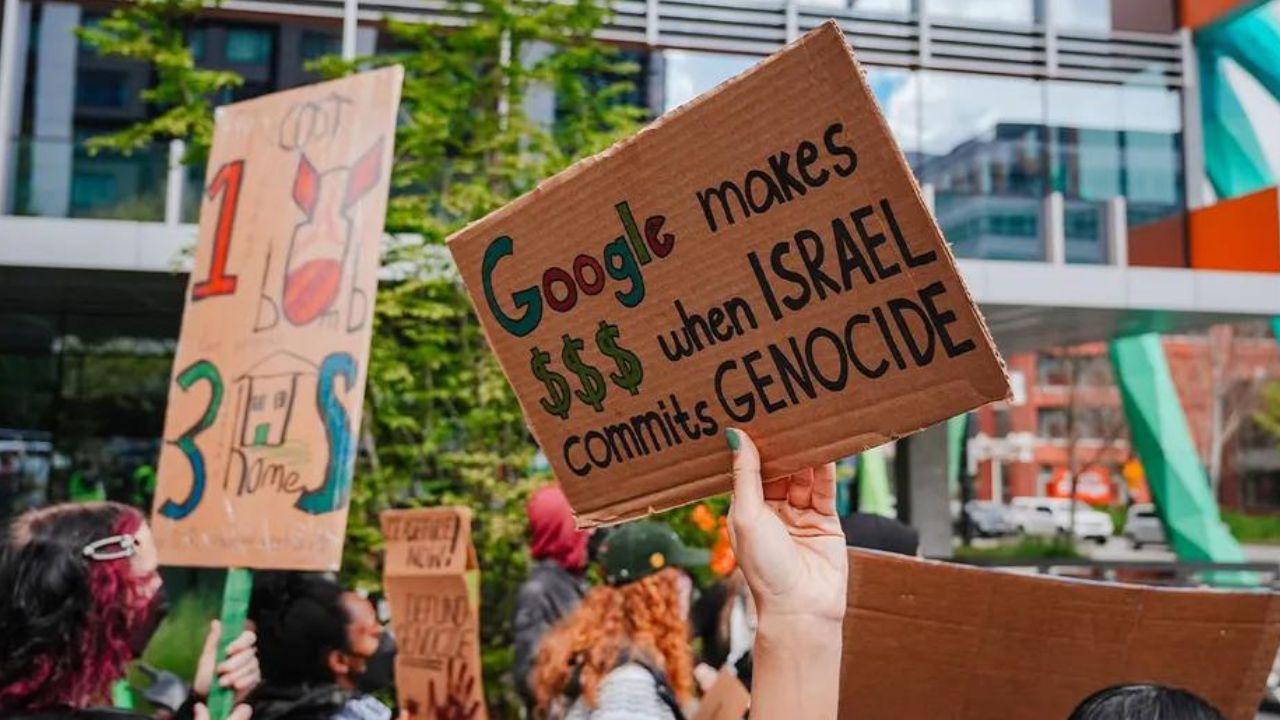
    New York, United States – Google fired 28 employees following a sit-down protest over the tech giant’s contract with the Israeli government, a Google spokesperson said Thursday.

    The Tuesday demonstration was organized by the group “No Tech for Apartheid,” which has long opposed “Project Nimbus,” Google’s joint $1.2 billion contract with Amazon to provide cloud services to the government of Israel.

    Video of the demonstration showed police arresting Google workers in Sunnyvale, California, in the office of Google Cloud CEO Thomas Kurian’s, according to a post by the advocacy group on X, formerly Twitter.

    Kurian’s office was occupied for 10 hours, the advocacy group said.

    Workers held signs including “Googlers against Genocide,” a reference to accusations surrounding Israel’s attacks on Gaza.

    “No Tech for Apartheid,” which also held protests in New York and Seattle, pointed to an April 12 Time magazine article reporting a draft contract of Google billing the Israeli Ministry of Defense more than $1 million for consulting services.

    A “small number” of employees “disrupted” a few Google locations, but the protests are “part of a longstanding campaign by a group of organizations and people who largely don’t work at Google,” a Google spokesperson said.

    “After refusing multiple requests to leave the premises, law enforcement was engaged to remove them to ensure office safety,” the Google spokesperson said. “We have so far concluded individual investigations that resulted in the termination of employment for 28 employees, and will continue to investigate and take action as needed.”

    Israel is one of “numerous” governments for which Google provides cloud computing services, the Google spokesperson said.

    “This work is not directed at highly sensitive, classified, or military workloads relevant to weapons or intelligence services,” the Google spokesperson said.

    jmb/nro

    © Agence France-Presse

  • Meta shouldn’t force users to pay for data protection: EU watchdog

    Meta shouldn’t force users to pay for data protection: EU watchdog

    Brussels, Belgium – Facebook owner Meta and other online platforms must not force users to pay for the right to data protection enshrined in EU law when offering ad-free subscriptions, the European data regulator said Wednesday.

    “Online platforms should give users a real choice when employing ‘consent or pay’ models,” the European Data Protection Board (EDPB) chair Anu Talus said in a statement.

    “The models we have today usually require individuals to either give away all their data or to pay,” she said. “As a result, most users consent to the processing in order to use a service, and they do not understand the full implications of their choices.”

    Meta in November launched a “pay or consent” system allowing users to withhold use of their data for ad targeting in exchange for a monthly fee — a model that has faced several challenges from privacy and consumer advocates.

    Meta has long profited from selling user data to advertisers but this business model has led to multiple battles with EU regulators over data privacy.

    The latest announcement came after the data protection authorities of The Netherlands, Norway and the German state of Hamburg went to the EDPB for an opinion regarding the pay-or-consent model used by Meta.

    The Silicon Valley company allows users of Instagram and Facebook in Europe to pay between 10 and 13 euros (around $11 and $14) a month to opt out of data sharing.

    Meta pointed to an EU court ruling last year that it said opened the way for subscriptions as a “legally valid” option. “Today’s EDPB opinion does not alter that judgment and subscription for no ads complies with EU laws,” a Meta spokesperson said.

    Meta is waiting for a decision on its model by the data privacy regulator in Ireland where the company is headquartered.

    ‘Binary choice’

    All digital platforms must comply with the European Union’s mammoth general data protection regulation (GDPR), which has been at the root of EU court cases against Meta.

    The EDPB in its opinion argued that Meta’s model was at odds with the GDPR’s requirement that consent for data use must be freely given.

    “In most cases, it will not be possible for large online platforms to comply with the requirements for valid consent if they confront users only with a binary choice between consenting to processing of personal data for behavioural advertising purposes and paying a fee,” the opinion read.

    The EDPB also warned the type of subscription service put forward by Meta “should not be the default way forward” for platforms.

    It suggested that platforms should consider an alternative that would give users the right to reject being tracked for advertising purposes without the need to pay.

    Privacy defenders welcomed the opinion.

    “Overall, Meta is out of options in the EU. It must now give users a genuine yes/no option for personalised advertising,” said prominent online privacy activist Max Schrems.

    “We know that ‘Pay or Okay’ shifts consent rates from about three percent to more than 99 percent — so it is as far from ‘freely given’ consent as North Korea is from a democracy,” said Schrems.

    Tech lobby group CCIA however warned the EDPB risked “opening a Pandora’s Box”.

    “Forcing businesses to offer services at a loss is unprecedented and sends the wrong signals,” said CCIA Europe’s senior policy manager, Claudia Canelles Quaroni.

    “All companies should be able to offer paid-for versions of their services.”

    raz/gv

    © Agence France-Presse