
Tag: whatsapp

  • Silence unknown callers: WhatsApp introduces solution to spam and scam calls

    Silence unknown callers: WhatsApp introduces solution to spam and scam calls

    WhatsApp, the messaging app owned by Meta, has introduced two new updates for its Android and iOS users. These updates offer enhanced privacy and control over incoming calls, as well as improved options for protecting user information.

    One of the updates is the “Silence Unknown Callers” feature, which automatically screens out unwanted calls from unknown or suspicious numbers. It helps users avoid spam, scams, and calls from people they don’t know. Instead of ringing on the phone, these calls will be listed in the call log, allowing users to check them later in case they are from important contacts. To enable this feature, users can go to their WhatsApp account privacy settings and select the “Silence Unknown Callers” option in the calls section.

    The second update is the “Privacy Checkup” feature, which assists users in navigating and configuring important privacy settings. By taking users through a step-by-step process, it helps them understand and choose the appropriate level of protection for their messages, calls, and personal information. By accessing the Privacy settings and selecting “Start checkup,” users can explore various privacy options and strengthen the security of their WhatsApp account.

    WhatsApp has taken innovative measures to spread awareness about these updates on a global scale. Emphasising the significance of secure communication, the app encourages users to connect with friends and family through private messaging, where they can freely express themselves. These updates aim to provide a safer and more private experience for WhatsApp users.

  • WhatsApp revolutionizes messaging experience with real-time message editing feature

    WhatsApp revolutionizes messaging experience with real-time message editing feature

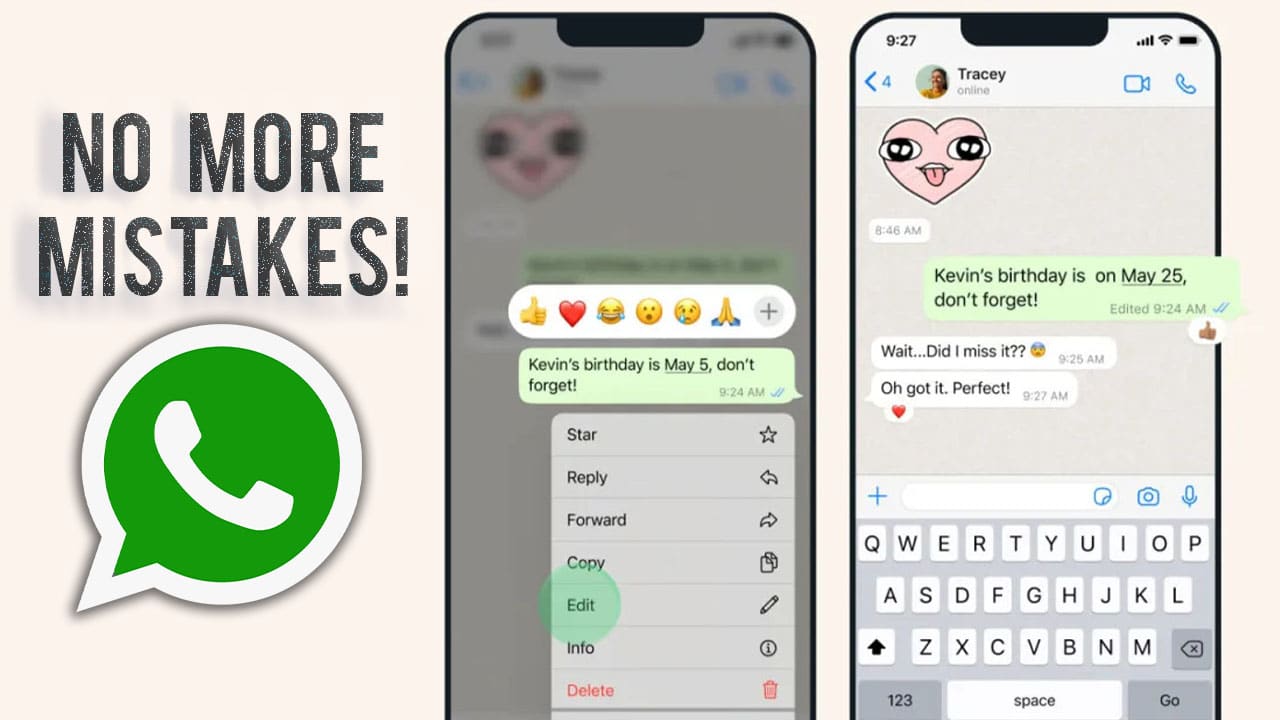
    WhatsApp, owned by Meta, is finally introducing a highly anticipated feature that allows users to edit their messages even after they’ve been sent, as reported by WaBetaInfo.

    The feature, known as ‘edit messages’ is currently available to some beta testers and will be gradually rolled out to more users in the coming days.

    Mark Zuckerberg announced the feature through Meta’s official channel on Instagram. It provides users with the ability to quickly fix any typos or make changes to their messages, even after sending them.

    The feature is accessible through the Microsoft Store and can be found in the message menu within 15 minutes of sending a message. To check if you have access to this feature, simply try editing a sent message.

    However, it’s important to note that messages sent from a different device cannot be edited. The WhatsApp watcher stated, “This may be a wider rollout, so some users on certain previous updates may also gain access to the same feature starting today.”

    We often find ourselves making typos or sharing incorrect information when conversing with someone. Thankfully, this much-needed and impressive feature now allows us to rectify those mistakes.

    According to WaBetaInfo, WhatsApp has plans to further enhance the message editing feature in order to provide users with an even better experience while using the application.

  • WhatsApp introduces user-friendly picture tool for editing

    WhatsApp introduces user-friendly picture tool for editing

    WhatsApp has rolled out a highly anticipated feature on the app, showing its commitment to improving user experience.

    The latest feature on the instant messaging platform is the picture editing tool, which has been introduced for the Desktop version of the app, as reported by WABetainfo.

    An article published on the website stated that the recently added feature is a “crop tool” for the drawing editor that allows users to trim images as required.

    “This addition has been eagerly awaited, as previous versions didn’t have this functionality. With this update, WhatsApp beta users on Windows can now enjoy the convenience of cropping their images within the app itself, making it easier for users to edit media,” it said.

    The “crop tool” also saves time for users as they no longer have to crop pictures using external image editing tools before sending them via the Desktop version.

    The built-in crop tool lets users easily crop their images without leaving the WhatsApp interface.

    However, not all users currently have access to the new feature as it has initially been released to some beta testers. It will be made available to more users soon.

  • WhatsApp will soon let you edit sent messages and lock chats

    WhatsApp will soon let you edit sent messages and lock chats

    The popular messaging app owned by Meta has commenced the phased rollout of its highly anticipated function, which will soon be accessible to all users in the forthcoming weeks.

    Under this innovative update, edited messages will bear a conspicuous label, indicating that modifications have been made, while preserving the confidentiality of the specific changes made. To initiate the editing process, users simply need to press and hold a message, then select the “edit” option from the convenient drop-down menu. However, it’s important to note that this edit feature remains available for a limited duration of 15 minutes after the message has been sent.

    According to a blog post by the company, this new functionality aims to address instances when users make inadvertent errors or alter their thoughts, providing them with a seamless means of rectifying mistakes or supplementing additional context within their conversations. WhatsApp is truly excited to offer enhanced control over chats, empowering users to correct typographical errors or refine their message content.

    WhatsApp now joins the league of other prominent messaging services like Telegram and Signal, which have already integrated the edit function into their platforms. Moreover, Twitter introduced its exclusive Edit Tweet feature for paying subscribers last year, while Facebook has allowed users to edit posts and comments for nearly a decade, albeit without extending the capability to messages until now.

    Notably, WhatsApp’s latest update coincides with Meta’s recent announcement that it will introduce the ability for users to lock and conceal conversations. Through the Chat Lock feature, a specific chat thread can be discreetly removed from the app’s standard onscreen inbox and relocated to a secure folder, safeguarded by a password or advanced biometric measures such as facial recognition or fingerprint authentication. Meta emphasizes that this offers an additional layer of security, although it may potentially raise concerns in relation to the UK government’s online safety bill.

    Prepare to experience an enhanced messaging experience as WhatsApp’s groundbreaking updates redefine the boundaries of user control. Stay tuned as the platform ushers in a new era of communication, offering unparalleled flexibility and security.

  • WhatsApp to introduce built-in sticker making tool in new update

    WhatsApp to introduce built-in sticker making tool in new update

    WhatsApp is reportedly working on a sticker making tool that will allow users to create their own stickers for the popular messaging app. The tool is expected to be released in a future update to WhatsApp.

    The sticker making tool will allow users to create stickers from scratch or from existing photos and videos. Users will be able to add text, emojis, and other decorations to their stickers. Once a sticker is created, it can be shared with other WhatsApp users.

    Emojis and Stickers have become increasingly popular in recent years, and WhatsApp is not the only messaging app that offers them. Other popular messaging apps that offer stickers include Telegram, Facebook Messenger, and Snapchat.

    Stickers are a fun and easy way to add personality to your conversations. They can also be used to express emotions that are difficult to convey with text alone. With the upcoming sticker making tool, WhatsApp users will be able to create their own stickers that perfectly reflect their unique personalities.

    The sticker making tool is just one of the many new features that WhatsApp is working on. The company is also reportedly working on a new interface for group chats, as well as a feature that will allow users to send disappearing messages.

    WhatsApp is one of the most popular messaging apps in the world, with over 2 billion active users. The company is constantly adding new features and improvements to the app in an effort to keep its users engaged. The sticker making tool is just one of the many new features that WhatsApp is working on, and it is sure to be a popular addition to the app.

  • WhatsApp to introduce biometric chat locks for enhanced privacy and security

    WhatsApp to introduce biometric chat locks for enhanced privacy and security

    A number of Android OS skins from prominent brands such as Xiaomi offer app lock capabilities, whereby individual apps require authentication to gain access, sometimes by way of biometric verification.

    Stock Android can also be endowed with this feature by utilising various apps accessible on the Play Store, though their reliability can be called into question. Given the confidential nature of WhatsApp conversations, Meta’s ongoing development of a per-chat biometric lock embedded into the app is a positive move in the right direction.

    For an app that is advertised as having a strong focus on privacy and security, the absence of in-app biometric authentication options is highly noticeable. Luckily, according to WABetaInfo, the latest WhatsApp beta update available on the Play Store (v2.23.8.2) gives indications of a new feature being developed. This feature will allow users to lock individual chats using either a passcode or fingerprint, even though only the latter’s toggle is visible. It is suspected that the fingerprint unlock will require a passcode to be set up as a backup.

    Screenshots imply that it will be possible to lock sensitive group chats from the group info section. It also appears that all locked chats will be relocated to a vault-like space, separated from regular chats, hence requiring authentication only once. While it isn’t apparent from the shared screenshots, WABetaInfo reports that WhatsApp will erase the chat if users wish to unlock it by force, such as in the event of forgetting the passcode.

    There is little information available about how notifications for these chats will be displayed, what will happen to the media in the conversations, and how many chats can be locked. WhatsApp is one of the most well-known encrypted messaging apps in existence, yet it is not at the forefront of this feature. For instance, Telegram has allowed passcode or fingerprint unlocking since around 2018, but it is for the app as a whole rather than individual chats. It is somewhat perplexing why WhatsApp has not followed this path.

  • WhatsApp to replace phone numbers with usernames for identifying unknown contacts in group chats

    WhatsApp to replace phone numbers with usernames for identifying unknown contacts in group chats

    According to WaBetaInfo, the Meta-owned messaging platform WhatsApp is developing a new feature that will simplify the identification of messages received from unknown contacts in WhatsApp group chats.

    The latest WhatsApp beta for Android 2.23.5.12 update has been released by the instant messaging app, which enhances the functionality introduced in December 2022 by swapping numbers with push names in the message bubble of group chats.

    As per the report, a push name will be shown every time a user receives a message from an unknown contact in a group chat, rather than the mobile number, in the chat list. This change makes it easier for the recipient to recognize who the unknown contact is without having to save the number as a new contact.

    This is particularly useful in large group chats where identifying unknown group members can be difficult. The push name may even appear instead of the phone number in different sections of the app, such as the group participants list.

    The new feature has also been made available to some iOS beta testers after installing the WhatsApp beta for iOS 23.5.0.73 update. The report notes that the new feature is currently accessible to some beta testers who install the latest updates of WhatsApp beta for Android from the Play Store, and it is anticipated to be made available to even more users in the coming days.

  • WhatsApp refuses to compromise on end-to-end encryption despite UK pressure

    WhatsApp refuses to compromise on end-to-end encryption despite UK pressure

    Will Cathcart, the head of WhatsApp, has stated that the company will not comply with the proposed online safety bill in the United Kingdom (UK), which aims to ban end-to-end encryption. Cathcart made these remarks during a visit to the UK, where he will meet with legislators to discuss the government’s internet regulation flagship policy. He further described the bill as the most concerning piece of legislation being discussed in the western world.

    Cathcart explained that users worldwide demand security, and 98 per cent of WhatsApp’s users are outside the UK. Therefore, it would be an odd choice for the company to lower the product’s security in a way that would affect the majority of its users. He added that end-to-end encryption is essential in messaging services to prevent anyone other than the communication recipients from decrypting it. WhatsApp cannot read messages sent over its service and cannot comply with law enforcement requests to hand over messages or actively monitor communications for child protection or anti-terrorism purposes.

    Cathcart noted that the online safety bill is an expansion of the UK government’s power to demand the removal of encryption, and it poses a grey area in the legislation. He called for similar language to be inserted into the UK bill as in the EU’s digital markets act, which explicitly defends end-to-end encryption for messaging services.

    Furthermore, under the proposed bill, the UK government or Ofcom could require WhatsApp to apply content moderation policies that would be impossible to comply with without removing end-to-end encryption. If WhatsApp refused to comply, it could face fines of up to 4 per cent of its parent company Meta’s annual turnover, or it would have to withdraw entirely from the UK market.

    Cathcart argued that large communities that use end-to-end encryption, such as WhatsApp’s “communities” offering, which allows group chats of over 1,000 users to be grouped together, have slim chances of causing trouble. He suggested that one person reporting any serious issues would suffice, making it easy for investigators to gain access.

    The online safety bill is expected to return to parliament in the summer, giving Ofcom significant new powers as the internet regulator and enabling it to require effective content moderation under the penalty of large fines. WhatsApp has never received a legal demand to remove encryption from the UK government, according to Cathcart.

  • You can now share your thoughts in a new way with WhatsApp voice statuses feature

    You can now share your thoughts in a new way with WhatsApp voice statuses feature

    WhatsApp has recently introduced a new feature, allowing users to post voice notes as statuses, with a maximum recording length of 30 seconds for their contacts to listen to. These voice notes will have a lifespan of 24 hours before disappearing, expanding the types of content that can be shared through the status feature.

    The meta-owned messenger introduced the status feature in 2017, which initially allowed users to share photos, videos, GIFs, and text updates. With the increasing popularity of voice messaging on the platform, the company has now added the option to share voice notes as statuses. In March of the previous year, WhatsApp announced that it was processing a daily average of 7 billion voice messages, further highlighting the growing demand for this feature.

    Moreover, WhatsApp is enhancing the status feature by offering status reactions, similar to the message reactions that were introduced by the company last year. Additionally, users will now have the ability to specify their desired audience for statuses, allowing them to control who can view their updates. This audience selection can be saved and applied to all future status updates, providing more control over privacy and visibility.

    It is currently uncertain how many users are actively utilizing the status feature to communicate with their contacts, however, the company is actively striving to increase its popularity.

  • WhatsApp to get new camera modes, blocking shortcut

    WhatsApp to get new camera modes, blocking shortcut

    WhatsApp will soon get two new features that will make using messenger more convenient. The first feature is the option to block a contact right from the message notification pop-up, and the second feature offers separate tabs for taking photos and recording videos from within the app.

    Presently, if you want to block someone on WhatsApp, you have to go to the app, select the chat, tap on the contact information, and then select the option to block the contact. Some people might find the process too lengthy, which is why WhatsApp is working on offering an option to block a contact right from an unwanted message’s pop-up notification. This will make it easier to block a contact.

    To prevent you from unintentionally blocking your contacts, this option will only appear for contacts that are not saved on your device.

    Currently, in WhatsApp, you must press and hold the camera shutter button in order to shoot a video. If you want to record a lengthy video, it can feel fairly difficult.

    WhatsApp is now testing a new feature that provides various tabs for shooting pictures and making videos. So, all you have to do to record a video is choose the video mode in the viewfinder and give the record button one quick tap.

    These features are expected to roll out to the stable version of the app in the next few months.