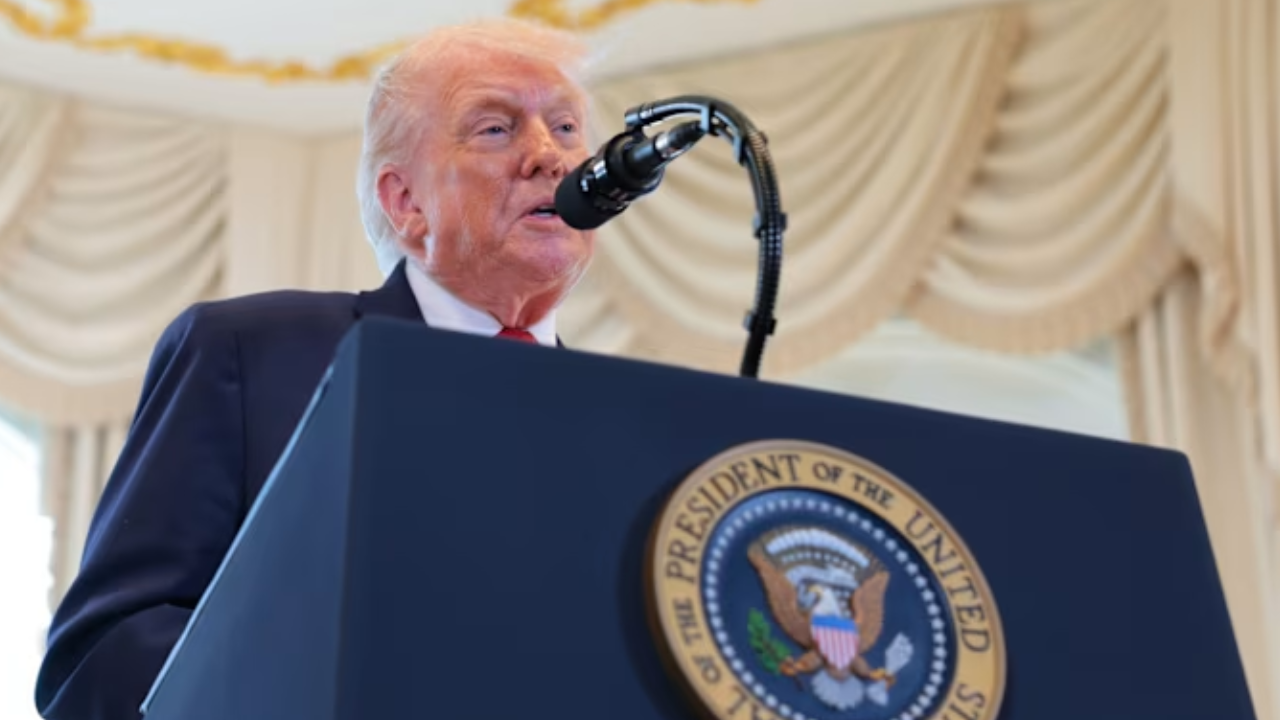
The White House has said that reports that countries must contribute $1 billion to join US President Donald Trump’s Board of Peace are “misleading”.
“This simply offers permanent membership to partner countries who demonstrate deep commitment to peace, security, and prosperity,” the White House said on X.
Trump initially unveiled the Board as part of phase two of a ceasefire agreement between Israel and Hamas, aimed at ending Israel’s genocide in Gaza. The body was envisioned to oversee “governance capacity-building, regional relations, reconstruction, investment attraction, large-scale funding, and capital mobilisation” in the enclave.
However, letters written by Trump and posted on social media by two leaders invited to join the board, Argentinian President Javier Milei and Paraguay’s leader Santiago Pena suggested broader ambitions.
According to the letters, Trump said the board would seek to “solidify peace in the Middle East” and “embark on a bold new approach to resolving global conflict.”
A draft charter sent to about 60 countries, seen by Reuters, also outlined an expanded role for the board. The Financial Times reported that the charter described it as “an international organisation that seeks to promote stability, restore dependable and lawful governance, and secure enduring peace in areas affected or threatened by conflict.”
“Durable peace requires pragmatic judgment, common sense solutions, and the courage to depart from approaches and institutions that have too often failed,” the charter added, without directly referencing Gaza.
Two diplomatic sources told an international news agency that the invitations included a charter that outlined the board’s wider mandate. One diplomat described it as “a ‘Trump United Nations’ that ignores the fundamentals of the UN charter.
A senior US official told an international wire service that an expanded role for the board remains “aspirational” and added that it was not intended to replace the UN.
For now, the Trump administration has said the board will initially focus on Gaza. On Friday, Trump announced Tony Blair, former UK prime minister, would serve as a founding executive member alongside Trump’s son-in-law Jared Kushner, US Secretary of State Marco Rubio, and US Middle East envoy Steve Witkoff. Other founding members include Marc Rowan, CEO of Apollo Global Management; World Bank Group President Ajay Banga; and Robert Gabriel, US deputy national security adviser.
Many of these figures were also named to a separate “Gaza executive board,” which will oversee a technocratic committee of Palestinians, the National Committee for the Administration of Gaza (NCAG), expected to handle day-to-day governance in Gaza.
The 11-member executive board includes Blair, Kushner, Witkoff, Turkish Foreign Minister Hakan Fidan, Qatari diplomat Ali Al Thawadi, UN Middle East peace coordinator Sigrid Kaag, UAE Minister of State for International Cooperation Reem Al-Hashimy, and Israeli-Cypriot billionaire Yakir Gabay.
Beyond Argentina and Paraguay, Turkiye and Egypt have confirmed their leaders, Recep Tayyip Erdogan and Abdel Fattah el-Sisi were invited to join the wider board of peace.
The initial announcement sparked outrage in the Middle East for excluding Palestinians from the “Board of Peace”.
Israeli Prime Minister Benjamin Netanyahu opposed the Gaza executive board, saying its composition “was not coordinated with Israel and runs contrary to its policy,” though his office did not specify what exactly it opposed.