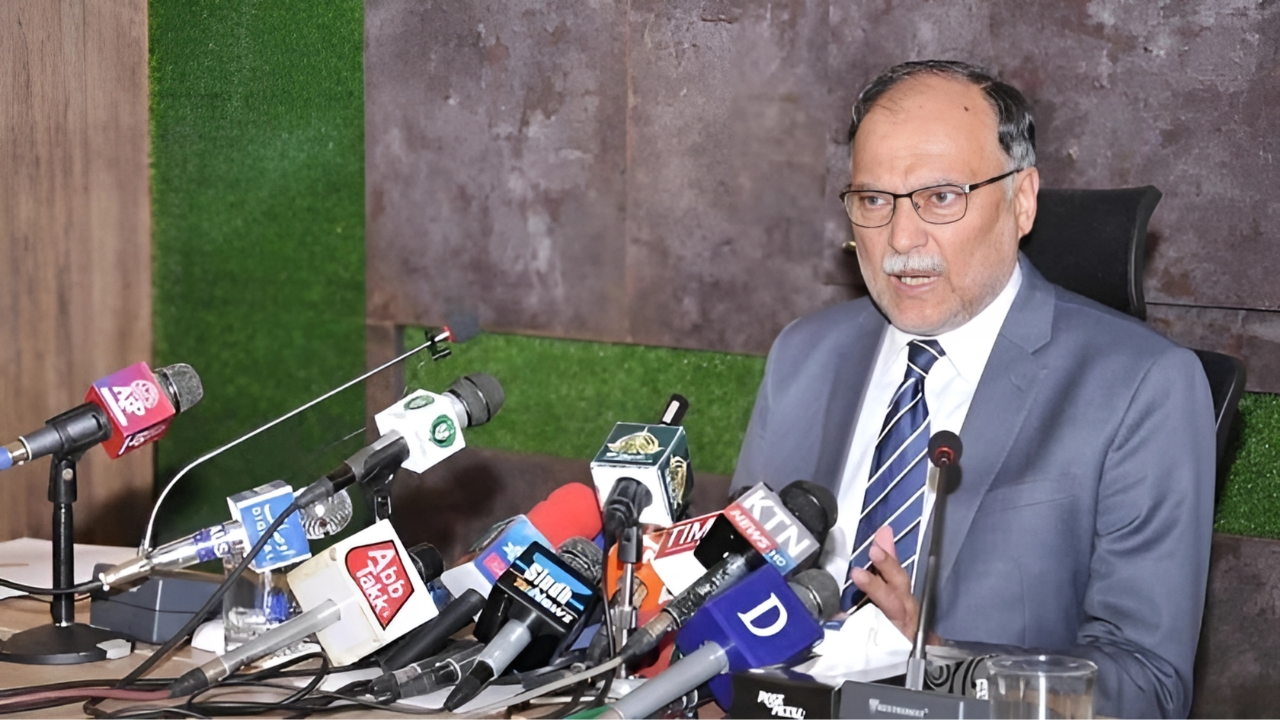
Planning and Development Minister Ahsan Iqbal met with members of the Overseas Investors Chambers of Commerce and Industry. He outlined the policies Islamabad is committed to following to assure foreign investors of Uraan Pakistan’s success.
In a press conference, the minister highlighted how three similar plans had failed in the past because of political instability and inconsistency in following the plan’s roadmap. He announced that to make Uraan Pakistan a success, it is imperative to create a politically stable environment where investors do not fear ‘policy reversals’ every one to two years.
He further highlighted the success of the federal government’s macroeconomic policies, which he claims brought about economic stability. Economic indicators lend credibility to his claim as inflation rates remain largely controlled while the GDP is beginning to grow again.
He also commented on how fluctuating exchange rates in previous periods restricted investors from even carrying out investment feasibility studies. However, he outlined how foreign investors were now returning to Pakistan because of the stability which the rupee has displayed over the past year.
The Minister highlighted Islamabad’s intent to initiate a phase of economic growth. He pointed out that growth would only be possible if the government actively designed policies which would restore the confidence of the private sector.
Informing the press of the government’s progress, Ahsan Iqbal announced that a mechanism has been set up where a group will actively review problems faced by the business community and investors every month. He also said that businesses will be informed of policies and steps will be taken to remove any ‘bottlenecks’ that investors face.
Stressing the importance of public-private engagement, he said that this plan would be the first step towards Pakistan’s larger goal of attaining economic growth.
Ahsan Iqbal mentioned that the government was looking into ways to leverage Pakistan’s low cost of production to “accelerate export-led development”. He reiterated one of Islamabad’s objectives: To double exports in the next five years.
Currently, Pakistan has a low average national income relative to developed economies, allowing Islamabad to attract significant investments. For instance, South Korea recently expressed its interest in shifting its industrial base from East Asia to Pakistan.
With the World Bank’s 20-billion-dollar loan package, Uraan Pakistan has the financial backing it needs to bring about actual economic change. Funding from supranational institutions and Ahsan Iqbal’s commitment to fostering an environment conducive to business growth might allow Islamabad to follow Uraan Pakistan’s roadmap.