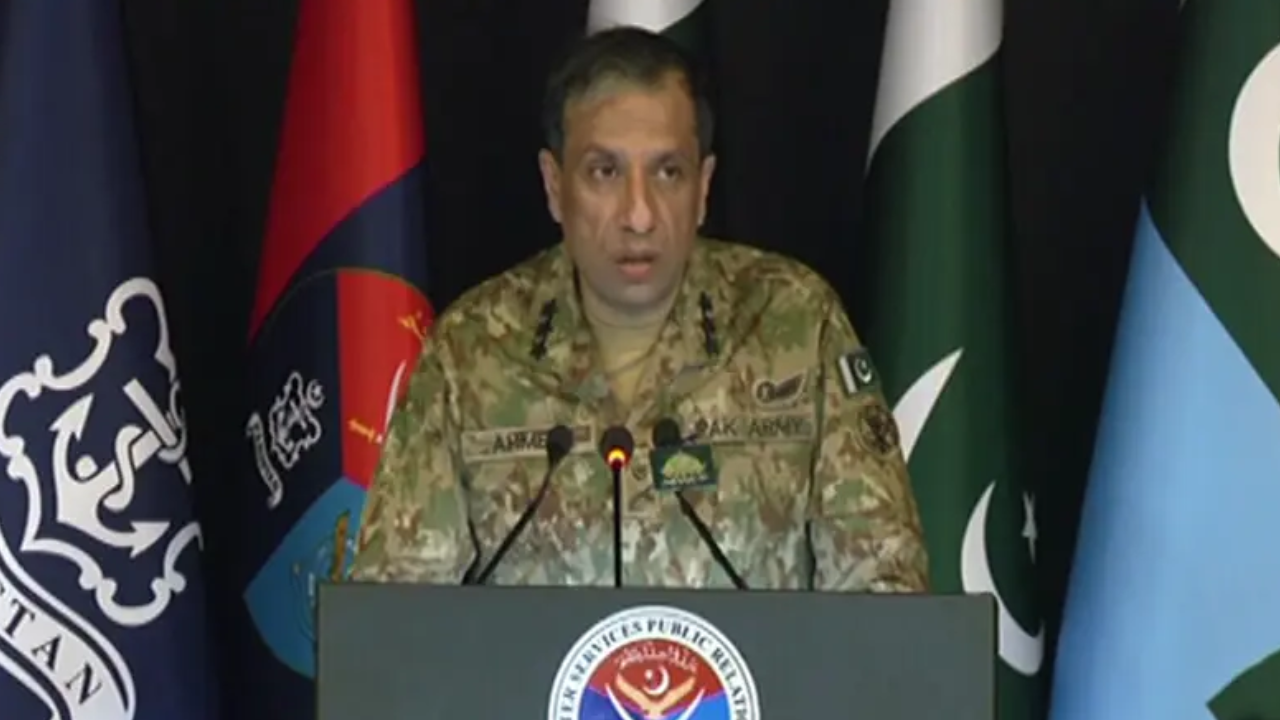
Director-General of the Inter-Services Public Relations (ISPR), Lieutenant General Ahmed Sharif Chaudhry, on Tuesday said that Khyber Pakhtunkhwa remained the worst terrorism-affected province, linking the trend to what he described as a “political-criminal-terror nexus”.
Addressing a press conference to brief the media on the country’s security situation, the ISPR chief said 71 percent of terrorist incidents reported in 2025 occurred in Khyber Pakhtunkhwa.
“The primary reason for this is a politically conducive environment and the flourishing political-criminal-terror nexus which is flourishing there,” he said.
Videos of Sohail Afridi were played during the briefing. Responding to statements by the Khyber Pakhtunkhwa government that military operations were not the solution, Lt Gen Ahmed Sharif Chaudhry questioned the alternative being proposed.
“Then what is the solution?” he said, while reiterating that the prevailing political environment in the province had enabled militant networks to operate.
In his opening remarks, Lt Gen Chaudhry said the purpose of the briefing was to provide a detailed overview of counterterrorism measures taken over the past year, which he termed a “landmark and consequential year” in the fight against terrorism.
Sharing data on counterterrorism operations, the ISPR chief said law enforcement agencies conducted 75,175 Intelligence-Based Operations (IBOs) across the country in 2025. Of these, 14,658 were carried out in Khyber Pakhtunkhwa, 58,778 in Balochistan, while 1,739 operations were conducted in other parts of the country.
He said a total of 5,397 terrorism incidents were reported nationwide during the year. According to the breakdown shared at the briefing, 3,811 incidents occurred in Khyber Pakhtunkhwa, 1,557 in Balochistan, and 29 incidents were reported from the rest of the country.
Lt Gen Chaudhry said 2,597 terrorists were killed during counterterrorism operations over the past year.
Video confessions of arrested militants were shown during the presser.
Referring to the Jaffar Express attack, the ISPR chief said 21 civilians were martyred and added that the incident would not fade from public memory. He also cited an attack on a civilian bus in Noshki and said an assault on the Frontier Corps headquarters in Quetta resulted in the martyrdom of eight civilians.
.
“This is a war of the nation, a war of every single child,” he said, rejecting a narrative that frames counterterrorism as solely the military’s responsibility.
“A narrative is built suggesting this is the army’s war. This is not true,” he added.
Addressing relations with Afghanistan, the ISPR chief said Pakistani border posts had come under attack by the Afghan Taliban regime, after which “whatever was needed was done, and a hard message was given”.
“Afghanistan has become the centre of terrorist operations in the region,” he said.
He said the Afghan Taliban regime had found a “new hero” in Indian Prime Minister Narendra Modi and added that the nexus between Fitna al-Khawarij and India became fully exposed in 2025.
“If Afghanistan and India wish to confront Pakistan, they are welcome to do so,” he said, adding, “We will fulfill their desire.”
Lt Gen Chaudhry said Pakistan had targeted terrorists along the Afghan border in October 2025 and that “dozens of Afghan posts were eliminated within hours”.
Recalling the 2020 Doha agreement, he said the Afghan Taliban had assured that terrorism would not be allowed to operate from Afghan soil, adding that Afghanistan remained a base for Fitna al-Khawarij and Fitna al-Hindustan.
“All terrorist organisations are based in Afghanistan and are being nurtured there,” he said.
The ISPR chief also rejected claims that the Pakistan Army uses drones during counterterrorism operations, saying armed quadcopters were first used by Fitna al-Khawarij and the TTP.
He said India provides support to these groups and that a dedicated militant wing operates armed quadcopters for attacks. According to him, militants use mosques, public places, and residential homes, and deploy women and children as human shields.