Category: Lifestyle

  • Police arrest five people for ‘sacrificing’ woman in Indian temple

    Indian police have arrested five men accused of conducting a human sacrifice in a temple in Assam. In 2019, the headless body of a woman was found in Guwahati, leading to an investigation.


    Shanti Shaw, 64, was beheaded with a machete at the temple as an “offering” to the temple goddess, police said.


    “The five people planned the killing of the woman,” police commissioner Diganta Barah said while talking to the media on Tuesday. “A total of 12 people took part,” he added.


    He continued by saying, “During investigation, we found this was a case of human sacrifice to please Maa Kamakhya (a Hindu goddess)”. The commissioner added that the alleged ringleader, Pradeep Pathak, 52, had orchestrated the killing as part of a religious rite to mark the anniversary of his brother’s death.

    “The accused apparently believed that the sacrifice would appease the soul of the deceased,” he added.


    Between 2014 and 2021, 103 instances of human sacrifice were reported to India’s National Crime Records Bureau.

  • Crazy Ex: Man arrested for making 800 calls to ex-girlfriend in two days

    Crazy Ex: Man arrested for making 800 calls to ex-girlfriend in two days

    A Maryland man is facing years behind bars after he was charged with cyberstalking his ex-girlfriend. The man bombarded his former lover with over 800 calls in two days.

    He also allegedly sent her tens of thousands of texts over a period of months and used social media posts to humiliate her.

    “Cyberstalking is a pervasive problem that we treat very seriously in West Virginia,” US Attorney William Ihlenfeld said in the official statement.
    “I encourage those who are being intimidated online and who suffer substantial emotional distress as a result to file a police report so that wrongdoers may be investigated and held to account.”

    If convicted, the man could face up to five years in prison.

  • FACT CHECK: India claims they are not removing Mughal history but the rumour has sparked some legendary memes

    FACT CHECK: India claims they are not removing Mughal history but the rumour has sparked some legendary memes

    Claim: The National Council of Educational Research and Training (NCERT) of India has removed chapters and topics related to the Mughal empire from its 12th-grade history syllabus.

    FACT: NCERT director Dinesh Prasad Saklani has denied the news reports calling them a lie. “There was a rationalisation process last year. Due to Covid, there was pressure on students everywhere,” the NCERT director said, adding that the expert committee recommended dropping the chapters which won’t impact the knowledge of the students.

    “The history of Mughals is being taught in Empires in section-2 of the 11th class book. And in the class 12th book there were 2 chapters on the history of the Mughals, out of which theme nine was removed last year, while theme eight is still being taught to the students. This year no chapter has been removed from any book,” Saklani said.

    However, the false claim generated a meme fest on Twitter. Have a look at some:

  • Four Paws has reached Pakistan to treat elephant Noor Jehan

    International animal welfare group Four Paws has reached Karachi on April 4 to examine and begin treatment of ailing elephant, Noor Jehan. In a press release posted on their website, Four Paws revealed that since 2021, they have been strongly recommending that both elephants Noor Jehan and Madhubala are shifted from Karachi Zoo, as the facility does not comply with international standards of providing habitable living conditions for animals.

    “However, no such measures to relocate them have been taken,” the post read.

    The team was led by the head of the organization, Dr Amir Khalil, along with  Dr Frank Göritz and Prof Dr Thomas Hildebrandt from the Leibnitz Institute for Zoo and Wildlife Research (IZW), and Dr Marina Ivanova from FOUR PAWS. Khalil spoke to journalists about Noor Jehan’s condition yesterday, as reported by Dawn and Express Tribune.

    He said that Jehan needs a detailed medical examination which includes endoscopy, ultrasound and X-rays, in order to provide proper insight into her condition.

    “We don’t know what went wrong with her. But, her condition has deteriorated very fast within a few weeks. She has got swelling on her hind legs as well as genital parts and she could barely walk. Right now, she has a 50-50 chance for survival,” he said.

    Khalil went on to reveal that their team was setting up a crane, wench and a fire brigade to help the animal remain stable and upright during surgery:

    “Our greatest concern is not to let the animal fall down. We fear that if Noor Jehan falls down, she it will not get up again. We will find out tomorrow whether it’s a fracture, trauma or an infection.”

    Today, the Karachi Metropolitan Center (KMC) spoke to DAWN and revealed that they were ready to facilitate the team in every way to help the elephants, and were making preparations to send them to Safari Park:

    “We are with Four Paws. All departments are ready to arrange any logistics needed for medical procedures. We are also making preparations to shift both zoo elephants to Safari Park within a month as per experts’ recommendation,” said Dr. Saif-ur-Rehman, Karachi Administrator.

    Rehman went on to add that Noor Jehan had been suffering from a neurological deficiency for the past two or three months which had impacted her hind legs. The government did not have the facilities for the treatment Noor Jehan needed in Pakistan which is why the international group was approached to help diagnose her illness and provide a solution.

    “The kind of treatment Noor Jehan requires isn’t available in Pakistan. So, we approached the international group to help us diagnose her illness and suggest and offer treatment, if possible,” Dr Rehman said.


  • Man fined $11,000 for taking 4,500 smoke breaks during 14 years of employment

    A Japanese government employee has been fined approximately $11,000 for smoking more than 4,500 times during the course of his 14-year employment.

    The human resource department discovered a secret stash of tobacco owned by the man and two other employees in the organisation.

    The 61-year-old director-level employee was deemed to have violated the “duty of devotion” under the Local Public Service Act.

    Osaka has stringent smoking regulations that are mandated by law. Since 2008, smoking has been prohibited on government property, including offices and public institutions. 2019 saw the addition of smoking prohibitions at work.

  • ‘Modest dress code’: Peshawar university bans wearing jeans on campus

    ‘Modest dress code’: Peshawar university bans wearing jeans on campus

    The Shaheed Benazir Bhutto Women University (SBBWU), Peshawar has introduced a new “modest” dress code for its students by banning them from wearing jeans and tights on the campus.

    The university’s registrar office issued a formal notification in which students have been asked to strictly adhere to the new dress code.

    “Students have to wear knee-length kurtas, shalwars, and white dupattas, which has been made compulsory for them as per the new dress code,” the notification read.

    The university directed students to wear their cards on university premises, warning them that the new code had been introduced after approval from the registrar office and violators would be fined Rs1,000.

    In March 2021, the Kohat University of Science and Technology (KUST) also introduced a dress code, asking girl students to wear abaya.

    In a notification issued on March 9, the KUST administration directed its male students to either wear white shalwar kameez or grey dress pants with black shoes.

    Female students had been asked to wear white shalwar with any kameez of full sleeves, scarf, dupata, chaddar, black abaya and black shoes. In the winters, they had to wear black sweaters, coats or plain jackets with black abayas.

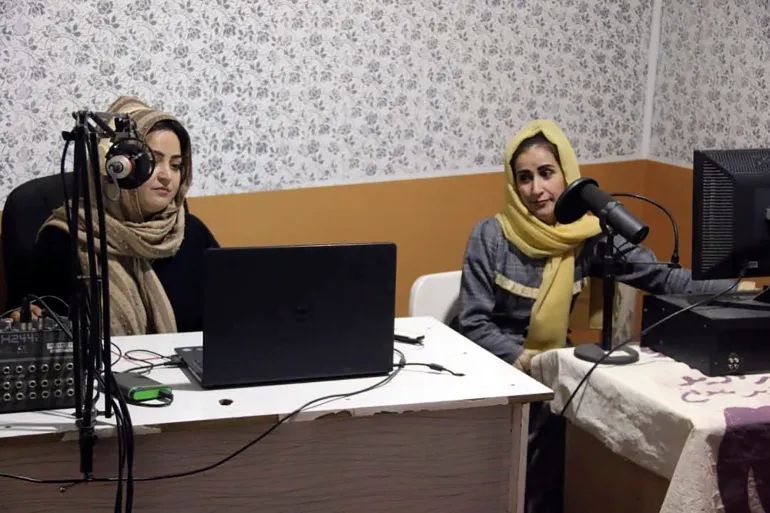
  • Taliban shut down women-run radio station for ‘playing music’ during Ramzan

    Taliban shut down women-run radio station for ‘playing music’ during Ramzan

    Taliban have shut down a women-run radio station in Afghanistan for playing music in the month of Ramzan.

    The radio station named ‘Sadai Banowan’ employed eight staff members, six of them female.

    The women-run radio station was started 10 years ago.

    According to Moezuddin Ahmadi, the director for Information and Culture in Badakhshan province, the station was shut down for repeatedly violating “laws and regulations of the Islamic Emirate”.

    “If this radio station accepts the policy of the Islamic Emirate of Afghanistan and gives a guarantee that it will not repeat such a thing again, we will allow it to operate again,” he added.


    However, station head Najia Sorosh has denied any violation, calling it a ‘conspiracy’.
    The Taliban “told us that you have broadcast music. We have not broadcast any kind of music,” she said.

  • Ramzan Miracle: ‘Mystery baby’ from Turkey earthquake reunited with mother previously declared dead

    Turkey’s ‘miracle baby’, rescued after nearly 128 hours under the rubble in the Turkey earthquake, has been reunited with her mother who was previously believed to be dead.

    The baby was handed over to her mother Yasemin Begdas at a hospital in the city of Adana, where she is receiving treatment.

    The baby had been named Gizem (Mystery) by the medical authorities who took care of her.

    “54 days of longing is over. Vetin Begdaş, who was rescued from the wreckage after 128 hours and named Gizem Bebek by our nurses, was reunited with her mother after 54 days. Vetin is now our baby too. As the Ministry, our support will always be with you,” Turkey’s Ministry of Family and Social Services, Derya Yanık tweeted.

    The baby’s father and two brothers lost their lives in the earthquake. The death toll from the February 6 earthquake and subsequent tremors in Turkey and Syria has risen to at least 44,000 according to Disaster and Emergency Management Authority (AFAD).

  • City Police Officer Islamabad directs all SHOs to disclose assets

    City Police Officer Islamabad directs all SHOs to disclose assets

    On Sunday, City Police Officer (CPO) Operations Syed Shahzad Nadeem Bukhari instructed all station house officers (SHOs) to disclose their assets. The CPO also directed that biometric attendance should be ensured in all wings of the operations division, and biometric machines should be installed as soon as possible.

    He added that the weekly performance of each officer will be reviewed, and investigation officers should meet plaintiffs in all cases. These instructions were given at a meeting held to review crime and performance at the divisional level, which was chaired by the Inspector General of Police (IGP) Islamabad Dr Akbar Nasir Khan.

    It is worth noting that police officers across the country, especially SHOs, face allegations of corruption due to the unlimited powers they hold as the head of police stations. CPO Bukhari urged present and former SHOs to work together to make a concrete action plan to deal with crime, with the main target being criminals and proclaimed offenders. He also instructed the officers to ensure the cleanliness of police stations and to make the patrolling system more efficient.

    According to Dawn, the IGP reviewed the crime performance at the divisional level and directed officers to adopt comprehensive strategies to prevent crime in their respective areas. He suggested that safe city monitoring should be implemented at the police station level to help SHOs trace criminal elements early. The IGP also instructed SHOs to spend more time in police stations and a special plan should be made to eliminate serious crimes, especially street crime, and drug trafficking, particularly in educational institutions. The details of buyers of stolen goods should also be collected, and postmortems should be done on every dead body.

    Moreover, the IGP urged the acceleration of the crackdown on illegal weapons, and the completion of challans of under-investigation cases as soon as possible and submitted to relevant courts. He also emphasised that more personnel were being provided in police stations, and special campaigns against offenders should continue, with offenders brought to justice. The IGP also listened to the problems of all the SHOs and promised to solve them on a priority basis.

  • Subha utha nahi jata? Don’t worry, researchers back up your laziness with scientific explanation

    Subha ka alarm miss hojata hai chahe kitni dafa time set karo?

    If you can’t wake up in the morning, you’re not alone. And now you have a scientific explanation that is more respectable than good old laziness.
    Researchers have concluded that there is a logical explanation behind why you can’t seem to become a morning person- and it all boils down to the way genes function, as Wired has reported.

    Previous research done by a group of biologists who later went on to win the Noble Prize in 2017 showed that human bodies have a total of 24 genes known as the ‘period genes’ which determine the human body clock.

    Now, research published by New Communications has concluded that there are actually 351 genes, which can determine whether a person is an early bird or a night owl. According to Michael Weedon, a bioinformatics at the University of Exeter Medical School:

    “Depending on how many of those genes you carry, you can be anywhere on the scale of ‘morningness’. But our research showed that the top five per cent with the most of those 351 genes go to sleep on average 25 minutes earlier than the five per cent who carry the least.”

    Furthermore, the study further looked into where those genes are more likely to be switched on in the body, because different parts of our body carry different tissues. Samuel Jones from the University of Exeter Medical School explained:

    “The genes we found to be related to our circadian rhythms tend to be switched on a lot more in the brain and in the retina,” he explained. “This helps us map what parts of the body are important in creating morning and evening people.”

    The scientists went on to explain how the genes are activated inside our brain. In a specific zone of the hypothalamus known as suprachiasmatic nucleus (SNC), an oscillator which sets our body time of the day, in accordance to the diffferent signals it receives from the environment.

    An important signal for the SNC to activate is light, because once the retina signals that it is night time, our brain releases a sleep-inducing hormone called melatonin, which is our cue to fall asleep.